
Ketu in the 9th house
Mesh Lagna (Aries Ascendant)
A practitioner study of Ketu in Dharma Bhava for Aries ascendant natives. The south node in friendly Dhanu in the dharma trikona, the classical sannyasa indicator read with the nuance the placement actually requires, and the father-karma-completion signature that shapes the inner spiritual life.
Ketu in 9th house for Mesh Lagna, the quick reference
If you carry Ketu in the ninth house of a Mesh chart, you hold one of the most spiritually weighted placements in the entire Aries ascendant catalogue, because the south node sitting in the dharma trikona produces the classical sannyasa indicator that traditional Jyotish texts treat with both reverence and care. The ninth house from Mesh is Dhanu (Sagittarius), ruled by Guru, and Jupiter is generally treated as friendly to Ketu in classical relationships. By sign relationship the placement is comfortable, neither exalted nor debilitated, and the friendly Dhanu sign welcomes the Ketu themes more readily than other signs would. The 9th house is also Dharma Bhava, the trikona of dharma, father, teacher, long journeys, classical learning, and the inner orientation toward truth that the trikona houses collectively rule. Placing the moksha karaka in the dharma trikona produces a configuration where the native's entire orientation toward faith, religion, and the dharmic dimension of life carries the south node's specific signature: detachment from inherited religious form combined with an unusually direct intuition of the underlying spiritual reality.
The second structural feature is the moksha-in-dharma signature itself. Ketu is the moksha karaka, the planet of liberation and detachment, and the 9th house is the seat of dharmic practice and inherited religion. The combination produces natives who often appear religious from the outside but who experience their inner relationship with faith as something different from the conventional version their family handed them. They reject the form. They keep the substance. They move beyond the rituals of the lineage but absorb the spiritual essence the lineage was protecting. Many natives with this placement become teachers in their own right but rarely within established institutional structures, and the placement is one of the classical indicators of what the texts call sannyasa yoga: the spiritual life lived outside formal monastic vows. This guide reads every layer of Ketu in 9th house for Mesh Lagna natives: the friendly Dhanu sign, the moksha-in-dharma signature, the father-karma-completion reading, the sannyasa indicator with proper nuance, and the cat's eye protocol that requires especially careful chart confirmation here.
Why the sannyasa label needs careful reading rather than literal application
Students often arrive at this placement carrying anxiety because popular astrology has labelled it as the sannyasa indicator, and the honest practitioner answer is that the label is technically correct but commonly misapplied. Classical texts use the term sannyasa yoga for placements where the chart strongly inclines the native toward the renunciate life, but the actual classical reading is more nuanced than the popular interpretation. The texts list multiple yogas for sannyasa, and most of them require several conditions to be present simultaneously (Ketu in 9th alone is one factor among many, not a sufficient cause). When the chart has only this one indicator, the sannyasa expression is usually internal rather than external: the native lives a householder life but carries a renunciate orientation inwardly. They marry but feel slightly removed from the conventional script. They work but treat the work as service rather than as career. They participate in family rituals but the participation feels chosen rather than automatic. The full external sannyasa expression appears only when the chart stacks several indicators together, and even then it is rare.
The dharma-trikona Ketu specifically deserves attention because it produces a recognisable inner experience that practitioners should describe to natives in consultation. The placement creates a tension between the inherited religious form (the 9th house) and the south node's pull toward direct experience over form (Ketu's nature). Natives often grow up in religious households and feel uncomfortable with the conventional rituals and teachings even when they cannot articulate why. They eventually find their way to a different lineage, a different teacher, a different practice, or a contemplative path that matches their inner orientation more accurately, and the discovery usually happens in their twenties or thirties through an unexpected encounter with a person, a book, or a place that opens the alternative. The third interpretive layer is the father reading. The 9th house is the father house and Ketu signifies past karma, so the placement often indicates that the native's karmic relationship with the father carries unfinished business from a previous life. Fathers of natives with this placement are typically religious or principled in some specific way, but the relationship between father and native is often distant or complicated even when both want it to be closer, and the distance is structural rather than personal.
Ketu in the dharma house does not refuse faith. It refuses the inherited form of faith, and asks the native to find the substance the form was protecting through their own direct experience instead.
How Ketu in friendly Dhanu shapes the Aries native
Physically the native carries the Mesh Lagna frame with the Ketu signature classical texts catalogue carefully. The face often holds a quiet, watchful, slightly otherworldly quality that strangers find both arresting and slightly distancing in the way Ketu placements consistently produce. The eyes are typically dark, deep-set, and described by friends as carrying an old-soul look that does not quite match the body's age. Many natives with this placement carry visible markers (birthmarks, distinctive moles, or unusual features) at the hip or thigh region because the 9th house body-part rulership covers exactly the region where Ketu's diagnostic signs often appear. The body tends to be lean rather than muscular, and the build often does not match either parent's physical type, as if the genetic instructions were partially edited at conception by the placement itself.
Temperament is the layer that most distinguishes the native from popular Aries stereotypes. These natives carry Mesh courage and willingness to act, but the action is almost always preceded by a quiet check against an inner sense of dharmic correctness that the native does not need to articulate even to themselves. They are unusually principled, often holding to commitments other people would have abandoned, and the holding is rooted in their own intuition of right rather than in inherited religious instruction. They tend to be reflective rather than performative, often retreating to quiet spaces during family religious gatherings because the gatherings exhaust them in ways the family does not understand. They love their parents but often feel that their inner spiritual life runs on a different track than the family lineage expected, and the divergence becomes more visible as they move into their twenties and thirties. The shadow side is the disengagement risk. Natives who do not honour the sannyasa-orientation pull can drift into spiritual cynicism, treating all faith as illusion when the chart actually wants them to find the deeper truth that the forms were protecting. Natives who pair the discernment with explicit contemplative commitment develop the rare combination of direct intuition and dharmic depth that this placement is genuinely capable of producing.
Strengths, shadows and career fits
- Friendly Dhanu welcomes the Ketu themes
- Moksha karaka in dharma trikona signature
- Direct intuition beyond inherited form
- Reflective and principled inner orientation
- Aspects 3H, brings depth to communication
- Sannyasa orientation expressed in householder life
- Disengagement from family religious life
- Distance in father relationship
- Hip and thigh diagnostic markers
- Risk of spiritual cynicism without practice
- Inherited dharma feels hollow until reframed
- Solo path complicates community belonging
- Independent spiritual teaching and contemplative writing
- Research in religion, philosophy, theology
- Hospice, palliative care, end-of-life work
- Yoga and meditation instruction outside institutions
- Anthropology, comparative religion, scholarship
- Long-form journalism on spiritual or ethical themes
Where the moksha-in-dharma vocation plays out
Career paths cluster around fields that allow the native to engage with dharmic themes outside conventional institutional structures. Independent spiritual teaching and contemplative writing are the strongest single fit. Many natives spend years studying within an established tradition before recognising that their actual vocation is to teach the substance they discovered in a form the inherited tradition would not accommodate. They often become independent teachers in their thirties or forties, building small communities around contemplative practices, philosophical writing, or scriptural commentary drawing on multiple traditions. Research in religion, philosophy, and theology suits natives whose vocational pull is more academic.
Hospice, palliative care, and end-of-life work fit the chart because the moksha karaka in the dharma trikona produces natives with unusual capacity to be present with dying. Yoga and meditation instruction outside institutional structures suit natives whose practice is rooted in personal experience rather than certification. Anthropology, comparative religion, and the scholarly study of how traditions evolve fit because the placement gives the native a structural perspective institutional adherents lack. Long-form journalism on spiritual and ethical themes rounds out the list. Ketu mahadasha is when the dharmic vocation crystallises, often through a sudden break from a conventional career path the native had been forcing themselves to walk, with the new direction arriving through an unexpected encounter with a teacher, text, or place.
Ketu marked in the ninth house of Mesh
- Ketu in Dharma Bhava in friendly Dhanu, marked in smoky violet
- 12 houses in North Indian format
- Upper-left diamond is the 9th house of dharma
Why this is one of the most spiritually loaded placements practitioners read
The sannyasa nuance is the most useful frame for Ketu in 9th of Mesh because popular astrology misreads it as literal renunciation prediction when the actual classical position is more conditional. Classical texts list multiple yogas for the renunciate life, and most require several factors stacked together: weakened lagna, Saturn or Ketu in 9th or 10th, weakened 7th, weakened Venus, and the Moon in specific configurations. Ketu in 9th alone is one indicator among many. When only this factor is present, the sannyasa expression is almost always internal: the native lives a conventional householder life but carries a renunciate orientation inwardly. They participate in family ritual but the participation feels chosen. They work but the work is service. The pattern is worth describing in consultation, but it is not a prediction of literal monastic life.
The father-karma reading is the second feature practitioners need to address. The 9th house is the father house and Ketu signifies past karma, so the placement often indicates the native's karmic relationship with the father carries unfinished business from a previous life. Fathers are typically religious or principled in some specific way, but the relationship is often distant or complicated even when both want it to be closer. The distance is structural rather than personal, and natives benefit from knowing this so they stop blaming themselves. Many experience a significant inner shift in the father relationship after his death, recognising the love beneath the distance. The third pattern is the encounter with a teacher outside the family lineage, usually in the late twenties or thirties through unexpected channels. Practitioners should ask about this because the encounter is often the structural turning point of the native's adult spiritual life.
When Ketu in 9th delivers its Dharma Bhava chapter
Ketu mahadasha is the defining window for this placement and arrives with the spiritual reorientation away from inherited form toward direct experience.
Hips, thighs and the contemplative sensitivity profile
Health follows the Ketu in dharma trikona pattern with specific 9th house considerations. Constitution is generally lean and reflective, with vata most prominent because Ketu carries vata-like qualities of dryness and inwardness. The 9th house body-part rulership covers the hips, thighs, and upper legs, and Ketu's marker often appears here as a birthmark, scar, or distinctive feature the family considered unusual. These markers are diagnostic signals confirming the placement is active.
The mysterious-ailment pattern Ketu produces appears here as conditions that respond to spiritual practice as much as medical treatment. Natives report that periods of consistent contemplative practice coincide with improved overall health, and periods of lapse coincide with vague symptoms that do not have a clear medical cause. The reading is the chart's literal expression of the dharma-body link the placement creates. Hip mobility and walking endurance are specific care areas because the body-part rulership is exact. Daily walking is the foundational physical practice the chart specifically supports. Annual screening from the late twenties is recommended because the diagnostic ambiguity makes baseline data more useful than reactive testing.
Remedies for Ketu in the Mesh dharma trikona
The daily Ganesha worship is the primary remedy for this placement because Ganesha is the classical patron deity of Ketu, and the secondary practice for this specific placement is contemplative reading of any dharmic text the native finds personally meaningful (rather than the text the family hands them). Rise before sunrise, bathe, wear white or off-white clothing, and visit a Ganesha or Vishnu temple if accessible. The Ganesh Pancharatnam is the primary recitation for this placement because it is the five-jewel hymn to Ganesha that classical tradition treats as a powerful daily Ganapati invocation, and reciting it activates the Ketu channel through the deity who carries it. Reciting the Ganesh Pancharatnam daily for forty days at any spiritual transition (a new teacher, a new practice, a long retreat, a major dharmic decision) is the formal protocol.
Offer dub grass, modaka, red flowers, and coconut at the altar, and donate to spiritual organisations the native genuinely connects with rather than to inherited family institutions. The contemplative practice is the single most important lifestyle remedy because the chart literally asks the native to honour the inner spiritual orientation rather than fight it. Twenty minutes of daily contemplative reading or sitting practice, plus longer retreats two or three times a year, produce compounding stability that the placement specifically rewards. The gemstone is cat's eye (Lehsunia, Vaidurya), made from chrysoberyl, and it is recommended only after careful chart confirmation because Ketu's intensity in the dharma trikona varies sharply between natives and the gemstone amplifies whatever the placement is currently expressing. Wear a natural chrysoberyl cat's eye of minimum five ratti set in silver on the small finger of the right hand on a Wednesday or Tuesday at sunrise after Ketu mantra recitation, and only after a practising Jyotishi has confirmed the timing. The lifestyle adjustment that compounds most is honouring the divergence from family lineage as the chart's instruction rather than as personal rebellion. Because the placement specifically asks the native to find the spiritual substance the inherited form was protecting, natives who accept the divergence and pursue their actual practice experience the placement as the source of unusually deep inner stability.
Gemstones for Ketu in 9th house Mesh Lagna
Cat's eye is the primary Ketu gemstone but is recommended only after careful chart confirmation because the dharma placement amplifies faith themes sharply.



Disclaimer: Cat's eye in the dharma trikona amplifies faith themes sharply. Always consult a qualified Jyotishi before permanent wearing.
Rudraksha beads for Ketu in 9th house
The Ketu-aligned rudraksha is the Ashta Mukhi (Eight Mukhi), the bead directly ruled by Ganesha and the south node.
The classical Ketu rudraksha and the bead specifically associated with Ganesha as the patron deity of the south node. Removes obstacles to the contemplative path, supports the spiritual practice the placement asks for, and stabilises the inner orientation when the dharma signature is calling for change.
The Jupiter rudraksha and the safest daily-wear bead in the tradition. For this placement specifically, the Panch Mukhi honours the dispositor of Ketu (Guru rules Dhanu) and compounds the placement's natural strength by strengthening both planet and sign-lord through the deity-lineage Jupiter carries.
Ketu Yantra for the dharma placement
Sacred recitations for Ketu in dharma trikona
Kala dharavatamsakam vilasi loka rakshakam
Anaya kaika nayakam vinashitebha daityakam
Natashubhashu nashakam namami tam vinayakam
Natetaratibhikaram navoditarka bhasvaram
Translation: He who joyfully holds the modaka sweet, who is always the giver of liberation, who wears the digit of the moon as ornament, the playful protector of the worlds, the leader who has no need for a leader, who destroyed the elephant demon, who removes the inauspicious for those who bow to him, I salute that Vinayaka. He who terrifies those who do not bow, who is brilliant as the newly risen sun. The Ganesh Pancharatnam is the five-jewel hymn to Ganesha by Adi Shankaracharya and is the perfect daily recitation for a chart where Ketu sits in the dharma trikona and the contemplative path needs Ganapati's blessing.
Read the full stotra on stotra.vastucart.inTools for Ketu 9th house Mesh natives
Is your Dharma Bhava Ketu carrying the sannyasa indicator?
Get a full personalised analysis of your ninth house Ketu, the father-karma reading, and the contemplative vocation pull.
Questions about Ketu in 9th house, Mesh Lagna
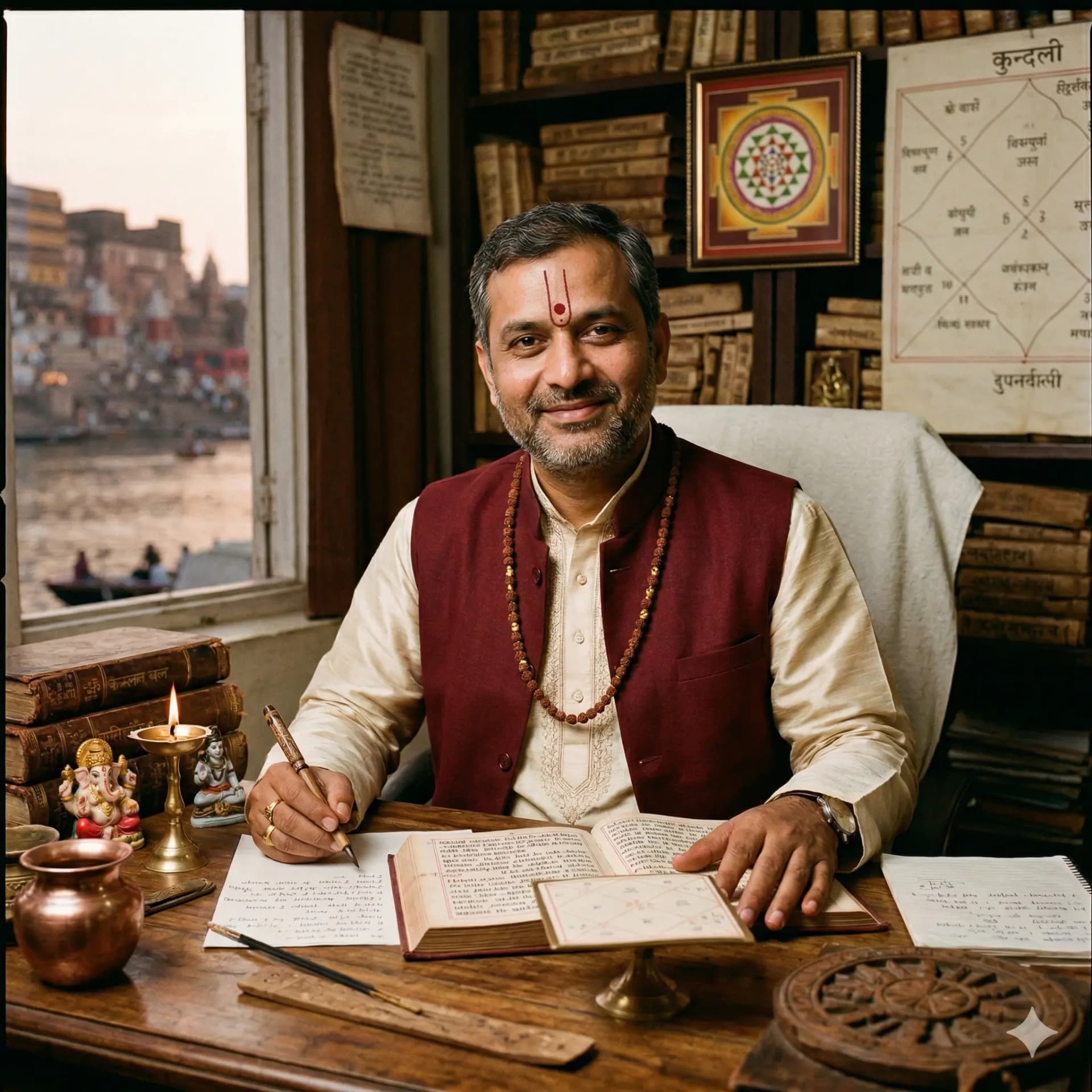
Pt. Raghav Sharma has practiced Parashari Jyotish for over twenty two years from Varanasi. A student of the Varanasi Jyotish tradition, he specialises in Graha-in-Bhava analysis, Vimshottari Dasha predictions, and Muhurta. He has authored over four hundred in-depth articles on Jyotish principles across the VastuCart knowledge network.