
Ketu in the 7th house
Mesh Lagna (Aries Ascendant)
A practitioner study of Ketu in Kalatra Bhava for Aries ascendant natives. The south node in friendly Tula in the marriage angle, the famous detachment-from-spouse signature, and the lagna-Ketu opposition that places the self-other axis at the centre of the native's spiritual work.
Ketu in 7th house for Mesh Lagna, the quick reference
If you carry Ketu in the seventh house of a Mesh chart, you hold one of the most misread placements in popular astrology, because the standard summary reduces this configuration to a simple sentence (Ketu in 7th means no marriage) that is both fear-mongering and structurally inaccurate. The actual reading is more interesting and more nuanced. The seventh house from Mesh is Tula (Libra), ruled by Shukra, and Venus is treated as friendly to Ketu in classical relationships. By sign relationship the placement is comfortable, neither exalted nor debilitated, and the friendly Tula sign softens the harsher edges of the south node placement in ways that the popular reading completely misses. Ketu has no own sign, no clear exaltation in mainstream Parashari tradition, and no house lordship because he is a shadow planet, but his nodal nature means he amplifies the house and sign he occupies and infuses the placement with his core themes regardless of dignity.
The second structural feature is the lagna-Ketu opposition. Mars (the Mesh lagna lord) sits in the 1st house and Ketu sits in the 7th, which means Mars's full 7th aspect falls on Ketu and Ketu's full 7th aspect falls back on the lagna. The two carry shared martial qualities (Ketu is described as Mars-like in classical texts) but pull in opposite directions: Mars wants self-assertion and direct action, Ketu wants dissolution into something larger. The opposition places the self-other axis at the structural centre of the native's spiritual work, and the marriage signature the placement produces is best understood as the chart's specific pedagogy on that axis rather than as a simple yes-or-no on whether marriage will happen. This guide reads every layer of Ketu in 7th house for Mesh Lagna natives: the friendly Tula softening, the lagna-Ketu opposition, the actual marriage and spouse signature (which is far more nuanced than the popular reading), and the cat's eye protocol that requires especially careful chart confirmation here.
Why the popular kalatra-dosha reading misses the structural truth
Students often arrive at this placement carrying anxiety because popular astrology labels it as marriage-killing, and the honest practitioner answer is that the label is overstated and structurally wrong in most cases. Ketu in 7th does not preclude marriage. It produces a specific marriage signature that requires the native to approach partnership consciously rather than by default. Marriages happen for natives with this placement at roughly the same rates as for other 7th house configurations. What differs is the type of marriage that lasts, the timing at which it arrives, and the kind of partner the native is structurally prepared to recognise.
The actual marriage signature this placement produces shows three specific patterns. First, marriage arrives later than peers, frequently in the early to mid thirties, because the chart asks the native to grow into self-other awareness before partnership. Rushed marriages in the twenties consistently underperform later ones. Second, the spouse often carries a Ketu signature: foreign nationality, contemplative orientation, unusual life history, or significant age difference. Third, the marriage that lasts tends to be unusually deep but quiet, with less social performance and more inner intimacy. The lagna-Ketu opposition (Mars at lagna directly aspecting Ketu in the 7th) places the self-other axis at the structural centre of the spiritual work. Natives who learn to honour both sides of the dialogue rather than choosing one over the other develop the rare relational maturity the placement is capable of producing.
Ketu in the marriage angle does not refuse the partnership. It refuses the unconscious version of the partnership, and the work of the placement is to learn that the conscious version is worth waiting for.
How Ketu in the marriage angle shapes the Aries native
Physically the native carries the Mesh Lagna frame with the unmistakable lagna-Ketu opposition signature that classical texts describe carefully. Because Ketu sits opposite the body and aspects it with his full 7th aspect, the body itself often carries small markers of the south node placement: a slight asymmetry between left and right sides, an unusual feature inherited from a grandparent the family does not remember, or a birthmark or scar that the native does not connect to a specific incident. The face is typically expressive but with a thoughtful, slightly removed quality that strangers find interesting without being able to name why. The eyes are often described as old-soul, holding a steady look that does not quite match the rest of the body's age. The body tends toward lean rather than muscular, and the build often does not match what either parent provided, as if the genetic instructions were partially edited at conception by the placement itself.
Temperament is the layer that most distinguishes this placement from every other Mesh combination because the inner experience is shaped by the constant lagna-Ketu dialogue. These natives carry the Mesh courage and the willingness to act, but they also carry an internal voice that asks whether the action is worth the cost, whether the relationship is worth the effort, and whether the conventional path other Aries natives walk is the path their own chart actually wants. The questioning is not pessimism. It is the south node performing its structural function of pulling the self-other axis into spiritual examination. They are unusually attuned to the partner's inner life, often reading the partner's moods and unspoken concerns before the partner expresses them, and the attunement makes them either deeply attractive or slightly intimidating to potential spouses depending on how the spouse meets the placement. They are slow to commit, not because of fear but because the chart specifically wants them to recognise the right partner rather than the convenient one, and the slowness usually feels like a failure to family members in the twenties before it reveals itself as wisdom in the thirties. The shadow side is the disengagement risk, because natives who never learn to honour the partnership pull can drift into isolation that looks like spiritual independence but feels like loneliness from the inside. Natives who pair the discernment with explicit relational courage develop the deeply intimate marriages the placement is genuinely capable of supporting.
Strengths, shadows and career fits
- Friendly Tula softens the detachment edge
- Lagna-Ketu opposition produces relational depth
- Discernment in choosing spouse
- Late marriage usually proves more durable
- Spouse often foreign or contemplative
- Capacity for unusually intimate partnership
- Marriage delay creates family pressure
- Risk of disengagement from partnership
- Self-other axis stays unresolved without work
- Lower abdomen and pelvis sensitivity
- Spouse may carry own Ketu burdens
- Conventional marriage fits poorly
- Counselling, couples therapy, mediation
- Foreign service and diplomatic work
- Spiritual teaching with relational focus
- Independent consulting and advisory
- Research, writing, contemplative scholarship
- Hospitality with international clientele
Where the self-other axis vocation plays out
Career paths cluster around fields that draw on the unusual relational depth the placement produces. Counselling, couples therapy, and mediation are the strongest single fit because the chart's central training ground is the self-other axis. Many natives spend their twenties and thirties processing their own relational pedagogy and then move into counselling work in their late thirties or forties when the personal experience translates into clinical capacity. Foreign service and diplomatic work fit because the 7th house rules partnerships at the public level, and Ketu's foreign signature combined with the partnership house often produces natives whose vocation involves cross-border negotiation or diplomatic posting.
Spiritual teaching with relational focus suits natives whose contemplative pull is strong and who want to teach in the householder context. Independent consulting and advisory work suit the chart because natives often find their best work happens one-on-one with clients rather than inside large institutions. Research, writing, and contemplative scholarship suit those whose strongest mode is solitary work that nonetheless deals with relational themes. Hospitality with international clientele rounds out the list. Ketu mahadasha is when vocational direction crystallises, often through a sudden shift away from a conventional career toward work that draws on the self-other axis.
Ketu marked in the seventh house of Mesh
- Ketu in Kalatra Bhava in friendly Tula, marked in smoky violet
- 12 houses in North Indian format
- Lower-right diamond is the 7th house of marriage
Why the chart asks the native to wait for the right partner
The lagna-Ketu opposition is the most useful frame for Ketu in 7th of Mesh because it explains both the inner experience and the practical marriage pattern. Mars sits at the lagna for any Mesh chart, Ketu sits at the 7th here, and the two are in direct mutual aspect. Mars represents the self in its most active asserting form. Ketu represents dissolution of self into something larger. The opposition does not cancel either side. It places both at the centre of the life and asks for a working relationship between them. Natives who try to resolve the opposition by choosing one side consistently report that the unchosen side returns louder later. Natives who honour both sides simultaneously find the dialogue becomes the source of the deepest insights they will ever have about partnership.
The marriage pattern deserves careful description because the popular reading misrepresents it. Most natives do marry, and the marriages that last share recognisable features: the spouse carries a Ketu signature, marriage crystallises in the early to mid thirties, the wedding ceremony is often unconventional or smaller than family expected, and the partnership grows quietly inward rather than performing its strength publicly. Practitioners should always ask about the partner's background when this placement appears, because the Ketu-signature partner is the structural prediction the chart is making. The third pattern is the period of singleness in the twenties and early thirties almost all natives experience. The singleness is not failure. It is the chart delaying marriage until the inner work is done, and natives who use the time consciously typically meet their lifelong partner shortly after the inner work crosses a threshold the chart was waiting for.
When Ketu in 7th delivers its Kalatra Bhava chapter
Ketu mahadasha is the defining window for this placement and arrives with the marriage decision, the spouse arrival, or the relational reorientation that the chart has been preparing.
Lower abdomen, pelvis and the partnership health link
Health follows the Ketu-in-7th pattern with specific 7th house body-part vulnerabilities. Constitution is generally lean and reflective, with vata most prominent because Ketu carries vata-like qualities of dryness and inwardness. The 7th house body-part rulership covers the lower abdomen, kidneys, urinary tract, and pelvis, all of which require sustained attention from early adulthood. Hydration, regular urinary screening, and pelvic-area awareness are preventive practices the chart specifically asks for, and natives benefit from establishing these in their twenties rather than waiting for symptoms.
The reproductive and partnership health link is the second specific layer because the 7th house rules both the kalatra (spouse) and the body region most directly involved in partnered intimacy. Natives with this placement report that their reproductive and intimate health is unusually responsive to their inner partnership state, and conditions in this region often improve when the relational life stabilises and worsen when the relational life is in turmoil. The reading is not psychosomatic in a dismissive sense, it is the chart's literal expression of the kalatra-body link the placement creates. The mysterious-ailment pattern that Ketu produces in general also appears here, with conditions that conventional diagnostics struggle to name. Recovery practices the chart responds to are silence, solitude, gentle movement, and contemplative practice. Annual general health screening from the late twenties is recommended because the diagnostic ambiguity makes baseline data more valuable than reactive testing.
Remedies for Ketu in the Mesh marriage angle
The daily Ganesha worship is one foundation remedy because Ganesha is the classical patron deity of Ketu, and the secondary practice for this specific placement is the Devi worship that addresses the kalatra dimension through the feminine principle Tula represents. Rise before sunrise, bathe, wear white or off-white clothing, and visit a Ganesha temple on Wednesdays or a Devi temple on Fridays. The Ketu Kavacham is the primary recitation for this placement because it is the protective armour stotra for the south node and works specifically to contain the disengagement pull when the placement asks the native to engage with partnership rather than retreat from it. Reciting the Ketu Kavacham daily for forty days at a major life decision point (engagement, marriage, partnership transition) is the formal protocol, and natives report a noticeable shift in inner clarity by the third week.
Offer dub grass, modaka, red or white flowers, and coconut at the altar, and donate to causes that support marriage stability (couples counselling organisations, family welfare, refugee family reunification work), all of which channel the kalatra signature constructively. The conscious-relationship practice is the single most important lifestyle remedy because the chart literally asks the native to enter partnership consciously rather than by default. Natives who develop a regular relational reflection practice (journaling about partnership, conscious conversation with significant others, occasional couples work even in good times) see the placement deliver its fullest expression as a life of unusually intimate and durable partnership. The gemstone is cat's eye (Lehsunia, Vaidurya), made from chrysoberyl, and it is recommended only after careful chart confirmation because Ketu in the 7th house specifically affects marriage themes and the gemstone amplifies whatever the placement is currently producing. Wear a natural chrysoberyl cat's eye of minimum five ratti set in silver on the small finger of the right hand on a Wednesday or a Tuesday at sunrise after Ketu mantra recitation, and only after a practising Jyotishi has confirmed the marriage chart is ready for the amplification. The lifestyle adjustment that compounds most is the deliberate practice of slowing the marriage decision. Because the chart asks for the conscious version of partnership, natives who refuse to be rushed into marriage and who give themselves the time to recognise the right partner experience the placement as the source of the deepest relationship of their life.
Gemstones for Ketu in 7th house Mesh Lagna
Cat's eye is the primary Ketu gemstone but is recommended only after careful chart confirmation because the kalatra placement requires especially careful timing.
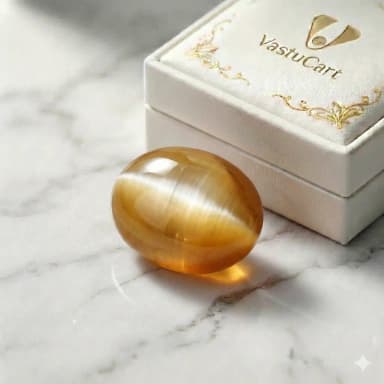
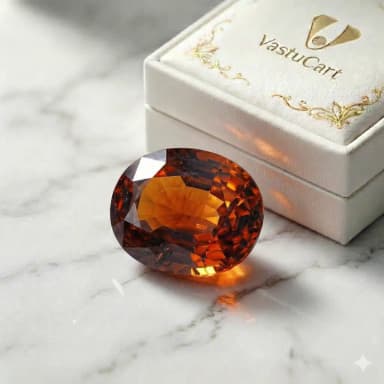

Disclaimer: Cat's eye in the marriage house amplifies kalatra themes sharply. Always consult a qualified Jyotishi before permanent wearing.
Rudraksha beads for Ketu in 7th house
The Ketu-aligned rudraksha is the Ashta Mukhi (Eight Mukhi), the bead directly ruled by Ganesha and the south node.
The classical Ketu rudraksha and the bead specifically associated with Ganesha as the patron deity of the south node. Removes obstacles to conscious partnership, supports the relational pedagogy the placement asks for, and stabilises the inner orientation when the disengagement pull is strong.
The six-mukhi bead is the Venus bead and serves as secondary support for this placement because the dispositor of Ketu here is Shukra. Wearing the Chha Mukhi alongside the Ashta Mukhi compounds the placement's natural strength by honouring both the planet and his sign-lord.
Ketu Yantra for the kalatra placement
Sacred recitations for Ketu in the marriage angle
Sa namaste pitamaha mukhya
Sa namaste pingala lochanaya
Tvam namaste sarva pitra svarupa
Translation: Salutations to Ketu, whose form is like the moon. Salutations to you, foremost among the ancestors. Salutations to you, the tawny-eyed one. Salutations to you, the form of all the ancestors. The Ketu Kavacham is the protective armour stotra for the south node and is the classical hymn for natives who need a containing field around the disengagement pull while still honouring the contemplative depth the placement produces.
Read the full stotra on stotra.vastucart.inTools for Ketu 7th house Mesh natives
Is your Kalatra Bhava Ketu carrying the conscious-marriage signature?
Get a full personalised analysis of your seventh house Ketu, the spouse pattern, and the timing the chart is preparing.
Questions about Ketu in 7th house, Mesh Lagna

Pt. Raghav Sharma has practiced Parashari Jyotish for over twenty two years from Varanasi. A student of the Varanasi Jyotish tradition, he specialises in Graha-in-Bhava analysis, Vimshottari Dasha predictions, and Muhurta. He has authored over four hundred in-depth articles on Jyotish principles across the VastuCart knowledge network.