
Sun in the 9th house
Mesh Lagna (Aries Ascendant)
A practitioner study of Surya in Dharma Bhava for Aries ascendant natives. Sun in friendly Dhanu, the 5L in 9H trine-to-trine Lakshmi raja yoga, the father-as-teacher signature, and the dharmic vocation that defines the life from a young age.
Sun in 9th house for Mesh Lagna, the quick reference
If you carry Surya in the ninth house of a Mesh chart, you hold one of the cleanest dharmic placements in the entire Aries ascendant catalogue, because three structural strengths converge here in the same direction. The ninth house from Mesh is Dhanu (Sagittarius), ruled by Guru, and Jupiter is Sun's classical friend. By sign relationship the placement is comfortable, neither exalted nor debilitated, holding mid-strength functional status that the friendly relationship supports throughout the chart. The ninth house is also Dharma Bhava, the trikona of dharma, father, teacher, long journeys, classical learning, purva punya (past life merit), and the inner orientation toward truth that the trikona houses collectively rule. Placing the soul karaka in the dharma trikona produces a native whose entire identity is wired toward the dharmic dimension of life from a young age, and the wiring is visible in the personality long before the native develops conscious philosophy about it.
The second structural feature is the trine-to-trine raja yoga the placement creates. For Mesh Lagna, Surya rules Simha (5th house) and is therefore the 5L. Placing the 5L in the 9H connects the two trikonas of dharma directly, because both the 5th and the 9th are trikona (trine) houses, and a trikona lord in another trikona house is one of the named raja yoga configurations classical texts call Lakshmi Yoga in some lineages and trine-to-trine raja yoga in others. The two trikonas reinforce each other rather than compete, and the result is a native whose creative intelligence (5L) flows directly into dharmic expression (9H), producing teachers, scholars, dharmic leaders, and creative practitioners whose work carries an unmistakable wisdom signature even when the technical craft is what other people notice first. This guide reads every layer of Sun in 9th house for Mesh Lagna natives: the friendly sign comfort, the trine-to-trine raja yoga, the father-as-teacher signature, and the ruby protocol that applies here with high confidence.
Why the trine-to-trine raja yoga is one of the cleanest in the catalogue
Students of classical Jyotish learn early that the strongest yoga combinations in Parashari texts are built on the relationships between trikonas (1st, 5th, 9th) and kendras (1st, 4th, 7th, 10th). The kendras are the four foundation angles. The trikonas are the three dharmic pillars. When the lord of one trikona occupies another trikona, the configuration is called trine-to-trine raja yoga because the dharmic current flows from one pillar directly into another and reinforces the entire trikona axis of the chart. Different lineages give the configuration slightly different names. Some call it Lakshmi Yoga because it brings the abundance and grace that Lakshmi rules. Others use trine-to-trine simply as a structural description. The classical effect is consistent regardless of name: the native experiences the dharmic dimension of life as an active resource that the chart specifically supplies rather than as something they must build from outside.
The Sun-as-5L specifically deserves attention here because the 5L for Mesh is unusually significant. Surya rules Simha which falls on the 5th house, and the 5th house is the seat of past life merit (purva punya), creative intelligence, children, mantra siddhi, and dharmic creativity. Placing this lord in the 9th house puts the past life merit and creative intelligence directly into the dharma house, and the practical effect is that the native arrives in this life with creative gifts and dharmic orientation that other natives have to develop more deliberately. Children with this placement often display unusual maturity around questions of right and wrong, take naturally to philosophical conversation by the early teens, and find their way to teachers, mentors, and lineage figures earlier than peers do. The third interpretive layer is the father reading. Surya is the karaka of father in Vedic astrology, and his placement in the 9th house (which is also classically the father house) creates a double father signature where the father becomes the central dharmic figure of the native's childhood. Fathers of natives with this placement are typically educated, principled, and recognised by their community for some form of moral or scholarly authority, and the native absorbs the father's dharmic example as the primary template for their own adult orientation.
When the soul karaka sits in the dharma trikona of his lord's friend, the native arrives carrying a teacher's quality before they have learned anything to teach. The work is to grow into the quality the chart already shows on the surface.
How Surya in friendly Dhanu shapes the Aries native
Physically the native carries the Mesh Lagna frame with the dharmic Sun signature that classical texts catalogue carefully. The face holds an unusual nobility that strangers notice immediately: the brow is broad, the bearing is upright, the gaze is steady without being intimidating, and the overall expression carries a quiet authority that does not need to perform itself. Complexion runs warm and golden rather than the cooler tones of some Mesh placements, hair is typically thick and slow to grey, and the build is athletic and balanced rather than wiry or heavy. The 9th house body-part rulership covers the hips, thighs, and upper legs, and natives should pay attention to all three throughout life because the dharmic Sun on this region produces good baseline strength but requires sustained mobility work to maintain it. Long walking, regular stretching, and explicit hip-opening practice (yoga, swimming, cycling) keep the chart's natural physical foundation strong into the fifties.
Temperament is the layer where the placement most distinguishes the native from popular Aries stereotypes. These natives carry Mesh courage filtered through a dharmic orientation that other Aries placements do not produce naturally. They take action when action is required, but the action is almost always preceded by a quiet check against an inner sense of what is right that the native does not need to articulate even to themselves. They lead, but their leadership has a teacher quality even when the role is technically managerial or commercial. They are unusually principled, often holding to commitments long after the original reason has expired simply because the holding is itself part of who they are. The shadow side is the same principled quality, because natives who do not learn to update their principles when the situation actually changes can become rigid in ways that limit them and their families. The chart specifically rewards the integration of principled commitment with situational wisdom, and natives who develop this combination produce the rare leader-as-teacher quality that this placement is capable of in its fullest expression. Children of these natives consistently report that their father modelled an orientation toward truth they did not appreciate until they were old enough to recognise how rare it actually is.
Strengths, shadows and career fits
- Trine-to-trine raja yoga in the dharma house
- 5L purva punya flows into 9L dharma
- Father becomes dharmic teacher figure
- Innate orientation toward truth
- Creative intelligence carries wisdom signature
- Long journeys and pilgrimages bring elevation
- Principled rigidity can limit family adaptation
- Holds outdated commitments past usefulness
- Father standard can intimidate own children
- Hip and thigh attention required
- Career may feel less urgent than dharma
- Income lags behind teaching authority
- Teaching, professorship, scholarly research
- Religious or philosophical writing and authority
- Law, especially constitutional or principled practice
- Higher education leadership and administration
- Travel writing, cultural scholarship, anthropology
- Dharmic non-profit leadership
Where the dharmic-teacher channel plays out
Career paths cluster around fields where the dharmic Sun signature can express directly, and the strongest single fit is teaching at every level: school, college, postgraduate, professional training, or independent dharmic instruction. Many natives spend years in academic settings even when family pushed them toward commercial careers, and they typically find their footing in their thirties when the teaching vocation crystallises into a recognised role. Religious and philosophical writing suits natives whose pull is more toward written than spoken transmission, and many become respected authors in their fifties.
Law, especially constitutional or public interest practice, fits because legal work at its best is the dharmic Sun expressed through institutional structure. Natives often rise to senior judicial or advocacy roles. Higher education leadership suits the chart in mid-career when teaching expertise translates into structural responsibility. Travel writing, cultural scholarship, and anthropology channel the 9th house themes of long journeys, and natives often build careers around extended periods of travel that produce written or visual work the rest of their career rests on. Dharmic non-profit leadership rounds out the list. Surya mahadasha is when the dharmic vocation crystallises into recognised authority, often through an unexpected invitation to teach, write, or lead that the native did not seek but could not refuse.
Sun marked in the ninth house of Mesh
- Surya in Dharma Bhava in Dhanu, marked in radiant saffron
- 12 houses in North Indian format
- Upper-left diamond is the 9th house of dharma
Why this is one of the cleanest dharmic configurations any chart can hold
The trine-to-trine raja yoga is the most useful frame for this placement because it captures both the structural strength and the lived expression. When the lord of one trikona occupies another trikona, the dharmic current does not need to cross into kendra territory or borrow strength from an external configuration. It flows internally between the two trikonas the chart already supplies, producing an unusually self-sustaining dharmic expression. Natives do not have to manufacture their orientation toward truth. The orientation is structurally present from birth, and the life work becomes the gradual translation of the inner orientation into outer form: a vocation, a body of teaching, a lineage of students, or an institution that carries the dharmic signature forward.
The father-as-teacher pattern deserves direct attention because it shapes the entire arc of childhood. Surya is the karaka of father, and his placement in the 9th house (also a father-house) produces a double father signature where the father becomes the formative dharmic figure. These fathers are typically educated, principled, and recognised by their communities for moral, scholarly, or professional authority. Most natives report not appreciating the father's gift until well into their thirties when they had enough life experience to see how rare the modelling actually was. The shadow side is the intimidation effect on the native's own children, who often find the parent difficult to live up to. The chart asks the native to make explicit room for their children to develop their own dharmic path. The third pattern is the long-journey signature, where pilgrimage, extended foreign study, or long-distance teaching journeys consistently play an outsized role in formation.
When Sun in 9th delivers its Dharma Bhava chapter
Surya mahadasha is the defining window for this placement and arrives with the dharmic vocation crystallising into recognised authority.
Hips, thighs and the dharmic vitality profile
Health follows the friendly-sign Sun pattern with specific 9th house body-part considerations. Constitution is generally strong because the friendly Dhanu sign supports the solar vitality, with pitta most prominent and a balanced kapha-vata secondary. The 9th house body-part rulership covers the hips, thighs, and upper legs, and natives should pay sustained attention to all three because the placement gives good baseline strength but requires deliberate mobility work to maintain hip and thigh function across decades. Long walking is the foundational practice the chart specifically supports, and natives who establish a daily walking habit in their twenties report sustained lower-body health into their fifties.
The cardiac vitality reading is the second important layer because the Sun governs the heart and the friendly sign supports good baseline cardiovascular function. Natives benefit from regular cardiovascular exercise (walking, swimming, cycling) and from explicit attention to cholesterol and blood pressure from the late thirties onward. Sunday is the ritual day, and the placement responds beautifully to weekly Surya observance because the chart is structurally aligned with the solar current and the day carries the planet's specific blessing. The hip-opening yoga practice deserves explicit mention because the 9th house body-part rulership combined with the chart's natural physical strength can produce hip stiffness in mid-life if the native does not maintain mobility deliberately. Annual cardiac screening from the late thirties and basic hip mobility assessment in the forties complete the preventive baseline.
Remedies for dharmic Surya in Dharma Bhava
The Sunday discipline is foundational and delivers genuine benefit for this placement because the chart is structurally aligned with the solar current the day carries. Rise before sunrise, bathe, wear saffron, red, or golden-toned clothing, and offer arghya (water libation) to the rising Sun facing east. Visit a Vishnu, Surya, or Aditya temple if accessible, and offer red flowers, wheat, jaggery, or copper at the morning altar. Donate books, scholarships, or funds to educational and dharmic institutions, all of which channel the 9th house karakatvas constructively. Pilgrimages to traditional dharmic sites (especially Sun temples and lineage seats) carry unusual weight for natives with this placement because the chart specifically rewards the long-journey expression of the 9th house current.
The Dwadash Aditya Stotram is the primary recitation for this placement because it is the classical hymn to the twelve forms of the Sun, and the dharmic 9th house specifically activates the multi-form expression of Surya the stotram invokes. Reciting the Dwadash Aditya Stotram daily for forty days at any major teaching transition (start of a new course, beginning of a writing project, acceptance of a leadership role) is the formal protocol, and natives often report a noticeable shift in clarity and authority by the third week. The gemstone is ruby (Manikya) and is recommended with high confidence here because the friendly sign and trikona placement together support the gemstone protocol cleanly. Wear a natural Burmese or African ruby of minimum three ratti set in gold on the ring finger of the right hand on a Sunday at sunrise after Surya mantra recitation. The lifestyle adjustment that compounds most is treating the dharmic vocation as primary even when the commercial returns are slower than peers see. Because the chart specifically rewards the dharmic dimension of work, natives who refuse to compromise the dharmic core for commercial gain experience the chart deliver its fullest expression as a life of recognised teaching authority that carries forward beyond their own lifetime.
Gemstones for Sun in 9th house Mesh Lagna
Ruby is the primary recommendation here because the friendly sign and trikona placement together support the gemstone protocol with high confidence.



Disclaimer: Ruby for dharmic Sun is one of the most reliable gemstone recommendations, but always consult a practising Jyotishi before permanent wearing.
Rudraksha beads for Sun in 9th house
The Surya-aligned rudraksha is the Ek Mukhi, the rarest bead and the one directly ruled by the Sun.
The rarest and most revered rudraksha and the primary bead for any Sun strengthening protocol. Amplifies the dharmic Sun signature, supports the teaching vocation, and is specifically recommended for natives stepping into recognised authority roles in education, law, or dharmic leadership.
The Jupiter rudraksha and the safest daily-wear bead in the tradition. For this placement specifically, the Panch Mukhi honours the dispositor of Surya (Guru rules Dhanu, the sign Sun occupies) and compounds the trine-to-trine raja yoga effect by strengthening both planet and sign-lord.
Surya Yantra for the dharmic Sun
Sacred recitations for dharmic Surya in Dhanu
Indro vivasvan pusha cha parjanyas tvashtra eva cha
Vishnur dvadashah prokto dvadasa vijaya vahah
Smriti matrena cha hartum sarva dukha shubha pradah
Dwadasha ditya stotram idam sarva papa pranashanam
Translation: Aditya, Varuna, Dhata, Mitra, Yama, Ansha, Bhaga, Indra, Vivasvan, Pusha, Parjanya, Tvashtra, and Vishnu are the twelve victorious forms of Surya. By mere remembrance they remove all sorrows and bestow auspiciousness. This Dwadasha Aditya Stotram destroys all sins. The Dwadash Aditya Stotram invokes the twelve solar forms in a single recitation and is the ideal hymn for a dharmic Sun in the trikona of dharma where the multi-dimensional Surya expression specifically activates.
Read the full stotra on stotra.vastucart.inTools for Sun 9th house Mesh natives
Is your Dharma Bhava Sun carrying the trine-to-trine raja yoga?
Get a full personalised analysis of your dharmic Surya, the father signature, and the teaching vocation timing.
Questions about Sun in 9th house, Mesh Lagna
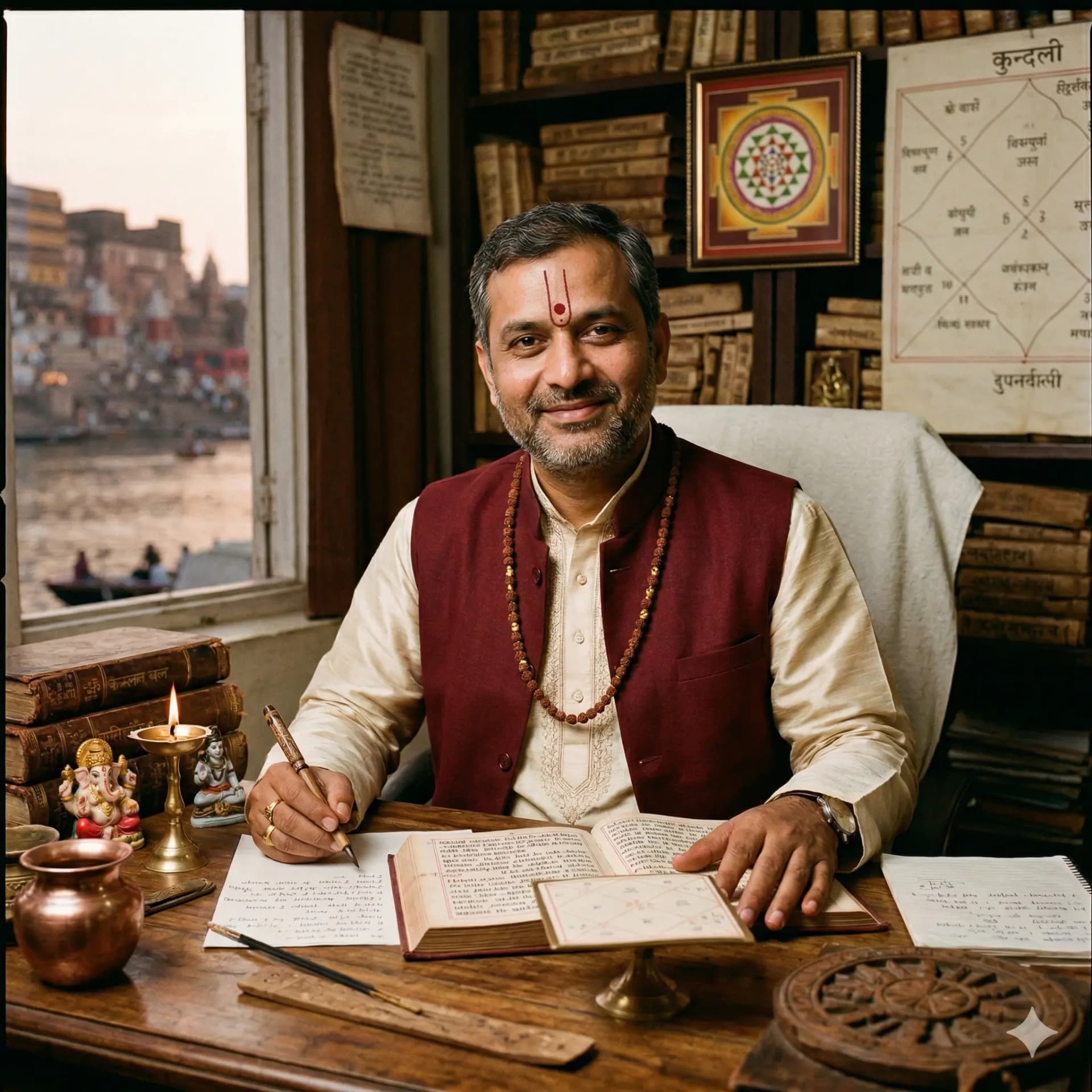
Pt. Raghav Sharma has practiced Parashari Jyotish for over twenty two years from Varanasi. A student of the Varanasi Jyotish tradition, he specialises in Graha-in-Bhava analysis, Vimshottari Dasha predictions, and Muhurta. He has authored over four hundred in-depth articles on Jyotish principles across the VastuCart knowledge network.