
Ketu in the 1st house
Mesh Lagna (Aries Ascendant)
A practitioner study of Ketu at the ascendant of Mesh Lagna. The south node in Mesha at the body angle, the warrior-monk detachment signature, and the soul that has come back already half-finished with worldly engagement and looks for the exit before the entrance is fully open.
Ketu in 1st house for Mesh Lagna, the quick reference
If you carry Ketu at the lagna of a Mesh chart, you hold one of the most spiritually loaded placements in the entire Aries ascendant catalogue, because the south node sitting on the body angle reshapes the entire personality around the themes Ketu rules: detachment, moksha, past-life karma, mysticism, scars, separation, and the inner sense that worldly engagement is something the soul has already mostly completed. Ketu is the moksha karaka, the planet that classical texts treat as the marker of liberation, and his presence at the lagna means the body itself becomes the vessel for the liberation signature rather than for the worldly drives most other lagna placements emphasise. Ketu has no own sign, no clear exaltation in mainstream Parashari tradition, and no house lordship because he is a shadow planet, but his nodal nature means he amplifies whatever house and sign he occupies and infuses the placement with his core themes regardless of dignity.
The second structural feature is the relationship between Ketu and Mesha. Mesha is Mars's sign, and Ketu shares martial qualities with Mars in classical texts, often described as Ketu being like Mars in temperament but with the worldly aim removed. Placing Ketu in Mesha at the lagna of Mesh produces the warrior-monk pattern where the native carries Aries courage and martial energy without the standard Aries hunger for personal achievement. They fight, but for causes rather than promotions. They lead, but reluctantly and only when they cannot avoid the responsibility. They look serious in childhood photographs and stay serious in ways family members find both impressive and slightly worrying. This guide reads every layer of Ketu in 1st house for Mesh Lagna natives: the south node at the body, the warrior-monk pattern, the mystical childhood signature, the appearance markers Ketu produces, and the cat's eye protocol that requires careful chart confirmation before wearing.
Why Ketu at the lagna reshapes the whole personality
Students often ask whether Ketu at the lagna is good or bad, and the honest practitioner answer is that the question does not quite apply to a shadow planet at the body angle. Ketu does not work on the good-bad spectrum the way the visible grahas do. He works on the engagement-disengagement spectrum, and his presence at the lagna of any chart shifts the native toward the disengagement end regardless of how the rest of the chart is arranged. The result is a personality that is not necessarily unhappy or unsuccessful but that does not relate to worldly engagement the way peers do. Where another Aries native chases promotions, recognition, romance, and visible markers of arrival, the Ketu-lagna native often watches those pursuits from a step removed, joining when the situation requires it and stepping back when it does not.
The second specific feature is the past-life completion signature classical texts assign to a strong Ketu at the lagna. The reading is that the soul comes into this incarnation already carrying significant karmic completion in the worldly domains and arrives with an inner orientation that resembles a meditation retreat in progress rather than a fresh beginning. Children with this placement often display an unusual seriousness, a quiet self-containment that does not match their age, and an early interest in mystical or contemplative themes that the family may or may not understand. The third interpretive layer is the scars and marks reading. Ketu is the planet of marks classical texts associate with the body, and natives with this placement often carry visible marks (birthmarks, scars from early childhood accidents, distinctive moles, or unusual features) at the head or face. These marks are interpretive signals to the practitioner: they confirm that the placement is functioning as the chart describes and that the native is the type who has lived this body's mystical layer rather than just inherited it on paper.
Ketu at the lagna is a soul that arrives at the gate of life already glancing toward the exit. The work is not to talk the native out of the glance, but to help them honour the worldly journey that the body still has to walk.
How Ketu at the lagna shapes the Aries native
Physically the native carries the Mesh Lagna frame with the unmistakable Ketu signature that classical texts catalogue precisely. The face often holds a quiet, watchful quality that strangers find both arresting and slightly distancing. The eyes are typically dark, deep-set, and described by friends as old-soul, holding the kind of look that makes new acquaintances ask whether the native is in a difficult mood when the truth is they are simply present in their usual way. Birthmarks, distinctive moles, scars from early childhood accidents, and small irregular features at the head or face are common diagnostic signs, and many natives report a specific birthmark or scar that the family already considered unusual before they knew about the placement. The body tends to be lean rather than muscular even when the native exercises consistently, because Ketu's nature is to draw energy inward rather than build it outward.
Temperament is the layer that most distinguishes this placement from every other Mesh lagna combination. These natives are not the loud Aries pioneers popular astrology describes. They carry the courage and the willingness to stand alone, but the standing alone is quiet rather than dramatic. They are often introverted by adult standards even when they were extroverted as small children, and the introversion deepens through adolescence in ways that worry parents who expected a more conventional personality. They are unusually honest because Ketu's cutting nature does not let them sustain pretence, and they often speak truths in casual conversation that other people find startling because they say them without apparent awareness that the truth is uncomfortable. They give little weight to social hierarchies, status games, or the markers of worldly arrival that motivate peers, and the lack of motivation is genuine rather than performative. The shadow side is exactly this disengagement, because natives who do not learn to honour the worldly journey their body still has to walk can drift into isolation, neglect of practical responsibilities, and a kind of low-grade depression that looks like spiritual progress from the outside but feels like emptiness from the inside. Natives who pair the natural detachment with explicit worldly commitment (a vocation, a partnership, a creative practice they show up for daily) develop the rare warrior-monk integration the placement is capable of in its fullest expression.
Strengths, shadows and career fits
- Body becomes moksha vessel from birth
- Innate detachment from worldly drives
- Mystical childhood and early intuition
- Warrior-monk integration possible
- Honesty without diplomatic filtering
- Past-life karmic completion signature
- Disengagement looks like depression
- Difficulty with self-promotion
- Drifts away from practical responsibility
- Marks and scars at head or face
- Early-life isolation tendency
- Money and recognition feel hollow
- Research, mathematics, theoretical sciences
- Mysticism, spiritual teaching, contemplative writing
- Healing arts, energy work, alternative medicine
- Backend technology, hidden infrastructure work
- Hospice, palliative care, end-of-life services
- Solo creative practice (poetry, fine art, music)
Where the warrior-monk vocation plays out
Career paths cluster around fields that allow meaningful work without the personal self-promotion other Aries placements thrive on. Research, mathematics, and theoretical sciences are the strongest single fit because they reward the depth of focus Ketu produces and do not require the native to perform charisma or build a personal brand. Many natives spend their working life in research roles where the work itself matters more than recognition, and they often become the quiet expert colleagues trust precisely because the native has no obvious agenda. Mysticism, spiritual teaching, and contemplative writing fit when the native commits explicitly to the contemplative path.
Healing arts, energy work, and alternative medicine work because Ketu rules the subtle body and natives often have unusual sensitivity to energetic dimensions of health. Backend technology and hidden infrastructure work suit the chart because Ketu is the planet of the unseen and natives often build careers in software architecture, cybersecurity, or systems administration where the work happens behind the scenes. Hospice and palliative care are the specific medical fits because the placement gives the native an unusual capacity to be present with dying. Solo creative practice (poetry, fine art, classical music) channels the detachment productively. Ketu mahadasha is when vocational direction crystallises, often through a sudden shift away from a conventional path the native had been forcing themselves to walk.
Ketu marked in the first house of Mesh
- Ketu at the lagna in Mesha, marked in smoky violet
- 12 houses in North Indian format
- Central diamond is the 1st house of Tanu Bhava
Why this is one of the most spiritually loaded lagna placements
The warrior-monk pattern is the most useful interpretive frame for Ketu in Mesha at the lagna, and it deserves careful reading because popular astrology flattens the placement into either pure spirituality or pure isolation. Ketu shares the martial nature of Mars but with the worldly aim removed, and Mesha is Mars's sign, so the placement takes Aries warrior energy and redirects it from personal achievement toward causes worth fighting for at the level of principle rather than ego. These natives are willing to confront difficult situations head on, willing to take unpopular positions, and willing to bear the cost of standing alone. What they are not willing to do is fight for status or personal reward.
The past-life completion signature is the second specific feature practitioners need to read with care. Classical texts treat a strong Ketu at the lagna as the marker of a soul that arrives in this body already carrying the inner orientation of a more advanced aspirant than the chronological age suggests. Practical consequences include early interest in contemplative themes, unusual maturity in childhood, and a sense that the native is older than peers in ways that have nothing to do with chronology. The third pattern is the relationship between Ketu and the rest of the chart's career signatures. Practitioners should always check the 10th house and the 10th lord when reading this placement, because Ketu's natural pull toward disengagement can compound with weak career indicators or balance against strong ones, producing very different lived versions of the same placement.
When Ketu in 1st delivers its Tanu Bhava chapter
Ketu mahadasha is the defining window for this placement and arrives with the spiritual deepening and worldly disengagement the chart specifically produces.
Head, marks and the Ketu sensitivity profile
Health follows the Ketu-at-the-body pattern with specific sensitivities. Constitution is generally lean and wiry, with vata dosha most prominent because Ketu carries vata-like qualities of dryness, irregularity, and inwardness. The 1st house body-part rulership covers the head, brain, and face. Ketu's specific marker is the birthmarks, scars, and distinctive features the placement produces at the head. These are not pathological and should be read as diagnostic signals confirming the placement is active.
The mysterious-ailment pattern is the second specific health layer because it appears consistently in clinical reports. Ketu produces conditions that conventional diagnostic protocols struggle to name: fatigue without obvious cause, digestive sensitivities without dietary triggers, skin issues that respond to spiritual practice as much as topical treatment. The reading is that Ketu's subtle-body emphasis gives the native an unusually sensitive nervous system that reports stress in ways the medical system does not always recognise. Recovery practices the chart responds to are silence, solitude, gentle daily walking, and consistent sleep. Annual general health screening from the late twenties is recommended because the diagnostic ambiguity Ketu produces makes regular baseline data more valuable than it would be otherwise.
Remedies for Ketu at the Mesh lagna
The daily Ganesha worship is the primary remedy for this placement because Ganesha is the classical patron deity of Ketu and his elephant-headed form is treated as the deva who accepts the south node's offerings. Rise before sunrise, bathe, wear white or off-white clothing, and visit a Ganesha temple if accessible. The Ganesh Atharvashirsha is the primary recitation for this placement because it is the Upanishadic hymn to Ganesha that classical tradition treats as the most powerful single text for invoking Ganapati and through him the Ketu channel. Reciting the Ganesh Atharvashirsha twenty-one times for forty-two days is the formal protocol, and natives often report a noticeable shift in clarity and inner stability by the third week of practice. Offer dub grass, modaka or any sweet, red flowers, and coconut at the altar, and donate to spiritual organisations, contemplative retreats, or animal shelters (especially dogs, which are Bhairava's vehicle and traditionally associated with Ketu's protective layer).
The daily contemplative practice is the single most important lifestyle remedy for this placement because the chart specifically asks the native to honour the contemplative pull rather than fight it. Twenty minutes of sitting meditation, scriptural reading, or silent prayer at the same time each day produces compounding stability across decades, and natives who establish this practice in their twenties report that it is what made the rest of the placement bearable in the periods when the disengagement was strong. The gemstone is cat's eye (Lehsunia, Vaidurya), made from chrysoberyl, and it is recommended only after careful chart confirmation because Ketu's intensity varies sharply between natives and the cat's eye amplifies whatever the placement is currently expressing. Wear a natural chrysoberyl cat's eye of minimum five ratti set in silver on the small finger of the right hand on a Wednesday or a Tuesday at sunrise after Ketu mantra recitation, and only after a practising Jyotishi has confirmed the placement is ready for the amplification. The lifestyle adjustment that compounds most is treating worldly engagement as a spiritual discipline. Because the placement pulls toward disengagement, natives who deliberately commit to one worldly anchor (a vocation, a partnership, a creative practice they show up for daily) find that the anchor becomes the ground from which the contemplative depth can flower without dissolving into isolation.
Gemstones for Ketu in 1st house Mesh Lagna
Cat's eye is the primary Ketu gemstone but is recommended only after careful chart confirmation because of the south node's amplification effect.
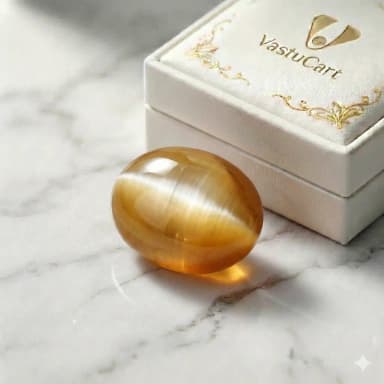
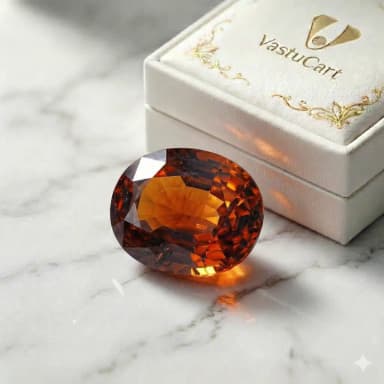

Disclaimer: Cat's eye amplifies whatever Ketu is currently expressing. Always consult a qualified Jyotishi before permanent wearing of any nodal gemstone.
Rudraksha beads for Ketu in 1st house
The Ketu-aligned rudraksha is the Ashta Mukhi (Eight Mukhi), the bead directly ruled by Ganesha and the south node.
The classical Ketu rudraksha and the bead specifically associated with Ganesha as the patron deity of the south node. Removes obstacles to spiritual progress, supports the contemplative practice the placement asks for, and stabilises the inner orientation when the disengagement signature is strong.
The nine-mukhi bead is the Rahu node's bead and is worn alongside the Ashta Mukhi when the practitioner wants to balance the full nodal axis. Recommended for natives who experience strong axis events (sudden shifts, mystical breakthroughs, identity restructuring) during transit windows.
Ketu Yantra for the lagna placement
Sacred recitations for Ketu at the lagna
Tvameva pratyaksham tattvamasi
Tvameva kevalam karta asi
Tvameva kevalam dharta asi
Tvameva kevalam harta asi
Tvameva sarvam khalvidam brahmasi
Tvam sakshad atma asi nityam
Translation: Om, salutations to Ganapati. You alone are the visible truth. You alone are the sole creator. You alone are the sole sustainer. You alone are the sole dissolver. You alone are truly all this Brahman. You are directly the eternal Self. The Ganesh Atharvashirsha is the most powerful single hymn for invoking Ganapati and through him the Ketu channel. The classical protocol is twenty-one recitations for forty-two days when the placement specifically asks for nodal stabilisation.
Read the full stotra on stotra.vastucart.inTools for Ketu 1st house Mesh natives
Is your Tanu Bhava Ketu carrying the warrior-monk signature?
Get a full personalised analysis of your lagna Ketu, the past-life karma marks, and the contemplative vocation pull.
Questions about Ketu in 1st house, Mesh Lagna
Pt. Raghav Sharma has practiced Parashari Jyotish for over twenty two years from Varanasi. A student of the Varanasi Jyotish tradition, he specialises in Graha-in-Bhava analysis, Vimshottari Dasha predictions, and Muhurta. He has authored over four hundred in-depth articles on Jyotish principles across the VastuCart knowledge network.