Sun in the 9th house
Meena Lagna (Pisces Ascendant)
A practitioner study of Surya in Dharma Bhava for Pisces ascendant natives. Sun is the 6L sitting in friend-sign Vrishchika at the dharma trikona, the rare Dharma Vipreet configuration where the lord of difficulty enriches a dharmic angle and the native fights structurally for righteous causes.
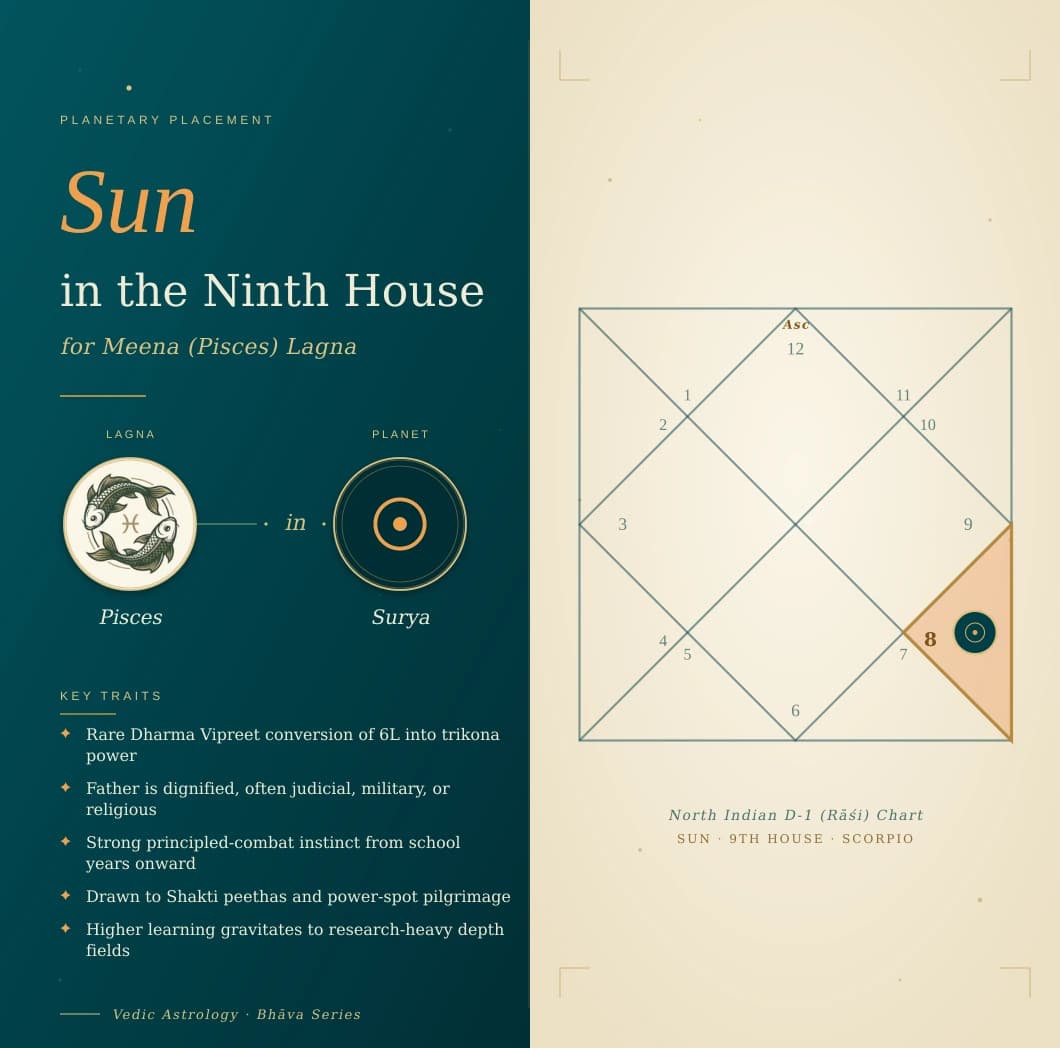
Sun sits in friend-sign Vrishchika at the ninth house dharma trikona for Pisces ascendant natives, the Dharma Vipreet Yoga signature.
Sun in 9th house for Meena Lagna, the quick reference
If you carry the Sun in the ninth house of a Meena chart, you hold a placement that practitioners read in two opposing registers and only the deeper Nadi reading does justice. Surya rules ONLY the 6th for Meena Lagna and lands here in Vrishchika (Scorpio), the mystical own sign of Mars. The dignity is therefore friend-sign Sun (mitra-graha placement, Mars and Sun being mutual friends in the natural relationships). The configuration produces what some Nadi schools call the Dharma Vipreet Yoga (the dharma reversal yoga, the 6L of difficulty enriching the dharma trikona from within).
The second feature is the Vipreet logic in trikona. Strict Parashari schools warn that a dusthana lord in the 9th can stain the dharma house with enemies, lawsuits, and chronic disease leakage into faith and father. Nadi schools and modern practitioners read the same configuration as the lord of righteous combat finally arriving on the dharmic seat: the native fights for righteous causes, defends the under-represented in court, runs medical missions in pilgrimage towns, takes a uniform into the field for principled work, and turns the fight itself into the dharma. The Vrishchika overlay sharpens this further. Mars's mystical sign gives the 9th-house dharma a depth-practitioner cast, an attraction to Shakti peethas and power-spots rather than orthodox temples, and a research-heavy higher-education pattern in fields like medicine, military, intelligence, depth psychology, or comparative religion. The third feature is the father karaka layered onto the bhava karaka. Sun is the natural significator of father, and the 9th is the bhava of father, so the placement runs a double signal on the paternal axis. Fathers of these natives are typically dignified, often judicial, military, religious, or self-made authorities, frequently with the Vrishchika intensity (secretive, mystical, depth-practitioner). This guide reads every layer of Sun in 9th house for Meena Lagna natives: the Vrishchika friend-sign, the 6L-in-9 Vipreet mechanics, the dharma trikona conversion, the father-and-pilgrimage arc, and the ruby (manik) protocol used carefully here.
Why the 6L Sun at the dharma trikona forms a Dharma Vipreet Yoga
Students often arrive at this placement carrying contradictory advice. One classical voice warns that a dusthana lord in a trikona stains the dharmic angle and the father suffers. Another voice says the lord of righteous combat finally finds his seat on the dharma throne and the native rises through principled fight. Both readings descend from real classical sources. The integrated reading is structural, not moralising.
The first feature is the friend-sign placement. Vrishchika is ruled by Mars, and Mars is a friend of Sun in the standard natural-relationship table (mitra-graha). Sun in friend-sign carries above-neutral dignity, stable and warm, and the warrior-energy of Mars's sign amplifies the regal-fight signature the Sun carries naturally. The principled-combat instinct activates very early, often in school debates and early-career advocacy postings. The second feature is the 6L-in-9 Vipreet mechanic. The strict Parashari rule says a dusthana lord contaminates whichever house it sits in. The Nadi reading is precise and different: when the lord of a dusthana sits in a trikona (1st, 5th, or 9th), the trikona container absorbs the difficulty signature and converts it. Enemies become the cause one defends, lawsuits become the cases one wins for the under-represented, and chronic illness becomes the field one heals professionally. The third feature is the bhava-karaka double signal on father. Sun is the karaka of father, and the 9th is the bhava of father. Clinical reports across years confirm that fathers of these natives carry serious institutional weight (judges, military officers, principled doctors, religious authorities). Compared with Surya-6 in own Simha (textbook Harsha at Ripu Bhava) and Surya-3 in Simha (Parakrama warrior register), Surya-9 in Vrishchika is uniquely the only Sun configuration for Meena where the dusthana lord lands in dharma trikona at friend-sign dignity.
Sun in friend-sign Vrishchika at the Meena 9th is not the lord of difficulty staining the dharma seat. It is the regal warrior of righteous combat finally arriving on the throne of dharma itself, defending the under-represented, walking pilgrimage to power-spots, and converting fight into faith across decades.
Terms used in this article
A short glossary of the Sanskrit and Jyotish terms that recur in this study. First-occurrence expansion is also retained inline.
- Dharma Bhava
- The 9th house, the bhava of father, dharma, higher learning, long pilgrimage, and the moral grammar of the life. A trikona, the strongest auspicious angle.
- Mitra-graha
- Friend-sign placement. A planet sitting in a sign owned by its natural friend carries above-neutral dignity, stable and supportive.
- Vipreet Raja Yoga
- Reverse royal yoga. The classical Parashari forms cover 6L, 8L, 12L lords sitting in another dusthana. The Nadi extension covers a dusthana lord sitting in a trikona, named Dharma Vipreet by some lineages.
- Trikona
- Auspicious dharmic angle. The 1st, 5th, and 9th houses carry the deepest dharmic significations of self, intelligence, and fortune.
- Dusthana
- Difficulty house. The 6th, 8th, and 12th carry the three classical difficulty significations of disease, transformation, and loss.
- Bhagya
- Fortune. The alternate Sanskrit name for the 9th house, emphasising the luck-and-grace dimension of the bhava.
- Pitru
- Father, paternal ancestors. The 9th-house karaka set, doubled here because Sun is also the natural father karaka.
- 6L
- Sixth-house lord. Carries the bhava of enemies, debt, illness, and service when situated in any other house.
How friend-sign Sun in dharma trikona shapes the Meena native
Physically the native carries the standard Meena soft-water frame underwritten by the Sun's saffron-fire vitality and the Vrishchika depth-glow, often producing a body strangers describe as quietly intense. The face tends elongated rather than round, the eyes carry a still penetrating gaze that holds attention longer than ordinary social rules permit, and the bearing has the unhurried command of someone walking a pilgrimage rather than rushing to a meeting. Hair is typically dark and abundant in the early decades, the complexion holds a warm undertone with occasional Vrishchika-related skin sensitivities, and the build trends athletic-lean with a noticeable hip-and-thigh strength that walking up temple steps tends to reward.
Constitution is where the Vrishchika overlay most distinguishes the temperament. The standard Meena empathic receptivity is intact, but it now travels through a dharmic-warrior channel that turns sentiment into principled stand-taking. The native is the empath who appears in court for the under-represented, the dreamer who walks Kedarnath in the off-season, the soft-hearted person who runs a free clinic in a difficult district, and the gentle child who grows into the doctor that takes the cases nobody else will accept. Many natives describe a lifetime pattern of being gently underestimated by polite society and then producing institutional results that surprise everyone, because the Vrishchika Sun keeps a private moral file and never compromises the verdict. The shadow side is the same Vrishchika depth. Natives who do not channel the Dharma Vipreet vocation consciously can attract intense conflicts inside religious communities, develop a quiet rigidity around their own dharmic certainty, accumulate hidden grievances against father or guru figures, or experience disorienting spiritual crises that shake the inherited faith and force a complete rebuild. Pairing the principled-combat work with explicit contemplative practice (silent retreat once a year, regular Shakti-peetha pilgrimage, journaling) keeps the placement integrated rather than turning it into its own friction.
Strengths, shadows and career fits
- Rare Dharma Vipreet conversion of 6L into trikona power
- Father is dignified, often judicial, military, or religious
- Strong principled-combat instinct from school years onward
- Drawn to Shakti peethas and power-spot pilgrimage
- Higher learning gravitates to research-heavy depth fields
- Recovers from spiritual crises with a deeper dharmic core
- Risk of intense disputes inside religious communities
- Quiet rigidity around private moral certainty
- Hidden grievances with father figures or gurus
- Spiritual crises that disrupt inherited faith for years
- Hip, thigh, and sciatic-nerve sensitivity after forty
- Long-haul travel exhaustion if pilgrimage is unmoderated
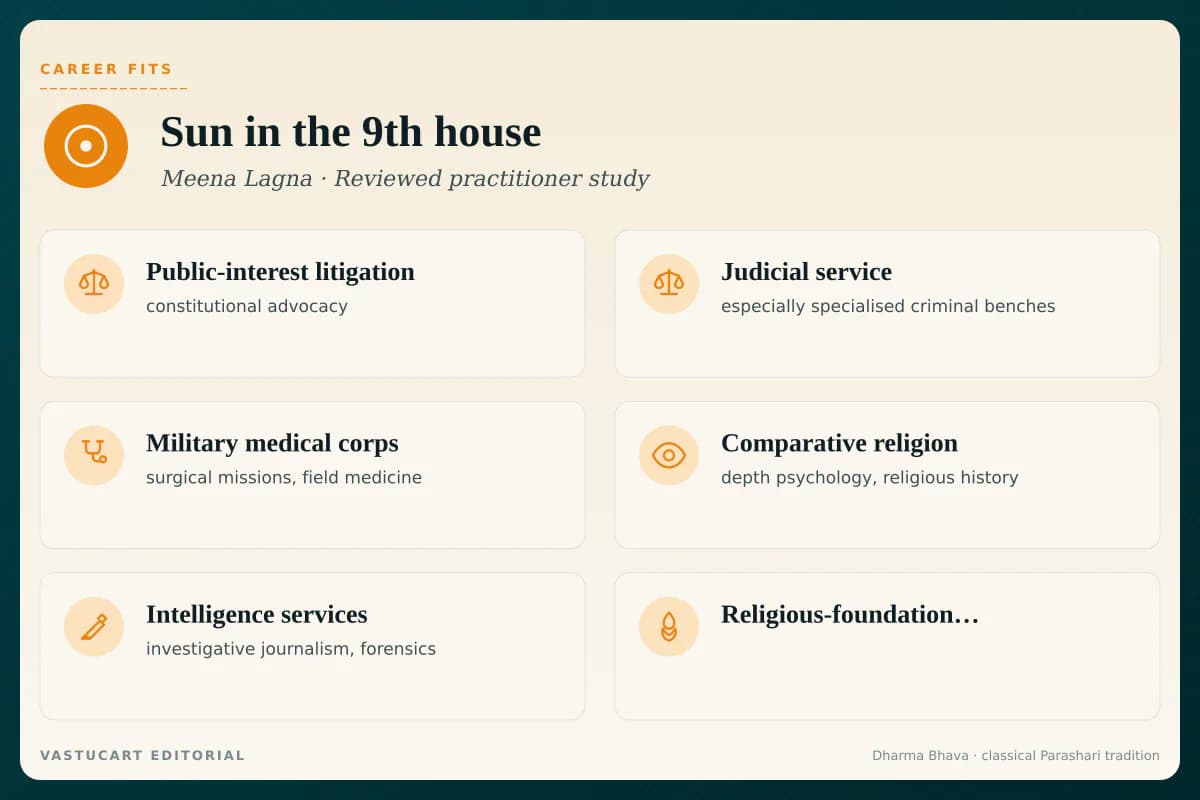
- Public-interest litigation and constitutional advocacy
- Judicial service, especially specialised criminal benches
- Military medical corps, surgical missions, field medicine
- Comparative religion, depth psychology, religious history
- Intelligence services, investigative journalism, forensics
- Religious-foundation leadership tied to pilgrimage routes
Where principled combat meets pilgrimage for the Meena native
Career paths cluster around fields that put the Sun's regal authority to work in a dharmic-combat register. Public-interest litigation and constitutional advocacy come first because the Dharma Vipreet signature delivers the precise fusion of righteous fight and ethical structure these careers require. Many natives become senior counsel for human-rights cases, public defenders whose conviction rates fall sharply when they appear, environmental-law specialists, and constitutional-bench advocates whose careers gather weight across decades. Judicial service, especially specialised criminal benches, suits natives whose vocational mode is principled judgement on the hardest cases society produces. Many take judicial posts in their thirties and rise to senior bench appointments by their fifties, often handling matters that combine grave stakes with limited public attention.
Military medical corps, surgical missions, and field medicine fit naturally because Sun in friend-sign Vrishchika gives the body unusual physical resilience, the dharmic angle organises the work around principled service, and the Vrishchika depth lets the practitioner stay clinically clear in crisis settings ordinary doctors find disorienting. Military doctors with this configuration often spend their careers in conflict-zone postings or rural-hospital chiefdoms in difficult terrain. Comparative religion, depth psychology, and religious history work suit natives whose vocational mode is sustained scholarly engagement with the deepest material a tradition produces, including comparative work across traditions that less Vrishchika-marked academics tend to avoid. Intelligence services, investigative journalism, and forensic work fit the Vrishchika investigative instinct combined with the Sun's institutional steadiness, producing operatives and reporters whose work changes the public record. Religious-foundation leadership tied to pilgrimage routes is the lesser-known fit that often consolidates in the second half of life, after the litigator-judge-doctor career has crystallised. Sun mahadasha is the defining dharmic chapter and arrives with the senior bench appointment, the constitutional-counsel partnership, the field-hospital chiefdom, the chair of comparative religion, the foundation directorship, or the Shakti-peetha trustee role that crystallises the Dharma Vipreet vocation.
Why the lord of difficulty in the dharma seat produces principled rise
The clearest way to read Sun in 9th of Meena is to hold the friend-sign dignity, the dusthana-lord-in-trikona mechanism, and the bhava-karaka double signal together rather than treating them in isolation. Trikona placement gives any planet a dharmic protective container that converts difficulty into integration. When the planet is a dusthana lord, the trikona container neutralises its natural capacity to project dusthana significations elsewhere and binds the difficulty energy to a dharmic vocation.
The single-house lordship is the second specific feature for Meena natives. The Sun rules ONLY the 6th for this lagna and no other house, which is structurally simplifying. Most planets carry dual lordship and split their effects across two bhavas, but the Sun for Meena is a single-house lord whose entire chart-impact concentrates on Ripu Bhava significations. When this single-house lord sits at the dharma trikona in friend-sign Vrishchika, the chart's whole solar dimension organises around a dharma-of-righteous-combat theme. The professional life often looks like a long arc of principled fight on behalf of others (constitutional cases, environmental defence, field medicine, depth-research scholarship, religious-tradition stewardship) that compounds across decades into a substantial reputation in dharma-domain mastery. The third interpretive layer is the comparison with the Sun's other apex placements across the twelve lagnas. Sun exalted in 2H Mesha for Vrishabha is foundational dhana-yoga apex. Sun in own Simha at the 6H for Meena is the textbook Harsha service apex. Sun in friend-sign Vrishchika at the 9H for Meena is uniquely the only Sun configuration where the single-house dusthana lordship, the friend-sign dignity, and the dharma-trikona Vipreet conversion align together. No other lagna in the wheel produces this exact threefold alignment.
When the Vrishchika Sun at dharma trikona delivers its Vipreet chapter
Sun mahadasha is the defining dharmic window for this placement and arrives with the senior bench appointment, constitutional-counsel partnership, field-hospital chiefdom, chair appointment, foundation directorship, or Shakti-peetha trustee role that crystallises the Dharma Vipreet vocation.
Hips, hepatic system and the dharma vitality signature
Health follows the Meena-with-Sun-in-9th pattern with a kapha-pitta constitution that runs warm because Surya brings fire-pitta into the kapha-water Meena baseline and the Vrishchika sign adds a hidden water-fire intensity. The 9H body-part rulership covers the hips, thighs, sciatic nerve, and the hepatic system, while the Meena sign emphasises the feet, lymphatic system, and the body's overall fluid balance. The Sun rules the heart, vital force, eyes, and the energetic backbone of the body. The placement therefore raises specific lifelong vulnerability to hip-joint and sciatic strain from long-haul pilgrimage and standing-court hours, hepatic stress from the Vrishchika tendency to absorb shadow material professionally, eye-strain from long document hours in litigation or scholarship, and the inflammatory markers that classical sources associate with strong pitta in a kapha-baseline.
The dharmic-vitality advantage is the second body-related layer to read carefully. Sun in friend-sign Vrishchika at the dharma trikona gives the body a steady reserve of physical resilience that powers long pilgrimage, sustained court schedules, and field-medicine deployments other natives find depleting. Many natives in field medicine and military medical corps report contracting infections from patients and clearing them in days, walking long high-altitude routes without acute mountain symptoms, and entering their fifties and sixties with knee-and-hip mobility their peers no longer carry. The pattern that does recur is hidden hepatic load from sustained shadow-work professionally, mild liver enzyme elevation by the late forties when ordinary lifestyle counterweights are absent, and shoulder-and-eye strain from long professional days. Daily walking before sunrise, regular hydration through the working day, weekly water-fast on Sunday (the Sun day, classically prescribed), annual full-panel screening from the late thirties with hepatic and cardiovascular focus, and disciplined sleep boundaries are the protective routines. Foot care also matters because Meena rules the feet directly, and natives in long-pilgrimage practice or long-standing professional roles benefit from regular foot massage with warming oil through the working decades.
Remedies for the Sun in the Meena dharma angle
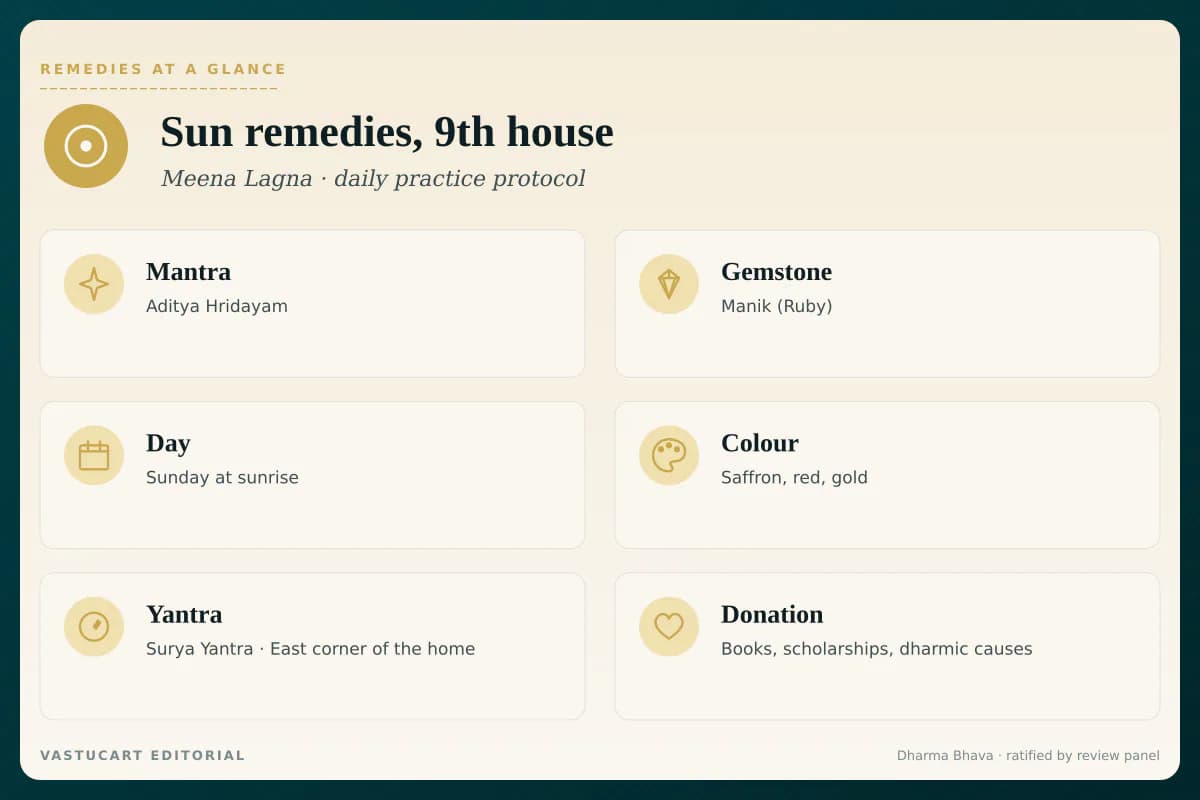
The daily Surya worship is the primary remedy for this placement because the Sun is his own deity and the dharma-trikona Vipreet Sun responds to direct devotional address most cleanly. Rise before sunrise, bathe, wear saffron or red clothing on Sundays, and offer water (arghya) to the rising Sun while reciting the Surya Mantra. The Aditya Hridayam is the primary recitation, the classical hymn from the Yuddha Kanda of the Ramayana that holds the Sun signature in its most refined warrior expression and resonates exactly with the principled-combat dharma of this placement. Reciting it at sunrise daily for forty days at any major Sun transition (a senior bench appointment, a constitutional-counsel partnership, a field-hospital chiefdom, a chair appointment, a foundation founding) is the formal protocol classical sources prescribe.
Offer red flowers (especially marigold and red lotus), jaggery sweets, and red sandal paste at the altar. Pilgrimage to Shakti peethas and Sun temples is the structural ritual remedy for this configuration: Konark, Modhera, Martand, the twelve Adityas of Kashi, and the major Shakti peethas across the subcontinent are the classical destinations. Donate to causes that support the dharma vocation directly: free legal-aid clinics for the under-represented, scholarship funds for medical students from rural districts, comparative-religion research grants, military-veteran welfare, and pilgrimage-route preservation are the structural gift channels for this placement. The conscious-restraint practice is the lifestyle remedy that compounds across decades into the difference between Dharma-Vipreet mastery and Dharma-Vipreet rigidity. A daily reflection on which dharmic positions actually serve and which have hardened into private certainty keeps the placement directed without producing brittle moralism. The gemstone is ruby (Manik), the primary Sun ratna, but is worn here only after careful chart review because the 6L lord is enriching a trikona from within and ruby amplifies the lord's signal in both registers (dharmic warrior and 6L health concerns).
Gemstones for Sun in 9th house Meena Lagna
Ruby is the primary Sun gemstone for this placement and is worn after a confirmed reading because the 6L lord at the dharma trikona benefits from amplification only when the dharma-vocation channel is actually being lived.


Disclaimer: Ruby over a 6L Sun at the dharma trikona amplifies both the principled-combat channel and the 6L health-and-litigation register, so this gemstone is recommended only after a confirmed reading by a qualified Jyotishi.
Rudraksha beads for Sun in 9th house
The Sun-aligned rudraksha is the Ek Mukhi (One Mukhi), the bead directly ruled by Shiva and the Sun.
The classical Sun rudraksha and the bead specifically associated with sovereign self-effort and the regal-warrior dharma. Supports the Dharma Vipreet signature, channels the principled-combat instinct toward sustainable territory, and stabilises solar authority when the litigation, judicial, military medical, scholarly, or foundation vocation is in active phase.
The twelve-mukhi bead supports solar radiance and dharmic resilience for long pilgrimage and sustained field deployment. Wearing the Barah Mukhi alongside the Ek Mukhi compounds the placement's natural strength in constitutional advocacy, surgical missions, comparative-religion scholarship, and any role where principled work must hold up under multi-decade pressure.
Surya Yantra for the Vrishchika dharma trikona placement
Sacred recitations for the Sun in the dharma angle
Jaya-avaham japen-nityam akshayam paramam shivam
Translation: The Heart of the Sun is sacred, destroyer of every enemy, bringer of victory, recited daily for inexhaustible welfare and supreme auspiciousness. The Aditya Hridayam is the canonical hymn given by the sage Agastya to Rama before his battle with Ravana, and it is the perfect daily recitation for a chart where the Sun sits as 6L at the dharma trikona and the Dharma Vipreet signature needs a containing devotional field. Many natives advanced in practice add the Surya Kavacham as a secondary protective layer once the daily Aditya discipline is steady.
Read the full stotra on stotra.vastucart.in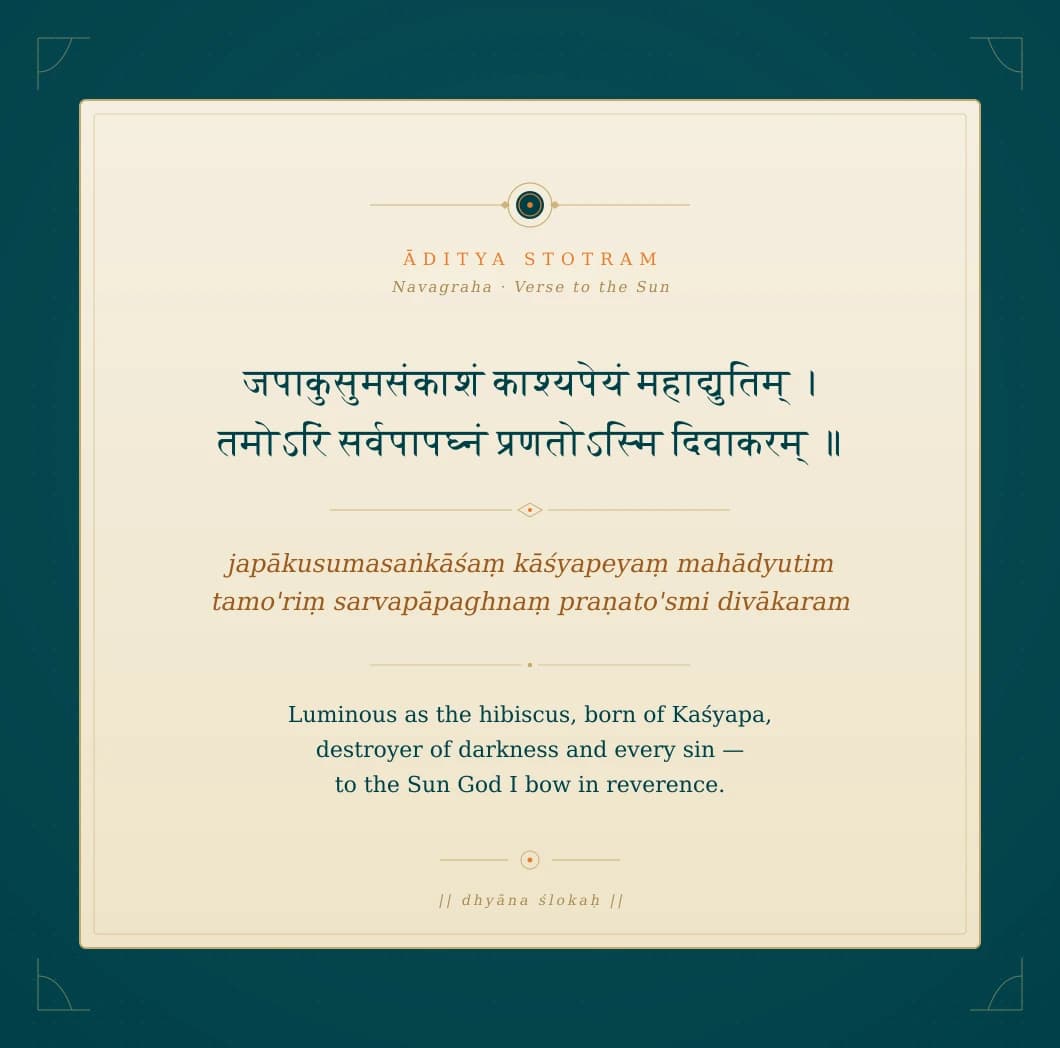
Tools for Sun 9th house Meena natives
Is your Dharma Bhava Sun carrying the Vipreet signature?
Get a full personalised analysis of your ninth house Sun, the friend-sign Vrishchika dignity, and the dharma-vocation timing.