Mars in the 9th house
Meena Lagna (Pisces Ascendant)
A practitioner study of Mangal in Dharma Bhava for Pisces ascendant natives. Mars swakshetra in his own sign Vrishchika in the ninth bhagya house, the 9L sitting in his own 9H producing bhavat-bhavam double dharma intensity, and the soldier-priest reading where pilgrimage, paternal lineage, and warrior dharma converge in one mystical own-sign placement.
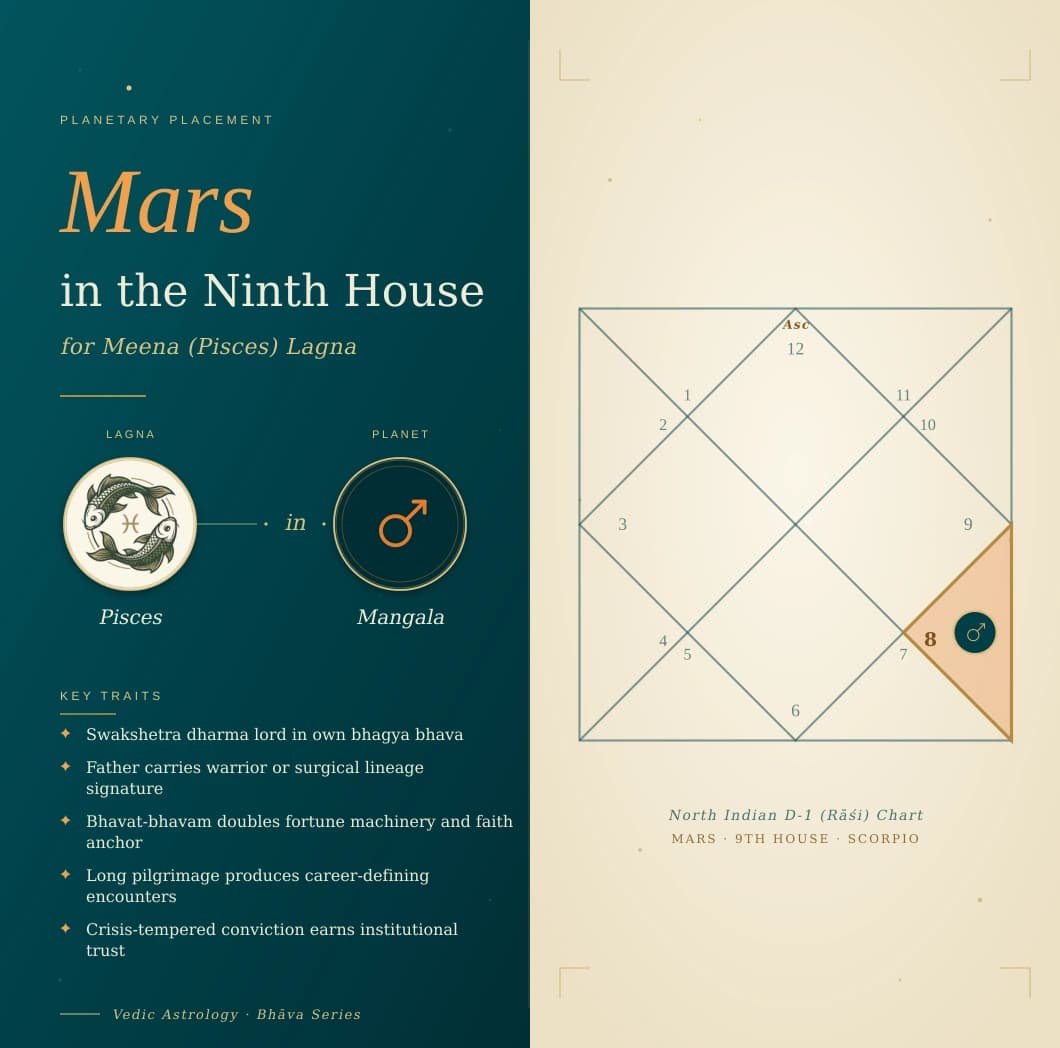
Mars sits in his own sign Vrishchika in the ninth dharma house for Pisces ascendant natives, the soldier-priest bhagya signature with double dharma intensity.
Mars in 9th house for Meena Lagna, the quick reference
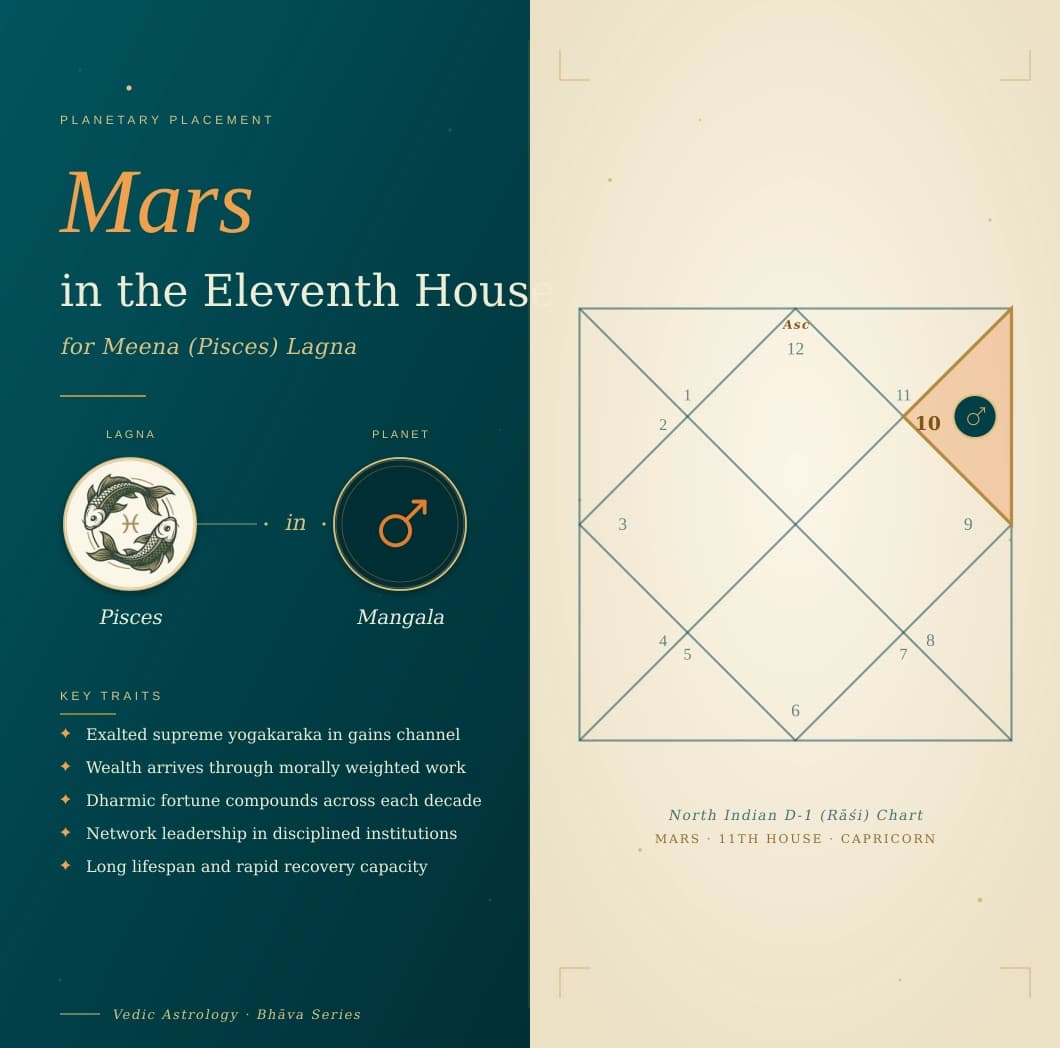
If you carry Mars in the ninth house of a Meena chart, you hold one of the rare swakshetra-in-own-bhava configurations classical Parashari treats as a structurally complete dharmic placement, because Mangal (Mars) sits in his own sign Vrishchika (Scorpio) inside Dharma Bhava (the ninth house, the bhava of paternal lineage, fortune, higher learning, long pilgrimage, and the lifelong faith framework). The ninth house from Meena is Vrishchika, Mars's mystical own sign, which makes the 9L sit inside his own 9H. This produces what classical sources call bhavat-bhavam intensity, the doubled dharma signature that arrives when a bhava lord occupies his own bhava.
The structural feature that distinguishes this placement is the joint dhana-dharma lordship. Mars rules Mesha (the 2nd house, dhana bhava of accumulated wealth, family resources, and speech) and Vrishchika (the 9th house, bhagya bhava of dharma, fortune, and paternal lineage) for Meena. This dual 2L plus 9L combination through Mars is classically called the Dhana-Dharma yoga lord pattern. When this dual lord sits in his own dharma trikona, the chart's wealth-and-faith spine routes through one mystical Mars-Vrishchika channel where ethical fortune and warrior conviction inseparably braid.
One classical clarification matters for marriage delineation. The Manglik dosha calculation reads Mars in houses 1, 4, 7, 8, and 12. The 9th is not on that classical list, so this Mars does not produce the Manglik signature.
The placement is read instead as a dharmic-warrior bhagya configuration where Mars's own-sign strength meets the dharma trikona at apex. This guide reads every layer of Mars in 9th house for Meena Lagna natives: the Vrishchika swakshetra, the bhavat-bhavam doubling, the dual 2L plus 9L lordship, the soldier-priest bhagya signature, and the red coral protocol.
Why swakshetra Mars in own dharma is the soldier-priest signature
Students often arrive at this placement aware that swakshetra Mars is broadly favourable but uncertain why classical commentators treat Mars in own Vrishchika in the 9H of Meena as a structurally distinct configuration above the merely-strong own-sign Mars placements other lagnas hold. The honest practitioner answer requires reading the bhavat-bhavam doubling, the dual 2L plus 9L Dhana-Dharma combination, and the mystical Vrishchika dimension together. Classical Parashari recognises that any bhava lord occupying his own bhava produces a structurally amplified version of that bhava's significations, and Mars as 9L sitting in own 9H of Vrishchika fuses dharmic fortune with warrior conviction at apex strength.
The bhavat-bhavam principle is the first specific feature practitioners need to handle correctly. Bhavat-bhavam refers to a bhava counted from itself, and the classical commentators use it to describe the doubling effect when a planet sits in a position that re-points to the same bhava. The 9L in the 9H is the textbook bhavat-bhavam case for the dharma channel: dharma counted from dharma, fortune amplifying fortune, paternal lineage doubled by the planetary lord of paternal lineage occupying paternal lineage. The native's life acquires a foundational dharmic anchoring that survives setbacks because the bhagya-fortune machinery is structurally redoubled.
The Vrishchika dimension is the second interpretive layer. Vrishchika is Mars's mystical, transformative own sign, distinct from Mesha which is his cardinal warrior sign. Vrishchika rules occult research, surgical depth, kundalini practice, intelligence work, hidden currents, and sustained transformation through crisis.
When Mars in own Vrishchika sits in the 9H of Meena, the dharma the native recognises is esoteric rather than exoteric. Faith arrives through depth-experience and crisis-tempered conviction rather than through inherited religious identity, and the paternal lineage often carries a rupture-and-rebuild signature.
The third layer is the dual 2L plus 9L Dhana-Dharma routing. Mars rules both Mesha (2nd dhana) and Vrishchika (9th bhagya) for Meena, which means Mars holds the joint lordship of accumulated wealth and dharmic fortune. When this dual lord sits in his own 9H, the chart fuses three dimensions into one continuous mystical channel: family wealth and speech (2L), dharmic fortune and paternal lineage (9L), and the bhagya bhava itself. Many natives in this configuration develop adult vocations where ethical conviction directly produces durable wealth, and where wealth carries the moral colour of the work.
Swakshetra Mars in own dharma is not a generic strong placement. It is the singular Meena configuration where the warrior planet rules dharma, sits inside dharma, and routes the chart's entire faith architecture through his own mystical Vrishchika channel.
Terms used in this article
A short glossary of the Sanskrit and Jyotish terms that recur in this study. First-occurrence expansion is also retained inline.
- Dharma Bhava
- The 9th house, the bhava of dharma, fortune, paternal lineage, higher learning, long pilgrimage, and the lifelong faith framework.
- Swakshetra
- Own-sign placement. A planet sitting in a sign he himself rules, expressing through native ground rather than borrowed terrain.
- Bhavat-Bhavam
- A bhava counted from itself. The doubling effect when the lord of a house occupies that same house, amplifying the bhava significations.
- Vrishchika
- Scorpio. Mars's mystical, transformative own sign, ruling occult depth, surgical sharpness, kundalini, intelligence work, and crisis-led transformation.
- Trikona
- The 1st, 5th, and 9th houses, the auspicious dharmic angles classical Parashari treats as the most consistent fortune-bearing positions.
- Dhana-Dharma yoga
- A combination where one planet rules both a dhana (2nd or 11th) and a dharma (5th or 9th) house, producing wealth tied to ethical work.
- Karakatva
- The natural significations a planet rules independent of any chart.
How swakshetra Mars in dharma shapes the Meena native
Physically the native carries the Meena soft-water frame anchored by a Mars-Vrishchika dense intensity, producing a body strangers describe as quietly magnetic and watchful under pressure. The eyes carry a piercing-depth quality, a Mars-Vrishchika signature that combines with the receptive depth the Meena lagna supplies, and the gaze tends searching and unblinking rather than scanning. That single feature translates well to operating theatres, intelligence briefings, monastic lineages, and any setting where sustained attention to hidden current registers as competent presence.
The build keeps Meena proportions through the upper body and adds a wiry tactical strength through the legs, hips, and shoulder line. Many natives carry small surgical or training scars from formative years, and several report a singular accident or near-death event in adolescence that became a private faith anchor. Hair tends dark and thick, the complexion runs warm with a coppery undertone, and the voice carries a low measured weight that can feel oracular to listeners without the native intending it.
Temperament is where the placement most distinguishes the native. These natives carry the standard Meena receptivity (intuitive sensing, emotional generosity, the willingness to absorb other people experience) but route it through depth-truthfulness and dharmic-conviction channels rather than purely empathic ones. They are drawn from young to settings where ethical depth and physical courage are equally tested: cadet corps with chaplaincy interest, peer groups organised around demanding spiritual practice, early responsibility for elderly relatives in crisis, and elders who model warrior-monastic integration.
The Meena empathy combines with swakshetra Mars's mystical discipline to produce natives whose presence carries both moral seriousness and operational steadiness. The signature shows up in military chaplaincy, surgical pilgrimage missions, intelligence work in conflict zones, and depth-research in fields where the answer demands ethical risk.
The shadow side is the same combination of intensity and receptivity. Natives who do not channel the dharma-warrior dimension consciously can experience cycles of zealotry, internal crusading, or paranoid certainty that compound across decades. Pairing the Mars-Vrishchika depth with explicit boundary practice produces the rare integration of moral courage and reflective humility the placement structurally supports.
Strengths, shadows and career fits
- Swakshetra dharma lord in own bhagya bhava
- Father carries warrior or surgical lineage signature
- Bhavat-bhavam doubles fortune machinery and faith anchor
- Long pilgrimage produces career-defining encounters
- Crisis-tempered conviction earns institutional trust
- Esoteric study compounds into respected expertise
- Zealotry risk if Mars-Vrishchika depth is unsupervised
- Hip and thigh injuries during operational phases
- Paternal relationship can carry rupture-and-rebuild arc
- Pilgrimage travel exposes the native to physical risk
- Over-identification with cause can drain personal life
- Internal crusading on small disagreements within family
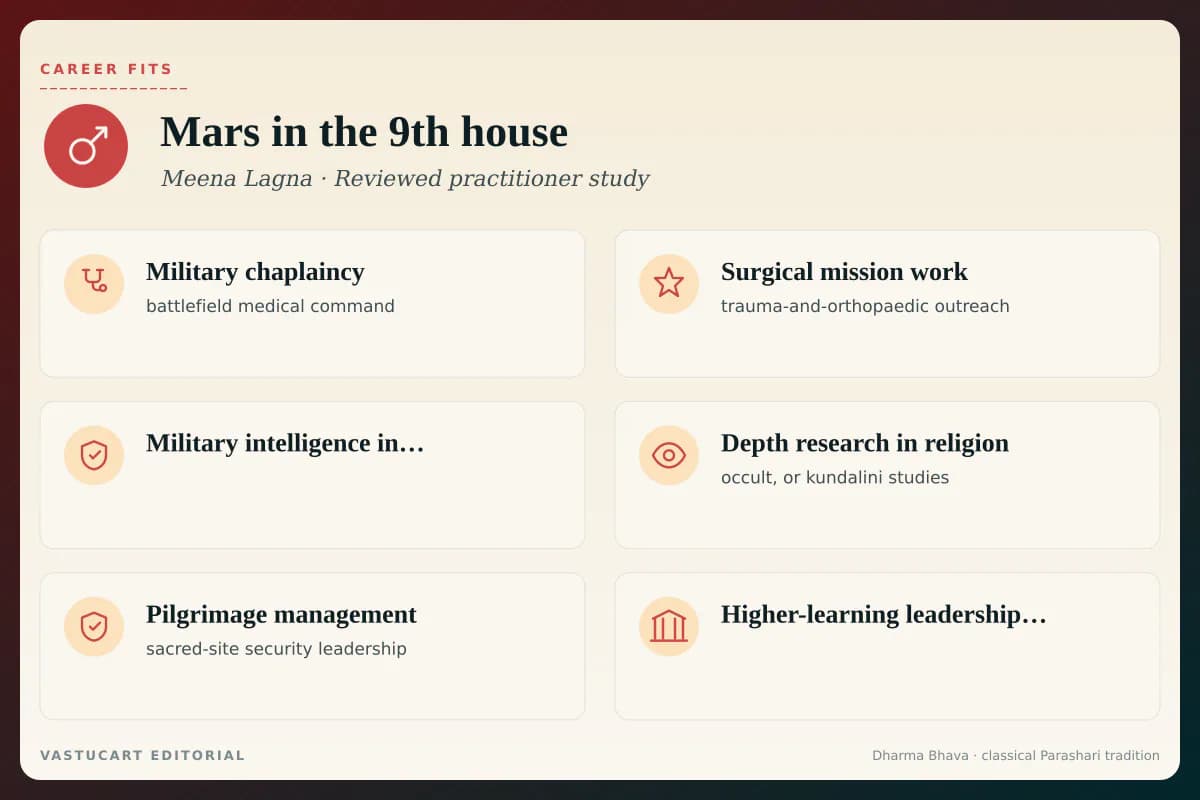
- Military chaplaincy and battlefield medical command
- Surgical mission work, trauma-and-orthopaedic outreach
- Military intelligence in conflict-zone deployment
- Depth research in religion, occult, or kundalini studies
- Pilgrimage management, sacred-site security leadership
- Higher-learning leadership at theological or strategic schools
Where the soldier-priest bhagya vocation plays out
Career paths cluster around fields that braid moral conviction with disciplined courage and long-form study. Military chaplaincy and battlefield medical command are the strongest single fit because the swakshetra dharma lord routes the warrior signature directly through pastoral and triage settings. The 2L plus 9L combination in own 9H structurally rewards officers who pair tactical capability with ethical responsibility, and many natives serve in chaplain corps, combat-medic units, or hospital-ship missions where the warrior and pastoral dimensions cannot be separated.
Surgical mission work and trauma-and-orthopaedic outreach reward natives whose income flows through sharp, decisive intervention performed in difficult terrain. Many natives in their thirties and forties join field hospitals in conflict zones, lead disaster-response surgical teams, or build careers at trauma centres serving under-resourced populations. The Mars-Vrishchika sign signature gives the surgical hand its decisive cleanness, and the dharma trikona routing produces practices that compound moral weight rather than pure commercial volume.
Military intelligence in conflict-zone deployment fits because Vrishchika rules hidden currents, depth assessment, and sustained operational secrecy, and Mars in own Vrishchika produces officers whose collection and analysis carry both empathic depth and tactical discipline. Many natives serve as case officers in human-source operations, station chiefs in difficult postings, or specialists in ethics-of-intelligence advisory roles. Depth research in religion, occult, or kundalini studies suits natives drawn to scholarship that risks personal transformation rather than purely academic distance.
Pilgrimage management and sacred-site security leadership are the under-recognised fit because Mars in own Vrishchika in the 9H literally rules long journey, sacred geography, and risk-managed dharmic travel. Many natives become pilgrimage organisation directors, sacred-site protection officers, or religious-tourism security advisers. Higher-learning leadership at theological seminaries, military academies, or strategic studies institutions compounds the dharmic-warrior signature into institutional standing across decades. Mars mahadasha is the defining window and arrives with the chaplain-corps appointment, surgical-mission directorship, intelligence-station chiefdom, monastic-research chair, pilgrimage-leadership mandate, or seminary-leadership appointment that crystallises the soldier-priest vocation.
Why this is structurally a foundational Mars in 9th house bhagya signature
The clearest way to read Mars in 9th of Meena is to hold the swakshetra strength, the bhavat-bhavam doubling, and the dharma trikona quality together rather than treating any of them in isolation. Classical Parashari recognises that own-sign placement gives a planet his most native expression, and bhavat-bhavam gives a bhava lord his most amplified channel through which to deliver bhava significations. When the same planet holds both at once and sits in a trikona, the alignment compounds: the planet expresses through native ground, the bhava receives doubled lord-attention, and the trikona quality protects the configuration from harsh outcome.
The bhavat-bhavam reading is the second feature practitioners need to handle correctly. Counted from the 9th, the 9th house is again the 9th. So the lord of the 9th sitting in the 9th re-points dharma significations through dharma, paternal lineage through paternal lineage, and fortune through fortune. The native's life acquires what classical commentators describe as a structural fortune anchor: setbacks dent the personal narrative without destabilising the dharmic skeleton, and recovery happens faster than peer charts because the bhagya machinery is internally redoubled.
The dharma trikona protection is the third interpretive layer. The 9th belongs to the trikona group of bhavas alongside the 1st and 5th, and trikonas are the auspicious dharmic angles classical Parashari treats as the most consistent fortune-bearing positions in any chart. When Mars sits in his own trikona, the planet's natural-fire intensity gets channelled through the trikona's auspicious quality, which moderates the harsher Mars edges. Early decades produce strong faith formation, the mid-thirties bring decisive vocational anchoring, and the forties through sixties produce the institutional standing that the dharmic-warrior signature structurally supports.
Practitioners often ask about the Manglik dosha overlap. The classical Manglik calculation reads Mars in the 1st, 4th, 7th, 8th, and 12th from lagna. The 9th is not on the Manglik list, so this Mars does not produce the Manglik signature for marriage delineation. Marriage planning for these natives proceeds through standard 7H analysis without the Manglik adjustment, and the dharma-warrior temperament shows up as marriage-partner quality rather than as compatibility friction.
When swakshetra Mars delivers its soldier-priest chapter
Mars mahadasha is the defining window for this placement and arrives with the chaplain-corps appointment, surgical-mission directorship, intelligence-station chiefdom, monastic-research chair, pilgrimage-leadership mandate, or seminary-leadership appointment that crystallises the soldier-priest bhagya vocation.
Hips, sciatic, and the Dharma Bhava health link
Health follows the Mars-in-9th pattern with specific Vrishchika and Meena body-part vulnerabilities. Constitution is generally robust, with pitta prominent because Mars carries fire-pitta and Vrishchika adds intense water-pitta brewing under the surface. The 9th house rulership covers hips, thighs, and the sciatic nerve, while Meena emphasises feet, lymphatic system, and fluid balance. Mars rules cuts, surgical wounds, accidents, and cardiovascular and musculoskeletal systems broadly.
The placement raises specific vulnerability to hip-and-thigh injuries during operational years, repetitive strain from long pilgrimage walking, sciatic flare during sustained desk-and-saddle work, accident-related injuries during Mars dashas, and reproductive-pelvic intensity that can compound into chronic pelvic-floor tension when the warrior dimension stays unprocessed. Many natives report unusually fast recovery from injury thanks to the swakshetra Mars vitality, but the same fire instinct draws the native into adventurous terrain in active years.
Most natives benefit from disciplined daily training incorporating hip-mobility and pelvic-floor work, regular foot-care during pilgrimage seasons, a weekly Tuesday fast (the classical Mars-day recommendation), and dietary pitta moderation in summer. Annual full-panel screening from the late twenties is recommended with attention to cardiovascular markers, blood pressure, lipid profile, and pelvic-region imaging when indicated. Daily yoga, warming-oil hip massage, and avoidance of late-night confrontational engagement are the lifestyle stabilisers across the senior service decades.
Remedies for swakshetra Mars in the Meena dharma trikona
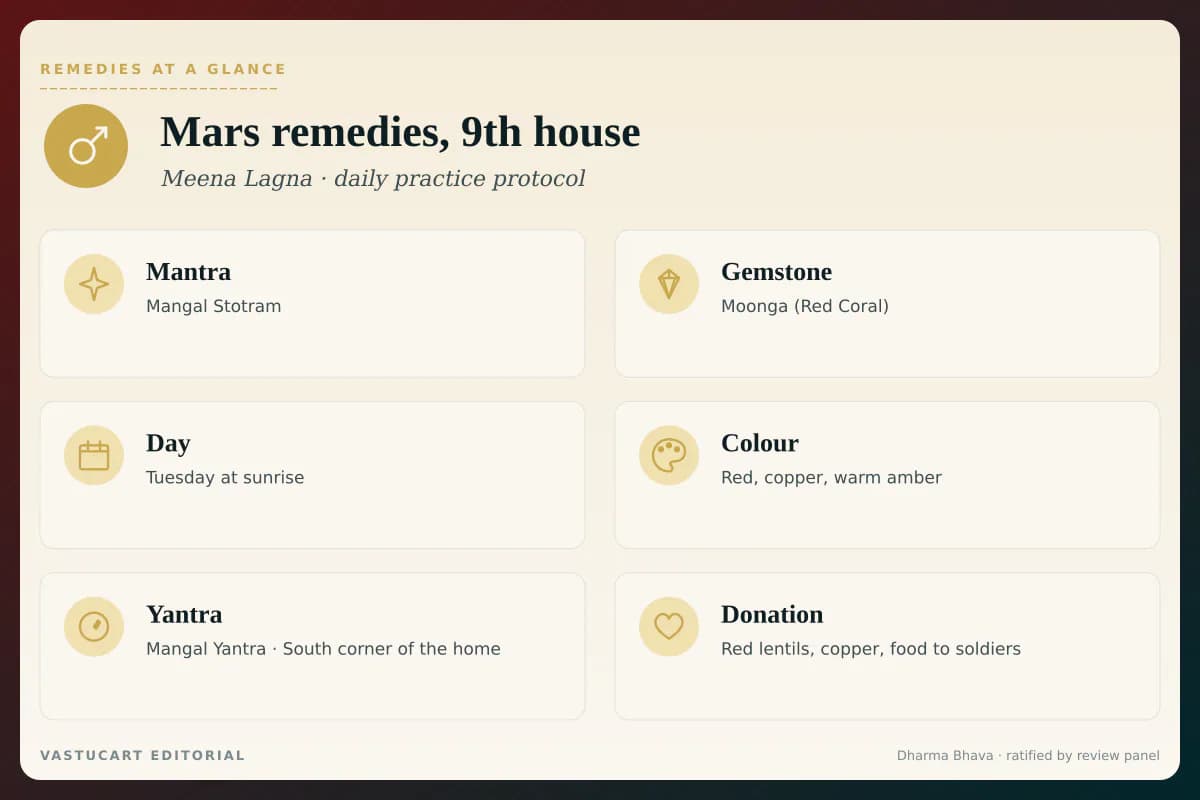
The daily Hanuman or Bhairava worship is the primary remedy for this placement because Hanuman is the classical patron deity of Mars and Bhairava is the depth-discipline form for natives drawn to the warrior-with-dharma dimension. Either form holds the swakshetra-dharma signature in its most refined expression. Rise before sunrise, bathe, wear red or deep saffron clothing on Tuesdays, and visit a Hanuman or Bhairava temple if accessible.
The Mangal Stotram is the primary recitation, the Navagraha verse to Mars that creates a containing field for the swakshetra dharma signature in its 9H expression. Reciting it at sunrise daily for forty days at any major Mars transition (a chaplain-corps appointment, a surgical-mission directorship, an intelligence-station chiefdom, a pilgrimage-leadership mandate) is the formal protocol classical sources prescribe.
Offer red flowers (especially hibiscus and red lotus), jaggery sweets, and red sandal paste at the altar, and donate to causes that support warrior-priest service and dharmic command. Veteran chaplain welfare, surgical-mission funding for under-resourced regions, theological-seminary scholarships, pilgrimage-safety programmes, and trauma-medicine training in conflict zones all carry the placement's natural moral signature. The conscious-discernment practice is the lifestyle remedy that compounds across decades into the difference between dharmic mastery and zealous over-extension. A daily reflection on which engagements are nourishing the warrior-priest mission and which are consuming bandwidth on private crusades keeps the placement directed.
The gemstone is red coral (Moonga), and this is one of the rewarding gemstone placements available to a Meena native because the swakshetra Mars in own dharma responds to amplification with measured ethical poise rather than the over-amplification risk that some other Mars placements carry. Wear a natural red coral of minimum five carats set in copper on the ring finger of the right hand on a Tuesday at sunrise after Mangal mantra recitation, and only after a confirmed reading by a qualified Jyotishi.
Gemstones for Mars in 9th house Meena Lagna
Red coral is the primary Mars gemstone and is worn confidently for this placement because swakshetra Mars in own dharma trikona responds to amplification with ethical poise rather than the over-fire risk other Mars placements carry.


Disclaimer: Red coral over a swakshetra Mars in dharma trikona amplifies the soldier-priest channel cleanly. Always consult a qualified Jyotishi before permanent wearing.
Rudraksha beads for Mars in 9th house
The Mars-aligned rudraksha is the Teen Mukhi (Three Mukhi), the bead directly ruled by Agni and Mars.
The classical Mars rudraksha and the bead specifically associated with disciplined warrior drive. Supports the swakshetra dharma signature, channels the depth-Mars instinct toward sustainable mission territory, and stabilises operational bandwidth when the chaplain, surgical, intelligence, or seminary vocation is in active phase.
The fourteen-mukhi bead supports protective wisdom and intuitive command judgement. Wearing the Chaudah Mukhi alongside the Teen Mukhi compounds the placement's natural strength in pastoral leadership, surgical decision-making, intelligence ethics, and theological-academy stewardship.
Mangal Yantra for the swakshetra dharma placement
Sacred recitations for swakshetra Mars in the dharma angle
Kumaram shakti-hastam cha mangalam pranamamy aham
Translation: I bow to Mangala, son of the Earth, radiant as a flash of lightning, the warrior youth holding the spear of victory. The Mangal Stotram is the canonical Navagraha verse to Mars and is the right daily recitation for a chart where Mars sits swakshetra in his own Vrishchika in the dharma angle and the soldier-priest signature needs a containing devotional field. Many natives advanced in practice add the Hanuman Chalisa or Bhairava Stotram recitation as a secondary layer once the daily Mangal discipline is steady.
Read the full stotra on stotra.vastucart.in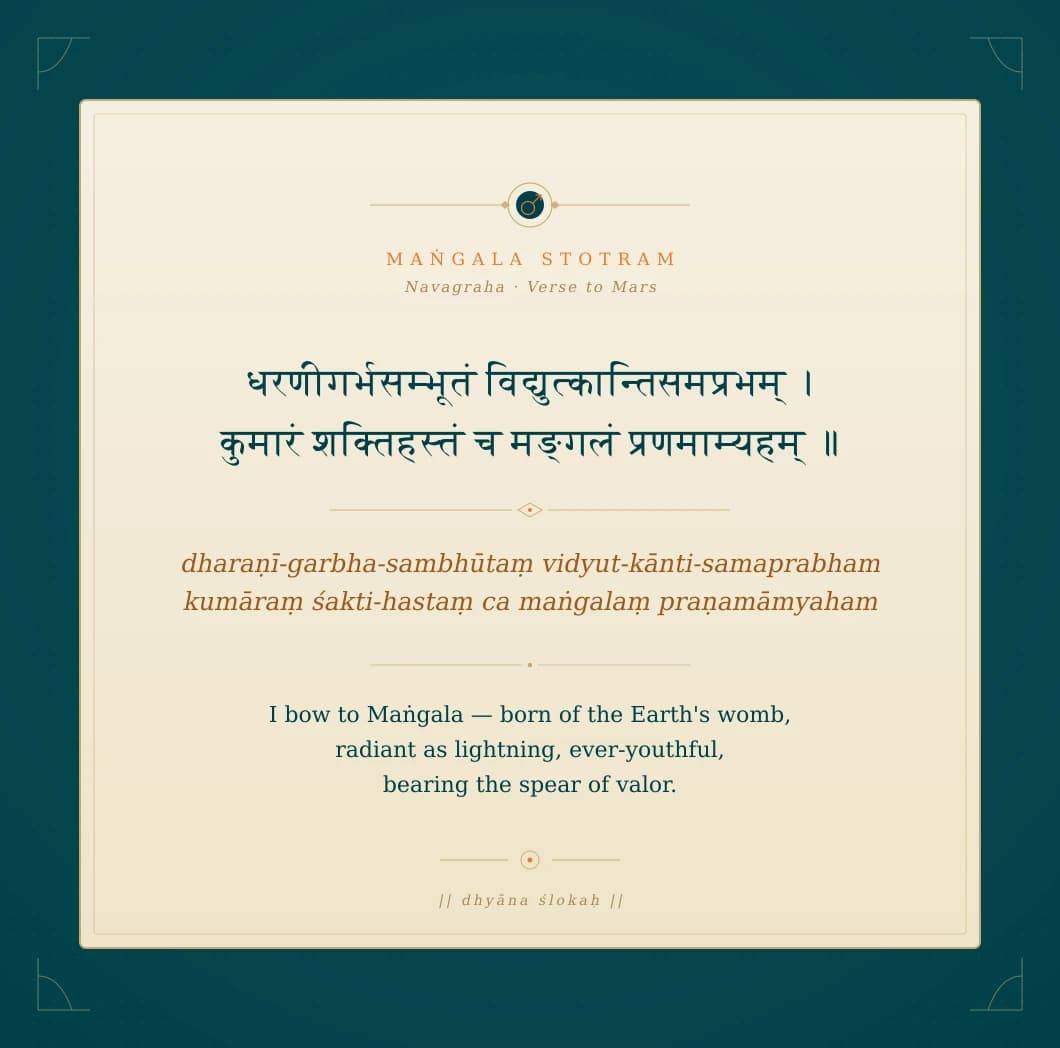
Tools for Mars 9th house Meena natives
Is your Dharma Bhava Mars carrying the swakshetra bhagya signature?
Get a full personalised analysis of your ninth house Mars, the swakshetra Vrishchika status, and the soldier-priest dasha timing.