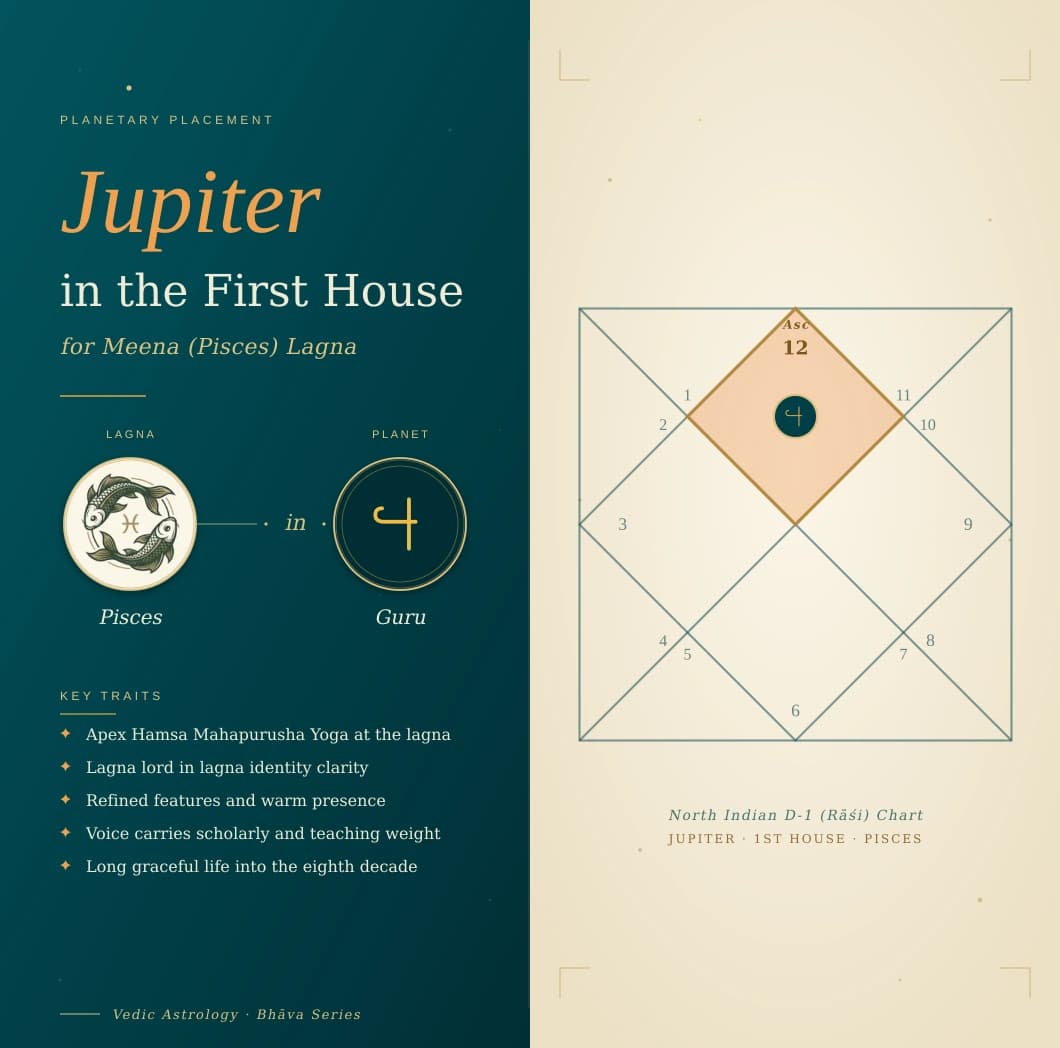
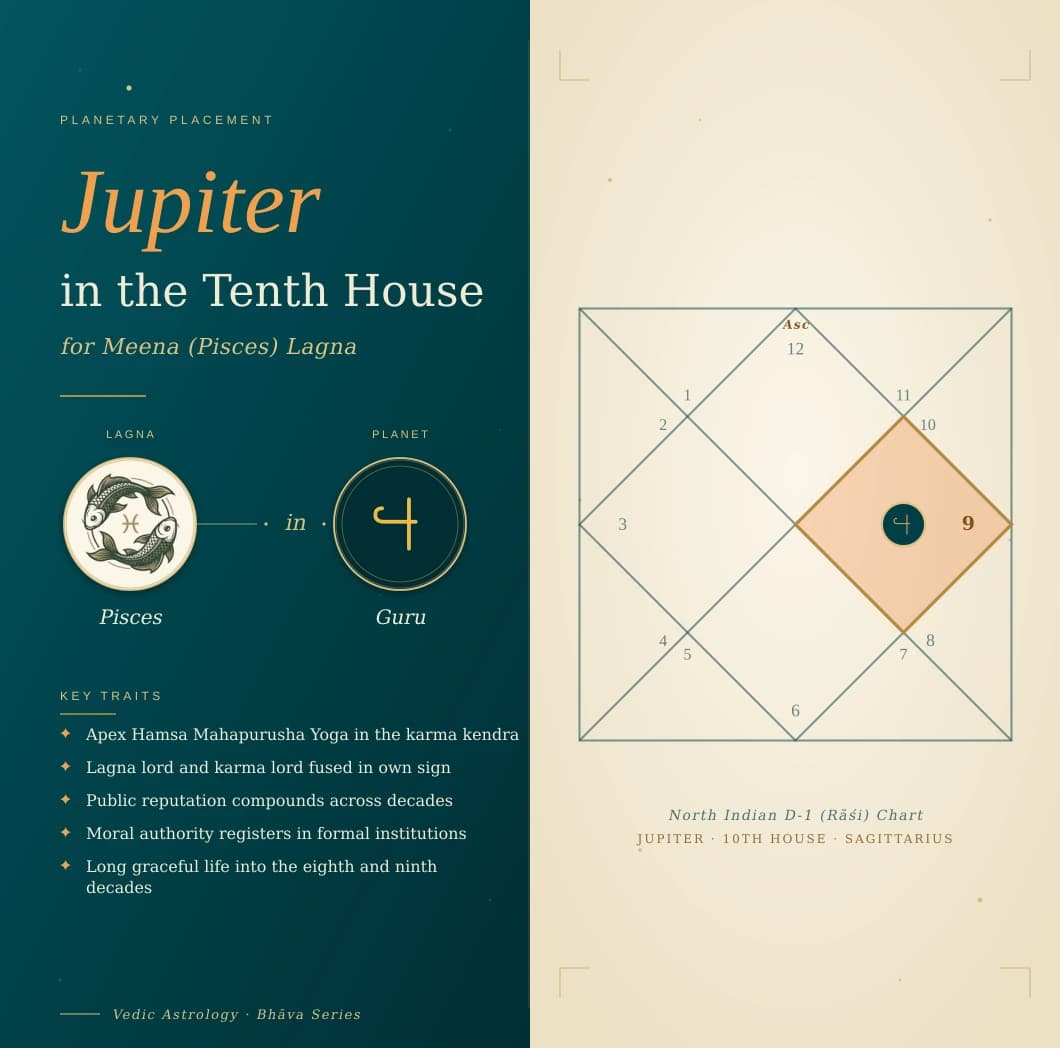
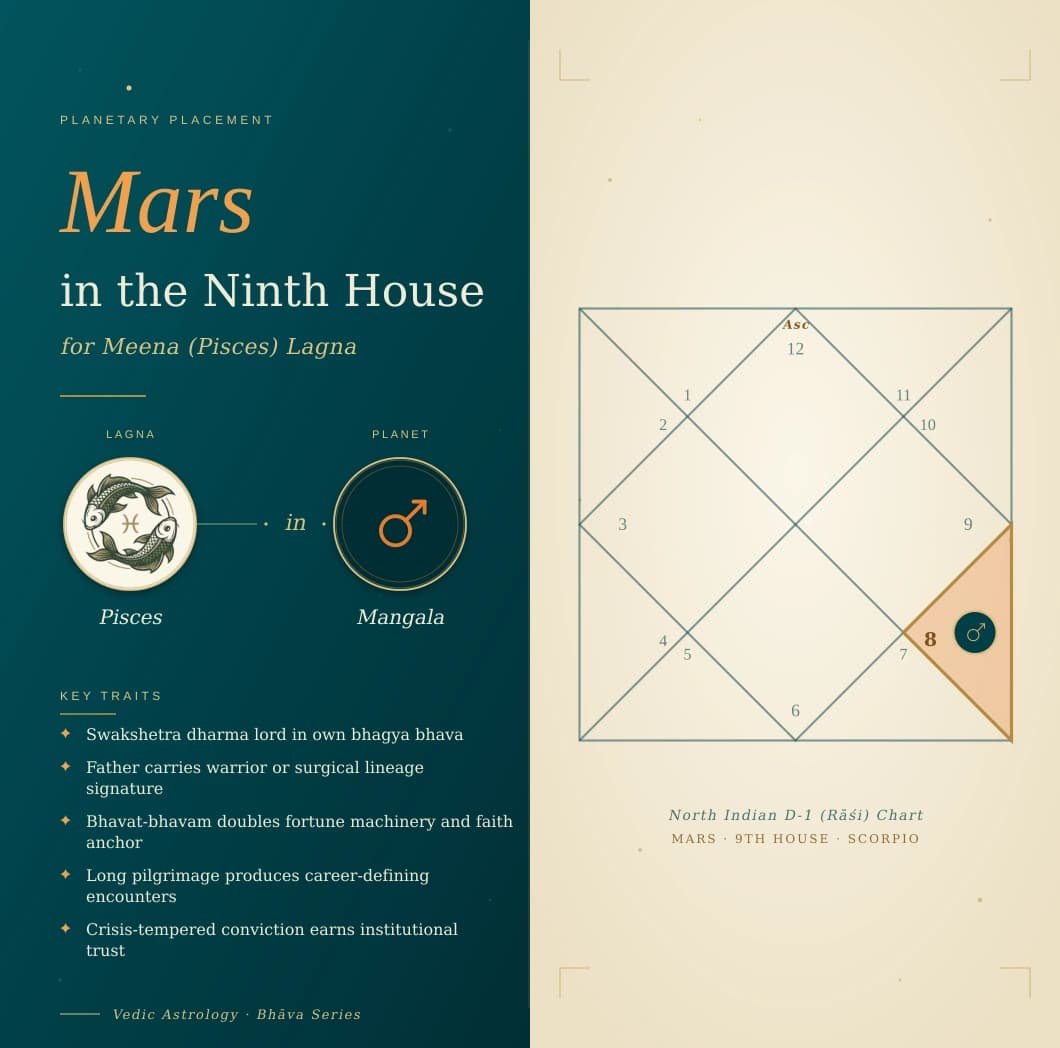
Jupiter in the 9th house
Meena Lagna (Pisces Ascendant)
A practitioner study of Guru in Dharma Bhava for Pisces ascendant natives. Jupiter in friendly Vrishchika as the dual lagna and karma lord, the dharma karaka landing inside his own dharma trikona, with the Tantrik Vrishchika overlay that distinguishes this configuration from every orthodox Jupiter placement.
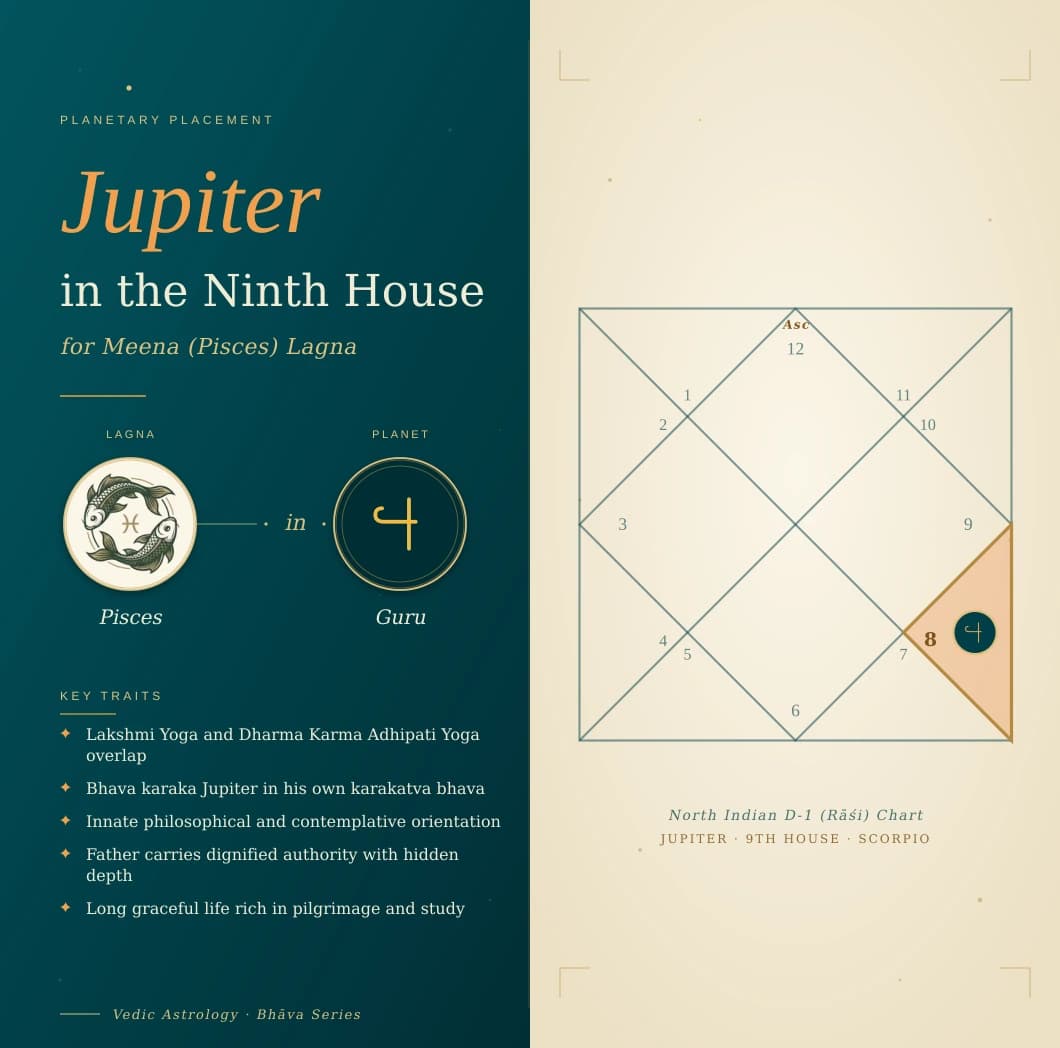
Jupiter sits in the friendly Vrishchika in the ninth dharma trikona of Pisces ascendant natives, the bhava-karaka in own bhava signature with Tantrik depth.
Jupiter in 9th house for Meena Lagna, the quick reference
If you carry Jupiter in the ninth house of a Meena chart, you hold a configuration where the dual lagna-and-karma lord lands in the dharma trikona, and the natural karaka of dharma settles into the very bhava he signifies. Guru (Jupiter) rules Meena (1st cusp) and Dhanu (10th cusp) for Pisces ascendants. The ninth from Meena is Vrishchika (Scorpio), the mystical own-sign of Mars.
Mars and Jupiter are mutual friends in classical natural relationships. Jupiter sits here in friendly territory rather than in dignity, and the strength comes from positional meaning rather than from sign rulership.
The first feature to register is the bhava-karaka-in-own-bhava signature. Jupiter is the natural karaka of dharma, gurus, fortune, father, higher learning, long pilgrimage, and pre-birth merit, and the ninth house signifies precisely those territories. When the karaka and the bhava align, the area of life floods with the planet's full natural meaning.
The second feature is the dual lordship. Jupiter is simultaneously the lord of the 1st (called the 1L, the lagna lord ruling body and self) and the lord of the 10th (called the 10L, the karma lord ruling profession and public dharma) for Meena natives. When this composite lord lands in another trikona, the chart fires a textbook Lakshmi Yoga (the wealth-and-grace yoga formed when the lagna lord and the dharma trikona join with strength) layered with Dharma Karma Adhipati Yoga (the dharma lord and the karma lord linking through bhava significance).
The third feature is the Vrishchika overlay. Vrishchika is the mystic, transformative, Tantrik own-sign of Mars, and Jupiter pulled into it teaches dharma through esoteric channels rather than through orthodox temple register. This guide reads every layer of Jupiter in 9th house for Meena Lagna natives: the friendly Vrishchika dignity, the composite lordship, the bhava-karaka resonance, and the Tantrik teacher-and-father pattern.
Why Jupiter in Vrishchika in Dharma Bhava forms Lakshmi Yoga for Meena
Students often arrive at this placement uncertain how to weigh it against the apex Jupiter configurations the same Meena chart produces in the first, fifth, or tenth house. Jupiter in 9th of Meena is not an apex dignity placement. The dignity is friendly Vrishchika, not own sign and not exalted, so positional power has to do the work sign power does in the Hamsa formations.
The Lakshmi Yoga reading is the first feature to handle. Classical Parashari treats the configuration where the lagna lord (1L) and the ninth lord (9L) link through conjunction, aspect, or trikona placement as the seed of Lakshmi Yoga, the wealth-with-grace signature. For Meena Lagna the 9L is Mars who rules Vrishchika, and the lagna lord Jupiter sitting in Mars's own sign produces the trikona-to-trikona linkage commentators read as the operational form of the yoga. Natives report a steady, almost gravitational pull toward dharmic earnings and the slow durable abundance the Lakshmi signature is known for.
The second feature is the bhava-karaka-in-own-bhava resonance. Jupiter is the universal karaka of the ninth house themes (father, gurus, teaching, pilgrimage, higher education, pre-birth merit) and placing the karaka in his own karakatva bhava amplifies all those significations to their fullest. The native is born already pulled toward classical study, religious-philosophical inquiry, and the quiet conviction that life is fundamentally meaningful.
The third layer is the contrast with the apex Jupiter placements. Guru in 1H Meena is lagna lord at lagna in own sign, identity-led Hamsa apex. Guru in 10H Dhanu is karma-led Hamsa apex. Guru in 5H Karka is exalted-trikona Lakshmi apex. Guru in 9H Vrishchika is dharma-trikona apex by significance rather than by sign, with Tantrik overlay.
Jupiter in the dharma trikona of a Meena chart is not an apex dignity placement. It is a karaka-in-own-bhava signature where the planet who rules dharma takes up residence inside the bhava that signifies dharma, and the native is born already inside the lineage rather than searching for it.
Terms used in this article
A short glossary of the Sanskrit and Jyotish terms that recur in this study. First-occurrence expansion is also retained inline.
- Dharma Bhava
- The 9th house, the bhava of father, gurus, dharma, long pilgrimage, higher learning, and pre-birth merit. A trikona.
- Bhava karaka
- The natural significator of a house. Jupiter is the bhava karaka of the 9th, so Jupiter-in-9th is karaka-in-own-bhava.
- Lakshmi Yoga
- Wealth-and-grace yoga formed when the lagna lord and the ninth lord link with strength. Operates here through trikona-to-trikona placement.
- Dharma Karma Adhipati Yoga
- Connection of the dharma lord and the karma lord, classical wealth-and-fame compound.
- Trikona
- Auspicious dharmic angle. Houses 1, 5, 9. Always benefic in Jaimini and Parashari frameworks.
- 1L
- First-house lord, the planet ruling the sign on the 1st cusp. Carries body, self-image, life direction.
- 10L
- Tenth-house lord, ruling career, public reputation, and dharmic action in the world.
- Tantrik
- Esoteric initiatory tradition that approaches the divine through transformation rather than orthodox devotional register. Vrishchika is its natural sign.
How Jupiter in Vrishchika dharma trikona shapes the Meena native
Physically the native carries the soft Meena water frame coloured by an unusual stillness in the eyes that reads, at first meeting, as someone who has thought about more than they say. The complexion is warm but darker than the orthodox Jupiter-in-Meena native. The gaze is direct and slightly piercing in the Vrishchika way.
Hair is generally thick and the build leans medium rather than the round-stout register Jupiter at the lagna would produce. The voice is resonant and quiet, frequently in a lower register than the body suggests, and translates well to teaching that earns attention by content rather than by volume.
Temperament is where the placement most distinguishes the native from siblings of the same lagna. These natives carry the standard Meena receptivity (intuitive sensing, emotional generosity, the willingness to absorb other people's experience) but route it through a depth-investigative channel rather than through the orthodox empathic one.
From young they are pulled toward subjects most children avoid: the death of grandparents, the meaning of dreams, the architecture of belief itself. The Meena empathy combines with the Tantrik Vrishchika edge to produce natives whose advice carries unusual weight in difficult moments, the combination that translates into hospice work, depth psychology supervision, and contemplative-tradition stewardship over the working decades.
The shadow side is the same intensity dimension. Natives who do not honour the Vrishchika undertow can experience cycles of secrecy, isolating spiritual perfectionism, and the quiet stubbornness that mistakes its own moral judgement for objective truth. Pairing the dharmic depth with regular peer supervision and frank confession to a senior teacher produces the integration of expansive warmth and transformative depth this placement supports.
Strengths, shadows and career fits
- Lakshmi Yoga and Dharma Karma Adhipati Yoga overlap
- Bhava karaka Jupiter in his own karakatva bhava
- Innate philosophical and contemplative orientation
- Father carries dignified authority with hidden depth
- Long graceful life rich in pilgrimage and study
- Voice carries quiet weight in difficult conversations
- Tantrik intensity if not held within a lineage container
- Tendency toward secrecy and private moral judgement
- Father relationship can carry unresolved silent material
- Liver and pancreas sensitivity if dietary discipline drifts
- Hip and thigh strain from prolonged sedentary study
- Romantic life can carry initiator-disciple undertones
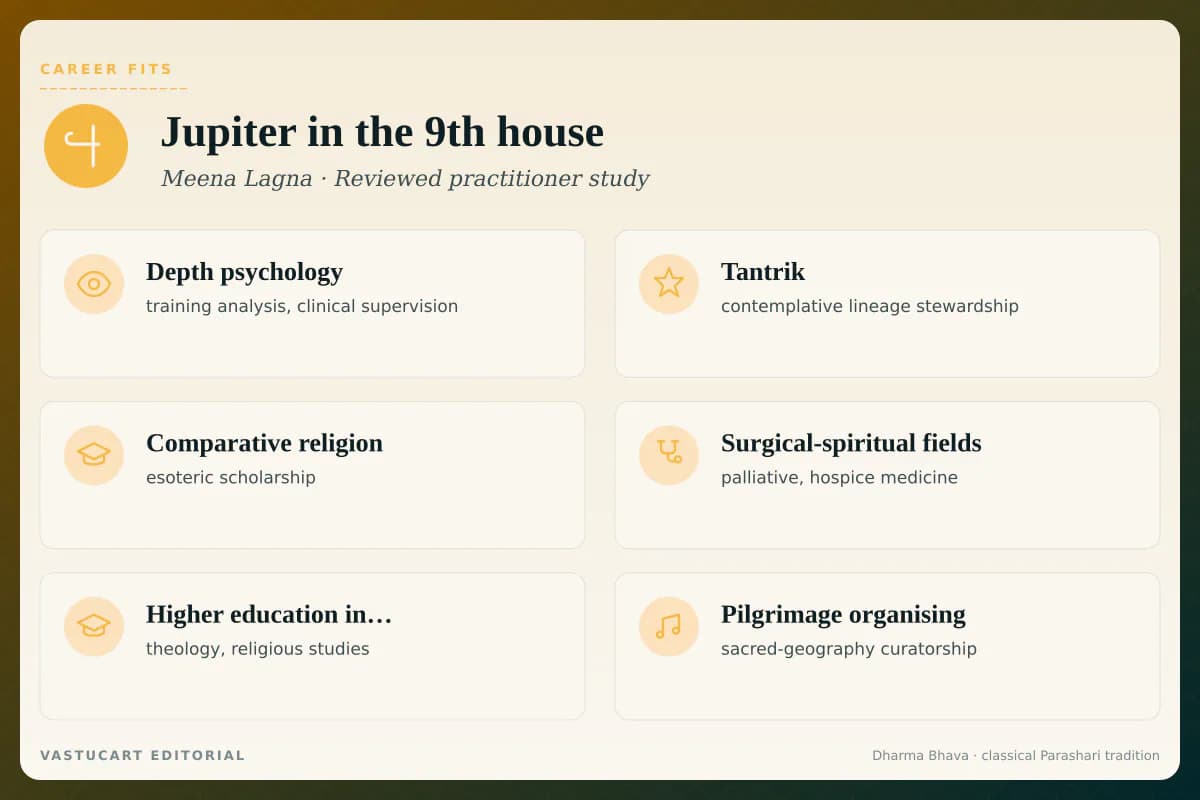
- Depth psychology, training analysis, clinical supervision
- Tantrik and contemplative lineage stewardship
- Comparative religion and esoteric scholarship
- Surgical-spiritual fields, palliative and hospice medicine
- Higher education in philosophy, theology, religious studies
- Pilgrimage organising, sacred-geography curatorship
Where the Tantrik dharma vocation plays out
Career paths cluster around fields that braid scholarly wisdom with depth-investigative work, the precise braid the Vrishchika overlay supplies. Depth psychology and training analysis come first. Jupiter in the dharma trikona on a Mars sign produces natives whose stance with difficult psychological material is held by both ethical structure and transformative competence. Many become Jungian or psychoanalytic training analysts, clinical supervisors at training institutes, or senior consultants whose case-judgement compounds across decades.
Tantrik and contemplative lineage stewardship is the second structural fit. The placement frequently produces lineage-holders rather than congregational teachers, those who carry initiation rights inside a transmission line and treat the lineage as a living inheritance. Comparative religion and esoteric scholarship work because Jupiter is the karaka of higher learning and the Vrishchika overlay rewards research into hidden or initiatory dimensions of religious traditions. Many become professors of comparative mysticism, kundalini-tradition scholars, or Sanskrit-tantra textual editors.
Surgical-spiritual fields fit because Vrishchika rules transformation through cutting and repair. Jupiter overlays the surgical with the dharmic frame: anaesthesiology with contemplative grounding, palliative care leadership, hospice medicine, and the chaplaincy programmes that braid medicine with religious counsel. Higher education in philosophy and theology suits the long textual arc, with the Vrishchika overlay drawing research interest toward heterodox or mystical strands rather than the canonical centre.
Pilgrimage organising and sacred-geography curatorship work because the placement produces a near-compulsive interest in teerthas, jyotirlingas, and shaktipeethas. Many become Himalayan-trek guides for spiritual groups, cultural-heritage trustees managing temple pilgrimage programmes, or scholars who write authoritative guides to specific sacred routes. Bhagya rises sharply after Jupiter matures at age twenty-eight and again across the Jupiter mahadasha, with the senior teaching appointment, lineage transmission, training-analyst certification, or foundation chairmanship arriving in that window.
Why this is the most distinctive Jupiter placement available to Meena
The clearest way to read Jupiter in 9th of Meena is to hold the Lakshmi Yoga structure, the bhava-karaka-in-own-bhava resonance, and the Tantrik Vrishchika overlay as three layers of a single chord rather than as separate features. Classical Parashari recognises that lagna lord plus dharma trikona produces wealth-and-grace. Karaka-in-own-bhava produces saturation of the bhava theme. Mars sign placement routes the dharma instinct through transformative rather than orthodox channels.
The trikona-to-trikona linkage is the second feature. Jupiter is the lagna lord and the karma lord for Meena, and dropping this composite lord into the dharma trikona forms the classical trikona-to-trikona Raja Yoga structure. Such alignments are read as the chart's most stable wealth-and-status compound because they pull entirely from auspicious bhavas rather than from angular-trikona crossings. The native enjoys earnings that look quiet from outside but compound substantially across decades.
The third layer is the bhagya activation timing. Jupiter matures at age twenty-eight in the standard graha maturity sequence. Natives with this configuration consistently report a sharp lift in dharmic clarity, vocation focus, and travel-led learning between twenty-eight and thirty-two. The Jupiter mahadasha of sixteen years is the chapter where the Lakshmi Yoga delivers its full expression: the senior teaching appointment, the lineage transmission, the training-analyst certification, the scholarly book publication, or the foundation founding all cluster inside this window.
When the dharma trikona Jupiter delivers its Lakshmi Yoga chapter
Jupiter mahadasha is the defining window for this placement and arrives with the senior teaching appointment, lineage transmission, training-analyst certification, surgical-leadership promotion, scholarly-book publication, or religious-cultural foundation founding that crystallises the dharma trikona Lakshmi Yoga.
Hips, liver, and the dharma vitality signature
Health follows a kapha-pitta constitution that leans pitta-dominant because Vrishchika is a fixed water sign with Mars's agni-tattva (fire-element) overlay, and Jupiter carries his own benefic warmth into that base. The ninth house body-part rulership covers hips, thighs, and the sciatic line. The Meena lagna emphasises feet, lymphatic system, and overall fluid balance.
Jupiter rules liver, pancreas, fat-tissue, and the broader metabolic-endocrine function. The placement raises specific lifelong vulnerability to hip-and-thigh strain from prolonged sitting, sciatic line tension on the right side following Vimshottari transitions, liver sensitivity if alcohol or rich food intake drifts, and the metabolic-syndrome markers that classical sources tie to Jupiter saturation of the constitution.
The Vrishchika depth-current is the second body-related layer. Jupiter on a Mars sign in the dharma trikona pulls the body into intermittent deep practice cycles (long fasting, contemplative retreats, kundalini-style energetic work, austerity programmes) that the body handles only when supervised. The pattern that recurs across clinical practice is steady weight maintenance through the thirties and forties due to disciplined practice, occasional metabolic dips when retreat schedules collide with professional load, and adrenal-sensitivity markers in the fifties when recovery time has been skipped.
Daily walking before sunrise, restraint with rich meals after sunset, regular fasting practice (one weekly fast on Thursday, the Jupiter day, is a classical recommendation), supervised retreat scheduling, and annual full-panel screening from the early thirties are the protective routines. Hip-strengthening yoga and gentle weight training protect against long-sitting attrition. Foot care also deserves attention because Meena rules the feet, and well-fitted shoes plus regular foot massage with warming oil protect the lower body across decades.
Remedies for Jupiter in the Meena dharma angle
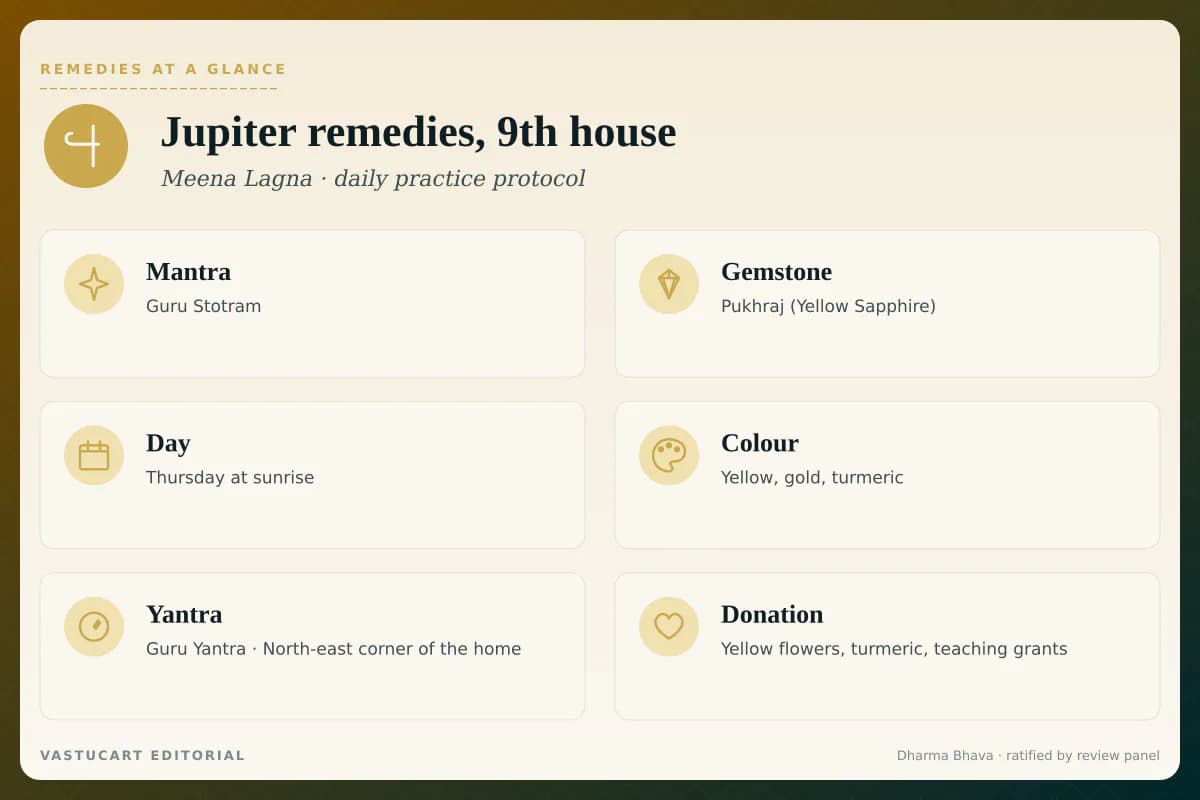
The daily Vishnu worship is the primary devotional remedy because Vishnu is the classical patron deity of Jupiter. The Vrishchika overlay specifically rewards Dakshinamurti (the Shiva-as-Guru form facing south, patron of silent transmission) and Dattatreya (the lineage-of-three Guru holding the Brahma-Vishnu-Shiva confluence) practices that orthodox Jupiter-in-Sagittarius natives often skip. Rise before sunrise, bathe, wear yellow or saffron clothing on Thursdays, and visit a Vishnu, Shiva, or Dattatreya shrine if accessible.
Maintain a fortnightly visit to any local jyotirlinga or shaktipeetha within travelling distance, and plan one major teertha pilgrimage every two to three years. The Guru Stotram is the primary daily recitation, the canonical Navagraha verse to Jupiter, recited at sunrise. For the Vrishchika overlay add the Dakshinamurthy Stotram once a week for the silent-transmission dimension, and the Guru Paduka Stotram for direct lineage-blessing during any major Jupiter transition.
Offer yellow flowers (especially marigold and yellow chrysanthemum), turmeric-rice, ghee, and yellow sweets at the altar. Donate to causes that support contemplative scholarship and dharmic education: scholarship funding for Sanskrit and theology students, monastic-tradition stipends, palliative-care endowments, and pilgrimage-route preservation are the structural gift channels for this placement.
The conscious-supervision practice is the lifestyle remedy that compounds across decades into the difference between dharmic depth and dharmic isolation. Regular peer supervision, a confessional relationship with a senior teacher, and the discipline of speaking the hardest material aloud rather than holding it privately keep the placement directed. The gemstone is yellow sapphire (Pukhraj), the primary Jupiter ratna, worn on the index finger of the right hand on a Thursday at sunrise after Guru mantra recitation, and only after a confirmed reading by a qualified Jyotishi.
Gemstones for Jupiter in 9th house Meena Lagna
Yellow sapphire is the primary Jupiter gemstone and is worn confidently for this placement because the dharma-trikona bhava-karaka-in-own-bhava configuration is structurally clean.



Disclaimer: Yellow sapphire over a dharma-trikona Jupiter amplifies the lineage-and-teaching channel cleanly. Always consult a qualified Jyotishi before permanent wearing, and never combine Pukhraj with Red Coral without explicit chart-level review of Jupiter-Mars interplay.
Rudraksha beads for Jupiter in 9th house
The Jupiter-aligned rudraksha is the Panch Mukhi (Five Mukhi), the bead directly ruled by Shiva-Kalagni-Rudra and Jupiter, and the Vrishchika overlay specifically calls for a Mars-aligned bead pairing.
The classical Jupiter rudraksha and the bead specifically associated with dharmic stewardship and wisdom-led leadership. Supports the dharma-trikona signature, channels the contemplative-investigative instinct toward sustainable territory, and stabilises bandwidth when the teaching, supervisory, surgical-spiritual, or lineage-transmission vocation is in active phase.
The three-mukhi bead is a Mars-aligned rudraksha and supports the ninth-house sign-lord. Wearing the Teen Mukhi alongside the Panch Mukhi balances the friendly Mars sign that holds Jupiter, smooths the agni-tattva charge in the constitution, and stabilises the surgical-spiritual or initiatory dimension of the dharma vocation.
Guru Yantra for the dharma-trikona placement
Sacred recitations for Jupiter in the Meena dharma trikona
Buddhi-bhutam tri-lokesham tam namami brihaspatim
Translation: I bow to Brihaspati, preceptor of gods and sages, radiant as gold, the embodiment of wisdom and the lord of the three worlds. The Guru Stotram is the canonical Navagraha verse to Jupiter and is the perfect daily recitation for a chart where Jupiter sits in the dharma trikona on a friendly Mars sign. Many natives advanced in practice add the Dakshinamurthy Stotram for the silent-transmission dimension and the Guru Paduka Stotram for direct lineage-blessing once the daily Guru discipline is steady.
Read the full stotra on stotra.vastucart.in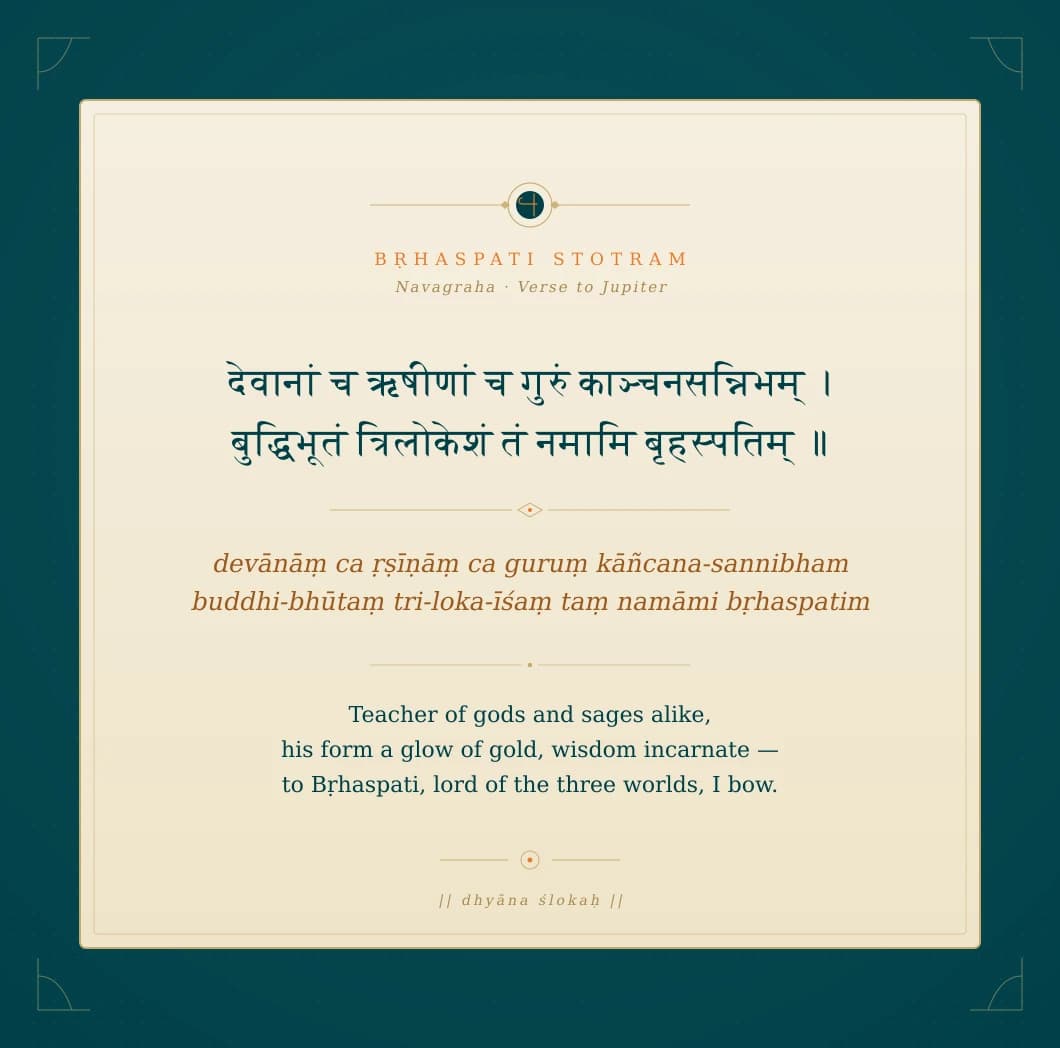
Tools for Jupiter 9th house Meena natives
Is your Dharma Bhava Jupiter carrying the Lakshmi Yoga signature?
Get a full personalised analysis of your ninth house Jupiter, the friendly Vrishchika dignity, and the dharma-trikona bhagya timing.