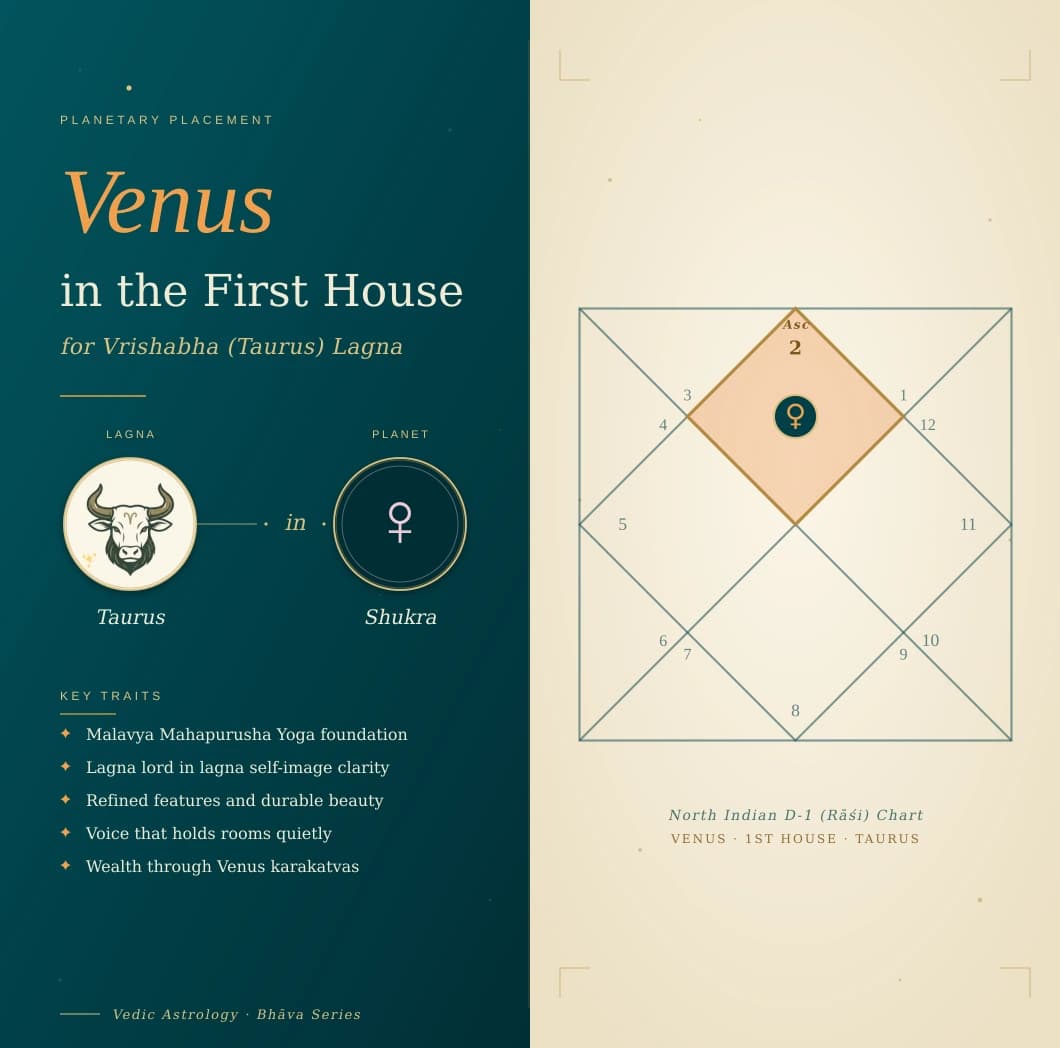
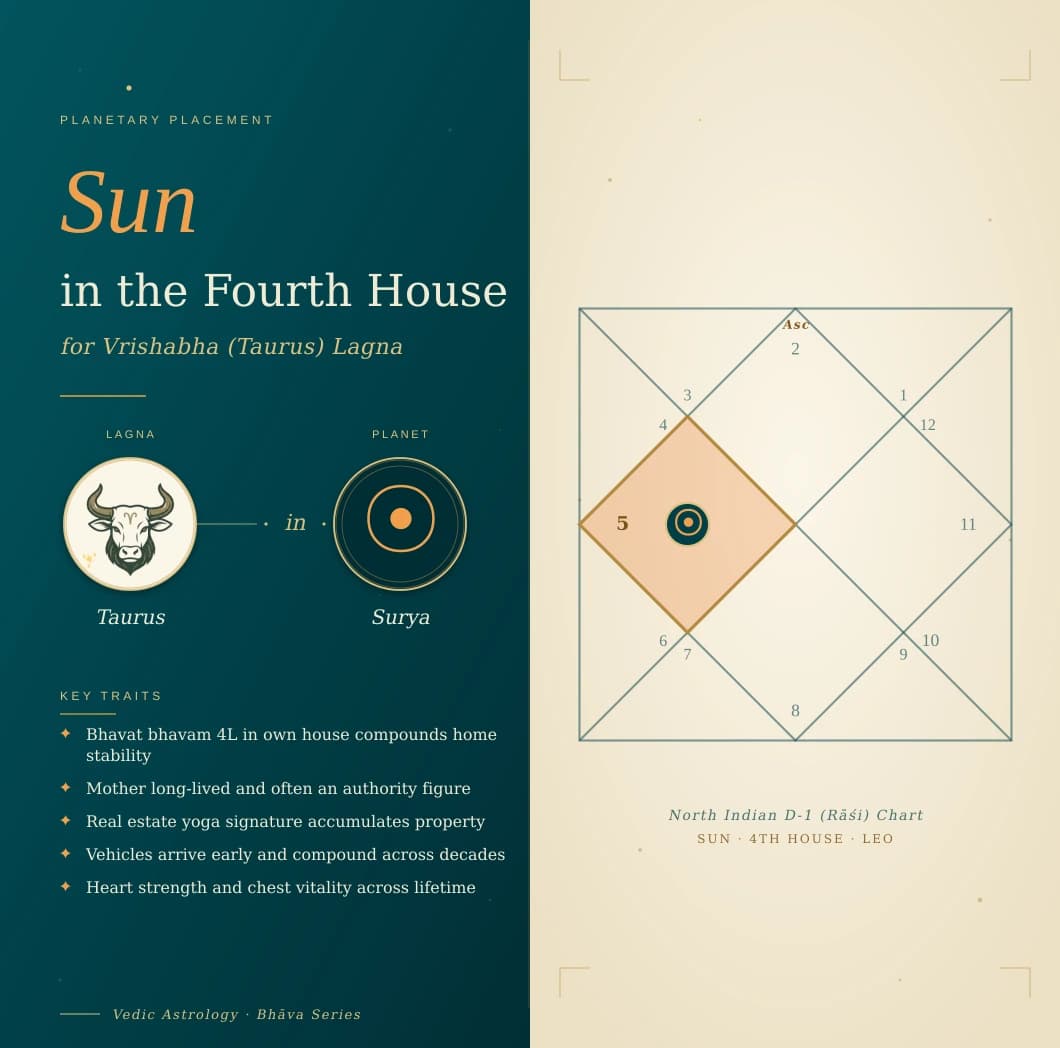
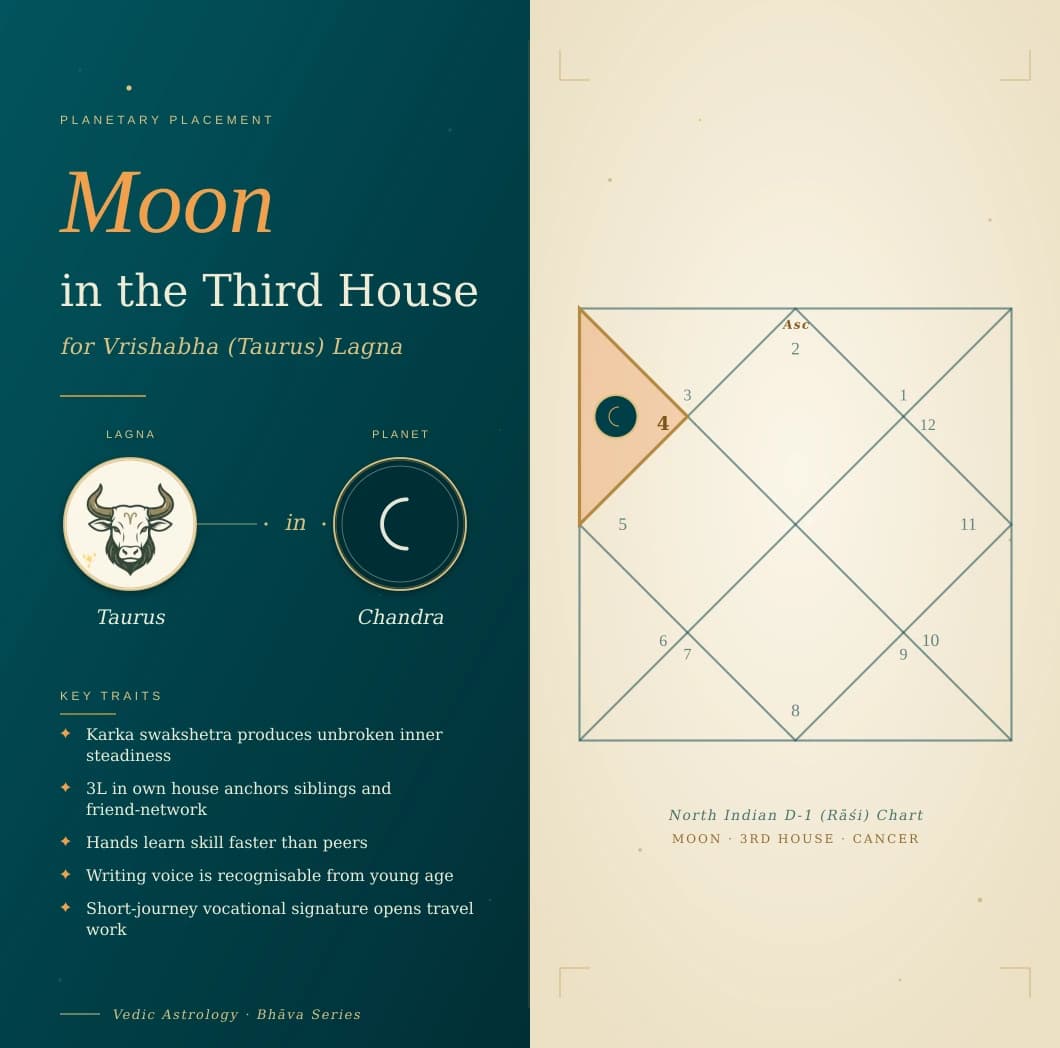
Surya in the 1st house
Vrishabha Lagna (Taurus Ascendant)
A practitioner study of Surya in Tanu Bhava for Taurus ascendant natives. Sun in shatru rashi Vrishabha serving as 4th lord lodged in lagna, the inner sovereign streak hidden under a Venusian outer frame, and the honest dignity reading classical Parashari texts insist on rather than the soft generic praise the placement often receives.
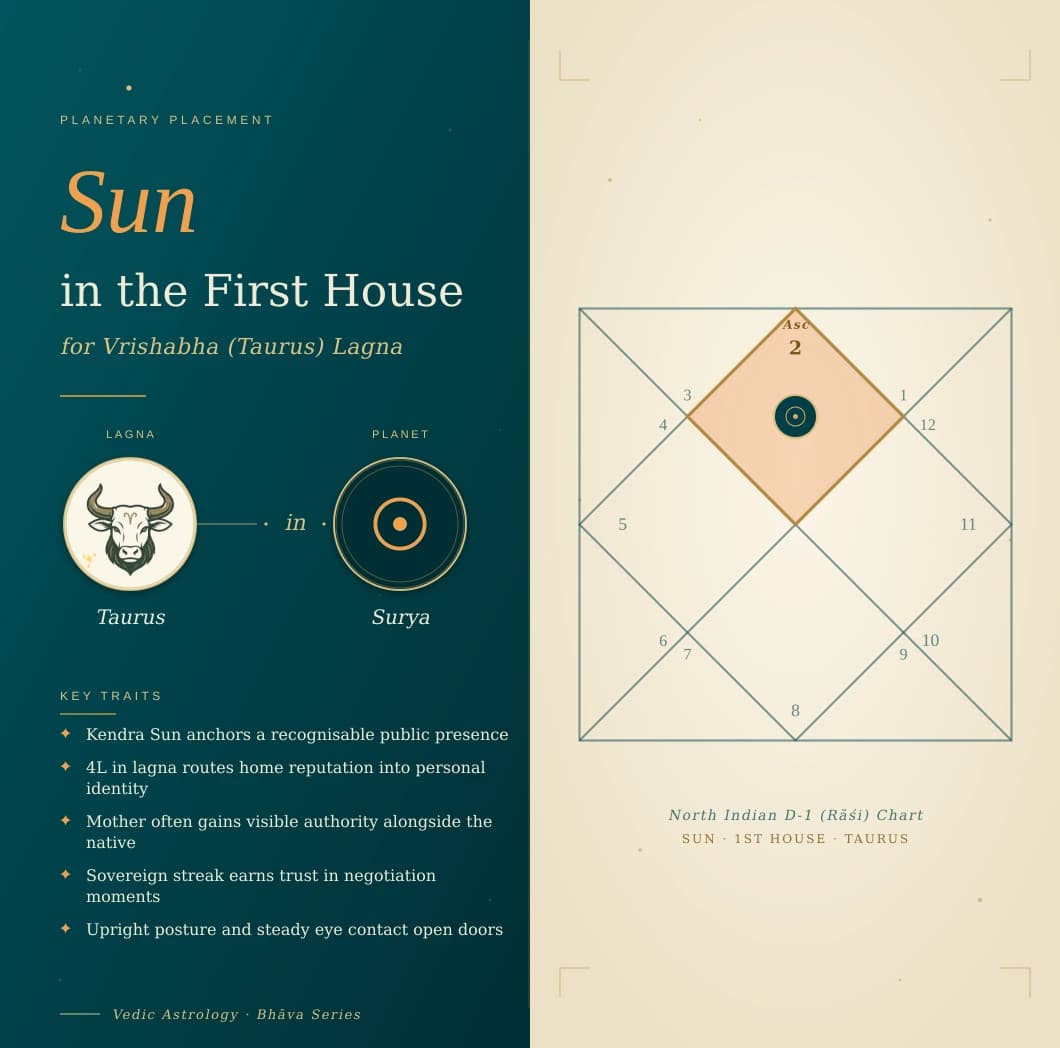
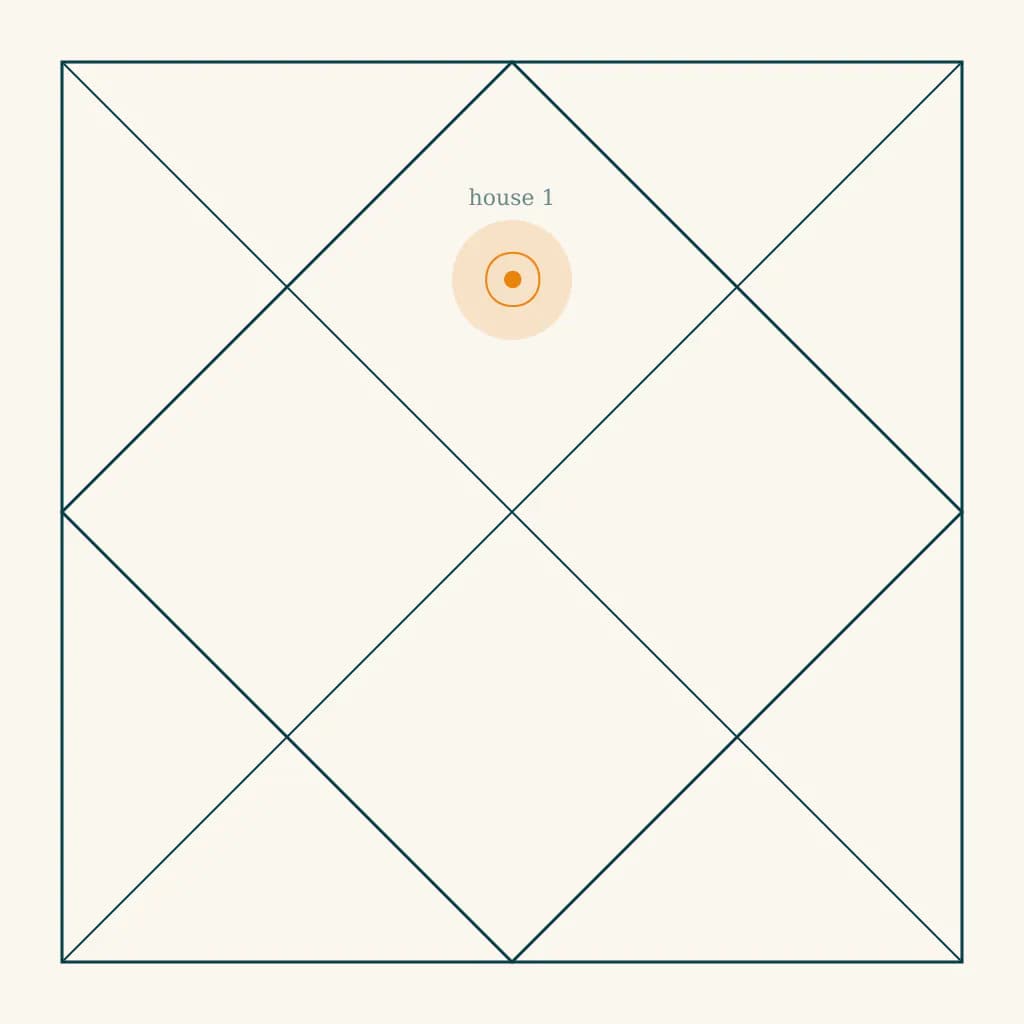
Surya sits in the first house in shatru rashi Vrishabha for Taurus ascendant natives, the 4L lodged in Tanu Bhava signature.
Surya in 1st house for Vrishabha Lagna, the quick reference
If you carry Surya in the 1st house of a Vrishabha (Taurus) chart, you hold one of the most interpretively delicate placements in the Taurus ascendant catalogue. Surya (Sun) sits in shatru rashi (enemy sign) here because Vrishabha is ruled by Shukra (Venus), and Sun and Venus are mutual enemies in the classical Parashari naisargika relationship table. The dignity is therefore neither swakshetra nor exalted, and honest reading refuses to soften that.
The placement still carries real strength because Surya serves as the 4L (Sukha lord) for Vrishabha, and a 4L in the lagna routes home, mother, vehicles, and primary education into the body and public face of the native. The composite is a kendra Sun in enemy dignity, which produces the recurring biographical pattern of a mild outer frame with a sovereign streak that surprises strangers when triggered. Father themes carry weight because Surya is the karaka of father, and the placement frequently records a complicated paternal bond where the father himself worked in a Venus-shaped career (artist, hospitality, finance, design).
This guide reads Surya in 1st house layer by layer for the Taurus chart. The shatru rashi dignity, the 4L-in-lagna mechanism, the Sun-Venus tension that sits inside the personality structure, the body-and-health profile, the leadership-in-luxury vocational template, the Surya mahadasha activation pattern, and the careful ruby Manik protocol that needs full chart confirmation before any wearing decision.
Why Sun in shatru rashi Vrishabha asks for honest reading rather than soft praise
Students often arrive at this placement carrying generic readings that flatten Sun-in-1st into a single positive statement about confidence and leadership. The honest practitioner answer for Vrishabha lagna specifically is that the picture is more layered.
Surya in Vrishabha is in shatru rashi because the dispositor Shukra is the Sun's enemy in classical Parashari relationships. The Sun does not lose his light in an enemy sign, but the surrounding sign-flavour reshapes how the solar identity expresses outwardly.
The first specific feature is the Sun-Venus tension. The Sun karakas ego, sovereignty, and fire while Vrishabha is the textbook signature of comfort, beauty, and earthbound aesthetic pleasure. The native's body therefore lodges two dispositions at once: the regal solar centre that wants recognition and authority, and the Venusian outer wrapping that prefers slow accumulation, sensual ease, and visible refinement.
Most natives spend their twenties resolving the apparent contradiction. The chart that wants to lead also wants to lounge, and the integration usually happens by the early thirties when the native finds a vocational form where dignity and aesthetic comfort coexist.
The second feature is the 4L-in-lagna routing. Sun rules the 4th house from Vrishabha, which holds home, mother, vehicles, primary education, and emotional foundation. With the 4L sitting in the lagna, those Sukha significations move out of the private interior and become part of the native's public face.
The home itself is part of the public identity, the mother's name often appears alongside the native's in social or professional contexts, and the family-business or hereditary-role signature recurs across consultation reports. The third feature is the kendra strength itself. The 1st house is a kendra, and a planet in a kendra always carries structural weight even when the dignity is mixed. The Sun does not become weak here; he becomes specific.
Sun in Vrishabha at the lagna is not a quiet Sun, it is a layered Sun. The native carries a Venusian outer frame above a sovereign solar centre, and integration of the two is the lifelong project the chart actually rewards.
Terms used in this article
A short glossary of the Sanskrit and Jyotish terms that recur in this study. First-occurrence expansion is also retained inline.
- Tanu Bhava
- The 1st house, the bhava of the body, identity, vitality, and the public face the chart presents to the world.
- Shatru Rashi
- Enemy-sign placement. A planet sitting in a sign owned by its naisargika enemy. The dignity is reduced but the planet still functions.
- 4L in Lagna
- The fourth-house lord placed in the first house. Routes home, mother, vehicles, and emotional foundation into the body and public face.
- Naisargika
- Natural or innate, used for the standard friendship and enmity table among grahas that holds across all charts.
- Kendra
- Angular houses 1, 4, 7, 10. Structural pillars of the chart that hold weight even when the planet sitting in them is mid-strength.
- Karaka
- Significator of a domain. Surya is the natural karaka of soul, father, vitality, and recognition for every chart.
- Manik
- Ruby, the primary corundum gemstone associated with Surya in classical Vedic ratna therapy.
How Surya in Tanu Bhava shapes the Vrishabha native
Physically the body shows the Vrishabha frame in the standard way, with the broad shoulders, the thick neck, and the strong jaw the lagna sign produces, but Surya at the lagna adds an unusually upright posture and an eye quality that strangers register before any other feature. The face often combines the soft Taurus mouth with sharper, more focused eyes than the lagna alone would produce. Voice tends to be resonant from the chest rather than the throat, and the head carries a noticeable forward presence that makes the native easy to spot in a crowded room.
Body-part rulership stacks two solar zones onto Vrishabha's natural ones. Surya rules the heart, eyes, and bones, while Vrishabha rules the face, throat, and neck. The placement therefore strengthens the upper torso visibly through young adulthood and produces a constitution that handles physical work better than the average Vrishabha frame, although the same intensity introduces a midlife heart and eye fragility that needs explicit care.
Temperament is where the placement most distinguishes the native from peers. The outward presentation reads as the steady Taurus calm with a gentler-than-expected manner, but a sovereign streak sits underneath that surprises observers when it surfaces. Most natives appear easy-going to colleagues and acquaintances for years before a triggering moment, an injustice, an attempted slight, a request that crosses a private dignity line, brings out the unmistakable royal voice the Sun lodged at the body always carried.
The shadow side rides the same engine. The integration of solar centre and Venusian wrapping is genuinely difficult work, and natives who never name the dual register sometimes oscillate between long passive stretches and abrupt assertions that even they find confusing. The remedy is conscious self-knowledge rather than will-power, and most natives report that the integration crystallises around age thirty when the chart starts giving the sovereign streak a vocational outlet.
Strengths, shadows and career fits
- Kendra Sun anchors a recognisable public presence
- 4L in lagna routes home reputation into personal identity
- Mother often gains visible authority alongside the native
- Sovereign streak earns trust in negotiation moments
- Upright posture and steady eye contact open doors
- Family-business or hereditary-role inheritance signature
- Sun-Venus tension produces internal dual-register
- Father bond often complicated and ambivalent
- Eye and heart fragility risk surfaces in midlife
- Throat sensitivity tracks emotional load
- Public-private oscillation when integration is unconscious
- Ego flares in close relationships during Surya antardasha
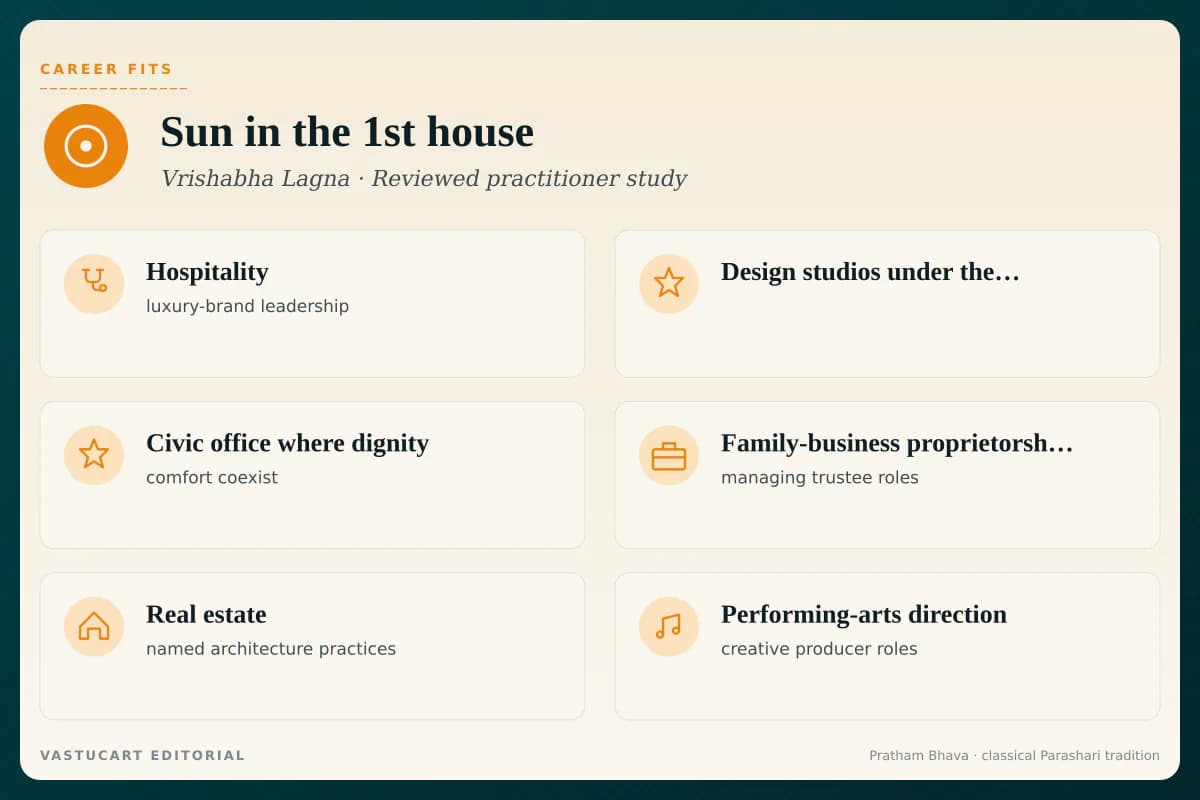
- Hospitality and luxury-brand leadership
- Design studios under the native's own name
- Civic office where dignity and comfort coexist
- Family-business proprietorship and managing trustee roles
- Real estate and named architecture practices
- Performing-arts direction and creative producer roles
Where the leadership-in-luxury vocation finds its visible form
Career paths cluster around fields that fuse solar authority with Venusian aesthetic, because the chart structurally asks for both at once. Hospitality leadership and luxury-brand management fit best because the work explicitly pairs dignified front-of-house with comfortable physical environment, and the 4L Surya in lagna gives the native enough institutional weight to lead the brand rather than execute someone else's. Most natives in this cluster reach a head-of-property or studio-principal level by their late thirties.
Design studios that operate under the native's own name form the second cluster because the placement combines the Vrishabha aesthetic instinct with the solar identity-bound trade. Architecture, interior design, fashion houses, and named editorial-design practices recur across consultation reports, and the studio name itself becomes a public expression of the chart's identity-and-authority composite.
Civic office and administrative leadership suit natives whose sovereign streak finds its outlet in formal institutional settings. The 4L Sun routes home and mother significations into public office in a specific way, and the family residence often becomes part of the office's visible fabric, the mother's reputation often reinforces the native's. Family-business proprietorship is the most common single fit because the chart is built to be the visible face of a hereditary or family enterprise, and the native usually inherits the role in stages between age twenty-eight and thirty-five.
Real estate and named architecture practices, and performing-arts direction round out the cluster. Surya mahadasha is the defining career window for any of these vocations and arrives with the studio launch, the brand acquisition, the office formalisation, or the family-business transition that gives the chart its visible long-form expression. Work environments that drain the native are subordinate roles where speech and dignity are rationed, anonymous corporate ladders, and any setting where the sovereign streak has no outlet.
Why the enemy-sign dignity coexists with real kendra strength
The cleanest way to read Surya in 1st house of Vrishabha is to hold the shatru rashi dignity and the 4L-in-lagna routing as a single composite rather than as competing readings. The Sun does not lose his fundamental nature in Vrishabha, the sign cannot subtract from the planet's intrinsic light, but the dispositor relationship reshapes how that light gets expressed. Shukra owns Vrishabha and is the Sun's enemy, so the planet sits in a sign whose ruler reads the Sun as a competitor rather than as an ally. The result is a Sun that operates with friction in his immediate neighbourhood, which the native experiences as the dual-register of solar centre under Venusian wrap.
The 4L-in-lagna mechanism is the second compositional feature. Sun rules the 4th from Vrishabha, and a 4L sitting in the 1st collapses the conventional public-private distinction the standard 1st-and-4th axis usually preserves. The body becomes the home, the public face becomes the family inheritance, and the personal identity becomes inseparable from the residence and mother. Most natives report that strangers know their family circumstances within the first conversation, often without the native having mentioned anything explicit, because the chart broadcasts the home through the body's presence.
The third interpretive layer is the kendra-versus-dignity question. Sun in a kendra is structurally important regardless of dignity because the kendra position itself confers weight, and the 1st house is the most weighted of the four kendras. A shatru rashi Sun in the lagna therefore reads as a planet that is structurally significant but expressively layered, and the practitioner's job is to read the layering honestly rather than collapse it into a single rating. Father themes carry weight because Surya is the karaka of father, and the placement produces a recurring pattern where the father worked in a Venus-shaped trade, art, hospitality, finance, design, and where the native's relationship with the father carries a permanent ambivalence that does not resolve into either warmth or rejection.
When Surya in 1st delivers its Tanu Bhava chapter
Surya mahadasha is the defining window for this placement and arrives with the studio launch, the brand acquisition, the family-business transition, or the public-identity formalisation that crystallises the 4L-in-lagna vocation.
Eyes, heart, throat and the Tanu vitality signature
Health follows the Sun-in-Vrishabha pattern with the body-part rulerships stacked from two directions. Surya governs heart, eyes, and bones across every chart, while Vrishabha lagna covers the face, throat, and neck. The placement therefore concentrates attention on these zones for the entire lifetime, and the practitioner reading should not skip the cumulative effect.
Constitution is kapha-pitta with pitta sharper than the standard Vrishabha kapha-pitta because Surya adds fire to the lagna's earth. The digestion is generally strong, but the heat does build and shows up in the upper body before any other system flags it. Vrishabha's earth element does cool the Sun's heat partially, so the diet caution that other lagnas need against Sun-fire (red meat, salt, heating spices) is real but less acute here than for Mesha Surya.
The eye fragility is the single most clinically distinctive feature for the long term. Sun rules vision and a shatru-rashi Sun in the body produces a recurring pattern of mid-thirties refractive shift, sometimes early presbyopia, and occasional episodes of dry-eye or photophobia under sustained screen work. Annual ophthalmic screening from age thirty is the most useful single preventive step, and natives who work with screens for long hours benefit substantially from explicit eye-rest protocols and Triphala wash.
Cardiac vitality is strong through the forties and asks for explicit care from the fifties forward. The pattern that recurs is high-functioning heart performance during the productive decades followed by hypertension or arrhythmia in the later fifties when accumulated pitta has not been released. The throat is the lagna's body-part shadow zone, and voice care plus the routine avoidance of evening cold or air-conditioning help. Pearl wearing for friend-of-Sun support is sometimes recommended after careful chart reading, and ruby itself asks for full kundali confirmation because the shatru-rashi dignity is not a free pass for the stone.
Remedies for Surya in the Vrishabha Tanu angle
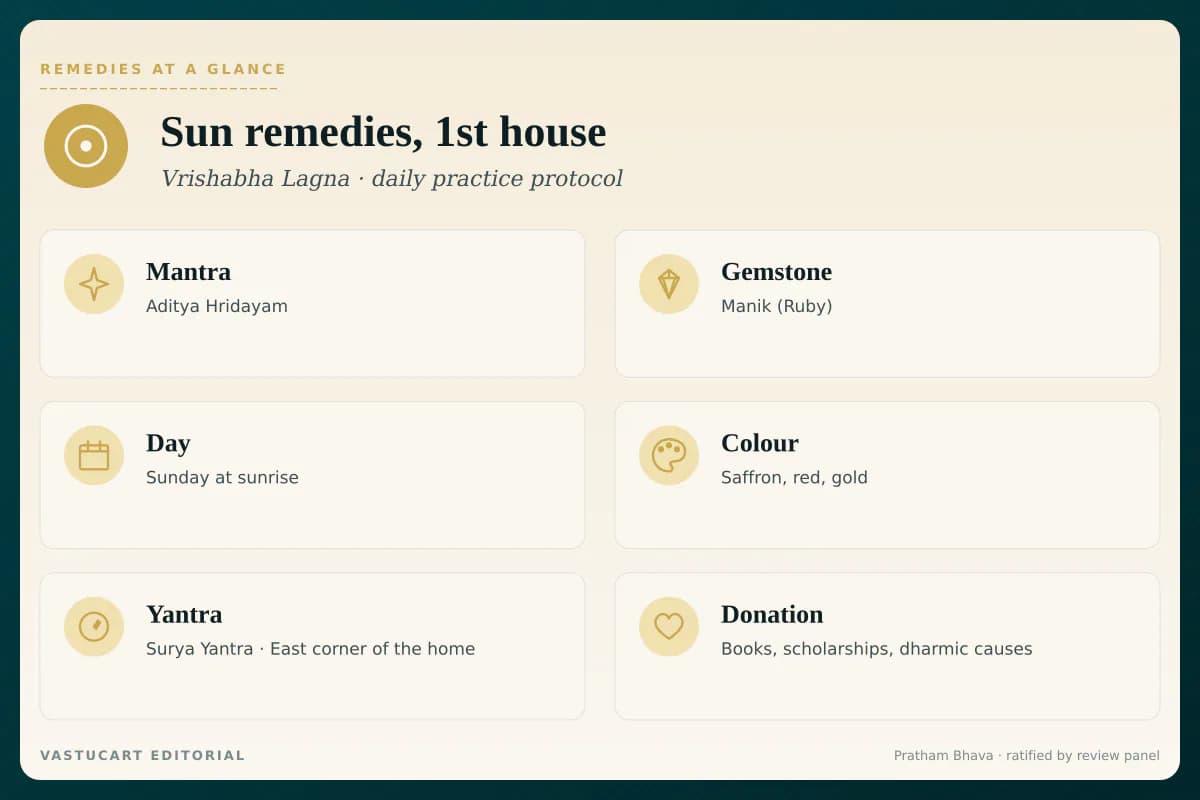
The daily Surya namaskar at sunrise is the primary remedy because the twelve-pose salutation routes the Sun's vitality through the body at the moment the planet rises, and that ritual directly addresses the 4L-in-lagna routing the chart asks for. Bathe before sunrise, wear copper, gold, or saffron clothing on Sundays, and visit a Surya temple or perform Surya darshan whenever travel allows. Reciting the Aditya Hridayam (heart of the Sun) at sunrise on Sundays for forty consecutive Sundays at any major Tanu transition (career launch, marriage, family-business inheritance, public-identity shift) is the formal protocol.
For the shatru rashi specifically, the remedies that strengthen the Sun without overheating the chart matter most. Pair the Aditya Hridayam with the Surya Stotram on Sundays, offer red flowers, jaggery, wheat, and ghee at the home altar, and donate red or copper-coloured items (red lentils, copper utensils, jaggery, woollen blankets) to elderly fathers, government workers, or temple priests on Sunday at sunrise with your own hand. The conscious-authority practice is the lifestyle remedy that compounds across decades into the difference between the integration that the chart wants and the dual-register oscillation that an unconscious life produces.
The gemstone is ruby (Manik), the primary Surya ratna, and it asks for careful chart confirmation here rather than confident immediate prescription because the Sun is in shatru rashi at the lagna. Wear a natural unheated Burmese or Mozambique ruby of minimum three to five ratti, set in gold or panchaloha, on the ring finger of the right hand, on a Sunday at sunrise after Surya mantra recitation, and only after a seven-day test reading and a full kundali audit by a qualified Jyotishi. Yellow sapphire (Pukhraj) is sometimes added as a friend-of-Sun secondary stone to bring Guru's blessing into the heart-throat zone, and some practitioners prefer pearl over ruby when the chart shows Mangal-Surya stress in the Tanu axis.
Gemstones for Surya in 1st house Vrishabha Lagna
Ruby is the primary Surya gemstone but the shatru-rashi dignity at the lagna asks for a careful chart reading and a seven-day test before any permanent wearing decision.
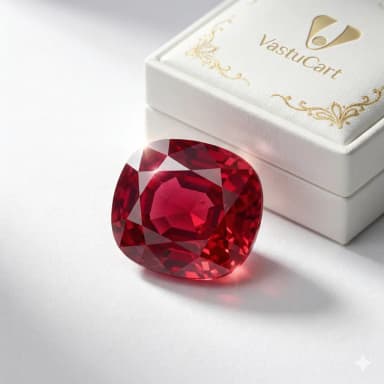


Disclaimer: Ruby on a shatru-rashi Sun produces strong activation and asks for a confirmed reading before permanent wearing because the dignity is mixed even though the placement is in a kendra. Always consult a qualified Jyotishi who has audited the full kundali.
Rudraksha beads for Surya in 1st house
The Surya-aligned rudraksha is the Ek Mukhi (One Mukhi), the rarest single-faced bead directly ruled by Shiva in his Surya form. The Dwadash Mukhi (Twelve Mukhi) is the alternate Aditya bead.
The rarest and most powerful Sun-aligned rudraksha, classically reserved for natives who carry a Sun signature at the lagna or a Surya mahadasha. Holds the integration of solar centre and Venusian wrap that this Vrishabha chart asks for, supports the 4L-in-lagna routing, and steadies the cardiac and ocular signatures over time. Substituted in practice with the half-moon Ek Mukhi Kaju when the round bead is unavailable.
The twelve-mukhi bead is the Aditya rudraksha and serves as a primary alternate when the Ek Mukhi is unavailable. Wearing the Dwadash Mukhi alongside a smaller Ek Mukhi compounds the Surya signature and channels the shatru-rashi Sun toward steady authority rather than oscillation.
Surya Yantra for the Tanu placement
Sacred recitations for Surya in the Tanu angle
Jaya avaham japen nityam akshayyam paramam shivam
Sarva mangala maangalyam sarva paapa pranashanam
Chinta shoka prashamanam ayur vardhana muttamam
Rashmimanam samudyantam devaasura namaskritam
Pujayasva vivasvantam bhaskaram bhuvaneshwaram
Translation: The heart of the Sun is sacred, destroyer of every enemy, bringer of victory, recited daily for inexhaustible auspiciousness and supreme welfare. Most auspicious of all auspicious things, dissolver of every sin, and quietener of worry and grief, supreme increaser of life span. Worship the radiant rising one, saluted by gods and demons alike, the maker of light, the lord of all worlds, Vivasvan Bhaskara. Sage Agastya gave this hymn to Lord Rama before the battle with Ravana, and it remains the canonical Surya recitation for any chart where the Sun sits at the lagna in a sign other than his own.
Read the full stotra on stotra.vastucart.in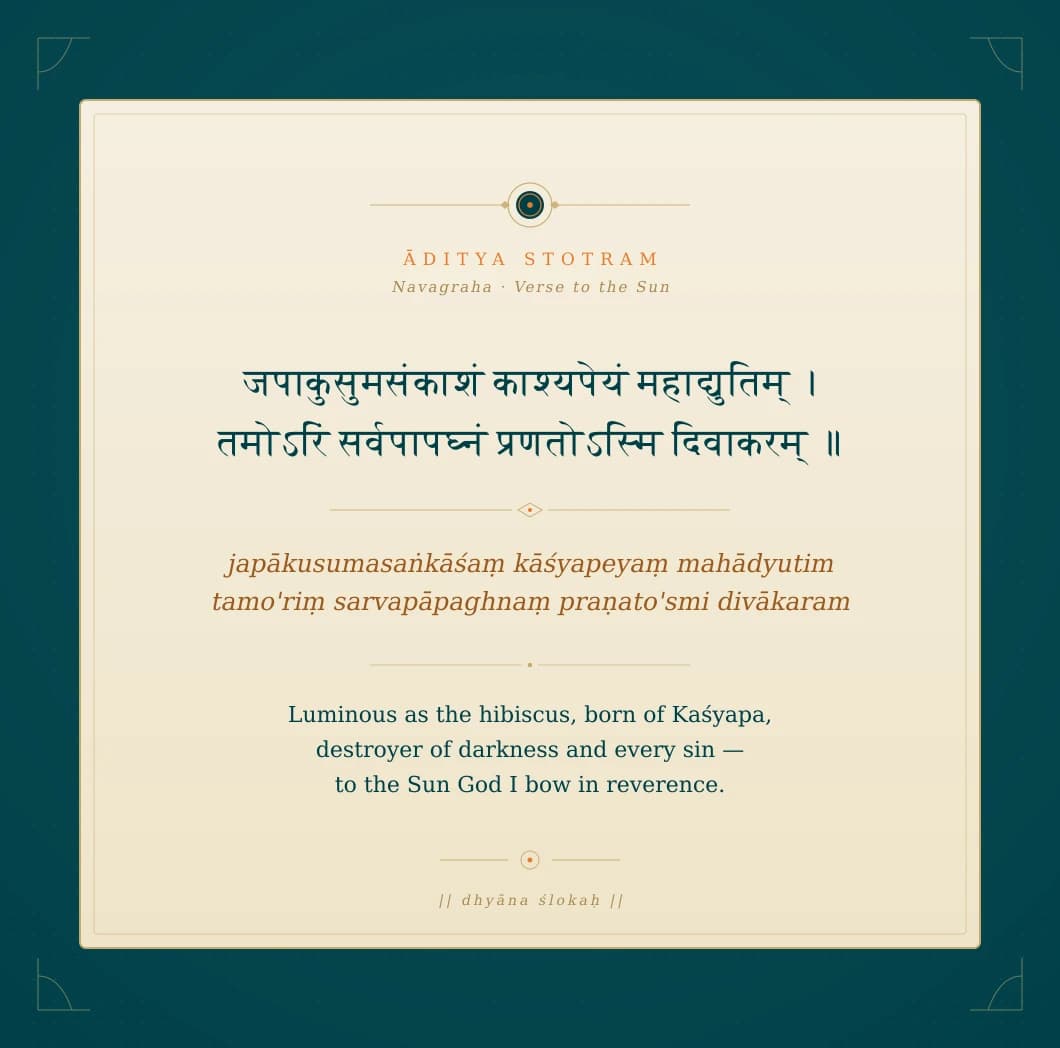
Tools for Surya 1st house Vrishabha natives
Is your Tanu Bhava Sun carrying the shatru-rashi 4L signature?
Get a full personalised analysis of your first house Surya, the Vrishabha enemy-sign dignity, and the safe ruby protocol.