Shukra in the 1st house
Vrishabha Lagna (Taurus Ascendant)
A practitioner study of Shukra in Tanu Bhava for Taurus ascendant natives. Venus in his own sign Vrishabha producing Malavya Mahapurusha Yoga, the lagna-lord-in-lagna self-image signature, and the rare integration of charm with steady ground.
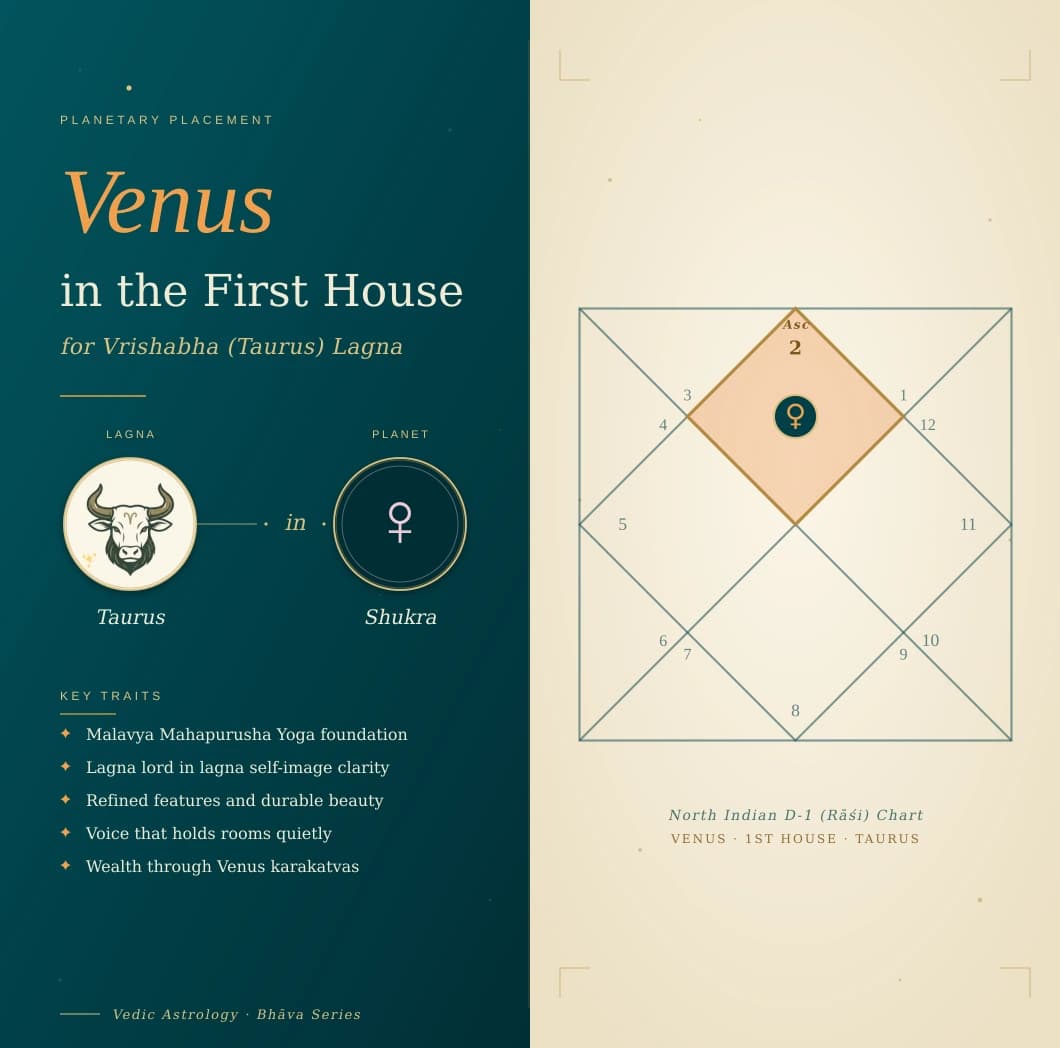
Shukra sits in his own sign Vrishabha in the first house for Taurus ascendant natives, the Malavya Mahapurusha Yoga signature.
Shukra in 1st house for Vrishabha Lagna, the quick reference
If you carry Shukra in 1st house of a Vrishabha Lagna chart, you hold the strongest self-image placement available to a Taurus ascendant. Shukra (Venus) is the lagna lord, and Vrishabha (Taurus) is one of his two own signs. The dignity is therefore swakshetra Venus (own-sign Venus), the highest band an own-sign placement can produce in classical Parashari Jyotish. Several schools call this configuration a textbook Malavya Mahapurusha Yoga, the panch mahapurusha yoga of Venus, because Shukra in own sign sits in a kendra, and the first house is both kendra and trikona simultaneously.
The second feature is the lagna-lord-in-lagna principle. Wherever the lagna lord lives, the body and the public self take their cues. When the lagna lord sits in the lagna itself, the gap between who you are and who you appear to be collapses. For a Venus Vrishabha chart, that transparency arrives wrapped in beauty, warmth, social ease, and a steadiness other Vrishabha Lagna natives spend decades learning. The third feature is Venus's secondary 6th lordship for Vrishabha Lagna. Shukra rules both Vrishabha (1st) and Tula (6th, the dushthana of conflict and service). In the 1st, kendra weight overrides 6L (sixth-house lord) shadow by structure, so the placement reads almost entirely positive, with the 6L tail surfacing only as occasional perfectionism around food, body, and craft. This guide walks Shukra in 1st house layer by layer: the swakshetra Venus dignity, the Malavya yoga mechanics, the Tanu Bhava self-image, the Shukra mahadasha activation, and the diamond Heera protocol that needs careful chart confirmation.
Why Shukra in Tanu Bhava produces Malavya Mahapurusha Yoga
Students arrive at this placement carrying the assumption that Venus in the 1st only signals beauty. The fuller answer is structural. Malavya is one of the five panch mahapurusha (five-great-men) yogas of classical Jyotish. The rule is precise. Venus must sit in his own or exalted sign, and the sign must occupy a kendra (1st, 4th, 7th, or 10th house). Vrishabha is Venus's own earth sign, and the 1st is a kendra by definition. The Vrishabha native therefore inherits a Malavya configuration the moment Venus settles into the lagna at birth.
The yoga delivers specific outcomes. Refinement of features and proportion of body. A voice that holds rooms without straining. Wealth that arrives through art, design, hospitality, or trade in objects of value. A spouse who carries social standing. Long life that retains its grace late into the eighth decade. Classical sources promise these outcomes when the yoga is unblemished by malefic aspect, and clinical practice confirms most of them across hundreds of charts. The second interpretive layer is Venus as lagna lord. The lagna lord shapes the body the soul lives in, and Venus shaping the Vrishabha body produces the dense bone structure of the bull combined with rounded features the sign is famous for. The third layer is the rare integration of attraction and steadiness. Most charts that produce magnetic charm pair it with restlessness or volatility. Venus in his own sign in the 1st pairs the charm with earth-element ground. The native attracts attention without chasing it and holds attention without performing for it.
Lagna lord in lagna is the rare placement where the chart announces itself before the native speaks. With Venus in his own sign, the announcement is warmth made visible, and the work is to keep the steadiness underneath the shine.
Terms used in this article
A short glossary of the Sanskrit and Jyotish terms that recur in this study. First-occurrence expansion is also retained inline.
- Tanu Bhava
- The 1st house, the bhava of body, self, and identity. Both kendra and trikona at the same time.
- Swakshetra
- Own-sign placement. A planet sitting in a sign it rules carries the second-highest dignity, just below exaltation.
- Malavya Mahapurusha Yoga
- Venus in his own or exalted sign in a kendra. One of the five panch mahapurusha (five-great-men) yogas of classical Jyotish.
- 1L
- First-house lord, the planet ruling the sign on the 1st house cusp. Carries the body, self-image, and life direction.
- 6L
- Sixth-house lord, ruling enemies, debt, service, and chronic illness. A dushthana lord.
- Kendra
- Angular houses 1, 4, 7, 10. The four pillars of the chart that hold the structural strength.
- Trikona
- Trinal houses 1, 5, 9. The dharmic giving angles that activate fortune.
How Shukra in Tanu Bhava shapes the Taurus native
Physically the native carries the classic Vrishabha body refined by Venus's own touch. The face is round to oval, the neck thick and well-formed, the throat noted for either a singing voice or a speaking voice that holds attention without volume. Eyes are large and steady, with eyelashes that even other Venusian natives notice in passing. The build is medium-tall with a low centre of gravity, and the body retains its proportion even when weight cycles fluctuate. Many natives report being told they look the same in school photos as in their forties, a trait that other lagnas almost never produce.
Temperament is where the placement reorders Vrishabha defaults. The standard Taurus native carries earth steadiness with occasional stubbornness. The Venus-in-own-sign lagna native softens the stubbornness into deliberateness, where decisions arrive slowly because they are being weighed, not because change is being resisted. Strangers consistently describe the native as warm without being effusive, attentive without being intrusive, and decisive without being harsh. The shadow side is the rarer 6L tail surfacing as perfectionism about food, body, and craft. These natives notice flaws other people miss, and the noticing becomes uncomfortable when it turns inward and chronic. Pairing the placement with conscious self-acceptance practice (and with a partner who is honest rather than diplomatic) is the single best lifestyle intervention.
Strengths, shadows and career fits
- Malavya Mahapurusha Yoga foundation
- Lagna lord in lagna self-image clarity
- Refined features and durable beauty
- Voice that holds rooms quietly
- Wealth through Venus karakatvas
- Steady marriage karaka in own sign
- Tendency to vanity if uncriticised
- Throat and tonsil sensitivities
- Comfort can soften ambition over time
- 6L tail produces food-body perfectionism
- Slow to act on red flags in love
- Reluctance to change winning routines
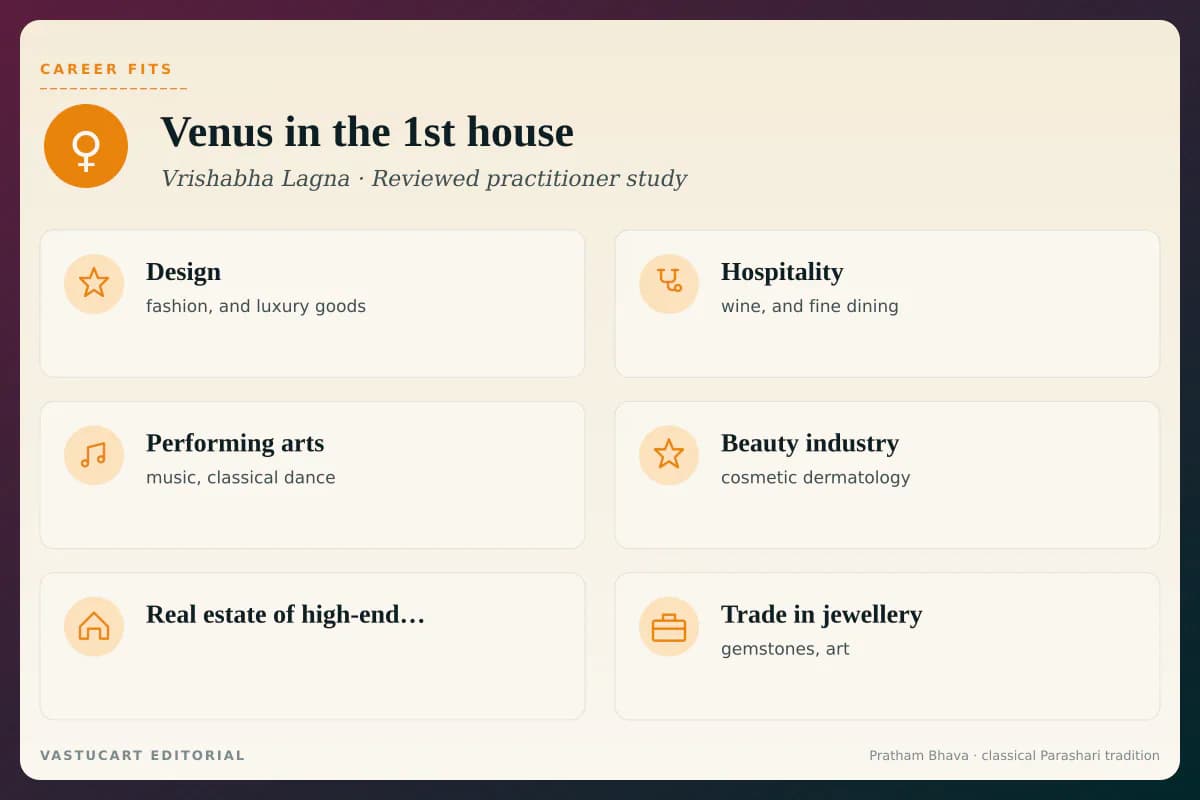
- Design, fashion, and luxury goods
- Hospitality, wine, and fine dining
- Performing arts, music, classical dance
- Beauty industry, cosmetic dermatology
- Real estate of high-end properties
- Trade in jewellery, gemstones, art
Where the Venusian vocation finds its visible form
Career paths for a Taurus ascendant carrying Shukra in 1st house cluster around fields that draw on Venus's natural rulership of beauty, refinement, and value. Design, fashion, and luxury goods come first because Venus Vrishabha rules aesthetics and the lagna lord placement gives the native enough self-presentation to lead the room rather than serve it. Hospitality, wine, and fine dining suit natives whose vocational mode is direct contact with people and a love of craft executed at scale. The performing arts (music, dance, singing) match because Venus Taurus karakas the rasa traditions and a Venus-ruled throat in the lagna often discovers itself early.
Beauty industry work and cosmetic medicine fit natives whose chart pairs Venus in 1st with strong Mercury or Saturn for the precision the work demands. Real estate of high-end properties suits natives who marry the Venus eye for proportion to the Vrishabha Lagna appetite for tangible assets. Trade in jewellery, gemstones, and art is a classical Vrishabha vocation, and a lagna lord in lagna chart often reaches it through an inheritance that the second mahadasha activates. Shukra mahadasha is the defining career window when it falls in the productive years, and arrives with the visible breakthrough that establishes the income engine the rest of the working life draws from. When Shukra mahadasha runs in childhood, the native usually comes back to its themes through a deliberate career pivot in their thirties.
Why the swakshetra reading overrides the dushthana lordship
The cleanest way to understand Shukra in 1st of Vrishabha is to read the own-sign dignity and the dual lordship together rather than treating either in isolation. Venus rules both Vrishabha (1st) and Tula (6th) for this lagna, which raises the textbook question of whether the lagna lord carries 6L dushthana shadow into the body. The Parashari resolution is precise. When a planet rules a kendra and a dushthana simultaneously, the kendra placement determines the primary expression and the dushthana lordship reduces to a secondary watermark.
For Shukra in 1st, the kendra weight is doubled because the 1st is both kendra and trikona, and the own-sign dignity adds a third structural strength on top. The 6L watermark surfaces only as the perfectionism mentioned earlier, and it rarely produces the open enmity, debt, or chronic illness that 6L placements ordinarily signal. The second specific feature is the difference between Venus in Vrishabha and Venus in Tula in this seat. Both signs are owned by Venus but Tula is air and Vrishabha is earth. Vrishabha gives the body a denser foundation, and the lagna lord in earth produces the steadiness that pure-air Venus charts lack. The third interpretive layer is exaltation comparison. Venus exalts in Meena (Pisces) at 27 degrees, which would land in the 11th for Vrishabha and produce a different yoga. Venus in own sign in the 1st is structurally stronger for self-image, while exaltation in the 11th is stronger for gain. Most practitioners agree that the 1st-house own sign is the more shaping placement across a lifetime.
When Shukra in 1st delivers its Tanu Bhava chapter
Shukra mahadasha is the defining window for this placement and arrives with the visible breakthrough that organises self-image, marriage, and the income engine for the rest of the working life.
Throat, kapha, and the Tanu vitality signature
Health follows the Vrishabha-with-Venus-in-1st pattern. Constitution is kapha-pitta with kapha dominant because Venus carries water-element rasa and the Vrishabha sign carries earth-element heaviness. Body part rulership for the 1st house and the Vrishabha sign together emphasises the face, the neck, the throat, the tonsils, and the thyroid. The placement raises specific lifelong vulnerability to throat infections in childhood, voice strain in performing-arts careers, and thyroid imbalance in the late thirties. Annual neck and throat screening from the early thirties is the most useful single preventive step.
The Venus-comfort risk is the second body-related layer to read carefully. Venus in own sign in the 1st gives the body a strong taste for sweet, dairy, fats, and rich food, and the Vrishabha digestion handles these well only up to a point. The pattern that recurs in clinical practice is steady weight gain through the thirties, plateauing in the forties, and chronic kapha-related conditions (sluggish thyroid, lipid issues, joint stiffness) emerging in the fifties when the lifestyle is not adjusted in advance. Daily walking before sunrise, restraint with desserts and dairy after sunset, and regular voice or breath work are the protective routines. Singers and public speakers with this placement should treat throat warm-ups as non-negotiable rather than optional, because the lagna lord routes its dignity through the voice when it is allowed to.
Remedies for Shukra in the Vrishabha Tanu angle
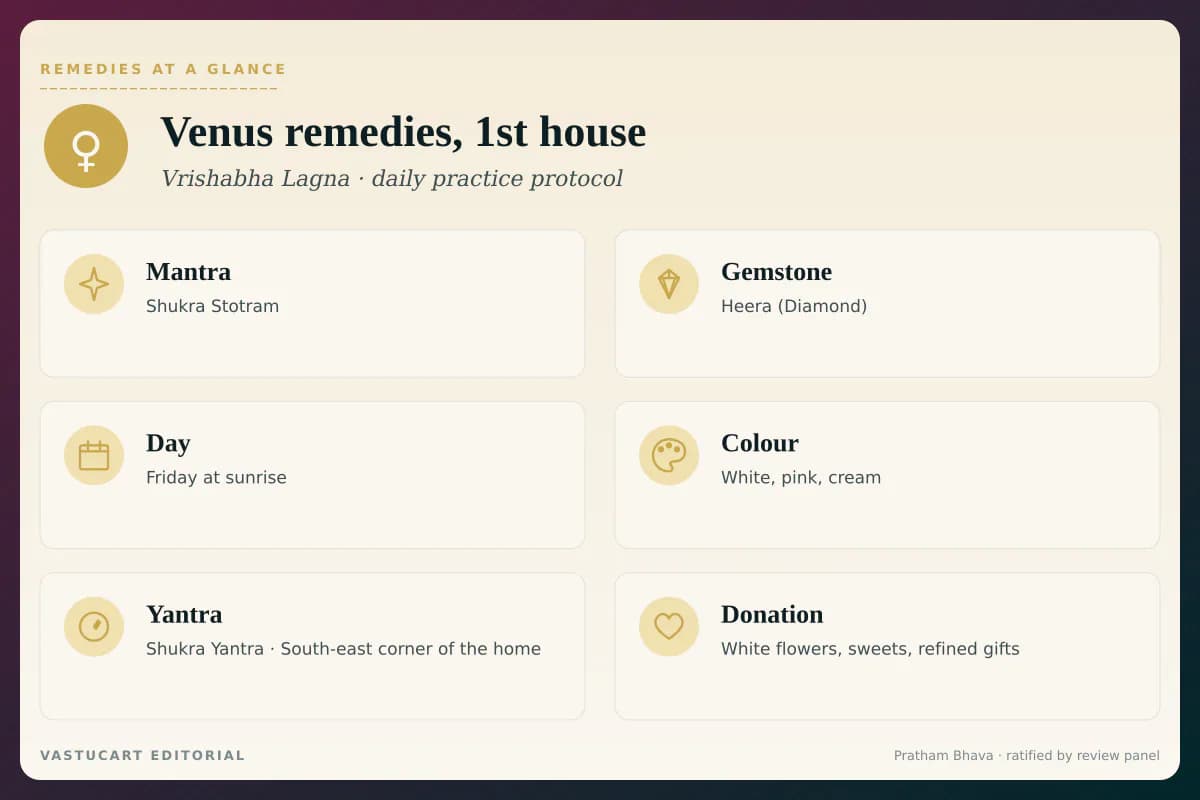
The daily Lakshmi worship is the primary remedy because Lakshmi is the consort-form of Venus's principle in the puranic tradition, and her grace stabilises the wealth and beauty significations that Shukra rules. Rise before sunrise, bathe, wear white or cream clothing on Friday, and visit a Lakshmi temple if accessible. The Lakshmi Stotram is the primary recitation, and reciting it at sunrise on Friday for sixteen consecutive weeks (one Mahalakshmi vrata cycle) is the formal protocol that classical sources prescribe. Pair the recitation with the Shukra Stotram on Friday morning so the planet and the deity are both honoured.
Offer white flowers, white sweets (kheer or rasgulla), curd, sugarcane juice, and rose water at the altar. Donate fragrant items (rose water, sandalwood, perfume) and women's items (sarees, bindis, bangles) to women who need them, ideally on Friday at sunrise, with your own hand. The conscious-generosity practice is the lifestyle remedy that compounds across decades into the difference between Malavya yoga shine and Malavya yoga decay. The gemstone is diamond (Heera), the primary Shukra ratna, and is recommended confidently here because the lagna-lord-in-lagna placement is structurally clean. Wear a natural untreated diamond of minimum half-ratti to one ratti, set in platinum or white gold, on the middle finger of the right hand, on a Friday at sunrise after Shukra mantra recitation.
Gemstones for Shukra in 1st house Vrishabha Lagna
Diamond is the primary Shukra gemstone and is worn confidently for this placement because the lagna-lord-in-lagna configuration is foundationally strong. Opal serves as the secondary Venus stone where diamond is cost-prohibitive.
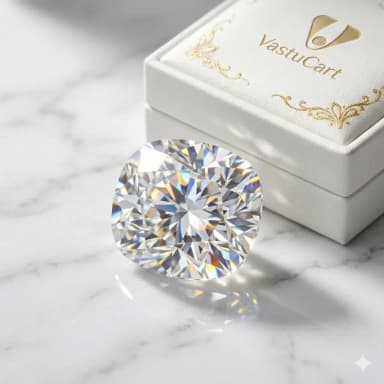
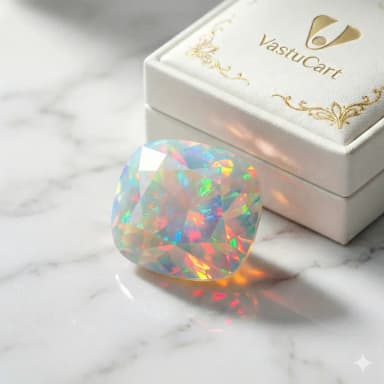

Disclaimer: Diamond is a powerful Venus stone and should never be worn against the lagna lord shape without confirmation. Always consult a qualified Jyotishi before permanent wearing.
Rudraksha beads for Shukra in 1st house
The Shukra-aligned rudraksha is the Shat Mukhi (Six Mukhi), the bead directly ruled by Kartikeya and Venus.
The classical Venus rudraksha and the bead specifically associated with Shukra. Stabilises charm into steady warmth, supports the lagna lord placement, and protects the throat and voice signature when the Tanu placement is active across decades.
The thirteen-mukhi bead is associated with Kamadeva and is a fitting secondary support for Venus in 1st because it deepens the magnetism and grace the placement already produces. Wearing the Tera Mukhi alongside the Shat Mukhi compounds the Venus signature without overheating it.
Shukra Yantra for the Vrishabha lagna placement
Sacred recitations for Shukra in the Tanu angle
Daitya guru maha buddhim sarva shastra vishaaradam
Shvetambara dharam devam shvetagandha anulepanam
Bharya gurum mahatmanam shukram pranamamy aham
Daanavaa uchatu shukram shukravaaro vishishyate
Shukrastu shukla varnasya shukra grahasya devata
Translation: I bow to Shukra, the white-bright one seated on a chariot, the great teacher of the asuras, learned in every shastra, clothed in white, anointed with white sandal, the husband-form of the divine teacher. The asuras call him Shukra, and Friday is the day held sacred to him. Shukra is white in colour and is the presiding deity of the planet Venus. The Shukra Stotram is the canonical Navagraha recitation for any chart where Venus is the lagna lord and the Tanu Bhava placement asks for steady devotional support.
Read the full stotra on stotra.vastucart.in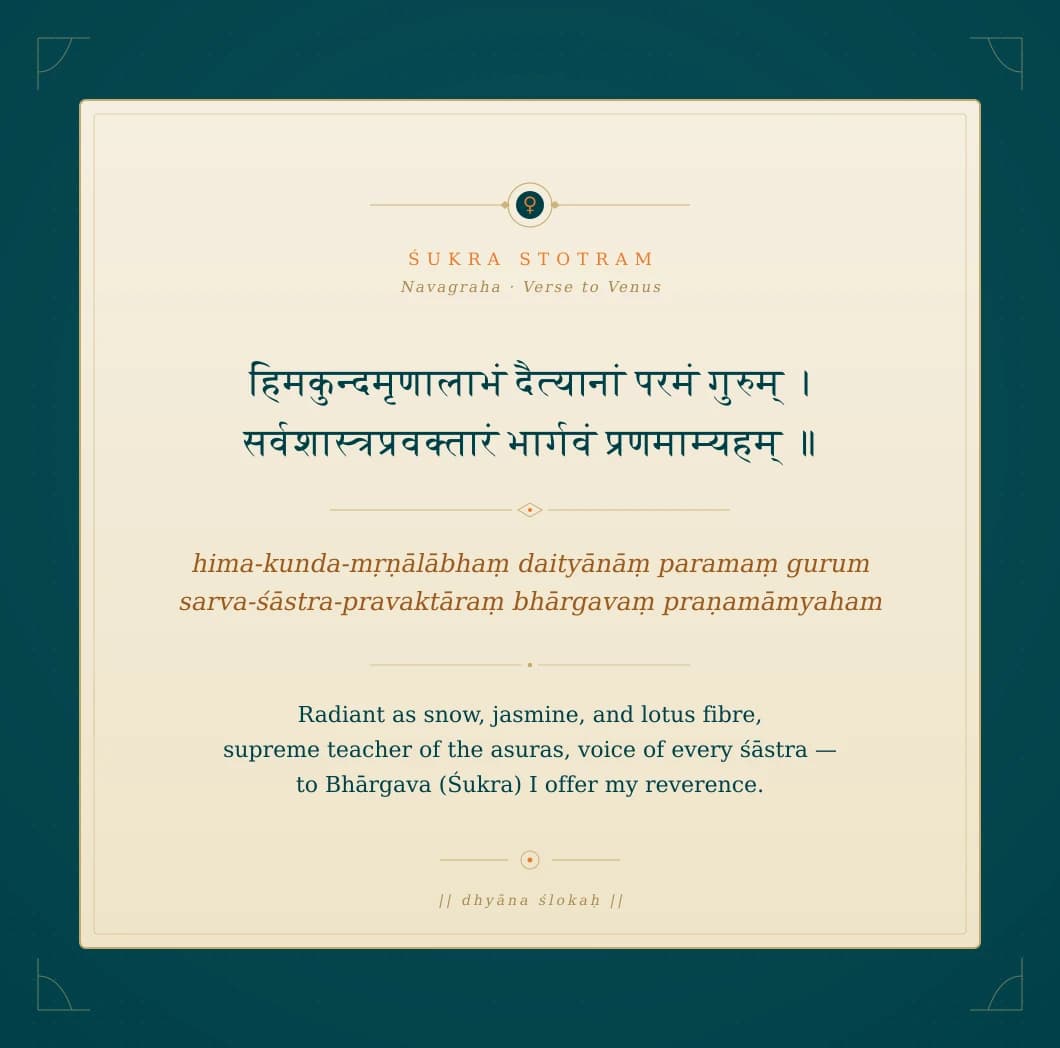
Tools for Shukra 1st house Vrishabha natives
Is your lagna Shukra carrying the Malavya yoga signature?
Get a full personalised analysis of your first house Venus, the swakshetra dignity, and the marriage timing.