Chandra in the 3rd house
Vrishabha Lagna (Taurus Ascendant)
A practitioner study of Chandra in Sahaja Bhava for Taurus ascendant natives. The Moon in his own sign Karka produces the 3L-in-3H swakshetra signature: emotional stamina that performs as physical courage, sibling-bond depth, and the writing-and-hands vocational template the Vrishabha chart consistently rewards.
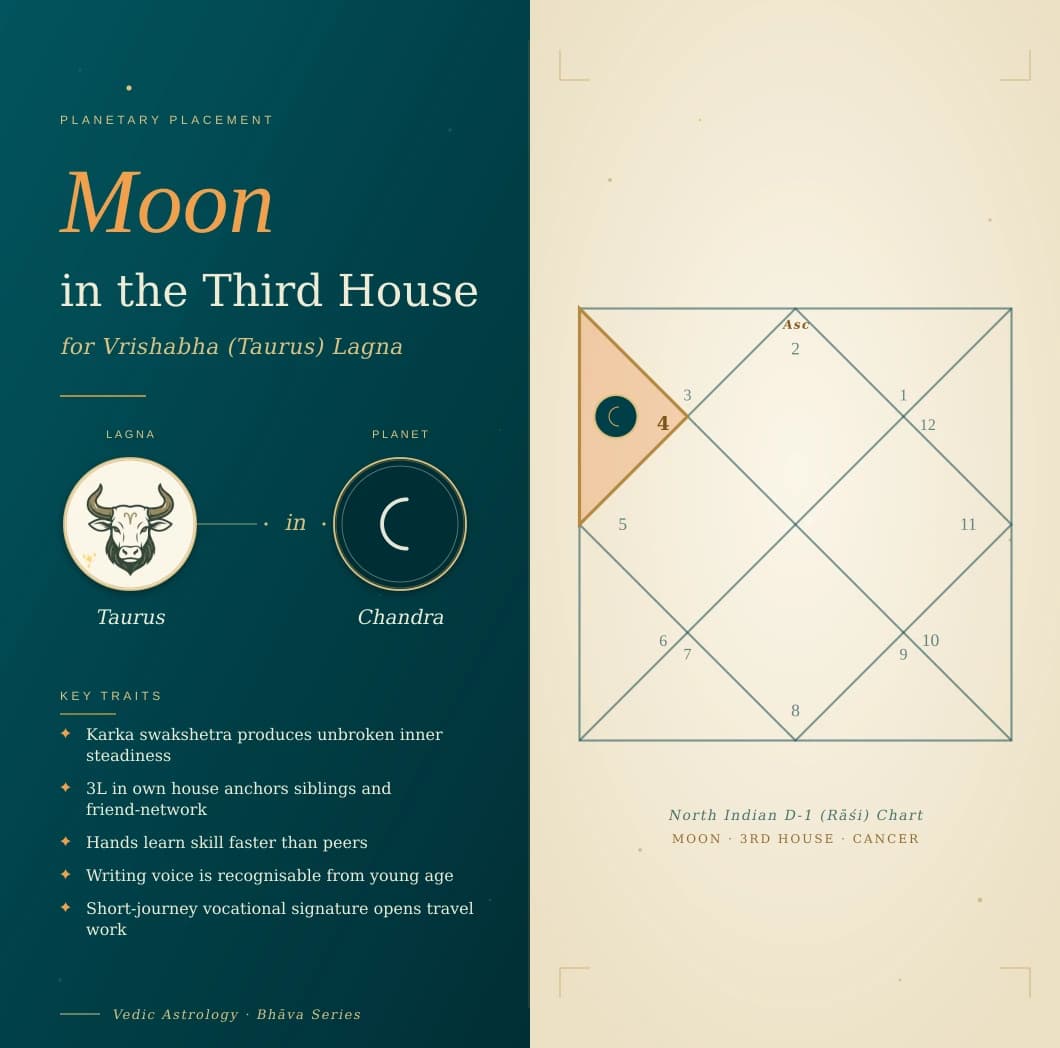
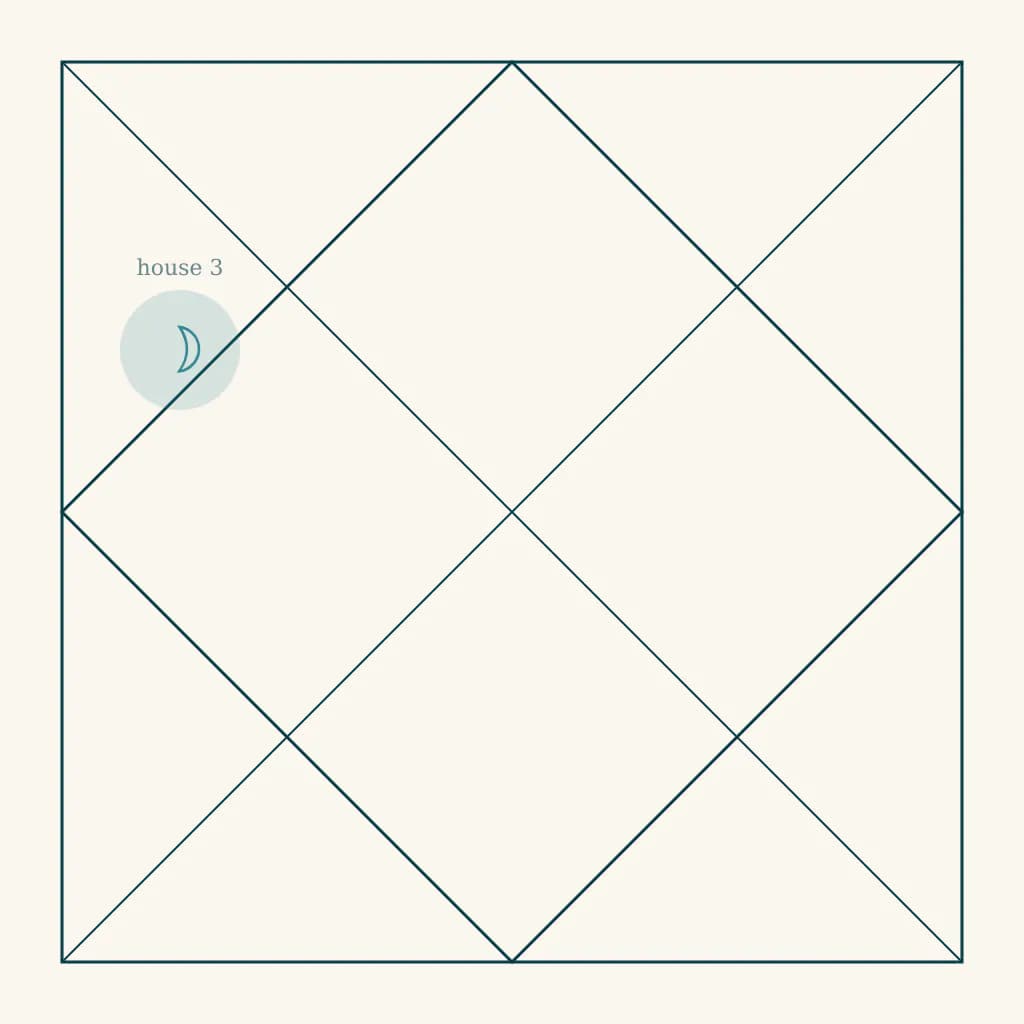
Chandra sits in his own sign Karka in the third house for Taurus ascendant natives, the 3L swakshetra in Sahaja Bhava signature.
Chandra in 3rd house for Vrishabha Lagna, the quick reference
If you carry Chandra in the third house of a Vrishabha chart, you hold one of the cleanest swakshetra placements in the entire Taurus ascendant catalogue, because the Moon sits in his own sign Karka (Cancer) in the bhava classical Jyotish assigns to parakrama (self-effort), siblings, hands-on skill, and the short journey. The third from Vrishabha is Karka, ruled by Chandra himself, so the 3L sits in his own sign in his own house. Practitioners read this as a doubled ownership signature: lord-in-own-house plus lord-in-own-sign produce a quiet structural confidence the chart carries forward across decades.
The second feature is the lagna interaction. Chandra is a friend of Shukra and the third house has no aspect on the lagna, so the placement supports the Taurus ascendant indirectly through stamina rather than directly through visibility. The native looks like the steady Vrishabha frame to strangers, but the Sahaja Bhava is doing the unseen work of holding the nervous system steady when the schedule turns demanding. The third feature is the karaka logic. Mangal is the natural karaka of the third, and Chandra in the third places the manas-karaka in the parakrama-karaka's seat without conflict because Karka is friendly to Mangal in classical Parashari texts.
This guide reads every layer of Chandra in 3rd house for Vrishabha Lagna natives: the Karka swakshetra, the 3L-in-own-house signature, sibling and hands-skill amplification, the writing-and-communication vocational template, and the pearl protocol that classical practitioners reach for when a chart confirmation is in place. Each section is built on clinical observation rather than greeting-card astrology, so the reader can decide what applies to their own kundali and what does not.
Why Chandra in Sahaja Bhava reads as nervous-system stamina rather than ordinary moodiness
Students often arrive at Chandra in the third carrying anxiety from popular astrology readings that label any Moon outside the lagna or fourth as emotionally compromised. The honest practitioner answer for this specific configuration is the opposite.
Chandra in his own sign Karka is the strongest placement the Moon takes after exaltation in Vrishabha, and putting him in the third house for a Taurus ascendant routes that strength into the parakrama channel where it does the most steady work. The native does not show as moody, they show as deliberately paced.
The first specific feature is the swakshetra logic. A planet in his own sign cannot be embarrassed by the dispositor because the dispositor is himself.
The Moon answers to no one in this configuration, which means the manas (mind) the chart carries is unbroken by the family or social conditioning that ordinarily pulls the Moon off-axis. Most natives report that they have always been able to find their own emotional level even when surroundings were chaotic.
The second feature is the lord-in-own-house bonus. The 3L sits in the 3H, which classical texts catalogue as a vipareet rajayoga only when the third is read as a dushthana. Even setting the rajayoga reading aside, the basic principle holds: the lord that owns a house, sitting inside that house, fortifies it.
Sibling bonds last, the writing voice is recognisable, the hands learn skills that the body can repeat for life. The third feature is the lagna interaction.
The third does not aspect the first by full graha drishti, so this placement supports Vrishabha indirectly through accumulated capability rather than through visible image. The lagna keeps its quiet bull-frame outline; the Moon does the inside work.
Chandra in his own Karka in the third for a Vrishabha native is not a moody Moon. It is a stamina-Moon: the manas in own sign in the courage house, building inner steadiness that strangers misread as outer calm.
Terms used in this article
A short glossary of the Sanskrit and Jyotish terms that recur in this study. First-occurrence expansion is also retained inline.
- Sahaja Bhava
- The 3rd house, the bhava of self-effort, siblings, courage, hands and short journeys.
- Parakrama
- Personal valour and self-made effort, the substantive territory of the 3rd house.
- Swakshetra
- Own-sign placement, where a planet sits in the sign he himself rules.
- 3L
- Third-house lord, the planet ruling the sign on the 3rd house cusp.
- Manas
- The receptive mind in classical Jyotish, the layer Chandra rules and protects.
- Upachaya
- An improving house (3, 6, 10, 11) where outcomes strengthen with time and effort.
- Karaka
- The natural significator of a domain; Mangal is the karaka of the 3rd house.
How Chandra in Sahaja shapes the Vrishabha native
Physically the native carries the Vrishabha bull-frame on top of a noticeable softness in the upper torso, particularly in the chest and shoulder line, that traces directly to the Karka watery signature lodged in the body's parakrama centre. The face often combines the Taurus calm jaw with unusually expressive eyes, and the hands look at home doing skilled work whether that work is keyboard, instrument, brush, or kitchen knife. Voice tends to be warm and well-modulated, a Chandra-third trademark.
Temperament is where the placement most distinguishes the native from peers. These natives carry the famous Taurus steadiness on the surface, but their internal life moves more like tide-water than like rock. They register a room's emotional weather faster than the room realises, and they store that information privately rather than reacting in the moment. Friends consistently report that the native is the one they call when something needs to be said calmly to a panicked relative, because the chart can hold another person's distress without dissolving into it.
The shadow side rides the same engine. The same nervous system that absorbs and holds also accumulates if there is no release valve, and natives who never give the manas an outlet (writing, music, walking, therapy, regular sibling-and-friend conversation) tend to develop chronic mid-thirties insomnia and digestive sensitivity. The 3L Chandra is built to flow outward through self-expression; blocked, it turns inward and registers as a body-level somatic load that no amount of will-power resolves. Most clinical reports emphasise that natives who write daily, even privately, retain emotional clarity well into the later decades the chart's longevity supports.
Strengths, shadows and career fits
- Karka swakshetra produces unbroken inner steadiness
- 3L in own house anchors siblings and friend-network
- Hands learn skill faster than peers
- Writing voice is recognisable from young age
- Short-journey vocational signature opens travel work
- Long-fuse listening compounds professional trust
- Quiet emotional accumulation if no release
- Mid-thirties insomnia risk under sustained pressure
- Digestive sensitivity tracks stress before mind does
- Tendency to over-give to siblings without naming cost
- Public reading misreads calm as low-energy
- Reluctance to ask for help when the chart is loaded
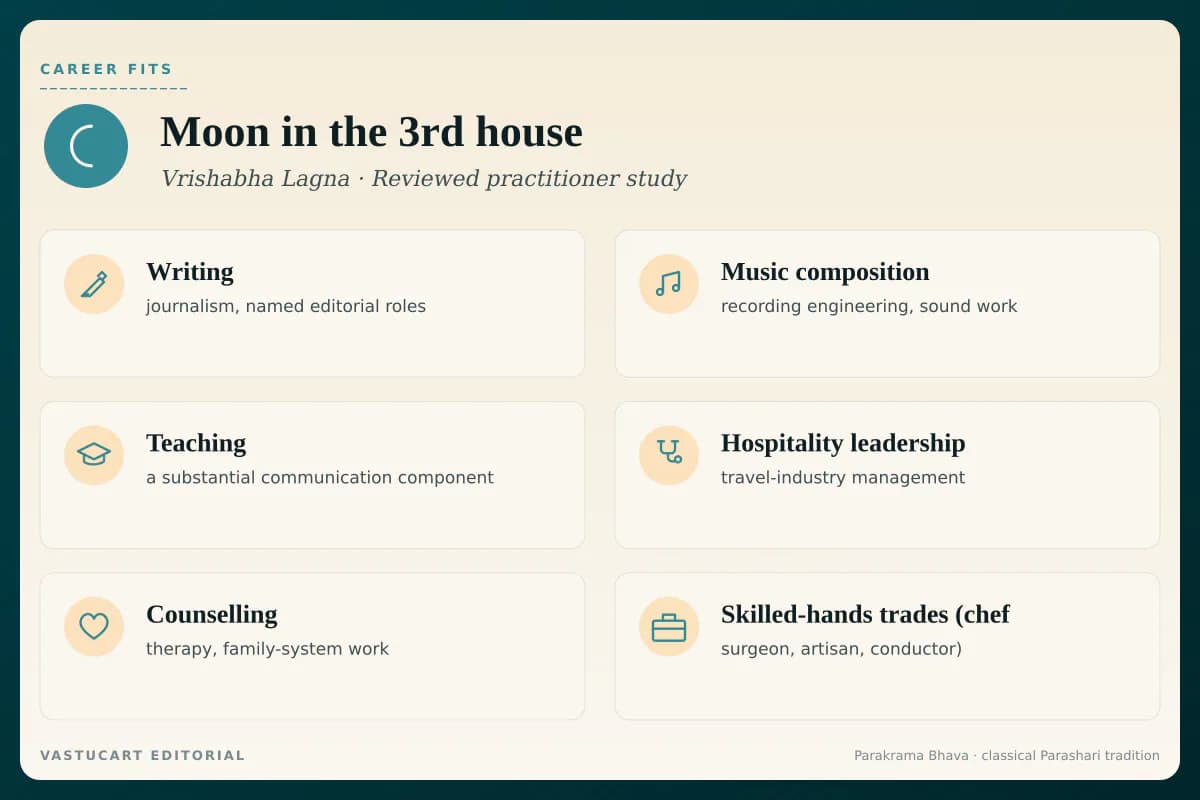
- Writing, journalism, named editorial roles
- Music composition, recording engineering, sound work
- Teaching with a substantial communication component
- Hospitality leadership and travel-industry management
- Counselling, therapy, family-system work
- Skilled-hands trades (chef, surgeon, artisan, conductor)
Where the writing-and-hands vocation plays out
Career paths cluster around fields that draw on the third house's communication, self-effort, and skilled-hands significations, all amplified by the Karka swakshetra's emotional intelligence. Writing, journalism, and named editorial roles fit best because the chart pairs verbal fluency with the emotional accuracy that good interview work requires. Most natives find their first professional foothold in some form of authored output before age thirty, and Chandra mahadasha typically delivers the breakthrough public byline.
Music composition and recording-engineering work form the second cluster because Karka rules sustained listening and the third rules the hands; the combination is built for studios, scoring rooms, and any field that pairs ear with patient finger-work. Teaching belongs here too when the teaching is communication-led rather than ranked-credential-led, and especially when the audience is younger or in transition.
Hospitality and travel-industry leadership recur in clinical reports because Karka's care signature joins the third's short-journey rulership to produce the temperament that good front-of-house, concierge, and tour-leadership work demands. Counselling, family-system therapy, and clinical psychology suit natives whose long-fuse listening has matured through their own sustained interior practice. Career typically peaks between 35 and 50 because the 3L upachaya rule rewards accumulated effort, and the Vrishabha chart compounds reputation slowly. Work environments that drain the native are aggressive sales floors, high-conflict office cultures, and any role where speech is rationed and the manas is forbidden the writing-or-music release valve.
Why the swakshetra in Sahaja reads as the chart's quiet structural strength
The clearest way to understand Chandra in Karka in the third for Vrishabha is to read the swakshetra and the lord-in-own-house signatures as a single composite rather than as two separate features. The Moon answers to nobody but himself in this configuration because the dispositor is identical to the placed planet. That removes one whole layer of contingency from the chart's emotional life, which translates to the simple clinical observation that the native does not borrow stability from circumstances; the stability is structural.
The second compositional feature is the upachaya benefit. The third is one of the four upachaya houses, where outcomes strengthen rather than weaken across the decades. Chandra in an upachaya in his own sign reads as a placement that becomes more valuable in the chart's third decade than it was in the first, and the same reading holds across mahadasha-antardasha sub-windows. Most natives report that the qualities Karka brings (sustained emotional accuracy, sibling loyalty, listening capacity) became visibly distinguishing only after their late twenties. Before that age the manas was still calibrating to the chart.
The third compositional feature is the karaka-on-karaka logic. Mangal is the natural karaka of the third house. Chandra in the third places the manas-karaka in Mangal's seat. Chandra and Mangal are friends in classical Parashari relationships, and Karka is the exaltation sign of Guru, which sweetens the third-house dispositor field further when Guru is well-placed. The composite produces what practitioners simply call a clean third: courage that does not curdle into combat, communication that does not drift into chatter, and self-effort that compounds rather than dissipates.
When Chandra in 3rd delivers its Sahaja Bhava chapter
Chandra mahadasha is the defining window for this placement and arrives with the writing breakthrough, the sibling bond consolidation, or the hands-skill recognition that crystallises the parakrama vocation.
Sleep, digestion, and the Sahaja health link
Health follows the Chandra-in-third pattern with the body-part rulership of arms, shoulders, hands, and throat, layered onto the Karka watery temperament. Constitution leans kapha-pitta because Vrishabha carries earth-cool kapha and Chandra adds water; the digestion is generally strong but reactive to emotional load. The hand-and-shoulder vulnerability is real, particularly for natives whose work routes through keyboard, instrument, or knife.
The sleep signature is the most clinically distinctive feature. The Karka swakshetra Moon needs and produces deep sleep when the manas is unblocked, but the same configuration registers life stress as sleep disturbance before any other body system catches the signal. Most natives report that whenever a phase of insomnia begins, an emotional accumulation is somewhere in the background that has not yet been named. The remedy is rarely sleep hygiene; it is naming the accumulation and giving the manas its writing or music release.
Daily disciplines that compound are an evening sound-or-water practice (warm bath, water-based meditation, soft music), a regular sibling or close-friend conversation rhythm so the third house has its natural channel, and an explicit hand-skill maintenance (instrument, instrument-equivalent, or kitchen) so the body's fine-motor system stays warm. The throat is the third's body-part shadow zone. Voice care, gentle pranayama, and explicit avoidance of evening cold or air-conditioning are the most reliable lifestyle stabilisers for this configuration. Pearl wearing, when chart-confirmed, supports rather than burdens this baseline.
Remedies for Chandra in the Vrishabha Sahaja angle
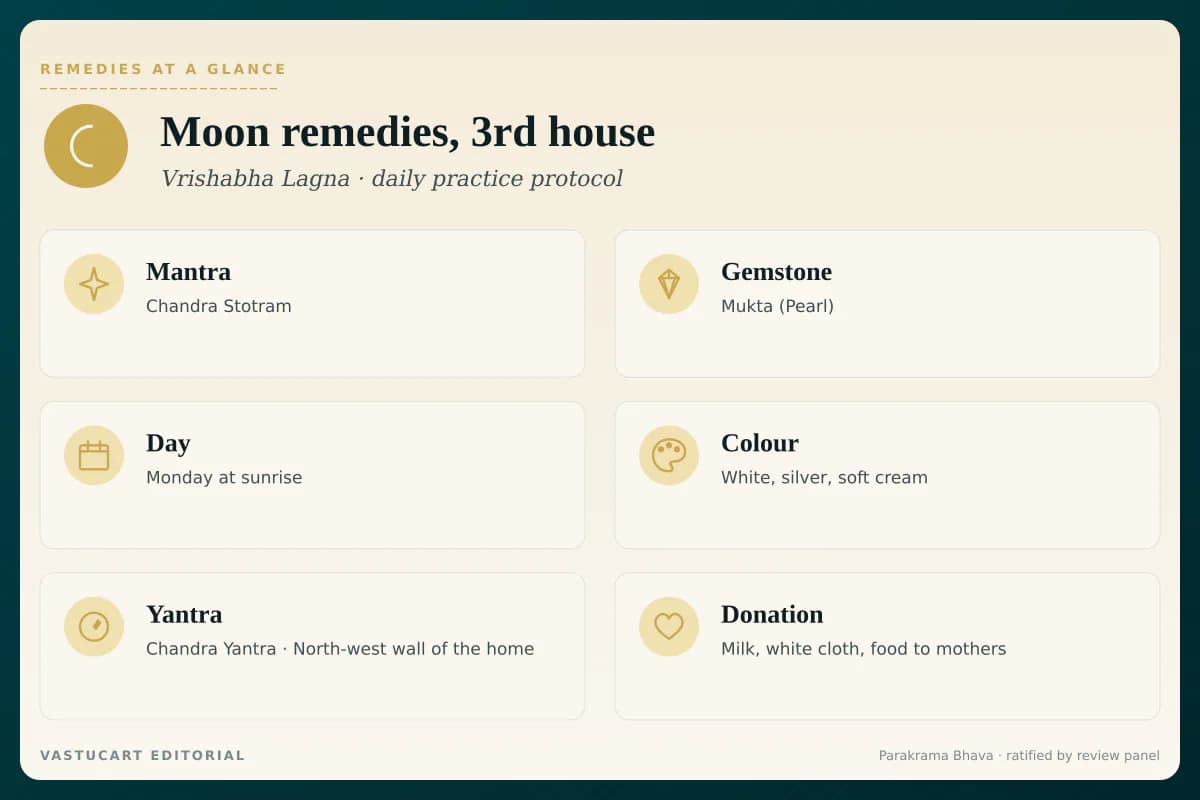
The daily Chandra recitation at moonrise is the primary remedy for this placement because it ritualises the relationship between the native's manas and the planet that owns it. Bathe before evening, wear cream or pale silver clothing on Mondays, and offer water and white flowers in the moonlight on full moon nights reciting the Chandra Kavacham. The Chandra Stotram is the longer recitation reserved for emotionally loaded windows.
For the 3L swakshetra specifically, a sustained writing practice is itself a remedial discipline because the chart's natural channel is parakrama through speech and hand. Even a private daily two-page page-count is enough to give the manas its outlet, and most clinical follow-ups confirm that natives who sustain this practice across a year report the most stable sleep and digestion of any sub-population in the Vrishabha cluster. Offer white rice, milk, and white sweets at the home altar on Mondays, and donate to causes that support sibling-aged or family-system needs (children's literacy, sibling-grief support groups, hospice family services).
The gemstone is pearl (Mukta), the primary Chandra ratna and the only stone consistently recommended for this placement after a confirmed reading. Wear a natural unblemished Basra or South Sea pearl of minimum five ratti set in silver on the small finger of the right hand on a Monday at moonrise after Chandra mantra recitation. Vrishabha is a friendly host for Chandra (Moon exalts in this lagna's sign), so pearl over a 3L Karka rarely overheats; the more common risk is under-dosing the stone and missing the steadiness benefit. Always consult a qualified Jyotishi who has read the full kundali before permanent wearing.
Gemstones for Chandra in 3rd house Vrishabha Lagna
Pearl is the primary Chandra gemstone and pairs cleanly with this 3L swakshetra placement after careful chart confirmation.


Disclaimer: Pearl over a Karka swakshetra is generally safe for the Vrishabha lagna because the lagna sign exalts the Moon. Even so, always confirm the full kundali with a qualified Jyotishi before permanent wearing.
Rudraksha beads for Chandra in 3rd house
The Chandra-aligned rudraksha is the Do Mukhi (Two Mukhi), the bead directly ruled by the Moon-and-Shiva pair.
The classical Chandra rudraksha and the bead specifically associated with the Moon's emotional containment. Strengthens the manas, supports the Sahaja Bhava self-expression rhythm, and stabilises the inner intensity when the Karka swakshetra is loaded by transit.
Guru is the exaltation lord of Karka and rules the 8L and 11L for Vrishabha. Wearing the Panch Mukhi alongside the Do Mukhi compounds the placement's natural strength by honouring both the Moon and the sign's exaltation lord.
Chandra Yantra for the Sahaja placement
Sacred recitations for Chandra in the Sahaja angle
namami shashinam somam shambhor-mukuta-bhushanam
Translation: Bright as curd, conch, and snow, born of the milk-ocean's churning flow, I bow to the Moon, jewel on Shiva's crest. The Chandra Stotram is the canonical Navagraha verse to the Moon and the perfect daily recitation for any Vrishabha native carrying Chandra in his own sign in the parakrama angle.
Read the full stotra on stotra.vastucart.in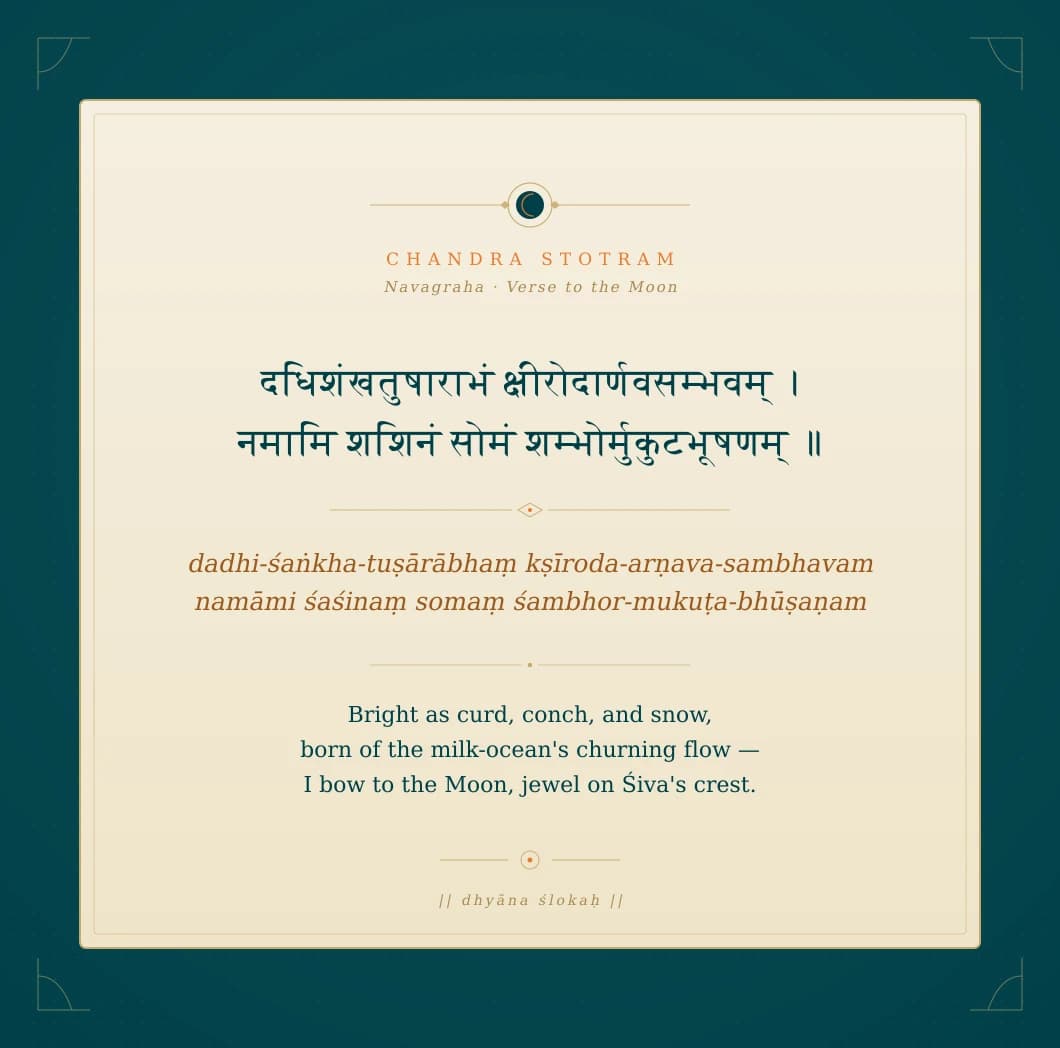
Tools for Chandra 3rd house Vrishabha natives
Is your Sahaja Bhava Chandra carrying the swakshetra signature?
Get a full personalised analysis of your third house Moon, the Karka own-sign placement, and the pearl protocol.