Venus in the 3rd house
Meena Lagna (Pisces Ascendant)
A practitioner study of Shukra in Sahaja Bhava for Pisces ascendant natives. Venus swakshetra in his own earthy Vrishabha in the 3rd upachaya, the dual 3L plus 8L lordship folded together where the 3L sits in his own bhava and pulls the 8L significator into a growth-house seat, producing the parakrama-craft yoga that turns sensual artistic effort into a self-made livelihood.
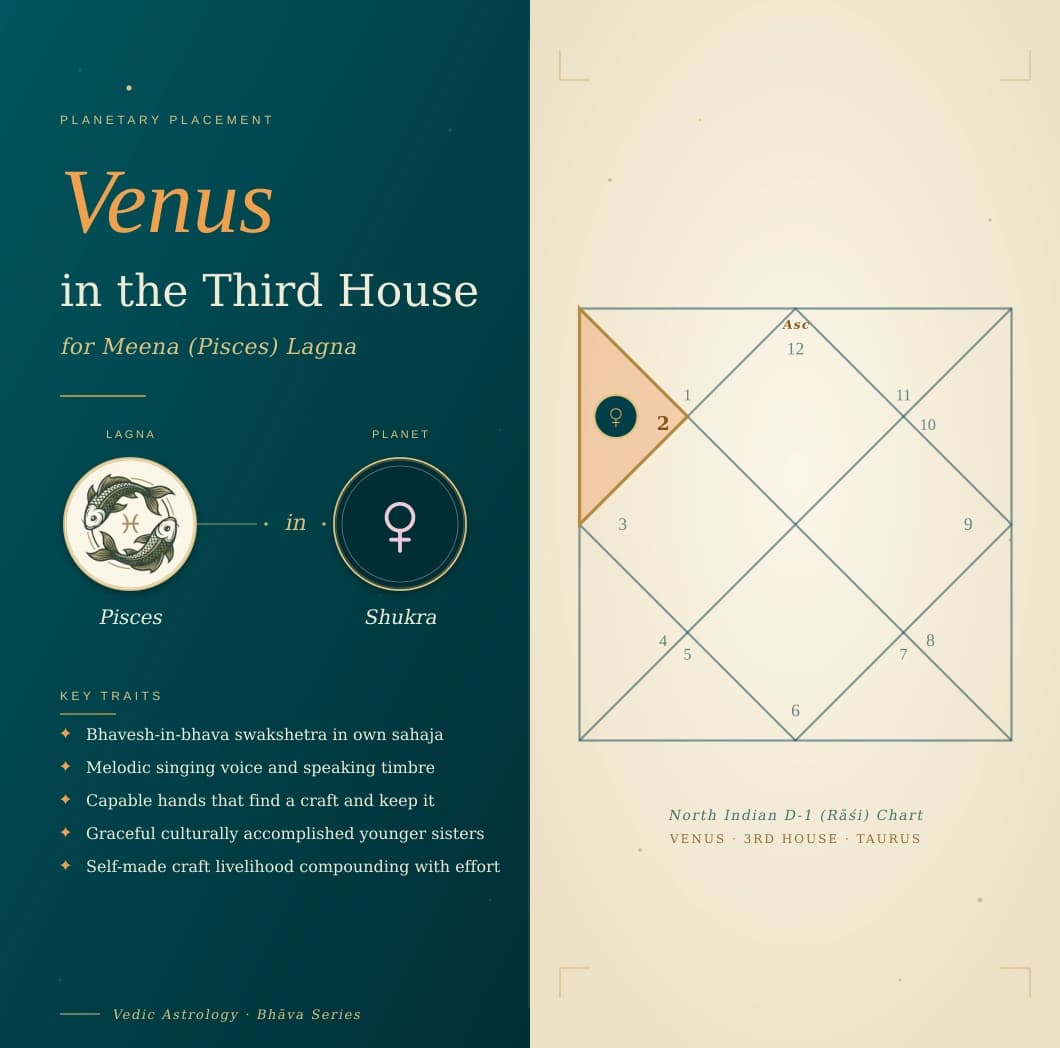
Venus sits swakshetra in his own earthy Vrishabha in the third house Sahaja Bhava for Pisces ascendant natives, the parakrama craft signature.
Venus in 3rd house for Meena Lagna, the quick reference
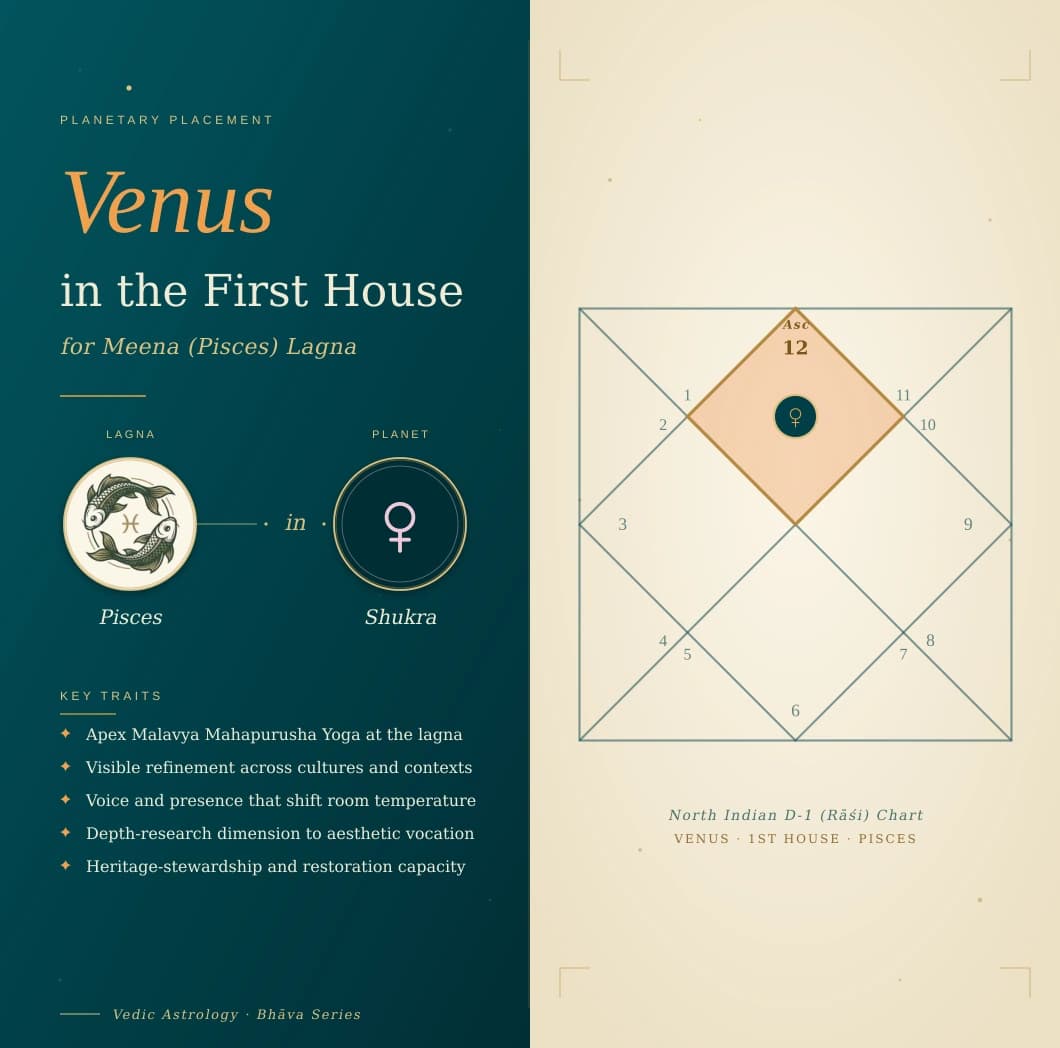
If you carry Venus in the third house of a Meena chart, you hold a configuration that classical Parashari prizes for self-made craft livelihood, because Shukra (Venus) sits swakshetra in his own earthy sign Vrishabha (Taurus) inside the Sahaja Bhava (the third house of personal effort, communication, siblings, and short journeys). Own-sign placement gives Venus his full natural strength. The third house is also an upachaya bhava, a house that grows in capacity through effort across decades, which means own-sign Venus in own bhava compounds positively the longer the native works the placement.
The second feature is the dual lordship. Venus rules both Vrishabha (3rd) and Tula (8th) for Meena, which means the same own-sign planet handles parakrama (self-effort, siblings, communication) and randhra (transformation, hidden material, inheritance) at once. The 3L sitting in his own 3 is the textbook bhavesh-in-bhava reading every classical commentator approves: the bhava lord seated in his own bhava strengthens that bhava and clears the lordship from across-chart obstruction. The simultaneous 8L ownership pulls a dushthana significator into an upachaya seat, and classical sources note that 8L in upachaya softens the dushthana shadow because growth-houses metabolise difficult karmic material rather than amplifying it. The third feature is the Vrishabha-earth signature. Vrishabha is Venus's earthy own sign and gives the placement a tactile, hands-on, sensual flavour that the Tula-air version of Venus does not carry. Natives turn aesthetic instinct into something the hand can shape: sculpture, ceramics, perfumery, food, textile design, instrument craft, hospitality interiors, and gemstone trade. The body voice is melodic because Vrishabha rules the throat. Younger sisters tend graceful and culturally accomplished. This guide reads every layer of Venus in 3rd house for Meena Lagna natives: the Vrishabha swakshetra, the 3L+8L convergence, the parakrama-craft formation, the upachaya softening, and the diamond protocol.
Why swakshetra Venus in Sahaja Bhava forms a Parakrama craft yoga
Students often arrive at this placement aware that Venus is strong in his own sign but uncertain why classical commentators rank Venus-in-own-Vrishabha-in-the-3rd above the merely-friendly Venus placements other charts can carry. The honest answer is structural. Venus has two own signs, Vrishabha (the earthy seat) and Tula (the airy diplomatic seat), and own-sign placement holds the second-highest dignity available to any planet. When the own sign occupies a bhava that the same planet also rules (Vrishabha is the 3rd house for Meena natives), the placement compounds two independent strengths at once: own-sign dignity and bhavesh-in-bhava strength. The 3rd is also an upachaya, the category of growth-houses (3, 6, 10, 11) that improve in functional capacity across the lifespan rather than peaking early.
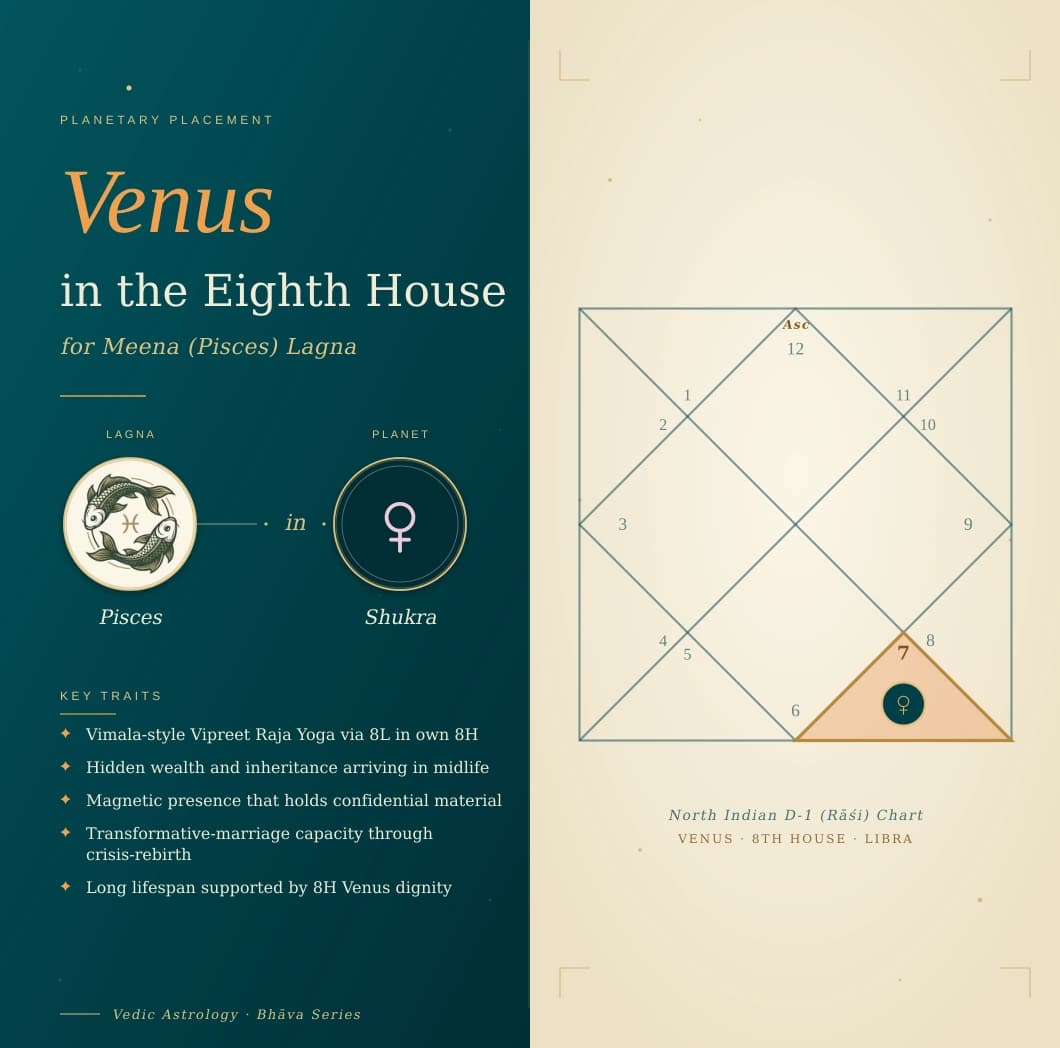
The 3L+8L convergence is the second specific feature practitioners need to handle correctly. Venus is the 3L (Vrishabha, the upachaya bhava of self-effort and craft) and the 8L (Tula, the dushthana bhava of transformation and inheritance) for Meena. The 3L placed in his own 3 satisfies the canonical lord-in-own-bhava rule; the 8L significator coming along into an upachaya seat is the second movement that classical sources note specifically softens the 8L shadow. When an 8L lord sits in an upachaya, the dushthana edge ceases to obstruct because growth-houses metabolise difficult material into compounding effort rather than amplifying its shadow weight. Many natives in this configuration become independent craft entrepreneurs in fields that braid sensory refinement with sustained hand-skill, founding ceramics studios, perfumery labels, hospitality boutiques, instrument-maker workshops, sculpture practices, gemstone-trade houses, and textile-design ateliers that grow steadily across the thirties and forties. The third interpretive layer is the comparison with the other two Shukra-Meena seats. Shukra-1 Meena is exalted Venus at the lagna in apex Malavya, structurally about visible aesthetic identity. Shukra-8 Meena is own-Tula Venus in randhra, structurally about transformative inheritance and crisis-and-rebirth marriage. Shukra-3 Meena is own-Vrishabha Venus in sahaja, structurally about self-made craft livelihood, the most hands-on of the three configurations because it routes the dignity through earth-element work rather than through the body or through hidden wealth.
Swakshetra Venus in the Meena sahaja is the rare configuration where own-sign dignity meets a growth-house seat in the same single position. The native's craft does not arrive ready-made. It compounds across decades into a livelihood the hand has earned.
Terms used in this article
A short glossary of the Sanskrit and Jyotish terms that recur in this study. First-occurrence expansion is also retained inline.
- Sahaja Bhava
- The 3rd house, the bhava of self-effort, siblings, communication, short journeys, courage, and hand-skill. An upachaya growth-house.
- Swakshetra
- Own-sign placement. A planet sitting in a sign it rules holds the second-highest dignity, just below exaltation.
- Upachaya
- The growth-house category (3rd, 6th, 10th, 11th). Bhavas that improve in functional capacity through sustained effort across decades.
- Bhavesh in bhava
- The lord of a bhava sitting in that same bhava. Classical sources read this as a strengthening signature for the bhava in question.
- Parakrama
- Personal valour, self-made effort, the courage to advance through one's own initiative rather than inherited support. The functional core of the 3rd house.
- Dushthana
- The 6th, 8th, and 12th houses. Bhavas of difficulty, hidden material, and dissolution that planets navigate carefully.
- Karakatva
- The natural significations a planet rules independent of any chart.
How swakshetra Venus in the 3rd shapes the Meena native
Physically the native carries the Meena water-frame routed through the Vrishabha-earth signature, often producing a body that strangers describe as quietly grounded rather than ethereally floating. The face tends rounded and full-cheeked with soft features, the gaze tends warm and direct, and the smile arrives easily and lingers. Skin tends warm-toned with a healthy clay undertone, hair tends thick and lustrous, and the bearing carries a tactile presence rather than a poised one. The voice is the standout body-feature. Vrishabha rules the throat, and own-sign Venus in the 3rd produces a melodic speaking timbre that often translates into singing capability. Many natives arrive at music school through a teacher noticing the voice in childhood. Hands tend strong and capable from young, the kind that find a craft and stay with it.
Temperament is where the placement most distinguishes the native. These natives carry the standard Meena emotional generosity (intuitive sensing, willingness to absorb others' experience, preference for harmony) but route it through the doing-hands channel rather than the empathic-feeling one. They are drawn from young to making things: drawing and painting through school years, baking and cooking with cultural depth, learning at least one musical instrument seriously, working with clay or wood or fibre or stone, organising the kitchen and the home with quiet aesthetic instinct. The Vrishabha steadiness combines with Venus relational warmth to produce natives who build communities around shared making, the rare combination that translates well into atelier-style entrepreneurship, hospitality founded on personal hand-skill, and music careers grounded in performance discipline rather than youth-market trend. The shadow side is the same earthy dimension. Natives who do not channel the upachaya effort consciously can drift into comfort-seeking patterns: prolonged stays in family homes well past independence age, food-and-pleasure routines that displace creative work, and sibling-conflict over inherited shared property that compounds across decades. Pairing the parakrama craft signature with explicit financial discipline and clear sibling boundaries produces the steady livelihood the placement is structurally capable of supporting.
Strengths, shadows and career fits
- Bhavesh-in-bhava swakshetra in own sahaja
- Melodic singing voice and speaking timbre
- Capable hands that find a craft and keep it
- Graceful culturally accomplished younger sisters
- Self-made craft livelihood compounding with effort
- Hospitality and short-journey neighbour networks
- Comfort-seeking that displaces creative discipline
- Prolonged stays in family home past independence
- Sibling conflict over inherited shared property
- Throat strain in performance-arts careers
- Weight gain through the thirties from sweet preference
- Tendency to absorb neighbour-network drama
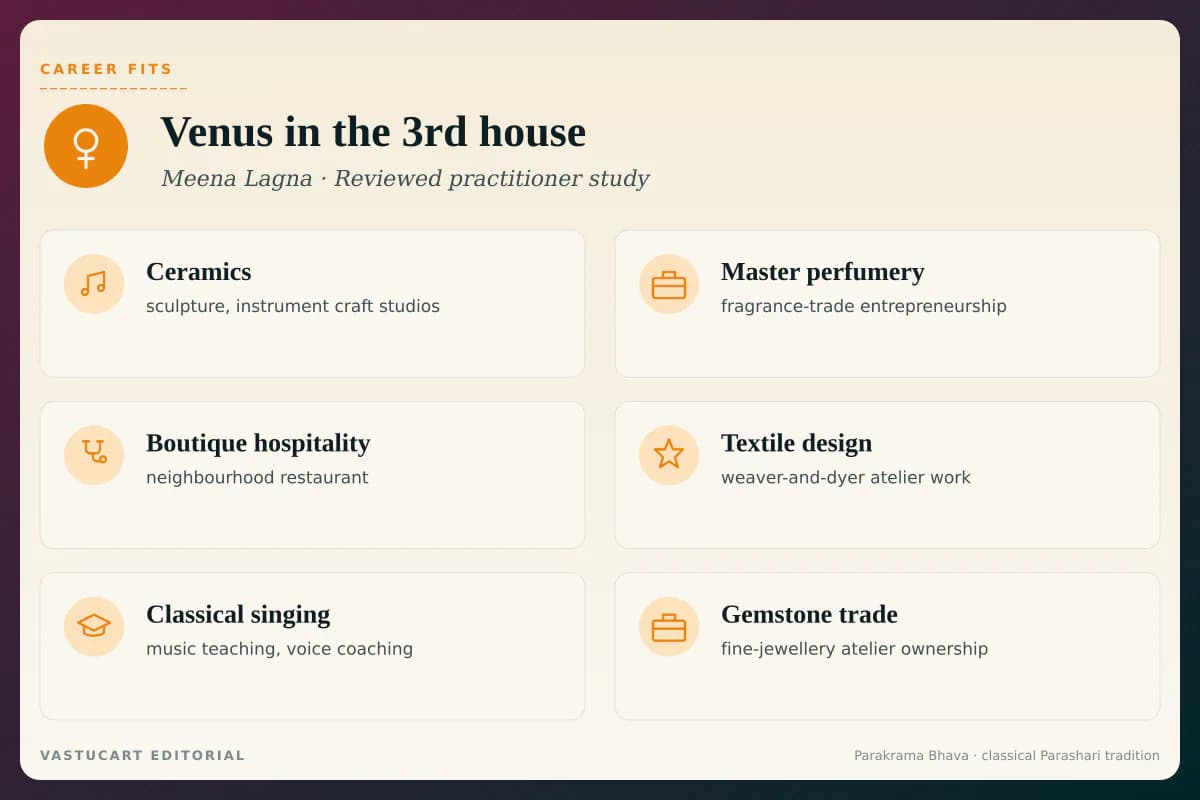
- Ceramics, sculpture, instrument craft studios
- Master perfumery, fragrance-trade entrepreneurship
- Boutique hospitality, neighbourhood restaurant
- Textile design, weaver-and-dyer atelier work
- Classical singing, music teaching, voice coaching
- Gemstone trade, fine-jewellery atelier ownership
Where the parakrama craft vocation plays out
Career paths cluster around fields that turn Venus aesthetic instinct into hand-shaped product. Ceramics, sculpture, and instrument-craft studios are the strongest single fit because Vrishabha is earth-element and the 3rd is the bhava of hand-skill, producing natives whose artistic vocabulary lives in clay, stone, wood, and metal rather than on the page or the screen. Many become studio potters, sculptors with gallery representation, lutenists or sitar-makers in classical traditions, and silversmith-jewellers who build their reputation through commissioned single pieces rather than production runs. The work tends to grow steadily from a small initial workshop in the late twenties into a recognised atelier by the late thirties.
Master perfumery and fragrance-trade entrepreneurship suit natives whose sensory refinement organises around scent. The Vrishabha throat-and-nose signature gives a discriminating olfactory palate, and the upachaya effort dimension supports the multi-year apprenticeship master perfumery requires. Many natives become independent perfumers, attar-makers in heritage traditions, or fragrance-house founders specialising in regional botanical traditions. Boutique hospitality and neighbourhood-restaurant ownership suit natives whose vocational mode involves running a small place that the surrounding community treats as its third room. The 3rd-house neighbour-network signature gives unusual loyalty to the local area, the Venus warmth makes the room itself comfortable, and the Vrishabha steadiness sustains the daily-shift work hospitality demands across decades.
Textile design and weaver-and-dyer atelier work pair Vrishabha tactility with Venus colour-eye, producing natives who run handloom studios, indigo-dyeing operations, and small-batch cloth design houses. Classical singing, music teaching, and voice coaching suit natives whose body voice is itself the working asset. Many become respected vocal teachers, performance singers in regional classical traditions, or voice coaches for stage actors and broadcasters. Gemstone trade and fine-jewellery atelier ownership suit natives whose Venus-Vrishabha eye recognises stone quality and whose 3rd-house hand-skill can either set stones personally or run a workshop that does. Venus mahadasha is the defining career window and arrives with the studio founding, the perfumery launch, the restaurant opening, the atelier inauguration, the recital series, or the jewellery-house establishment that crystallises the parakrama craft livelihood.
Why the growth-house seat rewards patient craft rather than fast wealth
The cleanest way to read Venus in 3rd of Meena is to hold the swakshetra dignity, the 3L-in-own-3 bhavesh seal, and the 8L-in-upachaya softening together rather than treating any of them in isolation. Classical Parashari recognises that own-sign placement gives a planet his full natural strength, and that bhavesh-in-bhava strengthens the bhava in question by anchoring the lordship clear of across-chart obstruction. When the same own-sign planet also carries an 8L significator, the upachaya seat metabolises the dushthana edge through the growth-house dynamic rather than amplifying it. Upachaya is the canonical category of bhavas (3, 6, 10, 11) that improve through effort, and 8L lords placed in upachayas commonly produce inheritance-and-transformation flows that arrive late and arrive cleanly rather than dramatically.
The slow-build dimension is the second specific feature practitioners need to handle correctly. The 3rd is a growth-house and the upachaya rule applies precisely: the placement does not peak in the twenties. The native's first studio, first label, first restaurant, first atelier opens small and stays small for several years before compounding takes hold. Many natives report that the breakthrough year arrives in the mid-thirties, the consolidation in the early forties, and the senior recognition in the fifties and sixties. The Venus mahadasha at twenty years is the longest mahadasha in the Vimshottari sequence, and natives who arrive at it during the upachaya consolidation phase commonly experience the placement as a sustained career-defining window rather than a single peak event. The third interpretive layer is the comparison with the other Shukra-Meena seats. Shukra-1 Meena gives apex visible identity. Shukra-8 Meena gives transformative inheritance. Shukra-3 Meena gives self-made craft livelihood, the most patient of the three configurations because the upachaya growth-house dynamic genuinely requires the decades of accumulated effort the placement asks for. Natives who study all three placements report that the 3rd-house version produces the steadiest career biographies and the deepest hand-skill mastery, even though the 1st-house version produces more visible recognition.
When the swakshetra Venus in sahaja delivers its parakrama chapter
Venus mahadasha is the defining window for this placement and arrives with the studio founding, the perfumery launch, the restaurant opening, the atelier inauguration, the recital series, or the jewellery-house establishment that crystallises the parakrama craft livelihood.
Throat, hands, and the Sahaja vitality signature
Health follows the Meena-with-Venus-in-3rd pattern with a kapha constitution that leans water-and-earth dominant because Venus carries water-element rasa and Vrishabha is earth-element. Body part rulership for the 3rd house emphasises the throat, ears, neck, shoulders, arms, and hands, and the Vrishabha sign emphasises the throat, lower jaw, palate, vocal cords, and the upper digestive tract. Venus rules the reproductive system, the throat-and-larynx region, and refined sensory function broadly. The placement therefore raises specific lifelong vulnerability to throat-and-vocal-cord strain in performance-arts careers, hand-and-wrist repetitive-stress injury in craft vocations, neck-and-shoulder tension in long studio sessions, and weight gain through the thirties from the Vrishabha sweet-and-rich-food preference.
The hand-tool risk is the second body-related layer to read carefully. Singers, musicians, ceramicists, sculptors, perfumers, jewellers, and chefs in this configuration spend decades working with hands and voice as primary instruments. The Vrishabha steadiness commonly delays the body's complaint signal until late, and natives often discover repetitive-strain injury or vocal-cord nodule formation in the late thirties when prevention should have started in the twenties. Daily wrist mobility practice, ergonomic studio furniture from day one, regular professional vocal coaching even for non-performance natives because Vrishabha throat carries lifelong significance, walking before sunrise to balance the seated workshop hours, and annual full-panel screening from the early thirties with specific attention to hand-joint and vocal-cord function are the protective routines. Singers and voice teachers should treat throat warm-ups and vocal hydration as non-negotiable rather than optional because the lagna routes its dignity through the voice when the body is allowed to maintain it.
Remedies for Venus in the Meena Sahaja angle
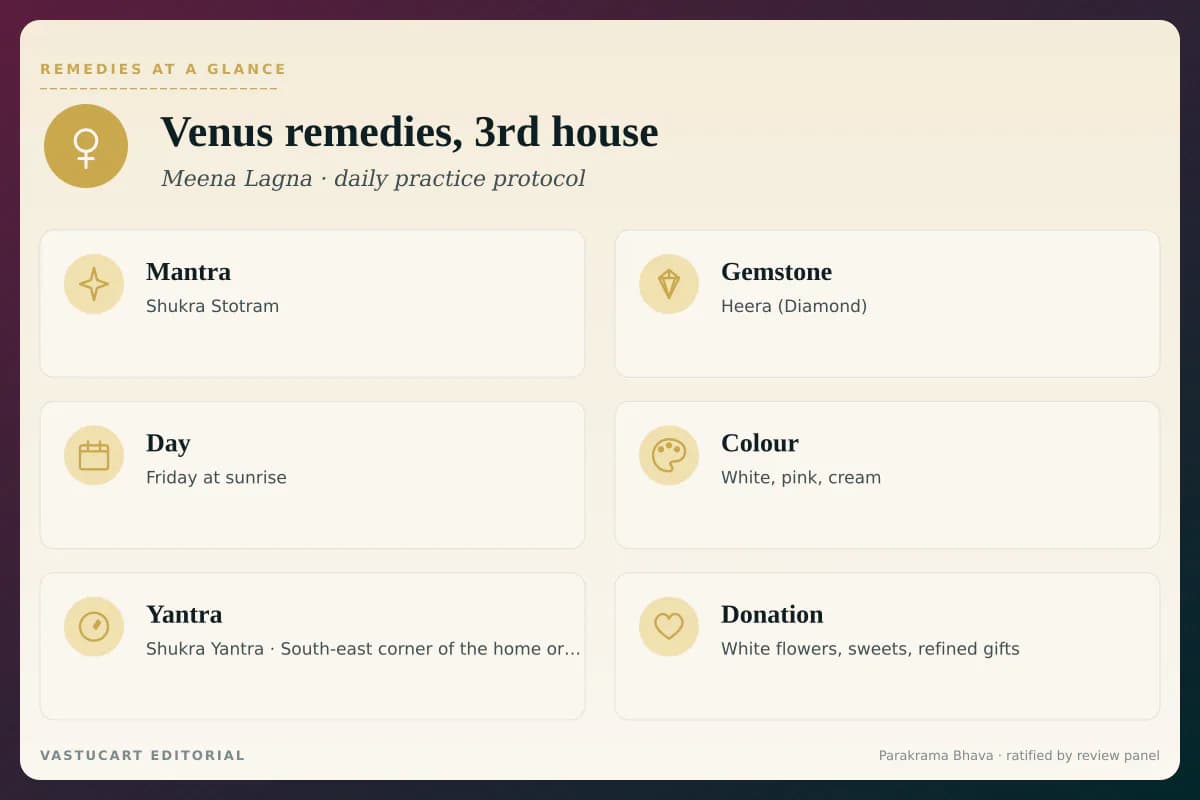
The daily Lakshmi worship is the primary remedy for this placement because Lakshmi is the consort-form of Venus's principle in the Vedic tradition, and her grace stabilises the wealth-and-craft significations that own-sign Venus rules through the parakrama livelihood. Rise before sunrise, bathe, wear white, cream, or pale rose clothing on Fridays, and visit a Lakshmi temple if accessible. The Shukra Stotram is the primary recitation, the Navagraha verse to Venus that creates a containing devotional field for the parakrama craft signature in its sahaja expression. Reciting it at sunrise daily for forty days at any major Venus transition (a studio founding, a perfumery launch, a restaurant opening, an atelier inauguration, a recital series, a jewellery-house establishment) is the formal protocol classical sources prescribe.
Offer white-and-rose flowers (especially white lotus, jasmine, and rose), white sweets, white sandal paste, and rose water at the altar. Donate fragrant items (rose water, sandal, jasmine garlands), women's items (sarees, bindis, bangles), and to causes that support working artisans (apprenticeship endowments for traditional craft, scholarship funding for music schools, materials-cost subsidy for emerging studio potters, voice-coaching grants for young singers from limited backgrounds). The sibling-relationship practice is the lifestyle remedy specific to the 3rd-house placement and compounds across decades into the difference between parakrama-flow and parakrama-conflict: an annual review of younger-sibling relationships and a quiet protocol for handling shared-property questions before they escalate keeps the placement directed. The gemstone is diamond (Heera), the primary Venus ratna, and is worn confidently here because the swakshetra Venus in the upachaya seat responds to amplification cleanly. Wear a natural untreated diamond of minimum half a carat set in platinum or white gold on the small finger of the right hand on a Friday at sunrise after Shukra mantra recitation, and only after a confirmed reading by a qualified Jyotishi.
Gemstones for Venus in 3rd house Meena Lagna
Diamond is the primary Venus gemstone and is worn confidently for this placement because the swakshetra Venus in the upachaya growth-house seat is structurally clean and amplifies cleanly under qualified guidance.
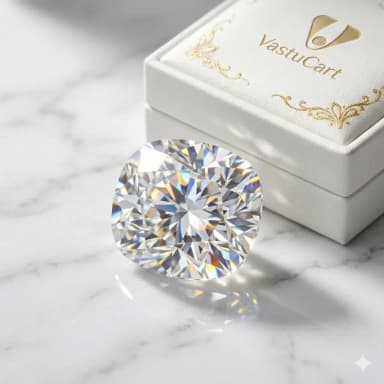
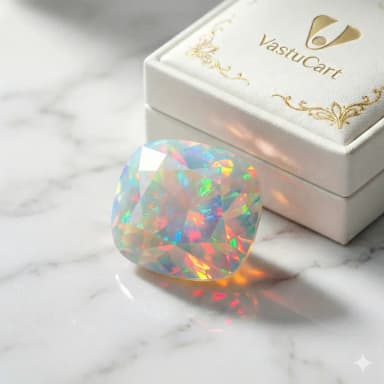

Disclaimer: Diamond over a swakshetra Venus in the upachaya sahaja amplifies the parakrama-craft channel cleanly. Always consult a qualified Jyotishi before permanent wearing.
Rudraksha beads for Venus in 3rd house
The Venus-aligned rudraksha is the Chhah Mukhi (Six Mukhi), the bead directly ruled by Kartikeya and Venus.
The classical Venus rudraksha and the bead specifically associated with relational harmony and aesthetic refinement. Supports the parakrama craft signature, channels the Vrishabha sensory instinct toward sustained workshop discipline, and stabilises the relational bandwidth when the studio, perfumery, restaurant, atelier, or recital practice is in active phase.
The three-mukhi bead supports parakrama and self-effort directly and is the bead specifically associated with the 3rd-house bhava and the courage required for self-made craft enterprise. Wearing the Teen Mukhi alongside the Chhah Mukhi compounds the placement's natural strength in independent studio work, neighbourhood hospitality, and the entrepreneurial dimension of the parakrama livelihood.
Shukra Yantra for the parakrama placement
Sacred recitations for swakshetra Venus in the sahaja
Sarva-shastra-pravaktaram bhargavam pranamamy aham
Translation: I bow to Bhargava, white as snow-jasmine and lotus-stem, the supreme preceptor of the daityas, the master who declares all sciences. The Shukra Stotram is the canonical Navagraha verse to Venus and is the perfect daily recitation for a chart where Venus sits swakshetra in the parakrama bhava and the craft livelihood needs a containing devotional field. Many natives advanced in practice add the Lakshmi Stotram on alternate days once the daily Shukra discipline is steady, because the upachaya growth-house dynamic responds well to the Lakshmi-prosperity layer.
Read the full stotra on stotra.vastucart.in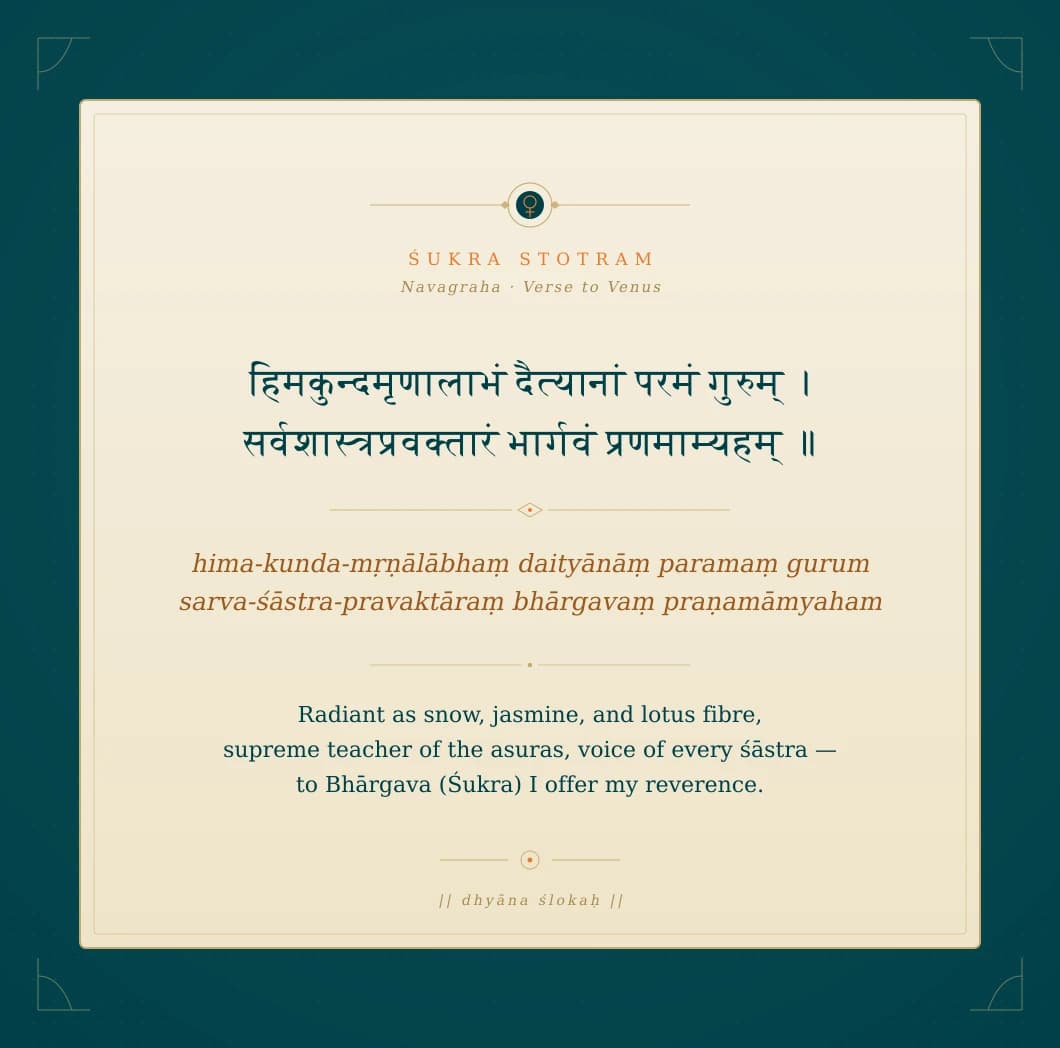
Tools for Venus 3rd house Meena natives
Is your Sahaja Bhava Venus carrying the parakrama craft signature?
Get a full personalised analysis of your third house Venus, the swakshetra Vrishabha seat, and the craft livelihood timing.