Venus in the 8th house
Meena Lagna (Pisces Ascendant)
A practitioner study of Shukra in Randhra Bhava for Pisces ascendant natives. Venus swakshetra in his own diplomatic Tula in the 8th dushthana, the dual 3L plus 8L lordship sitting inside a third dushthana yielding the Vimala-style Vipreet Raja Yoga formation, and the marana karaka sthana caution that this configuration uniquely softens through own-sign protection.
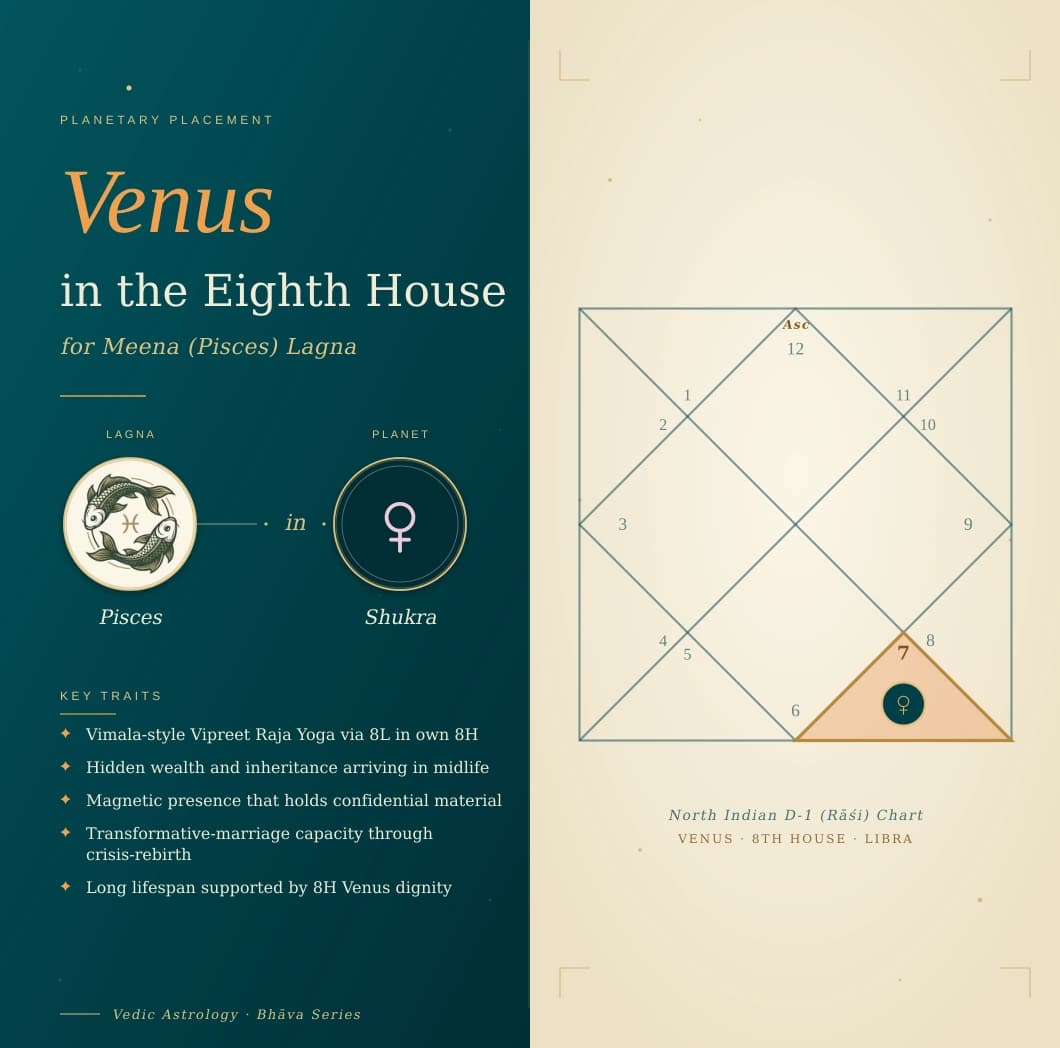
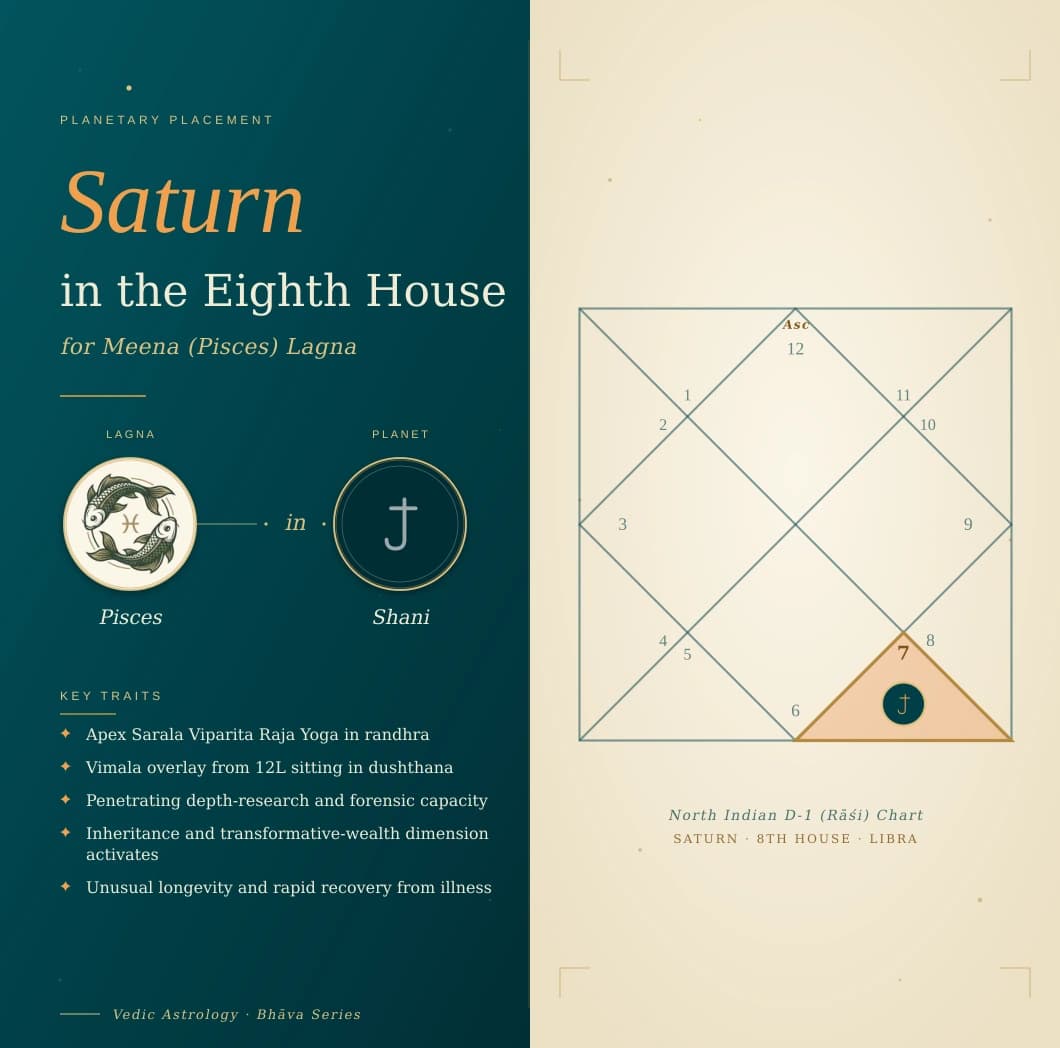
Venus sits swakshetra in his own Tula in the eighth house Randhra Bhava for Pisces ascendant natives, the dual-dushthana Vimala Vipreet signature.
Venus in 8th house for Meena Lagna, the quick reference
If you carry Venus in the eighth house of a Meena chart, you hold one of the most layered Venus configurations the wheel can produce, because Shukra (Venus) sits swakshetra in his own diplomatic sign Tula (Libra) inside the Randhra Bhava (the eighth house of transformation, inheritance, and hidden material). The dignity is therefore own-sign Venus, and own-sign placement protects the planet from the standard dushthana corrosion that an ill-dignified 8H Venus would otherwise carry. Classical Parashari treats this seat as a Vipreet Raja Yoga (reversal-style royal yoga) formation rather than a simple affliction, since both lordships Venus carries for this lagna route into the same dushthana through ownership.
The second feature is the dual lordship. Venus rules both Vrishabha (3rd) and Tula (8th) for Meena, which means the same own-sign planet handles parakrama (self-effort, courage, communication) and randhra (depth-research, transformation, inheritance) at once. The 3rd is itself a dushthana when read as a trika house, and the 8th is the canonical dushthana of transformation. When the 8th lord sits inside the 8th in his own sign and pulls the 3rd lord ownership along, the chart produces a textbook Vimala-style Vipreet Raja Yoga through the convergence of two dushthana lords inside the third dushthana via a single own-sign planet. The third feature is the marana karaka sthana caution. Venus is the karaka of marriage and partnership, and the 8th is classically a marana sthana (death-like position) for that significatory role, which sounds dramatic but in practice translates into marriages that pass through serious crisis-and-rebirth phases rather than smooth continuity. The own-sign protection softens this into a transformative-marriage signature rather than a dissolution one. This guide reads every layer of Venus in 8th house for Meena Lagna natives: the Tula swakshetra, the 3L+8L dual lordship, the Vimala Vipreet formation, the marana karaka softening, and the diamond protocol.
Why swakshetra Venus in Randhra Bhava forms Vimala Vipreet Raja Yoga
Students often arrive at this placement expecting an unequivocally afflicted Venus, since classical sources describe the eighth house as the dushthana that consumes the karakas placed within it. The honest reading is more nuanced. Among Venus's two own signs (Vrishabha and Tula), the Tula seat for Meena natives sits in the 8th, and own-sign placement gives the planet enough dignity to hold the bhava rather than be consumed by it. Classical Parashari describes a category of Vipreet Raja Yoga (reversal royal yogas) where dushthana lords route into other dushthanas. Vimala specifically forms when the 12th lord sits in the 12th, Sarala when the 8th lord sits in the 8th, and Harsha when the 6th lord sits in the 6th. The 8th lord Venus sitting in his own 8th here is the textbook Sarala Vipreet Raja Yoga formation, and the simultaneous 3rd lord ownership pulls a second dushthana lord into the same single position, layering the protective dynamic.
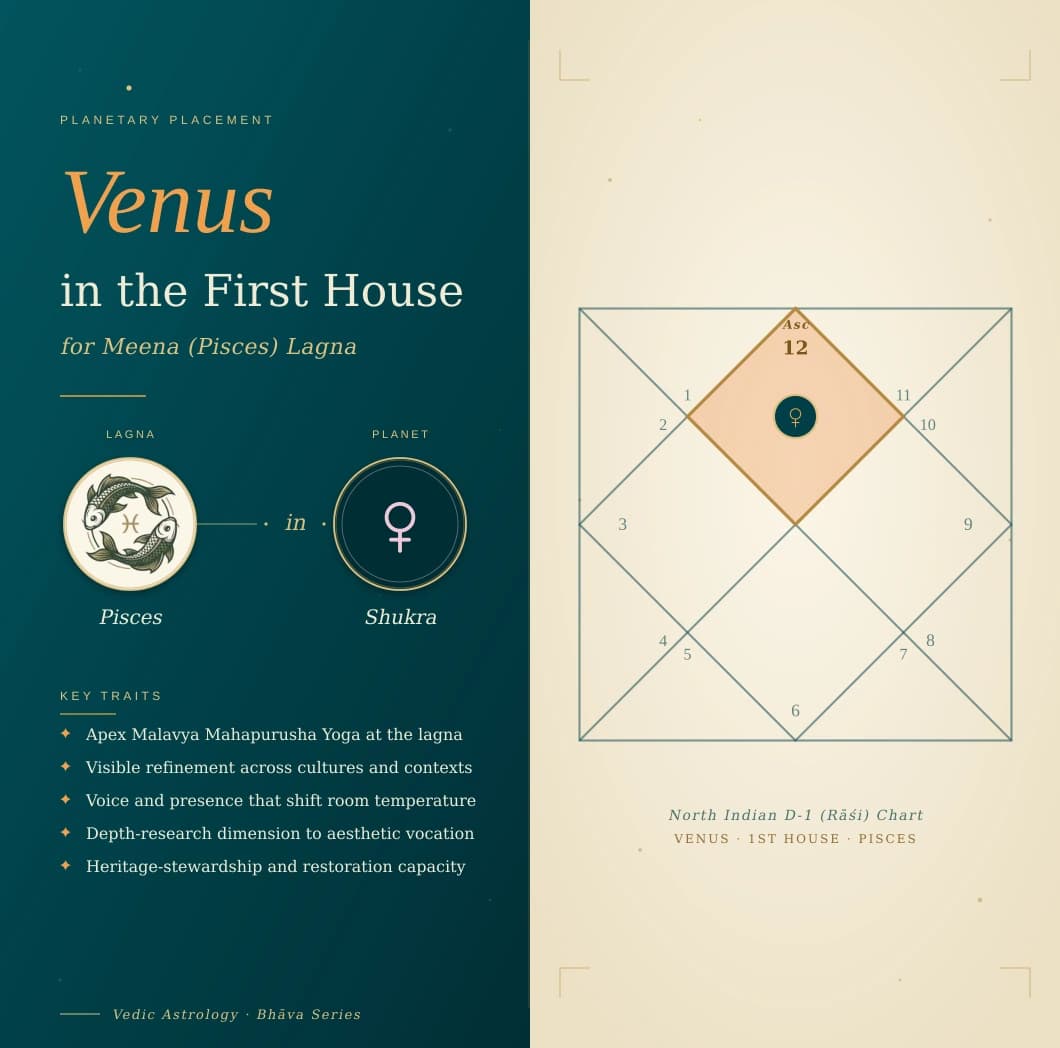
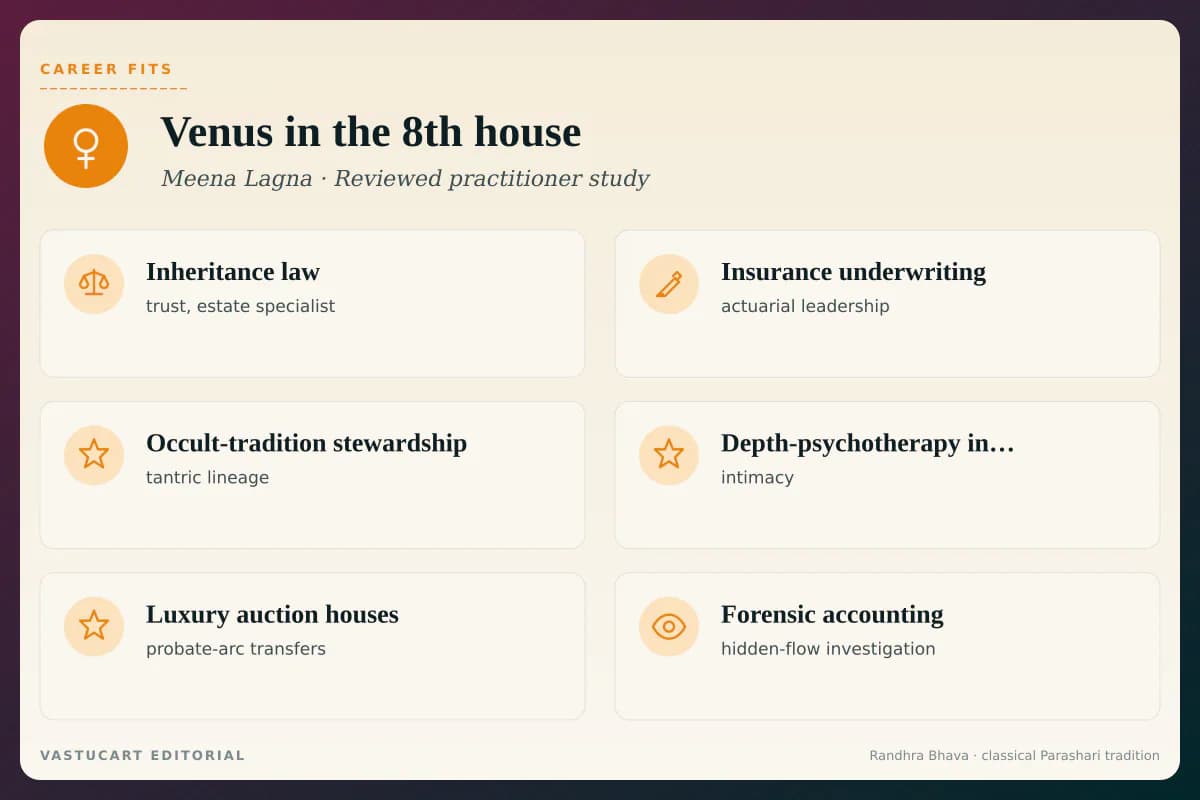
The 3L+8L convergence is the second specific feature that practitioners need to handle correctly. The 3rd house, when read through the trika lens (6, 8, 12 plus 3rd as upachaya-with-shadow), carries a dushthana edge for what classical sources call parakrama-shadow: communication with shadow material, sibling-relationship complexity, and the courage required for transformative effort. When the same own-sign planet rules both the parakrama-shadow domain and the randhra domain, the native draws professional vocation from territory most other charts can only enter awkwardly. Many natives in this configuration become senior occultists with serious investigative practice, inheritance attorneys and trust-and-estate specialists, insurance underwriters in the high-stakes catastrophe and life-policy categories, depth-psychotherapists working with sexuality and intimacy material, tantric-tradition practitioners and lineage-ritual leaders, and luxury-and-estate auctioneers handling probate-arc transfers. The third interpretive layer is the comparison with Shukra-1 Meena (apex Malavya Venus exalted at the lagna). Shukra-1 Meena is open-aesthetic apex placement, structurally about visible refinement. Shukra-8 Meena is hidden-aesthetic depth placement, structurally about transformative wealth and partnership routed through crisis-and-rebirth, the most rare configuration of all the Meena Venus seats.
Swakshetra Venus in the Meena randhra is the rare configuration where own-sign protection lets a natural karaka inhabit a marana sthana without dissolution. The native's wealth and partnerships transform through crisis rather than disappear in it.
Terms used in this article
A short glossary of the Sanskrit and Jyotish terms that recur in this study. First-occurrence expansion is also retained inline.
- Randhra Bhava
- The 8th house, the bhava of longevity, transformation, occult research, inheritance, and hidden material. A dushthana.
- Swakshetra
- Own-sign placement. A planet sitting in a sign it rules holds the second-highest dignity, just below exaltation.
- Vipreet Raja Yoga
- A reversal royal yoga formed when one dushthana lord (6L, 8L, or 12L) sits inside another dushthana, neutralising shadow weight.
- Vimala Yoga
- The 12L sitting in the 12H specifically. Sarala is 8L in 8H, Harsha is 6L in 6H. Together they form the Trika Vipreet set.
- Marana Karaka Sthana
- A house position considered death-like for a planet's significatory role. The 8th is marana for Venus as karaka of partnership.
- Dushthana
- The 6th, 8th, and 12th houses. Bhavas of difficulty, hidden material, and dissolution that planets navigate carefully.
- Karakatva
- The natural significations a planet rules independent of any chart.
How swakshetra Venus in the 8th shapes the Meena native
Physically the native carries the soft Meena water-frame routed through the 8th-house signature, often producing a body that strangers describe as quietly magnetic rather than openly luminous. The face tends well-balanced with a mysterious-eyed quality that reads as emotional depth, the gaze tends to hold longer than conversational norm, and the smile arrives slowly and selectively rather than freely. Skin tends pale-clear with a cooler undertone, hair tends fine and dark, and the bearing carries a contained refinement rather than a projected one. The voice tends measured and lower-registered than the body suggests, often praised for its calming quality in counselling, voice-over, and any setting where a steady tone holds difficult material. Many natives carry a noticeable scar, birthmark, or distinctive feature on the lower body or pelvic region that classical sources read as the Randhra physical signature.
Temperament is where the placement most distinguishes the native. These natives carry the standard Meena receptivity (intuitive sensing, willingness to absorb emotional weight, preference for non-confrontation) but route it through the 8th-house investigative channel rather than the open empathic one. They are drawn from young to mystery, hidden material, and depth-research: reading detective fiction and forensic case studies, asking the unspoken question in conversations others avoid, gravitating toward friends who carry unusual or transformative life histories, and being the person an extended family discreetly consults for sensitive matters. The Tula diplomatic instinct combines with the 8th-house depth-orientation to produce natives whose presence holds confidential material safely, the rare combination that translates well into senior counselling, occult-tradition stewardship, inheritance law, depth-psychotherapy, and discreet luxury-and-estate handling. The shadow side is the same hidden dimension. Natives who do not channel the marana karaka caution consciously can experience cycles of secret romantic-and-financial entanglement (relationships that operate underneath an existing partnership, hidden expenses funnelling toward a clandestine attachment, in-law conflicts that consume disproportionate bandwidth) that the placement is structurally vulnerable to. Pairing the Vimala Vipreet protection with explicit relational transparency and disciplined boundary-keeping produces the rare integration of depth-aesthetic vocation and durable partnership the placement is structurally capable of supporting.
Strengths, shadows and career fits
- Vimala-style Vipreet Raja Yoga via 8L in own 8H
- Hidden wealth and inheritance arriving in midlife
- Magnetic presence that holds confidential material
- Transformative-marriage capacity through crisis-rebirth
- Long lifespan supported by 8H Venus dignity
- Occult and depth-research vocation register
- Marana karaka caution for partnership karaka
- Risk of clandestine romantic entanglement
- In-law and joint-finance complexity
- Reproductive system and pelvic-region sensitivity
- Hidden expense flows toward shadow attachments
- Spouse may pass through severe crisis episodes
- Inheritance law, trust and estate specialist
- Insurance underwriting, actuarial leadership
- Occult-tradition stewardship, tantric lineage
- Depth-psychotherapy in sexuality and intimacy
- Luxury auction houses, probate-arc transfers
- Forensic accounting, hidden-flow investigation
Where the hidden-aesthetic vocation plays out
Career paths cluster around fields that braid Tula's diplomatic refinement with 8th-house depth-research. Inheritance law, trust-and-estate specialisation, and probate-arc handling are the strongest single fit. The 3L+8L convergence routes Venus's diplomatic eye through the legal-and-financial machinery of generational wealth transfer. Many natives become senior trust-and-estate partners, family-office succession architects, and constitutional-counsel attorneys in inheritance dispute. The work requires aesthetic sensitivity, legal precision, and the nervous-system stability to hold grief and money in the same conversation. Insurance underwriting in the catastrophe, life-policy, and high-net-worth-asset categories suits natives whose vocational mode is risk-and-mortality calculation.
Occult-tradition stewardship and tantric lineage practice work because the 8th house rules hidden knowledge and Venus brings the relational warmth initiation systems require. Many natives in their thirties step into lineage-holder roles in jyotish, tantra, kabbalistic, or hermetic traditions, transmitting confidential material to qualified students. Depth-psychotherapy specialising in sexuality and intimacy fits naturally because the marana karaka softening produces clinicians whose work with vulnerable client material is held by both refinement and depth. Many become senior trauma therapists, sex-therapy specialists, and couples therapists handling infidelity-recovery cases.
Luxury auction houses and probate-arc transfers suit natives whose vocational mode involves estate-handling: senior auctioneers at heritage houses, estate-liquidation specialists, and rare-art-and-jewellery dealers working with families in transition. Forensic accounting and hidden-flow investigation round out the technical edge. Venus mahadasha is the defining career window and arrives with the trust-and-estate partnership, the senior actuarial appointment, the lineage-holder confirmation, or the auction-house leadership that crystallises the Vimala Vipreet vocation.
Why the dushthana seat rewards depth rather than dissolves it
The cleanest way to read Venus in 8th of Meena is to hold the swakshetra dignity, the dual-dushthana lordship, and the marana karaka caution together rather than treating any of them in isolation. Classical Parashari recognises that own-sign placement gives a planet his full natural strength and protects him from the shadow corrosion ordinarily associated with dushthana seats. When the 8th lord sits in his own 8th, the formation classical sources name Sarala arises directly: the dushthana lord is contained within his own bhava and the standard 8H affliction reverses into a depth-research advantage. The simultaneous 3rd-lord ownership pulls a second dushthana-edge significator into the same own-sign position, layering Vimala-style protection into the seat through the dual-trika convergence.
The marana karaka sthana reading is the second specific feature practitioners need to handle correctly. Each planet has a house position considered death-like for its significatory function, and the 8th is marana for Venus as karaka of partnership and marriage. Read at face value this would mean Venus-as-marriage-karaka loses functional vitality in the 8th, but the own-sign protection here softens the rule into a transformative-marriage signature rather than a dissolution one. Many natives in this configuration marry partners who pass through serious health, professional, or family crisis episodes during the marriage and emerge transformed alongside the native rather than separating from them. The spouse often inherits substantial assets in midlife, the marriage commonly involves a significant cross-cultural or cross-tradition dimension, and the partnership tends to consolidate around joint-finance and estate stewardship rather than around shared social life. The third interpretive layer is the comparison with the Shukra-1 Meena placement (Venus exalted in Meena at the lagna). Shukra-1 Meena is apex visible aesthetic. Shukra-8 Meena is concealed depth-aesthetic with a transformative-marriage register. Natives who study both placements report that the 8H version produces clinically more layered partnership biographies and substantially more inheritance-driven wealth, even though the 1H version produces more visible personal beauty and broader public recognition.
When the swakshetra Venus in the randhra delivers its Vimala chapter
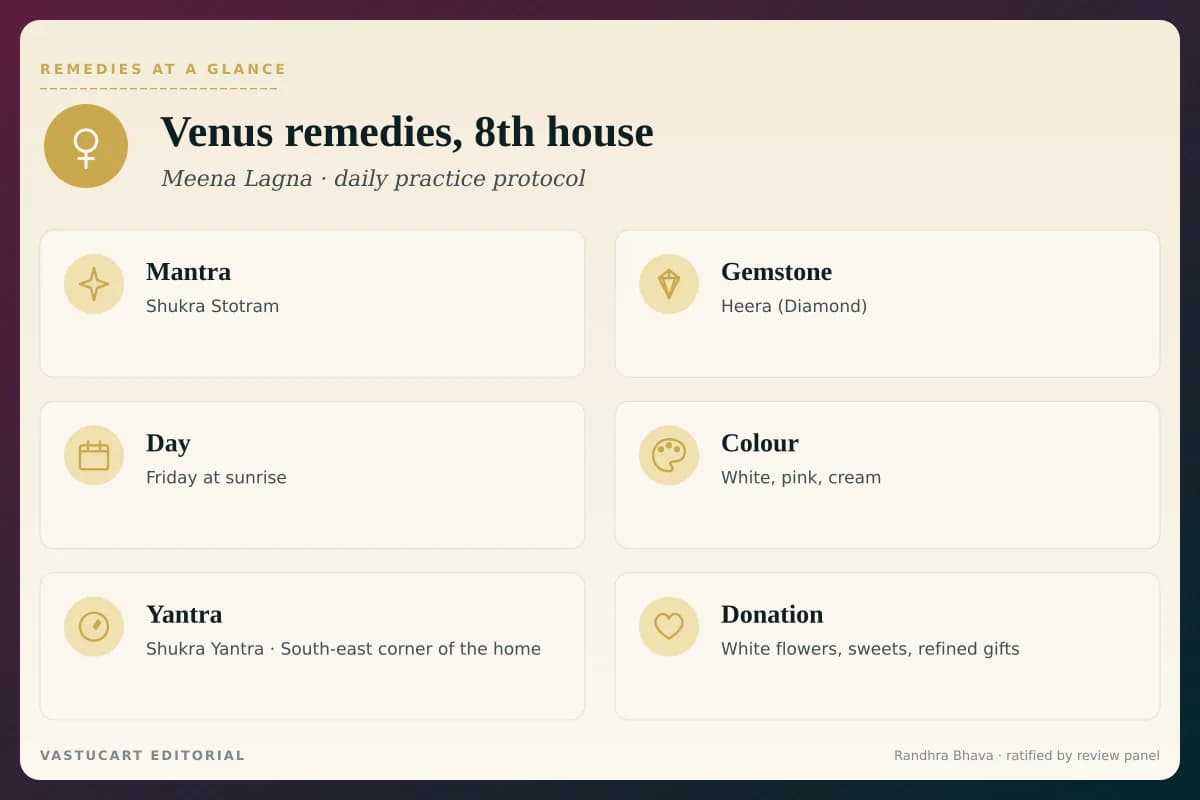
Venus mahadasha is the defining window for this placement and arrives with the trust-and-estate partnership, senior actuarial appointment, lineage-holder confirmation, depth-psychotherapy practice founding, auction-house leadership, or forensic-investigation chief role that crystallises the Vimala Vipreet vocation.
Pelvic basin, reproductive system, and the Randhra vitality signature
Health follows the Meena-with-Venus-in-8th pattern with a kapha-vata constitution that leans water-dominant because Venus carries water-element rasa and Meena is itself a water-kapha sign. Body part rulership for the 8th house emphasises the reproductive organs, the pelvic basin, the lower back, and the urogenital tract. Venus rules the reproductive system, the throat-and-larynx region, and refined sensory function broadly, pulling Venus karakatva and Randhra body-rulership onto the same anatomical zone. The configuration raises lifelong vulnerability to reproductive-system sensitivity, pelvic-floor weakness from the thirties onward, lower-back episodes during stress periods, and urogenital infection patterns that require tracking rather than reactive medicine.
The hidden-flow risk is the second body-related layer. Venus in the 8th gives the body a strong pull toward sweet-rich, dairy-heavy food consumed in private rather than at communal table. The secret-eating pattern is itself a recurring marker for natives who do not channel the placement consciously. The recurring pattern is steady weight gain through the thirties accumulating around the lower body, fluid-retention markers emerging in the forties, and metabolic-syndrome-with-pelvic-congestion presentation by the fifties when counterweights are absent.
Daily walking before sunrise, restraint with desserts and dairy after sunset, regular pelvic-floor exercise (yoga moola bandha practice is the classical recommendation), swimming for lymphatic drainage, and annual full-panel screening from the early thirties are the protective routines. Counsellors, voice-workers, and performers should treat throat warm-ups and vocal hydration as non-negotiable because Venus throat-rulership compounds with the placement's held-emotion tendency. The longevity dimension is the compensating signal. The 8th house rules ayur (lifespan), and Venus dignity inside it commonly supports unusually long life when body discipline is held, with many natives reaching the late eighties in active practice.
Remedies for Venus in the Meena Randhra angle
The daily Lakshmi worship is the primary remedy for this placement because Lakshmi is the consort-form of Venus's principle in the Vedic tradition, and her grace stabilises the wealth-and-partnership significations that swakshetra Venus rules even from the dushthana seat. Rise before sunrise, bathe, wear white, cream, or pale rose clothing on Fridays, and visit a Lakshmi temple if accessible. The Shukra Stotram is the primary recitation, the Navagraha verse to Venus that creates a containing devotional field for the Vipreet Raja Yoga in its dushthana expression. Reciting it at sunrise daily for forty days at any major Venus transition (a trust-and-estate partnership, a senior actuarial appointment, a lineage-holder confirmation, a depth-psychotherapy practice founding, an auction-house directorship) is the formal protocol classical sources prescribe.
Offer white-and-rose flowers (especially white lotus, jasmine, and rose), white sweets, white sandal paste, and rose water at the altar. The Sri Suktam is the secondary recitation specifically suited for this placement because the 8th-house Venus benefits from the Lakshmi-prosperity invocation more than the 1st-house Venus does, and many practitioners rotate Shukra Stotram on alternate days with Sri Suktam through the Venus mahadasha. Donate fragrant items (rose water, sandal, jasmine garlands), women's items (sarees, bindis, bangles), and to causes that support widows, single mothers, and inheritance-arc support work (legal-aid endowments for probate disputes, scholarship funding tied to family-loss recovery, depth-counselling practice subsidies). The conscious-relational practice is the lifestyle remedy that compounds across decades into the difference between Vipreet-mastery and Vipreet-entanglement: a daily reflection on which financial flows are above the table and which are operating underneath it keeps the placement directed. The gemstone is diamond (Heera), the primary Venus ratna, and is worn carefully here because the 8th-house seat asks for measured amplification after qualified consultation rather than the open wearing protocol the 1st-house apex placement supports. Wear a natural untreated diamond of minimum half a carat set in platinum or white gold on the small finger of the right hand on a Friday at sunrise after Shukra mantra recitation, and only after a confirmed reading by a qualified Jyotishi familiar with marana karaka sthana protocols.
Gemstones for Venus in 8th house Meena Lagna
Diamond is the primary Venus gemstone and is worn after qualified consultation for this placement because the marana karaka softening through own-sign protection requires a measured amplification protocol.
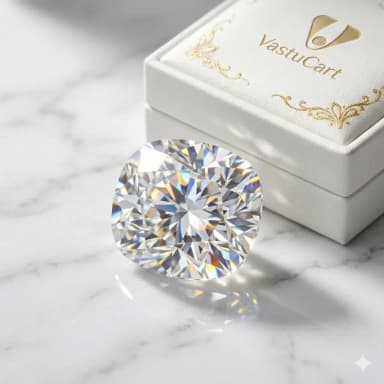
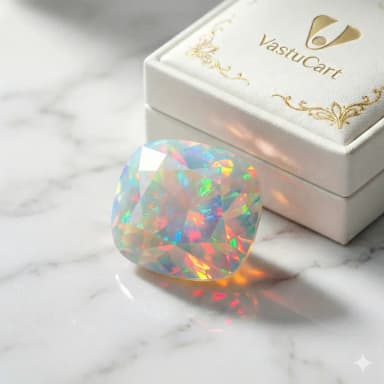

Disclaimer: Diamond over a swakshetra 8th-house Venus carries marana karaka considerations. Always consult a qualified Jyotishi familiar with Vipreet protocols before permanent wearing.
Rudraksha beads for Venus in 8th house
The Venus-aligned rudraksha is the Chhah Mukhi (Six Mukhi), the bead directly ruled by Kartikeya and Venus.
The classical Venus rudraksha and the bead specifically associated with relational harmony and aesthetic refinement. Supports the Vimala Vipreet signature, channels the partnership-karaka instinct toward transformative rather than clandestine territory, and stabilises the relational bandwidth when the trust-and-estate, lineage-holder, depth-psychotherapy, or auction-house vocation is in active phase.
The eight-mukhi bead removes obstacles specifically tied to 8th-house material and supports clean transit through transformative life passages. Wearing the Aath Mukhi alongside the Chhah Mukhi compounds the placement's natural strength in inheritance handling, family-transition stewardship, and the institutional dimension of the Vipreet vocation.
Shukra Yantra for the Randhra placement
Sacred recitations for swakshetra Venus in the randhra
Sarva-shastra-pravaktaram bhargavam pranamamy aham
Translation: I bow to Bhargava, white as snow-jasmine and lotus-stem, the supreme preceptor of the daityas, the master who declares all sciences. The Shukra Stotram is the canonical Navagraha verse to Venus and is the primary daily recitation for a chart where Venus sits swakshetra in the 8th and the Vimala Vipreet signature needs a containing devotional field. Many natives advanced in practice add the Sri Suktam recitation as a secondary layer because the 8th-house Venus benefits specifically from the Lakshmi-prosperity invocation that the verse carries.
Read the full stotra on stotra.vastucart.in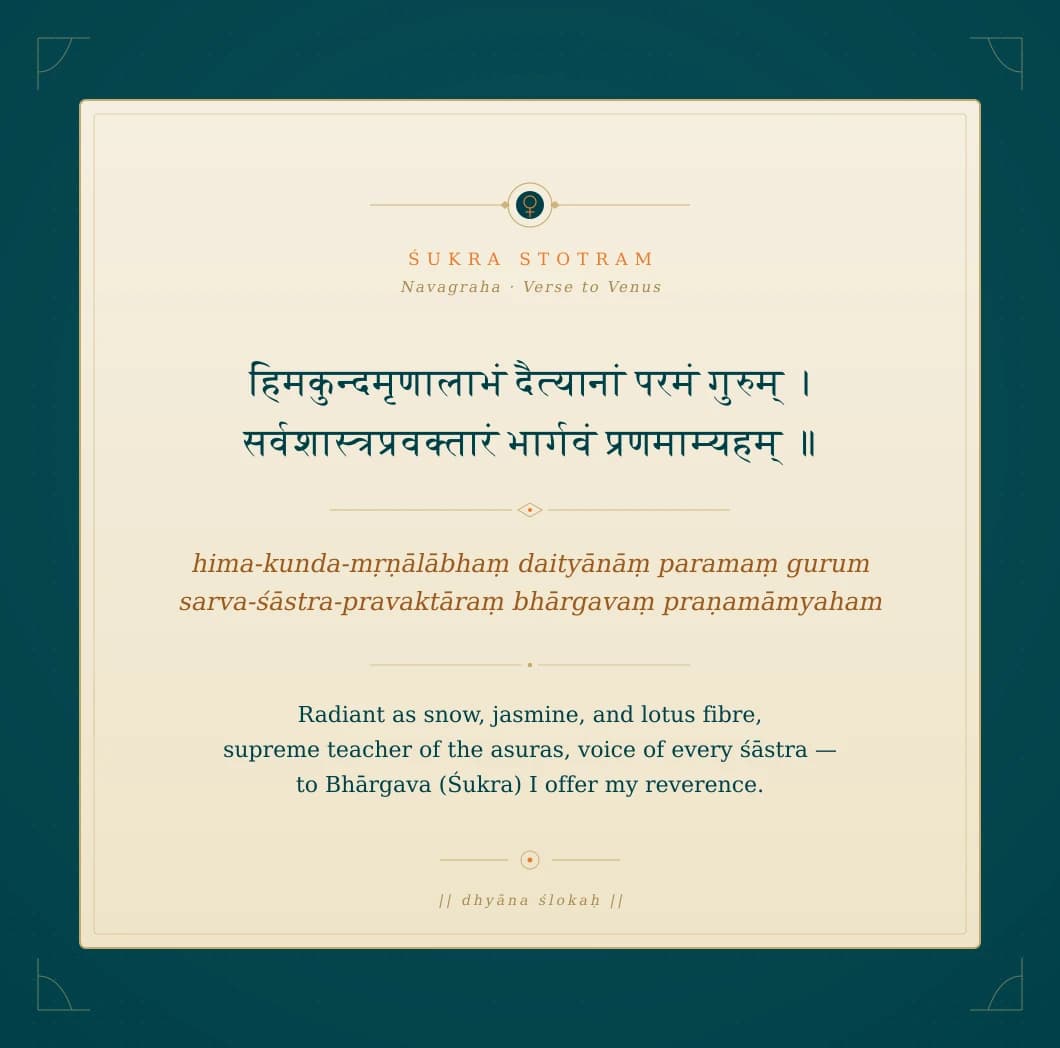
Tools for Venus 8th house Meena natives
Is your Randhra Bhava Venus carrying the Vimala Vipreet signature?
Get a full personalised analysis of your eighth house Venus, the swakshetra Tula seat, and the inheritance-and-transformation timing.