Jupiter in the 1st house
Meena Lagna (Pisces Ascendant)
A practitioner study of Guru in Tanu Bhava for Pisces ascendant natives. Jupiter swakshetra in his own sign Meena, the dual 1L and 10L lordship sitting at the lagna, the apex Hamsa Mahapurusha Yoga that defines the strongest Jupiter signature available to any chart.
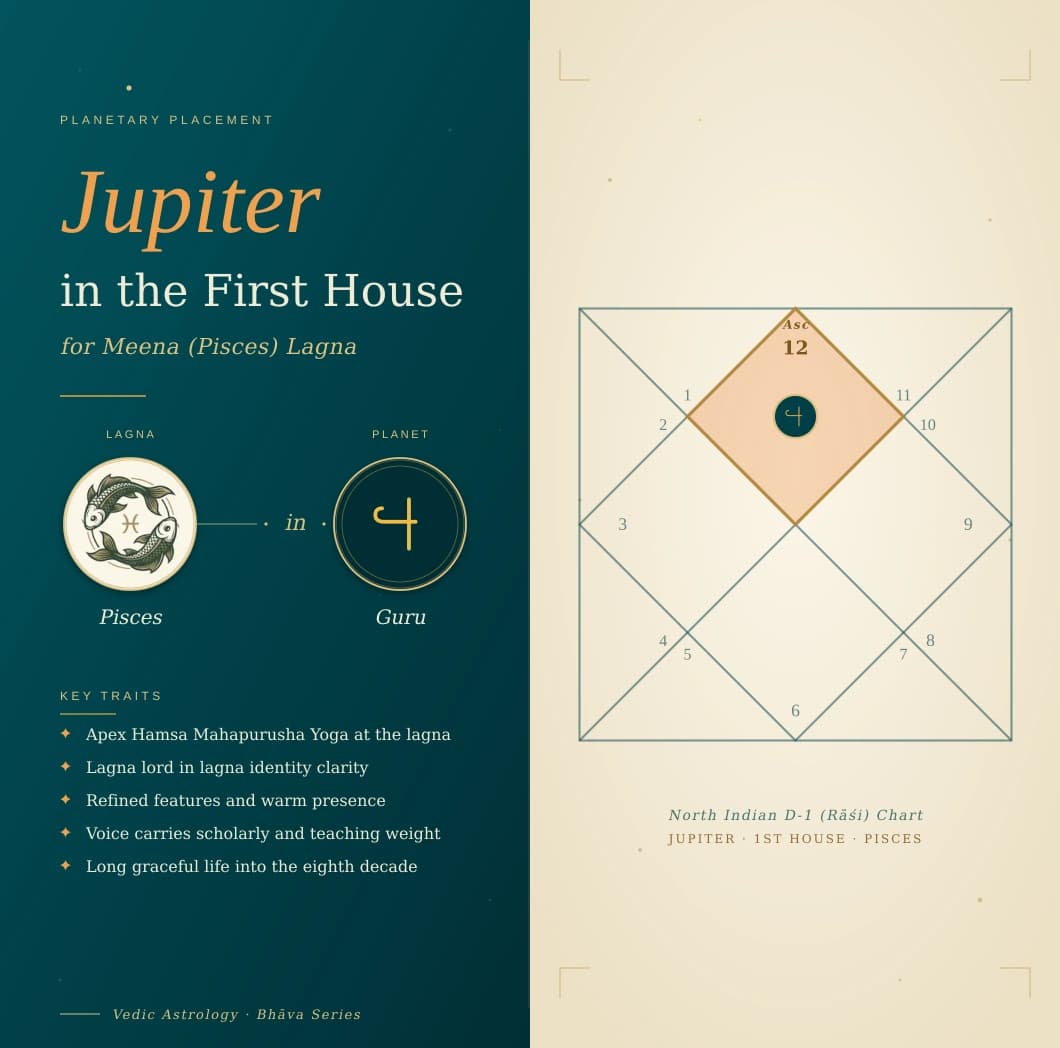
Jupiter sits swakshetra in his own Meena in the first house for Pisces ascendant natives, the apex Hamsa Mahapurusha Yoga signature.
Jupiter in 1st house for Meena Lagna, the quick reference
If you carry Jupiter in the first house of a Meena chart, you hold the apex Jupiter placement available to any lagna in the entire Vedic catalogue. Guru (Jupiter) is the lagna lord, and Meena (Pisces) is one of his two own signs. The dignity is therefore swakshetra Jupiter (own-sign Jupiter), and the placement creates a textbook Hamsa Mahapurusha Yoga (the swan great-person yoga of Jupiter) at the strongest possible angle, since the first house is a kendra and a trikona simultaneously.
The second feature is the dual lordship. Jupiter rules both Meena (1st) and Dhanu (9th's mirror image at 10th, but for Meena, the 10th-from-Meena is Dhanu, also Jupiter's other own sign). For Meena Lagna, Jupiter is the 1L (lagna lord, body and self) and the 10L (career, public dharma). When this dual lord sits in his own sign at the lagna, the chart fuses identity and vocation into one channel: the native cannot easily separate who they are from what they do, and the public role they grow into becomes itself an extension of their inner nature. Hamsa specifically delivers refined features, an unusually warm temperament, a teaching presence that registers across rooms, lifelong dharmic work, and the slow but durable wealth that follows wisdom-led careers. The third feature is the lagna-lord-in-lagna principle. The body and the public self take their cues from where the lagna lord lives. When the lagna lord sits at the lagna itself in his own sign, the gap between essence and appearance closes from birth. This guide reads every layer of Jupiter in 1st house for Meena Lagna natives: the Meena swakshetra, the 1L+10L lordship, the apex Hamsa formation, the dharma-karma fusion, and the yellow sapphire protocol.
Why swakshetra Jupiter in Tanu Bhava forms apex Hamsa Mahapurusha Yoga
Students often arrive at this placement aware that Jupiter is strong in his own sign but uncertain why classical commentators rank Jupiter-in-1st-of-Meena above the merely-exalted Jupiter placements other charts can hold. The answer is structural. Hamsa is one of the five Pancha Mahapurusha (five great-person) yogas of classical Jyotish, and the rule is precise. Jupiter must sit in his own or exalted sign, and the sign must occupy a kendra (1st, 4th, 7th, or 10th house). Meena is Jupiter's own water sign, and the 1st is the most foundational kendra because it is also a trikona, the single bhava that doubles as angular structure and dharmic backbone.
The dual 1L+10L reading is the second specific feature that practitioners need to handle correctly. Jupiter is the lagna lord (1L, ruling Meena) and the karma lord (10L, ruling Dhanu) for this chart. The 1H rules the body and the self, the 10H rules profession and public reputation, and a single planet ruling both ends of the dharma-karma axis is a configuration only Meena natives carry. When this same planet sits in his own sign at the lagna in apex kendra dignity, the chart's whole identity organises around the dharmic vocation. Many natives in this configuration become recognised by their thirties for work that visibly carries their inner character: scholarly teaching, classical philosophy, judicial service, banking and finance leadership, premium hospitality with dharmic edge, monastic instruction, and counselling traditions. The third interpretive layer is the contrast with Jupiter exalted in Karka (which lands in 5H for Meena). Jupiter exalted in 5H Karka would be apex by exaltation, but it would not be the lagna lord. Jupiter swakshetra in 1H Meena IS the lagna lord and IS in apex kendra Hamsa formation, which is why classical commentators rank this configuration above any other Jupiter placement available across the twelve lagnas.
Jupiter in his own sign at the Meena lagna is not a generic strong placement. It is the single configuration where the lagna lord, the apex Hamsa formation, and the dharma-karma axis all align in one position, and the native's identity and vocation become the same continuous arc.
Terms used in this article
A short glossary of the Sanskrit and Jyotish terms that recur in this study. First-occurrence expansion is also retained inline.
- Tanu Bhava
- The 1st house, the bhava of body, self, and identity. Both kendra and trikona at the same time.
- Swakshetra
- Own-sign placement. A planet sitting in a sign it rules carries the second-highest dignity, just below exaltation.
- Hamsa Mahapurusha Yoga
- Jupiter in his own or exalted sign in a kendra. One of the five Pancha Mahapurusha (great-person) yogas.
- Kendra
- Angular houses 1, 4, 7, 10. The four pillars of the chart that hold structural strength.
- 1L
- First-house lord, the planet ruling the sign on the 1st cusp. Carries the body, self-image, and life direction.
- 10L
- Tenth-house lord, ruling career, public reputation, and dharmic action in the world.
- Karakatva
- The natural significations a planet rules independent of any chart.
How swakshetra Jupiter at the lagna shapes the Meena native
Physically the native carries the classic Meena soft-water frame expanded by Jupiter's own warmth, often producing a body that strangers describe as substantial and visibly kind. The face tends round and full with an unusually warm complexion, the eyes are wide and set with a noticeable depth, and the smile carries a quick generosity that puts other people at ease. Hair is generally thick and abundant in the early decades, the bearing tends slightly stout rather than lean, and many natives carry an extra fullness through the upper body and lower face that classical sources read as the Hamsa physical signature. The voice is warm and resonant, frequently in a deeper register than the body suggests, and translates well to teaching, podcasting, broadcasting, and any platform where vocal warmth matters more than vocal force.
Temperament is where the placement most distinguishes the native. These natives carry the standard Meena receptivity (intuitive sensing, emotional generosity, the willingness to absorb other people's experience) but route it through the Jupiter-wisdom channel rather than the purely empathic one. They are drawn from young to teaching roles, advisory positions, and lineage-stewardship work: organising study circles for friends, taking on counsellor roles inside extended family, mentoring younger siblings or cousins, and seeking out elders who model long-form ethical practice. The Meena empathy combines with Jupiter's structural wisdom to produce natives whose advice carries durable weight, the rare combination that translates into senior counselling, judicial service, philosophical writing, and religious-cultural leadership over the working decades. The shadow side is the same expansive dimension. Natives who do not channel the Hamsa role consciously can experience cycles of over-extension (taking on too many advisory commitments, lending money or attention beyond actual capacity, treating every problem as one they must personally absorb) that drain bandwidth across years. Pairing the dharmic abundance with explicit boundaries and a regular practice of saying no produces the rare integration of expansive warmth and durable presence the placement is structurally capable of supporting.
Strengths, shadows and career fits
- Apex Hamsa Mahapurusha Yoga at the lagna
- Lagna lord in lagna identity clarity
- Refined features and warm presence
- Voice carries scholarly and teaching weight
- Long graceful life into the eighth decade
- Dharmic vocation visible from the thirties
- Over-extension if dharmic abundance is unmoderated
- Lending money and attention too freely
- Weight gain and metabolic slowdown across decades
- Liver and pancreas sensitivity if diet is loose
- Romantic life can carry mentor-student undertones
- Reluctance to set firm boundaries with family
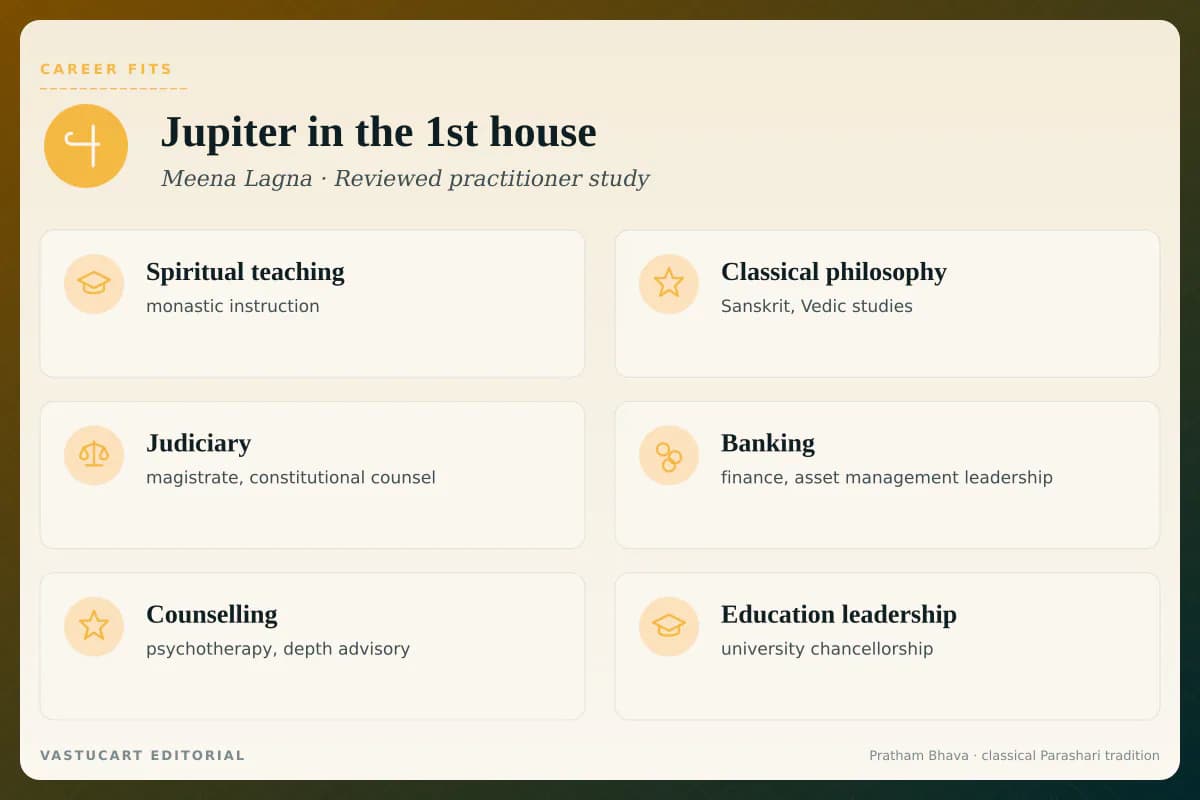
- Spiritual teaching, monastic instruction
- Classical philosophy, Sanskrit and Vedic studies
- Judiciary, magistrate, constitutional counsel
- Banking, finance, asset management leadership
- Counselling, psychotherapy, depth advisory
- Education leadership and university chancellorship
Where the wisdom-and-leadership vocation plays out
Career paths cluster around fields that braid scholarly wisdom with public-facing dharmic service. Spiritual teaching and monastic instruction come first because Jupiter in own sign at the lagna gives the native a teaching presence other lagnas spend decades cultivating, and the Meena emotional warmth makes the teaching reach across temperaments rather than addressing only the studious. Classical philosophy and Sanskrit-and-Vedic-studies scholarship suit natives whose vocational mode is deep textual engagement: many become professors, scholarly editors, or department heads whose careers compound across decades into substantial institutional standing.
Judiciary, magistrate, and constitutional-counsel roles fit naturally because the dual 1L+10L Jupiter pairs the lagna's identity weight with the 10H public-dharma reading, producing natives whose moral authority registers institutionally. Many take judicial positions in their forties and rise to senior bench appointments through their fifties and sixties. Banking and finance leadership work because Jupiter is the natural karaka of wealth and the 10L Jupiter in 1H projects the wealth-stewardship signature directly through the body of the native: senior bankers, asset-management partners, and family-office heads with this configuration build substantial institutional wealth-stewardship reputations. Counselling, psychotherapy, and depth-advisory roles suit natives whose vocational mode is the long therapeutic arc: the Hamsa wisdom combines with Meena empathy to produce clinicians whose work with difficult psychological material is held by both ethical structure and emotional resonance. Education leadership and university chancellorship fit because Jupiter is the karaka of teaching and the lagna placement produces natives whose presence carries the institutional weight senior academic appointments require. Jupiter mahadasha is the defining career window and arrives with the senior teaching appointment, the judicial promotion, the bank-board chairmanship, the chancellorship offer, or the religious-cultural foundation founding that crystallises the apex Hamsa vocation.
Why this is the strongest Jupiter placement in the Vedic catalogue
The clearest way to read Jupiter in 1st of Meena is to hold the swakshetra dignity, the apex kendra placement, and the 1L+10L identity together rather than treating any of them in isolation. Classical Parashari recognises that own-sign placement gives a planet his full natural strength and lord-in-his-own-house pattern gives the bhava his full natural strength because the lord and house align without mediation. When the lord is also the lagna lord and the bhava is also the 1H itself, the alignment compounds again: the planet's own-sign strength, the bhava's lord-in-house strength, and the lagna's identity strength all point at the same single position.
The dual kendra-lord reading is the second specific feature that practitioners need to handle correctly. Jupiter rules Meena (1st) and Dhanu (10th) for this lagna, the two kendras most directly tied to the native's public emergence: the 1H of body-and-self and the 10H of career-and-public-recognition. When the same planet rules both and that planet sits in his own sign at the lagna, the chart's identity and vocation collapse into a single continuous arc. Many natives report that the work they were known for at thirty looked like a magnification of who they already were at twenty, and the work at fifty looked like a deeper and more institutional version of the work at thirty. The third interpretive layer is the comparison with the other apex Jupiter placements other lagnas hold. Jupiter exalted in 2H of Mithuna is foundational dhana-yoga apex. Jupiter exalted in 4H of Mesha is Hamsa-with-digbala apex. Jupiter exalted in 9H of Mesha is dharma-trikona apex. Jupiter swakshetra in 1H of Meena is unique among them all because it is the only configuration where Jupiter is simultaneously the lagna lord, the 10L, in own-sign apex Hamsa formation, at the lagna itself. No other lagna in the entire wheel produces this fourfold alignment.
When the swakshetra Jupiter at lagna delivers its Hamsa chapter
Jupiter mahadasha is the defining window for this placement and arrives with the senior teaching appointment, judicial promotion, bank-board chairmanship, chancellorship offer, or religious-cultural foundation founding that crystallises the apex Hamsa vocation.
Liver, metabolism, and the Tanu vitality signature
Health follows the Meena-with-Jupiter-in-1st pattern with a kapha-pitta constitution that leans kapha-dominant because Jupiter carries water-element rasa and Meena is itself a water-kapha sign. Body part rulership for the 1H emphasises the head, face, and complexion, while the Meena sign emphasises the feet, lymphatic system, and the body's overall fluid balance. Jupiter rules the liver, pancreas, fat-tissue, and the broader metabolic-endocrine function. The placement therefore raises specific lifelong vulnerability to liver-and-pancreas sensitivity if dietary discipline is loose, weight-gain patterns from steady caloric abundance across decades, lymphatic congestion in humid climates, and the metabolic-syndrome markers (raised lipids, blood-sugar variability, elevated inflammation) that classical sources associate with unmoderated Hamsa constitution.
The Jupiter-comfort risk is the second body-related layer to read carefully. Jupiter in own sign at the lagna gives the body a strong appetite for sweet, fatty, dairy-rich, and ceremonially abundant food, and the Meena digestion handles this only up to a point. The pattern that recurs across clinical practice is steady weight gain through the thirties and forties, plateauing if disciplined or compounding into thyroid and metabolic-syndrome conditions if not, and chronic kapha-related markers (insulin resistance, fatty-liver indications, lymphatic sluggishness) emerging in the fifties when ordinary lifestyle counterweights are absent. Daily walking before sunrise, restraint with desserts and dairy after sunset, regular fasting practice (one weekly fast on Thursday, the Jupiter day, is a classical recommendation), and annual full-panel screening from the early thirties are the protective routines. Foot care is also worth specific attention because Meena rules the feet directly: well-fitted shoes, regular foot massage with warming oil, and care during long-standing professional days protect the lower body across decades.
Remedies for Jupiter in the Meena Tanu angle
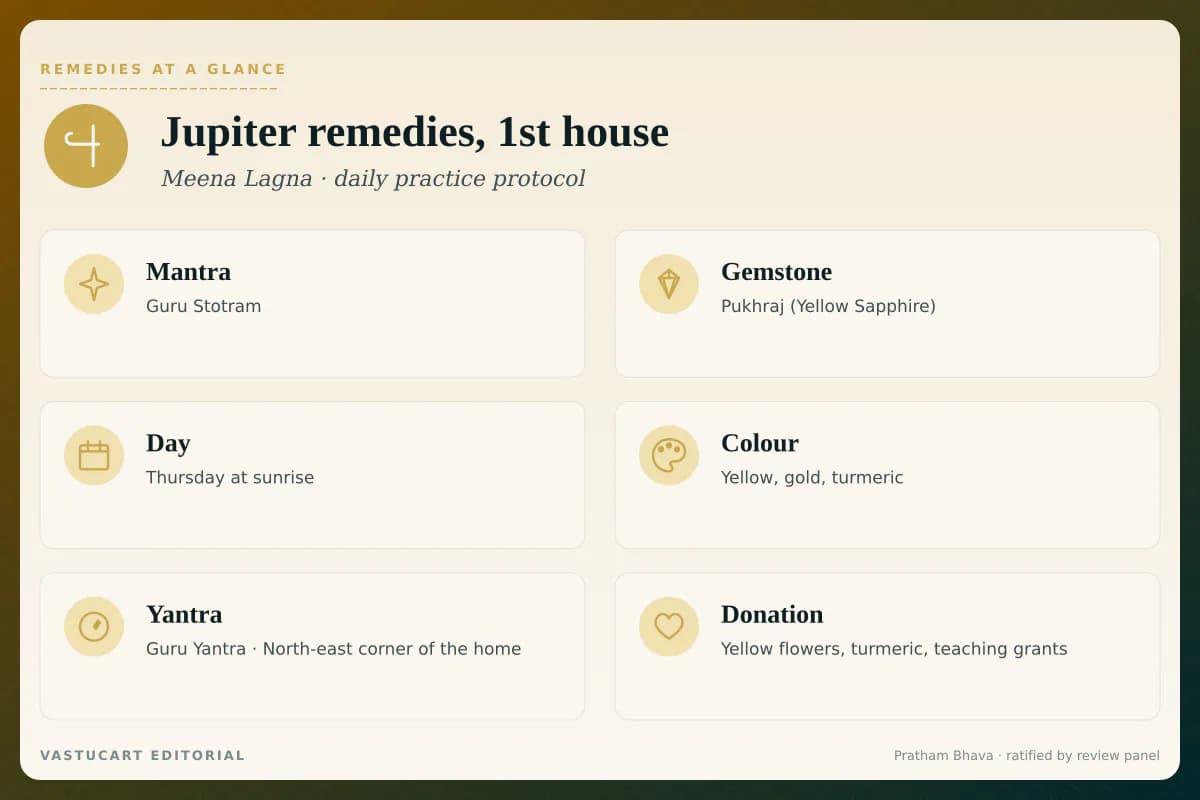
The daily Vishnu worship is the primary remedy for this placement because Vishnu is the classical patron deity of Jupiter in the Vedic tradition, and Jupiter's preceptor form (Brihaspati, the deva-guru) holds the Hamsa signature in its most refined expression. Rise before sunrise, bathe, wear yellow or saffron clothing on Thursdays, and visit a Vishnu temple if accessible. The Guru Stotram is the primary recitation, the Navagraha verse to Jupiter that creates a containing devotional field for the Hamsa signature in its swakshetra-lagna expression. Reciting it at sunrise daily for forty days at any major Jupiter transition (a senior teaching appointment, a judicial promotion, a chancellorship offer, a religious-foundation founding) is the formal protocol classical sources prescribe.
Offer yellow flowers (especially marigold and yellow chrysanthemum), turmeric-rice, ghee, and yellow sweets at the altar. Donate to causes that support education and dharmic scholarship: scholarship funding for under-resourced students, temple-board endowments, classical-arts preservation, and meditation-tradition support are the structural gift channels for this placement. The conscious-restraint practice is the lifestyle remedy that compounds across decades into the difference between Hamsa-mastery and Hamsa-overextension: a daily reflection on which advisory commitments are nourishing and which are depleting keeps the placement directed. The gemstone is yellow sapphire (Pukhraj), the primary Jupiter ratna, and is worn confidently here because the swakshetra Hamsa Jupiter responds to amplification cleanly. Wear a natural Ceylon yellow sapphire of minimum five carats set in gold on the index finger of the right hand on a Thursday at sunrise after Guru mantra recitation, and only after a confirmed reading by a qualified Jyotishi.
Gemstones for Jupiter in 1st house Meena Lagna
Yellow sapphire is the primary Jupiter gemstone and is worn confidently for this placement because the lagna-lord-in-lagna Hamsa configuration is foundationally clean.


Disclaimer: Yellow sapphire over a swakshetra Hamsa Jupiter at the lagna amplifies the dharmic-leadership channel cleanly. Always consult a qualified Jyotishi before permanent wearing.
Rudraksha beads for Jupiter in 1st house
The Jupiter-aligned rudraksha is the Panch Mukhi (Five Mukhi), the bead directly ruled by Shiva-Kalagni-Rudra and Jupiter.
The classical Jupiter rudraksha and the bead specifically associated with dharmic stewardship and wisdom-led leadership. Supports the apex Hamsa signature, channels the expansive instinct toward sustainable territory, and stabilises identity bandwidth when the teaching, judicial, banking, or counselling vocation is in active phase.
The seven-mukhi bead supports wealth-stewardship and dharmic abundance. Wearing the Saat Mukhi alongside the Panch Mukhi compounds the placement's natural strength in banking, finance, family-business stewardship, and the institutional dimension of the Hamsa vocation.
Guru Yantra for the swakshetra-lagna placement
Sacred recitations for Jupiter at the Meena lagna
Buddhi-bhutam tri-lokesham tam namami brihaspatim
Translation: I bow to Brihaspati, preceptor of gods and sages, radiant as gold, the embodiment of wisdom and the lord of the three worlds. The Guru Stotram is the canonical Navagraha verse to Jupiter and is the perfect daily recitation for a chart where Jupiter sits swakshetra at the lagna and the apex Hamsa signature needs a containing devotional field. Many natives advanced in practice add the Vishnu Sahasranama recitation as a secondary layer once the daily Guru discipline is steady.
Read the full stotra on stotra.vastucart.in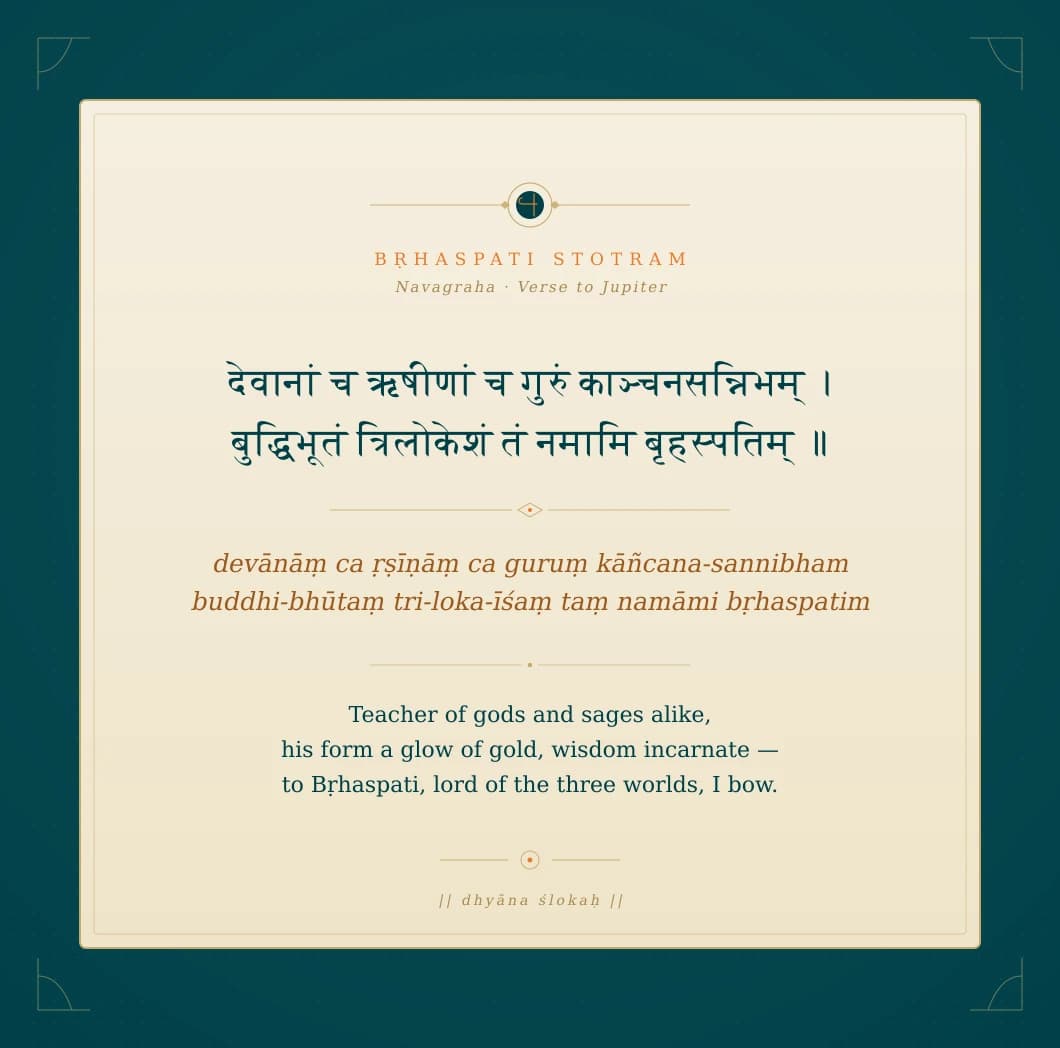
Tools for Jupiter 1st house Meena natives
Is your Tanu Bhava Jupiter carrying the apex Hamsa signature?
Get a full personalised analysis of your first house Jupiter, the swakshetra dignity, and the dharmic-vocation timing.