Rahu in the 8th house
Mesh Lagna (Aries Ascendant)
A practitioner study of Rahu in Randhra Bhava for Aries ascendant natives. The north node in classical neech sign Vrishchika tempered by occupying his own kama-trine bhava, the Mars-dispositor link with the lagna lord, and the occult-research signature that distinguishes this placement from the Ketu 8th dissolution.
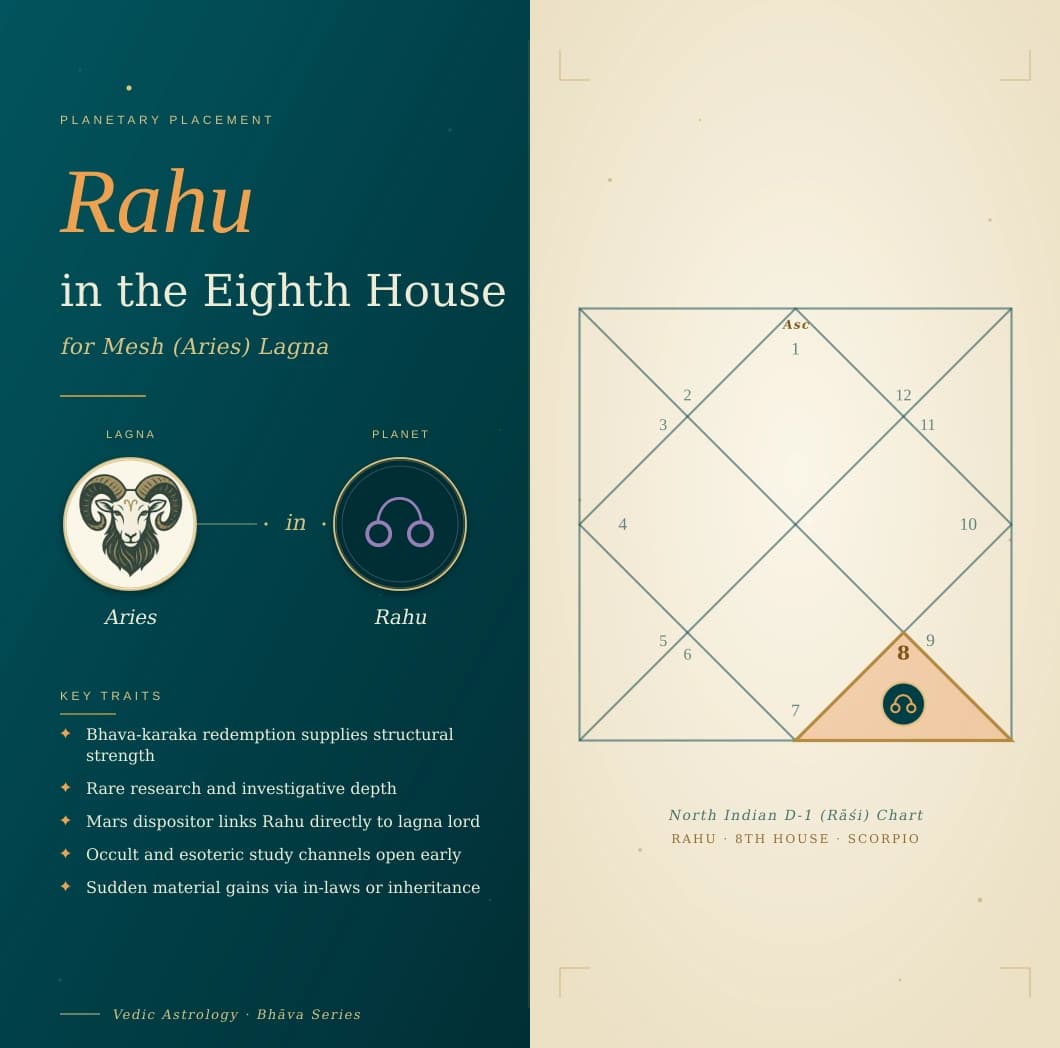
Rahu sits in classical neech Vrishchika in the eighth house for Aries ascendant natives, the occult-research and transformation-vehicle signature.
Rahu in 8th house for Mesh Lagna, the quick reference
If you carry Rahu in the eighth house of a Mesh chart, you hold one of the most layered placements in the entire Aries ascendant catalogue, because the north node sits in his classical debilitation sign while simultaneously occupying the bhava he is the natural karaka of. The eighth house from Mesh is Vrishchika (Scorpio), ruled by Mangal (Mars), and several mainstream Parashari schools assign Rahu's neech (debilitation) to Vrishchika. The same node, however, is the natural significator of the eighth house, the bhava that rules occult inquiry, sudden transformation, hidden wealth, longevity, surgery, and the unmasking of what the family chose to keep buried. The Bhava-Karaka effect partially redeems the sign-level debilitation: a planet placed in his own karaka bhava gains a structural strength even when the sign is uncomfortable, and Rahu is more at home in the 8th house than almost any other classical placement.
The second structural feature is the Mars-dispositor link. Mangal rules Vrishchika and Mangal is also the lagna lord of Mesh, so the Rahu placement is dispositor-bound to the body angle and the entire chart's organising planet. Whatever Rahu does in the 8th flows back through Mars into the lagna in a way that no other Rahu placement for this lagna produces. The result is a native whose entire identity is shaped around what Rahu is researching, transforming, or excavating in the Randhra Bhava. The third feature is the lagna-Rahu opposition tradition that some practitioners read here is incorrect: Rahu is not opposite the lagna in the 8th, he is in the 8th from the lagna and aspects the 12th, 2nd, and 4th houses by his classical 5th, 9th, and aspect lore. This guide reads every layer of Rahu in 8th house for Mesh Lagna natives: the Vrishchika neech tempered by Bhava-Karaka, the Mars-dispositor link, the occult-research signature, the longevity and in-laws' wealth themes, and the hessonite protocol that requires especially careful chart confirmation here.
Why Rahu in Randhra Bhava is the transformation vehicle rather than the longevity threat
Students often arrive at this placement carrying anxiety from popular astrology readings that label it as longevity-threatening or as the marker of sudden death. The honest practitioner answer is that Rahu in the 8th does not shorten life. It produces a specific kind of transformation signature that involves repeated cycles of inner death and rebuilding, often around themes the native did not consciously choose. The eighth house rules everything that begins as one form and ends as another: surgery, financial windfall and loss, the in-laws' wealth that arrives through marriage, occult initiation that reorganises the inner architecture, and the chronic-illness episode that ends with the native more whole than they were before it began. Rahu's presence in this bhava means the native cannot avoid the transformation pedagogy. The chart asks them to study the territory rather than fear it.
The Bhava-Karaka redemption is the second specific feature that practitioners need to read carefully. Classical Parashari assigns each house a natural significator, and Rahu (along with Saturn and Mars) is the natural karaka of the 8th. Mantreshwara in Phaladeepika notes that a planet in his own karaka bhava gains a structural strength that partially compensates for sign-level weakness. Rahu in Vrishchika in the 8th is therefore in a particular kind of mixed dignity: the sign is uncomfortable but the bhava is exactly the territory he is built to work in. The result is a native who carries the Rahu intensity (foreign signature, hunger to amplify, taboo-crossing curiosity) but channels it through the most rich research bhava in the chart. The third interpretive layer is the contrast with Ketu in 8th. Both nodal placements in the Randhra house produce occult and transformation signatures, but they work in opposite directions. Ketu in 8th produces dissolution of the self into the mystery and asks the native to surrender the seeker before the answers arrive. Rahu in 8th produces amplified hunger to penetrate the mystery and asks the native to develop discipline so the hunger does not consume the seeker. The two placements are mirror images of each other, and the contrast is the cleanest way to understand what each is actually doing.
Rahu in Randhra Bhava is not a longevity sentence, it is a research assignment. The chart hands the native the most concentrated transformation territory in the kundali and asks for discipline rather than fear.
Terms used in this article
A short glossary of the Sanskrit and Jyotish terms that recur in this study. First-occurrence expansion is also retained inline.
- Randhra Bhava
- The 8th house, the bhava of transformation, longevity, occult, and hidden things.
- Neech
- Debilitation, the sign in which a planet is at his classical weakest.
- Bhava-karaka
- A planet who is the natural significator of a particular house.
- Dispositor
- The lord of the sign in which another planet sits.
- Dushthana
- Difficulty house, the 6th, 8th, and 12th, where ordinary growth is harder.
- 8L
- Eighth-house lord, the planet ruling the sign on the 8th house cusp.
- Trika
- The three dushthana houses (6, 8, 12) read as the difficulty triad.
How Rahu in Randhra Bhava shapes the Aries native
Physically the native carries the Mesh Lagna frame with the eighth-house Rahu signature that classical texts catalogue carefully. Because Mars rules both the lagna and the sign Rahu sits in, the body inherits both planets at once: the Aries directness and physical confidence on the surface, and the Vrishchika depth and watchfulness underneath. The face is often striking in a way that reads as intense rather than ornamental. The eyes carry a probing quality strangers notice without naming, and the gaze tends to settle on people rather than scan past them. Many natives have a mole, mark, or scar on the lower abdomen, the reproductive area, or the back of the head, all classical eighth-house signatures. The build can be lean and wiry like the standard Mesh frame, or unusually dense and grounded depending on which dispositor signature dominates.
Temperament is the layer where the placement most distinguishes the native from popular Aries stereotypes. These natives carry the Mesh courage and the willingness to act, but they also carry a watchful interior quality the lighter Mesh placements do not produce. They are drawn to topics other people avoid: death, secrecy, finance, taboo, surgery, the occult, ancestral patterns, and the question of what the family kept hidden. They consistently report that they were the child who asked the uncomfortable questions at the dinner table, and many of them grew up with at least one significant family secret they later excavated themselves. The Aries directness combines with the Rahu hunger to penetrate, producing an investigative style that is patient when it needs to be and devastating when the moment arrives. The shadow side is the same intensity, because natives who do not channel the research hunger consciously can experience repeated cycles of obsessive digging followed by overwhelm, and the cycles can leave the native feeling that they are carrying weight that does not belong to them. Natives who pair the investigative hunger with explicit boundaries about what they are responsible for develop the rare integration of depth-research capacity with emotional sustainability that the placement is genuinely capable of supporting.
Strengths, shadows and career fits
- Bhava-karaka redemption supplies structural strength
- Rare research and investigative depth
- Mars dispositor links Rahu directly to lagna lord
- Occult and esoteric study channels open early
- Sudden material gains via in-laws or inheritance
- Chronic-illness episodes resolve with rebuilding
- Vrishchika neech sharpens Rahu's foreign edge
- Surgical and reproductive vulnerabilities
- Family secrets can absorb decades of attention
- Sudden financial reversals between gains
- In-laws' wealth can carry hidden conditions
- Tantra inquiry without a teacher is risky
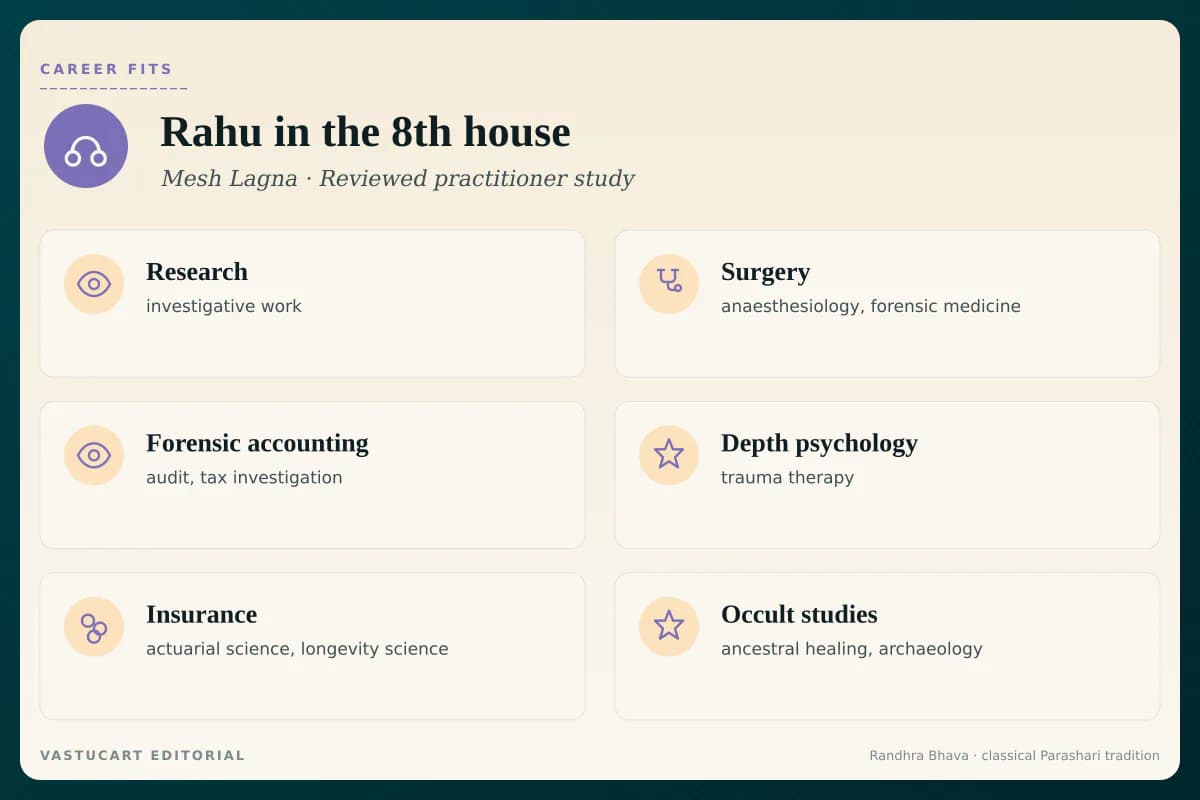
- Research and investigative work
- Surgery, anaesthesiology, forensic medicine
- Forensic accounting, audit, tax investigation
- Depth psychology and trauma therapy
- Insurance, actuarial science, longevity science
- Occult studies, ancestral healing, archaeology
Where the occult-research vocation plays out
Career paths cluster around fields that draw on the eighth house's research, transformation, and unseen-territory significations. Research and investigative work are the strongest single fit because the 8th house rules everything hidden, and Rahu here produces natives whose vocation involves uncovering what others miss. Many natives become investigative journalists, intelligence analysts, forensic researchers, or archival historians who specialise in the periods the mainstream looked away from. The Mars dispositor adds the courage to publish when most peers would step back.
Surgery, anaesthesiology, and forensic medicine fit the chart because the 8th house rules the reproductive and transformative organs and Mars-ruled bhavas classically attract the cutting professions. Forensic accounting and tax investigation suit natives whose investigative temperament expresses through financial territory: the 8th house rules in-laws' wealth and shared resources, and Rahu here produces specific aptitude for tracing money across borders, jurisdictions, and corporate veils. Depth psychology and trauma therapy work because the chart specifically supports holding the material the surface mind defends against. Insurance, actuarial science, and longevity research suit the statistical mode. Occult studies, ancestral-healing work, and archaeology suit natives whose research extends into territories classical Jyotish recognises as Rahu-ruled. Rahu mahadasha is the defining career window and arrives with the research breakthrough, the diagnostic accreditation, or the foreign posting that places the native at the centre of the territory the chart has been preparing them to handle.
Why the classical debilitation is partially redeemed in the Randhra bhava
The clearest way to understand Rahu in 8th of Mesh is to read the neech sign and the bhava karaka condition together rather than separately. Several Parashari schools (notably Mantreshwara's Phaladeepika and the Brihat Parashara tradition) assign Rahu's classical debilitation to Vrishchika, while other schools place his neech in Dhanu and his uchcha (exaltation) in Mithuna. The variation in the textual tradition is itself the first clue: Rahu is a shadow planet without a fixed sign-relationship in the way the seven major grahas have, and his dignity is read more through the dispositor and the bhava than through the sign alone. For practical analysis, treating Vrishchika as a sign Rahu finds difficult is correct, because Vrishchika is Mars-ruled and Rahu's air-shadow nature does not blend smoothly with Mars's fire-water intensity. The classical neech reading captures something real about the sign-level discomfort.
The Bhava-Karaka redemption is the second specific feature that the textbook accounts often miss. Rahu is the natural significator of the 8th house in classical Parashari logic (along with Saturn for chronic conditions and Mars for surgery and accidents). A planet in his own karaka bhava gains structural strength because the territory of the bhava is the territory he understands natively. Rahu in Vrishchika in the 8th is therefore neech in sign and bhava-karaka in house, and the two conditions partially neutralise each other. The native experiences the Vrishchika sharpness (intensity that shades into obsession, secrets that absorb attention, family material that surfaces against the native's preference) but channels it through the most fitting research bhava the chart offers. The third interpretive layer is the Mars dispositor link. Mars rules Vrishchika and Mars is also the lagna lord. Wherever Rahu travels in this 8th house, his energy is processed through Mars before it reaches the rest of the chart, and Mars then routes it back through the body angle. The lagna-Rahu link is therefore real but is mediated by the lagna lord rather than by direct opposition, and it produces natives whose entire identity is organised around what they are excavating rather than around what they are presenting to the world.
When Rahu in 8th delivers its Randhra Bhava chapter
Rahu mahadasha is the defining window for this placement and arrives with the research breakthrough, the diagnostic accreditation, or the foreign posting that places the native at the centre of the territory the chart has been preparing them to handle.
Reproductive system, surgery, and the Randhra health link
Health follows the Rahu-in-8th pattern with specific Randhra body-part vulnerabilities. Constitution is generally lean and intense, with vata and pitta both elevated because Rahu carries shadow-air and Mars carries fire-water, producing nervous-system intensity layered over deep-tissue heat. The 8th house body-part rulership covers the genitals, reproductive organs, rectum, and the deep glandular systems, and the placement raises specific risk for surgical interventions in these regions. Many natives undergo at least one surgery during the Rahu mahadasha and several report two, the surgical episodes resolving cleanly when the chart is supported and dragging when remedies have been ignored.
The diagnostic-ambiguity signature is the second specific layer. Rahu in the 8th produces conditions that hide from ordinary screening and reveal themselves only on the third or fourth round of testing. Natives report being told nothing was wrong for years before a specific test finally located the issue, and the longevity-related episodes that the placement is famous for almost always emerge from this diagnostic-ambiguity territory rather than from sudden trauma. The intoxicant risk is real because the placement amplifies whatever the native uses to soothe Randhra anxiety, and addiction histories run in the family material the placement tends to excavate. Annual full-panel screening from the late twenties is recommended and especially important for the native carrying this configuration because the diagnostic ambiguity Rahu produces makes baseline data more useful than reactive testing.
Remedies for Rahu in the Mesh Randhra angle
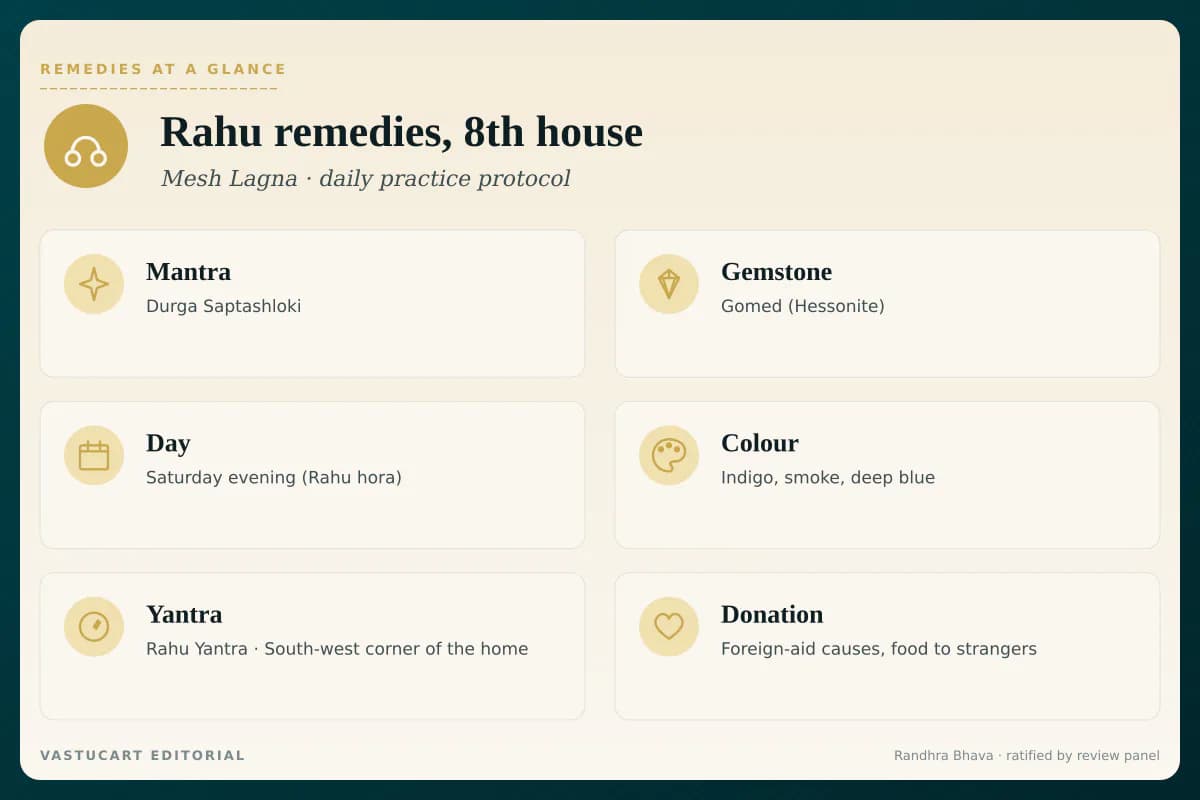
The daily Durga worship is the primary remedy for this placement because Durga is the classical patron deity of Rahu and her warrior form holds and directs the north node's hungry energy without being consumed by it. Rise before sunrise, bathe, wear dark blue, smoky grey, or deep red clothing as the practice settles, and visit a Durga or Bhairav temple if accessible. The Durga Saptashloki is the primary recitation, the seven-verse essence of the Devi Mahatmyam that creates a containing field for the amplification energy Rahu otherwise releases without direction. Reciting it at sunrise daily for forty days at any major Randhra transition (a surgery, a research breakthrough, an inheritance) is the formal protocol.
For the Randhra placement specifically, a secondary connection to Bagalamukhi, the Mahavidya goddess who unmasks what is hidden, is often added once the daily Durga practice is steady. The Bagalamukhi mantra is approached only with formal initiation by a qualified teacher because the goddess's power is severe. Offer red flowers, coconut, sesame seeds, and dark sweets, and donate to causes that protect vulnerable people in transition (hospice, trauma recovery, ancestral healing services). The conscious-research practice is the single most important lifestyle remedy because the chart asks the native to channel the investigative hunger toward territory that can hold serious inquiry. A daily research practice (writing, journaling, supervised case work, or formal study with a teacher) compounds across decades into the difference between Randhra-research success and Randhra-research overwhelm. The gemstone is hessonite (Gomed, grossular garnet), recommended only after careful chart confirmation because the gemstone amplifies whatever the placement is currently producing. Wear a natural Sri Lankan or African hessonite of minimum five ratti set in silver on the middle finger of the right hand on a Saturday at sunrise after Rahu mantra recitation, and only after a practising Jyotishi has confirmed the chart is structurally ready.
Gemstones for Rahu in 8th house Mesh Lagna
Hessonite is the primary Rahu gemstone but is recommended only after careful chart confirmation because the Randhra placement combines neech sign with bhava karaka strength and is therefore more sensitive than other Rahu placements.



Disclaimer: Hessonite over a neech-sign Rahu in a dushthana amplifies the placement sharply in either direction. Always consult a qualified Jyotishi before permanent wearing.
Rudraksha beads for Rahu in 8th house
The Rahu-aligned rudraksha is the Nau Mukhi (Nine Mukhi), the bead directly ruled by Durga and the north node.
The classical Rahu rudraksha and the bead specifically associated with Durga as the patron deity of the north node. Contains the amplification energy in the Randhra dimension, supports the conscious channelling of investigative hunger, and stabilises the inner intensity when the transformation signature is active.
The eight-mukhi bead is the Ganesha bead and serves as a secondary support for Randhra natives because Ganesha's removal of obstacles is the precise grace that an 8th house traveller needs at the threshold moments of surgery, inheritance, or research breakthrough. Wearing the Aath Mukhi alongside the Nau Mukhi is the standard pairing for a dushthana Rahu.
Rahu Yantra for the Randhra placement
Sacred recitations for Rahu in the Randhra angle
Balad akrishya mohaya maha maya prayachchhati
Durge smrita harasi bhitim ashesha jantoh
Svasthaih smrita matimativa shubham dadasi
Daridrya duhkha bhaya harini ka tvad anya
Sarvopakara karanaya sada ardra chitta
Translation: Even the minds of the wise are forcibly drawn by the goddess Bhagavati, the great Maya who bestows delusion. When remembered, O Durga, you remove the fear of all beings. When remembered by the well, you bestow auspicious wisdom. Who but you removes poverty, sorrow, and fear? Who but you is always compassionate, always doing good for all? The Durga Saptashloki is the seven-verse essence of the Devi Mahatmyam and is the perfect daily recitation for a chart where Rahu sits in the Randhra angle and the amplification energy needs a containing devotional field. Natives advanced in practice often add the Bagalamukhi Mahavidya recitation as a secondary layer once the daily Durga discipline is fully steady, but only with formal initiation.
Read the full stotra on stotra.vastucart.in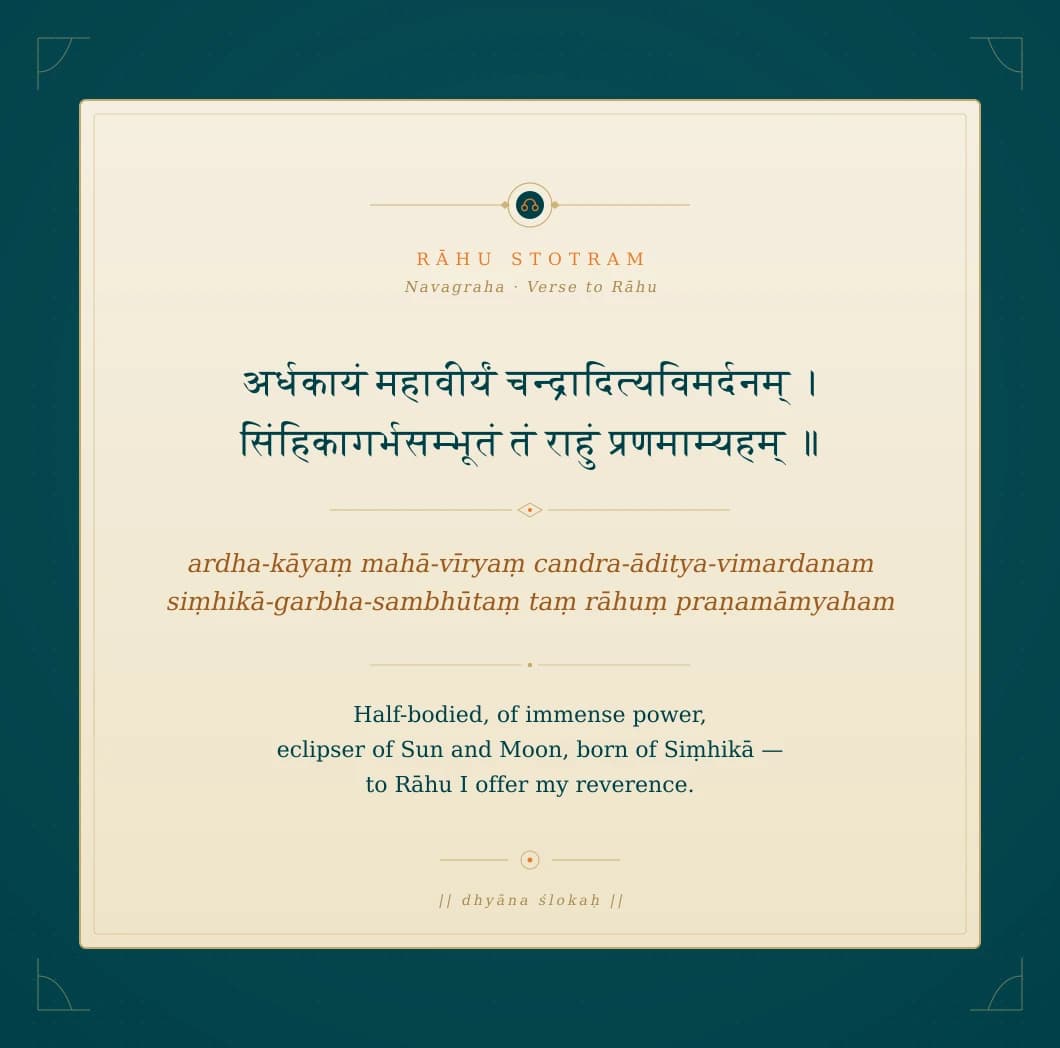
Tools for Rahu 8th house Mesh natives
Is your Randhra Bhava Rahu carrying the occult-research signature?
Get a full personalised analysis of your eighth house Rahu, the Mars-dispositor link, and the transformation timing.