
Rahu in the 7th house
Mesh Lagna (Aries Ascendant)
A practitioner study of Rahu in Kalatra Bhava for Aries ascendant natives. The north node in friendly Tula in the marriage angle, the foreign-spouse amplification signature, and the marriage-as-amplification-vehicle reading that distinguishes this placement from the Ketu 7th detachment.
Rahu in 7th house for Mesh Lagna, the quick reference
If you carry Rahu in the seventh house of a Mesh chart, you hold one of the most distinctive marriage placements in the entire Aries ascendant catalogue, because the north node sitting in the kalatra angle reshapes the partnership domain around the themes Rahu rules: amplification, foreign signature, hunger for difference, taboo-crossing, unconventional unions, and the magnetic pull toward partners who carry something the family did not provide. The seventh house from Mesh is Tula (Libra), ruled by Shukra, and Venus is treated as friendly to Rahu in classical relationships. By sign relationship the placement is comfortable, neither exalted nor debilitated, and the friendly Tula sign supports the relational expression that Venus naturally rules. Rahu has no own sign, no clear exaltation in mainstream Parashari tradition, and no house lordship because he is a shadow planet, but his nodal nature means he amplifies the house and sign he occupies and infuses the placement with his core themes regardless of dignity.
The second structural feature is the lagna-Rahu opposition that the placement creates with Mars at the Mesh lagna. Mars (the Mesh lagna lord) sits at the body angle and Rahu sits opposite at the kalatra angle, which means the two are in direct mutual aspect even when neither planet is conjunct another. Mars represents the self in its most active asserting form. Rahu represents the unprocessed desire that the soul has come to amplify in this incarnation. The opposition places the partnership domain at the centre of the native's amplification work, and the marriage signature the placement produces is best understood as the chart's specific vehicle for the broader Rahu life pattern: the marriage is the place where the unconventional, the foreign, or the taboo comes into the native's life regardless of whether the rest of the chart prepared them for it. This guide reads every layer of Rahu in 7th house for Mesh Lagna natives: the friendly Tula sign, the lagna-Rahu opposition, the foreign-spouse and unconventional-marriage signatures, and the hessonite protocol that requires especially careful chart confirmation here.
Why Rahu in the marriage angle is the amplification vehicle rather than the marriage destroyer
Students often arrive at this placement carrying anxiety from popular astrology readings that label it as marriage-destroying. The honest practitioner answer is that Rahu in the 7th does not destroy marriage. It produces a specific kind of marriage signature that is unconventional in form, amplified in intensity, and usually involves a partner whose background, nationality, age, or life history differs significantly from what the native's family expected. Marriages happen for natives with this placement at roughly the same rates as for other 7th house configurations. What differs is the type of marriage that arrives, the kind of partner the native is structurally drawn to, and the role the marriage plays in the native's broader life direction. Rahu is the planet of unprocessed desire, and his presence in the kalatra house means the native's desire stream meets its destination through the partnership rather than through other channels.
The marriage-as-amplification-vehicle reading is the second specific feature that practitioners need to read carefully. For natives with this placement, the marriage is rarely just a personal bond. It is the structural channel through which the broader Rahu themes (foreign experience, unconventional life path, exposure to difference, amplified ambition) enter the native's daily life. Many natives meet their spouse abroad, marry into a foreign family, marry someone whose career takes the native into a foreign country, or marry someone from a different culture, religion, class, or generation than their family ever imagined. The pattern is so consistent in clinical reports that practitioners can usually predict the foreign or unconventional element before the native confirms it. The third interpretive layer is the contrast with Ketu in 7th. Both nodal placements in the marriage angle produce non-conventional marriage signatures, but they work in opposite directions. Ketu in 7th produces detachment from partnership and asks the native to grow into conscious relating. Rahu in 7th produces amplified attraction toward partnership and asks the native to channel the amplification into a partner who can hold it without being consumed. The two placements are mirror images of each other, and the contrast is the cleanest way to understand what each is actually doing.
Rahu in the marriage angle does not refuse the partnership, it amplifies it past every conventional script. The work is to find a partner whose own chart can hold the amplification rather than be flattened by it.
How Rahu in the marriage angle shapes the Aries native
Physically the native carries the Mesh Lagna frame with the lagna-Rahu opposition signature that classical texts catalogue carefully. Because Rahu sits opposite the body and aspects it with his full 7th aspect, the body itself often carries the Rahu amplification: striking but unconventional features, an asymmetry that strangers find interesting without naming, and a magnetism that appears most strongly when the native is in close one-on-one situations with another person. The face often combines features that would be ordinary on different bodies into a face that pulls attention. The eyes are typically intense and sometimes asymmetric, the build can be either notably tall or notably distinctive in proportion, and many natives have a feature inherited from a grandparent or an ancestor several generations back the family barely remembers.
Temperament is the layer where the placement most distinguishes the native from popular Aries stereotypes. These natives carry the Mesh courage and the willingness to act, but they also carry an unusual hunger for relational intensity that other Aries placements do not produce. They are drawn to people who feel different, foreign, or unconventional, often without conscious decision, and they consistently report that they fell in love with someone their family did not understand or did not expect. The Aries directness combines with the Rahu hunger to produce a romantic style that is intense, fast-moving, and resistant to conventional dating scripts. They often skip the slow-build phase peers go through and arrive at deep attachment within weeks of meeting someone the chart has been waiting for. The shadow side is the same intensity, because natives who do not channel the relational hunger consciously can experience repeated cycles of intense attachment followed by abrupt disillusionment, and the cycles can leave the native feeling that they are living someone else's life rather than building their own. Natives who pair the relational intensity with explicit discernment about who can actually hold the amplification develop the rare integration of foreign-marriage depth with sustainable partnership the placement is genuinely capable of supporting.
Strengths, shadows and career fits
- Friendly Tula softens the amplification edge
- Marriage becomes amplification vehicle
- Foreign spouse signature opens unusual paths
- Magnetic relational presence
- Aspects 1H, body becomes attractive to others
- Unconventional marriage often more durable than expected
- Romance cycles can exhaust the native
- Family struggles to recognise the chosen partner
- Lower abdomen and kidney sensitivity
- Spouse may carry own Rahu burdens
- Public dimension of marriage feels exposing
- Conventional dating scripts feel hollow
- International business and diplomatic work
- Cross-cultural consulting and translation
- Foreign service and overseas posting
- Marriage and partnership therapy
- Public relations and brand work
- Joint venture and partnership-based business
Where the partnership-amplification vocation plays out
Career paths cluster around fields that draw on partnership and cross-cultural intensity. International business and diplomatic work are the strongest single fit because the 7th house rules public-facing partnerships and Rahu's foreign signature in the kalatra house produces natives whose vocation involves negotiating across cultures, languages, or borders. Many natives spend portions of their working life abroad, often through a marriage that takes them to the spouse's country, and the foreign posting becomes the platform from which the rest of the career builds. Cross-cultural consulting and translation work fit natives whose vocational mode is more linguistic.
Foreign service and overseas posting suit the chart because the 7th house at the public level rules the nation's partnerships with other nations. Marriage and partnership therapy work because the same chart that produces intense personal partnership lessons also produces clinical insight into other people's relational struggles, and natives often build counselling careers in their forties. Public relations and brand work suit natives whose magnetism translates into the visible-to-many register. Joint venture and partnership-based business work because the chart specifically supports building enterprises with another person, often the spouse. Rahu mahadasha is the defining career window and arrives with the foreign relocation, the marriage, or the partnership-based business that becomes the platform for the rest of the working life.
Rahu marked in the seventh house of Mesh
- Rahu in Kalatra Bhava in friendly Tula, marked in smoky indigo
- 12 houses in North Indian format
- Lower-right diamond is the 7th house of marriage
Why Rahu 7th and Ketu 7th are mirror images of each other
The clearest way to understand Rahu in 7th of Mesh is to read it against its mirror placement, Ketu in the same house. Both nodal placements in the kalatra angle produce non-conventional marriage signatures, but they work in opposite directions. Ketu in 7th produces detachment from partnership and asks the native to grow into conscious relating before marriage stabilises. Rahu in 7th produces amplified attraction toward partnership and asks the native to develop discernment about which partner can hold the amplification. Ketu's pedagogy is patience. Rahu's pedagogy is discernment. Both produce durable marriages when honoured, and both produce relational difficulty when ignored. Practitioners reading any nodal placement in the marriage angle should always ask which node and read accordingly.
The foreign-spouse pattern is the second specific feature deserving direct attention because clinical reports are remarkably consistent. Most natives with Rahu in 7th do marry, and the marriages that crystallise share recognisable features: the spouse is often of foreign nationality, comes from a different country, or carries a culture, religion, or class background the family did not expect. The wedding ceremony is often unconventional: an elopement, a destination ceremony, a fusion of two traditions, or a smaller celebration than family wanted. The marriage usually deepens rather than fading, contrary to popular astrology, and many natives report their spouse becomes the most important relationship of their life. The third pattern is timing. Marriage often arrives in the late twenties or early thirties, usually coinciding with a foreign opportunity or significant geographic move that brings the native into proximity with the spouse the chart was waiting to deliver.
When Rahu in 7th delivers its Kalatra Bhava chapter
Rahu mahadasha is the defining window for this placement and arrives with the foreign relocation, the marriage, or the partnership-based vocation crystallising decisively.
Lower abdomen, kidneys and the partnership health link
Health follows the Rahu-in-7th pattern with specific 7th house body-part vulnerabilities. Constitution is generally lean and intense, with vata most prominent because Rahu carries the air-fire mix that produces nervous-system intensity. The 7th house body-part rulership covers the lower abdomen, kidneys, urinary tract, and pelvis. Hydration is non-negotiable because the kidney signature combined with Rahu intensity produces specific risk for dehydration-related issues, kidney stones, and urinary infections that natives often dismiss until they advance.
The partnership health link is the second specific layer because the 7th house rules both the kalatra and the body region most directly involved in partnered intimacy. Natives report that reproductive and intimate health is unusually responsive to inner partnership state, and conditions often improve when the relational life stabilises and worsen when it is in turmoil. The intoxicant risk is real because the placement amplifies whatever the native uses to soothe relational arousal. Annual full-panel screening from the late twenties is recommended because the diagnostic ambiguity Rahu produces makes baseline data more useful than reactive testing.
Remedies for Rahu in the Mesh marriage angle
The daily Durga worship is the primary remedy for this placement because Durga is the classical patron deity of Rahu and her warrior form is the goddess who can hold and direct the north node's hungry energy without being consumed by it. Rise before sunrise, bathe, wear dark blue, smoky grey, or red clothing on different days as the practice settles, and visit a Durga temple if accessible. The Durga Saptashloki is the primary recitation for this placement because it is the seven-verse essence of the Devi Mahatmyam and creates a containing field for the amplification energy that the placement otherwise releases without direction. Reciting the Durga Saptashloki at sunrise daily for forty days at any major partnership transition (engagement, marriage, geographic move with the spouse) is the formal protocol, and natives often report a noticeable shift in inner stability and clarity by the third week.
Offer red flowers, coconut, and dark sweets at the altar, and donate to causes that protect vulnerable couples and families (refugee family reunification, women's shelters, immigrant family aid), all of which channel the Rahu and kalatra karakatvas constructively. The conscious-discernment practice is the single most important lifestyle remedy for this placement because the chart asks the native to channel the relational amplification toward a partner who can actually hold it. A daily relational reflection practice (journaling about partnership, conscious conversation with the spouse, occasional couples work even in good times) compounds across decades into the difference between a foreign-marriage success and a foreign-marriage struggle. The gemstone is hessonite (Gomed, made from grossular garnet), and it is recommended only after careful chart confirmation because Rahu in the kalatra house specifically affects marriage themes and the gemstone amplifies whatever the placement is currently producing. Wear a natural Sri Lankan or African hessonite of minimum five ratti set in silver on the middle finger of the right hand on a Saturday at sunrise after Rahu mantra recitation, and only after a practising Jyotishi has confirmed the marriage chart is ready for the amplification. The lifestyle adjustment that compounds most is honouring the foreign signature as a structural feature rather than fighting it. Because the chart specifically delivers the partnership through cross-cultural channels, natives who accept the foreign dimension as part of who they are experience the placement as the source of the most expansive relationship of their life.
Gemstones for Rahu in 7th house Mesh Lagna
Hessonite is the primary Rahu gemstone but is recommended only after careful chart confirmation because the kalatra placement amplifies marriage themes sharply.
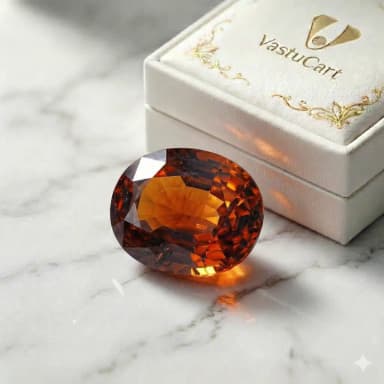
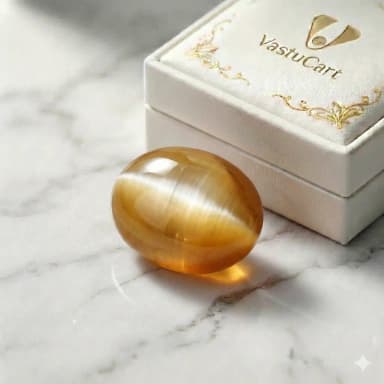

Disclaimer: Hessonite in the marriage house amplifies kalatra themes sharply. Always consult a qualified Jyotishi before permanent wearing.
Rudraksha beads for Rahu in 7th house
The Rahu-aligned rudraksha is the Nau Mukhi (Nine Mukhi), the bead directly ruled by Durga and the north node.
The classical Rahu rudraksha and the bead specifically associated with Durga as the patron deity of the north node. Contains the amplification energy in the kalatra dimension, supports the conscious channelling of relational hunger, and stabilises the inner intensity when the foreign-spouse signature is active.
The six-mukhi bead is the Venus bead and serves as secondary support for this placement because the dispositor of Rahu here is Shukra. Wearing the Chha Mukhi alongside the Nau Mukhi compounds the placement's natural strength by honouring both the planet and his sign-lord.
Rahu Yantra for the kalatra placement
Sacred recitations for Rahu in the marriage angle
Balad akrishya mohaya maha maya prayachchhati
Durge smrita harasi bhitim ashesha jantoh
Svasthaih smrita matimativa shubham dadasi
Daridrya duhkha bhaya harini ka tvad anya
Sarvopakara karanaya sada ardra chitta
Translation: Even the minds of the wise are forcibly drawn by the goddess Bhagavati, the great Maya who bestows delusion. When remembered, O Durga, you remove the fear of all beings. When remembered by the well, you bestow auspicious wisdom. Who but you removes poverty, sorrow, and fear? Who but you is always compassionate, always doing good for all? The Durga Saptashloki is the seven-verse essence of the Devi Mahatmyam and is the perfect daily recitation for a chart where Rahu sits in the marriage angle and the amplification energy needs a containing devotional field.
Read the full stotra on stotra.vastucart.inTools for Rahu 7th house Mesh natives
Is your Kalatra Bhava Rahu carrying the foreign-spouse signature?
Get a full personalised analysis of your seventh house Rahu, the partnership amplification pattern, and the marriage timing.
Questions about Rahu in 7th house, Mesh Lagna
Pt. Raghav Sharma has practiced Parashari Jyotish for over twenty two years from Varanasi. A student of the Varanasi Jyotish tradition, he specialises in Graha-in-Bhava analysis, Vimshottari Dasha predictions, and Muhurta. He has authored over four hundred in-depth articles on Jyotish principles across the VastuCart knowledge network.