Mars in the 2nd house
Meena Lagna (Pisces Ascendant)
A practitioner study of Mangal in Dhana Bhava for Pisces ascendant natives. Mars swakshetra in his own sign Mesha in the wealth angle, the 2L sitting in his own 2H while simultaneously holding 9L lordship of Vrishchika, and the entrepreneurial Dhana-Dharma yoga where speech becomes the cutting instrument of self-made fortune balanced against the marana karaka sthana caveat that classical sources attach to Mars in the dhana bhava.
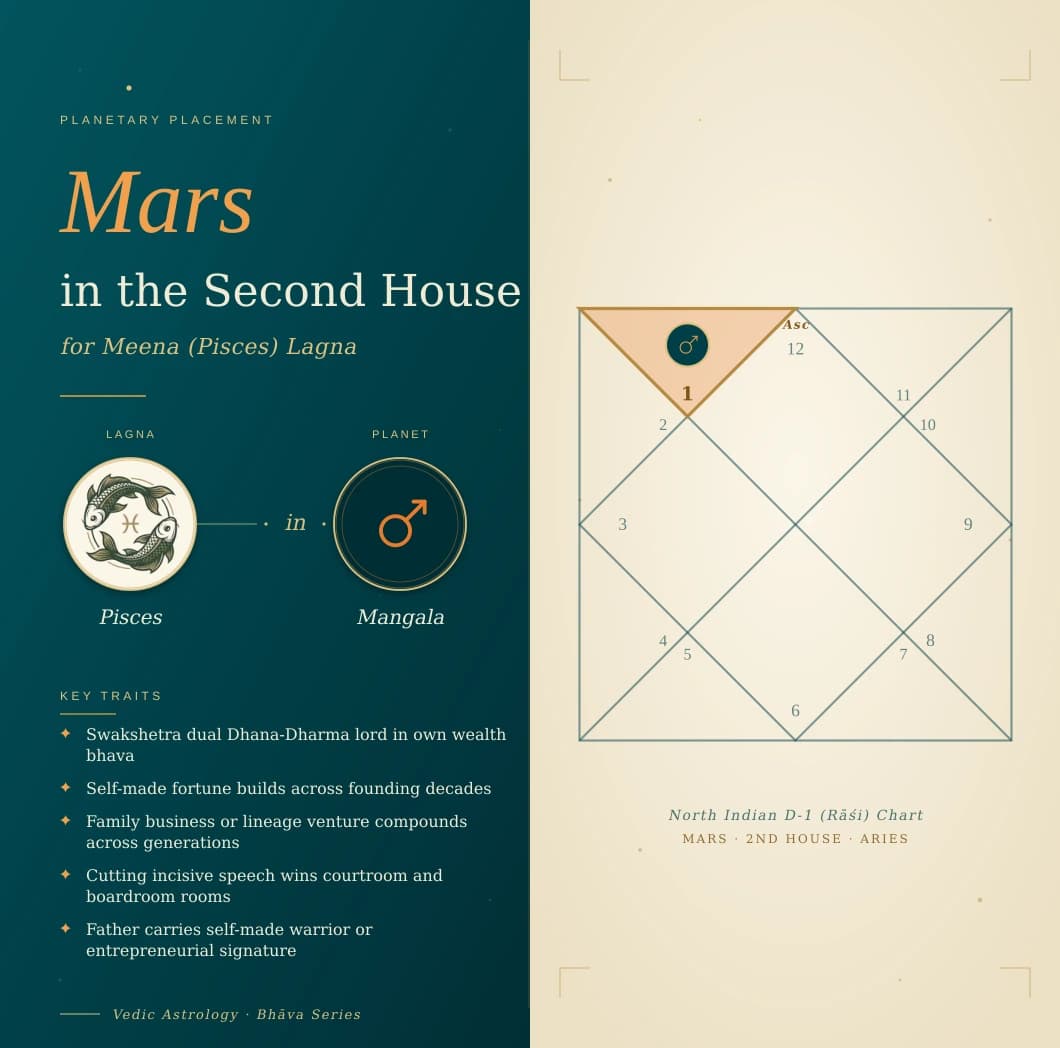
Mars sits in his own sign Mesha in the second wealth house for Pisces ascendant natives, the entrepreneurial Dhana-Dharma yoga where speech becomes the tool of fortune.
Mars in 2nd house for Meena Lagna, the quick reference
If you carry Mars in the second house of a Meena chart, you hold a configuration classical Parashari treats as a foundational entrepreneurial wealth signature with one specific caveat that demands honest handling, because Mangal (Mars) sits in his own sign Mesha (Aries) inside Dhana Bhava (the second house, the bhava of accumulated wealth, family resources, speech, food, and the right side of the face). The second house from Meena is Mesha, Mars's pioneering own sign, which makes the 2L sit inside his own 2H. Combined with Mars's simultaneous 9L lordship of Vrishchika, this placement produces what classical commentators call the Dhana-Dharma yoga in own dhana, where the 2L plus 9L combination routes both portfolios through the entrepreneurial Mesha channel.
The structural feature distinguishing this placement is the joint dhana-dharma lordship in own house. Mars rules Mesha (2nd, dhana) and Vrishchika (9th, bhagya) for Meena, the two strongest wealth-related angles in the entire chart because dhana governs accumulation while bhagya governs ethical fortune. When this dual lord sits swakshetra in his own dhana bhava, the chart fuses family wealth (2L), dharmic fortune (9L), and the dhana bhava itself into one continuous channel.
One classical caution matters. The 2nd house is described in Brihat Parashara Hora Shastra as the marana karaka sthana for Mars, the death-like position despite swakshetra strength, because the 2nd lord is a maraka (life-shortening lord) and Mars is a naturally violent malefic. The own-sign placement gives strong bhanga (cancellation) of the harshest dimension per Phaladeepika, but the speech and family-friction signature remains in moderated form. Additionally, the second house is one of the seven Manglik houses, which means this placement carries the speech-Manglik signature for marriage delineation, also moderated by the swakshetra bhanga rule. This guide reads every layer of Mars in 2nd house for Meena Lagna natives: the Mesha swakshetra, the 2L plus 9L Dhana-Dharma combination, the marana karaka sthana nuance, the speech-Manglik moderation, and the red coral protocol.
Why swakshetra Mars in own dhana is the entrepreneurial Dhana-Dharma signature
Students often arrive at this placement aware that swakshetra Mars is broadly favourable but uncertain how to weigh the swakshetra strength against the marana karaka sthana caveat the 2nd house carries for Mars. The honest practitioner answer requires reading the own-sign cancellation, the dual 2L plus 9L combination, and the Mesha pioneering temperament together. Classical Parashari recognises that own-sign placement gives a planet his most native expression, and Phaladeepika states that a malefic in his own sign produces a structural cancellation of the harsher dimension.
The Mesha pioneering dimension is the first feature practitioners need to handle correctly. Mesha is Mars's cardinal warrior sign, distinct from Vrishchika which is his mystical own sign. It rules first-mover initiative, founding capacity, sustained physical drive, and the temperament that converts raw effort into functioning enterprise. When Mars in own Mesha sits in the 2H of Meena, the dhana machinery acquires an entrepreneurial signature: family wealth tends to be self-made rather than inherited, the lineage often carries warriors or self-made business builders, and the native develops adult careers where income flows through founding and building rather than salaried service.
The 2L plus 9L Dhana-Dharma routing is the second interpretive layer. Mars rules both Mesha (2nd dhana) and Vrishchika (9th bhagya) for Meena, holding joint lordship of accumulated wealth and dharmic fortune. When this dual lord sits swakshetra in his own 2H, many natives develop adult vocations where ethical conviction directly produces durable family wealth, where wealth carries the moral colour of the founding-work that produced it, and where the family-business venture becomes the dharmic vehicle through which the lineage expresses its commitments across generations.
The marana karaka sthana caveat is the third layer practitioners must hold honestly. Mars in the 2nd is on the classical MKS list because the 2nd lord is a maraka and Mars is a naturally violent malefic, so the placement statistically increases family-quarrel risk, harsh-speech tendency, and accidents involving the face, mouth, or teeth during Mars dashas. The own-sign placement substantially moderates these risks per Phaladeepika and the practical clinical record, but moderation is not elimination, and the conscious-speech remedy this study describes carries genuine importance.
Swakshetra Mars in own dhana is not generic strength. It is the singular Meena configuration where the warrior planet rules wealth, sits inside wealth, holds the dharma trikona simultaneously, and routes the chart's entire Dhana-Dharma spine through the entrepreneurial Mesha channel of self-made fortune.
Terms used in this article
A short glossary of the Sanskrit and Jyotish terms that recur in this study. First-occurrence expansion is also retained inline.
- Dhana Bhava
- The 2nd house, the bhava of accumulated wealth, family resources, speech, food, savings, and the close-circle resource base.
- Swakshetra
- Own-sign placement. A planet sitting in a sign he himself rules, expressing through native ground rather than borrowed terrain.
- Dhana-Dharma yoga
- A combination where one planet rules both a dhana (2nd or 11th) and a dharma (5th or 9th) house, producing wealth tied to ethical work.
- Mesha
- Aries. Mars's cardinal pioneering own sign, ruling first-mover initiative, founding capacity, sustained physical drive, and entrepreneurial temperament.
- Marana Karaka Sthana
- A classical caveat marking specific planet-house combinations as death-like for the karakatva. Mars in the 2nd is the textbook MKS for Mars.
- Maraka
- Life-shortening lord. The 2nd and 7th lords of any chart carry the maraka classification because their bhavas terminate the lifespan.
- Bhanga
- Cancellation. A classical term for the moderation or reversal of a difficult planetary signature by a counter-balancing strength.
How swakshetra Mars in dhana shapes the Meena native
Physically the native carries the Meena soft-water frame anchored by a Mars-Mesha cardinal-fire signature, producing a body strangers describe as quietly athletic with a forward-leaning energy that suggests the native is always ready to move on a decision. The face often carries a small scar, a chipped tooth, or some early-childhood mouth or teeth event, the classical signature of Mars in the 2nd. The eyes carry the receptive depth Meena supplies combined with the alert direct-gaze quality Mars-Mesha contributes, and the gaze tends decisive rather than scanning, the rare combination that translates well to founding-team leadership, courtroom advocacy, surgical command, and sales leadership.
The build keeps Meena proportions through the upper body and adds a fibrous sustained strength through the shoulders, jaw, and forearms. Many natives carry small training or operational scars in their formative years, and the right-eye area can show a freckle, mole, or minor mark families remember as a birth distinguisher. Hair tends dark and coarse, the complexion runs warm with a coppery undertone, and the voice carries a cutting incisive quality (a Mars-2 signature) that registers as command authority in professional rooms but can wound family members in domestic settings if conscious-speech discipline slips.
Temperament is where the placement most distinguishes the native. These natives carry the standard Meena receptivity but route it through entrepreneurial-action and founding-builder channels rather than purely empathic ones. They are drawn from young to settings where independent decision-making and resource-building are tested early: family-business apprenticeship from teenage years, peer leadership in commercial student ventures, early management of family money or property, and elders who model self-made commercial command rather than inherited rentier wealth.
The Meena empathy combines with swakshetra Mars's commercial discipline to produce natives whose leadership carries both moral weight and founding-instinct. The signature shows up in family-business inheritance and expansion, founding-team command in defence-tech ventures, courtroom and arbitration advocacy, and surgical leadership in trauma settings. The shadow side is the same combination of intensity and receptivity. Natives who do not channel the Mars-2 speech dimension consciously can experience cycles of family-quarrel, harsh-word damage, and money-related friction with parents or siblings that compound across decades. Pairing the Dhana-Dharma drive with explicit conscious-speech practice produces the rare integration of self-made fortune and family stewardship the placement structurally supports.
Strengths, shadows and career fits
- Swakshetra dual Dhana-Dharma lord in own wealth bhava
- Self-made fortune builds across founding decades
- Family business or lineage venture compounds across generations
- Cutting incisive speech wins courtroom and boardroom rooms
- Father carries self-made warrior or entrepreneurial signature
- Wealth accumulates through morally weighted founding work
- Marana karaka sthana raises family-quarrel and speech-friction risk
- Harsh-word damage to parents, siblings, or spouse if unguarded
- Mouth, teeth, or right-eye accidents during Mars dashas
- Speech-Manglik signature affects marriage delineation
- Money disputes with relatives can fracture lineage harmony
- Founding ventures can absorb personal capital under stress
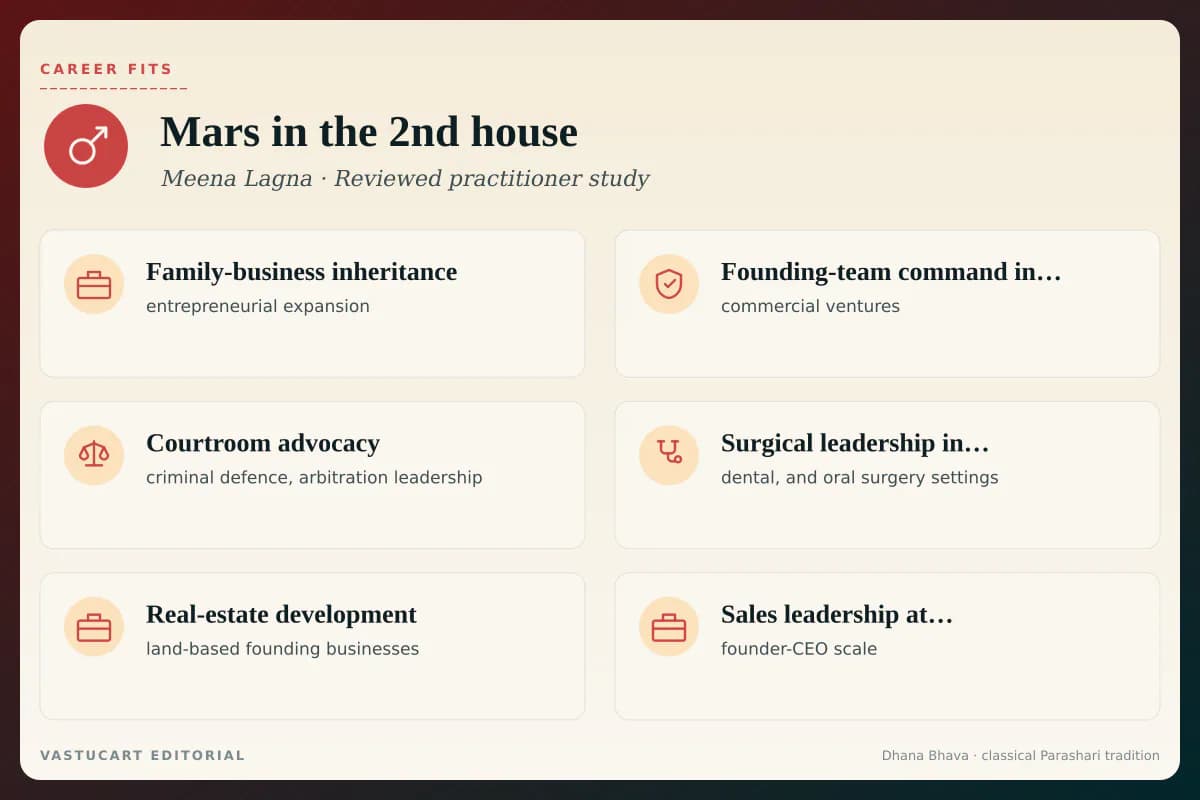
- Family-business inheritance and entrepreneurial expansion
- Founding-team command in defence-tech and commercial ventures
- Courtroom advocacy, criminal defence, arbitration leadership
- Surgical leadership in trauma, dental, and oral surgery settings
- Real-estate development and land-based founding businesses
- Sales leadership at executive and founder-CEO scale
Where the entrepreneurial Dhana-Dharma vocation plays out
Career paths cluster around fields that braid founding-instinct with disciplined courage and morally weighted commercial work. Family-business inheritance and entrepreneurial expansion is the strongest single fit because the swakshetra dual Dhana-Dharma lord routes accumulated family wealth directly through the native's founding-builder capacity. Many natives become second-generation chairs or third-generation founder-CEOs whose tenure is remembered as the building chapter rather than the maintenance chapter of the family's commercial story, often founding subsidiary divisions, opening new geographic markets, or pivoting the lineage business into adjacent territory the parent generation could not have reached.
Founding-team command in defence-tech and commercial ventures fits because Mars in own Mesha is the textbook founder-CEO temperament, and the 2L plus 9L routing produces ventures whose income tracks both commercial competence and ethical positioning. Many natives in their thirties and forties found defence-technology firms, security-and-surveillance commercial companies, fitness-industry ventures, real-estate development funds, or commercial-services firms where the founder's own face and family name become the brand carrier.
Courtroom advocacy, criminal defence, and arbitration leadership reward the conversion of cutting incisive speech into structurally protected income. The Mars-2 speech signature is one of the most reliable advocate-and-litigator markers in the classical lexicon, and many natives become senior trial counsel, criminal-defence partners, arbitration-and-mediation panellists, or commercial-litigation department heads whose practices carry the technical aggression and ethical conviction the dual Dhana-Dharma lordship supplies.
Surgical leadership in trauma, dental, and oral surgery settings fits because Mars rules sharp instruments and the 2nd house specifically rules face, mouth, teeth, and throat. Many natives become senior trauma surgeons, oral-and-maxillofacial surgeons, dental-practice founders, or otolaryngology department heads. Real-estate development and land-based founding businesses suit Mars in Mesha because Mars rules land, fire, and physical building. Sales leadership at executive and founder-CEO scale rounds out the cluster. Mars mahadasha is the defining window and arrives with the family-business chair confirmation, founding-CEO mandate, courtroom-chambers partnership, surgical-practice founding, real-estate-fund launch, or sales-leadership appointment that crystallises the Dhana-Dharma vocation.
How to weigh the swakshetra strength against the 2nd-house caveats
The clearest way to read Mars in 2nd of Meena is to hold the swakshetra strength, the MKS caveat, the Manglik-bhanga rule, and the dual Dhana-Dharma routing together. Classical Parashari recognises that own-sign placement gives a planet his most native expression and that own-sign occupation produces bhanga of the harshest dimension. When all four operate at once, the chart requires nuanced reading rather than a flat positive or negative verdict.
The MKS caveat reads as follows. The 2nd is a maraka bhava because the 2L is one of the two classical maraka lords alongside the 7L. Mars is a naturally violent malefic ruling weapons, accidents, fire, and adversarial confrontation. When Mars occupies the maraka bhava, the karakatva of decisive cutting action and the maraka quality combine into the MKS death-like signature despite any sign-strength. Phaladeepika and clinical records confirm that own-sign placement substantially moderates this caveat, but moderation is not elimination, and the family-quarrel, harsh-speech, and face-or-mouth accident statistics during Mars dashas remain elevated above baseline.
The Manglik-bhanga rule is the second feature for marriage delineation. Classical Manglik calculation reads Mars in houses 1, 4, 7, 8, and 12 from lagna, and most schools also include the 2nd. So this Mars formally carries the speech-Manglik signature where friction shows up around speech, family quarrels, and money disputes with spouse and in-laws. However, classical bhanga rules grant cancellation when Mars sits in his own sign, and this Mars receives strong bhanga per Phaladeepika. The formal Manglik tag applies but substantive friction is significantly reduced.
The dual Dhana-Dharma routing is the third layer that makes this configuration structurally favourable despite the caveats. When the 2L plus 9L sits in his own 2H, the chart's wealth-and-faith spine routes through one continuous Mars-Mesha channel, and the entrepreneurial Dhana-Dharma yoga becomes the dominant reading once the speech-discipline remedy is addressed.
When swakshetra Mars delivers its Dhana-Dharma chapter
Mars mahadasha is the defining window for this placement and arrives with the family-business chair confirmation, founding-CEO mandate, courtroom-chambers partnership, surgical-practice founding, real-estate-fund launch, or sales-leadership appointment that crystallises the entrepreneurial Dhana-Dharma vocation, while requiring careful conscious-speech practice to navigate the marana karaka sthana edge.
Face, mouth, teeth, and the Dhana Bhava health link
Health follows the Mars-in-2nd pattern with specific Mesha and Meena body-part vulnerabilities and the MKS caveat foregrounded. Constitution is generally robust, with pitta prominent because Mars carries fire-pitta and Mesha adds cardinal-fire intensity. The 2nd house rulership covers the right eye, face, mouth, teeth, throat, and tongue, while Meena emphasises feet, lymphatic system, and fluid balance. Mars rules cuts, surgical wounds, accidents, fevers, and the cardiovascular and musculoskeletal systems broadly.
The placement raises specific vulnerability to mouth, teeth, and right-eye accidents during Mars dashas, dental interventions across the operational decades, throat-and-voice strain from heavy public-speaking work, facial injuries from contact-training, and inflammatory pitta spikes when speech-discipline lapses into prolonged confrontational engagement. Many natives report fast injury recovery thanks to swakshetra Mars vitality, but the same fire instinct draws the native into adversarial commercial terrain where face and mouth carry disproportionate risk.
Most natives benefit from disciplined daily training, regular dental and oral-surgery preventive care from the late twenties (earlier than peer charts), a weekly Tuesday fast, throat-and-voice rest during heavy advocacy seasons, and dietary pitta moderation in summer. Annual full-panel screening from the late twenties is recommended with attention to dental health, blood pressure, lipid profile, and right-eye examination. The conscious-speech discipline doubles as the primary spiritual remedy and the primary health remedy because the 2nd-house Mars routes both wealth and physiological vulnerability through the same speech channel.
Remedies for swakshetra Mars in the Meena dhana angle
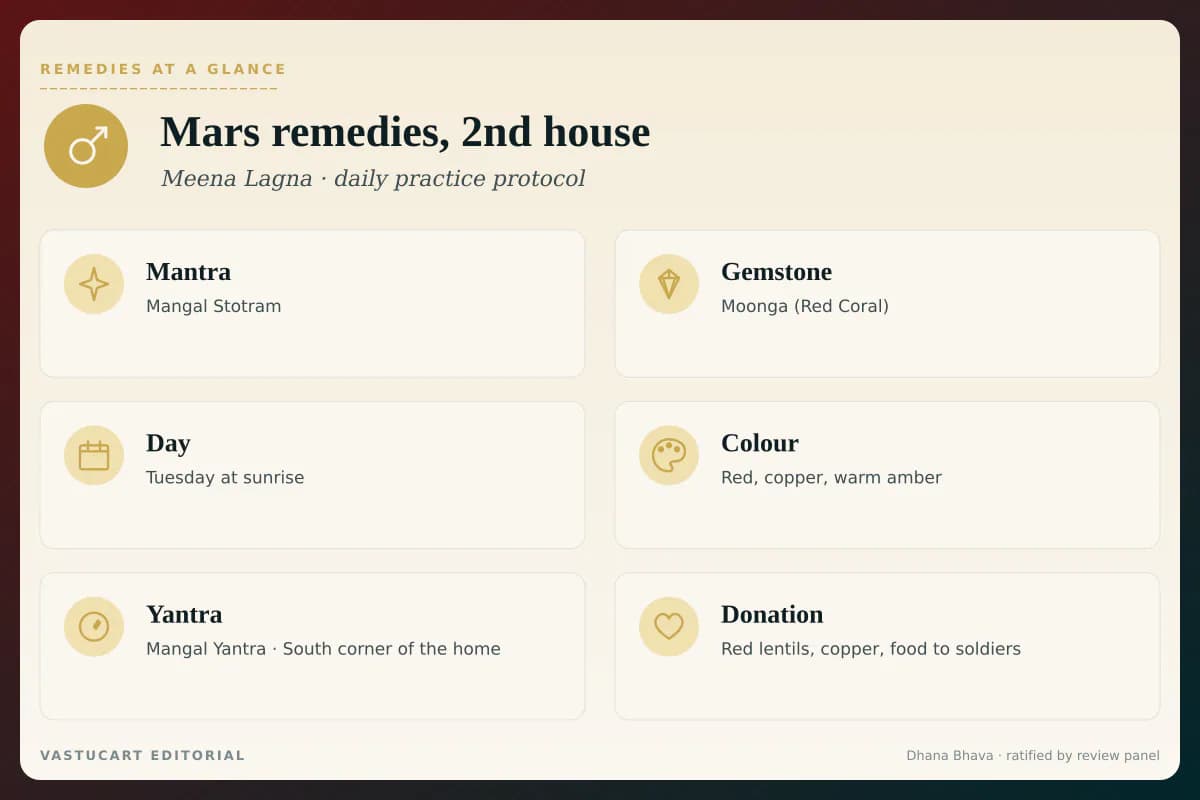
The daily Hanuman or Bhairava worship is the primary remedy for this placement because Hanuman is the classical patron deity of Mars and Bhairava is the depth-discipline form for natives drawn to the warrior-with-dharma dimension. Either form supplies the specific speech-restraint blessing the Mars-2 placement structurally requires. Rise before sunrise, bathe, wear red or deep saffron clothing on Tuesdays, and visit a Hanuman or Bhairava temple if accessible. The Mangal Stotram is the primary recitation, the Navagraha verse to Mars. Reciting it at sunrise daily for forty days at any major Mars transition is the formal protocol classical sources prescribe.
Offer red flowers (especially hibiscus and red lotus), jaggery sweets, and red sandal paste at the altar. Donate to causes supporting entrepreneurial-warrior service and family welfare: military-veteran widow funds, dental-and-oral-health programmes for low-income families, scholarship funding for first-generation entrepreneurs, courtroom legal-aid funds. The conscious-speech practice is the lifestyle remedy that compounds across decades into the difference between Dhana-Dharma mastery and MKS over-extension. A daily Mauna (silence) practice of ten minutes morning and evening, a weekly review of which family conversations carried unnecessary cutting edge, and a quarterly direct-apology practice are the three observances classical sources and modern practitioner records both endorse.
The gemstone is red coral (Moonga), one of the more nuanced Mars gemstone decisions because swakshetra Mars in own dhana responds to amplification with structural cleanness on the wealth channel but can amplify the MKS edge if conscious-speech practice is not in place first. Wear a natural red coral of minimum five carats set in copper on the ring finger of the right hand on a Tuesday at sunrise after Mangal mantra recitation, only after a confirmed reading by a qualified Jyotishi.
Gemstones for Mars in 2nd house Meena Lagna
Red coral is the primary Mars gemstone and is worn after speech-discipline foundation is in place because the 2nd-house marana karaka sthana caveat means amplification works cleanly only when the native has stabilised conscious-speech practice first.


Disclaimer: Red coral over a swakshetra Mars in the dhana bhava amplifies the entrepreneurial Dhana-Dharma channel, and the marana karaka sthana caveat means conscious-speech practice should be in place first. Always consult a qualified Jyotishi before permanent wearing.
Rudraksha beads for Mars in 2nd house
The Mars-aligned rudraksha is the Teen Mukhi (Three Mukhi), the bead directly ruled by Agni and Mars.
The classical Mars rudraksha and the bead specifically associated with disciplined warrior drive. Supports the swakshetra dhana signature, channels the Mars-Mesha founding instinct toward sustainable commercial territory, and stabilises operational bandwidth when the family-business, founding-CEO, courtroom, surgical, or real-estate vocation is in active phase. Particularly recommended for this placement because the bead's restraining quality moderates the marana karaka sthana speech edge.
The fourteen-mukhi bead supports protective wisdom and intuitive command judgement. Wearing the Chaudah Mukhi alongside the Teen Mukhi compounds the placement's natural strength in family-business stewardship, founding decision-making, courtroom advocacy, and surgical-practice leadership while supplying additional speech-discipline support.
Mangal Yantra for the swakshetra dhana placement
Sacred recitations for swakshetra Mars in the dhana angle
Kumaram shakti-hastam cha mangalam pranamamy aham
Translation: I bow to Mangala, son of the Earth, radiant as a flash of lightning, the warrior youth holding the spear of victory. The Mangal Stotram is the canonical Navagraha verse to Mars and is the right daily recitation for a chart where Mars sits swakshetra in his own Mesha in the dhana angle and the entrepreneurial Dhana-Dharma signature needs a containing devotional field while the marana karaka sthana edge is moderated by daily speech-discipline. Many natives advanced in practice add the Hanuman Chalisa or the Mangal Dosh Nivaran Stotram recitation as a secondary layer once the daily Mangal discipline is steady, especially during the marriage-search years when the speech-Manglik signature is most relevant.
Read the full stotra on stotra.vastucart.in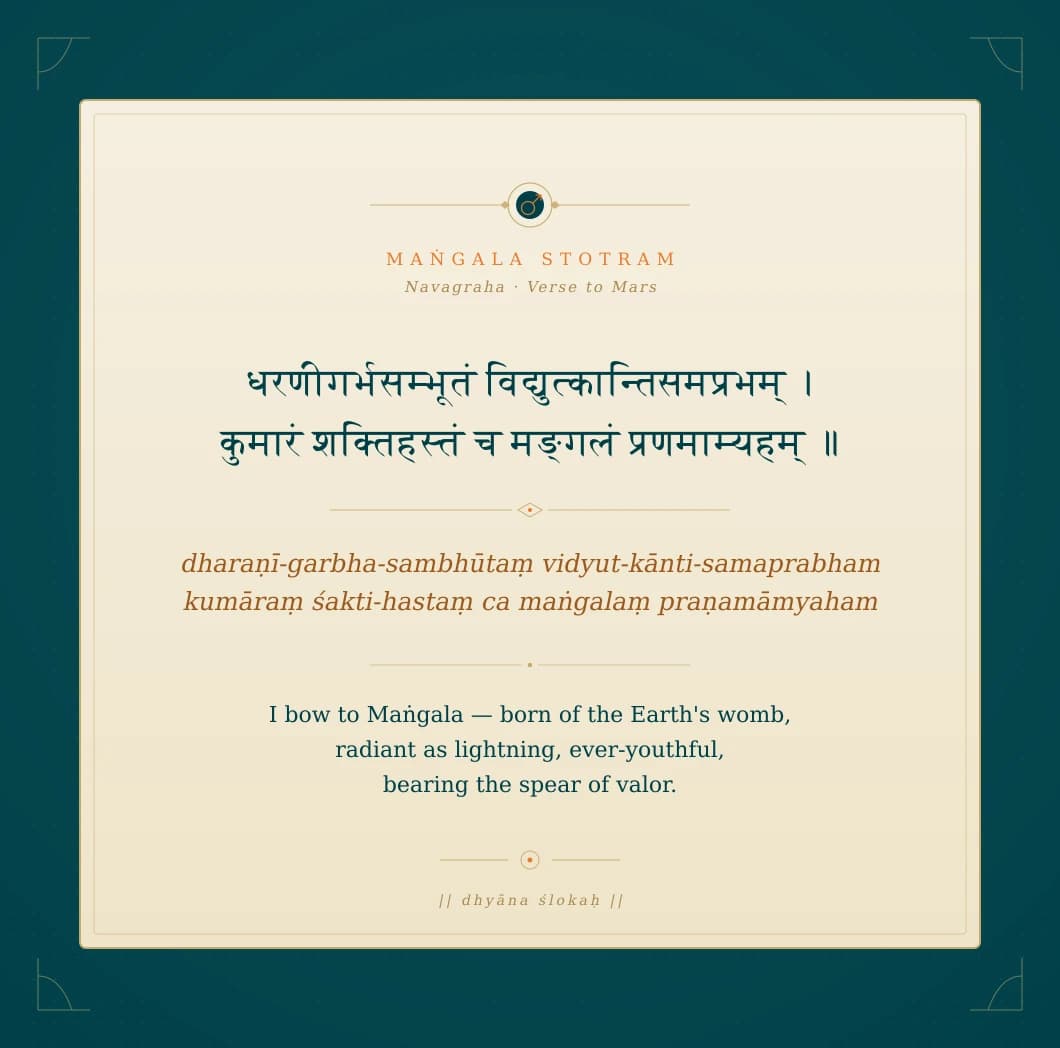
Tools for Mars 2nd house Meena natives
Is your Dhana Bhava Mars carrying the swakshetra Dhana-Dharma signature?
Get a full personalised analysis of your second house Mars, the swakshetra Mesha status, the speech-Manglik bhanga reading, and the entrepreneurial dasha timing.