
Sun in the 1st house
Mesh Lagna (Aries Ascendant)
A thorough, practitioner-level study of Surya in Pratham Bhava for Aries ascendant natives. Covers personality, health, career, marriage, dasha activation, gemstones, rudraksha, yantra, and stotra.
Sun in 1st house for Mesh Lagna, the quick reference
If you are reading this, you almost certainly already know your lagna and you have been told that the Sun sits in your first house. The combination is rare, the combination is powerful, and the combination is far better understood by the Mesh Lagna native who is reading this in Pratham Bhava terms than by anyone reading western horoscope columns. The Sun is uchha (exalted) in Aries, the lagna lord Mangal is a friend of the Sun, and for the Aries ascendant the Sun is the 5th lord of intelligence and progeny. Placing a fifth lord in the lagna creates a kendra-trikona rajyoga, the textbook signature of authority and recognition. Every Aries ascendant carrying this Sun in lagna placement is born into a chart that hands them the conditions for leadership and asks them in return to refine the ego that comes with it. This guide reads each layer of the Sun in 1st house combination for Mesh Lagna and Aries ascendant natives, from body and personality through career, marriage, dasha, and the practical remedies including the ek mukhi rudraksha and the Aditya Hridayam stotra that help the most.
When the Sun finds its natural throne
There are placements in a birth chart that whisper, and there are placements that announce. Sun in the first house for Mesh (Aries) Lagna is decidedly the latter. The first house, Pratham Bhava or Tanu Bhava, governs the physical body, the sense of self, and the very first impression you make upon the world. It is the mask you wear not to hide yourself, but because it is truly who you are.
Surya (the Sun), the planet of soul, authority, ego, and vitality, steps into this house and immediately feels at home. Aries, the natural first sign of the zodiac and ruled by Mangal (Mars), a friend of the Sun, creates a synergy that produces one of the most dynamic personality signatures in all of Jyotish. This is not a quiet placement. It is a sunrise placement, unmissable, powerful, and impossible to ignore.
For Mesh Lagna specifically, the Sun is also the fifth lord, ruling the trine of intelligence and past-life merit. Placing a trikona lord in a kendra is the classical signature of a raja yoga, a combination that produces status, recognition, and steady ascent. Twenty two years of practice have shown me that natives born with this yoga are marked early. Teachers notice them. Elders remember their names. They rarely hide in crowds.
When the Sun sits in the first house of Aries, the native does not search for identity, they radiate it. The question is never who they are, but how much of themselves the world can comfortably hold.
How this native moves through the world
The physical build of these natives is almost always erect, lean to medium in frame, with a face that holds its structure into later life. The forehead is pronounced, the jawline defined, the eyes steady, often slightly lighter than the surrounding skin would predict. Hair is thick in youth and thins early on the crown, which is a classical signature of Surya in the first house regardless of lagna, and especially visible here.
Temperament is direct, not blunt in the rude sense, but unwilling to bury a point in pleasantries. The native arrives at meetings already having decided what they think, and when they are wrong, they correct themselves publicly, which strangers often read as humility and insiders read as a kind of comfort with their own errors. First impressions among strangers are rarely neutral. Either people instinctively defer, or they take an immediate dislike. There is no middle response.
Personality, career, and challenges
- Commanding natural authority
- High physical vitality
- Fearless and decisive nature
- Natural leadership ability
- Strong immune constitution
- Excellent willpower
- Excessive ego and pride
- Domineering in relationships
- Pitta imbalances, excess heat
- Father relationship tensions
- Impatience and short temper
- Arrogance in authority
- Government (IAS, IPS, IFS)
- Surgery and medicine
- Military and defence
- Entrepreneurship
- Politics and judiciary
- Entertainment and media
Where command meets institution
The tenth lord from Mesh lagna is Shani (Saturn), placing Makar (Capricorn) on the tenth cusp. Saturn and Sun are bitter enemies in the classical scheme, and in a weaker chart this tension can keep the native orbiting around authority without ever becoming the authority. But Surya exalted in the first house overpowers that tension. He burns bright enough that Saturn's coldness is put to work rather than opposing him. The result is a career trajectory that moves through disciplined institutions and rises to the top of them.
The six fields I have seen deliver real results for this combination are government executive service, cardiac surgery and ophthalmology, military and police leadership, gold and bullion trade, direction and production in cinema, and electoral politics. The first category is classical because Sun in the first is the signature of a civil officer of rank. The second works because the first house body parts and the heart fall under this combined rulership, and surgical discipline suits the exalted Sun. Mars backs Surya and both agree on command, which makes the third category almost inevitable for natives with a strong chart. The rest follow from Surya's rulership of gold, creative authority, and public voice.
Placement in the North Indian chart
- Sun (Surya) in Lagna, highlighted in saffron
- 12 houses in North Indian format
- Central square is the 1st house (Lagna)
Pitta fire, solar bones, steady vitality
The first house body parts are the head, face and overall constitution. Surya rules bones, the heart, the right eye, and the general life force. When Surya sits here in exaltation, the native arrives with an unusually strong immune system and a bone structure that stays dense well into old age. Children born to this combination rarely fall seriously ill in the first seven years, and elders retain their posture past seventy.
The vulnerabilities are equally specific. Frontal headaches appear under Sun stress or during Sun dasha activation. The right eye shows dryness and early presbyopia. The heart is structurally sound but reacts badly to unresolved pride, which in medical terms translates into stress hypertension. Hair loss on the crown typically begins in the late twenties. The constitution is strongly pitta dominant, with a secondary vata influence from the cardinal fire nature of Aries. A practical guidance I give every such native is this. Cool the head before cooling the body. Splash cold water on the forehead first at sunset, before any other evening wash, and the daily heat of the placement will stop accumulating.
When this placement activates most powerfully
The Vimshottari Dasha system reveals which planet's period is running for a native. During Surya Mahadasha, six years, this first-house placement becomes the dominant force. Career peaks, authority is recognised, and the native's true solar identity shines without obstruction. Mangal's own period activates the lagna lord and brings enormous energy, while Guru brings wisdom and expansion, and Shani requires patience against Sun's heat.
Peak years and key antardashas to watch
Surya Mahadasha runs for six years. For a native with Surya exalted in the first, these are the years that set the trajectory of the whole life. If the mahadasha lands between the ages of twenty two and thirty five, which happens for many birth charts, it coincides with early career and marriage timing, and the native jumps three or four steps ahead of their peer group. If it lands in childhood, the child becomes the undeniable centre of the family. If it lands after fifty, it restores health and authority in a phase when most people are slowing.
Two antardasha combinations are decisive. Surya mahadasha with Guru antardasha brings public recognition, awards, or a promotion with visible ceremony. Surya mahadasha with Mangal antardasha initiates leadership roles and occasional public confrontations that the native wins. Transits of Shani through Simha or Kumbha tend to test this placement most severely, and every such test ends with the native emerging stronger rather than weaker. Transits of Guru through Mesh or Simha open fresh opportunities almost every month they pass through.
The father is the first teacher and the first mirror
In Parashari Jyotish, Surya is the natural karaka of the father, and when the Sun sits in the lagna of an Aries native, the father becomes the most defining presence of the early life. Sometimes by his strength, sometimes by his absence, but always central. I have read hundreds of charts with this combination over twenty two years, and the pattern is consistent enough that I now ask the question before the native volunteers it. Either the father was a tall figure in their formative years, an officer, a doctor, a respected elder in the community, and the native grew up in his shadow learning the language of authority by watching it. Or the father was distant, ill, or lost early, and the native learned authority by being forced to take it on themselves before their peers had to.
The classical texts treat this as pitru karma, the unfinished karma of the paternal line. The exalted Sun in the first house is itself the resolution. The native is, in effect, the son or daughter who completes a story the father could not. This is why the early career often replays the father's profession in some refined form, even when the native consciously rejects it. A doctor's child becomes a hospital administrator. A soldier's child becomes a security strategist. A farmer's child becomes the policy maker who shapes how farms are run. The shape changes, the lineage continues.
The remedial approach to this is direct. Honour the father visibly, even if the relationship was difficult, and especially after his passing. Perform tarpan on the new moon and on his death anniversary. Donate red wheat and copper on Sundays in his name. If the father is alive, touch his feet at every meeting without speaking, and accept whatever he gives, even if it is correction the native does not feel they need. The Sun in lagna does not soften by being defended. It softens by being placed at the service of the lineage that produced it. Natives who do this consistently report that the pride in their first house cools into a quieter authority by their late thirties, and the surrounding people stop reading them as commanding and start reading them as steady. That is the goal of the placement, and it is the highest form Surya in Pratham Bhava can take in this lifetime.
Power, pride, and partnership
The seventh aspect of Surya falls from the first house onto the seventh, which for Mesh Lagna is Tula (Libra), ruled by Shukra (Venus). Sun and Venus are natural enemies in the classical grammar of Jyotish. This aspect is one of the most commented on combinations in classical texts on marriage. It does not promise misery, but it does promise tension if the native is not conscious.
The spouse indicated is generally handsome or striking in appearance, socially confident, and from a family that carries some visible status. The trouble is the power balance. The native, used to walking into rooms and being deferred to, brings the same expectation home. Venus governs the seventh and wants partnership, softness, mutual negotiation. Surya in the first wants recognition and authority even in intimate spaces. If the native learns to listen at home the way they expect to be listened to in public, the marriage thrives. The most compatible lagnas for a lasting marriage are Dhanu, Simha, and Vrishchika.
Remedies that compound over years
The single most effective daily practice for this placement is the recitation of the Aditya Hridayam, the ancient hymn taught by sage Agastya to Lord Rama on the battlefield before his final duel with Ravana. Recite it at sunrise, facing east, ideally after a cold bath. Even one full reading of the thirty one verses in the morning is enough to settle the vitality for the day. On Sundays, keep a single grain diet, wheat in the morning, jaggery with ghee at midday, no evening meal. The charity specific to this placement is red wheat and raw sugar offered to a person over sixty on Sunday at sunrise, by the native's own hand, without being asked who they are.
For the gemstone and rudraksha matched to this exact combination, see the sections that follow. Both require a practitioner's confirmation before permanent wearing. The lifestyle adjustment that compounds over decades for this placement is simple and harder than any mantra, pause five full minutes before any major decision. For Mesh Lagna with exalted Sun, stillness is more difficult than action, and learning it directly addresses the one shadow this otherwise magnificent placement carries.
Gemstone recommendations for this placement
Gemstones in Jyotish work by amplifying a specific planet's energy through light frequency and crystalline structure. For Sun in the 1st house of Mesh Lagna, the primary stone is Ruby (Manik), with a secondary option for those who cannot afford a natural ruby. Always test the stone for seven days before permanent wearing and consult a qualified practitioner.
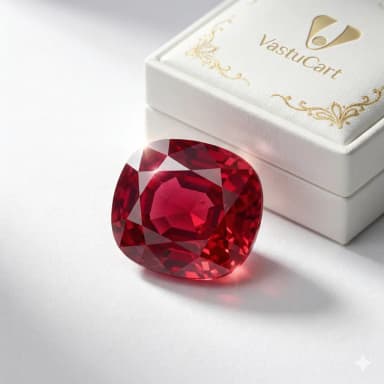


Disclaimer: Gemstone recommendations are based on classical Jyotish principles. Always consult a qualified Jyotishi who has reviewed your full birth chart before wearing any gemstone. Effects vary based on chart strength, dasha periods, and individual constitution. Do not substitute gemstone therapy for medical treatment.
Rudraksha beads for Surya and Mesh Lagna
Rudraksha beads are seeds of the Elaeocarpus ganitrus tree, held sacred in Shaivite tradition and prescribed in Jyotish for planetary strengthening and spiritual grounding.
Enhances soul clarity, removes ego distortions, boosts willpower. Ideal for Sun in lagna natives who struggle with pride. Worn on Monday after abhishek.
Represents the twelve Adityas. Removes fear, enhances authority and leadership ability. Beneficial for careers in government and public life for Mesh Lagna natives.
Surya Yantra for this ascendant
Sacred recitations for Surya and Mesh Lagna
Ravanam chagrato drshtva yuddhaya samupasthitam
Daivataishcha samagamya drashtumabhyagato ranam
Upagamyabravid Ramam Agastyo bhagavanrishih
Translation: When Rama stood exhausted in battle, the sage Agastya approached and said, recite Aditya Hridayam and you shall conquer all enemies, attain all knowledge, and never face defeat.
Read the full stotra on stotra.vastucart.inTools personalised to your Rashi and Lagna
Is your Sun this powerful in your own chart?
Get a complete, personalised analysis of your Surya placement, its current dasha strength, and specific remedies for your full chart.
Questions about Sun in 1st house, Mesh Lagna
Pt. Raghav Sharma has practiced Parashari Jyotish for over twenty two years from Varanasi. A student of the Varanasi Jyotish tradition, he specialises in Graha-in-Bhava analysis, Vimshottari Dasha predictions, and Muhurta. He has authored over four hundred in-depth articles on Jyotish principles across the VastuCart knowledge network.