Moon in the 2nd house
Mithuna Lagna (Gemini Ascendant)
A practitioner study of Chandra in Dhana Bhava for Gemini ascendant natives. The Moon swakshetra in his own Karka in the wealth angle, the 2L lordship in own sign producing strong dhana yoga, and the family-prosperity and refined-speech signature that defines the most rewarding Mithuna placement Moon can occupy.
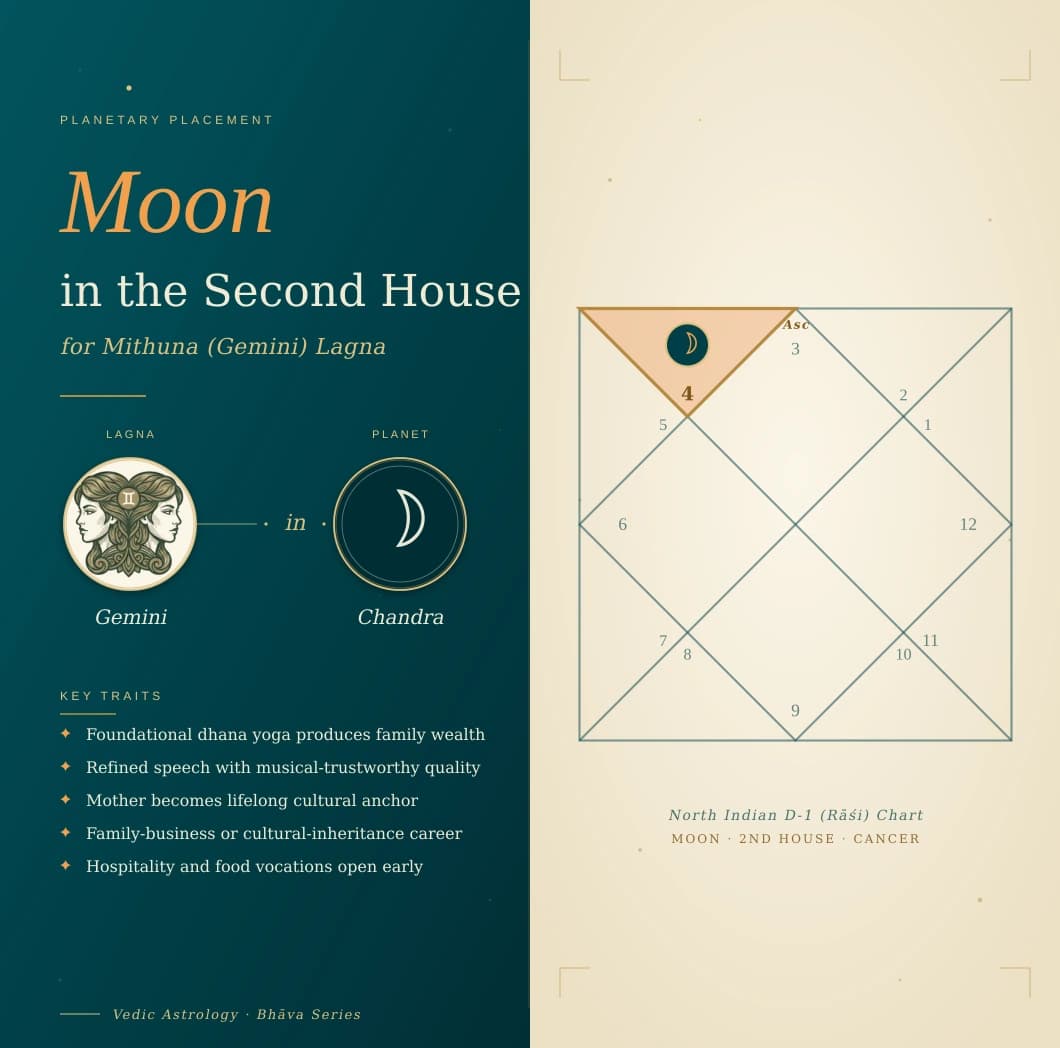
Moon sits swakshetra in his own Karka in the second house for Gemini ascendant natives, the family-prosperity and refined-speech signature.
Moon in 2nd house for Mithuna Lagna, the quick reference
If you carry the Moon in the second house of a Mithuna chart, you hold one of the most rewarding wealth placements in the entire Vedic catalogue, because Chandra (Moon) is the natural lord of nourishment, family, and emotional security, and his arrival in Dhana Bhava (the second house, the bhava of family wealth, lineage, speech, and accumulated resources) lifts these significations into territory where Moon's nurturing nature becomes the spine of the native's material life. The second house from Mithuna is Karka (Cancer), the Moon's own sign, which means the Moon sits swakshetra in the dhana angle. Classical Parashari recognises swakshetra placement of the dhana lord (2L) in the dhana house (2H) as one of the foundational dhana yogas in the chart.
The second structural feature is the 2L-in-2H pattern. The Moon is the 2L for Mithuna, ruling family wealth, speech, lineage, and accumulated resources. When the 2L sits in his own house in his own sign, the wealth-producing dimension of the chart receives a structural strength that compounds across decades. Many natives in this configuration report family wealth that arrives early (inheritance, family business, ancestral property) and grows steadily through the lifetime, with the chart specifically supporting the conservation and expansion of family resources rather than purely earned income. The third feature is the refined-speech signature. The 2nd house rules speech (vak) and the Moon rules emotional resonance, and the meeting point produces natives whose voice carries a particular musical and trustworthy quality. Many natives become broadcasters, voiceover artists, hospitality professionals, food writers, family-business stewards, or counsellors whose careers depend on a soothing and authoritative speaking presence. This guide reads every layer of Moon in 2nd house for Mithuna Lagna natives: the Karka swakshetra, the 2L lordship, the dhana yoga, the family-prosperity signature, and the pearl protocol.
Why the Moon in his own house creates a structural dhana yoga
Students often arrive at this placement aware that it is strong but uncertain why classical texts treat the 2L-in-2H pattern with particular reverence. The honest practitioner answer requires understanding what dhana yoga actually means. Classical Parashari recognises a hierarchy of wealth-producing combinations in the chart, and the strongest of these is when the 2L (dhana lord), 5L (poorvapunya lord), 9L (bhagya lord), or 11L (labha lord) sit in their own houses in their own signs. The Moon as 2L of Mithuna meeting the 2H in his own Karka produces this combination at the foundational level, which is why most experienced practitioners read this placement as one of the strongest possible Moon configurations for the lagna.
The lineage-and-speech reading is the second specific feature that practitioners need to handle correctly. The 2nd house rules family lineage (kutumb), the speech apparatus (vak), accumulated wealth (dhana), and the food-and-cuisine dimension of life (rasa). When the Moon sits swakshetra in this bhava, all four significations gain the lunar refinement: the family lineage tends to be culturally rich and emotionally cohesive, the speech carries an unusual musical and trustworthy quality, the wealth accumulates with conservative steadiness rather than speculative volatility, and the food-and-cuisine dimension often becomes a vocational direction. Many natives in this configuration develop adult careers in food media, hospitality, family-business stewardship, or cultural-heritage work where the Moon's nurturing temperament directly translates into professional expression. The third interpretive layer is the contrast with Moon in 4 (the kendra Moon for Mithuna). Moon in 4 of Mithuna would place Moon in friendly Kanya (Mercury sign), in the home-and-vehicle bhava. Moon in 2 is the dhana-bhava swakshetra, the family-and-speech pattern. Moon in 4 would also be favourable but lacks the swakshetra strength.
Moon in his own dhana house is not a generic strong placement. It is the specific configuration where the family lineage, the speech, and the wealth all become carriers of the native's emotional integrity rather than separate concerns.
Terms used in this article
A short glossary of the Sanskrit and Jyotish terms that recur in this study. First-occurrence expansion is also retained inline.
- Dhana Bhava
- The 2nd house, the bhava of family wealth, lineage, speech, and accumulated resources.
- Swakshetra
- Own sign. A planet placed in his own sign gains structural strength.
- 2L
- Second-house lord, the planet ruling family wealth and speech.
- Dhana Yoga
- Wealth-producing combination, classically the 2L, 5L, 9L, or 11L in own house in own sign.
- Kutumb
- Family lineage and ancestral household, ruled by the 2nd house.
- Vak
- Speech, the voice and articulation apparatus, ruled by the 2nd house.
- Karakatva
- The natural significations a planet rules independent of any chart.
How the Moon swakshetra in the dhana angle shapes the Mithuna native
Physically the native carries the Mithuna versatility softened by the Moon's nurturing presence, often producing a face that strangers describe as approachable and emotionally articulate. The eyes carry an unusual depth and the smile tends to be quick but genuine, the rare combination that translates well to camera and stage without performing warmth. The build keeps the standard Mithuna lean frame but adds a fullness around the lower face and throat (classical Moon 2H signatures), and many natives have an unusually melodious speaking voice that strangers comment on. Hair often grows abundantly and well-formed, especially in the early decades, and many natives have a noticeable mole or feature on the upper throat or neck.
Temperament is where the placement most distinguishes the native. These natives carry the Mithuna versatility (curiosity across domains, comfort with multiple frames) but route it through emotionally-attuned channels rather than purely analytical ones. They are drawn to caregiving and hospitality dimensions of life from young: cooking for friends, hosting gatherings, mediating family conflicts, and serving as the emotional anchor in their close circles. They consistently report family closeness from childhood, often with the mother as a significant cultural and emotional influence, and many natives find their first vocational opening through family-business contexts (food businesses, hospitality, cultural inheritance, family scholarship). The Mithuna directness combines with the Moon's empathy to produce natives who can have a difficult conversation with care, the rare combination that translates well into counselling, broadcasting, family-business leadership, and similar people-facing fields. The shadow side is the same emotional sensitivity: natives who do not channel the Moon-nurture role consciously can experience repeated cycles of family-overgiving that drain personal bandwidth, and the cycles can compound across years into reputational fatigue. Natives who pair the empathy with explicit family-system boundaries develop the rare integration of warm relationality and durable practice the placement is genuinely capable of supporting.
Strengths, shadows and career fits
- Foundational dhana yoga produces family wealth
- Refined speech with musical-trustworthy quality
- Mother becomes lifelong cultural anchor
- Family-business or cultural-inheritance career
- Hospitality and food vocations open early
- Conservative wealth growth across decades
- Family-overgiving can drain personal bandwidth
- Speech can carry emotional weight that strains
- Throat and jaw sensitivity in stress periods
- Inherited responsibilities can feel heavy
- Romantic life often follows family approval
- Conservative wealth approach may miss windows
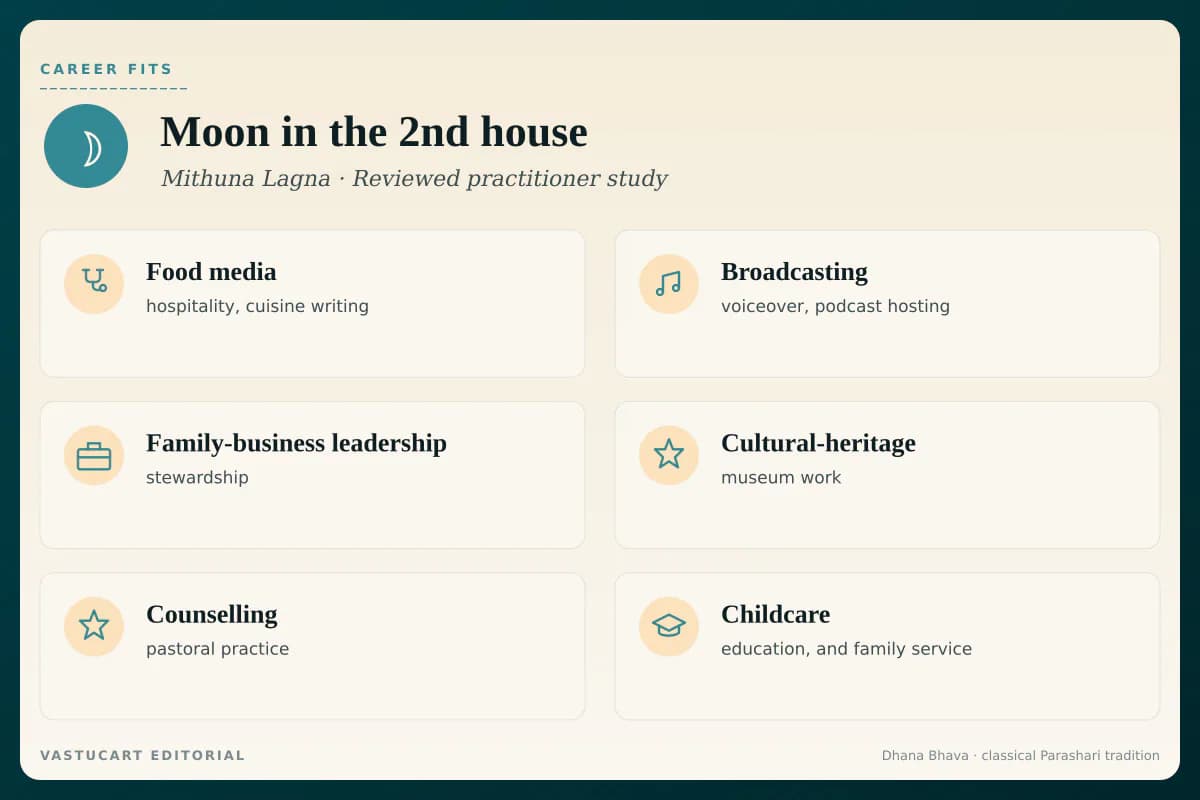
- Food media, hospitality, cuisine writing
- Broadcasting, voiceover, podcast hosting
- Family-business leadership and stewardship
- Cultural-heritage and museum work
- Counselling and pastoral practice
- Childcare, education, and family service
Where the family-prosperity vocation plays out
Career paths cluster around fields that braid emotional resonance with structured commerce. Food media, hospitality, and cuisine writing are the strongest single fit because the 2nd house rules food, the Moon rules nourishment, and the Mithuna versatility extends the cuisine dimension into writing, photography, and cultural translation. Many natives become food writers, restaurant critics, hospitality entrepreneurs, or cookbook authors whose careers compound across decades into substantial bodies of cultural reference. Broadcasting, voiceover, and podcast hosting suit natives whose vocational mode is more vocal: the Moon refinement of the speech apparatus combined with Mithuna's communication versatility produces natives whose voice carries unusually well across media.
Family-business leadership and stewardship work because the chart specifically rewards conservative wealth conservation and lineage-continuity, and Mithuna natives in this configuration often inherit family enterprises and grow them carefully across decades rather than reinventing them speculatively. Cultural-heritage and museum work fit the chart because the 2nd house rules accumulated cultural resources and the Moon rules emotional connection to lineage. Counselling and pastoral practice work because the chart specifically supports holding emotional material clients bring, and many natives in their forties build counselling careers focused on family-system issues. Childcare, education, and family service fit naturally because the Moon's nurturing temperament expresses through institutional childcare, family-counselling, or kinship-network leadership. Moon mahadasha is the defining career window and arrives with the family-business expansion, the broadcasting platform launch, the hospitality venture, or the cultural-institution appointment that crystallises the dhana yoga vocation.
Why this is among the strongest Moon placements for Mithuna
The clearest way to understand the Moon in 2nd of Mithuna is to read the swakshetra status, the 2L-in-2H pattern, and the dhana yoga formation together. Classical Parashari recognises that own-sign placement gives a planet his full natural strength, and lord-in-his-own-house pattern gives the bhava his full natural strength because the lord and the house align without mediation. When the lord, the sign, and the house all match (as they do here), the placement holds simultaneously the planet's strength, the lord's strength, and the bhava's strength, producing a configuration that classical texts read as foundational rather than merely strong.
The maraka note is the second specific feature that practitioners need to handle correctly. The 2nd house is technically a maraka station because it relates to the family-and-mortality dimension of life through the lineage-continuity reading. When the 2L sits in the 2H in own sign, the maraka classification is partially neutralised because the lord-in-his-own-house pattern is structurally constructive rather than destructive. Many natives in this configuration enjoy unusually long-lived parents, durable family relationships, and the kind of family-stewardship career that compounds across decades into substantial cultural standing. The third interpretive layer is the comparison with Moon-related dhana placements (Moon in 5L's house, etc.) that other lagnas offer. The Moon-in-2H-Karka swakshetra for Mithuna is the cleanest possible Moon-dhana combination because no other lagna places Moon's sign at the 2H cusp simultaneously with making Moon the 2L of the chart.
When the Moon in 2nd delivers its dhana yoga chapter
Moon mahadasha is the defining window for this placement and arrives with the family-business expansion, broadcasting platform launch, hospitality venture, or cultural-institution appointment that crystallises the dhana yoga vocation.
Throat, digestion, and the Dhana health link
Health follows the Moon-in-2nd pattern with specific Dhana body-part vulnerabilities. Constitution is generally balanced, with kapha most prominent because the Moon carries water-kapha and Karka is itself a water-kapha sign. The 2nd house body-part rulership covers the throat, mouth, jaw, and lower face, and the Moon rules the digestive function broadly. The placement raises specific risk for throat-and-jaw sensitivity in stress periods, dental issues across life, and digestive disturbances tied to emotional load. Many natives report that voice quality fluctuates with emotional state, which is the Moon-in-2H signature expressing through the speech apparatus.
The Moon-water-Karka constitution is the second specific layer. Classical reports consistently associate Moon swakshetra with strong constitutional fluid balance and good emotional resilience, but excess kapha can produce weight gain, lymphatic sluggishness, and metabolic slowdown during emotionally heavy periods. Most natives benefit from disciplined daily walking, moderate fasting practice, and mindful attention to dietary kapha (reducing dairy, refined sugar, and cold foods during humid months). Annual full-panel screening from the late twenties is recommended with specific attention to thyroid, dental, and metabolic markers. Daily yoga (specifically chest-opening and pranayama practices that support throat health), moderate intake of cold liquids, and avoidance of late-night emotional indulgences are the lifestyle stabilisers because the chart's natural pull toward emotional caregiving needs ordinary body discipline as a counterweight.
Remedies for the Moon in the Mithuna dhana angle
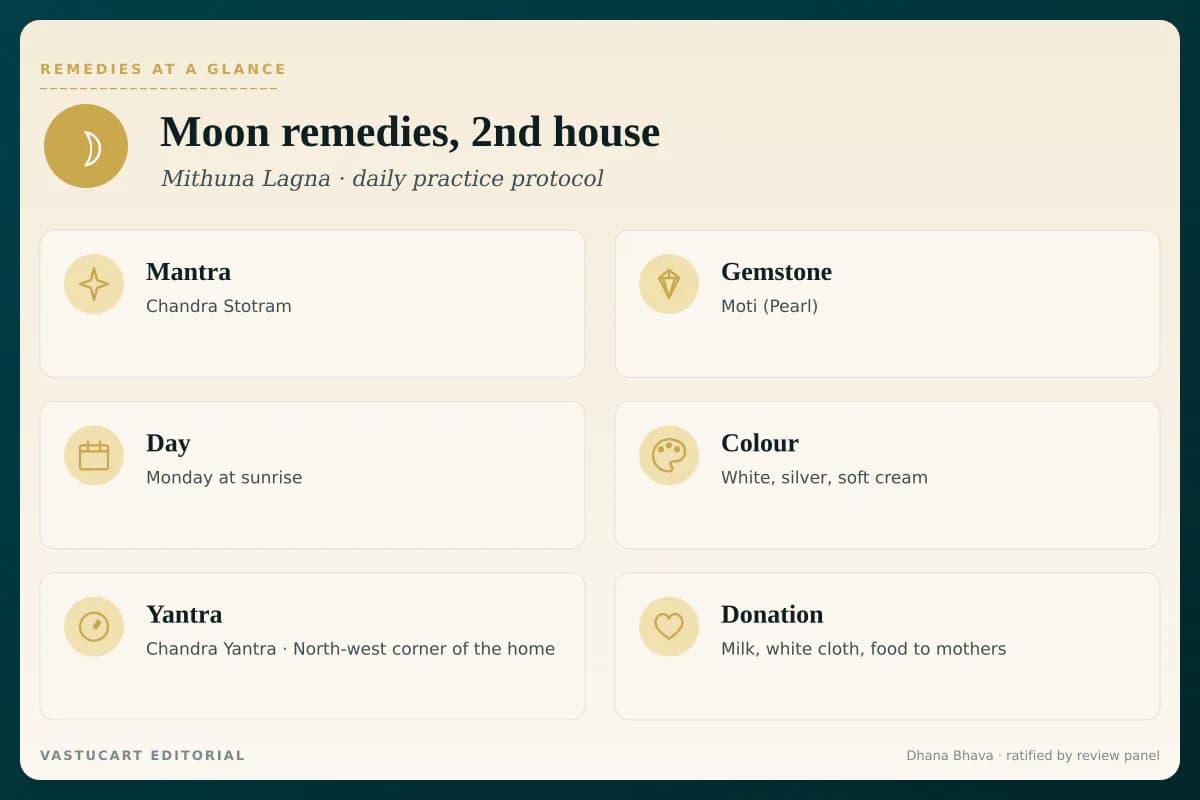
The daily Krishna or Devi worship is the primary remedy for this placement because Krishna is the classical patron deity of the Moon (and the Devi is the alternative for natives drawn to the maternal form), and either form holds the dhana yoga signature in its most refined expression. Rise before sunrise, bathe, wear white or pale silver clothing on Mondays, and visit a Krishna or Devi temple if accessible. The Chandra Stotram is the primary recitation, the Navagraha verse to Chandra that creates a containing field for the Moon signature in its swakshetra-dhana expression. Reciting it at sunrise daily for forty days at any major Moon transition (a family-business expansion, a broadcasting platform launch, a hospitality venture) is the formal protocol.
Offer white flowers (especially lotus and jasmine), milk-rice, kheer, and white sweets at the altar, and donate to causes that support family welfare and lineage-preservation (orphan-care institutions, family-counselling services, classical-cuisine apprenticeships). The conscious-boundaries practice is the lifestyle remedy that compounds across decades into the difference between Moon-2-mastery and Moon-2-overgiving: a daily reflection on which family commitments are nourishing and which are draining keeps the placement directed. The gemstone is pearl (Moti), and this is one of the most gemstone-rewarding placements because the swakshetra dhana Moon responds to amplification cleanly. Wear a natural sea pearl of minimum five carats set in silver on the small finger of the right hand on a Monday at sunrise after Chandra mantra recitation, and only after a confirmed reading.
Gemstones for Moon in 2nd house Mithuna Lagna
Pearl is the primary Moon gemstone and works particularly well here because the swakshetra dhana Moon responds to amplification cleanly.


Disclaimer: Pearl over a swakshetra dhana Moon channels the family-prosperity amplification cleanly. Always consult a qualified Jyotishi before permanent wearing.
Rudraksha beads for Moon in 2nd house
The Moon-aligned rudraksha is the Do Mukhi (Two Mukhi), the bead directly ruled by Shiva-Parvati and the Moon.
The classical Moon rudraksha and the bead specifically associated with relational harmony. Supports the family-prosperity signature, channels the empathy-instinct toward sustainable territory, and stabilises emotional bandwidth when the dhana yoga is in active phase.
The eleven-mukhi bead supports speech and communication strength. Wearing the Gyarah Mukhi alongside the Do Mukhi compounds the placement's natural strength in broadcasting, voiceover, and family-business communication.
Chandra Yantra for the dhana placement
Sacred recitations for the Moon in the dhana angle
Namami shashinam somam shambhor-mukuta-bhushanam
Translation: I bow to the Moon, bright as curd, conch, and snow, born from the cosmic ocean's nectar-filled flow, adorning Lord Shiva's crest with radiant glow. The Chandra Stotram is the canonical Navagraha verse to the Moon and is the perfect daily recitation for a chart where the Moon sits swakshetra in the dhana angle and the family-prosperity signature needs a containing devotional field. Many natives advanced in practice add the Devi Suktam recitation as a secondary layer once the daily Chandra discipline is steady.
Read the full stotra on stotra.vastucart.in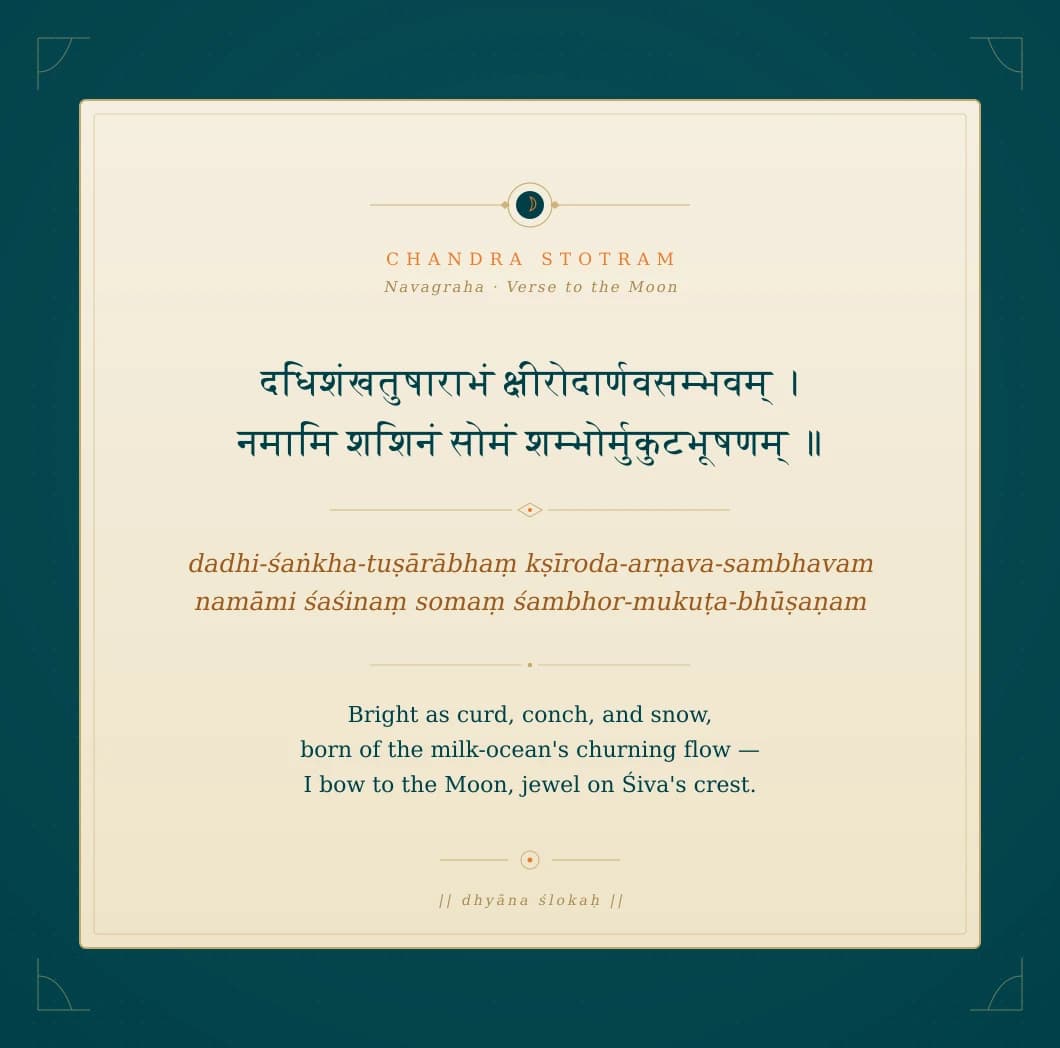
Tools for Moon 2nd house Mithuna natives
Is your Dhana Bhava Moon carrying the family-prosperity signature?
Get a full personalised analysis of your second house Moon, the dhana yoga, and the family-business timing.