Sun in the 5th house
Mithuna Lagna (Gemini Ascendant)
A practitioner study of Surya in Putra Bhava for Gemini ascendant natives. Sun debilitated in Tula in the trikona of creative intelligence, the 3L lordship landing in the putra angle, and the neecha-bhanga creative-authority signature that defines this Mithuna Sun placement when classical reversal conditions activate.
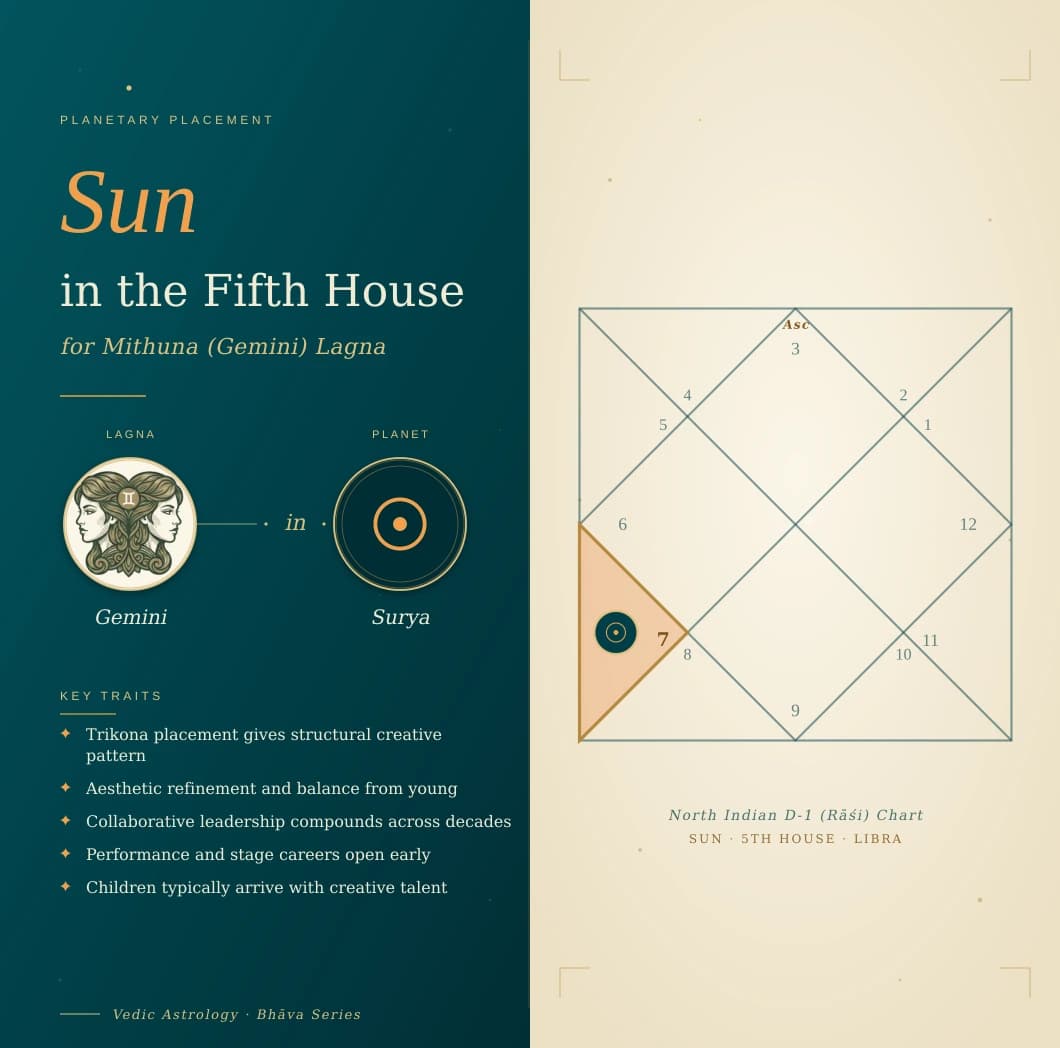
Sun sits debilitated in Tula in the fifth house for Gemini ascendant natives, the neecha-bhanga creative-authority signature.
Sun in 5th house for Mithuna Lagna, the quick reference
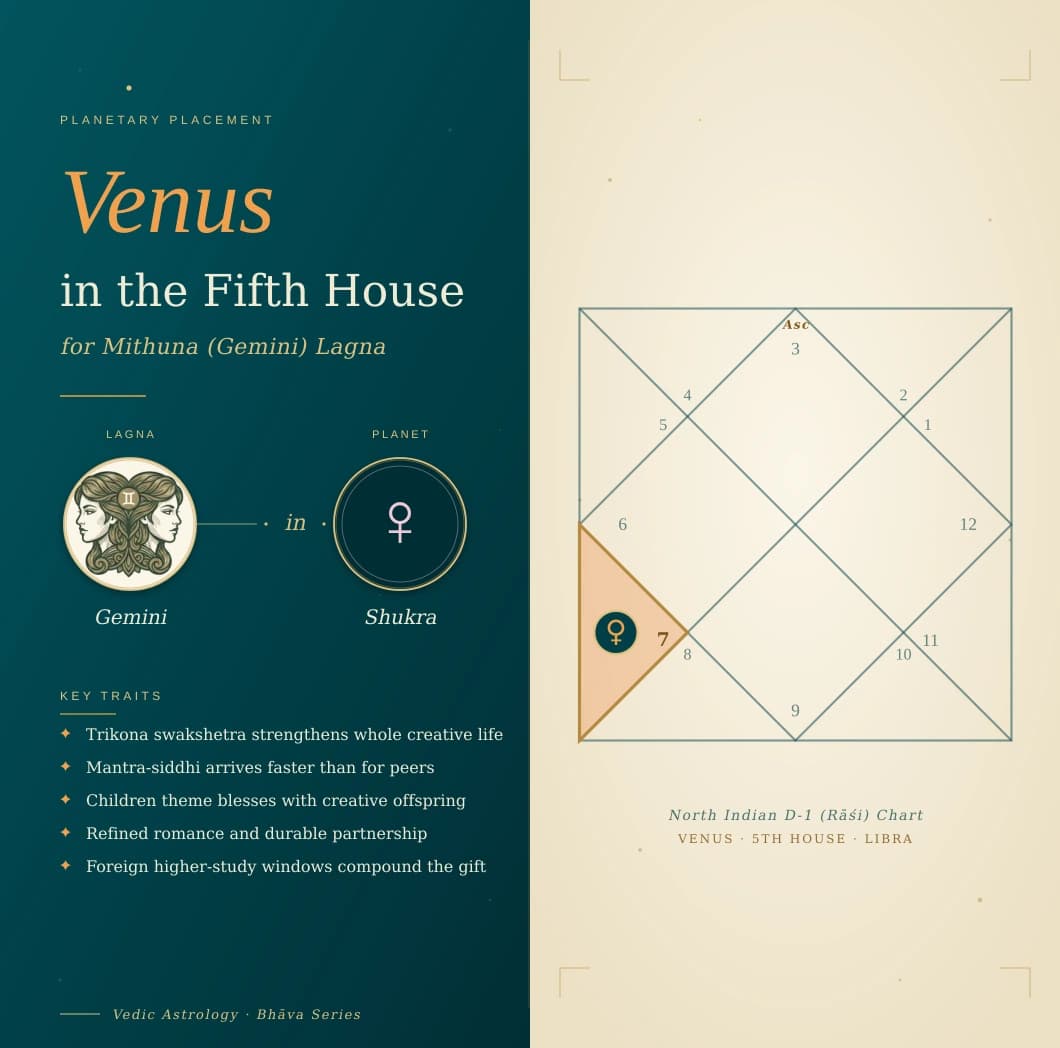
If you carry the Sun in the fifth house of a Mithuna chart, you hold one of the most paradoxical configurations in the Vedic catalogue, because Surya (Sun) is the natural lord of authority and self-illumination, yet his arrival in Putra Bhava (the fifth house, the bhava of poorvapunya, intelligence, creative output, and children) places him in Tula (Libra), his classical debilitation sign. The first practitioner reading is that the Sun in 5H of Mithuna is debilitated by sign yet placed in trikona by bhava, and the chart's creative-authority arc depends on whether the classical neecha bhanga conditions activate at birth.
The second structural feature is the 3L-in-5H pattern. The Sun is the 3L for Mithuna, ruling parakrama (effort), siblings, and written communication. When the 3L sits in 5H trikona, the effort-axis and the creative-output axis fuse, classically read as a yoga that compounds initiative into recognised creative work. The third feature is the Venus-mediated Sun signature. Because the 5H falls in Tula (a Venus sign), the creative vocation tends to involve aesthetic refinement, visual or musical art, performance, and the kind of cultural-leadership work where Sun's authority gets routed through Venus's harmony rather than through pure command. This guide reads every layer of Sun in 5th house for Mithuna Lagna natives: the Tula debilitation, the 3L lordship, the trikona-redemption pattern, the neecha bhanga checklist, and the ruby protocol.
Why debilitated Sun in trikona requires the neecha bhanga checklist
Students often arrive at this placement uncertain whether to read a debilitation in the most creative trikona as wasted. The honest practitioner answer is that the chart depends on classical neecha bhanga conditions verified case-by-case before reading the placement as raja-yoga producing or as struggle-shaped. Classical Parashari recognises four primary bhanga conditions, of which any one usually softens and two or more produce the strongest reversal: lord of debilitation sign in kendra from lagna or Moon, lord of exaltation sign in kendra from lagna or Moon, debilitated planet in kendra from Moon or lagna, and benefic aspect from a strong angle.
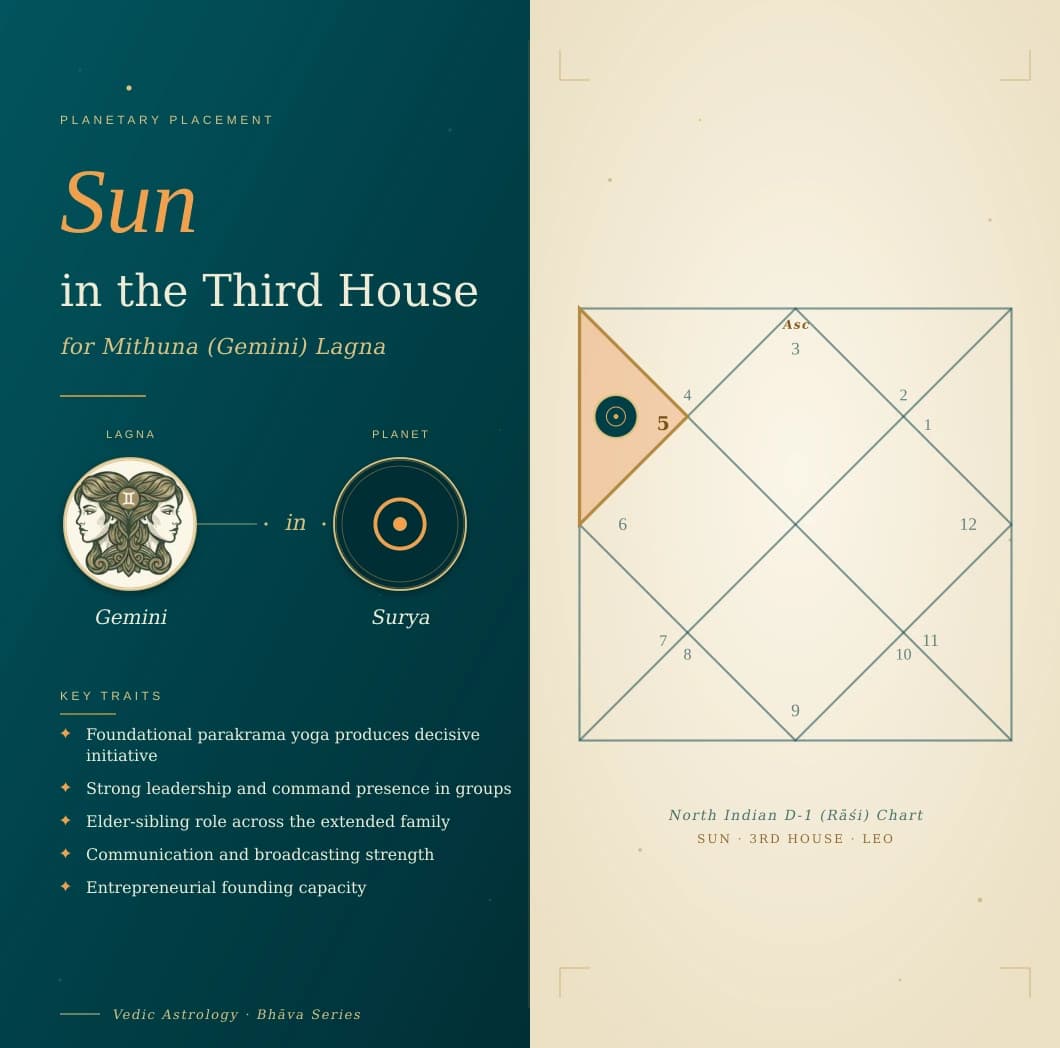
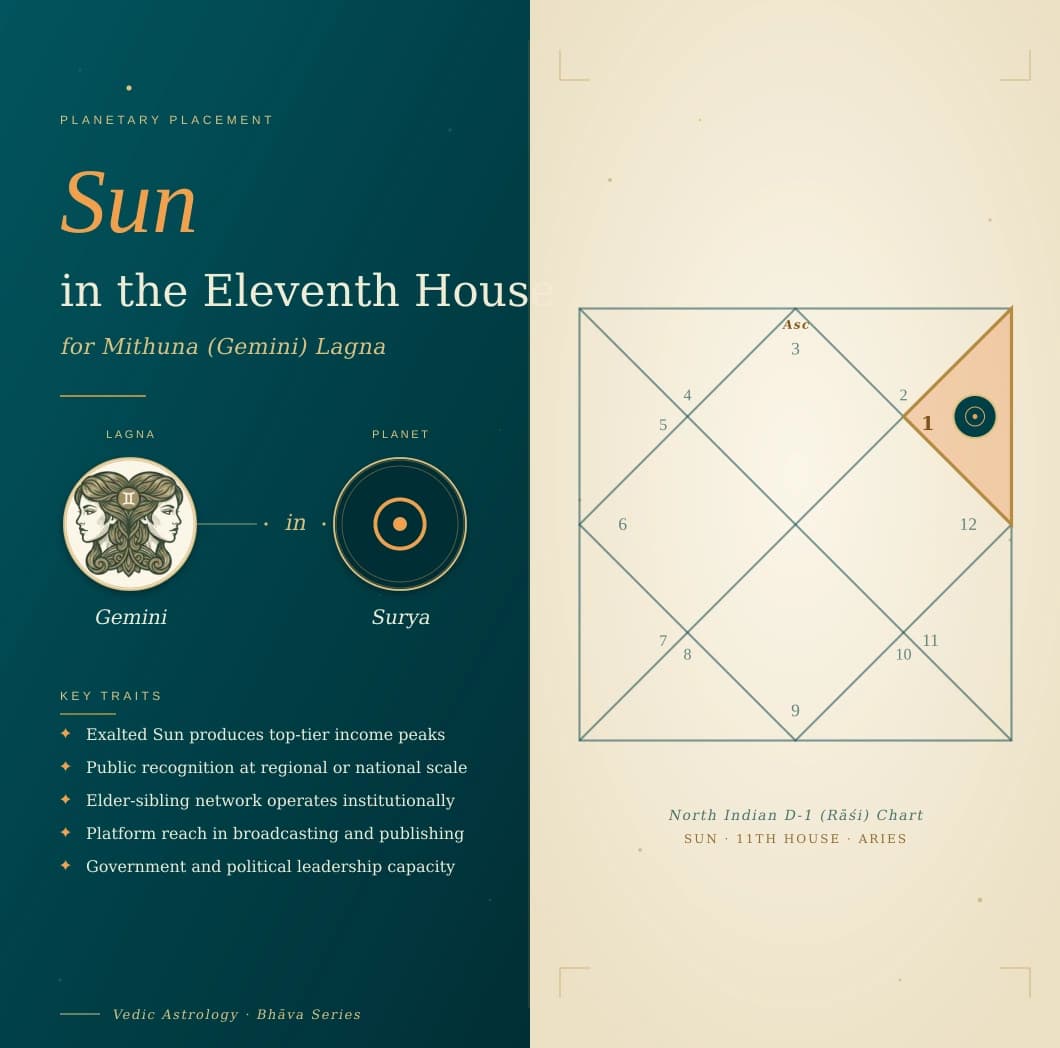
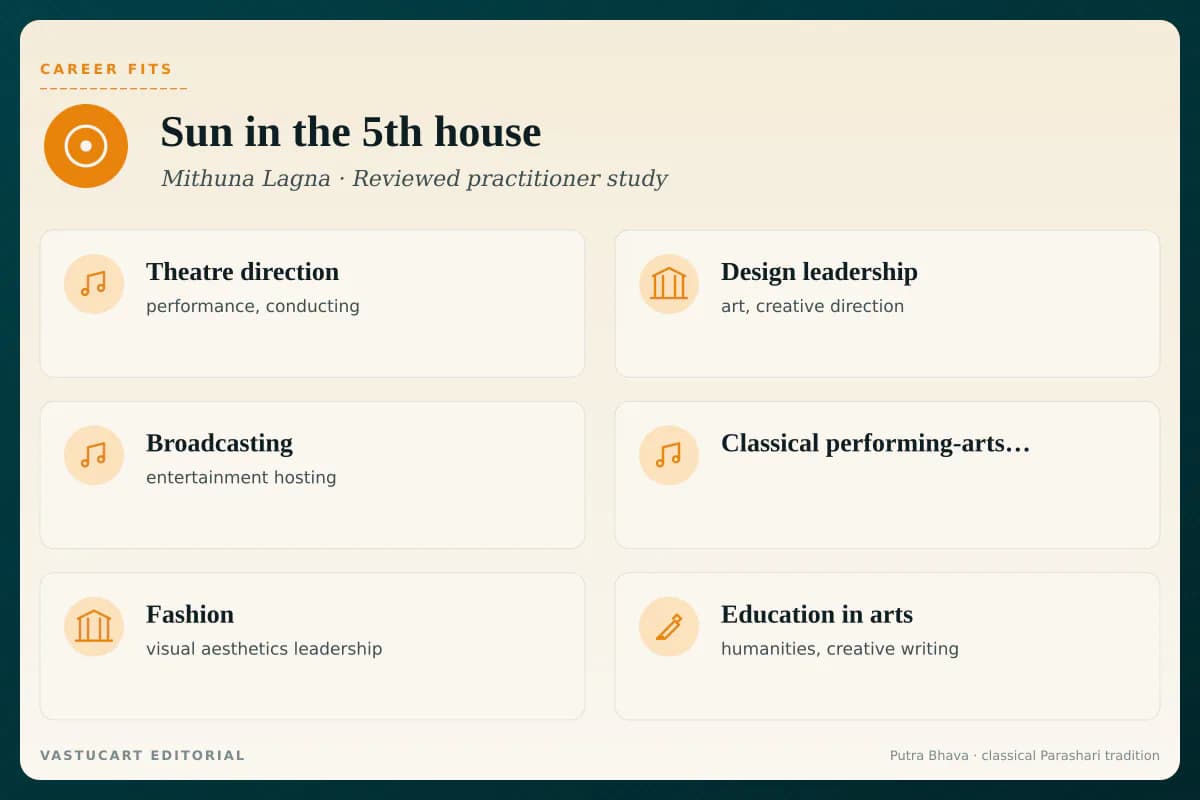
The 3L-in-trikona reading is the second specific feature. The Sun as 3L sitting in 5H produces a foundational pattern where the effort-axis fuels the creative-output axis: classical reports describe natives whose written, spoken, or initiative-led work compounds across decades into recognised creative authority. The Tula (Venus) influence brings aesthetic refinement, balance, and partnership-orientation to Sun's authority signature, producing natives whose creative leadership tends toward collaborative aesthetic disciplines rather than solo command. Many natives in this configuration build careers in performance and stage authority, art and design leadership, broadcasting and entertainment, classical performing-arts traditions, fashion and visual aesthetics, and the kind of educational leadership that combines content authority with collaborative class management. The third interpretive layer is the contrast with Sun in 3 (the swakshetra Surya for Mithuna). Sun in 3 of Mithuna places Sun in his own Simha in upachaya, the foundational parakrama yoga. Sun in 5 places Sun debilitated in Tula in trikona, the neecha-bhanga creative-authority pattern. Both fuel the chart's effort-and-output dimension but the dignity arc inverts: Surya-3 starts strong, Surya-5 starts conditional and grows into raja yoga as the bhanga conditions activate.
Debilitated Sun in the trikona of creativity is not a wasted authority. It is the configuration where solo command relaxes into collaborative aesthetic leadership, and the neecha-bhanga reversal turns the Venus-routed Sun into a recognised creative voice.
Terms used in this article
A short glossary of the Sanskrit and Jyotish terms that recur in this study. First-occurrence expansion is also retained inline.
- Putra Bhava
- The 5th house, the bhava of poorvapunya, intelligence, creative output, and children.
- Neecha bhanga
- Debilitation cancellation. Classical conditions that reverse a debilitated planet into raja-yoga producing strength.
- Trikona
- Trinal bhava (1, 5, 9). Structurally constructive locations for any planet.
- Poorvapunya
- Stored merit from previous lives, ruled by the 5th house.
- 3L
- Third-house lord, the planet ruling parakrama, siblings, and sustained personal initiative.
- Karakatva
- The natural significations a planet rules independent of any chart.
- Vidya Bhava
- Alternate Sanskrit name for the 5th house, emphasising the learning-and-knowledge aspect.
How debilitated Sun in the putra angle shapes the Mithuna native
Physically the native carries the Mithuna versatility softened by the Tula Sun's collaborative-aesthetic orientation, often producing a face that strangers describe as expressive and balanced. The eyes carry an unusually warm focus, the speaking voice tends to be melodious rather than commanding, and many natives have noticeably symmetric features that classical texts attribute to fifth-house Venus-sign Sun signatures. The build keeps the standard Mithuna lean frame but adds a stomach-and-upper-abdomen sensitivity that the placement specifically signals.
Temperament is where the placement most distinguishes the native. These natives carry the Mithuna versatility (curiosity across domains, comfort with multiple frames) but route it through aesthetic-collaborative channels rather than solo-command channels. They are drawn to the creative-performance dimension of life from young: theatre and music, visual art, storytelling practice, and the kind of stage or platform work that compounds across years into recognised creative authority. The Mithuna directness combines with the Tula aesthetic balance to produce natives whose creative leadership feels collaborative even when the work is large-scale, the rare combination that translates well into directing, conducting, design leadership, broadcast hosting, art-school deanship, and the kind of cultural-institution leadership that requires both creative authority and partnership instinct. The shadow side is the same aesthetic orientation: natives who do not consciously claim solo authorship can find their creative work absorbed into collaborative credit dilution, and the cycle can compound across years into reputational invisibility despite genuine contribution. Natives who pair the collaborative instinct with explicit solo-publication discipline (a signed work a decade, a directorial credit a year, a personal platform built over years) develop the rare integration of creative authority and durable practice the placement is genuinely capable of supporting once the bhanga conditions activate.
Strengths, shadows and career fits
- Trikona placement gives structural creative pattern
- Aesthetic refinement and balance from young
- Collaborative leadership compounds across decades
- Performance and stage careers open early
- Children typically arrive with creative talent
- Educational leadership in arts and humanities
- Solo authorship can dilute into collaboration
- Conventional command-style leadership feels forced
- Stomach and digestion need disciplined attention
- Children may demand significant emotional bandwidth
- Public visibility builds slowly without solo discipline
- Speculative creative ventures need careful screening
- Theatre direction, performance, conducting
- Design leadership, art and creative direction
- Broadcasting and entertainment hosting
- Classical performing-arts tradition transmission
- Fashion and visual aesthetics leadership
- Education in arts, humanities, creative writing
Where the creative-authority vocation plays out
Career paths cluster around fields that braid creative discipline with collaborative aesthetic commerce. Theatre direction, performance, and conducting are the strongest single fit because the fifth house rules creative output and the Sun rules authority, while the Tula influence brings the partnership-orchestration instinct that directing and conducting both require. Many natives in this configuration build careers as theatre directors, classical-music conductors, choreographers, or performance leaders whose work compounds across decades into recognised creative authority.
Design leadership, art and creative direction fit natives whose vocational mode is more visual: the fifth-house creative output combined with Sun's leadership signature produces natives who become art directors, brand creative directors, museum directors, or design-firm partners. Broadcasting and entertainment hosting suit Mithuna Mercury's communication versatility blended with Sun's authority, producing natives whose voice carries the right balance of warmth and authority for long-arc broadcast careers. Classical performing-arts tradition transmission fits natives whose vocational mode is more textual-classical: many natives become senior teachers in dance, music, or theatre traditions whose lineage transmission compounds across decades. Fashion and visual aesthetics leadership opens for natives drawn to the visual-cultural dimension: many natives become fashion directors, visual-merchandising leaders, or cultural-institution curators whose taste judgement anchors the field. Education in arts, humanities, and creative writing is the hidden career path many natives find in their forties: dean roles in art schools, creative-writing programme directors, or humanities-college leadership where the chart's creative-authority signature finally finds its institutional home. Sun mahadasha is the defining career window and arrives with the breakout creative project, the directorial appointment, the broadcasting platform consolidation, or the educational-leadership role that crystallises the creative-authority vocation.
Why this is among the most practitioner-dependent Sun placements
The clearest way to understand Sun in 5th of Mithuna is to read the Tula debilitation, the 3L-in-trikona pattern, and the neecha-bhanga checklist as a single integrated configuration. Classical Parashari treats debilitation cancellation as a four-condition checklist: any one condition usually softens the debilitation, and two or more produce a full raja yoga reversal. The first condition is the lord of the debilitation sign sitting in a kendra from the lagna or the Moon. For Sun debilitated in Tula, the debilitation lord is Venus, and Venus sitting in any kendra activates the bhanga.
The second condition is the lord of the exaltation sign sitting in a kendra. Sun exalts in Mesha (Aries), ruled by Mars, which means Mars sitting in any kendra activates the second bhanga condition. The third condition is the debilitated planet itself sitting in a kendra from the lagna or the Moon, which Sun in 5H does not directly satisfy because 5H is a trikona rather than a kendra; however, the trikona placement carries its own structural strength that classical commentators treat as analogous-to-kendra in many contexts. The fourth condition is benefic aspect from a strong angle. For most Mithuna natives carrying this configuration, conditions one and two are easy to verify chart-by-chart, and the trikona placement supplies a structural backbone independent of the bhanga reversal. The third interpretive layer is the comparison with Sun debilitations across other lagnas. Most other lagnas with Sun in 5H either lose the 3L status or hold a different relationship between Sun and the trikona, and the Mithuna configuration is structurally distinctive because the 3L lands in trikona while the 5H is also a Venus sign, producing the collaborative-creative signature this placement consistently delivers.
When debilitated Sun in 5th delivers the neecha bhanga chapter
Sun mahadasha is the defining window for this placement and arrives with the breakout creative project, directorial appointment, broadcasting platform consolidation, or educational-leadership role that crystallises the creative-authority vocation.
Stomach, digestion, and the Putra health link
Health follows the Sun-in-5th pattern with specific Putra body-part vulnerabilities. Constitution is generally pitta because Sun carries fire-pitta signature, but the Tula air-sign location adds a vata layer through the creative-overwork orientation. The 5th house body-part rulership covers the stomach and upper abdomen, and the placement raises specific risk for acid-reflux, mid-abdominal sensitivity during creative-deadline phases, and digestive disturbances tied to performance stress. Many natives report that stomach sensations track with creative-output cycles, which is the Sun-in-putra signature expressing through the digestive axis directly.
The Sun-pitta-Tula constitution is the second specific layer. Classical reports consistently associate debilitated Sun in Tula with strong base immunity but pitta excess in hot-humid environments, mild digestive sensitivity during creative-overwork phases, and a tendency toward acid-reflux during performance-deadline cycles. Most natives benefit from disciplined daily eating rhythm (consistent meal times, no late-night eating), moderate cooling diet (cucumber, coconut, mild ghee), and mindful attention to digestive ergonomics during creative-immersion phases. Annual full-panel screening from the late twenties is recommended with specific attention to gastrointestinal, cardiovascular, and ophthalmic markers. Daily yoga (specifically twists and digestive-supporting practices), warm-water consumption between meals, and avoidance of spicy-acidic foods during high-pitta seasons are the lifestyle stabilisers because the chart's natural pull toward creative-output intensity needs ordinary digestive discipline as a counterweight.
Remedies for debilitated Sun in the putra angle
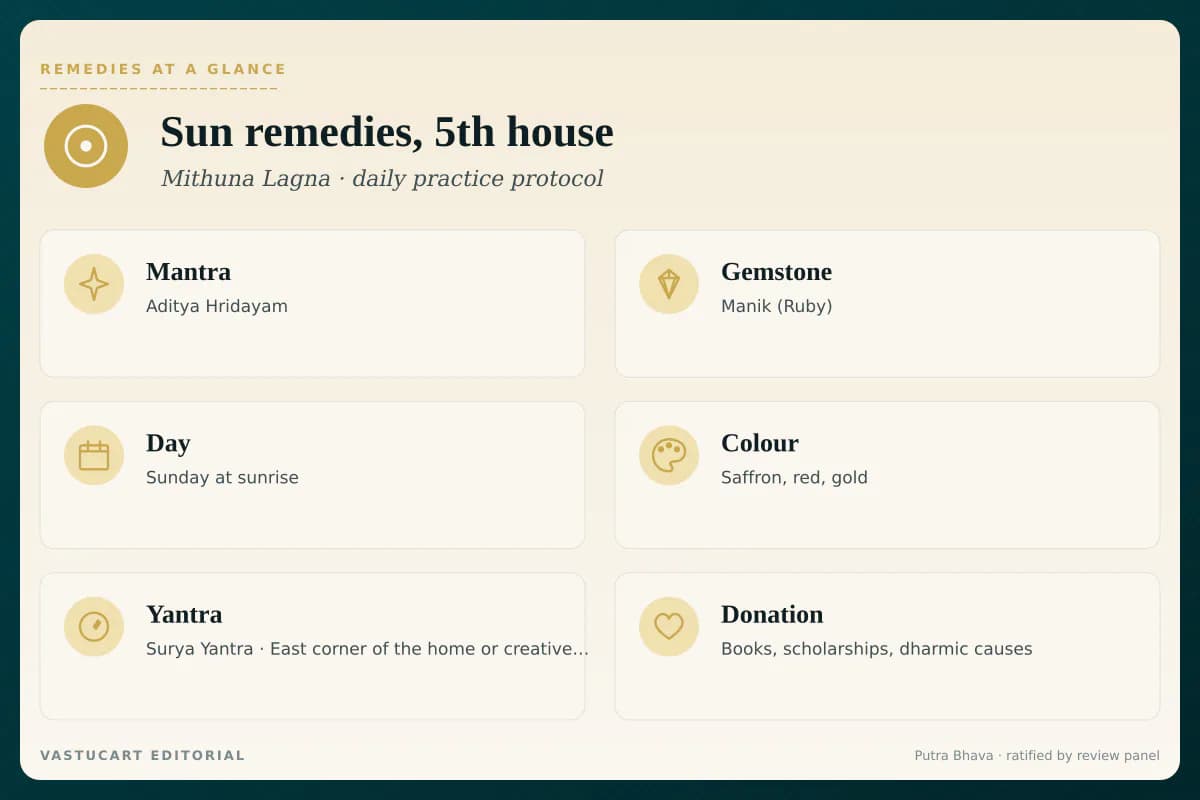
The daily Surya worship is the primary remedy for this placement because the Sun is its own patron deity and the trikona Sun signature responds cleanly to direct devotional contact even in debilitation. Rise before sunrise, perform Surya namaskar facing east, offer water arghya with red flowers, and visit a Vishnu or Shiva temple if accessible. The Aditya Hridayam is the primary recitation, the canonical hymn from the Ramayana that creates a containing field for the placement in its neecha-bhanga creative expression. Reciting it at sunrise daily for forty days at any major Sun transition (a creative-project breakout, a directorial appointment, a broadcasting platform consolidation) is the formal protocol.
Offer red flowers (especially hibiscus and red rose), wheat grains, and copper-vessel water at the altar, and donate to causes that support arts education and creative-vocation welfare (theatre scholarships, art-school grants, classical-tradition transmission programmes, child-creative-education funds). The conscious-solo-output discipline is the lifestyle remedy that compounds across decades into the difference between Sun-5-mastery and Sun-5-collaborative-credit-dilution: a yearly practice of producing one signed solo creative output (a directed work, a single-author book, a solo platform launch) keeps the creative authority directed individually. The gemstone is Manik (ruby), and this is one of the gemstone-helpful placements because the trikona Sun responds to amplification with creative-authority gains during the bhanga activation phase. Wear a natural ruby of minimum five carats set in gold on the ring finger of the right hand on a Sunday at sunrise after Surya mantra recitation, and only after a confirmed reading.
Gemstones for Sun in 5th house Mithuna Lagna
Ruby is the primary Sun gemstone and supports the trikona Sun during the neecha-bhanga activation phase.
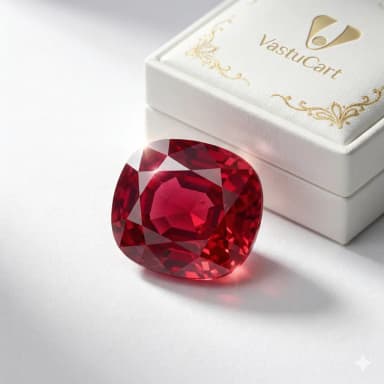

Disclaimer: Ruby over a debilitated trikona Sun supports the neecha-bhanga creative-authority channel. Always consult a qualified Jyotishi before permanent wearing, and confirm the bhanga conditions are present in your chart before committing to the gemstone.
Rudraksha beads for Sun in 5th house
The Sun-aligned rudraksha is the Ek Mukhi (One Mukhi), the bead directly ruled by Shiva and the solar channel.
The classical Sun rudraksha and the bead specifically associated with sovereign creative authority. Supports the creative-authority signature, channels the artistic instinct toward sustainable solo-output discipline, and stabilises creative bandwidth when the bhanga activation is in active phase.
The twelve-mukhi bead supports steady solar radiance directly. Wearing the Barah Mukhi alongside the Ek Mukhi compounds the placement's natural strength in directing, conducting, design leadership, and the kind of long-arc creative-authority careers the chart structurally rewards.
Surya Yantra for the putra placement
Sacred recitations for debilitated Sun in the putra angle
Jayavaham japen nityam akshyam paramam shivam
Translation: The Heart of the Sun is sacred, destroying every enemy, granting victory, eternally recited, supreme and auspicious. The Aditya Hridayam is the canonical solar hymn from the Yuddha Kanda of the Ramayana and is the perfect daily recitation for a chart where the Sun sits debilitated in the putra trikona and the creative-authority signature needs a containing devotional field. Many natives advanced in practice add the Saraswati Stotram as a secondary layer once the daily Aditya discipline is steady because Saraswati holds the creative-articulation channel directly.
Read the full stotra on stotra.vastucart.in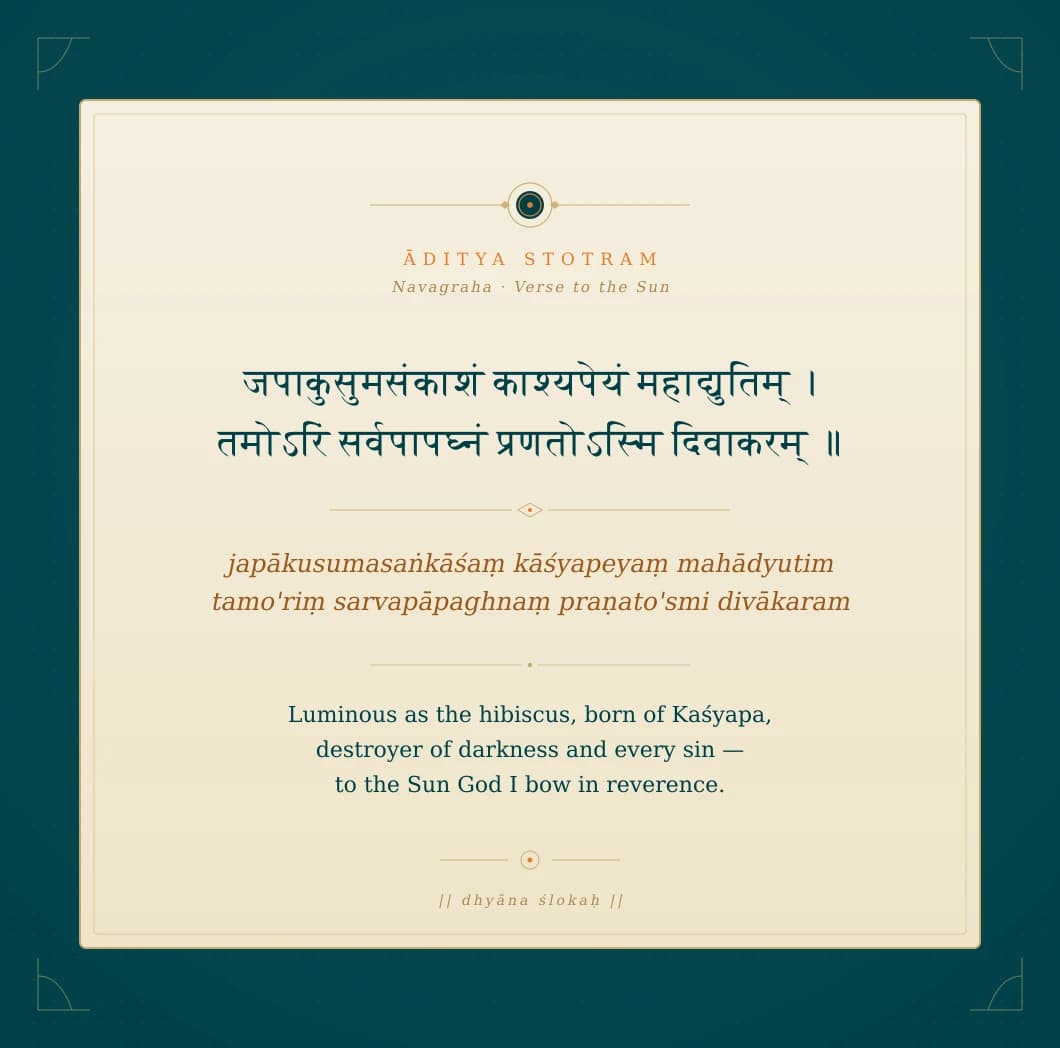
Tools for Sun 5th house Mithuna natives
Is your Putra Bhava Sun carrying neecha bhanga creative authority?
Get a full personalised analysis of your fifth house Sun, the bhanga conditions, and the creative-authority timing.