Venus in the 5th house
Mithuna Lagna (Gemini Ascendant)
A practitioner study of Shukra in Putra Bhava for Gemini ascendant natives. Venus swakshetra in his own Tula in the trikona of past-life merit, the 5L and 12L lifted into the dharma trine, and the creative-intelligence signature that defines the most rewarding Mithuna placement Venus can occupy.
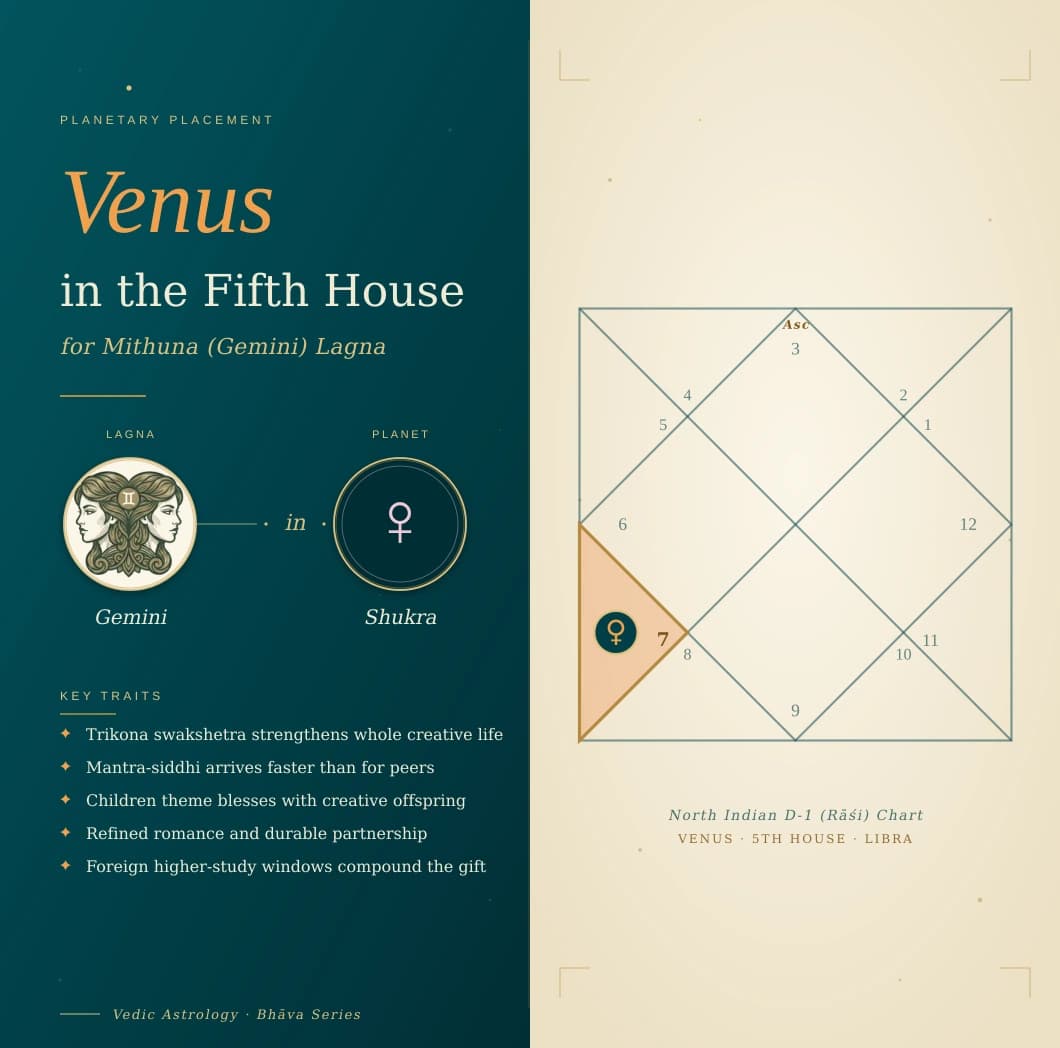
Venus sits swakshetra in his own Tula in the fifth house for Gemini ascendant natives, the creative-intelligence and refined-romance signature.
Venus in 5th house for Mithuna Lagna, the quick reference
If you carry Venus in the fifth house of a Mithuna chart, you hold one of the most rewarding creative-intelligence placements in the entire Vedic catalogue, because Shukra (Venus) is the natural lord of refinement, beauty, and creative output, and his arrival in Putra Bhava (the fifth house, the bhava of children, intelligence, past-life merit, and devotional practice) lifts these significations into the dharma trine. The fifth house from Mithuna is Tula (Libra), Venus's own sign, which means Venus sits swakshetra in a trikona for this lagna. Trikona swakshetra is one of the strongest possible configurations any planet can hold, and Venus in this position produces creative intelligence, mantra-siddhi, refined romance, and a children-theme that compounds across decades.
The second structural feature is that Venus is the lord of two houses for Mithuna: the 5th (Tula, his own sign) and the 12th (Vrishabha, his other own sign). Both lordships are significant: the 5th is a dharma trine and the 12th is the moksha-and-foreign bhava. With Venus elevated to the trikona, the 5L significations gain full strength while the 12L significations (foreign learning, charity, contemplative life, ashram exposure) braid into the trikona benefit rather than running parallel to it. Many natives in this configuration develop sustained creative practices that include foreign higher study, ashram or retreat time, or philanthropic dimensions that compound across decades. The third feature is the contrast with Venus in 11 (the other Venus swakshetra for some lagnas, but for Mithuna 11H is Kumbha not Vrishabha; the comparison here is with Venus in 12, also Venus's own sign for Mithuna). Venus in 12 of Mithuna is moksha-bhava swakshetra, the contemplative-aesthete pattern. Venus in 5 is dharma-trikona swakshetra, the creative-intelligence pattern. Both are strong; they simply express the swakshetra benefit through different doorways. This guide reads every layer of Venus in 5th house for Mithuna Lagna natives: the Tula swakshetra, the 5L and 12L lordship, the trikona elevation, the creative-intelligence signature, and the diamond protocol.
Why Venus swakshetra in the dharma trikona is the foundational creative placement
Students often arrive at this placement uncertain whether the trikona swakshetra is good (it is) or amplified beyond ordinary measure (it is). The honest practitioner answer requires understanding what trikona swakshetra actually means. Classical Parashari recognises that own-sign placement gives a planet his full natural strength, and trikona placement (1, 5, 9) gives the planet structural support because the dharma trines are the chart's auspicious core. When the two arrive together, the placement holds simultaneously its natural strength (own sign) and its bhava strength (trikona), and the two compound rather than add. Venus in 5 of Mithuna is therefore a placement at the structural maximum any planet can reach without exaltation.
The 5L and 12L reading is the second specific feature that practitioners need to handle correctly. The 5th house rules children, intelligence, mantra, devotional practice, and past-life merit. The 12th house rules foreign lands, expenditure, charity, ashram, and moksha. With Venus elevated to the trikona, the 5L significations gain full clarity while the 12L significations braid in as foreign-study and philanthropic dimensions of the same creative life. Many natives in this configuration spend portions of their twenties or thirties studying abroad, in residence at ashrams, or in serious mantra practice with classical teachers, and the creative life that emerges carries the depth this combination supplies. The third interpretive layer is the contrast with Venus in 11 (the gains upachaya, also for some lagnas a maraka neutralisation but Venus is not 2L+7L for Mithuna). Venus in 11 of Mithuna would be Venus in Kumbha (friend sign Saturn). Venus in 5 is the trikona swakshetra, more refined and dharmically ordered. Venus in 11 would be the gains-via-network pattern, more commercial and outward-facing. Both produce favourable Venus expression for this lagna; they simply express the planet's gift through different doorways.
Trikona swakshetra is not a generic strong placement. It is the specific configuration where Venus's rule over creative refinement becomes the dharma stream of the chart rather than a useful complement to it.
Terms used in this article
A short glossary of the Sanskrit and Jyotish terms that recur in this study. First-occurrence expansion is also retained inline.
- Putra Bhava
- The 5th house, the bhava of children, intelligence, past-life merit, and devotional practice.
- Trikona
- Trine houses (1, 5, 9), the dharma trines and most auspicious houses in Parashari tradition.
- Swakshetra
- Own sign. A planet placed in his own sign gains structural strength.
- 5L
- Fifth-house lord, the planet ruling the trikona of past-life merit.
- 12L
- Twelfth-house lord, the planet ruling foreign lands, charity, and moksha.
- Mantra-siddhi
- The rapid maturation of mantra practice into direct realisation.
- Karakatva
- The natural significations a planet rules independent of any chart.
How Venus swakshetra in the dharma trikona shapes the Mithuna native
Physically the native carries the Mithuna versatility softened by the Venus refinement, often producing a face that strangers describe as both quick-witted and unusually beautiful. The eyes carry an expressive depth that reads more lyrical than analytical, and many natives have an instinctive elegance in movement they did not consciously cultivate. The build keeps the standard Mithuna leanness but adds a Venusian grace to the bearing, and many natives have a beauty mark on the upper abdomen, near the heart, or on the upper arm, classical 5th house Venus signatures. The voice tends to carry a refined musical quality that translates well into camera, stage, and intimate-room presence.
Temperament is where the placement most distinguishes the native. These natives carry the Mithuna versatility (curiosity across domains, comfort with multiple frames) but route it through creative-aesthetic channels rather than purely analytical ones. They are drawn to art forms that combine intelligence with sensual refinement (classical music, scholarly poetry, designed architecture, philosophical fiction, sacred dance), and they consistently report falling into creative practice early in life with little formal pressure. The Mithuna directness combines with the Venus refinement to produce natives whose creative output is both incisive and graceful, the rare combination that translates well across audiences. The shadow side is the 12L moksha lordship: Venus's other Mithuna sign-rulership lands in the bhava of expenditure, foreign lands, and dissolution, so the placement still asks for vigilance about money during major Venus periods, especially when foreign relocation or major creative-investment decisions arise. Natives who pair the creative depth with explicit financial discipline develop the rare integration of refined art with sustainable practice that the placement is genuinely capable of supporting.
Strengths, shadows and career fits
- Trikona swakshetra strengthens whole creative life
- Mantra-siddhi arrives faster than for peers
- Children theme blesses with creative offspring
- Refined romance and durable partnership
- Foreign higher-study windows compound the gift
- Charitable dimension matures the practice
- 12L moksha asks vigilance about expenditure
- Refined tastes can outrun practical income
- Romantic life can feel philosophically demanding
- Speculation losses possible in Venus dasha
- Family struggles to read the creative depth
- Stomach and heart sensitivity in stress periods
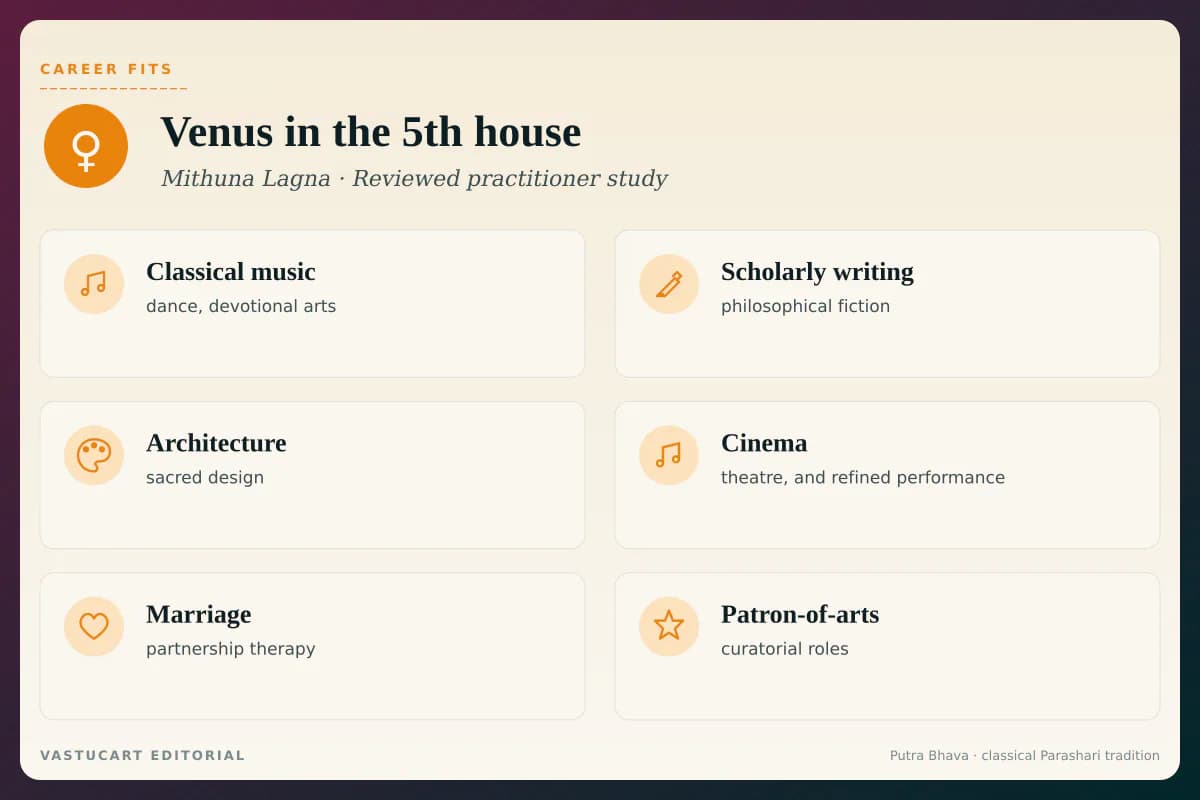
- Classical music, dance, devotional arts
- Scholarly writing and philosophical fiction
- Architecture and sacred design
- Cinema, theatre, and refined performance
- Marriage and partnership therapy
- Patron-of-arts and curatorial roles
Where the creative-intelligence vocation plays out
Career paths cluster around fields that combine creative refinement with intellectual depth. Classical music, dance, and devotional arts are the strongest single fit because the chart specifically supports the meeting point of refinement and devotion. Many natives in this configuration have lifelong practices in Carnatic vocal, Hindustani classical, Bharatanatyam, kirtan-based work, or sacred-poetry traditions, and the practice becomes both vocation and remedy. Scholarly writing and philosophical fiction work because the Mithuna versatility braided with Venus's aesthetic eye produces prose that sustains both intellectual rigour and stylistic grace.
Architecture and sacred design suit natives whose creative mode is structural and patron-oriented, and Mithuna natives in this configuration often work on temple-design projects, classical-textile commissions, or sacred-art preservation. Cinema, theatre, and refined performance fit the chart because Venus's combination with the 5th house's creative-display dimension produces natives whose work translates well to large audiences without sacrificing depth. Marriage and partnership therapy work because the chart specifically supports holding refined inner-life material clients bring, and many natives in their forties build counselling careers that focus on relationship and creative-life issues. Patron-of-arts and curatorial roles fit natives whose career arc includes an explicit philanthropic or institutional dimension. Venus mahadasha is the defining career window and arrives with the major artistic commission, the marriage, the academic appointment, or the international study placement that crystallises the trikona swakshetra vocation.
Why this is the most rewarding Venus placement for Mithuna
The clearest way to understand Venus in 5th of Mithuna is to read the swakshetra status, the trikona placement, and the dual 5L+12L lordship together rather than separately. Classical Parashari recognises that own-sign placement gives a planet his full natural strength, trikona placement provides structural support, and dual lordship of trikona-and-twelfth specifically braids the dharma significations with the moksha significations. The combination produces a native whose creative life is dharmically ordered and whose dharmic life carries a foreign-study or contemplative dimension that compounds across decades.
The 12L note is the second specific feature that practitioners need to handle carefully. Some classical schools read the 12L (twelfth-house lord) as a structurally weakening influence because the 12th is a dushthana. Modern Parashari treats the 12L as a layered lordship: when the 12L is also a trikona lord (5L, 9L, or 1L), the trikona blessing dominates and the 12L's dushthana note becomes a foreign-and-contemplative dimension rather than a loss-producing influence. Venus's 12L lordship for Mithuna is the layered case: the trikona elevation contains the 12L's moksha note constructively, producing natives whose creative life routinely includes foreign higher-study, ashram time, and charitable patronage rather than financial leakage. The third interpretive layer is the contrast with Venus in 9 (the other dharma trikona for Mithuna). Venus in 9 of Mithuna would place Venus in Kumbha, friendly Saturn sign, in the dharma trikona of teaching and pilgrimage. Venus in 5 is the trikona swakshetra, the strongest possible Venus position. Venus in 9 would still be favourable but lacks the swakshetra doubling.
When Venus in 5th delivers its trikona swakshetra chapter
Venus mahadasha is the defining window for this placement and arrives with the major artistic commission, the marriage, the academic appointment, or the international study placement that crystallises the trikona swakshetra vocation.
Stomach, kidneys, and the Putra health link
Health follows the Venus-in-5th pattern with specific Putra body-part vulnerabilities. Constitution is generally balanced, with kapha and pitta both elevated because Venus carries water-kapha and Tula is itself an air-pitta sign. The 5th house body-part rulership covers the stomach, upper abdomen, and heart, and Venus rules the kidneys, urinary system, and reproductive organs. The placement raises specific risk for digestive sensitivity in stress periods, mild renal issues during major Venus dasha, and the metabolic imbalances that come with refined-tastes lifestyle.
The trikona-Venus longevity signature is the second specific layer. Classical reports consistently associate trikona swakshetra placements with above-average longevity and durable creative bandwidth, and clinical reports confirm the pattern. Most natives reach late middle age in noticeably better creative health than peers, with output that compounds rather than diminishes across decades. The cost of the gift is the indulgence pull that Venus carries: rich food, late-night cultural events, refined alcohol, and the social rhythms of artistic life can compromise digestion and circulation over decades. Annual full-panel screening from the late twenties is recommended with specific attention to digestive, renal, and metabolic markers. Daily yoga (specifically heart-opening and digestive-fire practices), moderate intake of refined sugar and alcohol, and avoidance of late-night indulgences are the lifestyle stabilisers because the chart's natural pull toward refined enjoyment needs ordinary discipline as a counterweight.
Remedies for Venus in the Mithuna putra angle
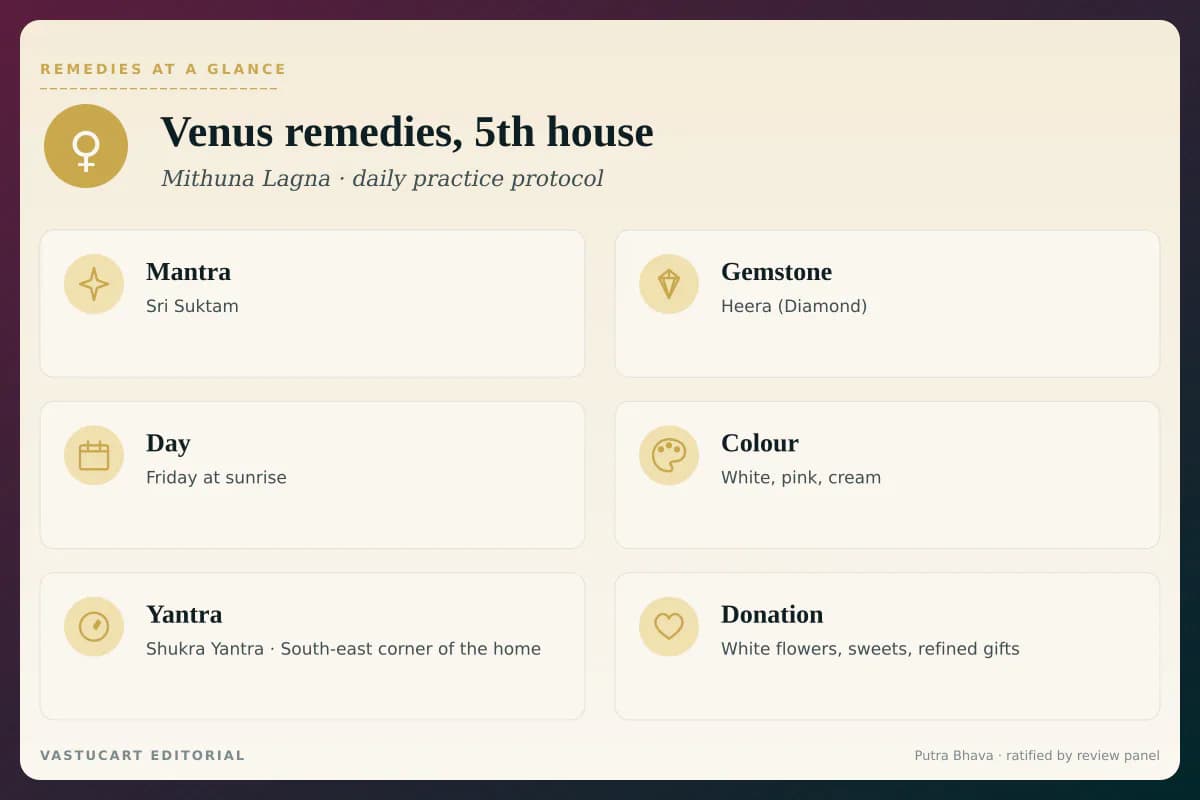
The daily Lakshmi worship is the primary remedy for this placement because Lakshmi is the classical patron deity of Venus, and her form holds the wealth, refinement, and creative-intelligence energies the placement amplifies. Rise before sunrise, bathe, wear white or pale rose clothing on Fridays, and visit a Lakshmi or Saraswati temple if accessible. The Sri Suktam is the primary recitation, the Vedic hymn to Lakshmi that creates a containing field for the Venus signature in its trikona-swakshetra expression. Reciting it at sunrise daily for forty days at any major Venus transition (a creative launch, a marriage, an academic appointment) is the formal protocol.
For the Putra placement specifically, a sustained mantra discipline is the single most stabilising remedy because the chart's 5th house specifically supports rapid mantra-siddhi. Many natives benefit from a deity-specific bija mantra (Saraswati, Krishna, Lakshmi) under formal initiation, and the disciplined recitation compounds across decades into the difference between Venus-5-mastery and Venus-5-scattering. Offer white flowers (especially lotus and jasmine), fresh fruit, sweet rice, and curd at the altar, and donate to causes that support classical-arts education (gurukula scholarships, classical-music apprenticeships, Sanskrit study grants). The conscious-discipline practice is the lifestyle remedy that compounds across decades into sustainable refined creative life. The gemstone is diamond (Heera), and this is one of the most gemstone-rewarding placements because Venus swakshetra in trikona responds to amplification cleanly. Wear a natural certified diamond of minimum quarter to half carat set in white gold or platinum on the small finger of the right hand on a Friday at sunrise after Shukra mantra recitation.
Gemstones for Venus in 5th house Mithuna Lagna
Diamond is the primary Venus gemstone and works particularly well here because the trikona swakshetra responds to amplification cleanly.


Disclaimer: Diamond over a trikona swakshetra Venus channels the creative-intelligence amplification cleanly. Always consult a qualified Jyotishi before permanent wearing.
Rudraksha beads for Venus in 5th house
The Venus-aligned rudraksha is the Chha Mukhi (Six Mukhi), the bead directly ruled by Kartikeya and Venus.
The classical Venus rudraksha. Supports the Venus signification in its trikona-swakshetra expression, channels the creative-intelligence instinct toward classical territory, and stabilises the inner refinement when the 12L moksha lordship is active in dasha.
The five-mukhi bead supports the dharma-trikona dimension of the placement. Wearing the Panch Mukhi alongside the Chha Mukhi compounds the placement's natural strength by honouring both Venus and the trikona context.
Shukra Yantra for the putra placement
Sacred recitations for Venus in the putra angle
Chandram hiranmayim Lakshmim jatavedo ma avaha
Tam ma avaha jatavedo Lakshmim anapagaminim
Yasyam hiranyam vindeyam gam ashvam purusham aham
Translation: Invoke for me, O Jatavedas, the goddess Lakshmi who is golden-hued, deer-like, garlanded with gold and silver, moon-like, and made of gold. Invoke that Lakshmi for me who never departs, by whose grace I shall obtain gold, cattle, horses, and human company. The Sri Suktam is the primary Vedic hymn to Lakshmi and is the perfect daily recitation for a chart where Venus sits swakshetra in the dharma trikona and the creative-intelligence signature needs a containing devotional field.
Read the full stotra on stotra.vastucart.in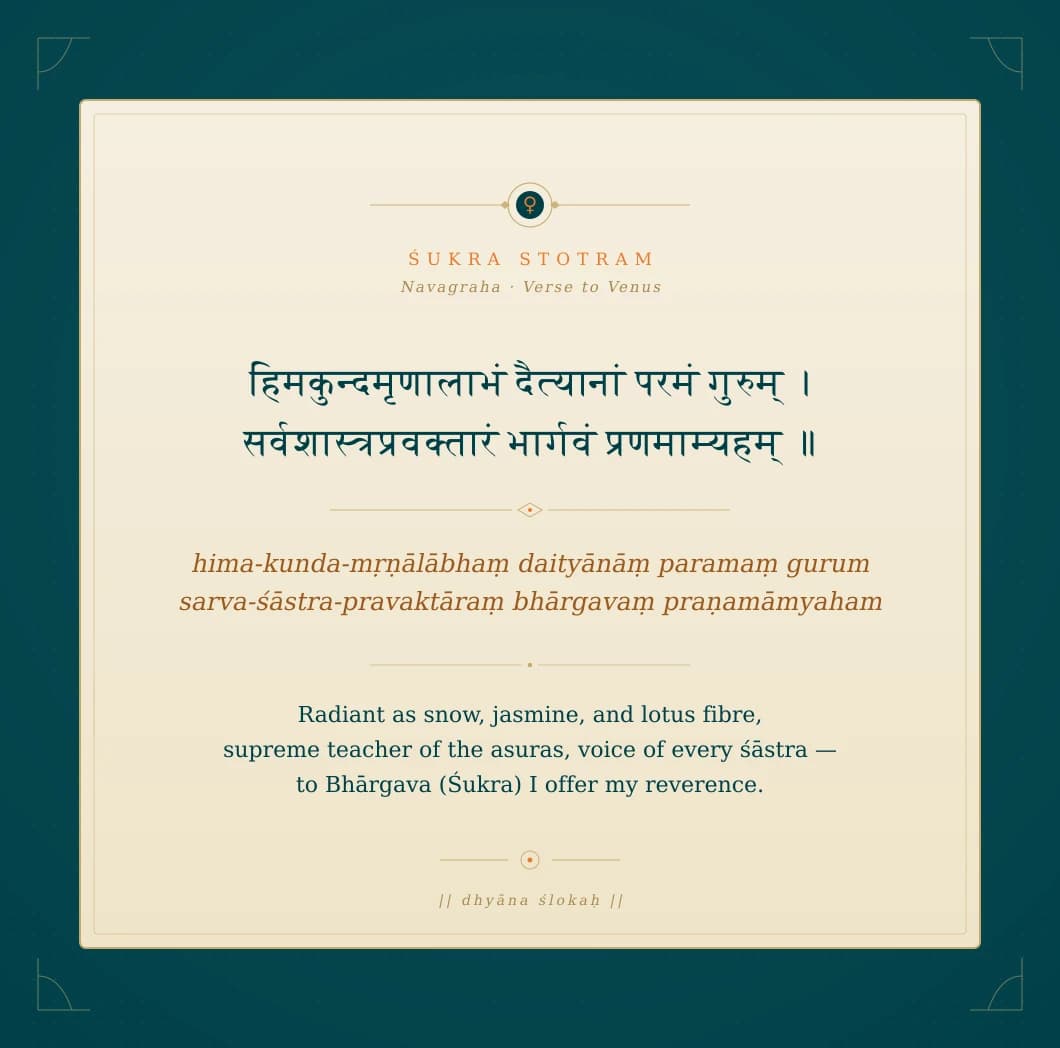
Tools for Venus 5th house Mithuna natives
Is your Putra Bhava Venus carrying the creative-intelligence signature?
Get a full personalised analysis of your fifth house Venus, the trikona swakshetra, and the creative timing.