
Sun in the 4th house
Mesh Lagna (Aries Ascendant)
A practitioner study of Surya in Sukha Bhava for Aries ascendant natives. Sun in friendly Karka, the 5L in 4H kendra-to-trikona raja yoga, the father-at-home authority signature, and the fire-water tension that asks the native to soften the solar register at home.
Sun in 4th house for Mesh Lagna, the quick reference
If you carry Surya in the fourth house of a Mesh chart, you hold one of the most distinctive solar placements in the entire Aries ascendant catalogue, because the placement combines two structural strengths and one specific tension that practitioners need to read together. The fourth house from Mesh is Karka (Cancer), ruled by Chandra, and the Sun and Moon are classical friends in their relationships. By sign relationship the placement is comfortable, neither exalted nor debilitated, holding mid-strength functional status that the friendly Sun-Moon relationship supports throughout the chart. The fourth house is also Sukha Bhava, the strongest of the four kendras and the seat of home, mother, vehicles, education, property, and the inner sense of contentment that the kendra angle supplies.
The second structural feature is the kendra-to-trikona raja yoga the placement creates. For Mesh Lagna, Surya rules Simha and is therefore the 5L. Placing the 5L in the 4H connects the deepest dharmic trikona (5th, the seat of past life merit and creative intelligence) with the deepest of the four foundation kendras (4th, the seat of home and emotional foundation), and a trikona lord in a kendra house is one of the cleanest raja yoga configurations classical Parashari texts describe. The two angles reinforce each other, and the practical effect is that the native's creative intelligence and dharmic orientation flow directly into the home and family life, producing fathers who become authority figures within the household, mothers who carry the native's creative inheritance, and natives whose entire vocational expression is grounded in the home angle. The third feature is the fire-water tension. Mesha Lagna is a fiery sign and Surya is the fiery soul karaka, but Karka is a watery sign ruled by Chandra. The tension is mild and the friendly Sun-Moon relationship contains it, but practitioners should still read it because it shapes the native's mood patterns and the emotional climate of the home. This guide reads every layer of Sun in 4th house for Mesh Lagna natives: the friendly sign comfort, the kendra-trikona raja yoga, the father-at-home authority, the fire-water tension, and the ruby protocol that applies here with high confidence.
Why kendra-to-trikona connections are among the cleanest raja yogas
Classical Parashari texts treat kendra-to-trikona raja yogas as one of the three cleanest raja yoga configurations in Vedic astrology, and the configuration appears here in mirror form to the more famous trikona-to-trikona pattern. When the lord of a trikona (1, 5, or 9) occupies a kendra house (1, 4, 7, 10), the dharmic blessing of the trikona enters the foundation angle and produces a native whose worldly stability is built directly on the dharmic strength the chart already supplies. The trikona supplies the meaning. The kendra supplies the form. The two work together rather than competing. For Mesh Lagna with Surya as 5L placed in the 4H, the 5L creative intelligence and past life merit flow into the 4L home and mother angle, which means the native's home life becomes the place where their dharmic inheritance gets expressed in concrete, lived form.
The Sun-as-5L specifically deserves attention here because the 5L for Mesh is unusually loaded. Surya rules Simha which falls on the 5th house, and the 5th house is the seat of past life merit (purva punya), creative intelligence, children, mantra siddhi, and dharmic creativity. Placing this lord in the 4th house puts the past life merit and creative intelligence directly into the home angle, and the practical effect is that the native arrives in this life with a relationship to home and family that is more dharmic than their peers experience. Children with this placement often display unusual maturity around the family role from a young age, take on responsibilities the family did not explicitly assign them, and grow into adults whose home life carries an authority that other people notice when they visit. The third interpretive layer is the father reading. Surya is the karaka of father, and his placement in the 4th house puts the father directly into the home angle, which produces a configuration where the father becomes the authority figure within the household rather than just outside it. Fathers of natives with this placement are typically present at home in ways that other fathers are not, and the native absorbs the father's presence as the formative emotional anchor of childhood.
When the soul karaka sits in the home angle, the home becomes the chart's central sanctuary. The work is to honour the warmth without letting the solar register burn the very people the placement was meant to nourish.
How Surya in friendly Karka shapes the Aries native
Physically the native carries the Mesh Lagna frame softened by the watery Karka sign in ways that distinguish this placement from other Sun positions. The face holds a fullness around the cheeks and chin that other Mesh natives do not carry, and many natives are described from infancy as having a noble but gentle expression that the family notices and remembers. The eyes carry the warm steadiness of a friendly Sun combined with a slightly moist quality from the Karka water, producing a gaze that strangers find both authoritative and approachable. Complexion runs warm with a slightly cooler undertone than typical Mesh natives because the watery sign tempers the standard solar warmth. Hair is typically thick and stays dark longer than peers. The build is balanced rather than athletic, and the body has a natural elegance even in casual movement. The 4th house body-part rulership covers the chest, heart, and lungs, and the watery Karka sign on this region adds specific sensitivity to fluid balance and emotional patterns expressed through the chest. Daily breathing practice and regular cardiovascular exercise are preventive medicine the chart specifically requests.
Temperament is the layer where the placement most distinguishes the native from popular Aries stereotypes. These natives are still pioneers and still carry Mesh courage, but the courage is filtered through an unusually strong attachment to home and family that other Aries placements do not produce. They take action when action is required, but the action almost always considers the impact on the family first, and natives rarely make decisions purely for personal achievement when the family's wellbeing is also at stake. They are warm but with a solar register that can occasionally feel imposing to family members who are more sensitive than the native realises. They love their mother openly and often defer to her judgment well into adulthood in ways their peers find surprising. The shadow side is the same solar register that gives the placement its strength. Natives who do not learn to soften the authority tone at home can produce a household where the family feels managed rather than nurtured, and the chart specifically asks for the deliberate practice of softening the solar voice when the audience is the spouse or the children. Natives who develop this softening produce the rare combination of authority and warmth that this placement is genuinely capable of supporting.
Strengths, shadows and career fits
- Kendra-to-trikona raja yoga in home angle
- 5L purva punya flows into 4L home
- Father becomes authority within household
- Mother as creative inheritance carrier
- Aspects 10H, brings home values to career
- Property and vehicles arrive earlier than peers
- Solar register can feel imposing at home
- Family expectation can limit independence
- Chest and lung sensitivity
- Fire-water tension produces mood patterns
- Mother authority complicates marriage timing
- Father standard intimidates own children
- Family business leadership and inheritance
- Real estate, property, land development
- Education leadership at school or college
- Hospitality and traditional guest-house work
- Cultural preservation and heritage work
- Home-based or family-anchored creative practice
Where the home-anchored vocation plays out
Career paths cluster around fields where home and family values translate directly into vocational structure, and the strongest single fit is family business leadership and inheritance. The 5L Sun placed in the 4L home angle produces a native whose vocational instinct is to take an existing family enterprise and grow it into the next generation's expression. Many natives step into family business roles in their twenties or thirties even when they had originally pursued a different career. Real estate, property, and land development work the chart productively because the 4L is the property karaka and natives instinctively understand land as long-term family assets.
Education leadership at school or college level suits the chart because the 5L creative intelligence combined with the 4L Karka produces a leader whose mode is unusually attuned to the emotional dimension of learning. Hospitality and traditional guest-house work fit because the native instinctively knows how to make other people feel at home. Cultural preservation and heritage work suit natives whose vocational pull is more historical. Home-based or family-anchored creative practice rounds out the list. Surya mahadasha is when the dharmic vocation crystallises, often through a family event (an inheritance, a parent's transition, a property decision) that opens the next phase of the working life.
Sun marked in the fourth house of Mesh
- Surya in Sukha Bhava in friendly Karka, marked in radiant saffron
- 12 houses in North Indian format
- Lower-central diamond is the 4th house of home
Why the chart asks the native to soften the solar register at home
The father-at-home pattern is the most useful frame for this placement because it captures the structural truth distinguishing this Sun position from every other Surya placement. When the karaka of father sits in the karaka house of home, the father becomes a presence within the household rather than just a provider from outside it. Fathers eat meals at home rather than at work, take an active role in the children's upbringing rather than delegating to the mother, and become visible authority figures the native absorbs as the formative emotional anchor of childhood. The pattern is consistent enough that practitioners can usually predict the father-presence signature before the native confirms it.
The fire-water tension is the second specific feature practitioners need to read. Surya is fire and Karka is water, and the friendly Sun-Moon relationship contains the tension but does not eliminate it. The practical effect is that the home life carries a specific dynamic where solar warmth and lunar emotional water occasionally meet to produce steam: moments of conflict between the authoritative tone and family sensitivity, periods of mood patterns where the native's energy heats the home faster than the family can absorb. The remedy is the deliberate practice of softening the solar voice at home, choosing tone, and making explicit room for the watery emotional climate. The third pattern is mother-as-inheritance-carrier. Because Surya is in Karka the mother sign, and 5L is the past life merit lord, the mother often carries the native's creative or dharmic inheritance and transmits it through home atmosphere rather than formal instruction. Many natives recognise the inheritance only after the mother is gone.
When Sun in 4th delivers its Sukha Bhava chapter
Surya mahadasha is the defining window for this placement and arrives with the home and family vocation crystallising into recognised authority.
Chest, lungs and the fire-water emotional profile
Health follows the fire-water tension pattern with specific 4th house considerations. Constitution is generally strong because the friendly Sun-Moon relationship supports solar vitality, with pitta most prominent and kapha secondary because Karka adds watery quality to the hot solar base. The 4th house body-part rulership covers the chest, heart, and lungs, and natives should pay attention to all three because the watery sign on this region adds sensitivity to chest congestion and the cardiac stress the solar pressure can produce. Daily breathing practice and regular cardiovascular exercise are non-negotiable.
The mood pattern is the second specific layer because the fire-water tension produces a recognisable rhythm. The native's emotional weather often runs parallel to the home atmosphere: when the family is settled the native is steady, and when the family is in turmoil the native experiences the turmoil as their own internal weather. The recovery framework is to maintain the home as a sanctuary deliberately. Sunday is the ritual day. Annual cardiac and respiratory screening from the late thirties completes the preventive baseline.
Remedies for Surya in the Mesh home angle
The Sunday discipline is foundational and delivers genuine benefit for this placement because the chart is structurally aligned with the solar current the day carries. Rise before sunrise, bathe, wear saffron, red, or golden-toned clothing, and offer arghya (water libation) to the rising Sun facing east. Visit a Surya, Vishnu, or Aditya temple if accessible, and offer red flowers, wheat, jaggery, or copper at the morning altar. Donate to causes that protect family stability and home life (women's shelters, child welfare, family welfare organisations, heritage preservation), all of which channel the 4L plus Surya karakatvas constructively. Pilgrimages to family ancestral sites carry unusual weight for this placement.
The Surya Kavacham is the primary recitation for this placement because it is the protective armour stotra for Surya and works specifically to contain the solar register at home while preserving the authority outside it. Reciting the Surya Kavacham daily for forty days at any major family transition (marriage, birth of children, parent's transition, property decision) is the formal protocol, and natives often report a noticeable shift in the home atmosphere by the third week. The gemstone is ruby (Manikya) and is recommended with high confidence here because the friendly sign and kendra placement together support the gemstone protocol cleanly. Wear a natural Burmese or African ruby of minimum three ratti set in gold on the ring finger of the right hand on a Sunday at sunrise after Surya mantra recitation. The lifestyle adjustment that compounds most is treating the home as the central altar of the practice. Because the chart specifically wires the dharmic intelligence into the home, natives who honour the home space with daily ritual care (fresh flowers, lit lamps in the morning, clean surfaces, attention to family meal times) experience the placement deliver its fullest expression as a life of quietly authoritative warmth that the family carries forward across generations.
Gemstones for Sun in 4th house Mesh Lagna
Ruby is the primary recommendation here because the friendly sign and kendra placement together support the gemstone protocol with high confidence.
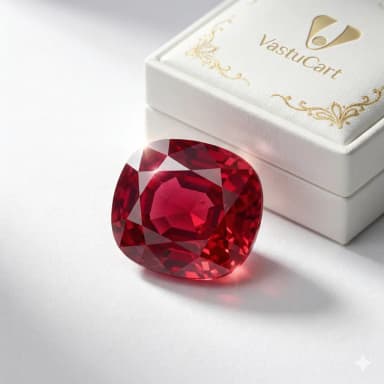


Disclaimer: Ruby for friendly-sign Sun in the kendra is a clean recommendation, but always consult a practising Jyotishi before permanent wearing.
Rudraksha beads for Sun in 4th house
The Surya-aligned rudraksha is the Ek Mukhi, the rarest bead and the one directly ruled by the Sun.
The rarest and most revered rudraksha and the primary bead for any Sun strengthening protocol. Amplifies the friendly-sign Sun in the home angle, supports the father-at-home authority signature, and is specifically recommended for natives stepping into family business or inherited leadership roles.
The Moon bead serves as secondary support for this placement because the dispositor of Sun here is Chandra (Moon rules Karka, the sign Sun occupies). Wearing the Do Mukhi alongside the Ek Mukhi compounds the placement's strength by honouring both planet and sign-lord, and softens the solar register at home.
Surya Yantra for the home Sun
Sacred recitations for Surya in friendly Karka
Tasmai namo mahadeva dharmadhwaja namostu te
Adityasya namaskaram ye kurvanti dine dine
Jamantara sahasreshu dauridryam nopajayate
Akala mrityu haranam sarva vyadhi nivaranam
Surya pada jalam pitva sapta janma agha nashanam
Translation: The deity of sacrifice, the deity of dharma, the deity of the world, the maker of day. Salutations to that great deity, salutations to the dharma-bannered one. Those who offer salutations to Aditya day after day do not face poverty for thousands of births. The Sun's foot-water removed, all diseases healed, sins of seven births destroyed when the Surya-pada water is drunk. The Surya Kavacham is the protective armour hymn for the Sun and is the classical recitation for natives who need to contain the solar register at home while preserving the authority outside it.
Read the full stotra on stotra.vastucart.inTools for Sun 4th house Mesh natives
Is your Sukha Bhava Sun carrying the kendra-trikona raja yoga?
Get a full personalised analysis of your fourth house Surya, the father-at-home pattern, and the family vocation timing.
Questions about Sun in 4th house, Mesh Lagna
Pt. Raghav Sharma has practiced Parashari Jyotish for over twenty two years from Varanasi. A student of the Varanasi Jyotish tradition, he specialises in Graha-in-Bhava analysis, Vimshottari Dasha predictions, and Muhurta. He has authored over four hundred in-depth articles on Jyotish principles across the VastuCart knowledge network.