Venus in the 9th house
Kumbha Lagna (Aquarius Ascendant)
A practitioner study of Shukra in Bhagya Bhava for Aquarius ascendant natives. Venus swakshetra in his own sign Tula in the dharma trikona, the 4L plus 9L lord taking own dignity in own trikona, and the dharma-and-luxury career signature that defines the supreme Venus placement available to the lagna.
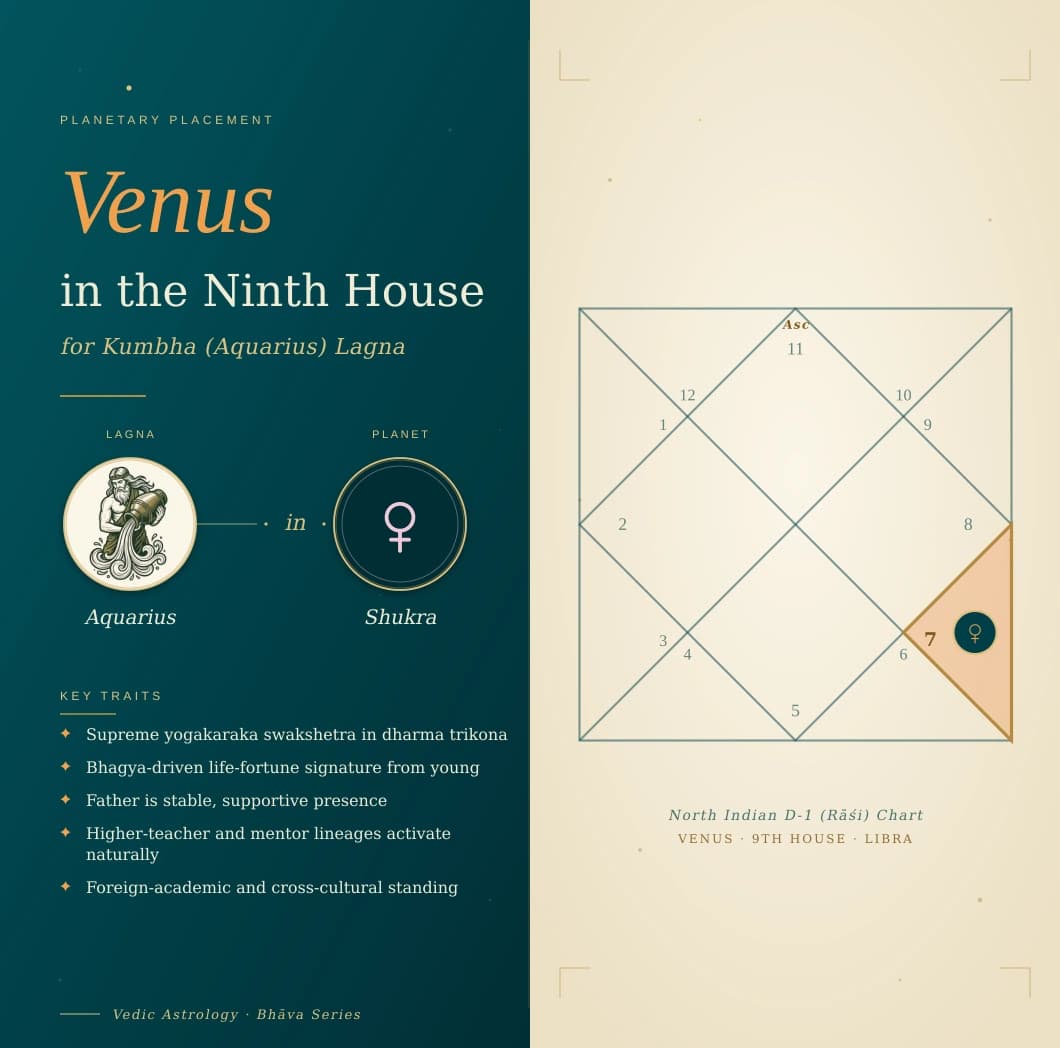
Venus sits in his own swakshetra Tula in the dharma trikona for Aquarius ascendant natives, the supreme yogakaraka signature.
Venus in 9th house for Kumbha Lagna, the quick reference
If you carry Venus in the ninth house of a Kumbha chart, you hold the supreme dharma-and-fortune placement available to the lagna. Shukra (Venus) is the natural lord of beauty, art, partnership, and refinement. His arrival in Bhagya Bhava (the ninth house, the bhava of fortune, dharma, the father, the higher teacher, long journeys, and the foreign-academic dimension) lifts these significations into territory where Venus's natural grace becomes the structural engine behind durable life-fortune.
The ninth house from Kumbha is Tula (Libra), Venus's own swakshetra sign. Classical Parashari recognises a planet in his own sign in his own trikona as one of the most rewarding placements possible. Venus swakshetra in his own 9H carries the planet's strong dignity in the bhava that classical commentators consistently rank as the single most auspicious house in the chart.
The second structural feature is the dual lordship. Venus rules the fourth house (called the 4L, the lord of Sukha Bhava, the bhava of home, mother, vehicles, property) AND the ninth house (called the 9L, the lord of Bhagya Bhava) for Kumbha natives. That dual lordship makes Venus the classical yogakaraka for the lagna, the planet whose simultaneous kendra and trikona rulership generates raja yoga from a single body.
When this yogakaraka sits swakshetra in his own 9H, the chart fuses career-fortune, home-and-mother prosperity, dharma teaching, foreign-academic standing, and the higher-wisdom dimension into a single flowing channel. The native arrives at adult life supported by a clear sense of purpose. The 9H trikona signature compounds across decades into the kind of life that classical commentators describe as bhagya-driven.
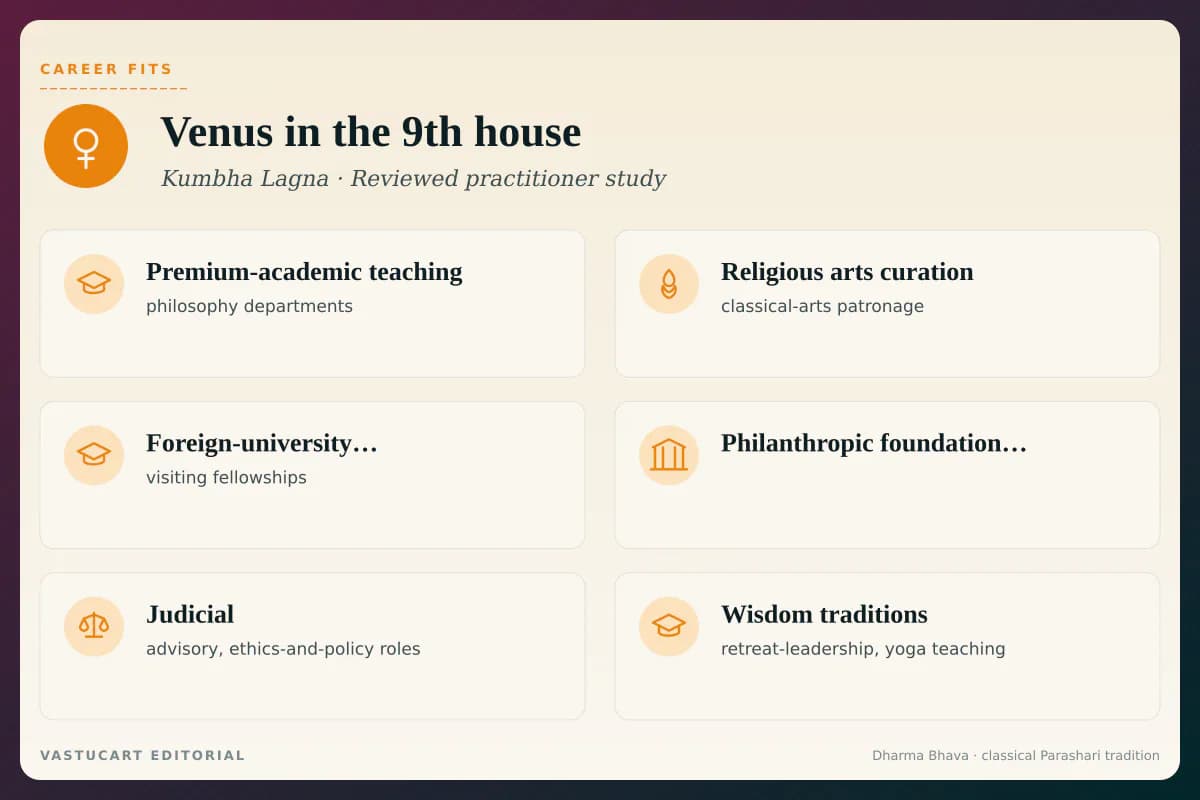
The third feature is the dharma-raja-yoga reading. Yogakaraka swakshetra in own trikona is among the highest-ranked classical raja yogas the chart can carry. Many natives in this configuration develop adult careers in fields where teaching, philosophy, and aesthetic-spiritual transmission meet, including premium-academic teaching, religious-arts curation, foreign-university appointments, philanthropic-foundation leadership, judicial and advisory work, and the wisdom-traditions that braid art with dharma. This guide reads every layer of Venus in 9th house for Kumbha Lagna natives.
Why swakshetra Venus in own trikona forms supreme dharma raja yoga
Students often arrive at this placement aware that swakshetra Venus is strong but uncertain why swakshetra Venus specifically in the 9H of Kumbha is treated by classical commentators as among the most rewarding Venus configurations available to any chart. The honest practitioner answer requires reading three structural facts together.
Venus is the supreme yogakaraka for Kumbha lagna. His own sign Tula sits exactly on the 9th-house cusp. The resulting placement holds the planet's swakshetra dignity in the bhava of dharma and fortune.
The yogakaraka logic deserves its own reading. For Kumbha natives, Venus rules the 4th and 9th simultaneously. Classical Parashari recognises any planet that rules one kendra (angular house, 1, 4, 7, or 10) and one trikona (auspicious dharmic angle, 1, 5, or 9) at the same time as a yogakaraka.
When that same yogakaraka sits swakshetra in his own 9H, the chart holds two structural strengths simultaneously. The yogakaraka raja yoga generates from the kendra-trikona dual rulership. The 9L-in-9H pattern generates the lord-in-own-bhava strength that classical commentators specifically associate with the activated trikona.
The 9H amplification is the third specific feature. The 9th house is not just Bhagya Bhava in a generic sense. It is the house of higher dharma, the father, the higher teacher, long journeys, philosophical orientation, and the foreign-academic dimension.
When the yogakaraka sits swakshetra here, every dimension amplifies. Dharmic clarity arrives early and fortune compounds across decades.
The father is a stable supportive presence in many natives. The higher-teacher dimension produces the kind of mentor-student lineage that classical texts associate with apex 9H Venus.
The contrast with Venus-in-9 for non-Kumbha lagnas is illustrative. Venus-in-9 for Mesh natives is the Dhanu placement, friendly Jupiter sign with the 2L+7L lordship. Only Kumbha gets the full triple stack of swakshetra plus yogakaraka plus own-trikona in a single placement.
Swakshetra Venus in own dharma trikona is not a generic strong placement. It is the specific configuration where the 4L plus 9L yogakaraka takes his own dignity in the bhava of dharma, producing the supreme dharma raja yoga the Kumbha chart can carry.
Terms used in this article
A short glossary of the Sanskrit and Jyotish terms that recur in this study. First-occurrence expansion is also retained inline.
- Bhagya Bhava
- The 9th house, the bhava of fortune, dharma, the father, the higher teacher, long journeys, and foreign-academic standing.
- Yogakaraka
- A planet that rules one kendra and one trikona simultaneously and so generates raja yoga from a single body. Venus is the yogakaraka for Kumbha lagna.
- Swakshetra
- Own sign. A planet in the sign he himself rules, the second-strongest dignity after exaltation.
- Trikona
- Auspicious dharmic angles 1, 5, 9. Bhavas of fortune, intelligence, and dharma.
- 4L
- Fourth-house lord, the planet ruling home, mother, vehicles, and property.
- 9L
- Ninth-house lord, the planet ruling fortune, dharma, the father, and higher teaching.
- Pitru
- Father and the paternal lineage, an alternative name for the 9th house dimension.
How swakshetra Venus in dharma trikona shapes the Kumbha native
Physically the native carries the Kumbha tall, elongated frame layered with the Venus-Tula swakshetra refinement that softens the Saturn-ruled austerity. The face tends to register as classically attractive in a balanced, symmetrical way, with even features, an unusually pleasant smile, and the kind of composed dignity that classical commentators specifically associate with swakshetra Venus in 9H.
The hips and thighs carry the strong proportional balance of Tula. Posture is naturally upright, gait registers as graceful, and many natives carry an easy athletic capacity that compounds well into yogic practice through their thirties and forties.
Temperament is where the placement most distinguishes the native. These natives carry the Kumbha intellectual independence routed through dharmic-and-aesthetic channels. They are drawn to philosophy, comparative religion, classical-arts study, and the wisdom traditions from young, often arriving at adult life with an unusually mature sense of purpose.
The 9H signature of higher dharma combined with Venus's natural aesthetic refinement produces natives whose moral compass is steady, whose ethical reasoning carries weight, and whose relationships rest on a baseline of fairness and reciprocity. Many natives become natural mentors and teachers, the kind of friend whose counsel changes another life direction, or the senior colleague whose advice shapes an entire career trajectory.
Speech registers as measured and dharmically grounded. Vak (the Sanskrit word for refined speech) takes Venus's relational warmth here and produces speakers whose voices carry the institutional weight of someone who has thought long about what they say. They explain difficult matters in ways that listeners trust. They rarely overstate. They navigate ethical complexity without performing virtue.
The shadow side is the same dharmic dimension. Natives who do not channel the placement consciously can experience cycles of moral perfectionism, the over-accommodating partnership pattern that gives more than it receives, and the dharmic-overcommitment that stretches bandwidth across too many causes simultaneously. Natives who pair the dharmic clarity with explicit boundary discipline develop the integration of fortune-and-grace and durable practice the placement supports.
Strengths, shadows and career fits
- Supreme yogakaraka swakshetra in dharma trikona
- Bhagya-driven life-fortune signature from young
- Father is stable, supportive presence
- Higher-teacher and mentor lineages activate naturally
- Foreign-academic and cross-cultural standing
- Ethical reasoning carries institutional weight
- Moral perfectionism can paralyse decisions
- Over-accommodating partnerships and unequal exchange
- Dharmic-overcommitment stretches bandwidth thin
- Hip and thigh sensitivity in stress periods
- Sciatic nerve patterns under unmoderated stress
- Romantic-aesthetic indulgences eat working time
- Premium-academic teaching, philosophy departments
- Religious arts curation, classical-arts patronage
- Foreign-university appointments and visiting fellowships
- Philanthropic foundation leadership
- Judicial, advisory, ethics-and-policy roles
- Wisdom traditions, retreat-leadership, yoga teaching
Where the dharma-and-luxury vocation plays out
Career paths cluster around fields that braid dharmic teaching with aesthetic refinement. Premium-academic teaching is the strongest single fit because the 9th house specifically rules higher learning, the swakshetra Venus brings the aesthetic-and-relational dimension into the teaching mode, and the Kumbha intellectual independence produces natives whose lectures register as both scholarly and unusually elegant.
Many natives become senior philosophy lecturers, comparative-religion professors, classical-arts faculty, or premium humanities educators whose careers compound across decades into named professorships, institute directorships, and editorial-board appointments. Religious-arts curation and classical-arts patronage suit natives whose vocational mode is institutional-curatorial. The 9H signature places the work inside the dharma-fortune dimension, the swakshetra Venus brings the aesthetic-and-craft sensibility, and the result is natives who become museum curators, classical-arts foundation heads, religious-arts editorial leaders, or premium publishing acquirers.
Foreign-university appointments and visiting fellowships work because the 9H specifically rules long journeys and foreign-academic standing. Many natives in their forties and fifties take research postings abroad, hold visiting chairs at international institutions, or build adult careers entirely around cross-border academic collaboration. Philanthropic foundation leadership fits because Venus is the karaka of generosity and the 9H places generosity inside the higher-dharma dimension.
Many natives in their fifties become senior philanthropic-foundation heads, classical-arts endowment directors, or charitable-trust leaders whose body of work shapes cultural patronage at institutional scale. Judicial, advisory, and ethics-and-policy roles work because the 9H rules higher dharma specifically, and Venus brings the relational-balance dimension that judicial work requires. Many natives become senior judges, ethics-board chairs, advisory-council leaders, or policy-think-tank directors.
Wisdom traditions, retreat leadership, and yoga teaching at premium standard fit because the 9H is the moksha-adjacent trikona and Venus brings the aesthetic-and-refined-presence dimension that wisdom-traditions teaching needs. Venus mahadasha is the defining career window and arrives with the named professorship, the museum directorship, the visiting fellowship, the philanthropic-foundation appointment, the senior judicial role, or the wisdom-tradition leadership that crystallises the supreme dharma raja yoga.
Why this is among the supreme Venus placements available
The clearest way to understand Venus in 9th of Kumbha is to read the swakshetra dignity, the yogakaraka role, and the trikona placement as a single nested structure. Classical Parashari recognises that own-sign placement gives a planet his second-strongest expression after exaltation. Yogakaraka status gives the planet structural authority to produce raja yoga across kendra and trikona simultaneously. The 9H placement gives the planet full activation of the dharma-and-fortune dimension.
When all three align constructively, as they do here with swakshetra Venus as 4L plus 9L yogakaraka in own 9H, the placement carries simultaneously the planet's own-sign strength, the dual-lord raja yoga authority, and the trikona activation. This produces the supreme dharma raja yoga the Kumbha chart can carry.
The dharma raja yoga reading is the second specific feature. Among the three trikonas (1, 5, 9), the 9th carries the most dharmic association because it is the bhava of higher learning and divine grace. Yogakaraka swakshetra in 9H produces the strongest classical dharma raja yoga the chart can hold, the configuration where life-fortune arrives both through the inherited dharmic stream of the family and through the native's own ethical work, with the two streams reinforcing each other across decades.
The third interpretive layer is the long-arc dasha pattern. Venus's mahadasha runs twenty years, the longest in the Vimshottari sequence. The placement's defining fortune window opens for an unusually extended duration when it activates. Many natives in this configuration experience a Venus mahadasha that brackets the entire arc of mid-life dharmic-academic consolidation. The named professorship, the foundation directorship, or the wisdom-tradition leadership often arrives in the early years of the dasha and consolidates institutionally by its close.
When the swakshetra Venus in 9H delivers its supreme chapter
Venus mahadasha is the defining window for this placement and arrives with the named professorship, museum directorship, visiting fellowship, philanthropic-foundation appointment, senior judicial role, or wisdom-tradition leadership that crystallises the supreme dharma raja yoga.
Hips, thighs, sciatic nerve and the Bhagya health link
Health follows the Venus-in-9H pattern with specific Bhagya body-part vulnerabilities. Constitution is generally balanced, with kapha-vata most prominent because Venus carries water-kapha and Tula is itself an air-vata sign with refined sensory-relational dimension. The 9th house body-part rulership covers the hips, thighs, and sciatic nerve. Venus rules the throat and reproductive system more broadly.
The placement raises specific risk for hip-and-thigh sensitivity during long-sit periods, sciatic nerve patterns under unmoderated stress, lower-back tension that compounds with frequent travel, and the sleep-and-circadian disruption that long-distance academic work produces.
Many natives report that hip mobility fluctuates with travel intensity and that lower-back tension signals upstream stress before it manifests as a structural issue. Annual full-panel screening from the late twenties is recommended with attention to lower-back imaging, hip-joint review, hormonal markers, and metabolic-syndrome assessment. Daily yoga (specifically baddha konasana and hip-mobilising practices that support long travel), moderate intake of warm liquids, and avoidance of extended seated work without breaks are the lifestyle stabilisers because the chart's natural pull toward dharmic-academic immersion needs ordinary body discipline as a counterweight.
Remedies for swakshetra Venus in the Kumbha bhagya angle
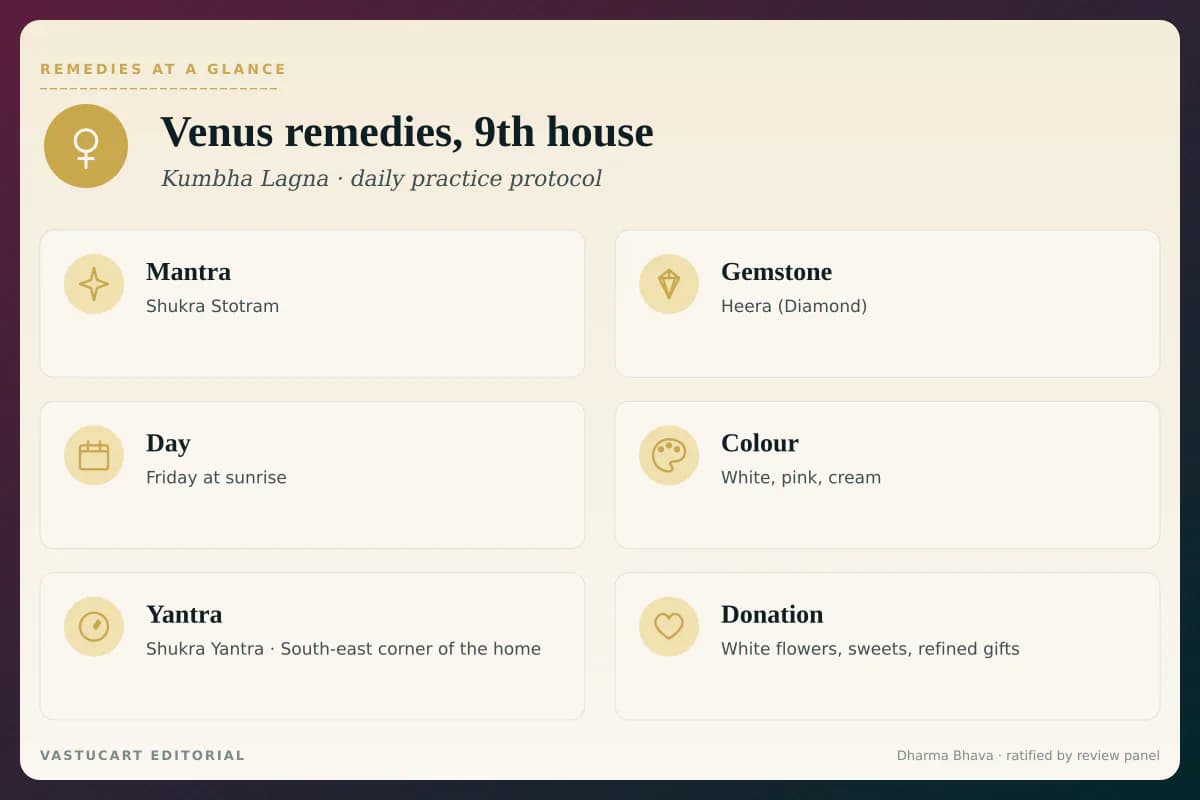
The daily Lakshmi worship is the primary remedy for this placement because Lakshmi is the classical patron deity of Venus and holds the dharma-fortune signature in its most refined expression. Rise before sunrise, bathe, wear white or pale rose clothing on Fridays, and visit a Lakshmi temple if accessible.
The Shukra Stotram is the primary recitation, the Navagraha verse to Venus that creates a containing field for the yogakaraka in his swakshetra-trikona expression. Reciting it at sunrise daily for forty days at any major Venus transition (a named professorship, a museum directorship, a foundation appointment, a senior judicial role) is the formal protocol.
Offer white-and-rose flowers (especially white lotus and rose), white sweets, and white sandal paste at the altar, and donate to causes that support higher-academic dharma and classical-arts preservation (scholarship funding for philosophy departments, classical-music endowments, religious-arts conservation programmes). The conscious-dharma-and-aesthetic-discipline practice is the lifestyle remedy that compounds across decades.
The gemstone is diamond (Heera), and this is one of the most gemstone-rewarding placements because the swakshetra yogakaraka Venus responds to amplification cleanly. Wear a natural diamond of minimum half a carat set in platinum or white gold on the small finger of the right hand on a Friday at sunrise after Shukra mantra recitation, and only after a confirmed reading.
Gemstones for Venus in 9th house Kumbha Lagna
Diamond is the primary Venus gemstone and works exceptionally well here because the swakshetra yogakaraka Venus responds to amplification cleanly.


Disclaimer: Diamond over a swakshetra yogakaraka Venus amplifies the dharma channel cleanly. Always consult a qualified Jyotishi before permanent wearing.
Rudraksha beads for Venus in 9th house
The Venus-aligned rudraksha is the Chhah Mukhi (Six Mukhi), the bead directly ruled by Kartikeya and Venus.
The classical Venus rudraksha and the bead specifically associated with relational harmony and aesthetic refinement. Supports the supreme yogakaraka signature, channels the dharmic instinct toward sustainable territory, and stabilises bandwidth when the academic, foundation, or wisdom-tradition vocation is in active phase.
The thirteen-mukhi bead supports magnetic presence and aesthetic charm. Wearing the Terah Mukhi alongside the Chhah Mukhi compounds the placement's natural strength in mentor-and-teaching contexts, classical-arts curation, and any front-of-room dharmic leadership.
Shukra Yantra for the swakshetra yogakaraka placement
Sacred recitations for swakshetra Venus in the dharma trikona
Sarva-shastra-pravaktaram bhargavam pranamamy aham
Translation: We bow to Bhargava, white as snow-jasmine and lotus-stem, the supreme preceptor of the daityas, the master who declares all sciences. The Shukra Stotram is the canonical Navagraha verse to Venus and is the perfect daily recitation for a chart where Venus sits swakshetra in the dharma trikona and the supreme yogakaraka signature needs a containing devotional field. Many natives advanced in practice add the Lakshmi Ashtottara recitation as a secondary layer once the daily Shukra discipline is steady.
Read the full stotra on stotra.vastucart.in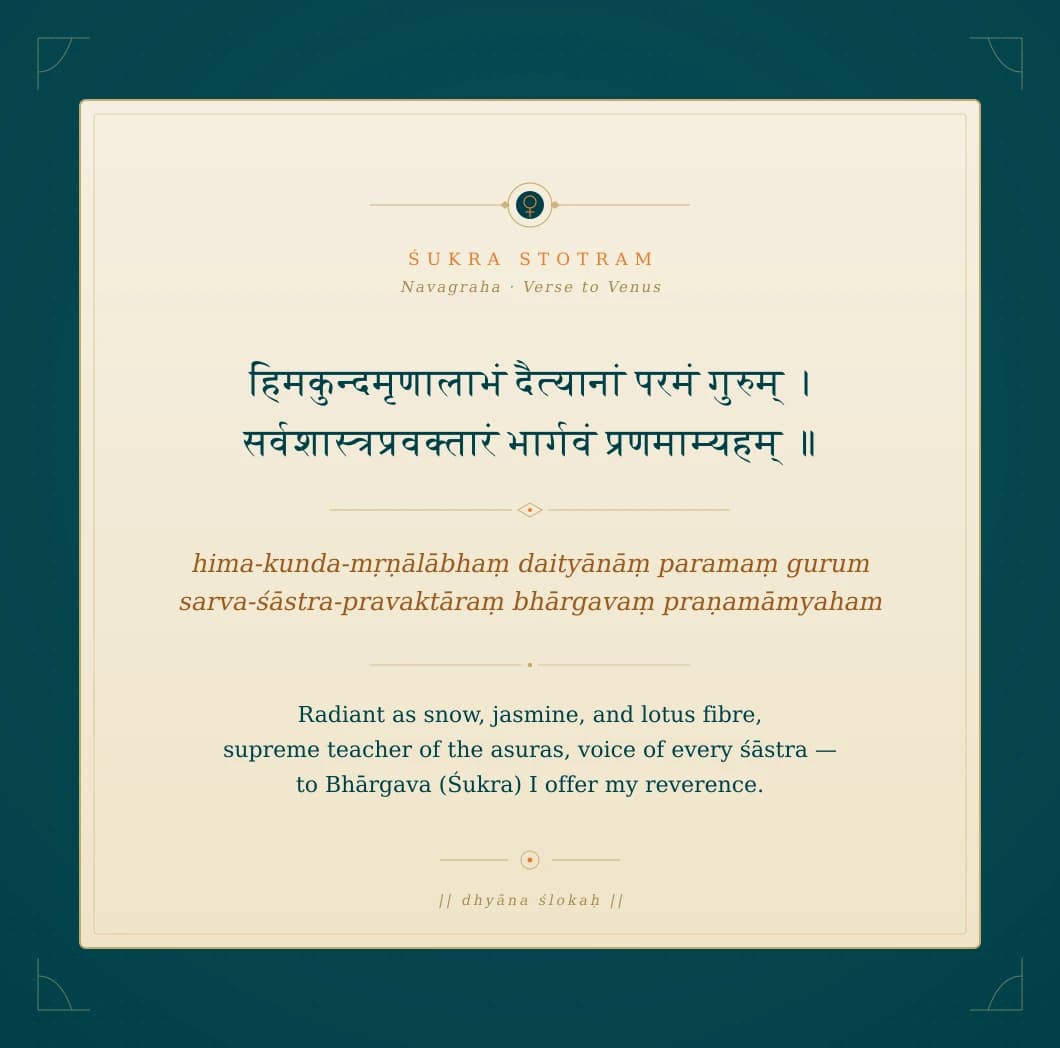
Tools for Venus 9th house Kumbha natives
Is your Bhagya Bhava Venus carrying the supreme yogakaraka signature?
Get a full personalised analysis of your ninth house Venus, the swakshetra dignity, and the dharma dasha timing.