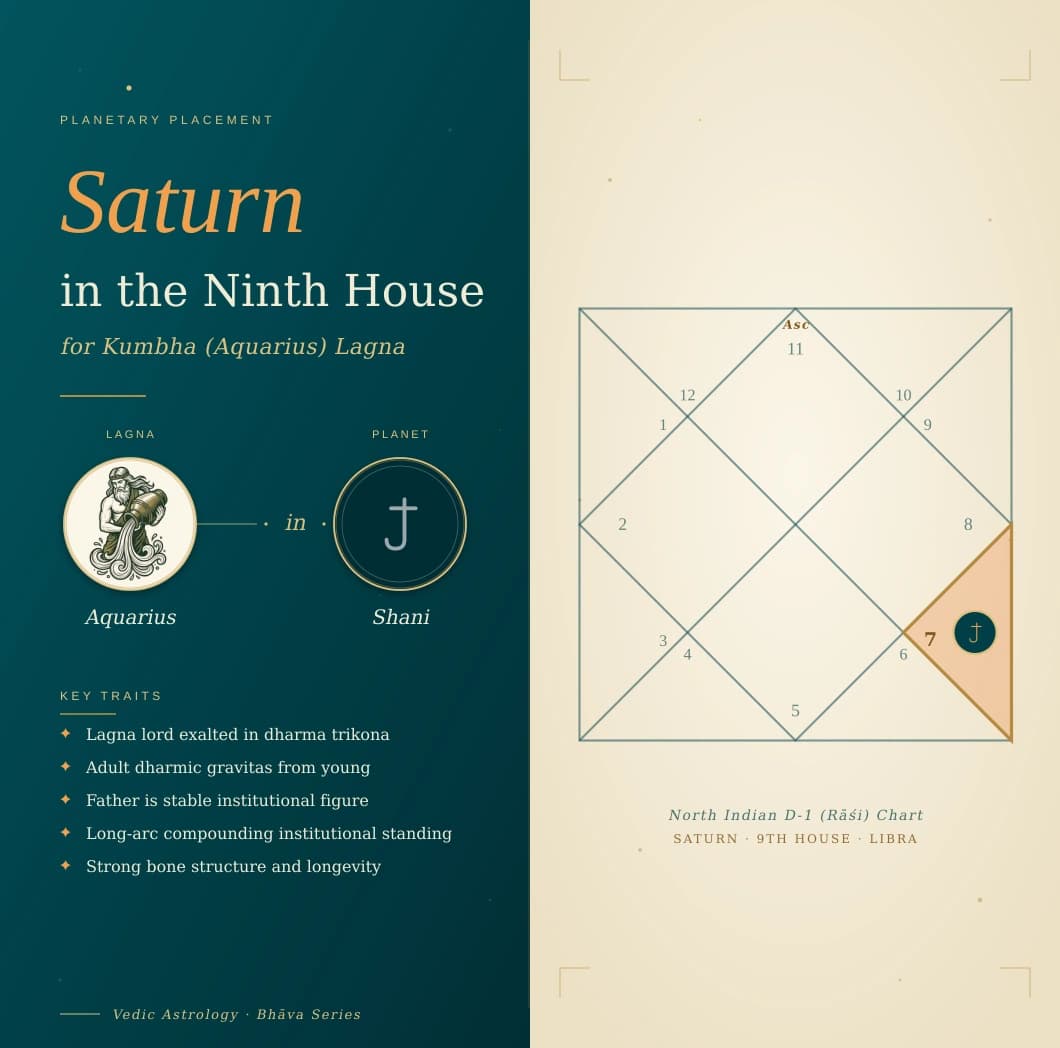
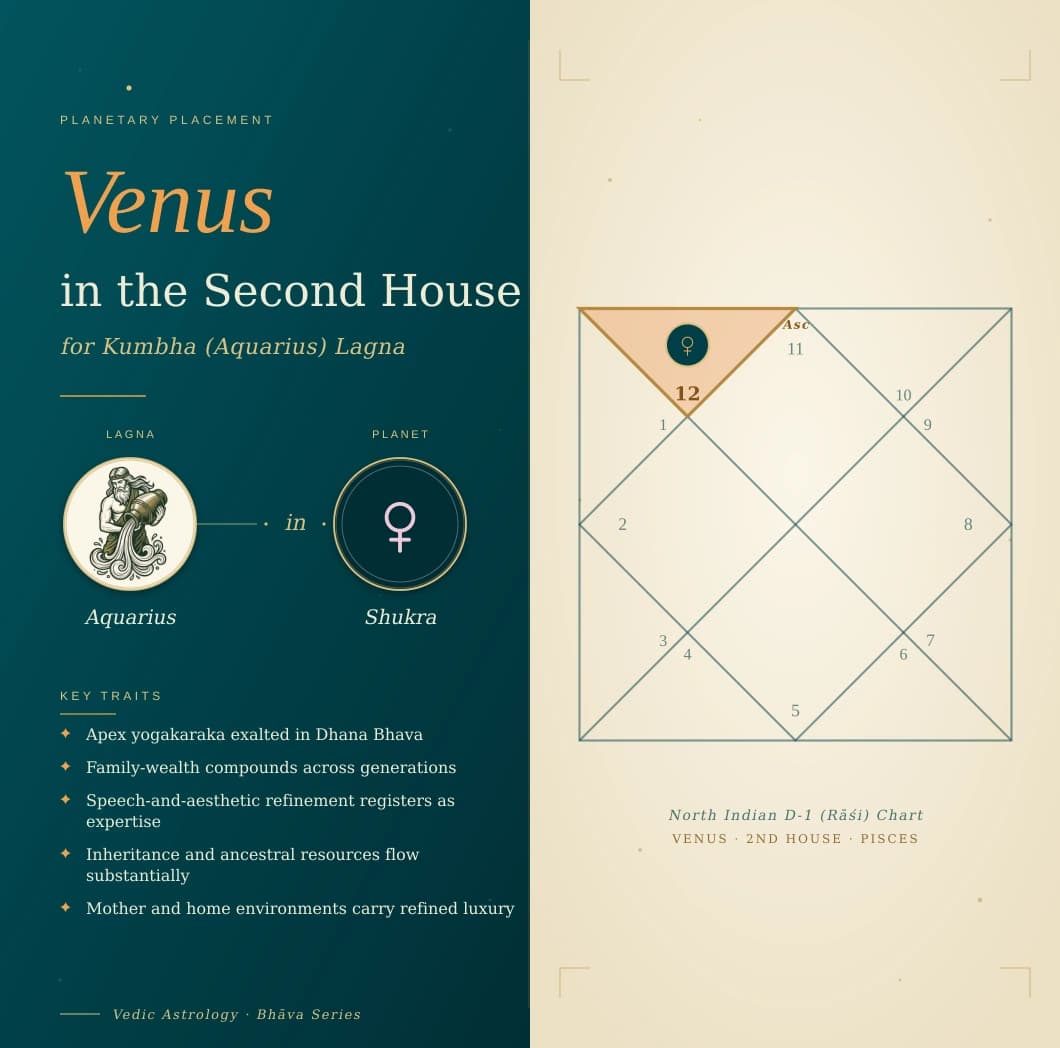
Saturn in the 1st house
Kumbha Lagna (Aquarius Ascendant)
A practitioner study of Shani in Tanu Bhava for Aquarius ascendant natives. Saturn swakshetra in Kumbha at the lagna kendra, the 1L plus 12L lordship at lagna forming Sasa Mahapurusha Yoga, and the long-arc institutional career signature that defines the strongest Saturn placement available to the lagna.
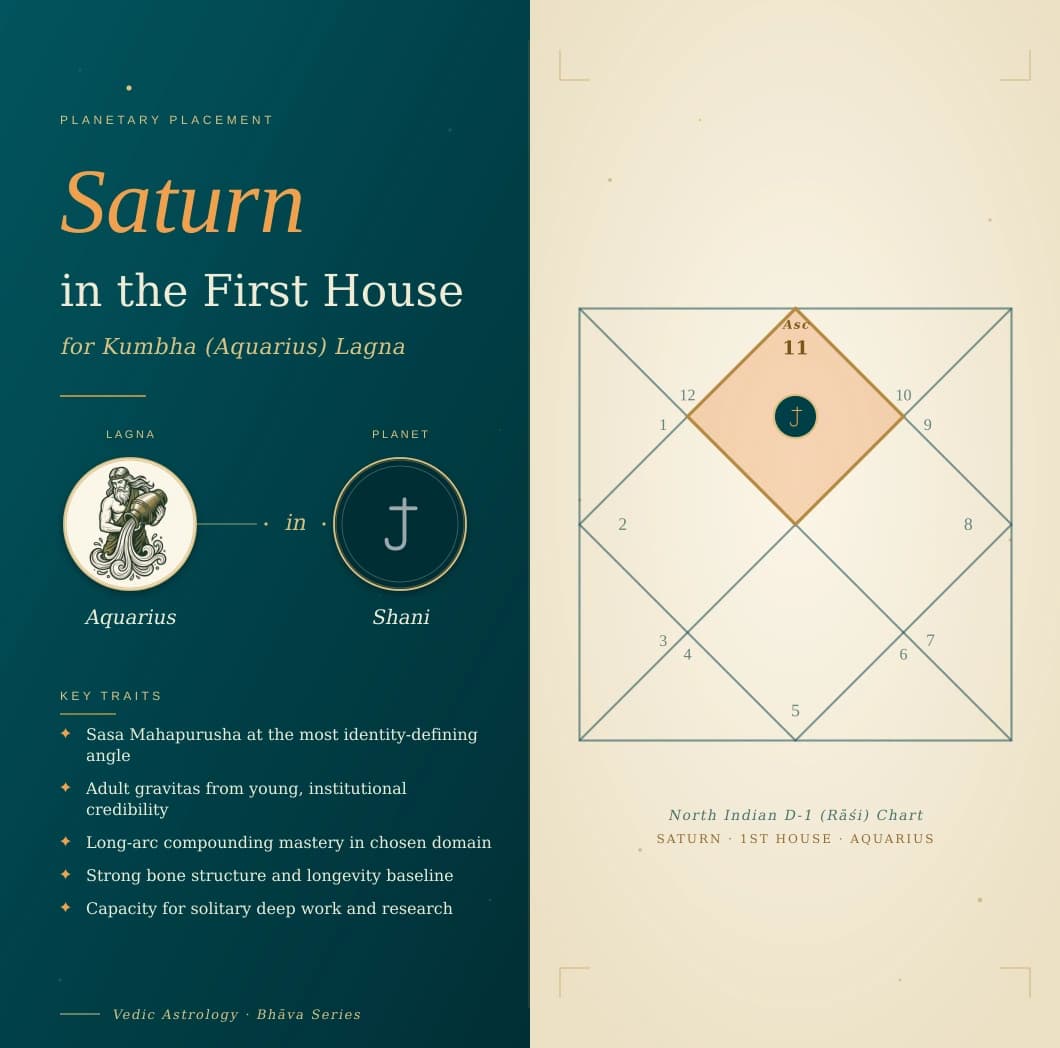
Saturn sits in his own swakshetra Kumbha at the lagna for Aquarius ascendant natives, the Sasa Mahapurusha lagna lord signature.
Saturn in 1st house for Kumbha Lagna, the quick reference
If you carry Saturn in the first house of a Kumbha chart, you hold the foundational lagna-lord signature on which every other reading of your chart pivots. Shani (Saturn) is the natural lord of structure, discipline, time, longevity, and institutional gravitas. His arrival in Tanu Bhava (the first house, the bhava of self, body, identity, and the entire frame through which the chart expresses) brings these significations directly into the native's identity.
The first house from Kumbha is itself Kumbha (Aquarius), Saturn's own sign. Classical Parashari recognises lagna lord at lagna as one of the strongest classical lagna-strength patterns. The placement also forms the apex form of the Sasa Mahapurusha Yoga, one of the five Pancha Mahapurusha Yogas the Vedic catalogue treats as apex configurations.
The second structural feature is the dual lordship that makes this particular Saturn placement uniquely loaded among all Saturn-in-1 readings across the twelve lagnas. Saturn rules the first house (called the 1L, the lord of self and identity) AND the twelfth house (called the 12L, the lord of Vyaya Bhava, foreign lands, moksha, dissolution-of-self, and hospitality) for Kumbha natives. That dual lordship folds the renunciation-and-foreign dimension directly into the self.
When the same swakshetra Saturn sits at the lagna, the chart fuses self-identity, structural mastery, foreign orientation, and the long-arc maturity that the 12L brings into a single body. The native carries adult gravitas from young, develops naturally toward institutional roles that compound across decades, and frequently builds professional life in cross-border or research-leaning contexts where the foreign dimension expresses through the work rather than purely through travel.
The third feature is the Sasa Mahapurusha reading specifically. Among the five Pancha Mahapurusha Yogas, the lagna-kendra version of any Mahapurusha Yoga is read by classical commentators as the most identity-defining of the four kendra positions because the 1H is where the planet's signature directly shapes the native's body, presence, and self-pattern. Sasa Mahapurusha at lagna produces natives whose entire personhood organises around Saturn's institutional-and-disciplined signature. This guide reads every layer of Saturn in 1st house for Kumbha Lagna natives.
Why swakshetra Saturn at lagna forms apex Sasa Mahapurusha
Students often arrive at this placement aware that Saturn at lagna is structurally heavy, but uncertain why swakshetra Saturn specifically in the 1H of Kumbha is treated by classical commentators as among the most rewarding Saturn placements in the Vedic catalogue. The honest practitioner answer requires reading three structural facts together.
Saturn is the lagna lord for Kumbha. His own sign Kumbha sits exactly on the 1st-house cusp. The resulting placement holds the planet's swakshetra dignity in the bhava of self and personhood.
The Sasa Mahapurusha logic deserves its own reading. Classical Parashari recognises five great-person yogas (Bhadra for Mercury, Hamsa for Jupiter, Malavya for Venus, Ruchaka for Mars, Sasa for Saturn). Each forms when the planet sits in his own or exaltation sign in a kendra (1, 4, 7, or 10). The 1st-house version of any Mahapurusha Yoga is read by classical commentators as the most identity-defining because the lagna kendra is where the planetary signature directly shapes the native's body and presence.
The 1L plus 12L combined reading is the second specific feature. The 1L rules self and identity, and the 12L rules moksha, foreign lands, dissolution, and the renunciation dimension. When this dual lord sits swakshetra at lagna, the foreign-and-renunciation dimension folds directly into the native's self-pattern.
Many natives in this configuration develop adult lives oriented around institutional service in foreign or research contexts, build professional identity around long-arc systems work that takes decades to mature, or carry an unusual capacity for solitude that classical commentators specifically associate with 1L-12L lagna-kendra Saturn. The contrast with Saturn-in-1 for non-Kumbha lagnas is illustrative. Saturn-in-1 for Tula natives is the Tula placement of the 4L+5L: yogakaraka with a different bhava emphasis. Only Kumbha gets the full triple stack of swakshetra plus lagna-lord-at-lagna plus Sasa Mahapurusha in a single placement.
Swakshetra Saturn at lagna is not a generic strong placement. It is the specific configuration where the 1L plus 12L lord takes his own dignity in the bhava of self, producing the Sasa Mahapurusha Yoga at the most identity-defining angle the chart can hold.
Terms used in this article
A short glossary of the Sanskrit and Jyotish terms that recur in this study. First-occurrence expansion is also retained inline.
- Tanu Bhava
- The 1st house, the bhava of self, body, identity, and the entire frame through which the chart expresses.
- Swakshetra
- Own sign. A planet in the sign he himself rules. The second-strongest dignity after exaltation.
- Sasa Mahapurusha Yoga
- Saturn in own or exalted sign in a kendra (1, 4, 7, or 10). One of the five Pancha Mahapurusha Yogas.
- Kendra
- Angular houses 1, 4, 7, 10. Bhavas of structural strength where planets express through public life.
- 1L
- First-house lord, the planet ruling self, body, and life direction.
- 12L
- Twelfth-house lord, the planet ruling foreign lands, moksha, dissolution-of-self, and hospitality.
- Vyaya Bhava
- The 12th house, ruling foreign lands, moksha, expenditure, hospitality, and the bed-pleasure dimension.
How swakshetra Saturn at lagna shapes the Kumbha native
Physically the native carries the classical Sasa Saturn body type. The frame is tall and lean, sometimes notably so, with prominent bone structure, a long face, deep-set eyes that register as quietly observant, and the kind of grave composure that strangers describe as adult-from-young. The complexion runs cooler and the body holds an unusual stillness that classical commentators specifically associate with swakshetra Saturn at lagna.
Bones are dense, joints are stable, and longevity is genuinely strong. The frame rarely shifts dramatically across decades, and many natives report that physiotherapists and orthopaedic specialists comment on unusually well-aligned posture. The build keeps the Aquarian-tall verticality and adds the Saturn-bone solidity that carries the body through long-duration work without the structural vulnerabilities other lagnas exhibit.
Temperament is where the placement most distinguishes the native. These natives carry adult gravitas from young, often acting as the responsible sibling, the cousin everyone defers to in family decisions, the colleague whose voice closes meetings rather than opens them. They speak less than peers, observe more, and arrive at conclusions through methodical examination rather than intuitive jumps.
The 12L dimension folded into the self produces an unusual capacity for solitude. Many natives are entirely comfortable working alone for long periods, prefer reading and contemplation to social gatherings, and develop adult lives organised around solitary creative-and-research practice without needing the validation other temperaments require. The Saturn-Aquarian intellect compounds across decades into deep specialist knowledge of whatever domain the native settles into.
The shadow side is the same Saturn-12L dimension. Natives who do not channel the placement consciously can experience cycles of social withdrawal that compound into isolation, perfectionism that delays launches indefinitely, and the heaviness that classical commentators associate with Saturn-loaded charts. Natives who pair the discipline with deliberate community-and-collaboration discipline develop the rare integration of structural mastery and human warmth the placement is capable of supporting.
Strengths, shadows and career fits
- Sasa Mahapurusha at the most identity-defining angle
- Adult gravitas from young, institutional credibility
- Long-arc compounding mastery in chosen domain
- Strong bone structure and longevity baseline
- Capacity for solitary deep work and research
- Naturally trustworthy presence in formal settings
- Social withdrawal compounding into isolation
- Perfectionism that delays launches indefinitely
- Knee, joint, and dental sensitivity in stress periods
- Late marriage and slow romantic timing
- Skin and complexion patterns under unmoderated stress
- Grim mood cycles during 12L transit pressure
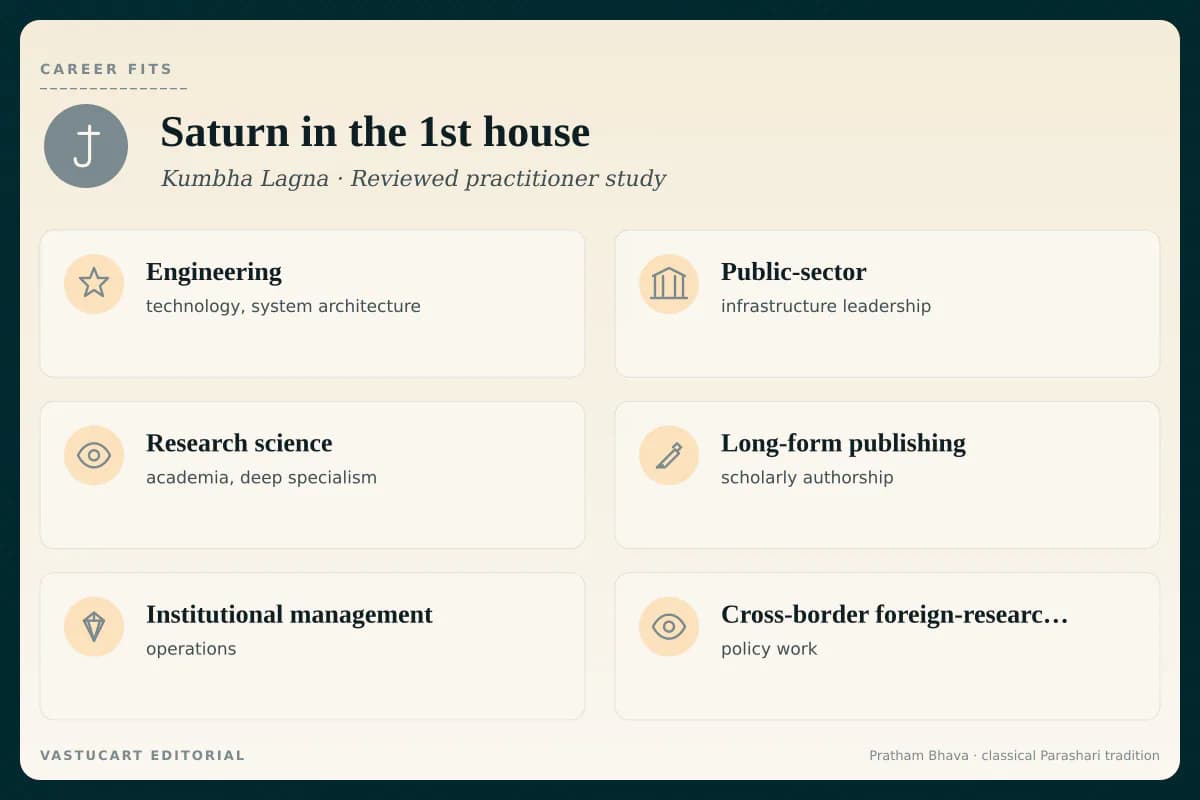
- Engineering, technology, system architecture
- Public-sector and infrastructure leadership
- Research science, academia, deep specialism
- Long-form publishing, scholarly authorship
- Institutional management and operations
- Cross-border foreign-research and policy work
Where the Sasa lagna lord vocation plays out
Career paths cluster around fields that braid structural discipline with long-arc institutional contribution. Engineering, technology, and systems architecture is the strongest single fit because the Aquarian intellect specifically rewards systems thinking, Saturn rules structure-and-engineering as karakatva, and the Sasa lagna placement produces natives whose technical mastery compounds across decades into senior architectural roles.
Many natives become principal engineers, chief architects, infrastructure leads, or technical fellows whose careers are defined by the systems they build rather than the speed of their advancement. Public-sector and infrastructure leadership work because Saturn rules institutional governance, the 12L brings the public-service dimension, and the Sasa signature produces natives whose authority feels institutional rather than personal.
Many natives in their forties and fifties step into senior public-sector roles, infrastructure-policy positions, or large-institution administrative leadership where the Saturn signature reads as natural authority. Research science, academia, and deep specialism fit because the 12L-at-lagna folds the contemplative-research dimension into the self, and many natives become principal investigators, tenured professors, or research-institute directors whose body of work compounds across decades.
Long-form publishing, scholarly authorship, and document-based authority work because Saturn rules the slow accumulation of canonical knowledge. Many natives in their fifties publish the field-defining textbook, monograph, or treatise that becomes the reference work for their domain. Institutional management and operations fit naturally because the Saturn-Aquarian combination specifically rewards systems-administration capacity at scale.
Cross-border foreign-research and policy work suits natives whose 12L-at-lagna places professional vocation outside the country of birth or in cross-border research contexts. Many natives migrate professionally, take research postings abroad, or build careers entirely around international policy collaboration. Saturn mahadasha is the defining career window and arrives with the principal-architect appointment, the senior public-sector role, the tenured professorship, the institute directorship, the canonical publication, or the cross-border research consolidation that crystallises the apex Sasa Yoga.
Why this is among the strongest Saturn placements available
The clearest way to understand Saturn in 1st of Kumbha is to read the swakshetra dignity, the lagna-kendra placement, and the dual lordship together. Classical Parashari recognises that own-sign placement gives a planet his second-strongest expression after exaltation. Lagna-lord-at-lagna pattern gives the chart its single most direct identity-and-self activation. When the planet, the lordship, and the bhava all align as they do here, the placement carries simultaneously the planet's swakshetra strength, the lagna-lord identity authority, and the kendra Mahapurusha activation.
The kendra Mahapurusha Yoga reading is the second specific feature. Among the four kendras (1, 4, 7, 10), the 1st carries the most direct identity association because it is the bhava of self and the most fundamental of the four angles. Mahapurusha Yogas in the 1st are read by classical commentators as the most identity-defining versions of the five Mahapurusha types, producing natives whose entire personhood organises around the planetary signature at issue.
Many natives in this configuration become known within their professional communities for the Saturn signature itself. Reliable authority, structural mastery, long-arc patience, and the kind of cross-decade institutional standing that classical texts associate with apex-level Sasa placements. The third interpretive layer is the long-arc dasha pattern.
Saturn's mahadasha runs nineteen years, the second-longest in the Vimshottari sequence. The placement's defining career window opens for an extended duration when it activates. Many natives in this configuration experience a Saturn mahadasha that brackets the entire arc of mid-career institutional consolidation, with the principal-architect appointment, the tenured professorship, or the institute directorship arriving in the early years of the dasha and consolidating institutionally by its close.
When the swakshetra Sasa Saturn delivers its apex chapter
Saturn mahadasha is the defining window for this placement and arrives with the principal-architect appointment, the senior public-sector role, the tenured professorship, the institute directorship, or the canonical publication that crystallises the apex Sasa Yoga.
Bones, joints, complexion and the Tanu health link
Health follows the Saturn-in-1H pattern with specific Tanu body-part vulnerabilities. Constitution is generally vata-kapha, with vata most prominent because Saturn carries air-vata and Kumbha is itself an air-vata sign. The 1st house body-part rulership covers the whole body broadly, the head, the brain, and the complexion. Saturn rules the bones, joints, knees, and teeth more specifically.
The placement raises specific risk for joint sensitivity and arthritis patterns from the late thirties onward, dental and gum issues if oral hygiene drifts, complexion patterns under unmoderated stress, and the chronic-tension postural issues that long sedentary work compounds. Many natives report that knee, lower-back, and shoulder comfort fluctuates with sleep discipline and seasonal cold.
Annual full-panel screening from the late twenties is recommended with attention to bone-density markers, joint inflammation, dental review, and metabolic-syndrome assessment. Daily yoga (specifically pavanamuktasana and joint-mobilising practice that supports long-sit work), regular oil massage in winter, and avoidance of cold-stagnant food are the lifestyle stabilisers because the chart's natural Saturn dryness needs ordinary body warmth as a counterweight.
Remedies for swakshetra Saturn in the Kumbha lagna angle
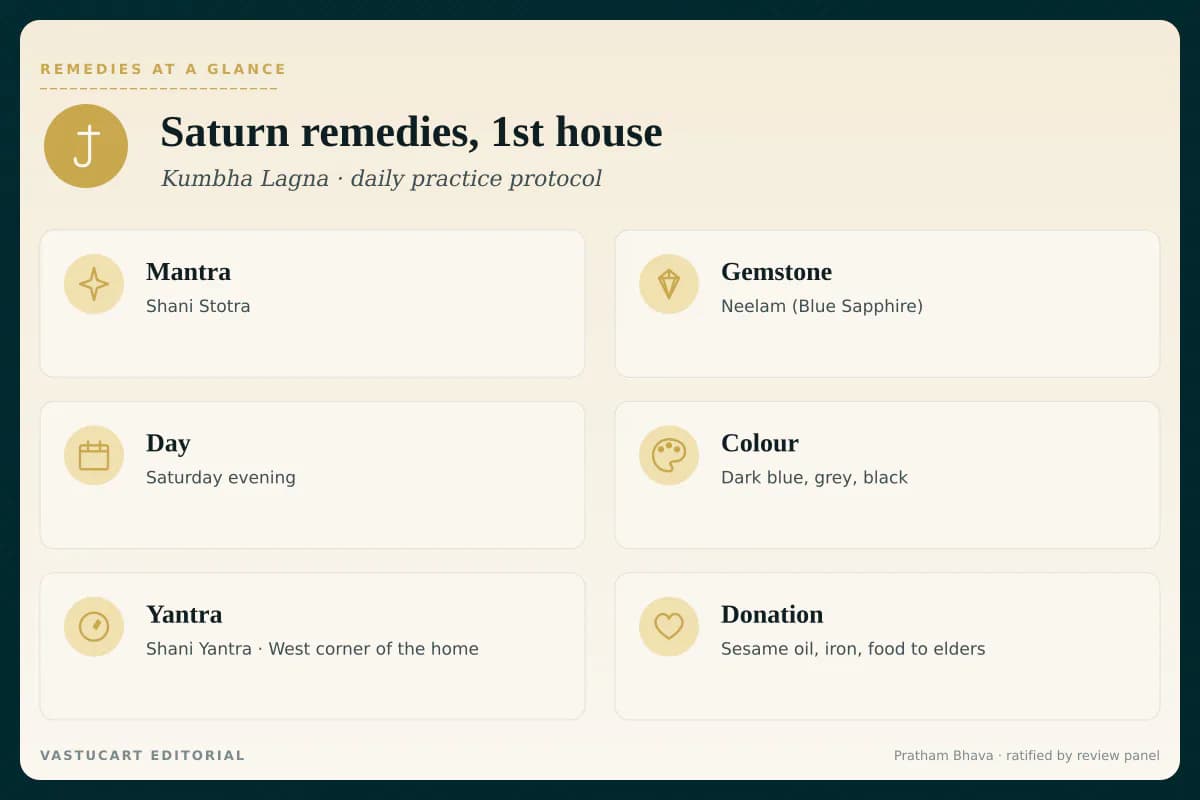
The daily Hanuman or Shani worship is the primary remedy for this placement. Hanuman is the classical tamer of Saturn and Shani is the planet's own deity. Rise before sunrise, bathe, wear blue or black clothing on Saturdays, and visit a Hanuman or Shani temple if accessible.
The Shani Stotra is the primary recitation, the Navagraha verse to Saturn that creates a containing field for the lagna-lord swakshetra signature. Reciting it at sunrise daily for forty days at any major Saturn transition (a principal-architect appointment, a tenured professorship, an institute directorship, a canonical publication launch) is the formal protocol. Many natives also adopt the Hanuman Chalisa as a parallel weekly practice on Tuesdays and Saturdays.
Offer black sesame seeds, blue flowers, mustard oil, and iron items at the Shani altar, and donate to causes that support institutional service and long-arc research (scholarship funding for engineering and research universities, public-library endowments, infrastructure-charity contributions). The conscious-discipline-and-warmth practice is the lifestyle remedy that compounds across decades.
The gemstone is blue sapphire (Neelam). This is one of the most gemstone-rewarding placements because the swakshetra Saturn responds to amplification cleanly when properly tested. Wear a natural blue sapphire of minimum two carats set in silver or white gold on the middle finger of the right hand on a Saturday at sunrise after Shani mantra recitation, and only after a confirmed three-day trial reading.
Gemstones for Saturn in 1st house Kumbha Lagna
Blue sapphire is the primary Saturn gemstone and works exceptionally well here because the swakshetra Sasa Saturn responds to amplification cleanly.


Disclaimer: Blue sapphire over a swakshetra Saturn amplifies the lagna-lord channel powerfully. Always run the three-day trial and consult a qualified Jyotishi before permanent wearing.
Rudraksha beads for Saturn in 1st house
The Saturn-aligned rudraksha is the Saat Mukhi (Seven Mukhi), the bead directly ruled by Mahalakshmi and Saturn.
The classical Saturn rudraksha and the bead specifically associated with structural prosperity and durable institutional standing. Supports the Sasa lagna-lord signature, channels the discipline instinct toward sustainable territory, and stabilises bandwidth when the institutional, research, or infrastructure vocation is in active phase.
The fourteen-mukhi bead supports clear decision-making and protects against the depressive cycles that Saturn-heavy charts can experience. Wearing the Chaudah Mukhi alongside the Saat Mukhi compounds the placement's natural strength in long-arc systems work and senior leadership.
Shani Yantra for the swakshetra lagna lord placement
Sacred recitations for swakshetra Saturn at lagna
Chaya-martanda-sambhutam tam namami shanaishcharam
Translation: We bow to Shanaishchara, dark as collyrium, son of Surya, elder brother of Yama, born of Chaya and Martanda. The Shani Stotra is the canonical Navagraha verse to Saturn and is the perfect daily recitation for a chart where Saturn sits swakshetra at the lagna and the Sasa lagna-lord signature needs a containing devotional field. Many natives advanced in practice add the Hanuman Chalisa as a Tuesday and Saturday secondary layer.
Read the full stotra on stotra.vastucart.in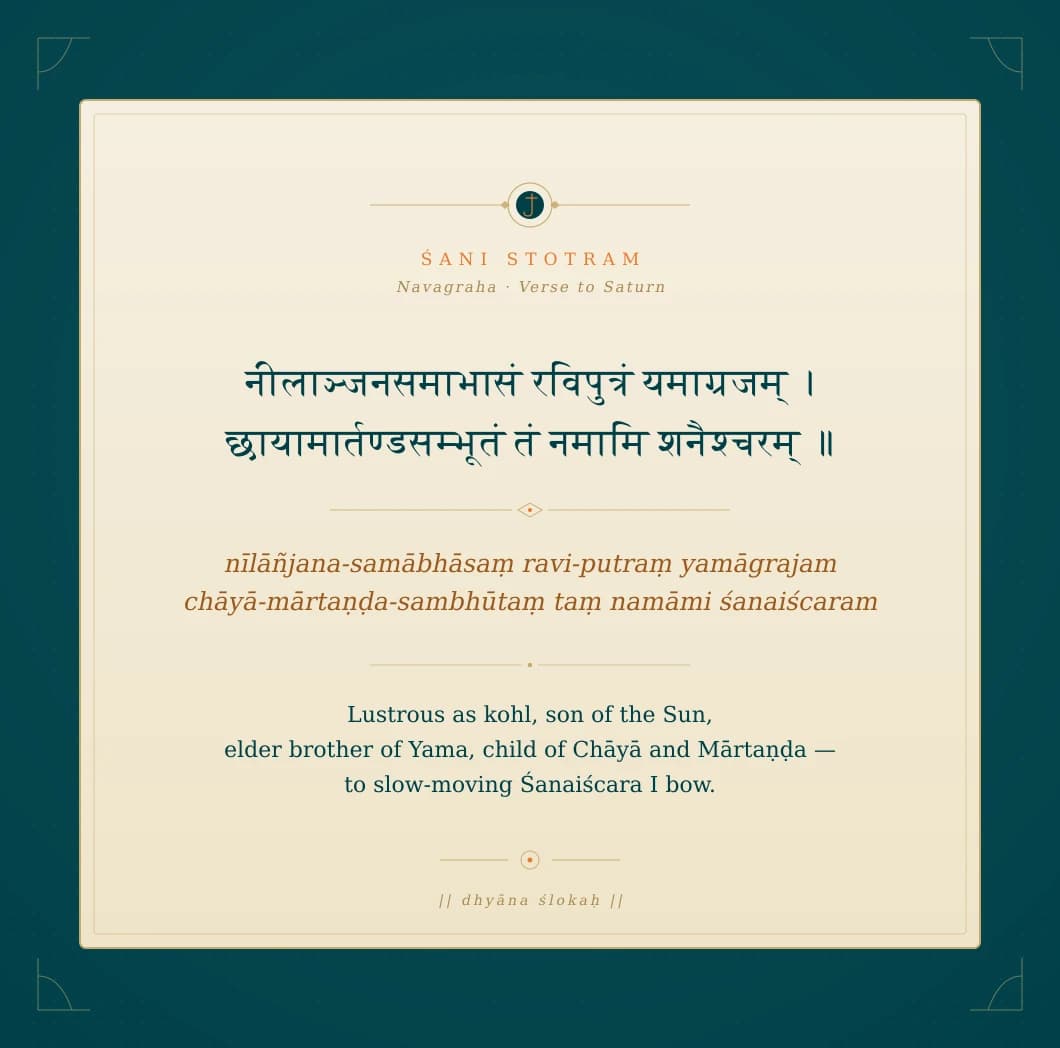
Tools for Saturn 1st house Kumbha natives
Is your Tanu Bhava Saturn carrying the Sasa Mahapurusha signature?
Get a full personalised analysis of your first house Saturn, the swakshetra dignity, and the long-arc dasha timing.