Jupiter in the 7th house
Mithuna Lagna (Gemini Ascendant)
A practitioner study of Guru in Kalatra Bhava for Gemini ascendant natives. Jupiter swakshetra in his own Dhanu in the marriage angle, Hamsa Yoga in a kendra, and the teacher-spouse signature that defines the most rewarding Mithuna kalatra placement.
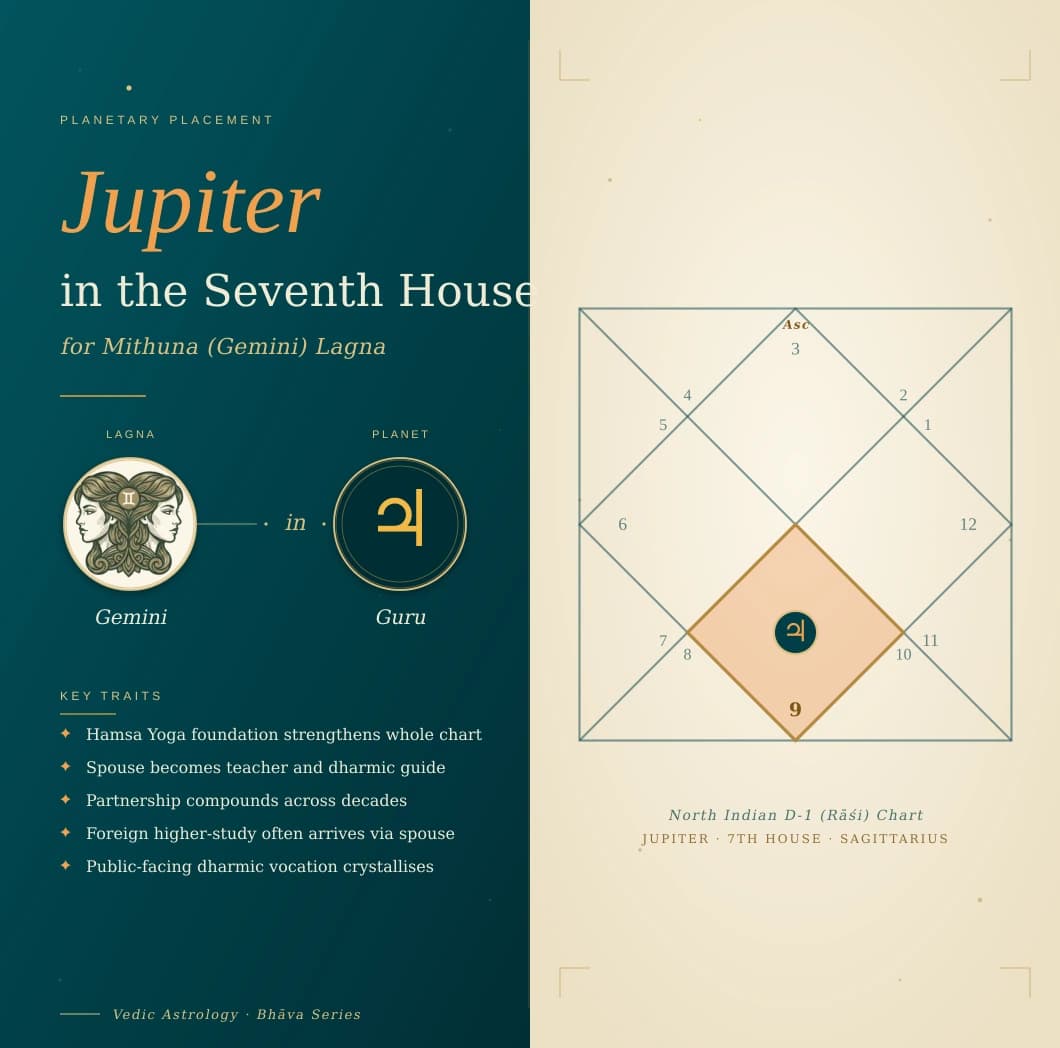
Jupiter sits swakshetra in his own Dhanu in the seventh house for Gemini ascendant natives, the Hamsa Yoga and teacher-spouse signature.
Jupiter in 7th house for Mithuna Lagna, the quick reference
If you carry Jupiter in the seventh house of a Mithuna chart, you hold one of the most rewarding marriage placements in the entire Vedic catalogue, because Guru (Jupiter) is the natural lord of wisdom, dharma, and refined relating, and his arrival in Kalatra Bhava (the seventh house, the bhava of marriage and partnership) lifts the partnership domain into territory that classical Parashari treats as foundational. The seventh house from Mithuna is Dhanu (Sagittarius), ruled by Jupiter, which means Jupiter sits in his own sign at a kendra. The configuration produces Hamsa Yoga, one of the five Pancha Mahapurusha (Five Great-Personality) Yogas.
The second structural feature is the swakshetra-in-kendra strength. Hamsa Yoga forms when Jupiter occupies his own sign (Dhanu or Meena) or his exaltation sign (Karka) in a kendra (1, 4, 7, 10) of the chart. Jupiter in 7th of Mithuna meets both conditions simultaneously: Dhanu is Jupiter's own sign, and the 7th is a kendra. The yoga grants wisdom, dharmic orientation, refined relating, prosperity through partnership, and a marriage that consistently functions as a major life vehicle for the native's broader development. The third feature is the marriage-as-dharma reading. The 7th house rules partnership and Jupiter rules dharma, and the meeting point produces a marriage signature where the spouse is structurally a teacher, scholar, or fellow seeker on a serious dharmic path. Many natives marry someone in higher education, religious tradition, or contemplative practice, and the partnership becomes the central vehicle through which dharmic life enters the daily routine. This guide reads every layer of Jupiter in 7th house for Mithuna Lagna natives: the Dhanu swakshetra, the Hamsa Yoga formation, the marriage-as-dharma signature, and the yellow sapphire protocol.
Why Jupiter swakshetra in the marriage angle creates Hamsa Yoga
Students often arrive at this placement aware that it is strong but uncertain why classical texts treat it with particular reverence. The honest practitioner answer requires understanding what the Pancha Mahapurusha Yogas actually do. When one of the five major non-luminary planets (Mars, Mercury, Jupiter, Venus, Saturn) occupies his own sign or exaltation sign in a kendra, the chart receives a foundational strength that elevates the native's life direction in the way that planet rules. Jupiter rules wisdom, dharma, refinement, and expansion, and Hamsa Yoga delivers all four with unusual durability across decades.
The marriage-as-dharma reading is the second specific feature that practitioners need to handle correctly. The 7th house rules everything that the native shares with another (marriage, business partnership, public-facing engagement), and Jupiter's presence in this bhava means the partnership domain becomes a vehicle for dharmic development rather than a separate sphere of personal life. Most natives with this placement marry someone significantly invested in higher education, religious tradition, scholarship, or contemplative practice, and the marriage usually deepens into a partnership of shared inquiry rather than purely domestic settlement. The third interpretive layer is the contrast with Jupiter in 1 (the other kendra Jupiter for Mithuna). Jupiter in 1 of Mithuna would place Jupiter in the friendly Mithuna sign at the body angle, which is strong but not Hamsa Yoga because Mithuna is not Jupiter's own sign. Jupiter in 7 is the only Hamsa-producing Jupiter placement for this lagna, which is why it is treated as the foundational marriage placement Mithuna natives can hold.
Hamsa Yoga in the marriage angle is not generic relationship-favour. It is the specific configuration where Jupiter's rule over wisdom and dharma becomes the spine of the partnership rather than a useful complement to it.
Terms used in this article
A short glossary of the Sanskrit and Jyotish terms that recur in this study. First-occurrence expansion is also retained inline.
- Kalatra Bhava
- The 7th house, the bhava of marriage, spouse, and partnership.
- Swakshetra
- Own sign. A planet placed in his own sign gains structural strength.
- Pancha Mahapurusha Yoga
- Five Great-Personality Yogas formed when Mars, Mercury, Jupiter, Venus, or Saturn is in own or exaltation sign in a kendra.
- Hamsa Yoga
- The Jupiter-specific Pancha Mahapurusha Yoga, formed when Jupiter is in own or exaltation sign in a kendra.
- Kendra
- Angular house — the 1st, 4th, 7th, 10th — the structural pillars of the chart.
- 7L
- Seventh-house lord, the planet ruling the marriage angle.
- Karakatva
- The natural significations a planet rules independent of any chart.
How Jupiter swakshetra in the marriage angle shapes the Mithuna native
Physically the native carries the Mithuna versatility softened by the Jupiter expansion. The face often combines the sharp Mithuna features with a noticeable warmth that strangers register as approachable wisdom, and many natives report being treated as older or more authoritative than peers from a young age. The build can take on more weight than other Mithuna placements as the native ages, because Jupiter's expansive influence tends to soften the typical lean Mithuna frame into a fuller body during the major Jupiter dasha periods. Many natives have a mark or feature on the lower abdomen or hip, classical 7th-house signatures.
Temperament is where the placement most distinguishes the native. These natives carry the Mithuna versatility (curiosity across domains, comfort with multiple frames) but route it through dharmic orientation rather than purely commercial or analytical channels. They are drawn to philosophy, religious study, classical traditions, and the company of teachers from early adulthood, and many natives find their first serious spiritual practice or scholarly mentor through partnership rather than through family or formal education. The Mithuna directness combines with the Jupiter wisdom to produce natives who can hold complex frameworks lightly and convey them with unusual generosity, the kind that listeners describe as teacherly without the lecturer's edge. The shadow side is the maraka lordship: Jupiter rules the 7th and the 10th for Mithuna and the 7th is also a marakasthana, so the placement asks for vigilance about partnership during major Jupiter periods. Natives who pair the dharmic orientation with explicit attention to the relationship as a working partnership develop the rare integration of wisdom and durable marriage that Hamsa Yoga is genuinely capable of supporting.
Strengths, shadows and career fits
- Hamsa Yoga foundation strengthens whole chart
- Spouse becomes teacher and dharmic guide
- Partnership compounds across decades
- Foreign higher-study often arrives via spouse
- Public-facing dharmic vocation crystallises
- Refined patron-network forms around marriage
- 7L maraka asks vigilance in Jupiter dasha
- Body weight increases in Jupiter periods
- Spouse's career can dominate the household
- Family struggles to read the dharmic orientation
- Foreign relocation through spouse may strain
- Romantic life can feel philosophically demanding
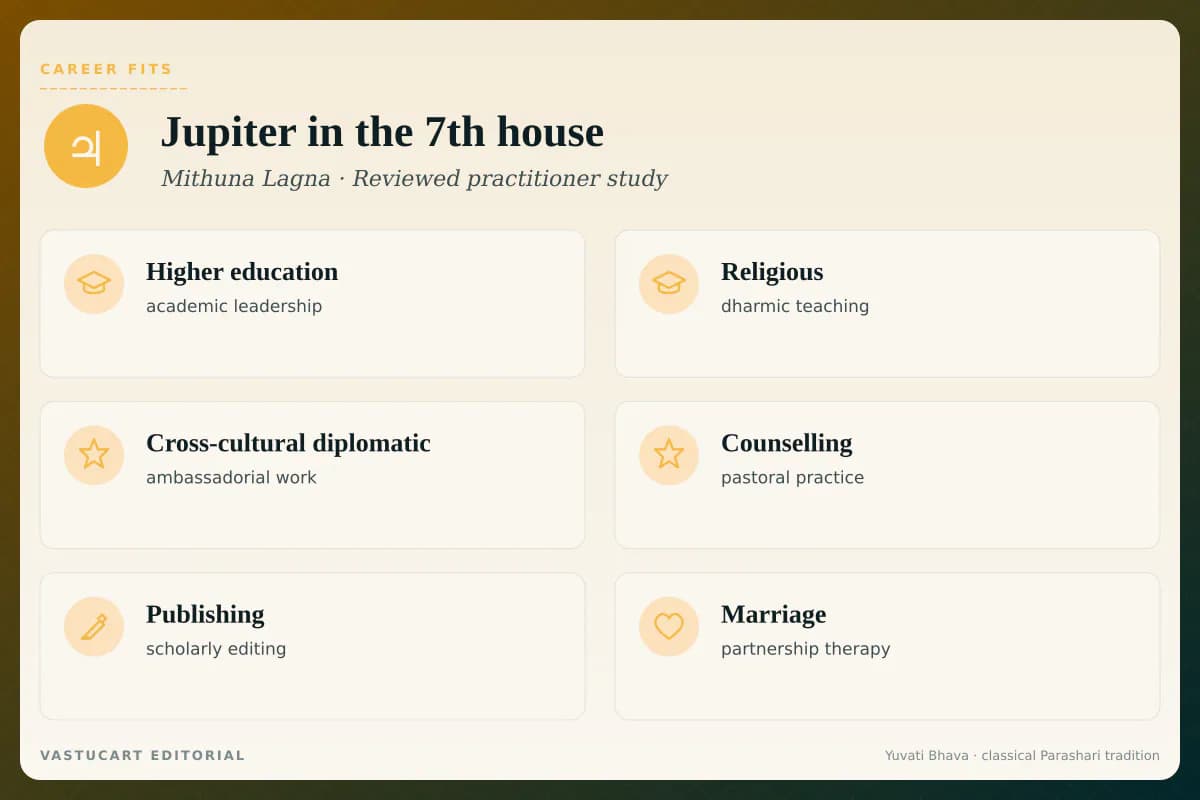
- Higher education and academic leadership
- Religious and dharmic teaching
- Cross-cultural diplomatic and ambassadorial work
- Counselling and pastoral practice
- Publishing and scholarly editing
- Marriage and partnership therapy
Where the dharmic-partnership vocation plays out
Career paths cluster around fields where wisdom and partnership combine. Higher education and academic leadership are the strongest single fit because Jupiter rules teaching and the 7th house rules public-facing engagement. Many natives become professors, deans, vice-chancellors, or senior administrators in universities and the work consistently extends into mentorship and scholarly community-building. Religious and dharmic teaching suits natives whose vocational mode is more contemplative, and Mithuna natives in this configuration often translate or commentate on classical texts, run scholarly retreats, or hold teaching roles in traditional lineages.
Cross-cultural diplomatic and ambassadorial work fit the chart because the 7th house rules foreign partnerships at the public level and Jupiter's wisdom-dispositorship channels the foreign signature through dharmic and educational territories. Counselling and pastoral practice work because the chart specifically supports holding the heaviest material clients bring without absorbing it. Publishing and scholarly editing suit natives whose intellectual capacity matures into the commissioning and shaping of others' work, and many natives in their forties move from individual scholarship into editorial leadership. Marriage and partnership therapy fit naturally because the same chart that produces the dharmic-marriage signature also produces clinical insight into other people's partnership patterns, and the chart specifically supports the long-arc engagement these fields require. Jupiter mahadasha is the defining career window and arrives with the senior academic appointment, the major book contract, the diplomatic posting, or the marriage that becomes the platform for the rest of the working life.
Why this is the most rewarding Jupiter placement for Mithuna
The clearest way to understand Jupiter in 7th of Mithuna is to read the swakshetra status, the kendra position, and the natural-ruler alignment together. Classical Parashari recognises that own-sign placement gives a planet his full natural strength because the dispositor is the planet himself; there is no friction between his nature and the sign environment. Kendra placement provides structural support because kendras are the four pillars holding up the chart's overall direction. Natural-ruler alignment means Jupiter is the natural significator of the 7th house's deeper themes (legal partnership, dharmic alignment between souls), so his presence here amplifies the bhava's most refined expression.
The maraka note is the second specific feature that practitioners need to handle carefully. The 7th house is a maraka station because it is the bhava through which the body's tenure in this birth is mediated (the 7th is read as the kalatra-bridge to mortality in classical Parashari). When the 7th lord sits in the 7th, the maraka classification is partially neutralised because the lord-in-his-own-house pattern is structurally constructive, but the placement still asks for ordinary care during Jupiter's dasha periods. The third interpretive layer is the comparison with Jupiter in 10 (the other Mithuna swakshetra Jupiter, in Meena). Jupiter in 10 of Mithuna is karma-trikona Hamsa Yoga (career-and-public-life dharmic vocation), the academic-leader pattern. Jupiter in 7 is kalatra-trikona Hamsa Yoga (marriage-and-partnership dharmic vehicle), the teacher-spouse pattern. Both produce the Hamsa benefit; they simply route it through different doorways.
When Jupiter in 7th delivers its Hamsa Yoga chapter
Jupiter mahadasha is the defining window for this placement and arrives with the senior academic appointment, the major book contract, the diplomatic posting, or the marriage that becomes the platform for the rest of the working life.
Lower abdomen, liver, and the Kalatra health link
Health follows the Jupiter-in-7th pattern with specific Kalatra body-part vulnerabilities. Constitution is generally balanced, with kapha most prominent because Jupiter carries the expansive kapha temperament and Dhanu is itself a fire-kapha sign. The 7th house body-part rulership covers the lower abdomen, kidneys, urinary tract, and pelvis, and Jupiter rules the liver, fat metabolism, and the broader bandwidth of expansive function. The placement raises specific risk for liver-related conditions, weight gain in Jupiter dasha periods, and hip or pelvic issues that emerge in the second half of life.
The Hamsa-Yoga longevity signature is the second specific layer. Classical reports consistently associate Hamsa Yoga with above-average longevity and a calm, durable constitution that handles ordinary life with surprising stability. Most natives reach late middle age in noticeably better health than peers, especially natives who pair the chart's natural pull toward refined indulgence (rich food, cultural events) with disciplined daily practice. The cost of the gift is the kapha excess that the placement carries: weight gain, mild metabolic slowing, and joint stiffness are common during Jupiter dasha peaks. Annual full-panel screening from the late twenties is recommended with specific attention to liver, pelvic, and metabolic markers. Daily yoga (specifically hip-opening and digestive practices), moderate intake of dairy and ghee, and avoidance of late-night refined-food indulgences are the lifestyle stabilisers because the chart's natural pull toward expansion needs ordinary discipline as a counterweight.
Remedies for Jupiter in the Mithuna kalatra angle
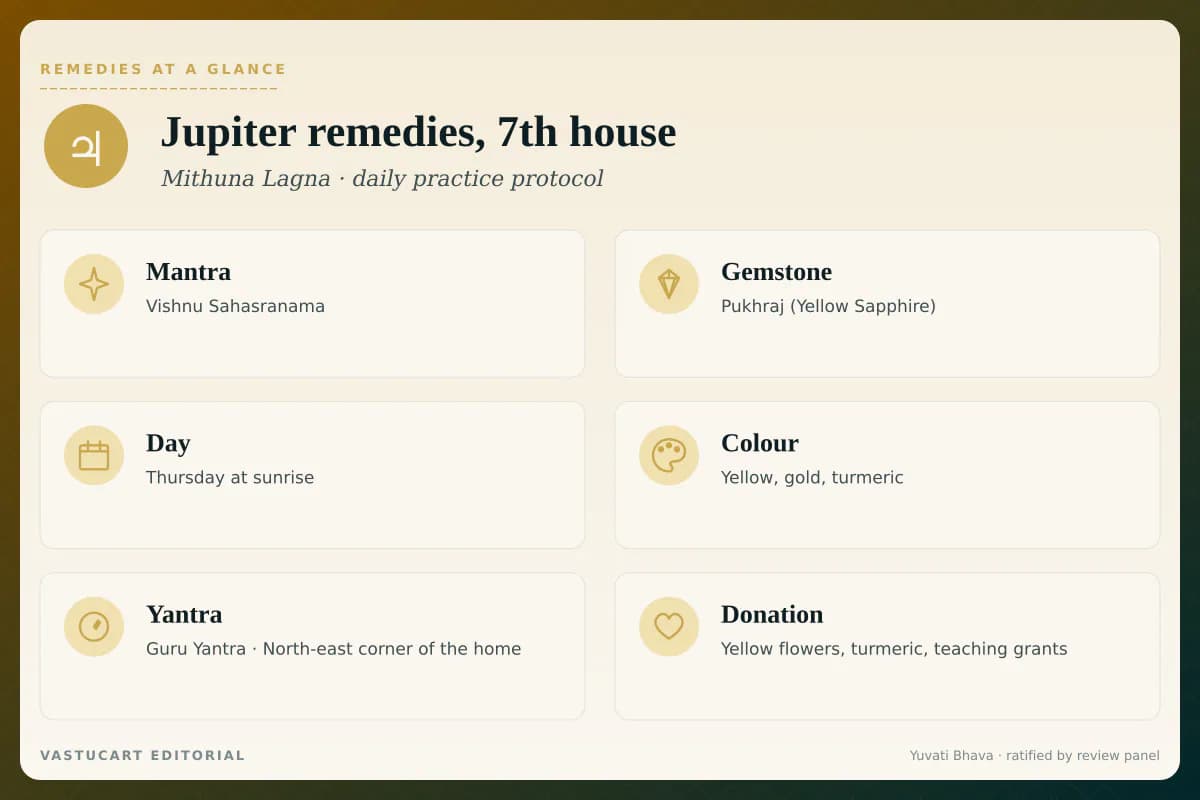
The daily Vishnu worship is the primary remedy for this placement because Vishnu is the classical patron deity of Jupiter, and the cosmic-order-preserving form holds the Hamsa Yoga signature in its most refined expression. Rise before sunrise, bathe, wear yellow clothing on Thursdays, and visit a Vishnu, Krishna, or Brihaspati temple if accessible. The Vishnu Sahasranama is the primary recitation, the thousand-name hymn to Vishnu that creates a containing field for the Hamsa signature. Reciting it at sunrise daily for forty days at any major Jupiter transition (engagement, marriage, academic appointment, major book launch) is the formal protocol.
Offer yellow flowers, kheer, banana, and saffron rice at the altar, and donate to causes that support classical scholarship and dharmic education (Sanskrit colleges, Vedic-tradition apprenticeships, refugee-scholar grants). The conscious-partnership practice is the lifestyle remedy that compounds across decades into the difference between Hamsa-marriage and Hamsa-strain: a daily commitment to the partnership as a working relationship (regular conversation, shared practice, occasional couples work even in good times) prevents the dharmic ideal from drifting into dharmic abstraction. The gemstone is yellow sapphire (Pukhraj), and this is one of the most gemstone-rewarding placements because Jupiter swakshetra in kendra responds powerfully to amplification. Wear a natural Sri Lankan yellow sapphire of minimum five carats set in gold on the index finger of the right hand on a Thursday at sunrise after Guru mantra recitation, and only after a confirmed reading.
Gemstones for Jupiter in 7th house Mithuna Lagna
Yellow Sapphire is the primary Jupiter gemstone and works particularly well here because the swakshetra Hamsa Yoga responds powerfully to amplification.


Disclaimer: Yellow sapphire over a Hamsa Yoga Jupiter amplifies both the dharmic gain and the maraka lordship simultaneously. Always consult a qualified Jyotishi before permanent wearing.
Rudraksha beads for Jupiter in 7th house
The Jupiter-aligned rudraksha is the Panch Mukhi (Five Mukhi), the bead directly ruled by Shiva and Jupiter.
The classical Jupiter rudraksha and the most widely used bead in classical sadhana. Supports the Hamsa Yoga signature, channels the dharmic-marriage instinct toward classical territory, and stabilises the inner expansion when the maraka lordship is active in dasha.
The ten-mukhi bead is the Vishnu bead and serves as primary secondary support for this placement because Vishnu is the patron deity of Jupiter. Wearing the Das Mukhi alongside the Panch Mukhi compounds the placement's natural strength.
Guru Yantra for the kalatra placement
Sacred recitations for Jupiter in the kalatra angle
Bhuta-Krit Bhuta-Bhrid Bhavo Bhutatma Bhuta-Bhavanah
Putatma Paramatma cha Mukti-Naam Parayanam
Agraahyah Shashvatah Krishno Lohitakshah Pratardanah
Translation: Om, the Lord who is the universe, the all-pervading Vishnu, the controller, lord of past present and future, creator and bearer of beings, the becoming, the soul of beings, the bringer-into-being. The pure-souled, the supreme self, the highest refuge of the liberated. Ungraspable, eternal, dark-hued, with red eyes, the destroyer of suffering. The Vishnu Sahasranama is the thousand-name hymn to Vishnu and is the perfect daily recitation for a chart where Jupiter sits swakshetra in the kalatra angle and the Hamsa Yoga signature needs a containing devotional field.
Read the full stotra on stotra.vastucart.in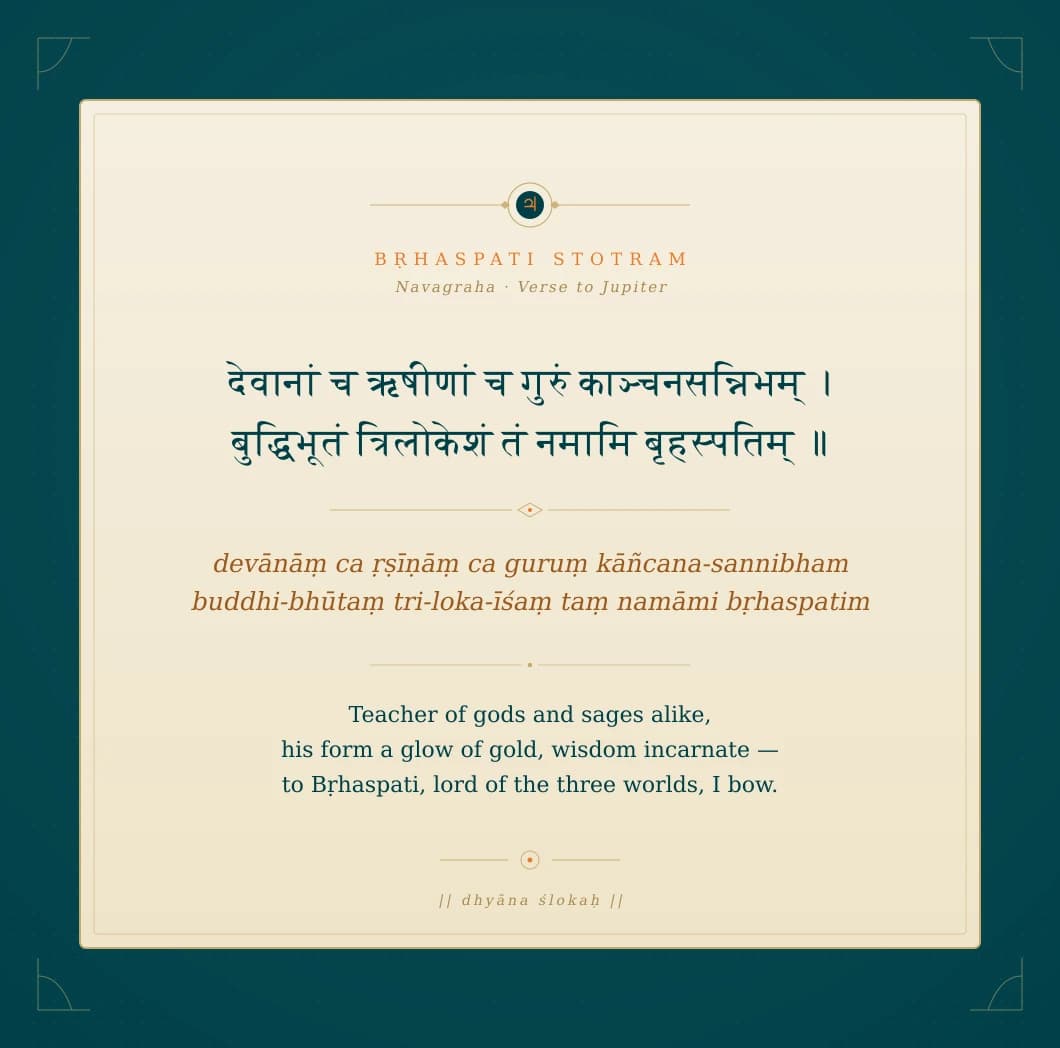
Tools for Jupiter 7th house Mithuna natives
Is your Kalatra Bhava Jupiter carrying the Hamsa Yoga signature?
Get a full personalised analysis of your seventh house Jupiter, the Pancha Mahapurusha formation, and the marriage timing.