Shani in the 9th house
Vrishabha Lagna (Taurus Ascendant)
A practitioner study of Shani in Dharma Bhava for Taurus ascendant natives. Saturn in his own sign Makara serving as yogakaraka in the dharma trikona, the foundational discipline signature, and the slow late-blooming authority that classical Parashari tradition reads as one of the strongest Vrishabha placements.
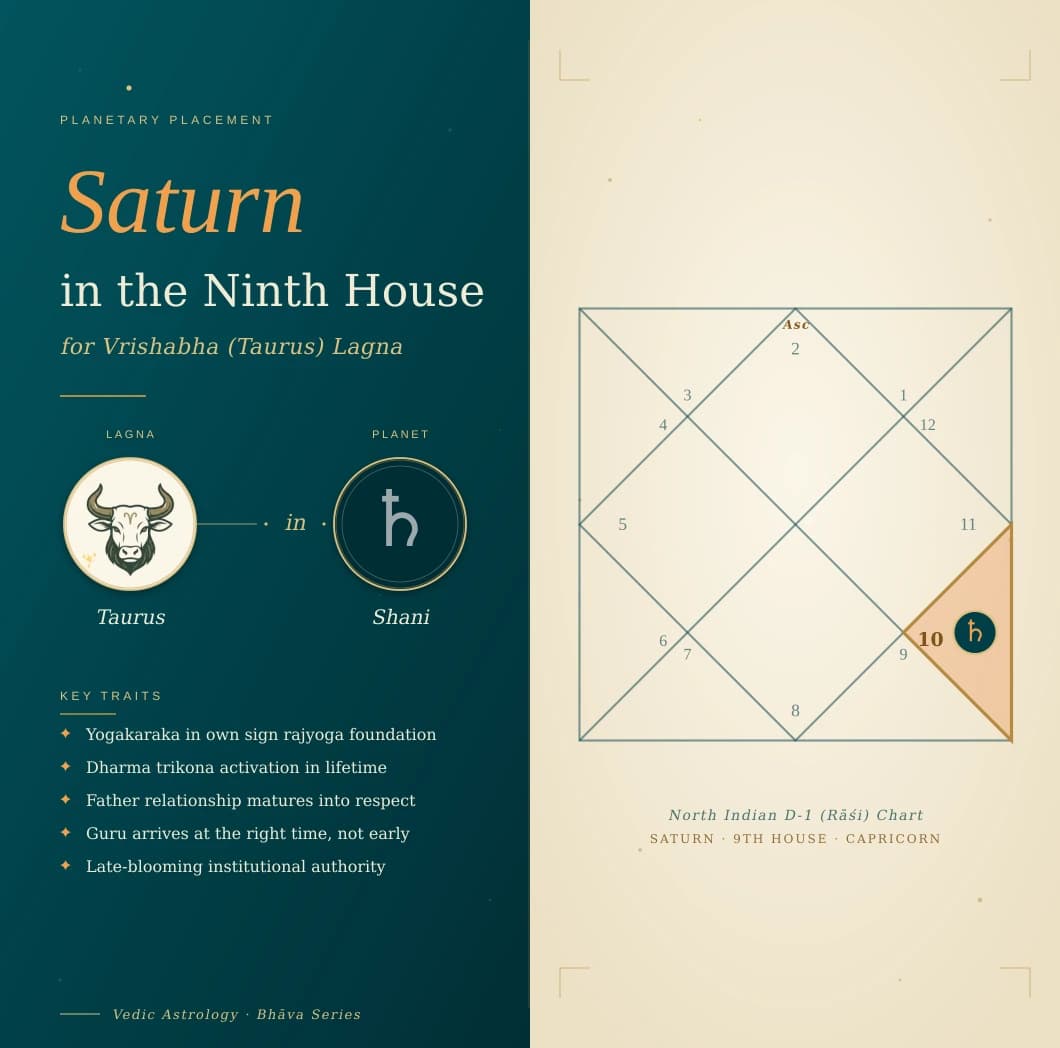
Shani sits in his own sign Makara in the ninth house for Taurus ascendant natives, the yogakaraka in dharma trikona signature.
Shani in 9th house for Vrishabha Lagna, the quick reference
If you carry Shani in 9th house of a Vrishabha Lagna chart, you hold one of the strongest single placements in the entire Taurus ascendant catalogue, because Saturn for Vrishabha is the yogakaraka Saturn (planet that simultaneously rules a kendra and a trikona, producing rajyoga). Yogakaraka Shani rules the 9th (Dharma Bhava, the trikona of fortune) and the 10th (Karma Bhava, the kendra of profession) for this lagna. When the yogakaraka also sits in his own sign in a trikona, the configuration becomes structurally one of the cleanest 9th lord placement rajyogas the zodiac produces, the saturn dharma trikona pinnacle.
The second feature is the swakshetra Saturn dignity. The ninth from Vrishabha is Makara (Capricorn), and Saturn Makara (Saturn Capricorn) is one of Shani's two own signs. Shani in own sign 9th (Saturn in own sign 9th) carries unbroken focus rather than the diluted version that sits in friend or neutral signs. The third feature is the dharma trikona placement. The 9th house rules father, guru, higher learning, foreign teaching, long pilgrimage, and the inherited dharmic line. Shani in this seat orders these themes around discipline, patience, and time-tested authority. The native typically arrives at major life stations later than peers but arrives with the institutional weight that compounds across decades. This guide reads Shani in 9th house layer by layer: the yogakaraka mechanics, the swakshetra Saturn strength, the dharma signature, the Shani mahadasha activation, and the blue sapphire neelam protocol that needs careful chart confirmation.

Why Shani in Dharma Bhava is yogakaraka in own sign rather than dushthana lord
Students sometimes arrive at this placement carrying anxiety from popular astrology readings that label any Saturn placement as a marker of delay or deprivation. The honest practitioner answer is that Saturn for Vrishabha is the single most beneficial classical lord in the chart, and his own-sign placement in a trikona is the rare configuration where the popular Saturn fear is structurally inverted. The yogakaraka rule is precise. Any planet that rules both a kendra and a trikona simultaneously produces rajyoga. For Vrishabha, Saturn rules the 9th trikona and the 10th kendra, which qualifies him as yogakaraka by definition.
The own-sign mitigation removes the standard Saturn ambiguity. Saturn in friendly or neutral signs needs careful reading because his shadow tendencies (delay, restriction, austerity) sometimes outweigh his benefic structural role. Saturn in his own sign sheds those tendencies and becomes the steady builder Parashari sources describe as the planet of mature dharma. The third interpretive layer is the dharma trikona itself. The 9th house is the highest trikona in any chart, the seat of fortune, father, guru, and the inherited line of teaching. Saturn placed here orders these themes around discipline rather than chaos. Father is often older or absent in the early years, the relationship matures into one of mutual respect across decades. Guru arrives later than peers but is the right teacher for the long path. Higher learning often takes the form of professional doctoral or institutional credentials rather than youthful undergraduate enthusiasm. The compounded effect is a chart that grows weight quietly through the thirties and forties and arrives at full authority in the late fifties or early sixties.
Yogakaraka in own sign in dharma trikona is one of the rarest classical signatures in the Vrishabha catalogue. The reward is institutional authority that compounds slowly. The price is patience while peers race ahead in the early years.
Terms used in this article
A short glossary of the Sanskrit and Jyotish terms that recur in this study. First-occurrence expansion is also retained inline.
- Dharma Bhava
- The 9th house, the bhava of father, guru, fortune, dharma, and higher learning. The highest trikona in classical reading.
- Yogakaraka
- A planet that simultaneously rules a kendra (1, 4, 7, 10) and a trikona (1, 5, 9). Produces rajyoga in any chart it sits in.
- Swakshetra
- Own-sign placement. A planet sitting in a sign it rules carries the second-highest dignity, just below exaltation.
- Trikona
- Trinal house (1, 5, 9). Houses of dharma and fortune that activate the giving karmas of the chart.
- 9L
- Ninth-house lord, the planet ruling fortune, father, and dharma. The most beneficial single lord in any chart.
- Sade Sati
- Seven and a half year period when Saturn transits the 12th, 1st, and 2nd houses from natal Moon. Ordinary in any life.
- Bhagya
- Fortune. The 9th house is also called the Bhagya bhava because it carries the giving destinies of the chart.
How Shani in Dharma Bhava shapes the Taurus native
Physically the native carries the standard Vrishabha frame with Shani's specific signature on the bone density and the long bones. The face is Vrishabha-rounded but with a sharper cheekbone definition than the lagna alone produces. Build is medium-tall with surprising height in the legs, and the body holds its proportion late into life because Saturn rules the bone structure and his own-sign placement gives the skeleton the architecture to last. Many natives report being told they look distinguished rather than youthful even in their twenties, which is the early signature of the late-blooming authority arc.
Temperament is where the placement most distinguishes the native from popular Vrishabha stereotypes. The lagna gives the steady earth, but Saturn in 9th adds a deliberate, patient, almost old-soul quality to the personality even in childhood. These natives often gravitate toward older mentors, prefer one or two long friendships over many shallow ones, and carry a quietly serious orientation that can read as introversion in social settings. The shadow side is the early-years frustration that comes from watching peers reach milestones first. Career, marriage, public recognition, parenthood, and authority all tend to arrive five to ten years later than for non-yogakaraka peers, and the early disappointment that this produces can harden into pessimism if not consciously reframed. Pairing the placement with deliberate longevity practices (regular exercise, contemplative reading, professional credentialing) is the single best strategic intervention. The natives who pace themselves for the long arc reach institutional authority by their late fifties that the peers who raced ahead never quite achieve.
Strengths, shadows and career fits
- Yogakaraka in own sign rajyoga foundation
- Dharma trikona activation in lifetime
- Father relationship matures into respect
- Guru arrives at the right time, not early
- Late-blooming institutional authority
- Long-form discipline produces compounding gain
- Early years feel slow next to peers
- Pessimism risk when timeline misread
- Father may be older or distant in childhood
- Knee, hip, and bone vulnerabilities
- Marriage often delayed until late twenties
- Risk of hardness when softness is needed
- Law, judiciary, and constitutional practice
- Higher academia and tenure-track research
- Civil services and senior administration
- Religious institutional leadership
- Engineering and mining at scale
- Long-form publishing and editorial work
Where the yogakaraka vocation finds its institutional form
Career paths cluster around fields that reward sustained discipline, institutional credentials, and the slow build that Saturn engineers across decades. Law and judiciary work come first because the 9th house rules dharma and Saturn rules institutional structure. Many natives qualify as lawyers in their twenties, build practice through their thirties, and reach senior counsel or judicial appointments by their late fifties. Higher academia and tenure-track research suit natives whose vocational mode is the patient accumulation of authority through publications and teaching cycles.
Civil services and senior administration are a classical Saturn vocation, and Shani in the 9th of Vrishabha tends to produce administrators who reach the senior cadres slowly but stay in office longer than peers. Religious or institutional leadership fits natives whose chart pairs the Saturn discipline with strong Jupiter or Moon for the pastoral capacity the role demands. Engineering and mining at scale (energy, infrastructure, large-format construction) are Vrishabha-Saturn vocations that combine the lagna appetite for tangible building with the Saturn ability to manage long timelines. Long-form publishing and editorial work fit natives whose temperament prefers slow careful production over fast iterative cycles. Shani mahadasha is the defining career window for any of these vocations and arrives with the institutional appointment, the doctoral defence, the senior partnership, or the tenured chair that sets the late-career platform.
Why this configuration is structurally one of the rarest Vrishabha rajyogas
The cleanest way to understand Shani in 9th of Vrishabha is to read the yogakaraka rule and the own-sign trikona placement together rather than treating either alone. Parashari Jyotish identifies five lagnas where one classical lord serves as yogakaraka because of dual kendra-trikona rulership: Vrishabha (Saturn), Tula (Saturn), Karka (Mars), Simha (Mars), and Makara and Kumbha (with their own complications). For Vrishabha, Saturn is the most powerful single lord precisely because of this dual lordship.
The own-sign trikona placement compounds the strength. Saturn in Makara in the 9th house is a planet sitting in his own sign in his most beneficial-by-lordship house. The configuration produces the textbook outcomes the classical sources describe for yogakaraka in trikona: father lives long and reaches public standing, guru arrives at the right time and shapes the dharmic life, foreign higher study or institutional credentialing arrives in the second mahadasha, and the chart's overall fortune compounds slowly but visibly across decades. The third interpretive layer is the contrast with Shani in 10th house in Kumbha, the alternate own-sign Saturn placement for Vrishabha. Saturn in 10th in own sign produces a strong career placement but routes the rajyoga through professional structure rather than through dharma. Saturn in 9th in own sign routes the rajyoga through fortune and inherited dharma. Most experienced practitioners read the 9th-house version as the slightly stronger of the two for spiritual maturation, while the 10th-house version is slightly stronger for visible career titles. Both placements produce durable lives.
When Shani in 9th delivers its Dharma Bhava chapter
Shani mahadasha is the defining window for this placement and arrives with the institutional appointment, the doctoral or professional credential, or the inherited dharmic responsibility that crystallises the late-career platform.
Hips, knees, and the Dharma health link
Health follows the Saturn-in-Makara pattern with specific Dharma body-part vulnerabilities. Constitution is vata-kapha with vata sharper than the standard Vrishabha kapha-pitta because Saturn carries vata-air and Makara carries earth-air. The 9th house body-part rulership covers the hips, the thighs, the lower back, and the long bones of the leg. The placement raises specific lifelong vulnerability in these areas, and many natives report knee or hip issues by the late forties if not pre-empted by sustained joint care.
The bone-density signature is the second body-related layer. Saturn rules the skeletal structure across the chart, and his own-sign 9th-house placement produces dense bone in youth and gradual loss in the sixties unless calcium intake, weight-bearing exercise, and sunlight exposure are managed deliberately. The Vata constitution adds dryness in the joints that yoga, oil massage, and warm hydrating foods address. Annual full-panel screening from the late thirties is recommended, especially for bone density and thyroid function. The pessimism risk mentioned earlier shows up in the body as chronic muscle tension across the lower back and hips, and the long-term solution is a sustained physical practice that combines mobility work with weight bearing. The long discipline that the placement rewards in career also stabilises the body across decades when applied with the same patience.
Remedies for Shani in the Vrishabha Dharma angle
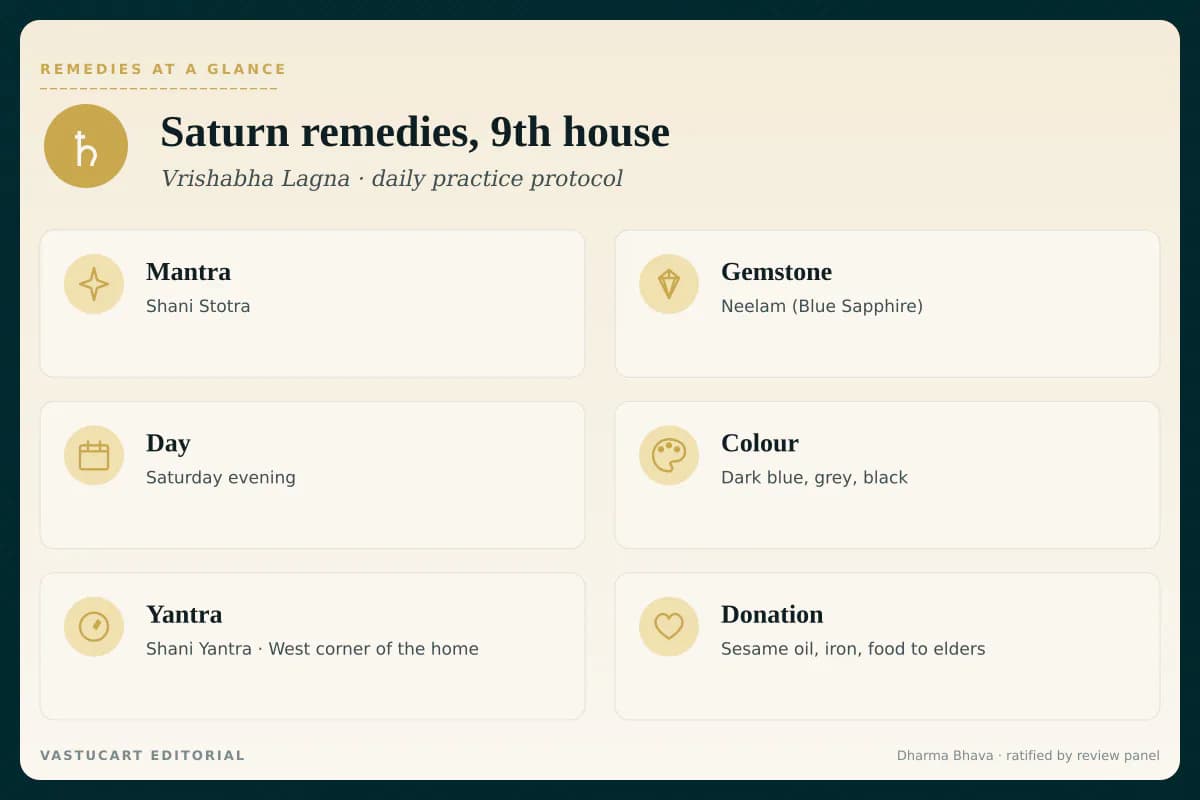
The daily Shanidev worship is the primary remedy because Shanidev is the deity-form of Saturn in the puranic tradition, and his shadow-form holds the yogakaraka energy without releasing it as harshness. Rise before sunrise, bathe, wear black or dark blue clothing on Saturday, and visit a Shani temple if accessible. The Shani Stotra is the primary recitation, the canonical Navagraha hymn that orders the Saturn signature across decades. Reciting it daily at sunrise on Saturday for forty consecutive Saturdays at any major Dharma transition (academic or professional credentialing, father-related event, marriage) is the formal protocol.
Pair the recitation with the Hanuman Chalisa on Saturday morning because Hanuman is the classical balancer of Saturn's intensity in puranic tradition, and the two recitations together compound the yogakaraka strength. Offer black sesame, mustard oil, urad dal, and iron-form items at the altar, and donate dark blue or black items (dal, oil, blankets, footwear) to the elderly, the disabled, or labourers on Saturday at sunrise with your own hand. The conscious-service practice is the lifestyle remedy that compounds across decades into the difference between yogakaraka authority and yogakaraka harshness. The gemstone is blue sapphire (Neelam), the primary Shani ratna, and is recommended confidently for this placement because Saturn is yogakaraka in own sign for Vrishabha. Wear a natural unheated Ceylon or Kashmir blue sapphire of minimum five ratti, set in silver or platinum, on the middle finger of the right hand, on a Saturday at sunrise after Shani mantra recitation, and only after a confirmed seven-day test reading.
Gemstones for Shani in 9th house Vrishabha Lagna
Blue sapphire is the primary Shani gemstone and is recommended confidently for this placement because Saturn is yogakaraka in own sign in trikona for Vrishabha Lagna. The seven-day test before permanent wearing remains mandatory because Neelam is the most reactive ratna in the Vedic system.



Disclaimer: Blue sapphire is the most reactive ratna in the Vedic system. Always test for seven days and consult a qualified Jyotishi before permanent wearing.
Rudraksha beads for Shani in 9th house
The Shani-aligned rudraksha is the Saat Mukhi (Seven Mukhi), the bead directly ruled by Mahalakshmi and Saturn.
The classical Saturn rudraksha and the bead specifically associated with Mahalakshmi. Holds the yogakaraka 9th-house Saturn energy across decades without releasing it as harshness, supports the dharma and discipline signature, and stabilises the late-blooming authority arc.
The fourteen-mukhi bead is associated with Hanuman and serves as a primary secondary support for this placement because Hanuman is the classical balancer of Saturn intensity. Wearing the Chaudah Mukhi alongside the Saat Mukhi compounds the placement's strength while keeping the temperament free of the pessimism risk Saturn carries.
Shani Yantra for the Dharma placement
Sacred recitations for Shani in the Dharma angle
Chaaya martanda sambhutam tam namami shanaischaram
Suryaputro deergha dehi vishaalakshyah shivapriyah
Mandachara prasannatma peedam harati me shanih
Konasthah pingalo babhrur krishno raudrontako yamah
Saurih shanaischaro mandah pippalaadena samstutah
Translation: I bow to Shanaischara, dark like blue collyrium, son of the Sun, elder brother of Yama, born of Chaya and Martanda. Son of Surya, long-bodied, wide-eyed, dear to Shiva, slow-moving, of pleased mind, may Shani remove my afflictions. Praised as Konastha, the tawny one, the brown, the dark, the fierce, the ender, Yama, Sauri, the slow-mover, the patient, by the sage Pippalada. The Shani Stotra is the canonical Navagraha recitation for any chart where Saturn is yogakaraka and the Dharma placement asks for steady devotional containment.
Read the full stotra on stotra.vastucart.in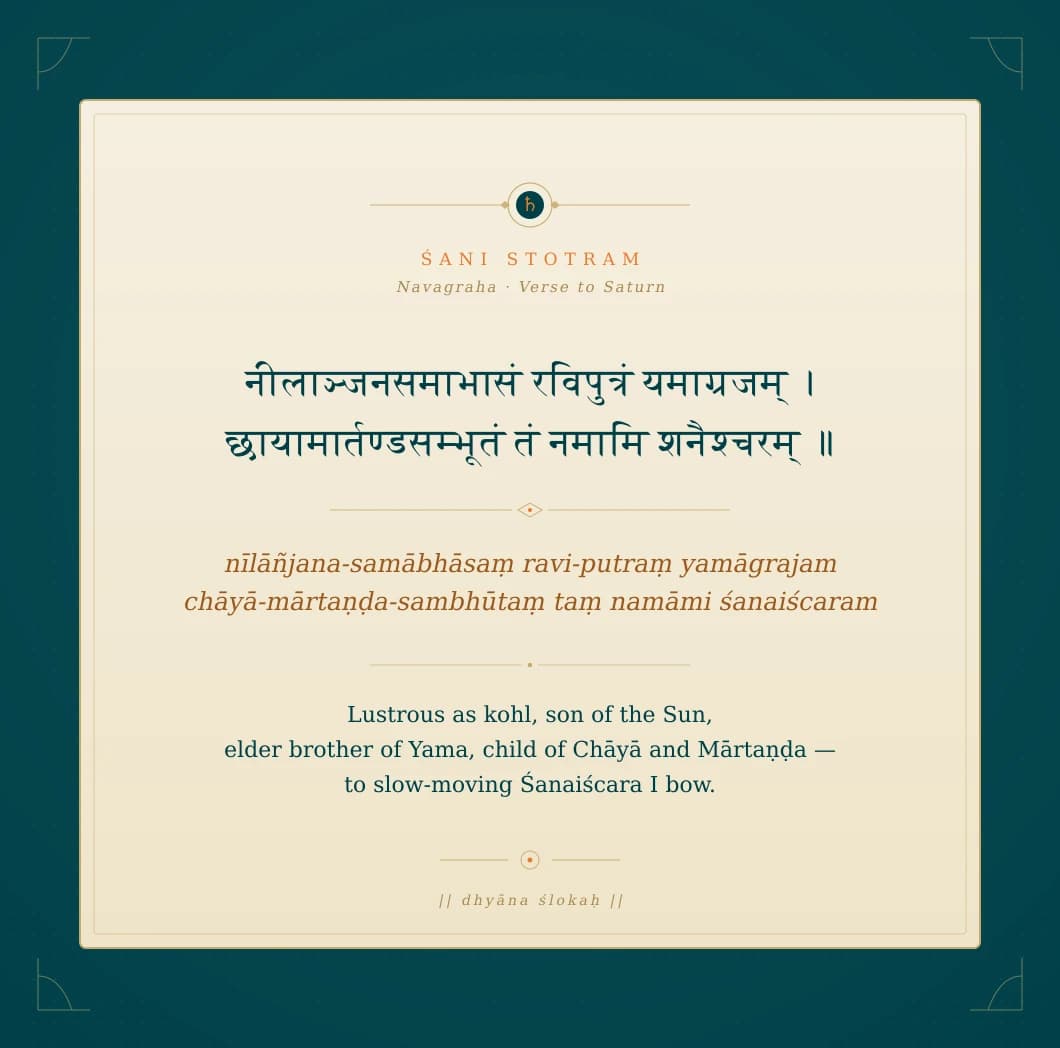
Tools for Shani 9th house Vrishabha natives
Is your Dharma Bhava Saturn carrying the yogakaraka own-sign signature?
Get a full personalised analysis of your ninth house Shani, the swakshetra Makara dignity, and the late-blooming timing.