Saturn in the 12th house
Meena Lagna (Pisces Ascendant)
A practitioner study of Shani in Vyaya Bhava for Pisces ascendant natives. Saturn swakshetra in his own intellectual sign Kumbha at the moksha vyaya angle, the dual 11L plus 12L lordship producing a clean Vimala Viparita reading where 12L sits in own sign in own bhava and the renunciate-foreign vocational arc becomes the lifelong professional channel.
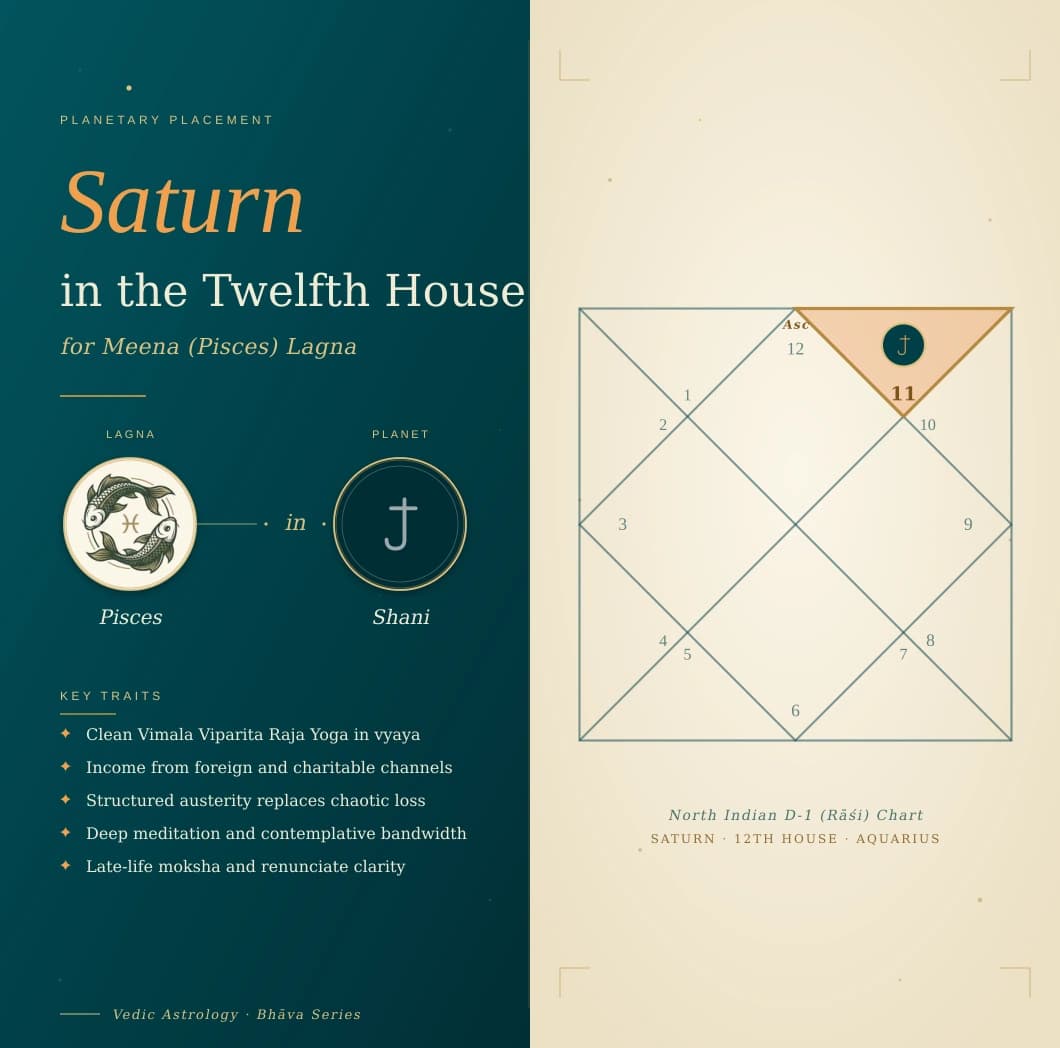
Saturn sits swakshetra in his own intellectual sign Kumbha in the twelfth house for Pisces ascendant natives, the moksha-foreign renunciation arc.
Saturn in 12th house for Meena Lagna, the quick reference
Holding Saturn in the twelfth house of a Meena chart places you in front of the only configuration where Saturn sits in his own sign in his own natural bhava for a Pisces ascendant. Shani (Saturn) lands in Kumbha (Aquarius), his intellectual-humanitarian own sign, inside Vyaya Bhava (the twelfth house, the bhava of expenditure, foreign settings, ashram seclusion, hospital service, and moksha).
Both planet and bhava share signature. Saturn naturally rules vyaya themes of austerity, dissolution, and renunciation, and Kumbha on the twelfth cusp turns the bhava into a structured intellectual workshop rather than a chaotic loss zone.
The first feature is the swakshetra-in-bhavat-bhavam logic. Kumbha is the natural twelfth-from-Meena sign, so Saturn here becomes the 12L sitting in the 12H in his own sign. Classical commentators ranked this as the cleanest reading of the Vimala-pattern Viparita: the loss-bhava lord stays home in his own ruling dignity, the difficulty cancels itself, and the expenditure channel becomes a structural advantage.
Bills and debts are paid on time, austerity becomes chosen rather than imposed, and the spending the chart demands routes toward foreign travel, ashram donations, hospital service, scholarly subscriptions, and elder-care expenses.
The second feature is the dual lordship. Saturn rules Makara (11H labha) and Kumbha (12H vyaya) for Meena, so the same Saturn carries 11L plus 12L weight. The 11L in the 12H produces income from foreign sources, charitable institutions, hospitals, ashrams, monastic publishing, intelligence services, or back-room consulting that converts straight into donation or renunciate spending rather than personal accumulation.
The third feature is the moksha drive. Saturn-12 in Kumbha consistently activates the late-life sannyasa archetype, the deep meditation appetite, the long-arc pilgrimage instinct, and the elder-service vocation. This guide reads every layer: the Kumbha swakshetra, the 11L plus 12L lordship, the Vimala overlay, the foreign-renunciation arc, and the cautious blue sapphire protocol.
Why swakshetra Saturn in 12th house produces clean Vimala Yoga
Students often arrive at this placement uncertain because Saturn in any 12H reads at first glance as draining, and introductory texts warn natives away from any Saturn-vyaya combination. The honest practitioner answer requires recognising what Kumbha specifically does to the standard reading.
Saturn rules two signs. Makara is the structured-institutional earth sign that runs through 11H here. Kumbha is the intellectual-humanitarian air sign of inventors, ashram councils, scientific committees, and humanitarian organisations.
When Saturn sits as 12L in his own Kumbha, the spending and dissolution the 12H rules get routed through Kumbha's network-and-service channels rather than through chaotic personal loss.
The 12L-in-12H pattern is the Vimala Viparita logic itself: a dushthana lord trapped in his own dushthana cancels his potential to undermine the chart. Classical commentators rank this as the cleanest of the three Viparita formations because there is no migration of energy across bhavas to interpret. The lord stays home, in his own sign, in his own bhava.
The 11L plus 12L double-lordship is the second specific feature. Saturn here is not just the loss lord. He is also the gains lord, and the gains lord sitting in the loss bhava in his own sign produces the signature of income-becoming-expenditure-becoming-merit.
Money the native earns from elder-network sources, foreign salaries, monastic publishing royalties, or research stipends does not pile up. It moves through the native into ashram support, scholarship funding, hospital donation, pilgrimage expense, and the slow renunciate divestment classical sources associate with the Vimala signature.
The third interpretive layer is the contrast with Saturn-8 of Meena (apex Sarala Viparita, crisis-to-power conversion) and Saturn-11 of Meena (Sasa Mahapurusha, institutional gains-yoga). Saturn-12 in Kumbha is neither. It is the moksha-foreign renunciation channel, cleaner and quieter, structurally pointed at the seventh-decade ashram-or-hospice arc rather than the institutional power arc.
Saturn swakshetra in 12 of Meena is not a draining placement. It is the cleanest Vimala formation any chart can hold, where the 12L stays in his own bhava in his own sign, expenditure becomes structured discipline rather than chaotic loss, and the renunciate-foreign vocational arc becomes the most productive professional channel of the entire lifetime.
Terms used in this article
A short glossary of the Sanskrit and Jyotish terms that recur in this study. First-occurrence expansion is also retained inline.
- Vyaya Bhava
- The 12th house, the bhava of expenditure, foreign settings, ashram seclusion, hospital service, monastic withdrawal, and moksha.
- Swakshetra
- Own-sign placement. A planet sitting in a sign it rules carries the second-highest dignity, just below exaltation.
- Vimala Yoga
- The Viparita named for the 12L-trapped-in-dushthana pattern. Cleanest when the 12L sits in his own sign in the 12H itself.
- Bhavat-Bhavam
- The same-house-from-itself principle. The 12th from the 12th returns to the 11th, but the 12L in the 12H stays self-referential and self-resolving.
- Dushthana
- Houses 6, 8, 12. The difficult bhavas where lords trapped in their own dushthana create reversal yogas.
- 11L
- Eleventh-house lord, ruling labha (gains, fulfilment, elder siblings, network).
- Moksha
- Liberation, the 12th house karma signature. The release-from-cycles arc that Saturn-12 quietly compounds across decades.
How swakshetra Saturn in vyaya shapes the Meena native
Physically the native carries the Meena soft-water frame anchored by Saturn-Kumbha lean structure, often producing a body strangers describe as taller than expected, lightly built, and unusually still in motion.
The face tends narrow with a deeply observational gaze, the cheekbones sit higher than the Meena average, and the hairline frequently recedes early from the temples. Many natives wear glasses from young because the 12H rules the eyes, and the voice carries a quiet contemplative quality with long pauses that read as considered rather than hesitant.
That bearing translates well to ashram libraries, monastic study cells, hospice bedside rooms, intelligence-debrief suites, and the night-shift research benches that demand quiet sustained attention. Many natives in this configuration have long fingers, narrow feet, and a walking gait that registers as deliberate rather than rapid.
Temperament is where the placement most distinguishes the native. These natives carry the Meena receptivity but route it through ashram-service, foreign-fieldwork, and moksha-oriented contemplative channels rather than purely empathic personal ones.
They are drawn from young to overnight reading practice, long solo travel, monastic-tradition study, scholarly subscription work, foreign humanitarian deployment, hospice and palliative volunteer service, and the quiet back-room research roles institutional bureaucracies need but rarely advertise.
The Meena empathic receptivity combines with swakshetra Saturn's structured austerity to produce natives who can sit with hardship across decades without abandoning the practice. That combination translates into ashram-administration leadership, hospice direction, foreign humanitarian service, monastic publishing, elder-care institution founding, and the back-room contemplative-and-research roles that quietly hold institutions together.
The shadow side is the same dissolution dimension. Natives who do not channel the Vimala-vyaya role consciously can experience cycles of chronic insomnia, low-grade melancholy across years, retreat from relational life into research isolation, and the lifelong solo-living pattern classical sources associate with unprocessed sannyasa drive. Pairing the renunciate vocation with explicit relational-and-devotional practice produces the contemplative-authority integration the placement can support.
Strengths, shadows and career fits
- Clean Vimala Viparita Raja Yoga in vyaya
- Income from foreign and charitable channels
- Structured austerity replaces chaotic loss
- Deep meditation and contemplative bandwidth
- Late-life moksha and renunciate clarity
- Foreign settlement or ashram residency arc
- Chronic insomnia and disturbed sleep architecture
- Low-grade melancholy across long stretches
- Retreat from relational life into solo research
- Eye strain and ankle-joint sensitivity
- Marriage delayed or chosen-late by temperament
- Foreign-residency relocation strain in midlife
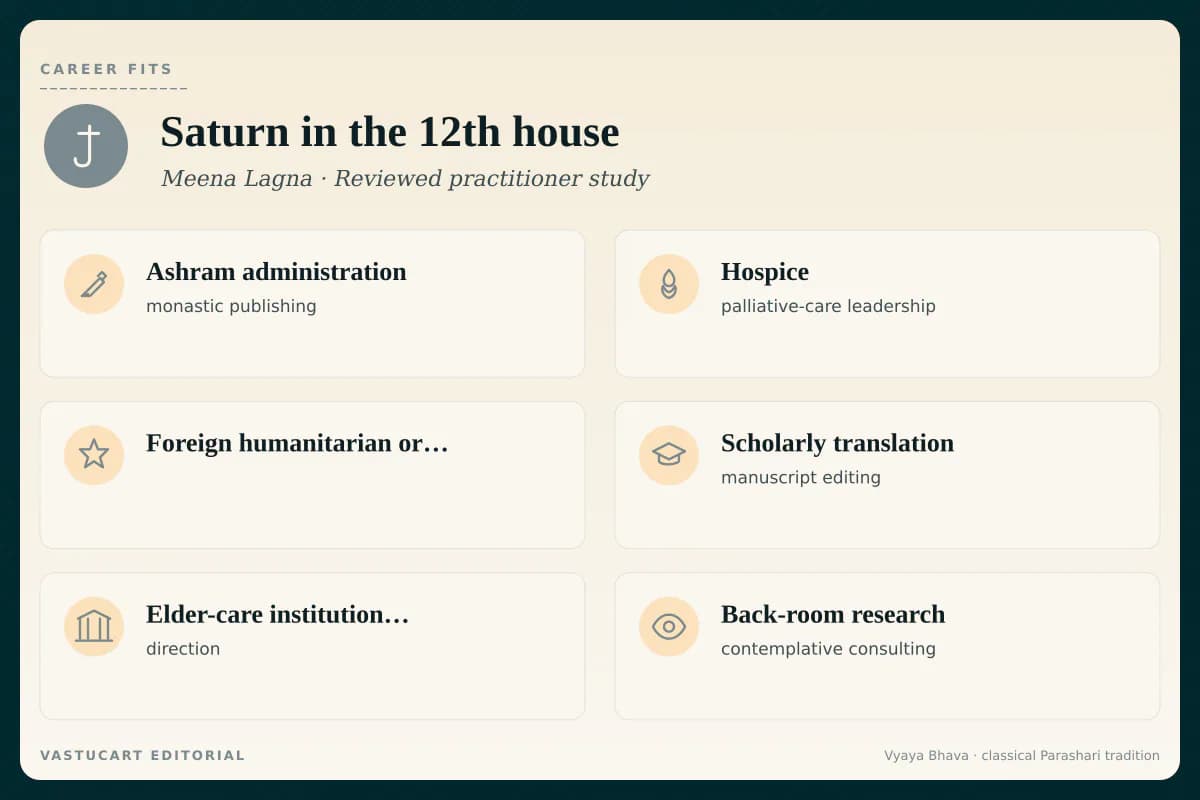
- Ashram administration, monastic publishing
- Hospice and palliative-care leadership
- Foreign humanitarian or intelligence service
- Scholarly translation, manuscript editing
- Elder-care institution founding and direction
- Back-room research and contemplative consulting
Where the foreign-renunciate vocation plays out
Career paths cluster around fields that braid disciplined service with the foreign-or-renunciate dimensions the twelfth house rules. Ashram administration and monastic publishing come first because Kumbha is Saturn's network-and-philosophical face, the 12H rules monastic settings directly, and the 11L-plus-12L swakshetra Saturn produces natives whose long-arc administrative discipline becomes the backbone many spiritual institutions quietly depend on.
Many natives in this configuration become senior administrators of teaching ashrams, editorial directors of small monastic presses, treasury keepers of pilgrimage-sites, and the committee members who make the visible spiritual leaders possible.
Hospice and palliative-care leadership work because the 12H rules end-of-life and bedside-comfort dimensions, and swakshetra Saturn supplies the patient discipline classical hospice practice demands. The Meena empathy adds the emotional resonance that makes long bedside vigils sustainable.
Foreign humanitarian and intelligence service fits because the 11L-plus-12L Saturn in the 12H produces income earned through long foreign deployments. Many natives spend decades in field-based humanitarian medicine, refugee-support administration, foreign embassy intelligence-analysis roles, monastic-tradition fieldwork in foreign monasteries, or diplomatic-archive work that demands disciplined isolation from the home country.
Scholarly translation and manuscript editing suit natives whose mode is the long quiet textual arc. Many become senior translators of religious-philosophical material across Sanskrit, Pali, Tibetan, classical Chinese, classical Arabic, or other contemplative-tradition languages, with careers compounding into substantial scholarly reputations.
Elder-care institution founding works because the 12H rules elder seclusion and the dual-lord Saturn produces administrators whose financial stewardship and bedside presence both register as authoritative. Back-room research and contemplative consulting fit because the placement specifically rewards the sustained behind-the-scenes role rather than the visible public one.
Saturn mahadasha is the defining career window. It arrives with the senior ashram-administration appointment, the hospice-institute founding, the foreign humanitarian senior posting, the scholarly-translation publishing contract, the elder-care-institution direction offer, or the contemplative-consultancy founding that crystallises the swakshetra-Vimala vocation.
Why this is the cleanest Saturn placement on the Meena wheel
The clearest reading of Saturn in 12 of Meena holds the swakshetra dignity, the dual 11L plus 12L lordship, and the Vimala self-resolution logic together rather than separately. Classical Parashari recognises own-sign placement as full natural strength, and lord-in-own-bhava as the bhava's full natural strength because the lord and bhava share the same ruling sign without mediation.
When the bhava is a dushthana and the lord stays home, Vimala activates. The loss-bhava lord cannot leak into other bhavas because he is sitting at home. The dushthana cannot generate undirected damage because the lord is in his own dignity. The spending-and-dissolution the bhava natively rules becomes a structured channel rather than a drain.
The Kumbha-specific dimension is the second feature practitioners must hold. Saturn's two own signs are not interchangeable. Makara is the structured-institutional earth sign. Kumbha is the intellectual-humanitarian air sign.
Saturn in own-Makara reads as institutional builder, judicial bureaucrat, infrastructure engineer, classical state administrator. Saturn in own-Kumbha reads as ashram councillor, humanitarian-organisation leader, scientific-committee chair, philosophical-tradition steward, and contemplative-research administrator. A Saturn-12 reading that ignores the Kumbha intellectual-humanitarian dimension will misread the placement as merely austere when the actual signature is networked-philosophical-renunciate.
The third interpretive layer is the comparison with Saturn elsewhere on the Meena wheel. Saturn in 11 of Meena gives swakshetra Makara producing apex Sasa Mahapurusha Yoga in the labha kendra. Saturn in 8 of Meena gives exalted Tula producing apex Sarala Viparita with Vimala overlay.
Saturn in 12 of Meena gives swakshetra Kumbha in own dushthana producing clean Vimala without exaltation. Only this placement produces the textbook 12L-in-12H-in-own-sign signature classical commentators rank as the cleanest single Vimala formation across the wheel. The chart points at quiet contemplative authority across the working decades and explicit moksha vocation across the seventh and eighth decades.
When the swakshetra Saturn in 12th delivers its Vimala chapter
Saturn mahadasha is the defining window for this placement and arrives with the senior ashram-administration appointment, hospice-institute founding, foreign humanitarian senior posting, scholarly-translation publishing contract, elder-care-institution direction offer, or contemplative-consultancy founding that crystallises the swakshetra-Vimala vocation.
Sleep, eyes, ankles and the vyaya longevity signature
Health follows the Saturn-in-12th pattern with specific Vyaya body-part vulnerabilities and a constitution that leans vata-dominant. Saturn carries air-vata, Kumbha is itself an air-vata sign, and the 12H rules sleep architecture directly.
The most consistent clinical pattern is chronic insomnia, fragmented sleep, late-onset sleep-cycle disturbance, and the dry-vata cognitive overdrive that long-form research can compound when lifestyle counterweights are absent. Many natives report never sleeping more than five or six hours a night since adolescence, with sleep itself light, dream-heavy, and broken by predawn waking.
The 12H also rules the eyes, especially the left eye in classical body-part rulership. Lifelong mild visual-acuity reduction, dry-eye patterns from long manuscript reading, and predisposition to early presbyopia are typical. Kumbha rules the lower legs and ankles, so ankle-joint sensitivity, calf-muscle tightness from long sitting, and attention to footwear become lifelong lifestyle requirements.
The swakshetra-Saturn constitution is the second specific layer. Classical reports associate own-sign Saturn with strong baseline longevity, durable structural integrity into the seventh and eighth decades, and the late-life cognitive clarity the renunciate vocation needs.
Excess vata produces dryness, sleep disturbance, anxious cognition, lymphatic congestion in cold-dry climates, and metabolic slowdown from long sedentary research hours. Most natives benefit from daily walking with slow grounded gait, oil-massage with warming sesame or mustard oil applied to the soles, calves, and scalp, and disciplined dietary vata management with warming well-cooked foods and regular meal times.
Sleep hygiene is the single highest-impact body intervention. A strict no-screens-after-sunset rule, evening Shani Stotram or Hanuman Chalisa recitation, warming foot-soak before bed, and a quiet meditation seat in the same place every night anchor the chronic sleep pattern over months. Annual screening from the late twenties is recommended for vitamin D, thyroid function, sleep quality, and ophthalmological review.
Remedies for swakshetra Saturn in the Meena vyaya
The daily Hanuman or Shiva-Rudra worship is the primary remedy for this placement. Hanuman is the classical patron deity of Saturn, and Shiva in his Rudra and Mahayogi forms is the moksha-bhava deity for natives drawn to the renunciate dimension. Either form holds the swakshetra-Saturn-in-vyaya signature in its most refined expression.
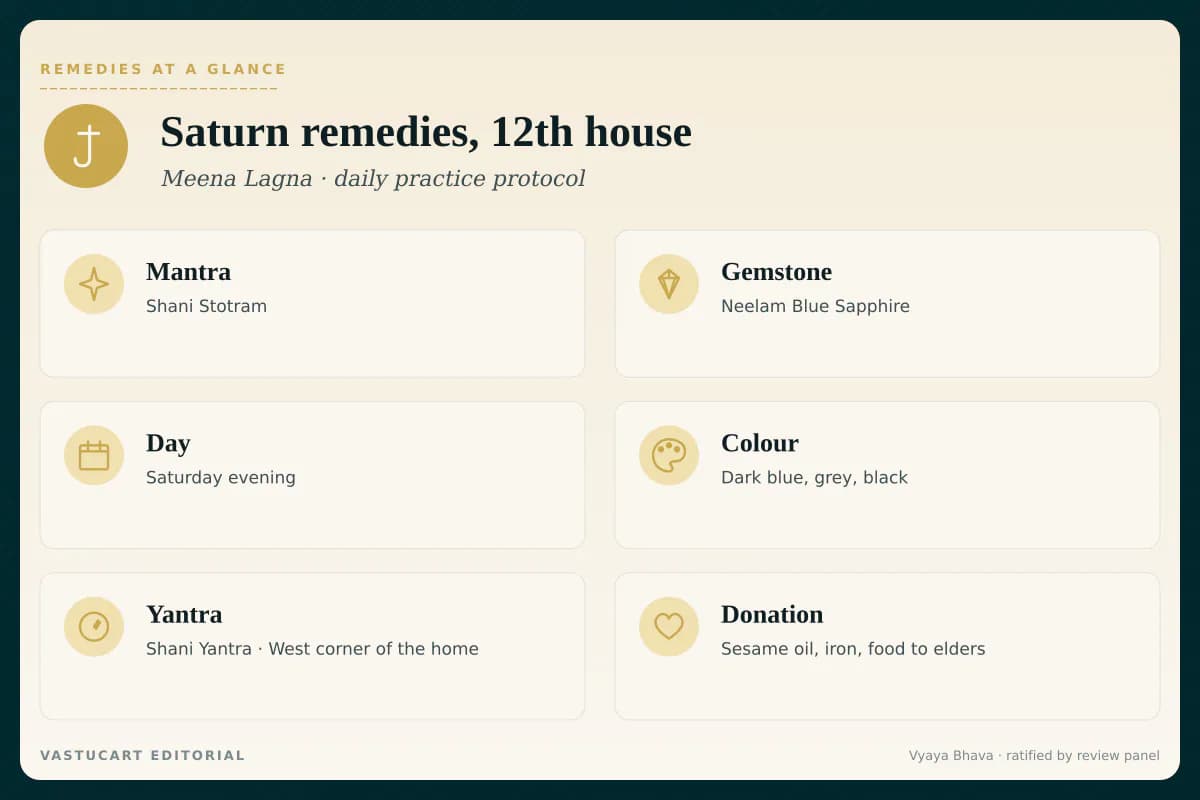
Rise before sunrise, bathe, wear black, slate-blue, or indigo clothing on Saturdays, and visit a Hanuman or Shiva temple if accessible. The Shani Stotram is the primary recitation, the Navagraha verse to Saturn that creates a containing devotional field for the swakshetra-vyaya expression.
Reciting it at sunrise daily for forty days at any major Saturn transition (a senior ashram-administration appointment, a hospice-institute founding, a foreign humanitarian senior posting, a scholarly-translation publishing contract, an elder-care-institution direction offer) is the formal protocol classical sources prescribe.
Offer dark-blue flowers, black sesame seeds, and mustard oil at the altar. Donate to causes that align with the placement's natural channels: ashram-construction funding, hospice-bed sponsorship, monastic-publishing endowment, scholarly-translation grant funding, elder-care institute support, and foreign humanitarian medical-mission funding convert the chart's natural outflow into directed merit.
The conscious-relational practice is the lifestyle remedy that separates Vimala-mastery from Vimala-isolation across decades. A daily reflection on which contemplative withdrawals are nourishing and which are closing the relational world keeps the placement directed.
The gemstone is blue sapphire (Neelam), the primary Saturn ratna, worn carefully because the 12H placement amplifies all Saturn signals cleanly including the dissolution dimension. A strict three-day trial period is non-negotiable. Wear a natural Kashmir blue sapphire of minimum five carats set in silver on the middle finger of the right hand on a Saturday at sunrise after Shani mantra recitation, and only after a confirmed reading by a qualified Jyotishi and a successful three-day trial.
Gemstones for Saturn in 12th house Meena Lagna
Blue sapphire is the primary Saturn gemstone and is worn carefully here because the swakshetra-Vimala configuration amplifies all Saturn signals cleanly, including the dissolution dimension. A strict three-day trial period is non-negotiable.


Disclaimer: Blue sapphire over a swakshetra Saturn in vyaya amplifies the renunciate channel cleanly but also amplifies the dissolution and sleep-disturbance dimensions if the trial is rushed. A strict three-day trial period is structurally non-negotiable before permanent wearing, and any adverse signal during the trial means the gemstone is not appropriate. Always consult a qualified Jyotishi.
Rudraksha beads for Saturn in 12th house
The Saturn-aligned rudraksha is the Saat Mukhi (Seven Mukhi), the bead directly ruled by Mahalakshmi and Saturn.
The classical Saturn rudraksha and the bead specifically associated with disciplined wealth-and-merit. Supports the swakshetra-Vimala signal, channels the renunciate-spending instinct toward sustainable territory, and stabilises sleep architecture when the ashram-administration, hospice, foreign humanitarian, or scholarly-translation vocation is in active phase.
The fourteen-mukhi bead supports protective wisdom and contemplative-research insight. Wearing the Chaudah Mukhi alongside the Saat Mukhi compounds the placement's natural strength in monastic publishing, hospice and palliative-care leadership, foreign humanitarian service, and the back-room contemplative-consulting work that demands sustained discernment under low-information conditions.
Shani Yantra for the swakshetra-vyaya placement
Sacred recitations for swakshetra Saturn in the vyaya
Chhaya-martanda-sambhutam tam namami shanaishcharam
Translation: I bow to Shanaishchara, dark as black collyrium, son of the Sun, elder brother of Yama, born of Chhaya and the Sun. The Shani Stotram is the canonical Navagraha verse to Saturn and is the perfect daily recitation for a chart where Saturn sits swakshetra in the vyaya angle and the clean Vimala signature needs a containing devotional field. Many natives advanced in practice add the Hanuman Chalisa recitation as a secondary layer once the daily Shani discipline is steady, and natives drawn to the moksha dimension add the Rudrashtakam or the Moksha Prapti Stotram as the renunciate-vocation companion piece.
Read the full stotra on stotra.vastucart.in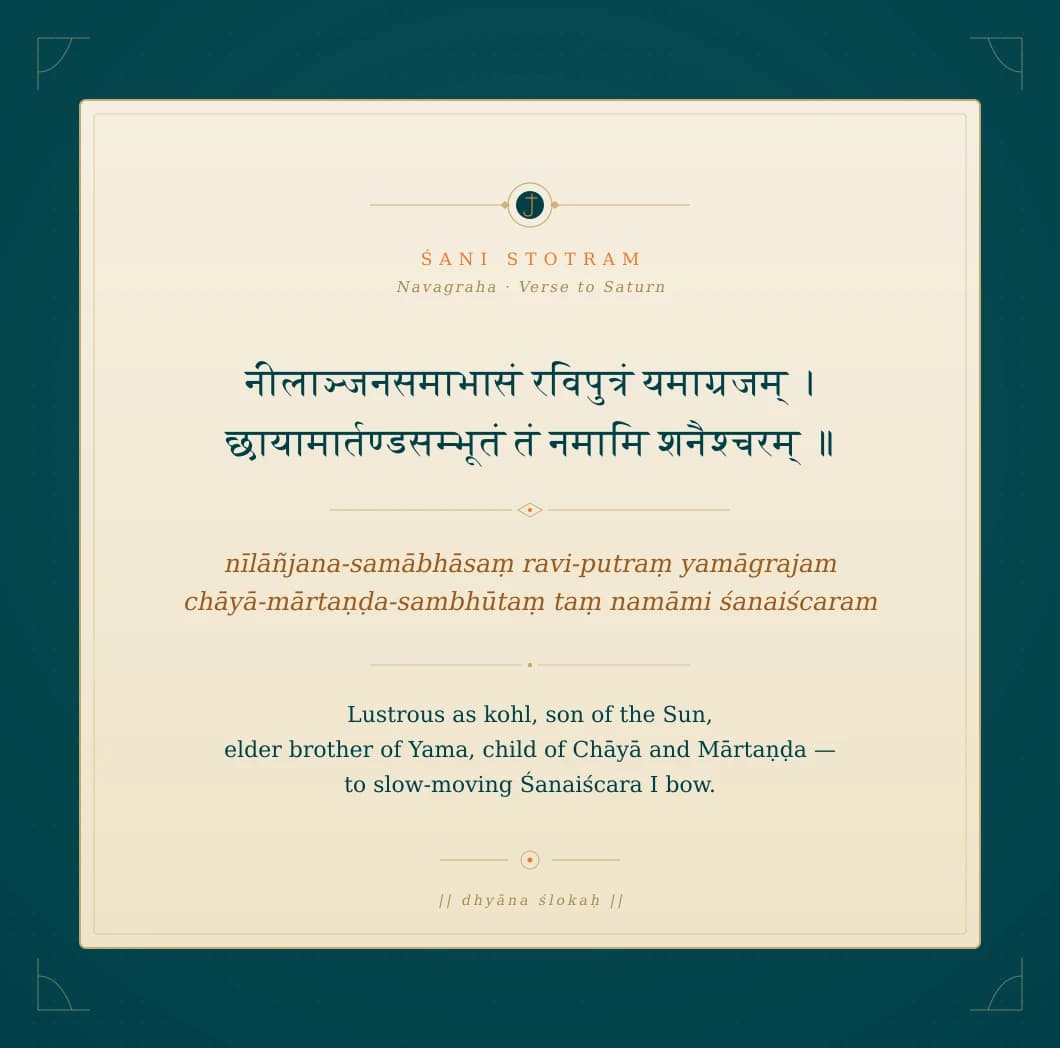
Tools for Saturn 12th house Meena natives
Is your Vyaya Bhava Saturn carrying the swakshetra Vimala signature?
Get a full personalised analysis of your twelfth house Saturn, the Kumbha own-sign dignity, and the foreign-renunciate vocation timing.