Saturn in the 11th house
Meena Lagna (Pisces Ascendant)
A practitioner study of Shani in Labha Bhava for Pisces ascendant natives. Saturn swakshetra in his own Makara in the gains angle, the dual 11L plus 12L lordship that produces the apex own-sign labha-vyaya income yoga, and the slow-compounding institutional wealth signature that defines the most consequential gains-channel Saturn placement available to the chart.
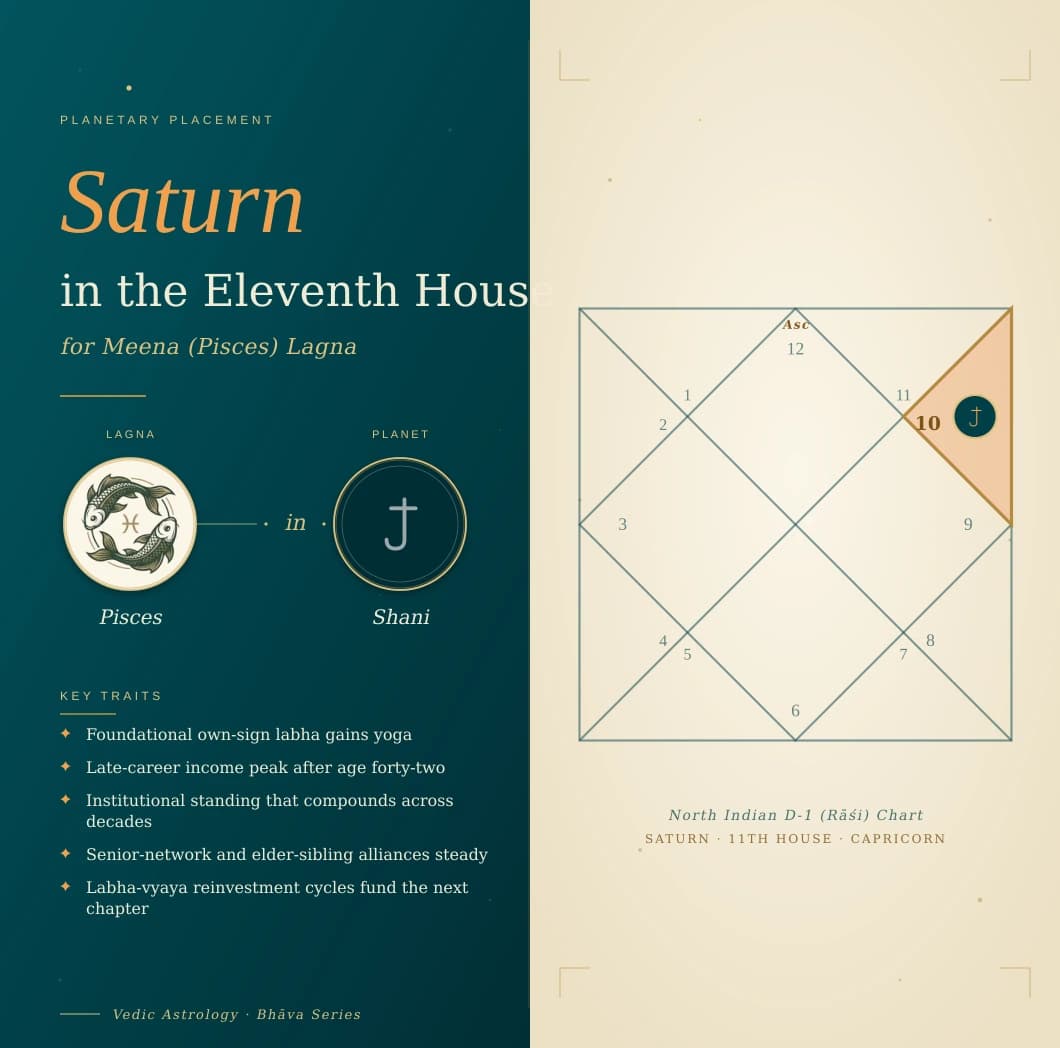
Saturn sits swakshetra in his own Makara in the eleventh house for Pisces ascendant natives, the apex own-sign labha gains yoga signature.
Saturn in 11th house for Meena Lagna, the quick reference
If you carry Saturn in the eleventh house of a Meena chart, you hold the strongest gains-channel Saturn placement any Pisces ascendant chart can show, because Shani (Saturn) is the natural karaka of disciplined labour and structured time, and his arrival in Labha Bhava (the eleventh house, the bhava of gains, fulfilment of desires, elder siblings, networks, and public recognition) places him in the very angle his slow-compounding nature is built to reward. The eleventh house from Meena is Makara (Capricorn), Saturn's own rashi, which means Shani sits swakshetra in his own labha angle. Classical Parashari recognises swakshetra placement of the labha lord (11L) in the labha house (11H) as a foundational gains-yoga, the lord-in-his-own-house pattern where the income channel receives structural reinforcement without mediation.
The structural feature that distinguishes this placement from every other Saturn position on the Meena wheel is the dual lordship no other Meena planet replicates. Saturn rules both Makara (11H of labha, gains and elder-network alliances) AND Kumbha (12H of vyaya, expenditure, foreign settings, monastic withdrawal, moksha) for Meena. The 11L in 11H gives the foundational gains-yoga; the 12L in 11H produces what classical commentators call the labha-vyaya yoga, the income-and-expenditure-fused pattern where earnings and spending run on the same continuous channel. Many natives build careers where every income chapter is funded by structured reinvestment, and wealth compounds through long-arc institutional channels rather than quick speculative wins.
The third feature is the upachaya pairing. The 11th is one of the four upachaya bhavas (3, 6, 10, 11) where planets gain strength gradually across decades, and Shani is the slowest of the seven and therefore the planet most benefited by upachaya growth. When the slow-planet karaka sits in his own upachaya, the chart's pull toward late-career income peak becomes the defining feature of the lifetime. This guide reads every layer of Saturn in 11th house for Meena Lagna natives: the Makara swakshetra, the 11L plus 12L lordship, the labha-vyaya own-sign yoga, the upachaya growth principle, and the blue sapphire protocol.
Why swakshetra Saturn in own labha produces the apex Meena gains yoga
Students often arrive at this placement aware that Saturn in 11H is broadly favourable for income, but uncertain why classical commentators rank Shani swakshetra in 11th of Meena above the merely-strong Saturn placements other lagnas hold. The honest answer requires reading the swakshetra status, the dual 11L plus 12L lordship, and the upachaya growth pattern as one integrated configuration. Own-sign placement gives a planet his full natural strength; lord-in-own-house gives the bhava its full strength because lord and house align without sign-mediation. When Saturn as 11L sits in his own Makara which is the 11H, planet, lord, and bhava integrate into a single channel where the gains-of-labour dimension expresses without friction.
The dual 11L plus 12L combined reading is the second feature practitioners must hold. The 11L rules income, network reach, elder-sibling alliances, and desire-fulfilment; the 12L rules vyaya, structured expenditure, foreign settings, monastic withdrawal, moksha. When this dual lord sits in the 11H itself, earnings and reinvestment fuse into one continuous channel. Many natives discover their income arrives specifically through engagements where they spend steadily on infrastructure, training, capital tools, foreign deployment, or institutional expansion. Classical commentators name this fused pattern the labha-vyaya yoga.
The third layer is upachaya growth. The 11th belongs to the upachaya group where planets gain strength across working years rather than expressing fully at birth, and Saturn is the slowest of the seven, the karaka whose reward arrives by accumulation. When the slow-planet karaka sits in his own upachaya, growth and karaka strength reinforce each other. Early decades produce solid foundational standing, the mid-thirties bring institutional acknowledgement, and the forties through sixties produce the senior-leadership chapter the swakshetra labha lord supports.
The fourth layer contrasts the Saturn-Meena triangle. Saturn exalted in 8 (Tula randhra) gives the apex Sarala Viparita with Vimala overlay, the depth-research authority signature. Saturn swakshetra in 12 (Kumbha vyaya) gives 12L in own sign producing a clean Vimala. Saturn swakshetra in 11 uniquely combines own-sign strength, dual 11L+12L lordship, the labha-vyaya fused yoga, and upachaya growth into the foundational income-yoga signature. No other lagna produces Saturn as both 11L and 12L sitting in his own labha.
Swakshetra Saturn in own labha bhava is not a generic strong placement. It is the specific Meena configuration where labour-discipline, network elderhood, and structured reinvestment fuse into one continuous income channel that compounds across every working decade and only reveals its full reward after the fortieth year.
Terms used in this article
A short glossary of the Sanskrit and Jyotish terms that recur in this study. First-occurrence expansion is also retained inline.
- Labha Bhava
- The 11th house, the bhava of gains, income, elder siblings, networks, and fulfilment of desires.
- Swakshetra
- Own sign. A planet placed in his own sign gains structural strength on his own terms.
- 11L
- Eleventh-house lord, the planet ruling labha (gains, income, networks, elder-sibling alliances).
- 12L
- Twelfth-house lord, ruling vyaya (structured expenditure, foreign settings, monastic withdrawal, moksha).
- Labha-Vyaya Yoga
- The fused income-and-expenditure pattern produced when the same lord rules both the 11H and the 12H, here uniquely held by Saturn for Meena.
- Upachaya
- Houses 3, 6, 10, 11. Bhavas where planets gain strength gradually across decades, especially the slow planets.
- Karakatva
- The natural significations a planet rules independent of any chart, here Saturn's slow-arc disciplined labour.
How swakshetra Saturn in own labha shapes the Meena native
Physically the native carries the Meena soft-water frame anchored by the Saturn-Makara dense-bone signature, often producing a body strangers describe as composed and unshowy with quiet endurance that wears better across decades than across single seasons. The eyes carry a steady weighted observational quality, and the gaze tends measured rather than reactive, the combination that translates well to long boardroom sessions and government policy chambers where patient attention reads as competence.
The build keeps Meena lymphatic softness through the upper body but adds wiry skeletal toughness through the legs and lower spine. Hair tends dark and may grey early at the temples, a classical Saturn marker. The voice registers as senior even in the native's twenties.
Temperament is where the placement most distinguishes the native. These natives carry the standard Meena receptivity but route it through structured-labour and institutional-network channels rather than purely empathic ones. They are drawn from young to roles requiring patient long-arc commitment: cadet corps and training programmes that take years to complete, peer-network organising around shared institutional projects, early responsibility for ageing family members, and elder-mentor relationships with senior figures who model long-form discipline. Friendships are built brick by brick rather than viral, and the closest network at age fifty is often built from the same handful of trusted alliances seeded in early adulthood.
The Meena empathic receptivity combines with swakshetra Saturn's structural patience to produce natives whose income arrives through engagements where the work itself is the proof of standing rather than through self-promotion. The shadow side is the same patient dimension: natives who do not channel the role consciously can experience cycles of over-extension on duty, saying yes to one more committee, taking on unpaid mentorship that nobody else wants, accepting foreign deployment that drains family bandwidth, that compound across decades into a quiet attrition. Pairing the structural discipline with explicit boundary practice produces the integration of institutional standing and durable presence the placement structurally supports.
Strengths, shadows and career fits
- Foundational own-sign labha gains yoga
- Late-career income peak after age forty-two
- Institutional standing that compounds across decades
- Senior-network and elder-sibling alliances steady
- Labha-vyaya reinvestment cycles fund the next chapter
- Foreign deployment and infrastructure leadership reward
- Slow income velocity in the twenties and early thirties
- Over-extension on unpaid committee and mentorship duty
- Foreign deployment can drain family bandwidth
- Calf, ankle, and lower-back vulnerability under sustained labour
- Romantic life can carry duty-first undertones
- Reluctance to delegate compounds workload across years
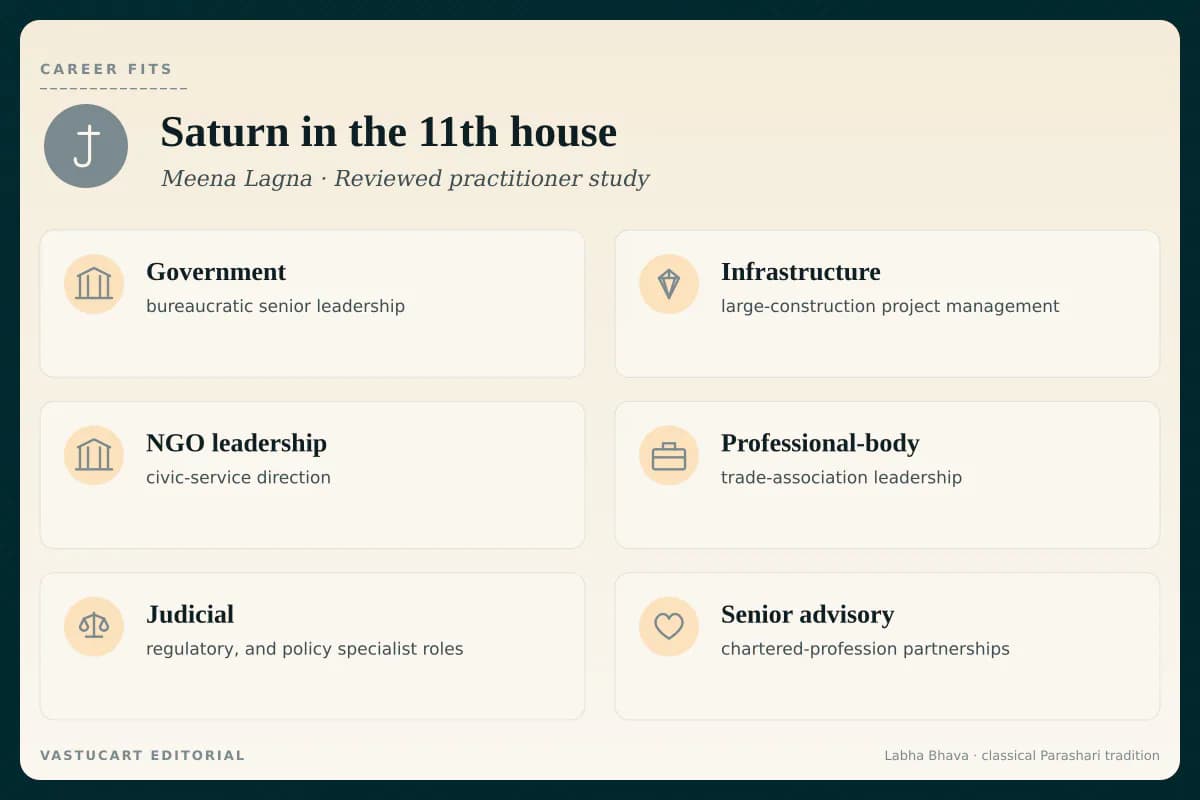
- Government and bureaucratic senior leadership
- Infrastructure and large-construction project management
- NGO leadership and civic-service direction
- Professional-body and trade-association leadership
- Judicial, regulatory, and policy specialist roles
- Senior advisory and chartered-profession partnerships
Where the slow-arc institutional income vocation plays out
Career paths cluster around fields that braid disciplined long-form labour with the network-and-institution dimensions the eleventh house rules. Government and bureaucratic senior leadership is the strongest single fit because the swakshetra labha lord in his own gains-house aligns naturally with the slow ladder of public administration. The 11L plus 12L combined in 11H structurally rewards officers who rise through service-cadre intake, secretariat postings, and sectoral ministry assignments into senior advisory or department-headship roles. Many natives become chief secretaries, sectoral commissioners, regulatory-board chairpersons, or senior-cadre advisors whose careers compound into substantial standing across two or three decades of public service.
Infrastructure and large-construction project management work because Saturn is the natural karaka of foundations, masonry, civil engineering, and the long-arc projects that take years to complete. Many natives become senior project directors at metro-rail authorities, port-and-airport development corporations, dam-and-canal authorities, urban-planning bodies, or large private infrastructure firms whose practice is built around projects measured in five-to-ten-year horizons. NGO leadership and civic-service direction fit because the labha-vyaya fused yoga channels resources from network donors into structured field expenditure. Many natives become founder-directors of social-impact organisations, senior trustees of educational endowments, or programme directors at global aid agencies whose work is sustained across decades rather than funding cycles.
Professional-body and trade-association leadership reward natives whose pace aligns with the slow consensus-building that membership organisations require. Many become presidents or secretaries-general of chartered-profession bodies, industry associations, employer federations, or alumni organisations where standing accrues through years of unpaid committee work. Judicial, regulatory, and policy specialist roles work because Saturn's nature is rule-bound deliberation and the 11L+12L combined in own labha routes regulatory income through specialty practices that develop slowly. Senior advisory and chartered-profession partnerships round out the picture: chartered-accountancy partners, legal-firm senior partners, actuarial-consulting principals, management-consulting directors who serve a small portfolio of long-term institutional clients across decades. Saturn mahadasha is the defining career window and crystallises the apex own-sign labha vocation.
Why this is the Meena chart's foundational gains placement
The contrast practitioners should hold most clearly is between Saturn and Mars in the same 11H of Meena. Mars exalted in 11H of Meena is the supreme yogakaraka in own labha, the dharmic-warrior wealth signature where income arrives through morally weighted command roles. Saturn swakshetra in 11H of Meena is the foundational labha-karaka in own labha, the institutional-income signature where wealth arrives through patient long-arc structured service. Same house, same lagna, completely different vocational arc: Mars rewards decisive command engagement, Saturn rewards patient committee and consensus accumulation. Practitioners reading both placements in the same chart should expect the native to combine the two modes.
The second comparative layer reads the Saturn-Meena triangle across the 8th, 11th, and 12th houses. Saturn exalted in 8 delivers depth-research authority through dushthana-Viparita reversal. Saturn swakshetra in 12 delivers monastic-withdrawal Vimala through own-sign vyaya placement. Saturn swakshetra in 11 delivers institutional-income compounding through own-sign labha placement. Of the three, the 11H reading is the most pragmatically wealth-rewarding because the income channel itself is the bhava the swakshetra Saturn sits in, and the labha-vyaya fused yoga channels expenditure straight back into the income source.
The third comparative layer is the dasha trigger. Saturn mahadasha is nineteen years, the longest in the Vimshottari cycle, and for this placement it functions as the defining institutional-income chapter rather than a generic Saturn period. Most natives whose Saturn dasha activates between ages thirty-four and fifty-three experience the chief-secretary appointment, infrastructure-authority chairmanship, NGO founder-directorship, professional-body presidency, regulatory-commission seat, or senior chartered-profession partnership during the Saturn major-period itself. Natives whose dasha activates later often see the post-retirement advisory chapter become the actual income peak.
When swakshetra Saturn in own labha delivers its institutional chapter
Saturn mahadasha is the defining window for this placement and arrives with the chief-secretary appointment, infrastructure-authority chairmanship, NGO founder-directorship, professional-body presidency, regulatory-commission seat, or senior advisory partnership that crystallises the apex own-sign labha vocation.
Calves, joints, and the slow-recovery longevity signature
Health follows the Saturn-in-11th pattern with specific Labha and Meena body-part vulnerabilities. Constitution leans vata-kapha because Saturn carries air-vata, Makara is an earth-vata sign, and Meena supplies the kapha-water dimension. The 11H body-part rulership covers calves, ankles, and lower legs, while Meena emphasises feet, lymphatic system, and fluid balance. Saturn rules joints, bones, lower back, knees, and broader nervous-system function. The placement raises specific lifelong vulnerability to calf-and-ankle stiffness during sustained office work, knee-and-lower-back patterns from long sedentary planning sessions, foot-and-lymphatic sensitivity that humid climates can compound, and slow-onset arthritic markers in the sixth and seventh decades.
The swakshetra-Saturn-in-Makara constitution is the second specific layer to read carefully. Classical reports consistently associate own-sign Saturn with strong longevity, durable structural integrity, and a steady cognitive baseline that often continues into the seventh and eighth decades, which is why this placement frequently appears in the charts of senior bureaucrats, judicial officers, and chartered professionals who continue working productively long past ordinary retirement age. But excess vata can produce dryness, sleep disturbance, anxious cognition, and the rumination patterns long-form planning work compounds when ordinary lifestyle counterweights slip.
Most natives benefit from disciplined daily walking with calf-stabilising and ankle-mobility work, regular oil-massage with warming sesame or mustard oil, a weekly Saturday fast or simplified evening meal, and mindful attention to dietary vata, warming well-cooked foods with healthy oils, avoiding cold-and-raw food in winter. Annual full-panel screening from the late twenties is recommended, with bone-density markers from age forty, vitamin-D and B-12 levels (often low in long-form indoor workers), lumbar imaging if back patterns develop, sleep quality, and metabolic markers. Daily yoga, especially gentle hip-opening, ankle-mobility, and slow-breathing pranayama, plus moderate winter sun exposure to counter Saturn-Meena lymphatic patterns, and the avoidance of late-night planning work, are the lifestyle stabilisers.
Remedies for swakshetra Saturn in the Meena labha
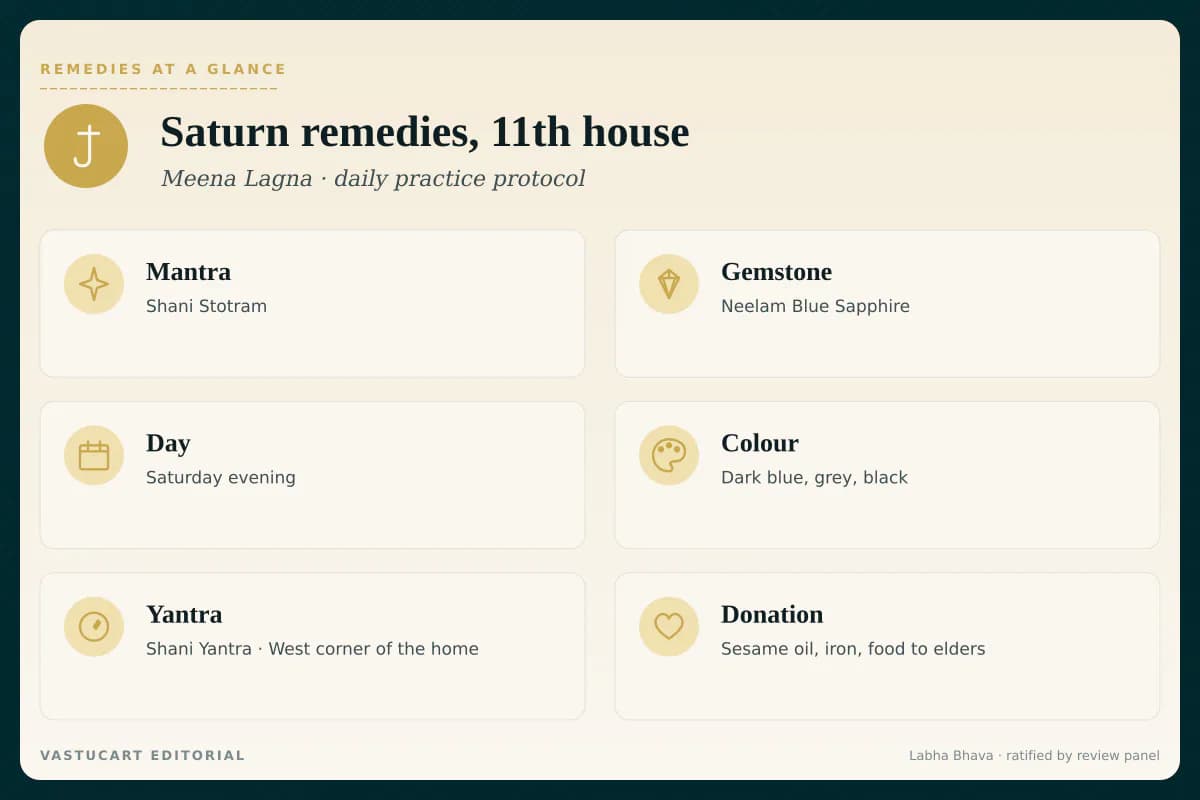
The daily Hanuman or Bhairava worship is the primary remedy for this placement because Hanuman is the classical patron deity of Saturn, and Bhairava is the depth-discipline form for natives drawn to the slow-arc institutional dimension. Either form holds the swakshetra-Saturn-in-labha signature in its most refined expression. Rise before sunrise, bathe, wear black, dark-blue, or indigo clothing on Saturdays, and visit a Hanuman or Shani temple if accessible. The Shani Stotram is the primary recitation, the Navagraha verse to Saturn. Reciting it at sunrise daily for forty days at any major Saturn transition (a chief-secretary appointment, infrastructure-authority chairmanship, NGO founder-directorship, professional-body presidency, regulatory-commission seat, or senior chartered-profession partnership offer) is the formal protocol classical sources prescribe.
Offer dark-blue flowers, especially blue lotus and blue iris where available, otherwise dark-blue thread offerings, black sesame seeds, and mustard oil at the altar on Saturdays. Donate to causes that support patient long-arc institutional service: scholarship funding for civil-service preparation, infrastructure-engineering training endowments, NGO operational-support grants, regulatory-fellowship support, and elder-care institute funding are the structural gift channels for this placement. A weekly reflection on which committee commitments are nourishing the institutional standing and which are merely consuming bandwidth keeps the placement directed toward income-yielding work rather than endless unpaid duty.
The gemstone is blue sapphire (Neelam), the primary Saturn ratna, and this is one of the safer Saturn placements for sapphire because swakshetra Saturn in own labha responds to amplification with structural steadiness rather than the volatility that the dushthana Saturn placements show. A standard three-day trial period is still classical protocol for any new sapphire wearer. Wear a natural Kashmir blue sapphire of minimum five carats set in silver on the middle finger of the right hand on a Saturday at sunrise after Shani mantra recitation, and only after a confirmed reading by a qualified Jyotishi.
Gemstones for Saturn in 11th house Meena Lagna
Blue sapphire is the primary Saturn gemstone and is worn with confidence for this placement because swakshetra Saturn in own labha is structurally one of the cleaner Saturn amplification targets across all twelve lagnas. A standard three-day trial is still classical protocol.


Disclaimer: Blue sapphire over a swakshetra Saturn in own labha amplifies the institutional-income channel cleanly, but a standard three-day trial period is classical protocol for any new sapphire wearer. Always consult a qualified Jyotishi before permanent wearing.
Rudraksha beads for Saturn in 11th house
The Saturn-aligned rudraksha is the Saat Mukhi (Seven Mukhi), the bead directly ruled by Mahalakshmi and Saturn.
The classical Saturn rudraksha and the bead specifically associated with disciplined wealth-and-merit. Supports the swakshetra labha-vyaya signature, channels the institutional-labour instinct toward sustainable territory, and stabilises commitment bandwidth when the bureaucratic, infrastructure, NGO, professional-body, or chartered-profession vocation is in active phase.
The fourteen-mukhi bead supports protective wisdom and intuitive senior-advisory judgement. Wearing the Chaudah Mukhi alongside the Saat Mukhi compounds the placement's natural strength in administrative leadership, infrastructure project direction, civic-service founding, and chartered-profession partnership work.
Shani Yantra for the swakshetra-labha placement
Sacred recitations for swakshetra Saturn in own labha
Chhaya-martanda-sambhutam tam namami shanaishcharam
Translation: I bow to Shanaishchara, dark as black collyrium, son of the Sun, elder brother of Yama, born of Chhaya and the Sun. The Shani Stotram is the canonical Navagraha verse to Saturn and is the perfect daily recitation for a chart where Saturn sits swakshetra in his own labha angle and the foundational labha-vyaya gains signature needs a containing devotional field. Many natives advanced in practice add the Hanuman Chalisa recitation as a secondary layer once the daily Shani discipline is steady, and natives drawn to the institutional-discipline dimension add the Shani Kavacham as the protective armour layer.
Read the full stotra on stotra.vastucart.in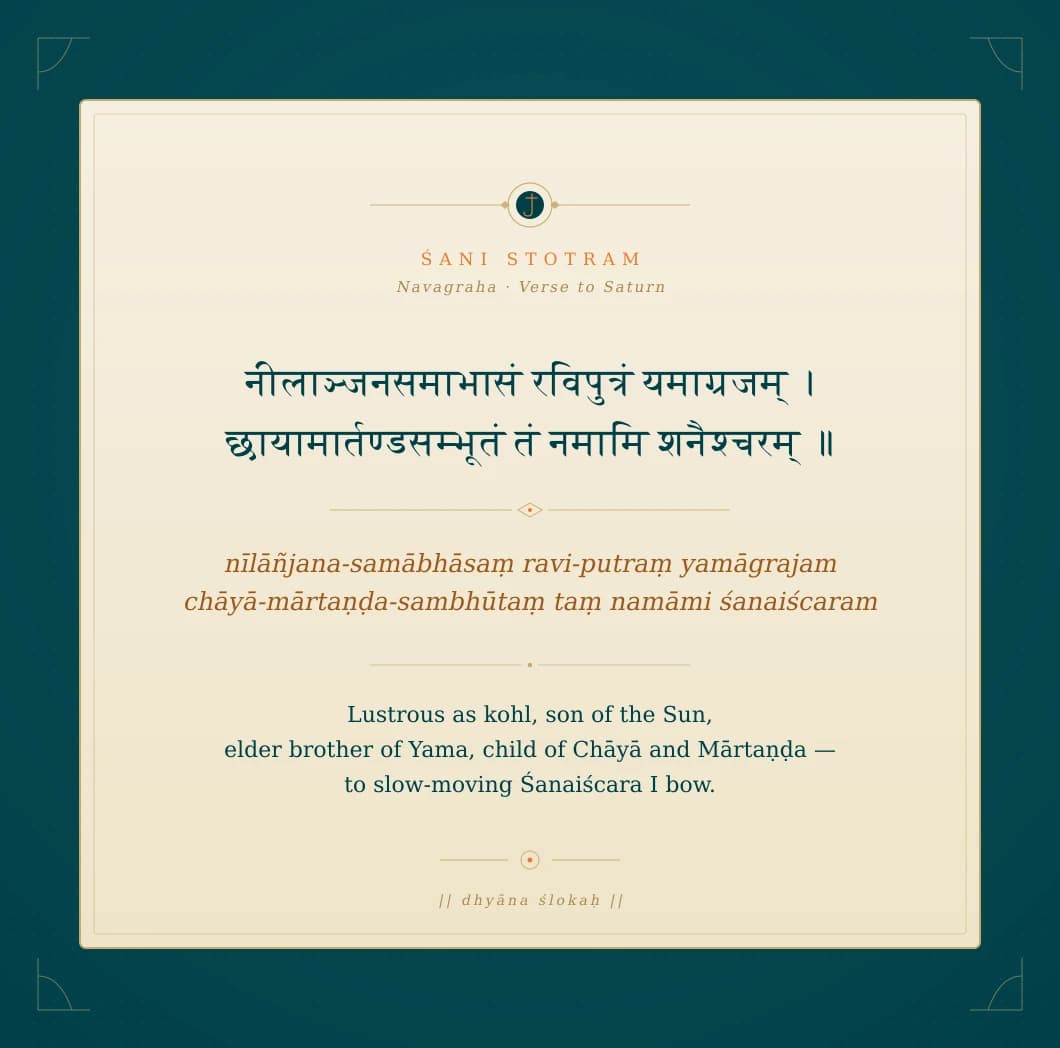
Tools for Saturn 11th house Meena natives
Is your Labha Bhava Saturn carrying the swakshetra income signature?
Get a full personalised analysis of your eleventh house Saturn, the own-sign labha-vyaya yoga, and the institutional-income vocation timing.