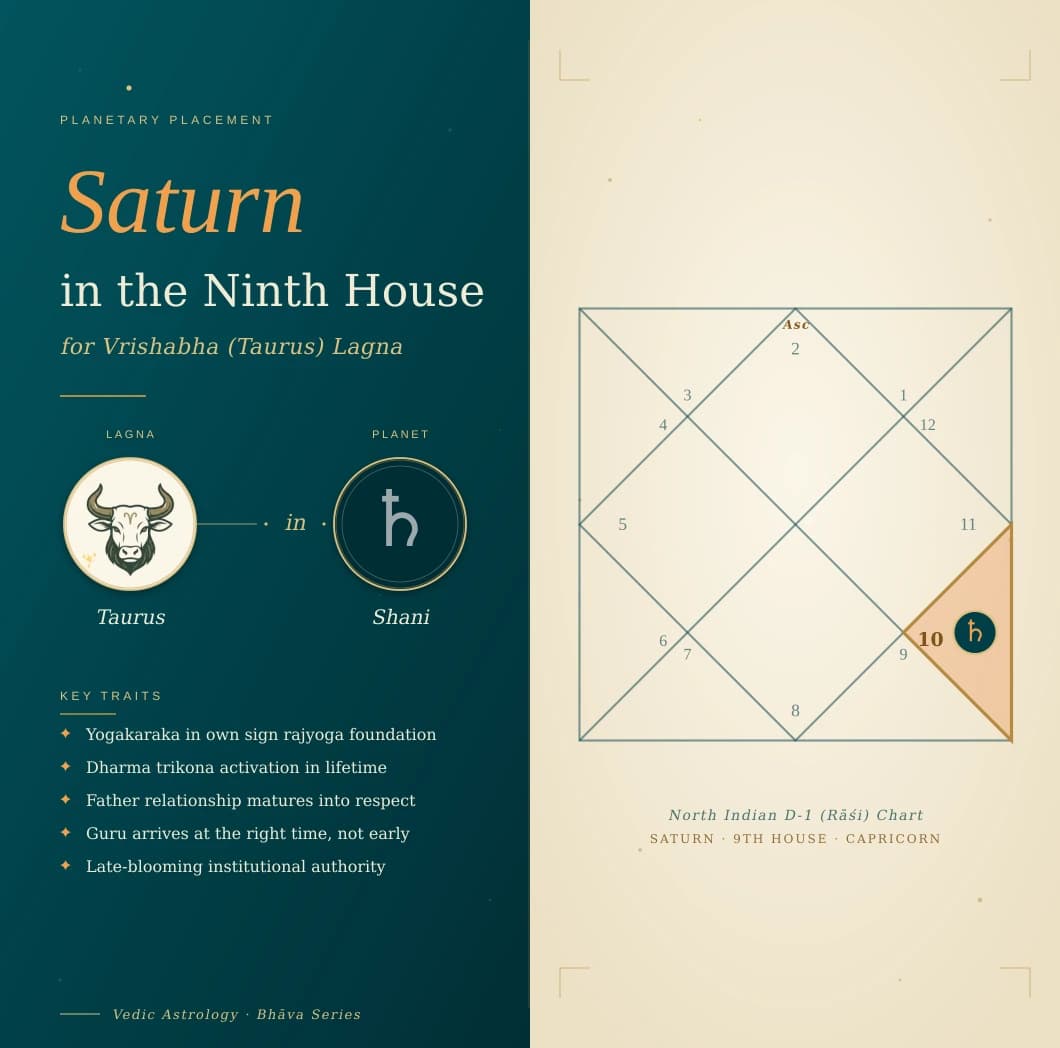
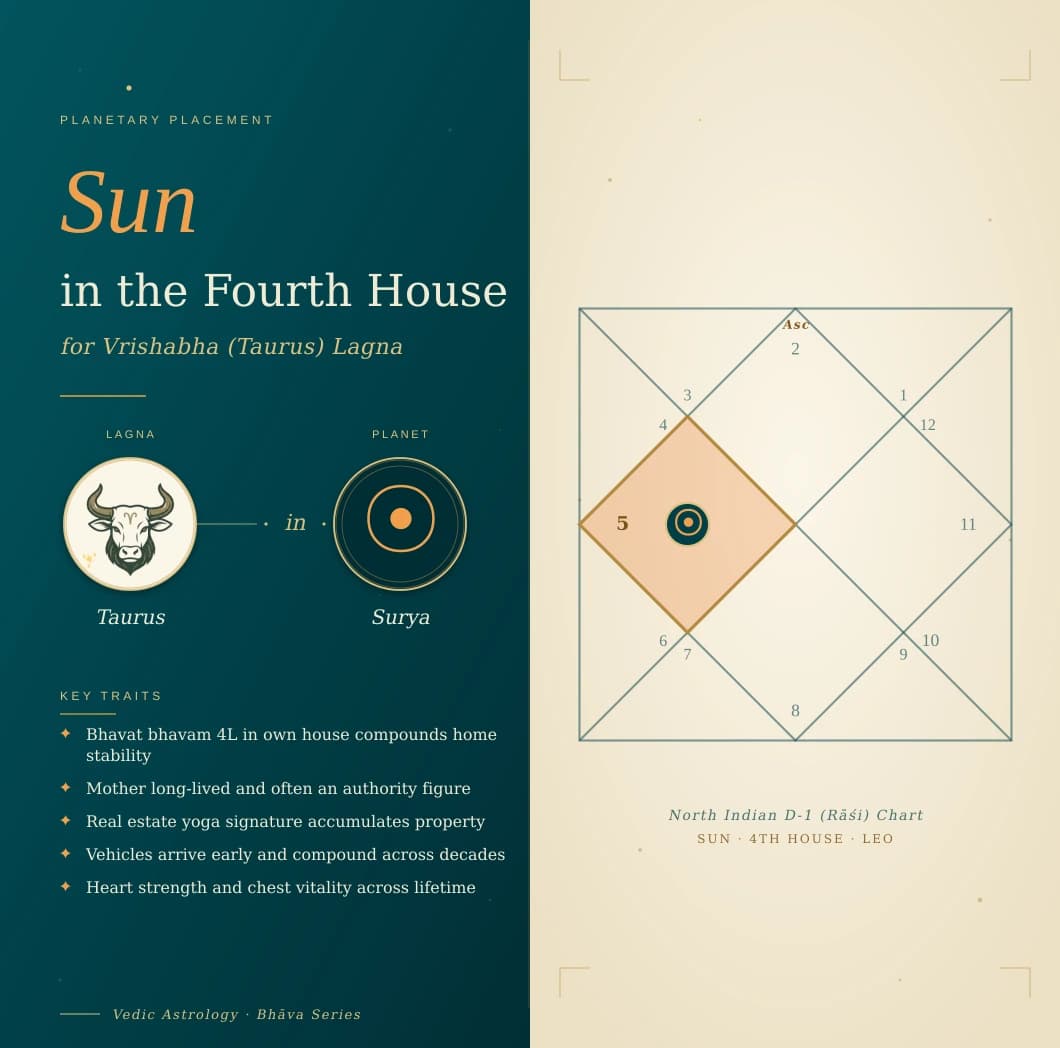
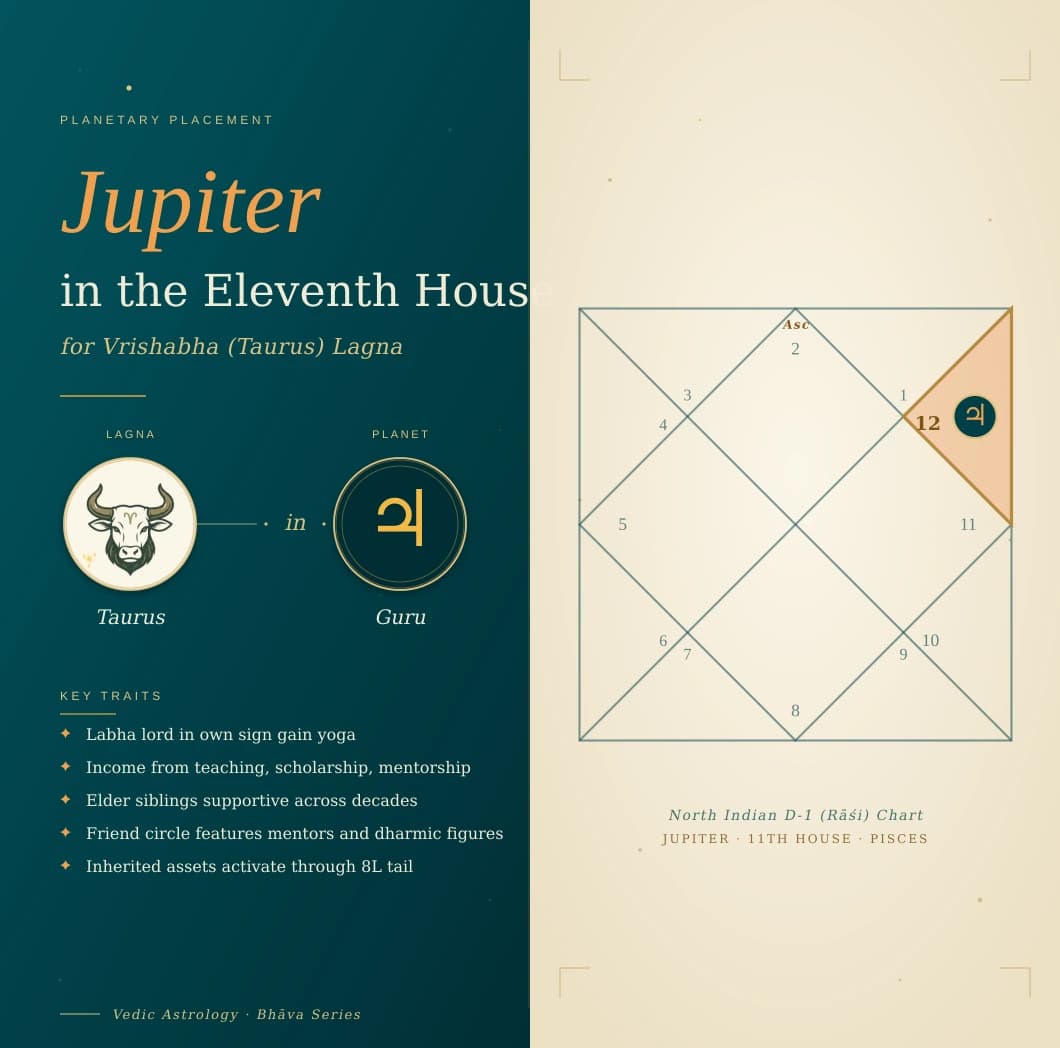
Shani in the 10th house
Vrishabha Lagna (Taurus Ascendant)
A practitioner study of Shani in Karma Bhava for Taurus ascendant natives. Saturn in his own sign Kumbha forms the rare Sasa Mahapurusha Yoga in the kendra of public action, producing the institutional career and reputation that the Vrishabha chart compounds slowly across the second Saturn return.
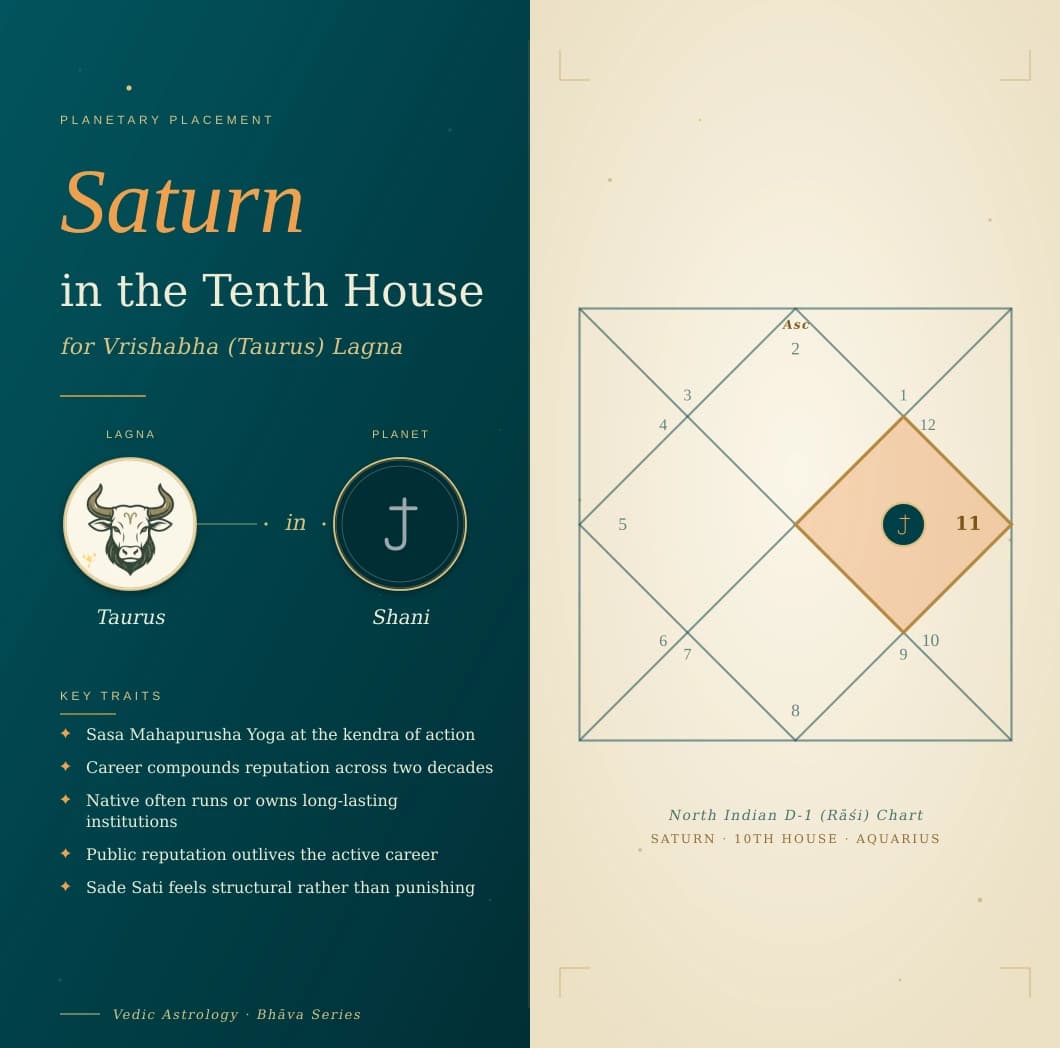
Shani sits in his own sign Kumbha in the tenth house for Taurus ascendant natives, the Sasa Mahapurusha Yoga career signature.
Shani in 10th house for Vrishabha Lagna, the quick reference
If you carry Shani in 10th house of a Vrishabha (Taurus) chart, you hold a placement classical Parashari authors single out as a peak signature. Two of the rarest Vedic strength rules converge on the same square here. Saturn for this lagna is the yogakaraka (a planet that simultaneously rules a kendra and a trikona), and the tenth house from Vrishabha is Kumbha (Aquarius), Saturn's own air sign.
The convergence is exact. The yogakaraka sits in his own sign in a kendra, which classical sources catalogue as a Pancha Mahapurusha Yoga (one of the five Great Person yogas of Vedic astrology). Specifically, this is the Sasa Mahapurusha Yoga, formed only when Saturn occupies a kendra in Makara, Kumbha, or his exaltation Tula.
The second feature is the Karma Bhava location itself. The 10th house is the bhava classical texts call Karma Bhava (the house of public action, profession, and the visible footprint a person leaves on the world). Placing the chart's most beneficial single lord in this house routes a lifetime of disciplined effort directly into reputation, title, and institutional standing.
The third feature is the dual lordship effect. Shani rules both the 9th and the 10th for Vrishabha, so this single planet carries the dharma trikona alongside the karma kendra. His presence in his own sign in the 10th anchors both lordships in one composite seat. The native typically arrives at full public stature later than ambitious peers, but arrives carrying weight that the early-arrivers rarely match.
This guide reads Shani in 10th house for Vrishabha Lagna in clinical layers: the Sasa Mahapurusha Yoga mechanics, the swakshetra Kumbha air-quality temperament, the institutional career arc, the second-Saturn-return ascendancy timing, the Sade Sati pattern when Saturn lives at home in the chart, and the blue sapphire Neelam protocol that classical practitioners reach for when full kundali confirmation is in place. The reading is built on observed cases rather than greeting-card astrology.

Why Sasa Yoga in Karma Bhava reads as institutional weight rather than visible flash
Many readers come to Shani in the 10th carrying generic anxieties about Saturn or generic excitement about a Mahapurusha Yoga. The honest practitioner answer for this specific configuration sits between those poles. The placement is structurally one of the most powerful career signatures the zodiac produces, but the strength shows up as durability rather than as visibility, and the early years often feel slower than the chart's eventual outcomes suggest.
The first specific feature is the Mahapurusha rule. Five planets each form a Mahapurusha Yoga when they occupy a kendra in their own sign or exaltation. Mars produces Ruchaka, Mercury produces Bhadra, Jupiter produces Hamsa, Venus produces Malavya, and Saturn produces Sasa (named after the hare or rabbit, the classical glyph of Shani's measured pace).
Sasa is the rarest of the five in living charts. Saturn is the slowest planet, so his return to a kendra in his own sign or in Tula is uncommon, and many decades go without a Sasa native being born under any given lagna.
The second feature is the kendra+swakshetra logic. A planet in a kendra holds the chart's structural skeleton. A planet in his own sign answers to no one but himself.
The Vrishabha 10th-house Saturn carries both qualities at once. The layered effect is that the chart's professional life is unbroken by external disposition. The native is not buffeted by office politics, by economic cycles, or by industry fashion in the way most charts are. The internal ordering is simply more durable than the surroundings.
The third feature is the dual lordship of Shani for Vrishabha. The same planet rules the 9th and the 10th. When this planet sits in the 10th in own sign, both lordships are anchored in the most professionally relevant kendra. Father, guru, and dharma are quietly fed into the public-action signature, so the career often carries a teaching, judicial, or dharmic flavour even when the surface profession is technical, administrative, or industrial.
Sasa Mahapurusha Yoga in the 10th of Vrishabha is not a Saturn that punishes. It is a Saturn that builds. The chart compounds reputation across two decades while early peers race ahead and burn out.
Terms used in this article
A short glossary of the Sanskrit and Jyotish terms that recur in this study. First-occurrence expansion is also retained inline for newcomers.
- Karma Bhava
- The 10th house, the bhava of profession, public action, authority, and the durable footprint a chart leaves in the world.
- Sasa Mahapurusha Yoga
- The Saturn variant of the Pancha Mahapurusha Yoga, formed when Saturn sits in a kendra in own sign Makara, Kumbha, or in his exaltation Tula.
- Kendra
- Angular house (1, 4, 7, 10). The structural skeleton of any chart, where any planet acquires durability and visibility.
- Swakshetra
- Own-sign placement. A planet sitting in a sign it rules carries the second-highest dignity in the chart, just below uchha exaltation.
- 10L
- Tenth-house lord, the planet ruling the sign that falls on the 10th cusp. Carries the chart's professional and reputational thread.
- Sade Sati
- The seven and a half year window when Saturn transits the 12th, 1st, and 2nd from the natal Moon. Felt as structural rather than punishing when natal Saturn lives at home.
- Aspada
- An alternate Sanskrit name for the 10th house, literally the seat or position one occupies in society.
How Shani in Karma Bhava shapes the Vrishabha native
Physically these natives carry the recognisable Vrishabha bull-frame on top of an unusually structured skeletal architecture. The shoulder line is broad, the spine carries vertically with very little forward curve, and the knees hold their alignment well into the seventies in most cases. The face often shows the Taurus rounded jaw with sharper cheekbones than the lagna alone would predict, and the eyes carry a settled gravity strangers register before the native has spoken. Many natives report being mistaken for being older than their actual age throughout their twenties, which is the early body-level signal of the institutional weight the chart accumulates.
The temperament is where this configuration most distinguishes its holders from the Vrishabha stereotype. The lagna gives the bull's earth-stamina, but Saturn in the 10th in Kumbha adds a fixed-air clarity that runs underneath the steady surface. These natives think in systems. They notice institutional patterns that other people normalise. Childhood teachers consistently describe them as serious, often fair to a degree their peers find inconvenient, and quietly stubborn when an adult tries to push a shortcut.
The shadow side runs along the same axis. The same systems-thinking mind that builds careers can harden into rigidity when life refuses to follow the system's logic. Marriage timing, family-of-origin chaos, and creative volatility are the three life domains that test this configuration most severely, because none of them respect the calendar discipline Saturn prefers. Natives who marry the Sasa Yoga discipline to deliberate softness practices (visible affection, structured rest, an artistic hobby) reach the late-life authority stage with intact relationships. Natives who let the discipline ossify reach the same stature alone, which is a recognisable shadow of this placement.
Strengths, shadows and career fits
- Sasa Mahapurusha Yoga at the kendra of action
- Career compounds reputation across two decades
- Native often runs or owns long-lasting institutions
- Public reputation outlives the active career
- Sade Sati feels structural rather than punishing
- Authority signal recognised early by senior figures
- Early years pace slower than restless peers
- Knee, kneecap, and lower-thigh vulnerabilities
- Marriage often delayed past peer median
- Risk of system-rigidity hardening into isolation
- Tooth and bone calcium issues without diet care
- Public role can crowd out private warmth if unwatched
- Civil services, public administration, senior bureaucracy
- Engineering firm leadership and infrastructure
- Judiciary, constitutional law, senior counsel
- Multi-decade family business or institution
- Manufacturing, mining, heavy industry leadership
- Educational administration and university leadership
Where Sasa Yoga turns into a visible institutional footprint
Career paths cluster around fields where slow-built durability matters more than rapid pivots, and where the institution itself, not the individual, is the eventual carrier of reputation. Civil services and senior administration are the textbook Vrishabha-Saturn vocation. Many natives clear competitive examinations later than the median age but rise faster once inside, because the same systems-thinking that delayed the entry now reads as rare administrative competence. Senior bureaucracy, regulatory authority work, and policy implementation roles fit the placement cleanly.
Engineering and infrastructure leadership form the second cluster. Roles where projects span multiple decades suit the chart best. Civil engineering at scale, energy and utilities, large-format construction, and the senior project-management ranks of any technical industry fit a temperament that thinks in twenty-year cycles. Many natives who enter as junior engineers end up running the firm by their late fifties. The path is usually inheritance, partnership transition, or organic ascendancy rather than aggressive job-hopping.
Judiciary work and constitutional practice are a recurring third cluster, drawing on the dual 9L+10L Saturn lordship that puts dharma into the karma seat. Higher academic administration, vice-chancellor and provost-track university roles, and the educational-foundation leadership space are similar fits because they pair institutional patience with the dharmic teaching note.
Multi-decade family businesses and named professional firms are the fourth cluster. The chart tends to either inherit and refound, or to start small and slowly compound a named practice that becomes itself an institution. Sasa Yoga careers typically peak between 45 and 60 years, after the second Saturn return at around 58. The short and frantic peer climbs of the early thirties give way to the long arc the chart was always going to walk.
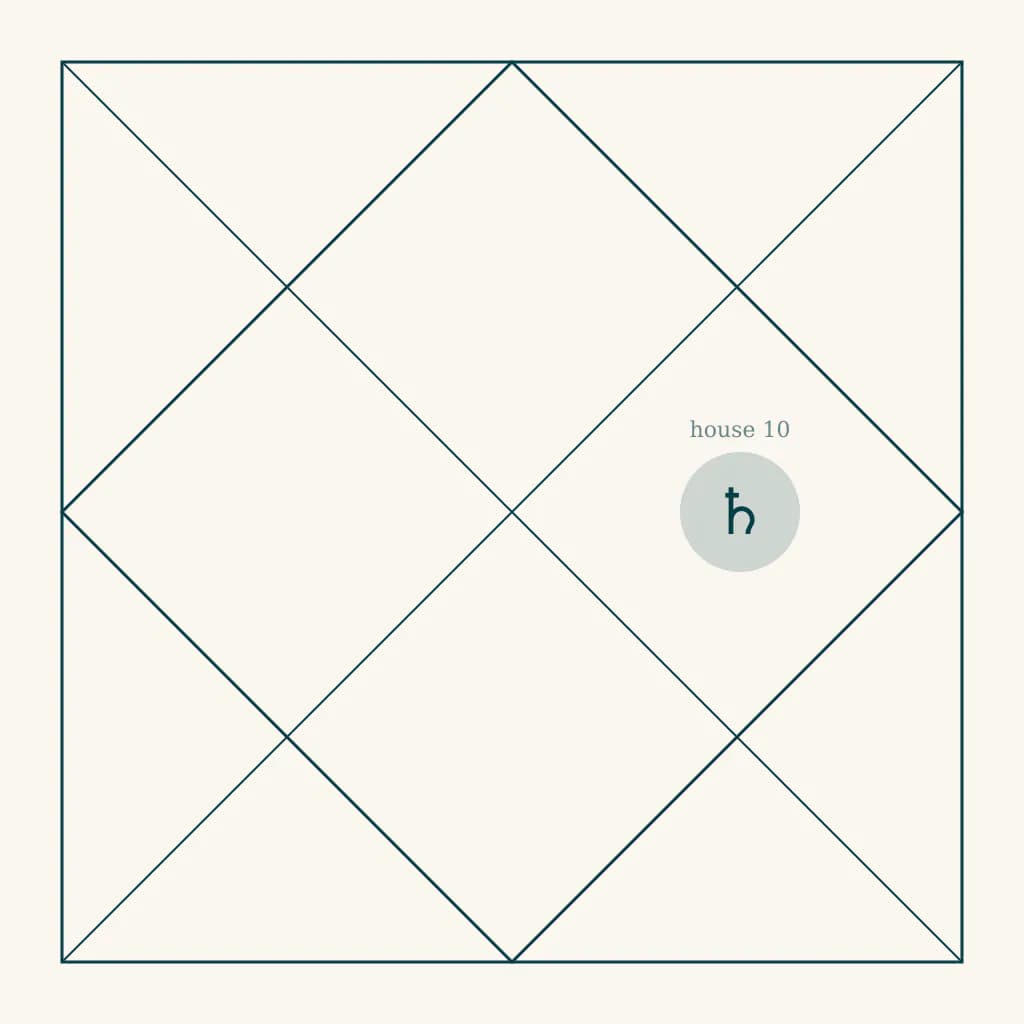
Why Saturn in Kumbha in the 10th carries unusual aspect-strength across the chart
The deepest reading of this configuration treats Sasa Mahapurusha Yoga and the Saturnian aspect logic as a single composite, because the two together explain why the placement feeds so much of the rest of the chart. Saturn casts three special drishtis (planetary glances) beyond the universal seventh. He looks at the third house from himself, at the seventh, and at the tenth. From the natal 10th of Vrishabha, those special aspects fall on the 12th house, the 4th house, and the 7th house. Each landing is structurally useful for this lagna.
The first aspect, on the 12th house Mesha, restrains expenditure and disciplines the foreign and bed-pleasure significations the 12th rules. Native finances do not bleed quietly the way they often do in less-disciplined Vrishabha charts.
The second aspect, on the 4th house Simha, brings the 10L's stabilising glance onto the home, the mother, the ancestral property, and inner happiness. Domestic life acquires a steady frame that survives the volatility of the broader world.
The third aspect, on the 7th house Vrishchika, anchors the marriage and partnership angle. The same Saturn that delays the marriage also protects it once it arrives. Partnerships across business and life tend to be long, written, and respected in the wider community.
The Sasa Mahapurusha Yoga compounds these aspects further by giving them the strength only a Mahapurusha planet carries. Classical sources from Brihat Parashara Hora Shastra to Phaladeepika describe the Sasa native as long-lived, prosperous, slow-blooming, and structurally honoured by society in the second half of life. The native does not necessarily attract the loud worship of charisma-driven peers, but the worship that arrives is durable. Cities name buildings after these natives; institutions retain their photograph in the boardroom for decades; family lineages catalogue them as the figure who steadied the line.
When Shani in 10th delivers its Karma Bhava chapter
Shani mahadasha is the keystone window for this placement, the period during which the Sasa Yoga moves from latent strength into visible career architecture. Each subsequent dasha builds on that platform.
Knees, teeth, and the long-bones discipline
Health follows the Saturn-in-Kumbha pattern with knees as the primary lifelong watchpoint and teeth, joints, and bones as the supporting territory. The 10th house in classical anatomy rules the knees and kneecaps, and Saturn rules the bones across the chart. When the 10L Saturn sits in the 10th, both rulerships compound on the same body region. Most natives report knee or kneecap sensitivity by the late thirties if running, court sports, or stair-heavy work has been part of the routine without preventive care. The remedy is sustained mobility work from the early thirties onward.
Bone density is the second body-level layer. Sasa Yoga natives often have unusually dense skeletons in youth, but the same density can mask early calcium loss in the late fifties because the body started from such a high baseline. Annual full-panel bloodwork from the late thirties, weight-bearing exercise sustained across decades, calcium and vitamin D adequacy, and oil-based self-massage on Saturdays are the foundational disciplines.
Teeth follow a parallel pattern. Many natives carry strong teeth into the forties and then meet a single concentrated round of dental work in the fifties. Six-month dentist visits from the thirties onward are the simple lifestyle intervention that resolves this.
The Vata-Kapha constitution carries dryness in the joints alongside the Vrishabha kapha-base. Warm hydrating foods, oil massage with sesame or mustard oil, regular yoga that emphasises hip openers and knee tracking, and protection of the kneecap area in cold weather are the daily disciplines. Pranayama practices that open the chest and shoulders are useful because Kumbha rules the calves and ankles in some classical schemes alongside the knees, and circulation through the lower body benefits from active breath work. Wearing Neelam, when chart-confirmed, supports rather than burdens this baseline.
Remedies for Shani in the Vrishabha Karma angle
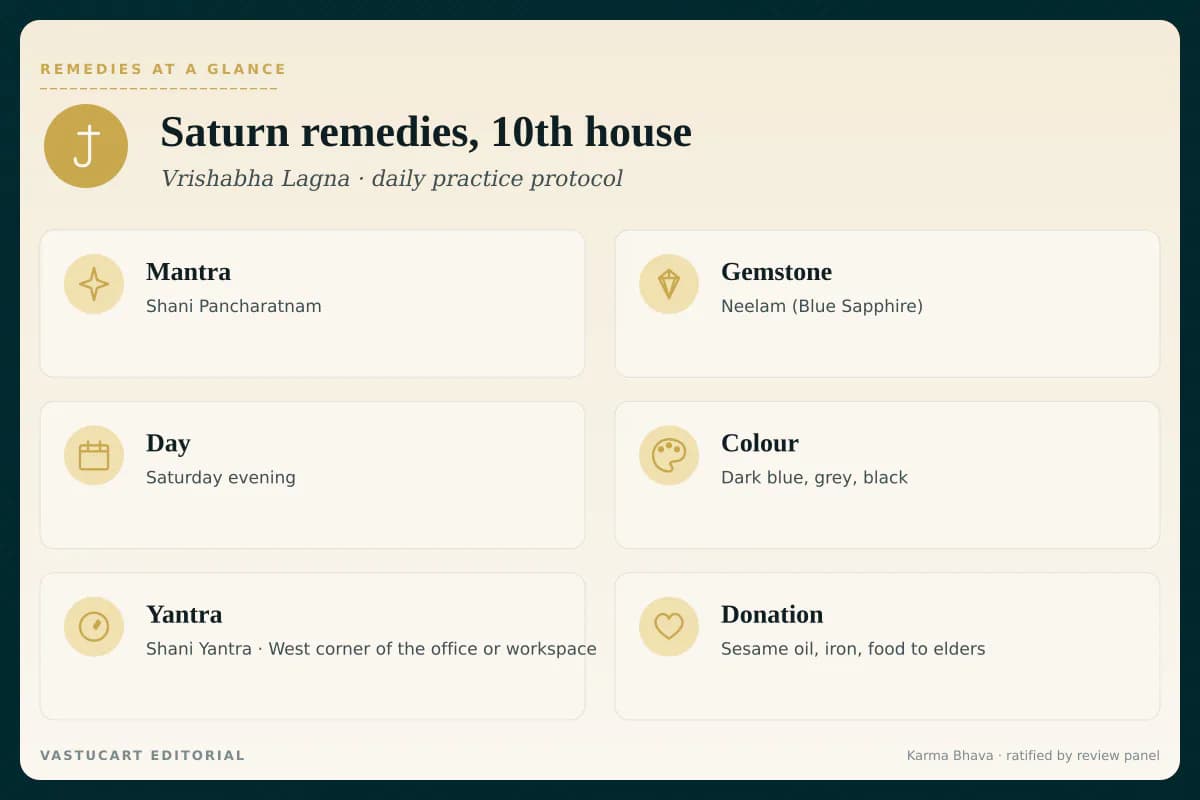
The Saturday discipline is the foundational remedy because it ritualises the relationship between the native and the planet that owns most of his professional fate. Rise before sunrise on Saturday, bathe in cool water, wear navy blue or steel grey, light a sesame-oil lamp, and recite the Shani Pancharatnam (the five-jewelled Saturn hymn). The Pancharatnam is the preferred recitation for this placement specifically because its five-fold structure mirrors the five Mahapurusha Yogas, and the native carrying the Sasa form benefits from the resonance.
Pair the recitation with the Hanuman Chalisa on Tuesday and Saturday morning. Hanuman is the classical balancer of Saturn intensity in the puranic tradition because of the boon Hanuman extracted from Shanidev, and the two-track recitation prevents the Saturn discipline from hardening into the joyless rigidity the placement otherwise risks. Offer black urad dal, mustard oil, black sesame, and iron items at the home altar on Saturdays, and donate dark blue or black goods (blankets, footwear, food grains, oil bottles) to the elderly, the disabled, or labourers on Saturday at sunrise placed in their hands directly. The conscious-service practice is the lifestyle remedy that compounds across decades into the difference between Sasa Yoga authority and Sasa Yoga harshness.
The gemstone is blue sapphire (Neelam), the primary Shani ratna, and is recommended confidently for this configuration because Saturn is yogakaraka in his own sign in a kendra and additionally forms a Mahapurusha Yoga, which is the strongest stack of strength rules a Saturn placement can carry. Choose a natural unheated Ceylon or Kashmir blue sapphire of minimum five ratti, set in silver or platinum, worn on the middle finger of the right hand, on a Saturday at sunrise after Shani mantra recitation. The seven-day test before permanent wearing is mandatory because Neelam is the most reactive ratna in the Vedic system, and even a yogakaraka Saturn deserves the courtesy of confirmation. Always work through a qualified Jyotishi who has read the full kundali.
Gemstones for Shani in 10th house Vrishabha Lagna
Blue sapphire is the primary Shani gemstone and is recommended confidently for this placement because Saturn is yogakaraka in own sign in a kendra and forms Sasa Mahapurusha Yoga for Vrishabha Lagna. The seven-day test before permanent wearing remains mandatory.


Disclaimer: Blue sapphire is the most reactive ratna in the Vedic system. Test for seven days and consult a qualified Jyotishi before permanent wearing, even when the chart carries Sasa Yoga.

Rudraksha beads for Shani in 10th house
The Saturn-aligned rudraksha is the Saat Mukhi (Seven Mukhi), the bead governed by Mahalakshmi and Shani.
The classical Saturn rudraksha and the bead specifically associated with stable wealth and Saturn-led prosperity. Holds the Sasa Mahapurusha Yoga energy across decades, supports the Karma Bhava reputation arc, and stabilises the late-blooming public footprint without releasing Saturn intensity as harshness.
The fourteen-mukhi bead is associated with Hanuman, the classical Saturn balancer, and serves as a primary secondary support for this placement. Wearing the Chaudah Mukhi alongside the Saat Mukhi compounds the Sasa Yoga strength while protecting the temperament from the rigidity risk that pure Saturn discipline carries.
Shani Yantra for the Karma placement
Sacred recitations for Shani in the Karma angle
Chhaya martanda sambhutam tam namami shanaischaram
Sauram sahasra-bhujam shyamam shanim shubha-pradayinam
Manda-gam mandala-stham cha bhasvad-bhasita-mandalam
Vande tam shanim devam yo dharati prasannataam
Translation: Bright as blue collyrium, son of the Sun, elder brother of Yama, born of Chaya and Martanda, I bow to Shanaischara. Saturn the slow, the dark, the auspicious, thousand-handed, dwelling at the rim of his own orbit, radiant with subtle light, I revere the deva who, when honoured, holds his pleased countenance. The Shani Pancharatnam, the five-jewelled hymn, is the recitation a Vrishabha native carrying Sasa Mahapurusha Yoga turns to during major Karma Bhava transitions.
Read the full stotra on stotra.vastucart.in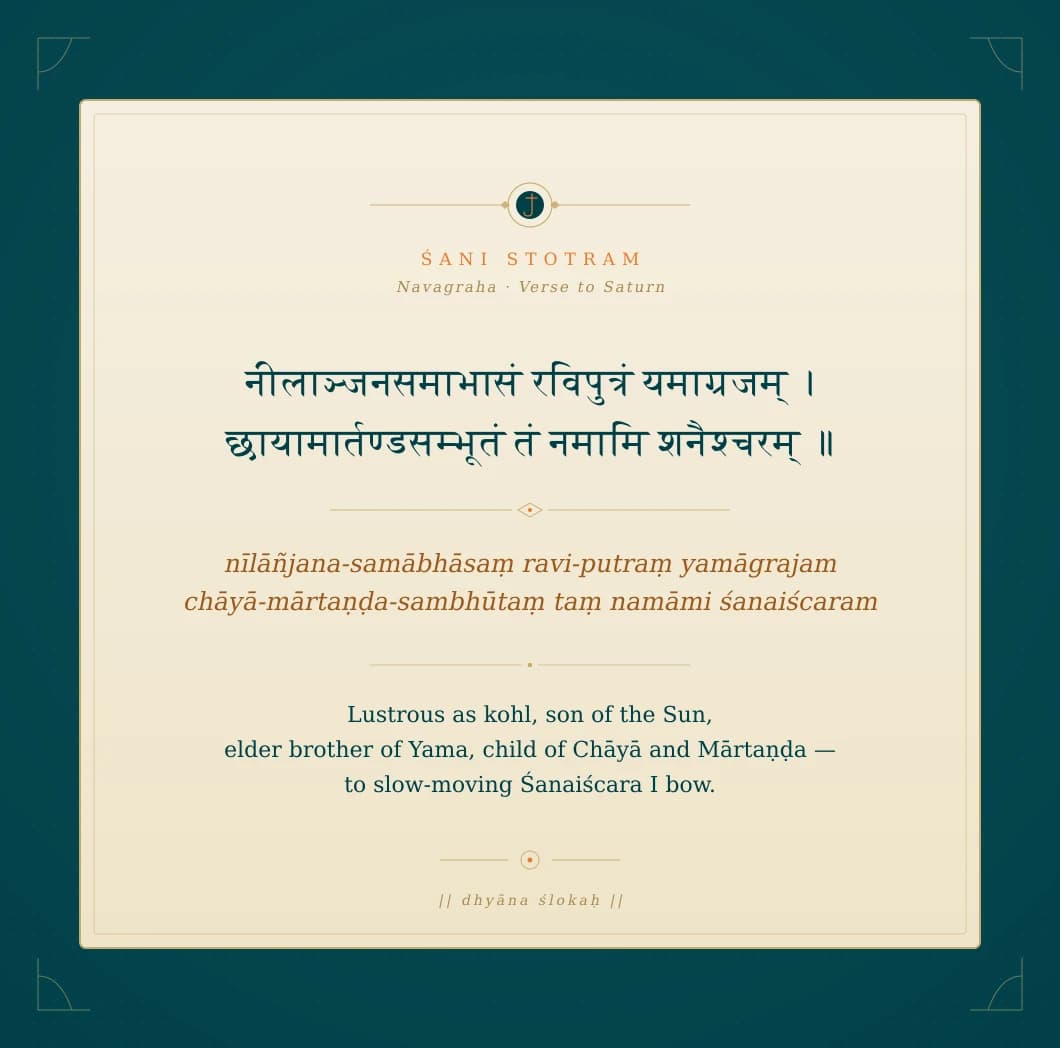
Tools for Shani 10th house Vrishabha natives
Is your Karma Bhava Saturn carrying the Sasa Mahapurusha signature?
Get a personalised analysis of your tenth house Shani, the swakshetra Kumbha dignity, and the late-career timing pattern.