
Saturn in the 9th house
Mesh Lagna (Aries Ascendant)
A practitioner study of Shani in Dharma Bhava for Aries ascendant natives. The tenth and eleventh lord in Jupiter's sign Dhanu in the trine of dharma, the classical dharma-karma raja yoga signature, and the institutional authority pattern this combination produces.
Saturn in 9th house for Mesh Lagna, the quick reference
Saturn in 9th house for Mesh Lagna is one of the classically favourable Shani placements in the Aries ascendant catalogue because it combines a neutral sign placement with the specific raja yoga configuration that the 9th house creates for Mesh. The ninth house from Mesh is Dhanu (Sagittarius), Jupiter's sign, and Shani and Jupiter are classical neutrals in most Parashari traditions, meaning the sign is neither friendly nor hostile. More importantly, the 9th house is Dharma Bhava, the trine of dharma, father, higher learning, teachers, long journeys, and fortune. Shani is the 10L (Makara) and 11L (Kumbha) for Mesh Lagna, so placing the 10L in the 9th creates the classical Dharma-Karmadhipati raja yoga where the career lord sits in the dharma house, connecting the native's professional work directly to their ethical and dharmic current. Classical texts describe this as one of the cleanest institutional authority signatures in Vedic astrology, producing natives who rise through decades of disciplined service to senior positions in law, academia, government, or religious institutions. This guide reads every layer of Saturn in 9th house for Mesh Lagna natives: the Dharma-Karmadhipati raja yoga, the neutral sign placement, the long travel and father signatures, and the Neelam protocol that is supported here more confidently than in enemy-sign Saturn placements.
Why the karma planet in the dharma house creates institutional authority
The ninth house is Dharma Bhava, the second trikona (trine of dharma) in the chart, the domain of dharma, father, higher learning, teachers, long journeys, pilgrimage, fortune, publishing, and the larger philosophical framework the native lives inside. Classical tradition treats it as one of the most beneficial houses in the chart alongside the 1st and 5th, and planets in the 9th carry the blessing of the chart's dharmic current. For malefics specifically, the trikona produces a mild reduction of raw malefic expression because the trine is a dharmic blessing house rather than a malefic-favourable zone. However, Shani is a disciplined malefic whose nature is already oriented toward duty and structured effort, so the reduction is softer for Saturn than for Mars or Rahu in the same house.
The 10L in 9H configuration creates the classical Dharma-Karmadhipati raja yoga, which is one of the most consistent raja yoga signatures in Parashari tradition. The rule is specific, when the lord of the 10th house (karma) sits in the lord of the 9th house (dharma), or when the lord of the 9th sits in the 10th, the two lords of the two most benefic trikona-to-kendra connections create a raja yoga seed. For Mesh Lagna, Shani is the 10L and placing him in the 9H activates the Dharmadhipati side of this yoga. The 11L in 9H adds a second layer because it connects gains to dharma, producing wealth that arrives through ethically-aligned work rather than through compromise. Dhanu rashi is Guru's sign, and although Jupiter and Saturn are technically neutrals, Jupiter's benefic influence on the sign softens the Shani weight noticeably, producing natives whose discipline is tempered by wisdom and whose career paths typically carry a teaching or advisory dimension alongside the formal institutional authority.
Shani in Dharma Bhava does not give the native fortune for free, he makes them earn every blessing through disciplined service to something larger than personal ambition. The reward is authority that cannot be unseated.
How a Dharma Bhava Shani shapes the Aries native
Physically the native carries a tall Mesh Lagna frame with strong thighs and hips (the 9th house body-part rulership), measured walking pace, and a face that holds institutional gravitas from early adulthood. The eyes are steady and thoughtful, the voice carries a quality of earned authority, and the overall bearing is of someone whose presence older relatives and senior colleagues respect without the native having to announce anything. Complexion runs cool, hair is typically thick and greys gradually, and the dignified posture is noticeable even in casual settings.
Temperament is disciplined dharmic seriousness. These natives carry Aries courage processed through Shani duty and Dhanu philosophical depth, producing personalities that take ethics seriously from childhood onwards, refuse to compromise on principle even when it costs them promotions or friendships, and develop over decades into the figures other people trust with sensitive ethical questions. The shadow side is occasional rigidity around principles that can make the native inflexible in situations that would benefit from pragmatism, and natives who develop the capacity to hold principles firmly while handling situations flexibly see the fullest expression of the placement arrive. The redemption arrives in the mid-forties when the accumulated dharmic capital from decades of disciplined work starts producing visible institutional recognition that faster-moving but ethically looser peers cannot match. Classical texts specifically describe these natives as the ones whose authority cannot be challenged because it was earned rather than claimed.
Strengths, shadows and career fits
- Dharma-Karmadhipati raja yoga
- 10L and 11L in trikona
- Institutional authority signature
- Ethical career foundation
- Long travel for work and learning
- Father relationship stable and formal
- Occasional rigidity around principles
- Father can feel formal rather than warm
- Long travels feel duty-bound
- Hip and thigh attention from midlife
- Slow career recognition early
- Trikona reduction mild but present
- Judicial and senior legal practice
- Government civil service senior
- Academic and university leadership
- Religious institutional leadership
- Foreign service and diplomacy
- Publishing and scholarly authorship
Where the dharmic institutional authority channel plays out
Careers cluster around fields that combine ethical seriousness with institutional hierarchy and long-tenure building. Judicial and senior legal practice are the strongest fit because the 9th house rules law at the dharmic level and Shani brings the methodical preparation and measured judgement these roles require. Many natives rise through decades of legal practice to senior judicial positions, and their reputations rest on the exact integrity and patience the chart produces. Government civil service at senior levels, particularly in ministries handling policy, law, or international affairs, suits the combination because the institutional pace matches the native's temperament and the seriousness of the work draws on their dharmic orientation.
Academic and university leadership, especially deanships, provostships, and senior administrative roles in universities, fit the combination because the 9th house rules higher learning and Shani provides the patience institutional leadership requires. Religious institutional leadership, whether as ordained clergy, senior monastic figures, or administrators of religious institutions, channels the placement's dharmic current directly. Foreign service and diplomacy work the long travel dimension of the 9th house productively, and natives often spend significant portions of their career abroad in formal diplomatic or international organisational roles. Publishing and scholarly authorship, especially serious long-form books on law, history, philosophy, or religion, suit the patient writing capacity Shani combined with Dhanu wisdom produces. Shani mahadasha typically delivers the career authority peak, often through a major appointment, a published work that becomes a reference text, or a senior institutional position that consolidates decades of earned dharmic authority.
Saturn marked in the ninth house of Mesh
- Shani in Dharma Bhava, marked in deep indigo
- 12 houses in North Indian format
- Right-lower diamond is the 9th house trikona
Why the chart produces a formal but durable father bond
The 9th house is the classical house of the father in Parashari tradition, and Shani in the 9th produces a specific signature around the father relationship that practitioners read carefully. The father is typically older than the mother, often significantly so, and carries a disciplined, serious temperament that shapes the native's early understanding of authority and duty. Classical texts describe the father as respected but not necessarily warm, and the childhood memory of the father often centres on his work ethic, his principled decisions, and the seriousness with which he took his responsibilities rather than on playful or emotionally demonstrative moments. Many natives report that they understood their father better in adulthood than in childhood because the father's operating mode became legible only once the native themselves took on adult responsibilities.
The long travel signature is the second interpretive pattern. The 9th house rules long journeys and Shani here produces natives whose adult life involves significant travel for work, education, or dharmic purpose rather than for leisure. Many spend years abroad in formal postings, complete higher education in institutions far from their birthplace, or travel extensively for research and institutional work across their career. The travels typically feel duty-bound rather than adventurous, and natives who embrace the journey dimension of their work find that the sustained mobility produces depth and perspective that stationary peers cannot match. The father relationship and the travel pattern often intertwine in practice because the father sometimes inspires the career that produces the long travel, and the native's adult travel often takes them back to places the father would have recognised and approved of.
When Saturn in 9th delivers its dharma chapter
Shani mahadasha is the defining nineteen-year window. Guru, Surya and Mangal periods also support the dharma and father themes.
Hips, thighs and the institutional-work body profile
Health concentrates on the 9th house body-part rulership: thighs, hips, and lower back. Shani here produces natives whose hip mobility decreases earlier than peers if not actively maintained, and lower back issues can develop from long hours of sedentary institutional work. The Saturn constitution runs cool, endurance is above average, and the body handles sustained stress well but recovers slowly from acute injury. Liver function should be tracked annually from the mid-thirties as standard Shani care.
The corrective routine blends standard Saturn discipline with specific hip mobility work. Daily walking, yoga with hip opening postures and spinal mobility, and regular stretching are essential from the late twenties onwards. Strength training two to three times weekly maintains muscle mass around the hips and core. Dietary discipline around inflammatory foods matters for joint health. Include turmeric, ginger, and collagen-rich foods for connective tissue support. Saturday is the ritual day, and the Hanuman Chalisa at dusk softens the Shani weight. Annual preventive care including hip imaging if discomfort begins compounding.
Remedies for Shani in Dharma Bhava
Saturday discipline is foundational. Thursday is the important secondary day because Guru rules Dhanu and honouring the sign lord alongside the occupying planet is the classical courtesy for this specific configuration. On Saturday rise before sunrise, wear dark blue or black, recite Shani stotras, visit a Shani temple, donate iron or food. On Thursday wear yellow, recite the Guru Stotram, visit a Vishnu temple, and offer chana dal or yellow flowers. The Hanuman Chalisa at dusk daily is non-negotiable for any Saturn placement.
The gemstone is Neelam (blue sapphire), and for this placement the neutral-sign trikona placement supports the stone more confidently than enemy sign Saturn placements, but the mandatory three-day trial wearing protocol still applies because Neelam is the most sensitive stone in the Vedic system. When indicated after trial and practitioner review, wear a natural Ceylon Neelam of minimum four ratti set in silver or panchdhatu on the middle finger of the right hand on a Saturday at sunrise. The Saat Mukhi rudraksha is the safer first step. The lifestyle adjustment that compounds most is committing to a field where principles matter. Natives who choose careers specifically because the ethical dimension is central (law, judiciary, academic leadership, religious institutional work) see the chart deliver its fullest expression, while natives who take ethically-ambiguous work often feel a nagging dissatisfaction the chart is producing as a signal to redirect toward dharmic alignment.
Gemstones for Saturn in 9th house Mesh Lagna
Blue sapphire is supported by the neutral-sign trikona placement but still requires mandatory trial wearing.


Disclaimer: Blue sapphire remains the most sensitive gemstone in the system. Complete trial wearing before permanent commitment.
Rudraksha beads for Saturn in 9th house
Saat Mukhi is primary. Panch Mukhi honours the Jupiter sign lord.
Classical Saturn rudraksha. Safer first step than Neelam. Supports the Dharma-Karmadhipati yoga directly. Worn after Shiva abhishek on Saturday.
Honours Jupiter as the sign lord of Dhanu and softens the Shani weight with benefic warmth. Important secondary bead for this configuration.
Shani Yantra for Dharma Bhava
Sacred recitations for Dharma Bhava Shani
Baranau raghubar bimal jasu, jo dayaku phal chari
Buddhiheen tanu janike, sumirau pavan kumar
Bal budhi bidya dehu mohi, harahu kalesa bikar
Translation: Having cleansed the mirror of my mind with the dust of the lotus feet of the divine guru, I describe the pure glory of Raghunath. Knowing my body to be without wisdom, I remember the son of the wind god, grant me strength, intelligence, and knowledge, and remove my afflictions. Hanuman is the classical deity who softens Shani harshness.
Read the full stotra on stotra.vastucart.inTools for Saturn 9th house Mesh natives
Is your Dharma Bhava Shani carrying the raja yoga signature?
Get a full personalised analysis of your Saturn placement.
Questions about Saturn in 9th house, Mesh Lagna
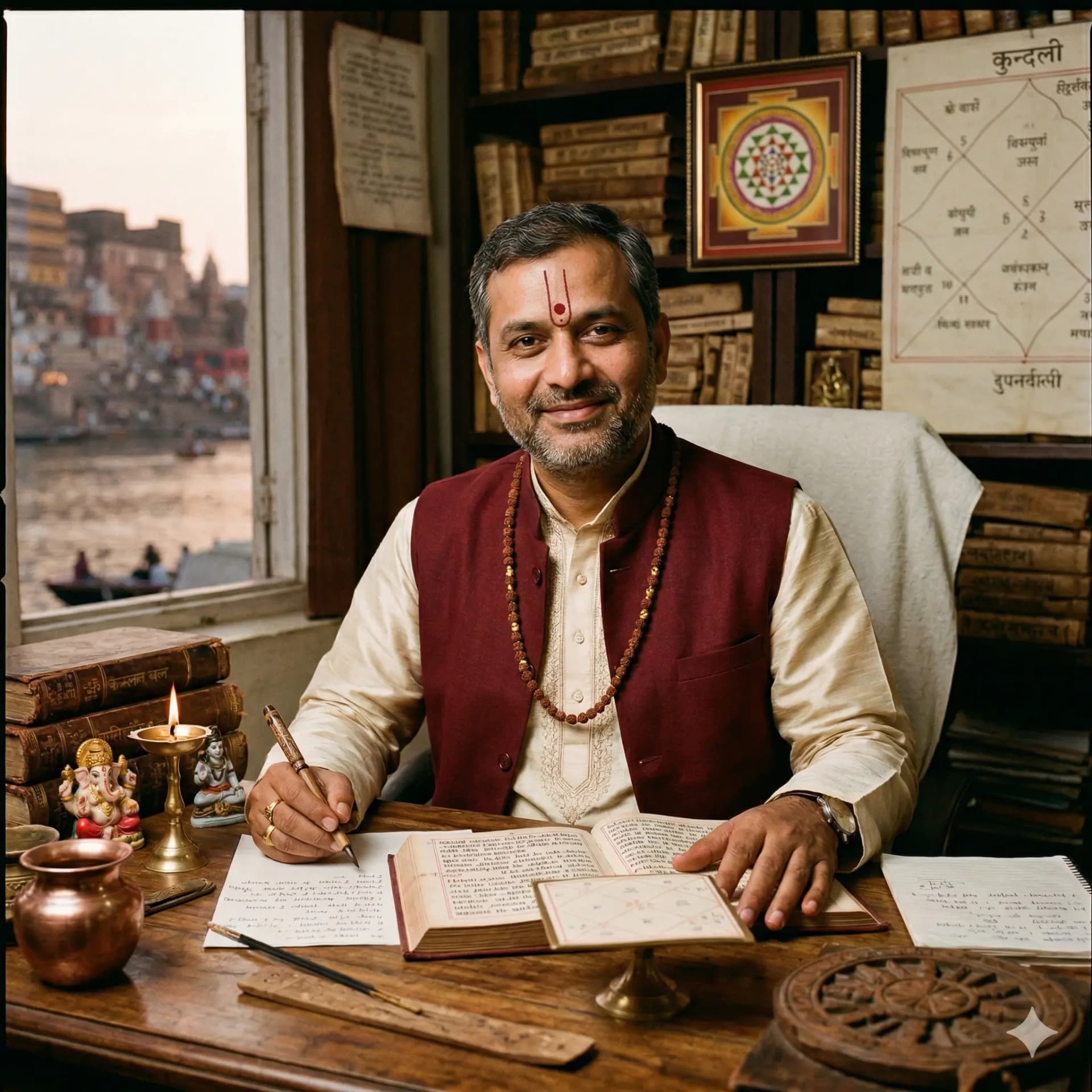
Pt. Raghav Sharma has practiced Parashari Jyotish for over twenty two years from Varanasi. A student of the Varanasi Jyotish tradition, he specialises in Graha-in-Bhava analysis, Vimshottari Dasha predictions, and Muhurta. He has authored over four hundred in-depth articles on Jyotish principles across the VastuCart knowledge network.