
Mars in the 9th house
Mesh Lagna (Aries Ascendant)
A practitioner study of Mangal in Dharma Bhava for Aries ascendant natives. The lagna lord in Jupiter's friendly sign Dhanu, the classical Kshatriya dharma placement, the foreign travel and father signatures, and the trikona blessing that distinguishes it from the three Upachaya Mars placements.
Mars in 9th house for Mesh Lagna, the quick reference
Mars in 9th house for Mesh Lagna is the classical Kshatriya dharma placement of the Aries ascendant catalogue. The ninth house from Mesh is Dhanu (Sagittarius), Guru's sign, and Mangal in Dhanu sits in a friendly sign because Jupiter is a classical friend of Mars, unlike the enemy-sign positions in Mithuna, Tula, Kumbha, or Kanya that the other Mars placements had to overcome. Two structural features define this combination. First, the 9th is a trikona (trine of dharma), and classical Parashara tradition treats any planet in a trine as carrying a blessing signature, particularly when the lagna lord itself occupies the trikona. Second, Mangal as the lagna lord in Dharma Bhava produces a native whose core identity is wired directly into dharmic effort, father relationship, foreign travel, higher learning, and the pursuit of righteousness through action. For Mesh specifically, there is a third layer to watch, Mangal is also the 8th lord, and 8L sitting in the 9H can occasionally affect the father's health or longevity which the practitioner must verify through secondary factors. This guide reads every layer of Mars in 9th house for Mesh Lagna natives: the trikona blessing, the Kshatriya dharma channel, the father signature, foreign travel outcomes, and the red coral protocol that works without hesitation for this placement.
When the warrior planet meets the house of dharma
The ninth house is Dharma Bhava, the trine of higher wisdom, teachers, guru, father, fortune (bhagya), long journeys, foreign travel, pilgrimage, publishing, higher learning, and the larger philosophical framework the native lives inside. Classical texts treat it as the second trikona and one of the three most beneficial houses in any chart after the lagna itself. A planet in the ninth house is said to carry the blessing of the chart's dharmic current, and for malefics specifically, the trikona softens the raw malefic nature and channels it toward dharmic effort rather than destructive action. This is a very different mechanism from the Upachaya growth curve that supports Mars in the 3rd, 6th, and 11th. Trikonas do not grow the malefic through sustained effort, they refine it through the chart's underlying blessing.
Dhanu rashi adds the second layer. Guru rules Dhanu, Guru is the classical friend of Mars, and the sign itself is a fiery mutable sign that matches the Mars temperament while adding philosophical depth. Natives with this combination are not just courageous, they are courageous in service of something larger than themselves. They fight for principles rather than for personal gain, they travel for training or pilgrimage rather than for leisure, and they respond to questions about meaning with unusual seriousness for an Aries ascendant. The shadow layer worth naming is the 8th lordship complication. Mangal is the 8L for Mesh Lagna, and placing the 8L in the 9H is a classical signature that practitioners always cross-check against the father's chart and the condition of Guru elsewhere. The warning is not absolute, and in many cases the father lives a long and healthy life, but the practitioner should verify the condition rather than assume it. A well-placed Guru elsewhere in the chart typically neutralises the concern entirely.
Mars in Dharma Bhava does not take the native out of the battlefield, it puts a purpose on the battlefield. The chart is asking the native to fight for something worthy of the courage it gave them.
How a Dharma Bhava Mars shapes the Aries native
Physically the native carries a confident Mesh Lagna frame with unusually strong thighs and hips (the ninth house body-part rulership), a stride that reads as purposeful rather than aggressive, and a bearing that often causes strangers to assume the native holds some quiet authority even in casual settings. The face holds a steady intelligence, the eyes meet others without challenge but without retreat, and the overall impression is of someone who has already thought about the bigger questions that most people get to only after being forced by circumstance. Complexion runs warm, the hair is typically thick and slow to grey, and the walking pace has a forward-leaning quality as though the native is always slightly ahead of where their feet are.
Temperament is the layer that makes this placement distinctly Kshatriya in the classical sense. These natives carry Aries courage but channel it through a moral framework that shapes every major decision. They refuse to fight for unworthy causes, they back colleagues who are in the right against colleagues who have simply outmanoeuvred them, and they walk away from opportunities that require compromising the principles they hold. The shadow side is self-righteousness during the twenties, when the dharmic instinct is present but not yet tempered by the wisdom that comes from having been wrong about something important at least once. Natives who develop humility alongside the dharma instinct by their early thirties see the placement deliver its fullest expression, becoming the kind of leaders, teachers, or senior officers that younger colleagues measure themselves against for decades.
Strengths, shadows and career fits
- Trikona blessing for the lagna lord
- Mars in friendly Jupiter sign Dhanu
- Dharmic orientation of courage
- Foreign travel and training windows
- Natural leadership in principled fights
- Not a Manglik Dosha position
- 8L in 9H father health attention
- Self-righteousness in the twenties
- Friction when principles are tested
- Thigh or hip injury risk in sports
- Restlessness without a worthy cause
- Over-committing to distant projects
- Military officer rank and combat leadership
- Defence and strategic advisory
- Dharma teaching and martial arts instruction
- Foreign service and international relations
- Higher education and academic leadership
- Religious or philosophical publishing
Where the Kshatriya dharma channel plays out
Career paths cluster around fields that combine action with principled purpose. Military officer careers, and specifically commissioned ranks involving strategic command rather than pure infantry work, are the single strongest fit because the combination literally places the courage planet in the dharma house of the lagna lord itself. Many natives with this placement rise to senior ranks in defence services or strategic advisory roles that support defence decision-making at the policy level. Defence journalism, conflict analysis, and international relations careers involving defence or diplomacy work well for the same reason, the native's instinct to engage seriously with hard questions about power, principle, and national interest suits these fields naturally.
Dharma teaching, martial arts instruction with a spiritual dimension, and traditional schools that combine physical training with philosophical depth (karate, kalaripayattu, kung fu, Iaido, archery) draw these natives because the combination recognises its own in these traditions. Foreign service, international relations, and careers involving long postings abroad suit because the ninth house rules long journeys and Mars gives the courage to embrace unfamiliar environments. Higher education leadership, particularly as professors of history, political science, philosophy, or any field that demands moral clarity as well as analytical skill, channels the placement productively. Religious and philosophical publishing, book writing about dharma or strategic thought, and documentary journalism in conflict regions all fit. Mangal mahadasha is typically when the defining assignment or posting arrives, and it almost always involves travel, principle, or both. Natives who lean into the international dimension of their work see the chart deliver far more than those who try to build a purely local career.
Mars marked in the ninth house of Mesh
- Mangal in Dharma Bhava, marked in warm saffron
- 12 houses in North Indian format
- Right-lower diamond is the 9th house of dharma
Why the ninth house demands a careful father reading
The ninth house is the classical house of the father in Parashara tradition (along with the Sun as the natural karaka of the father), and any planet here shapes the father relationship significantly. A strong Mars in the 9th produces a father who is typically commanding, physically capable, and often from a background where authority, service, or principled leadership was the family pattern. Many natives with this combination have fathers who served in defence, civil service, or established professional practice, and who held the native to high standards that felt demanding during childhood but turned out to be formative in adulthood. The relationship carries a competitive undertone during the native's teenage years because the lagna lord sits in the father's house and both the native and the father are essentially fighting for the same symbolic space, but this almost always resolves in adulthood as the native comes into their own authority.
The complication the practitioner must verify is the 8L-in-9H angle. For Mesh Lagna, Mangal rules the 8th (Vrishchika) and placing the 8L in the 9H is a classical signature to check carefully because the 8th lord carries longevity-related significations and placing it in the father's house can occasionally indicate the father's health becoming a serious concern during the native's adult years. The warning is not absolute. In the many charts I have read with this exact placement, the outcome is strongly shaped by the condition of Guru elsewhere in the chart. A well-placed Jupiter (in own sign, exaltation, kendra, or trikona) often neutralises the 8L concern completely, and the father lives a long and healthy life. A weak or afflicted Jupiter amplifies the concern and practitioners should then advise the native to maintain close attention to the father's health, especially during Mangal or Rahu antardasha windows. Always verify before drawing conclusions, never panic, and never communicate the warning to the native without the full diagnostic context.
When Mars in 9th delivers its dharma chapter
Mangal mahadasha is the defining window for this placement, and Guru mahadasha is especially potent because Guru is the sign lord and friend of the occupying Mars.
Thighs, hips and the warrior-athlete profile
Health follows the strong-Mars pattern with specific ninth-house vulnerabilities. Constitution is pitta-dominant with above-average strength and endurance, the body handles sustained physical effort well, and recovery from exertion is rapid. The specific vulnerabilities are the thighs and hips (the ninth house body-part rulership), and natives should pay attention to hip mobility, hamstring flexibility, and the repetitive-use injuries that often develop in martial arts practitioners or long-distance runners. Hip impingement and hamstring strains are the most common physical issues reported, usually in the late thirties onwards, and almost always resolved cleanly with targeted physiotherapy because the underlying constitution is robust.
The corrective routine leans into the warrior-athlete profile rather than restraining it. Physical training is non-negotiable but the emphasis should be on mobility and flexibility alongside strength, because unbalanced training produces exactly the hip and hamstring injuries the chart flags. Include yoga or pranayama weekly because the trikona placement responds to contemplative practice with unusual depth, and the dharma orientation of the combination makes meditation feel natural rather than forced. Avoid excessive alcohol and late-night eating during demanding career phases because pitta excess shows up first in the liver and digestive fire. Tuesday is the primary ritual day, Thursday is the secondary day (honouring Guru as the sign lord), and both should carry lighter diet and deliberate recitation. Annual full-panel blood tests from the mid-thirties catch metabolic drift early, and the placement responds to preventive care far better than to reactive treatment later.
Remedies for the Dharma Bhava warrior
The Tuesday discipline is foundational and the Thursday observance is the strong secondary ritual because Guru rules Dhanu and honouring the sign lord alongside the occupying planet is a classical courtesy that strengthens the whole arrangement. On Tuesday rise before sunrise, wear red or saffron-toned clothing, and recite the Mangal Kavacham or Mangal Stotra in the morning window. On Thursday wear yellow or gold-toned clothing, visit a Vishnu or Dattatreya temple if accessible, and recite the Guru Stotram or Vishnu Sahasranama. The combined Tuesday and Thursday practice is specifically what this placement responds to most because the trine house and the sign lord are both being honoured in their respective weekdays.
The Hanuman connection remains central. Reciting the Hanuman Chalisa at dusk every day is the single most effective compound practice for any Mars placement and especially for one in the dharma house because Hanuman himself is the exemplar of courage in service of a higher purpose, which is the exact pattern the chart is asking the native to embody. The gemstone is red coral (Moonga) and this is a placement where the stone can be recommended with confidence because the friendly sign plus trikona house combination supports direct amplification without the friction risks that debilitated or afflicted Mars placements carry. Wear a natural Italian or Mediterranean red coral of minimum six ratti set in gold (preferred for trikona Mars) or copper on the ring finger of the right hand on a Tuesday morning after Mangal mantra recitation. The lifestyle adjustment that compounds most is the deliberate practice of identifying and defending a principled cause each year, whether professional, civic, or personal, because the dharma orientation of the placement deepens when it has a concrete application and weakens when it drifts into abstract moral posturing without action.
Gemstones for Mars in 9th house Mesh Lagna
Red coral (Moonga) is the primary stone. Yellow sapphire is a strong secondary for honouring Guru, the sign lord of Dhanu.



Disclaimer: Always consult a qualified Jyotishi before wearing any gemstone, even a supported one. Chart review verifies the combination before permanent wearing.
Rudraksha beads for Mars in 9th house
The Mangal rudraksha is the Teen Mukhi, with the Panch Mukhi as the Guru-sign-lord complement for this specific placement.
The direct Mars rudraksha. Amplifies the trikona blessing, stabilises the dharmic courage channel, and is the primary bead for any trikona Mars placement. Worn after Tuesday abhishek.
The classical Jupiter bead that honours Guru as the sign lord of Dhanu. Adds benefic warmth to the warrior placement and complements the Teen Mukhi Mangal bead perfectly for this specific combination.
Mangal Yantra for the Dharma Bhava lagna lord
Sacred recitations for the Dharma Bhava Mangal
Baranau raghubar bimal jasu, jo dayaku phal chari
Buddhiheen tanu janike, sumirau pavan kumar
Bal budhi bidya dehu mohi, harahu kalesa bikar
Translation: Having cleansed the mirror of my mind with the dust of the lotus feet of the divine guru, I describe the pure glory of Raghunath, who grants the four fruits of life. Knowing my body to be without wisdom, I remember the son of the wind god, grant me strength, intelligence, and knowledge, and remove my afflictions and distortions. Hanuman is the classical exemplar of courage in service of dharma, and the Chalisa is the core daily recitation for any Mars in Dharma Bhava.
Read the full stotra on stotra.vastucart.inTools for Mars 9th house Mesh natives
Is your Dharma Bhava Mars carrying the Kshatriya signature?
Get a full personalised analysis of your Mars placement, father chart verification, and travel timing.
Questions about Mars in 9th house, Mesh Lagna
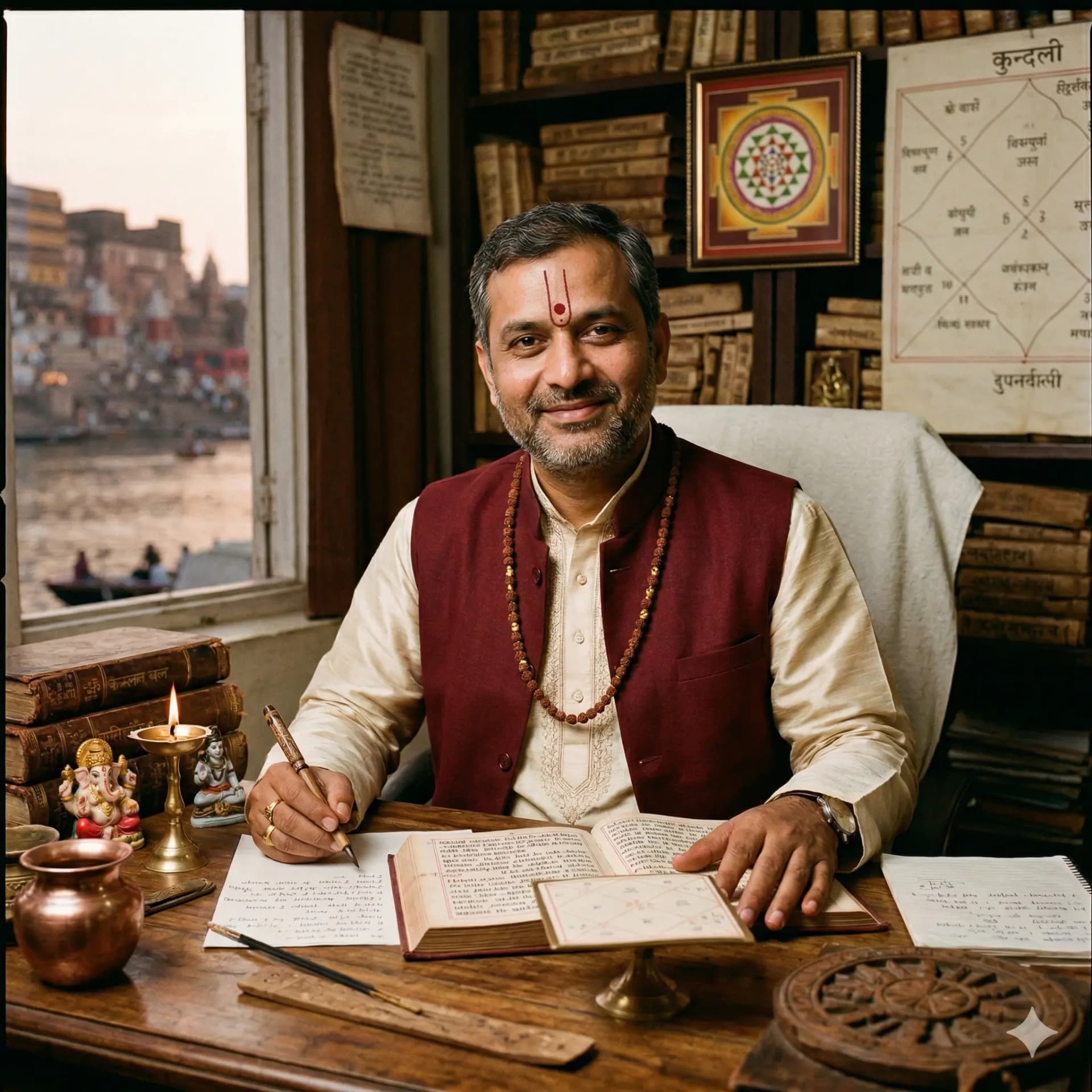
Pt. Raghav Sharma has practiced Parashari Jyotish for over twenty two years from Varanasi. A student of the Varanasi Jyotish tradition, he specialises in Graha-in-Bhava analysis, Vimshottari Dasha predictions, and Muhurta. He has authored over four hundred in-depth articles on Jyotish principles across the VastuCart knowledge network.