Rahu in the 12th house
Mesh Lagna (Aries Ascendant)
A practitioner study of Rahu in Vyaya Bhava for Aries ascendant natives. The north node in friendly Meena under Jupiter's dispositorship, the foreign-settlement and moksha-amplification signature, and the contemplative orientation that distinguishes this placement from the Ketu 12th surrender.
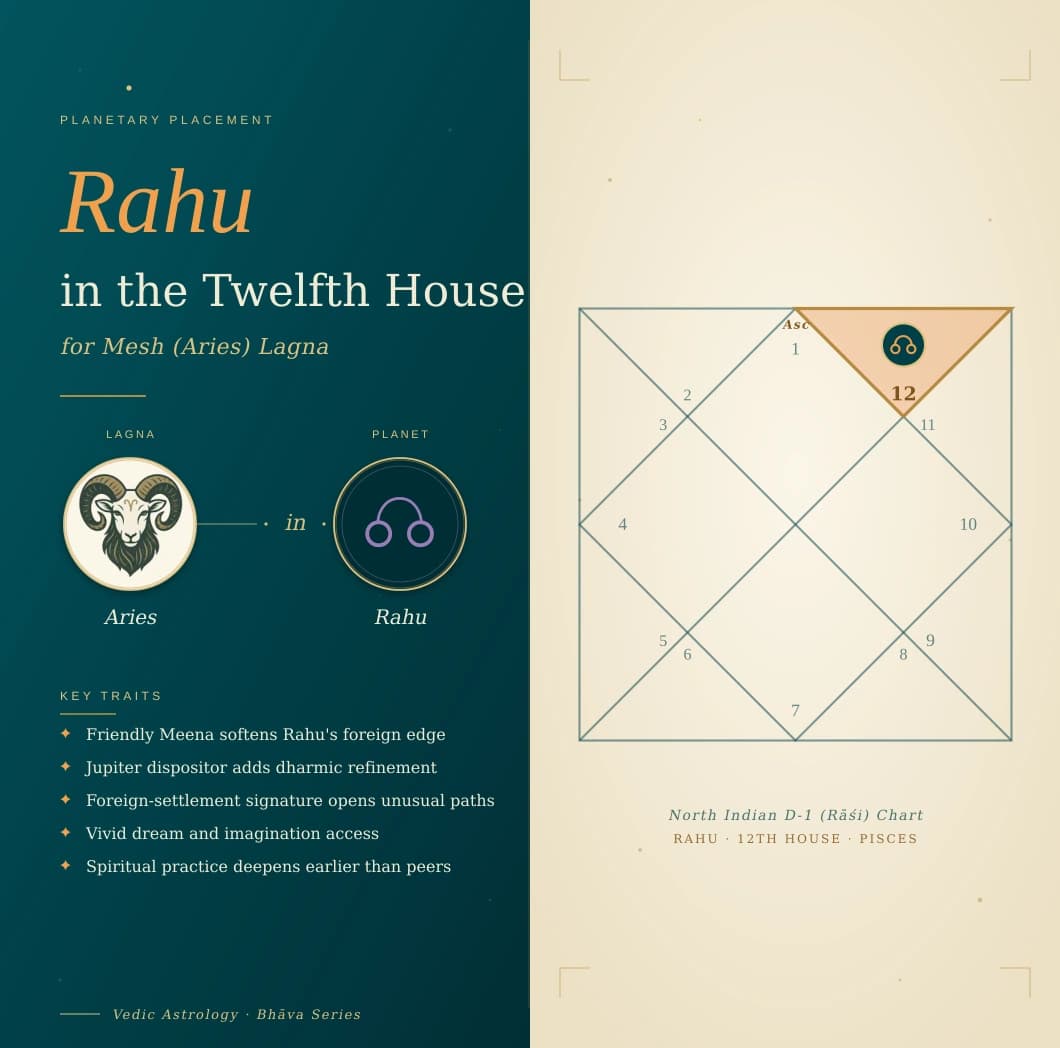
Rahu sits in friendly Meena in the twelfth house for Aries ascendant natives, the foreign-settlement and moksha-amplification signature.
Rahu in 12th house for Mesh Lagna, the quick reference
If you carry Rahu in the twelfth house of a Mesh chart, you hold one of the most contemplative Rahu placements in the entire Aries ascendant catalogue, because the north node sits in friendly Meena (Pisces) ruled by Jupiter (Guru) in the bhava that classical Jyotish assigns to moksha (liberation), foreign lands, isolation, expenditure, and the unseen layers of life. The twelfth from Mesh is Meena, ruled by Guru, and Rahu treats Jupiter's signs more comfortably than the fire signs because the watery temperament of Meena dilutes the air-shadow intensity of the north node into something closer to imagination than amplification. The placement is therefore neither exalted nor debilitated and sits in a friendly sign relationship that mainstream Parashari schools recognise as supportive.
The second structural feature is the Jupiter dispositorship. Guru rules the 9th and 12th for Mesh, and his ownership of the sign Rahu sits in routes the Rahu energy through the wisdom and foreign-territory grah of the chart before it reaches the rest of the kundali. The result is a native whose Rahu signature does not erupt as raw foreign hunger but matures into specific orientations: spiritual exploration, foreign higher study, ashram or monastic exposure, work that involves long stays in countries far from birth, and a contemplative interior life the family rarely sees. The third feature is the lagna-twelfth relationship. The twelfth house is the bhava immediately preceding the lagna and rules the unseen part of the self, the sleep state, dreams, and what the soul is letting go of in this incarnation. Rahu here means the native's broader life amplification arrives through what is hidden, distant, or surrendered rather than through the visible angles of action and partnership. This guide reads every layer of Rahu in 12th house for Mesh Lagna natives: the friendly Meena sign, the Jupiter dispositorship, the foreign-settlement and moksha-amplification signatures, and the hessonite protocol that requires careful chart confirmation.
Why Rahu in Vyaya Bhava is the moksha vehicle rather than the loss signature
Students often arrive at this placement carrying anxiety from popular astrology readings that label the 12th house as the house of loss and Rahu in it as the marker of unending expenditure. The honest practitioner answer is that Rahu in the 12th does not produce permanent loss. It produces a specific kind of dispersal signature that channels the native's resources, attention, and identity into territories the visible world does not credit. The 12th house rules everything that the native gives away: sleep, dreams, charity, sympathy, foreign experience, ashram time, and the surrender of the small self. Rahu's presence here means the dispersal is amplified rather than diminished, and the native's broader life work involves dispersing into something larger rather than accumulating around something smaller.
The friendly-sign redemption is the second specific feature that practitioners need to read carefully. Meena is one of the most receptive signs in the zodiac, ruled by Guru and characterised by emotional depth, oceanic imagination, and an instinctive comfort with what is invisible. Rahu in this sign loses much of his abrasive edge because the watery temperament of Meena absorbs and softens the air-shadow intensity. The native does not feel Rahu as raw hunger but as expansive imagination, and the foreign-amplification signature arrives through dharmic and contemplative channels rather than through aggressive ambition. The third interpretive layer is the contrast with Ketu in 12th. Both nodal placements in the Vyaya house produce moksha-oriented signatures, but they work in opposite directions. Ketu in 12th produces direct surrender and asks the native to release before the gain is even attempted. Rahu in 12th produces amplified longing for the unseen and asks the native to develop discrimination so the longing finds genuine territory rather than escapist substitutes. Ketu's pedagogy is surrender. Rahu's pedagogy is direction. Both placements produce durable spiritual lives when honoured, and both produce diffuse dissipation when ignored.
Rahu in Vyaya Bhava is not a sentence to permanent loss, it is an invitation to dispersal in service of something larger. The work is to find a contemplative or foreign territory that can hold the longing without consuming the seeker.
Terms used in this article
A short glossary of the Sanskrit and Jyotish terms that recur in this study. First-occurrence expansion is also retained inline.
- Vyaya Bhava
- The 12th house, the bhava of expenditure, foreign lands, sleep, and moksha.
- Moksha
- Liberation, the release from the cycle of rebirth, the fourth purushartha.
- Dispositor
- The lord of the sign in which another planet sits.
- 12L
- Twelfth-house lord, the planet ruling the sign on the 12th house cusp.
- Dushthana
- Difficulty house, the 6th, 8th, and 12th, where ordinary growth is harder.
- Trika
- The three dushthana houses (6, 8, 12) read as the difficulty triad.
- Ashram
- A traditional spiritual community where the seeker lives in residence with a teacher.
How Rahu in Vyaya Bhava shapes the Aries native
Physically the native carries the Mesh Lagna frame with the twelfth-house Rahu signature that classical texts catalogue carefully. The face often combines the Mesh sharpness on the upper register with a softer, more dreamlike quality in the eyes. Strangers consistently report that the native looks like they are partly elsewhere, and the comment is accurate: the 12th house rules the layer of the self that is permanently in dialogue with the unseen, and Rahu's presence amplifies that quality. The build can be wiry like the standard Mesh frame, or surprisingly long-limbed and water-shaped depending on which dispositor signature dominates. Many natives have an unusual mark on the foot or near the base of the spine, classical 12th house signatures.
Temperament is the layer where the placement most distinguishes the native from popular Aries stereotypes. These natives carry the Mesh courage and the willingness to act, but they also carry a permanent inner pull toward what the visible world does not contain. They report vivid dreams from childhood, an early fascination with foreign places they had not visited, and a comfort with solitude that surprised parents who expected an Aries extrovert. Many of them spend significant portions of their twenties or thirties living abroad, often in countries whose language and culture differ markedly from their birth context, and many find their first sustained spiritual practice through a foreign teacher rather than the family tradition. The shadow side is the same intensity: natives who do not channel the longing toward genuine territory often experience repeated cycles of escapist drift, sleep disturbance, and self-medicating habits that drain the chart. Natives who pair the contemplative pull with explicit discipline (a teacher, an ashram, a foreign-study commitment, a charity practice) develop the rare integration of action and contemplation the placement is genuinely capable of supporting.
Strengths, shadows and career fits
- Friendly Meena softens Rahu's foreign edge
- Jupiter dispositor adds dharmic refinement
- Foreign-settlement signature opens unusual paths
- Vivid dream and imagination access
- Spiritual practice deepens earlier than peers
- Charity and service work stabilise the chart
- Sleep disturbance and insomnia common
- Escapist substance use risk if undirected
- Foreign expenditure can outrun income
- Family struggles to read the contemplative side
- Loneliness in early adult years
- Diffuse identity if no spiritual anchor
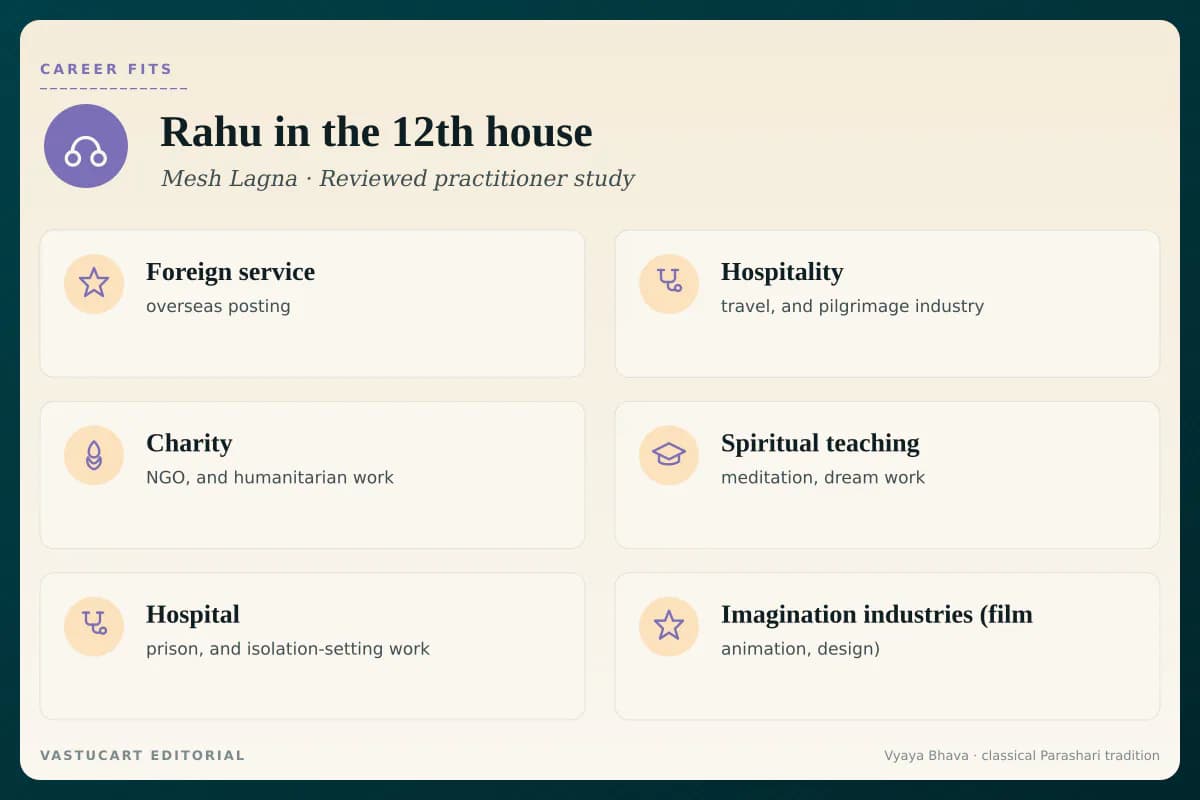
- Foreign service and overseas posting
- Hospitality, travel, and pilgrimage industry
- Charity, NGO, and humanitarian work
- Spiritual teaching, meditation, dream work
- Hospital, prison, and isolation-setting work
- Imagination industries (film, animation, design)
Where the foreign-contemplative vocation plays out
Career paths cluster around fields that draw on the twelfth house's foreign, contemplative, and unseen significations. Foreign service and overseas posting are the strongest single fit because the 12th house rules foreign lands and Rahu amplifies the foreign signature when his dispositor is comfortable. Many natives spend years in foreign capitals, often at embassies, multilateral organisations, or international NGOs, and the foreign tenure usually crystallises during Rahu mahadasha. Hospitality, travel, and pilgrimage work suit natives whose vocational mode is more direct contact with travellers.
Charity, NGO, and humanitarian work fit the chart because the 12th house rules giving and the Jupiter dispositorship channels the giving through dharmic structures. Spiritual teaching, meditation guidance, and dream-work practice suit natives whose contemplative life has matured through long practice with a teacher. Hospital, prison, and other isolation-setting work (the classical bandhana sthana significations of the 12th) fit natives whose vocation involves serving people the visible world has separated from ordinary circulation. Imagination industries (film, animation, design, fiction writing) suit natives who route the dream-rich interior into visible artefacts, and many natives in these fields find their best work emerges from material that arrived in dreams or extended solitude. Rahu mahadasha is the defining career window and arrives with the foreign relocation, the spiritual deepening, or the charitable commitment that becomes the platform for the rest of the working life.
Why the 12th house Rahu reads gentler than its dushthana label suggests
The clearest way to understand Rahu in 12th of Mesh is to read the friendly sign and the Jupiter dispositorship together rather than treating the dushthana label as the final word. The 12th house is classified as a dushthana because it rules expenditure, isolation, and what the native gives away, but the same significations are exactly the territory a maturing soul is meant to surrender into. Rahu's presence in the moksha bhava under Jupiter's wing turns what would be raw dissipation in another sign into directed surrender into territories Jupiter sanctions: foreign higher study, dharmic charity, ashram residence, contemplative work, and the long pilgrimage that reorganises the inner architecture.
The Jupiter-Rahu relationship is the second specific feature that the textbook accounts often miss. Some classical schools list Jupiter as a neutral or mild enemy of Rahu, but Rahu's behaviour in Jupiter's signs (Dhanu and Meena) is consistently more constructive than in Mars or Sun signs, and most experienced practitioners read the relationship as functionally cooperative when Jupiter is well-placed. The dispositor advantage means the Rahu energy is processed through the 9th and 12th lord before it reaches the rest of the chart, and Jupiter routes the amplification toward dharmic territories. The third interpretive layer is the lagna-twelfth relationship. The 12th is the bhava immediately preceding the lagna in the natural zodiac and rules what the soul is releasing in the current incarnation. Rahu in this position means the native's broader amplification arrives through what is being released rather than through what is being grasped, and the most successful natives explicitly orient their adult life toward the surrender themes the chart is asking them to engage.
When Rahu in 12th delivers its Vyaya Bhava chapter
Rahu mahadasha is the defining window for this placement and arrives with the foreign relocation, the spiritual deepening, or the charitable commitment that crystallises the contemplative vocation.
Sleep, feet, and the Vyaya health link
Health follows the Rahu-in-12th pattern with specific Vyaya body-part vulnerabilities. Constitution is generally lean and intense, with vata most prominent because Rahu carries shadow-air and Meena carries oceanic kapha-vata, producing a temperament that needs steady grounding routines. The 12th house body-part rulership covers the feet, the sleep state, and the deep nervous system, and the placement raises specific risk for sleep disturbance, vivid or disturbing dreams, and foot-related conditions. Many natives report lifelong sleep irregularity that responds to disciplined evening routines.
The foreign-infection signature is the second specific layer. The 12th house rules foreign lands and the body's encounter with unfamiliar pathogens, and Rahu's presence amplifies the susceptibility to conditions that arrive during foreign travel. Annual full-panel screening from the late twenties is recommended and especially important after any extended foreign stay. The escapism risk is real because the placement amplifies whatever the native uses to soothe the contemplative longing, and substance-related histories run in many families with this configuration. Steady sleep hygiene, daily meditation practice, and avoidance of late-night intoxicants are non-negotiable lifestyle stabilisers because the chart's natural pull toward the unseen needs ordinary discipline as a counterweight rather than as opposition.
Remedies for Rahu in the Mesh Vyaya angle
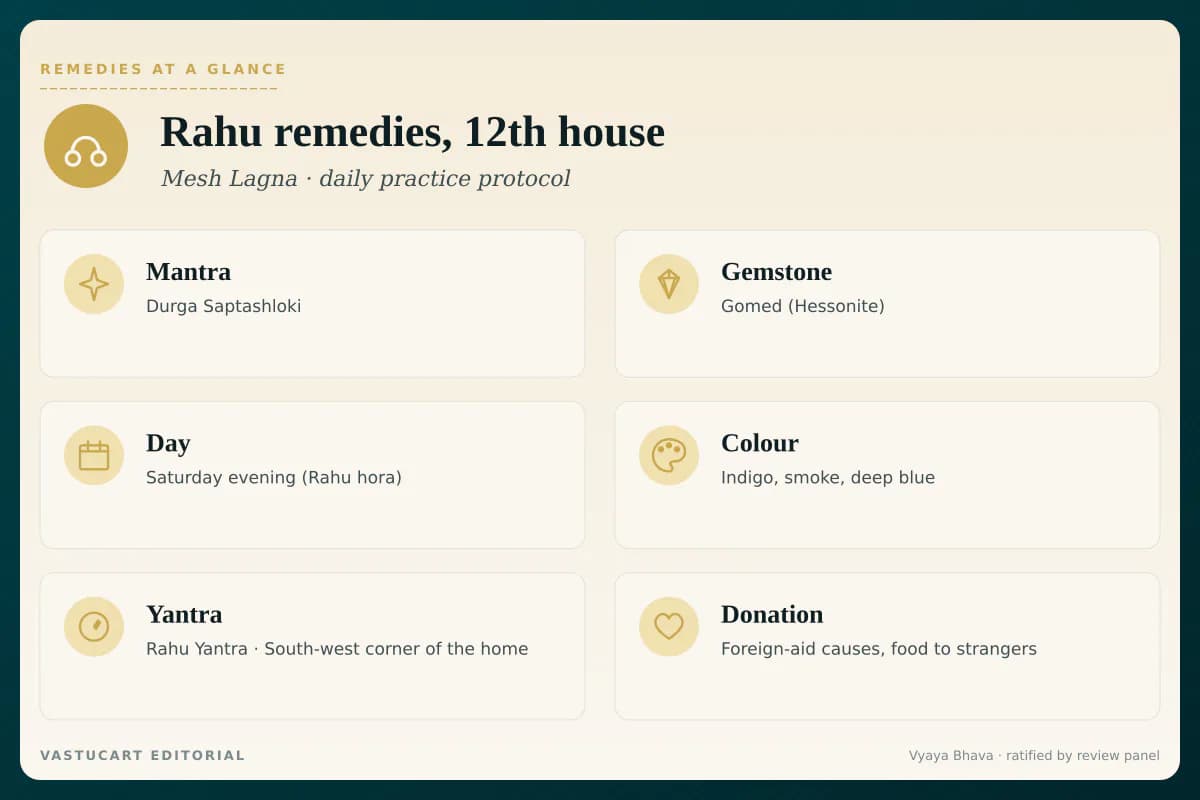
The daily Durga worship is the primary remedy for this placement because Durga is the classical patron deity of Rahu and her warrior form holds the north node's longing without being absorbed by it. Rise before sunrise, bathe, wear dark blue or smoky grey clothing as the practice settles, and visit a Durga temple if accessible. The Durga Saptashloki is the primary recitation, the seven-verse essence of the Devi Mahatmyam that creates a containing field for the amplified longing the placement otherwise releases as drift. Reciting it at sunrise daily for forty days at any major Vyaya transition (a foreign relocation, an ashram entry, a major charitable commitment) is the formal protocol.
For the Vyaya placement specifically, a sustained meditation or contemplative practice with a qualified teacher is the single most stabilising remedy because the chart's longing toward the unseen requires structured territory rather than open dispersal. Offer red flowers, coconut, sesame seeds, and dark sweets at the altar, and donate to causes that serve the dispossessed (refugee aid, hospice, ashram support), all of which channel the Rahu and Vyaya karakatvas constructively. The conscious-surrender practice is the lifestyle remedy that compounds across decades into the difference between Vyaya-spiritual depth and Vyaya-spiritual drift. The gemstone is hessonite (Gomed, grossular garnet), recommended only after careful chart confirmation because the gemstone amplifies whatever the placement is currently producing, and a Vyaya Rahu can sharpen either the contemplative gain or the dispersal risk. Wear a natural Sri Lankan or African hessonite of minimum five ratti set in silver on the middle finger of the right hand on a Saturday at sunrise after Rahu mantra recitation.
Gemstones for Rahu in 12th house Mesh Lagna
Hessonite is the primary Rahu gemstone but is recommended carefully because the Vyaya placement is sensitive to amplification in either direction.



Disclaimer: Hessonite over a Vyaya Rahu can sharpen either the contemplative gain or the dispersal risk. Always consult a qualified Jyotishi before permanent wearing.
Rudraksha beads for Rahu in 12th house
The Rahu-aligned rudraksha is the Nau Mukhi (Nine Mukhi), the bead directly ruled by Durga and the north node.
The classical Rahu rudraksha and the bead specifically associated with Durga. Contains the amplification energy in the Vyaya dimension, supports the contemplative orientation, and stabilises the inner intensity when the foreign-settlement signature is active.
The five-mukhi bead is the Jupiter bead and serves as a primary secondary support for this placement because Jupiter is the dispositor of Rahu in Meena. Wearing the Panch Mukhi alongside the Nau Mukhi compounds the placement's natural strength by honouring both the planet and his sign-lord.
Rahu Yantra for the Vyaya placement
Sacred recitations for Rahu in the Vyaya angle
Balad akrishya mohaya maha maya prayachchhati
Durge smrita harasi bhitim ashesha jantoh
Svasthaih smrita matimativa shubham dadasi
Daridrya duhkha bhaya harini ka tvad anya
Sarvopakara karanaya sada ardra chitta
Translation: Even the minds of the wise are forcibly drawn by the goddess Bhagavati, the great Maya who bestows delusion. When remembered, O Durga, you remove the fear of all beings. When remembered by the well, you bestow auspicious wisdom. Who but you removes poverty, sorrow, and fear? Who but you is always compassionate, always doing good for all? The Durga Saptashloki is the seven-verse essence of the Devi Mahatmyam and is the perfect daily recitation for a chart where Rahu sits in the Vyaya angle and the amplified longing needs a containing devotional field.
Read the full stotra on stotra.vastucart.in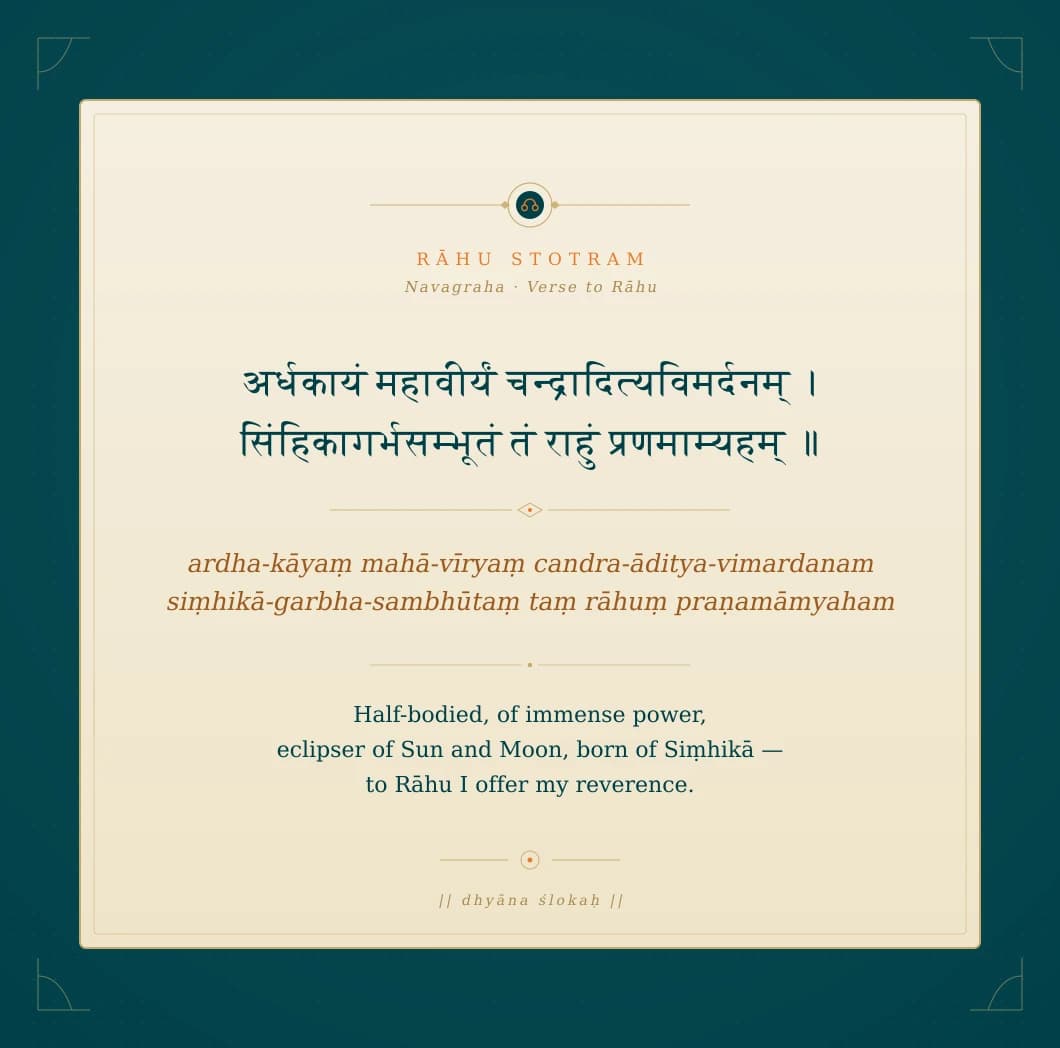
Tools for Rahu 12th house Mesh natives
Is your Vyaya Bhava Rahu carrying the foreign-settlement signature?
Get a full personalised analysis of your twelfth house Rahu, the Jupiter dispositor link, and the moksha timing.