
Moon in the 12th house
Mesh Lagna (Aries Ascendant)
A practitioner study of Chandra in Vyaya Bhava for Aries ascendant natives. Moon in friendly Meena, the 4L in 12H mother-as-moksha signature, the sleep-and-dream significance, and the foreign home pattern that distinguishes this placement from the grounded Moon 4th home angle.
Moon in 12th house for Mesh Lagna, the quick reference
If you carry Chandra in the twelfth house of a Mesh chart, you hold one of the more interpretively nuanced Moon placements in the Aries ascendant catalogue because the friendly sign softens what popular astrology often treats as a flat dushthana reduction. The twelfth house from Mesh is Meena (Pisces), ruled by Guru, and Jupiter-Moon relationship is classically neutral but practically favourable because both planets share temperamental affinities around contemplation, emotional depth, and the dissolution themes the 12th house rules. Meena is specifically a water sign and the Moon is classically a water planet, which means the sign provides a medium the Moon's nature actually welcomes even though the technical rule treats the relationship as neutral. The net reading is a placement that softens considerably from the fear-mongering version popular astrology produces, though the dushthana reduction still applies at a structural level.
The second structural feature is the 4L in 12H configuration. For Mesh Lagna, Chandra rules Karka and is therefore the 4L, the lord of home, mother, emotional foundation, and inner sukha. Placing this 4L in the 12H creates a specific configuration where the mother becomes structurally tied to the moksha, foreign, and dissolution themes the 12th house rules. Classical texts treat 4L in 12H with practitioner nuance rather than with fear: the mother is often geographically distant, spiritually oriented, or structurally tied to the native's moksha pedagogy in a way that other Moon placements do not produce. Home also tends to be foreign or temporary for significant portions of the native's adult life, and the emotional foundation runs through dissolution rather than through the grounded attachment that Moon-in-4th natives experience. This guide reads every layer of Moon in 12th house for Mesh Lagna natives: the friendly Meena sign, the 4L in 12H mother-as-moksha signature, the sleep and dream significance, the foreign home pattern, and the pearl protocol that applies here with confidence once the paksha check is run.
Why the 12th house Moon softens rather than destroys
Students often arrive at this placement carrying the popular astrology reading that any benefic in the 12th house suffers, and the honest practitioner answer is that the popular reading is structurally incomplete. Classical tradition does apply a reduction rule to benefics in dushthana houses, but the reduction is always qualified by the sign dignity and the specific friendly or hostile relationships at play. Moon in Meena is in a friendly water sign, and the two waters reinforce each other rather than fighting. The 12th house is also specifically the house of moksha, sleep, dreams, hidden matters, foreign lands, charity, and the dissolution of self into something larger, and the Moon's karakatvas of mind, mother, and emotional depth genuinely belong to this territory. The placement is not the destruction of the Moon's gifts, it is the relocation of those gifts into the contemplative-dissolution register rather than into the active emotional register other Moon placements produce.
The 4L in 12H configuration is the second specific feature that needs careful reading because it shapes both the mother relationship and the home-life pattern across decades. When the lord of home and mother occupies the house of dissolution and foreign lands, the mother becomes structurally tied to the moksha and foreign themes. Mothers of natives with this placement are often spiritually inclined, geographically distant from the native for significant parts of adult life, or carry a specific contemplative or charitable orientation that shapes the native's inner world. Home, similarly, tends to be foreign or temporary in ways the 4th-house Moon natives do not experience: the native may live abroad, move frequently, build homes that feel temporary even when they are technically permanent, or experience the concept of home itself as more inward than outward. The third interpretive layer is sleep and dream significance. The 12th house specifically rules sleep, and Moon (the mind-karaka) in this house produces natives with unusually vivid dream life, often with predictive, instructive, or unusually significant dreams that classical texts treat as diagnostic of the placement. Many natives keep dream journals from early adulthood because the chart literally asks them to.
When the mother-karaka sits in the moksha house of Jupiter's friendly sign, the mother becomes the first bridge to the inner life. The home that other natives build from brick and soil, this native builds in sleep and dream and the quiet spaces between wakefulness.
How Chandra in friendly Meena shapes the Aries native
Physically the native carries the Mesh Lagna frame softened by the watery Moon quality that friendly Meena intensifies. The face is round to oval with a gentle fullness, the cheeks hold warmth, and the eyes carry an unusually moist dreamy quality classical texts describe as the mark of a water-sign Moon. Complexion runs notably fairer because the watery Meena sign adds cool luminous quality. The 12th house body-part rulership covers the feet, left eye, and sleep cycle, and natives should pay sustained attention because the water-on-water combination produces a pattern where foot care, left eye sensitivity, and sleep quality all carry unusual significance.
Temperament distinguishes this native from every other Moon combination. These natives carry Mesh courage combined with an unusually contemplative inner life. They are pioneers but their pioneering has a dreamy quality, and they often pursue ventures other people would consider impractical because the native's inner landscape has shown them something the outer world has not yet caught up with. They cry easily and openly but the tears signify depth rather than fragility. They love their mother deeply but the love often involves geographical distance, or a sense that the mother is more present in the inner life than in physical proximity. They sleep more than peers and treat sleep as genuinely important. The shadow side is the dissolution pull the 12th house can produce if the native does not ground it in explicit worldly commitments. Natives who pair depth with specific active engagements (daily practice, vocation, relationships they actively maintain) develop the rare contemplative-active integration this placement supports.
Strengths, shadows and career fits
- Friendly water sign softens dushthana
- 4L in 12H mother-as-moksha signature
- Unusually vivid dream life
- Contemplative depth from early age
- Foreign home signature opens new paths
- Sleep treated as genuinely important
- Dushthana reduction still applies at baseline
- Krishna paksha reduces functional strength
- Mother often geographically distant
- Home feels temporary even when stable
- Feet and left eye require attention
- Dissolution pull needs deliberate grounding
- Contemplative writing and spiritual teaching
- Dream and sleep research, sleep medicine
- Foreign service and international charity
- Psychotherapy and depth counselling
- Art, music, poetry with inner-life themes
- Hospice, palliative care, end-of-life services
Where the contemplative-Moon vocation plays out
Career paths cluster around fields that honour the contemplative depth and foreign or hidden dimensions the placement produces. Contemplative writing and spiritual teaching are the strongest single fit because the chart produces natives whose inner life is unusually rich and whose capacity to put that inner life into written or spoken form grows across decades into a body of work that reaches readers other charts cannot reach. Many natives spend years writing or practising privately before publishing or teaching openly, and the eventual public expression carries a quality of depth that reflects the years of private preparation. Dream and sleep research, sleep medicine, and the psychiatric subspecialties that address nocturnal experience fit the chart because the 12th house rules sleep directly and Moon here gives the native an unusual professional affinity for the sleep domain.
Foreign service and international charity work suit the chart because the 12th house rules foreign lands and Moon here often produces natives whose vocational calling takes them abroad for significant portions of their career. Psychotherapy and depth counselling fit because the lunar emotional intelligence combined with the 12th house hidden-mind orientation produces natives whose clinical mode reaches psychological territory other therapists approach more cautiously. Art, music, and poetry with inner-life themes suit natives whose creative pull is more aesthetic, and many build careers in forms that specifically express the dream-and-dissolution register the placement understands natively. Hospice, palliative care, and end-of-life services round out the list because the placement gives the native unusual capacity to accompany people through transition themes without emotional destabilisation. Chandra mahadasha is when the vocational direction crystallises, often through a foreign opportunity or a dream that shapes the next decade of the native's working life in ways the native did not consciously plan.
Moon marked in the twelfth house of Mesh
- Chandra in Vyaya Bhava in friendly Meena, marked in luminous silver
- 12 houses in North Indian format
- Upper-central diamond is the 12th house of moksha
Why the chart delivers inner life through specific outer patterns
The mother-as-moksha reading is the most useful frame for Moon in 12th of Mesh. The 12th house rules dissolution themes (moksha, foreign lands, sleep, dreams, hidden matters, charity), and when Chandra occupies this house, the mother becomes structurally tied to these themes. Mothers of natives with this placement are often spiritually oriented, geographically distant for periods of the native's adult life, or carry a quality of inwardness that distinguishes them from more active mothers. The mother is the bridge through which the native first encounters the contemplative dimension. The relationship is often deeper than other mother-child dynamics precisely because it runs through the inner life, and natives often describe feeling closest to their mother during the periods when they were physically farthest from her.
The dream significance is the second specific feature clinical reports show. The 12th house rules sleep directly, and Moon here produces natives with unusually vivid, instructive dream life. Classical texts describe predictive dreams for natives with strong Moon in the 12th, and in consulting practice the report is reliable enough that I now ask about it directly. Many natives keep dream journals from early adulthood. They often report that important life decisions were made after dreams clarified something their waking mind could not resolve. The third pattern is the foreign-home signature. Because the 4L occupies the 12H and the 12H rules foreign lands, natives often live abroad for significant portions of their adult life, and the foreign setting frequently becomes the place where the native finally feels at home in a way the birth country never provided.
When Moon in 12th delivers its Vyaya Bhava chapter
Chandra mahadasha is the defining window for this placement and arrives with the contemplative depth and foreign home pattern crystallising in concrete form.
Feet, sleep cycle and the watery sensitivity profile
Health follows the Moon-in-12th-of-friendly-water-sign pattern with specific 12th house body-part considerations. Constitution tends toward kapha dominance because both the Moon and the Meena sign carry watery qualities, and the combination produces a durable but slightly fluid tissue quality that natives need to balance with movement. The 12th house body-part rulership covers the feet, left eye, and the sleep cycle, and natives should pay sustained attention to all three. Foot care is specifically important because the watery combination can produce foot swelling, sensitivity, or circulation issues if the native does not maintain deliberate foot health practices. The left eye is the specific side that needs attention because the 12th house marks this asymmetry classically.
Sleep is the single most important health layer for this placement because the 12th house rules sleep itself and Moon here produces natives whose sleep quality directly affects their mental, emotional, and physical health in ways other natives do not experience as strongly. Natives who sacrifice sleep for work or social commitments experience the placement's signature dim within days, while natives who honour sleep as a primary practice (consistent bedtime, dark room, no screens an hour before bed, morning daylight exposure) see the chart's gifts compound across decades. Monday is the ritual day, and Thursday adds a secondary observance because the dispositor of Moon here is Guru (Jupiter). Annual general health screening from the late twenties is recommended because the dushthana placement makes baseline data more valuable than reactive testing, and the sleep pattern specifically needs early monitoring if the native reports any sleep disruption.
Remedies for Chandra in the Mesh moksha house
The Monday discipline is foundational and delivers benefit for this placement because the chart is structurally aligned with the lunar current, and Thursday adds a secondary observance because Jupiter is the dispositor of Moon here. Rise before sunrise, bathe with cool water, wear white, silver-grey, or pale cream clothing on Mondays and yellow or gold on Thursdays. Visit a Shiva temple if accessible because Chandra sits on Shiva's matted hair and Shiva worship strengthens the lunar channel, and visit a Vishnu temple on Thursdays because Jupiter as the sign lord here specifically honours the Vishnu lineage. The Annapurna Stotram is the primary recitation for this placement because it is the hymn to Annapurna the mother goddess of nourishment, and the placement's 4L mother signature in the moksha house specifically benefits from the mother-of-nourishment invocation.
Reciting the Annapurna Stotram daily for forty days at any major life transition involving mother, home, or foreign relocation provides the stabilising current the chart rewards. Offer white flowers, white rice, milk, or sugar at the altar, and donate food, dairy, or funds to mothers in need, elderly women, or charities serving displaced families. The full moon practice is particularly important for this placement, and natives who establish a Purnima observance (sitting in moonlight, hydrating with water rested in moonlight, recitation of a chosen Chandra hymn) see the placement deliver its fullest expression across decades. The gemstone is pearl (Moti) and is recommended with confidence here because the friendly Meena sign softens the dushthana reduction enough to make the gemstone protocol effective. Wear a natural Basra or saltwater pearl of minimum five ratti set in silver on the small finger of the right hand on a Monday at sunrise after Chandra mantra recitation, and confirm the paksha reading with a practising Jyotishi before permanent wearing. The lifestyle adjustment that compounds most is treating dreams as information rather than as noise. Because the chart specifically wires sleep and dream significance into the native's emotional-practical life, natives who keep a dream journal and pay attention to the imagery experience the placement as a source of unusually accurate inner guidance across decades.
Gemstones for Moon in 12th house Mesh Lagna
Pearl is the primary recommendation here because the friendly Meena sign softens the dushthana reading enough to support the gemstone protocol.


Disclaimer: Pearl in the 12th house is a clean recommendation when the friendly sign applies, but the paksha reading should be confirmed by a qualified Jyotishi.
Rudraksha beads for Moon in 12th house
The Chandra-aligned rudraksha is the Do Mukhi (Two Mukhi), the bead directly ruled by the Moon and the Shiva-Parvati pair.
The classical Moon rudraksha and the safest daily-wear bead for any Chandra strengthening protocol. Supports the contemplative vocation, amplifies the mother-as-moksha signature, and is specifically recommended for natives in contemplative writing, sleep medicine, psychotherapy, or any vocation drawing on inner-life awareness.
The Jupiter rudraksha and the safest daily-wear bead in the tradition. For this placement specifically, the Panch Mukhi honours the dispositor of Moon (Guru rules Meena) and compounds the placement's natural strength by strengthening both planet and sign-lord through Jupiter's dharmic current.
Chandra Yantra for the moksha Moon
Sacred recitations for Chandra in friendly Meena
Nirdhutakhila ghosha nishkala para jyotih svarupa mayi
Atma rama shivatmakena manasa sarvada karpasi
Bhiksham dehi kripa avalambana kari mata annapurneshwari
Adaksha dana kshamaa shakti naveena janma avana kari
Bhiksham dehi kripa avalambana kari mata annapurneshwari
Translation: Giver of eternal bliss, granter of fearlessness, the ocean of beauty, who removes all the uproar of the world, the pure supreme light itself. With a mind ever delighting in the self and united with Shiva, giving at all times. Grant me food, O compassionate mother Annapurna Ishwari. Giver of patience, strength, and renewed life, grant me food, compassionate mother Annapurna Ishwari. The Annapurna Stotram is the classical hymn to the mother goddess of nourishment and is the perfect daily recitation for a chart where the mother-karaka sits in the moksha house and the mother signature is wired into the inner life.
Read the full stotra on stotra.vastucart.inTools for Moon 12th house Mesh natives
Is your Vyaya Bhava Moon carrying the mother-as-moksha signature?
Get a full personalised analysis of your twelfth house Chandra, the dream significance, and the foreign home pattern.
Questions about Moon in 12th house, Mesh Lagna
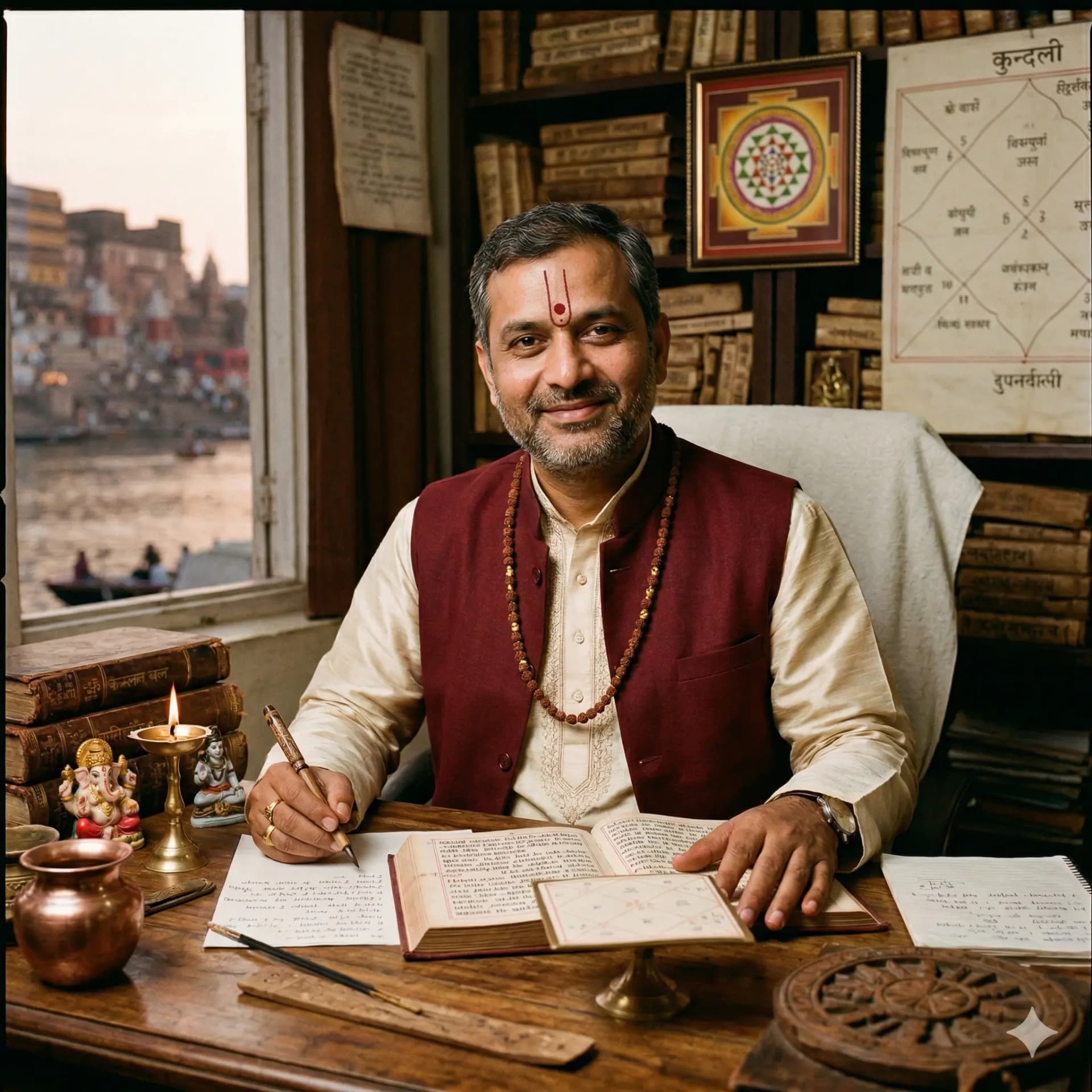
Pt. Raghav Sharma has practiced Parashari Jyotish for over twenty two years from Varanasi. A student of the Varanasi Jyotish tradition, he specialises in Graha-in-Bhava analysis, Vimshottari Dasha predictions, and Muhurta. He has authored over four hundred in-depth articles on Jyotish principles across the VastuCart knowledge network.