Mangal in the 12th house
Vrishabha Lagna (Taurus Ascendant)
A practitioner study of Mangal in Vyaya Bhava for Taurus ascendant natives. Mars in his own sign Mesha under direct sign rulership produces the 7L-and-12L-in-12H signature, with foreign relocation, expedition vocation, and a Manglik 12th flag tempered by the swakshetra dignity.
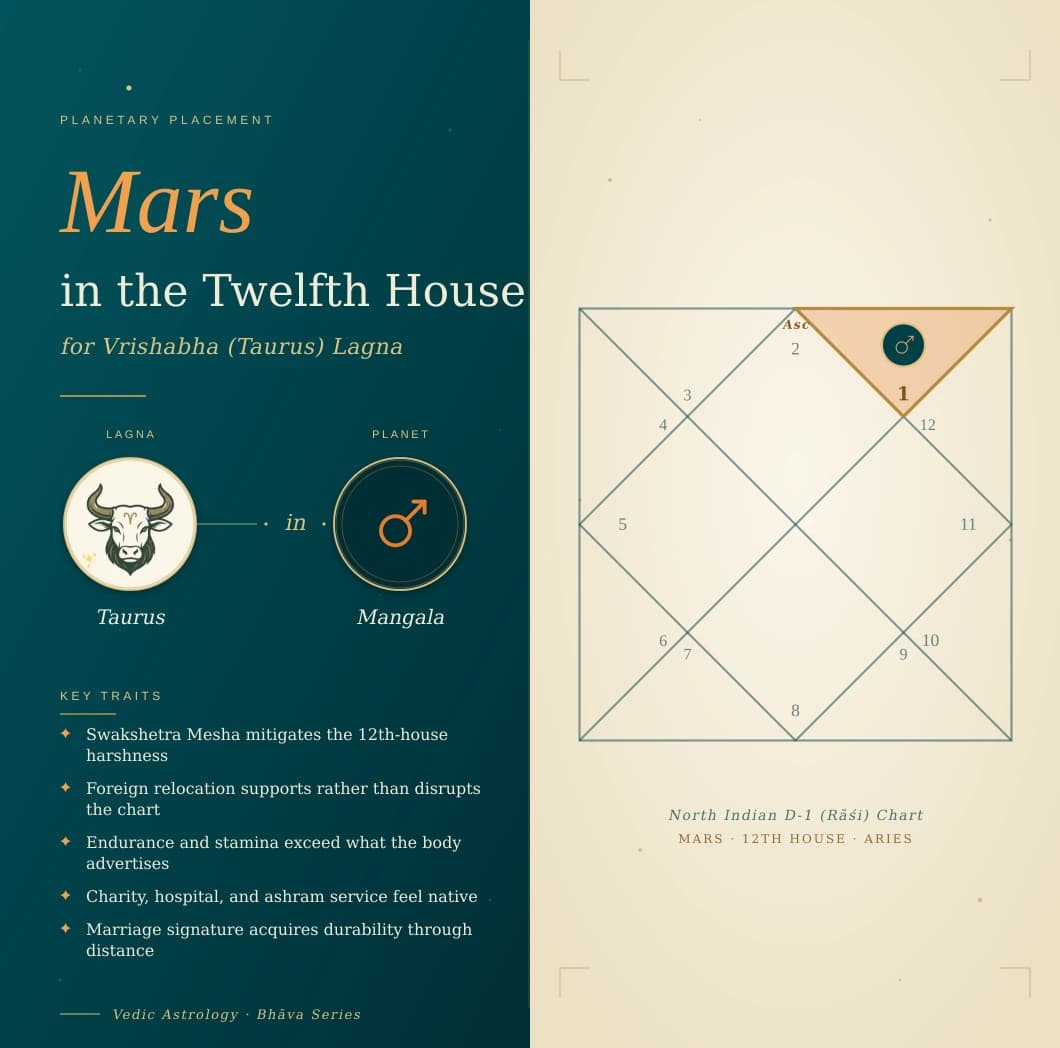
Mangal sits in his own sign Mesha in the twelfth house for Taurus ascendant natives, the 7L-and-12L-in-Vyaya foreign-vocation signature.
Mangal in 12th house for Vrishabha Lagna, the quick reference
If you carry Mangal in the twelfth house of a Vrishabha chart, the placement folds two of the chart's most consequential lords into the bhava of foreign lands and unseen expenditure. The twelfth from Vrishabha is Mesha (Aries), and Mesha is one of Mangal's two own signs. The dignity is therefore swakshetra Mars (own-sign Mars), so the placement is not afflicted, only deeply intense and routed through the chart's expense, dissolution, and foreign-territory channel.
The second feature is the 7L-and-12L double lordship for Vrishabha. Mangal rules both Vrishchika (the 7th lord, marriage and partnership) and Mesha (the 12th lord, foreign and expense). When the same planet ruling marriage sits in the 12th in his own sign, the marriage signature itself acquires a foreign or relocation flavour. Most practitioners read this as a chart whose partnership story unfolds away from the family city, often in another country, and whose income-and-spending pattern flows through cross-border channels by middle age.
The third feature is the Manglik 12th flag. Mars in 1, 4, 7, 8, or 12 from the lagna carries the classical kuja dosha (Manglik) signature, and the twelfth-house position is one of the canonical five. The own-sign mitigation reduces the harshness because an unafflicted Mars carries focused intensity rather than chaotic friction, but the matching protocol still applies. This guide reads every layer of the placement: the swakshetra Mesha, the 7L-and-12L composite, the foreign-vocation and expedition career template, the eighth aspect on the seventh house that defines the marriage signature, and the red coral protocol that fits this configuration when chart confirmation is in place.
Why Mangal in Vyaya Bhava reads as expedition vocation rather than dissolved energy
Students often arrive at this placement carrying anxiety from popular astrology readings that treat any twelfth-house Mars as a guarantee of injury, hospitalisation, or wasted effort. The honest practitioner answer is more textured.
Mars in his own sign Mesha in the twelfth house is not a wasted Mars; it is a Mars whose work happens out of public sight, away from the home city, in service to causes that ordinary jobs do not capture. Hospitals, ashrams, frontier zones, foreign deployments, expedition camps, and charity field offices are the structural settings where this configuration earns its keep.
The own-sign factor matters first. A planet in his own sign cannot be embarrassed by the dispositor because the dispositor is himself.
Mars answers to nobody but Mars in this placement, which means the courage and motor force the chart carries is unbroken by the watery or earthy houses' contingencies. The 12L sits in the 12H, which classical texts catalogue as a vipareet rajayoga seed when the twelfth is read as a dushthana lord-in-own-house signature.
The second feature is the kendra-trikona contrast. The twelfth is neither a kendra (angle) nor a trikona (auspicious dharmic angle), so the visible career and dharma houses do not directly carry the Mars output.
Instead, the chart's productive engine routes through losses, donations, sleep cycles, the foreign country, and the bandhana sthana (places of confinement) including hospitals, ashrams, prisons, and military barracks. The third feature is the karaka logic.
Mangal is not the natural karaka of the twelfth (Shani holds that role classically), but Mars in own sign in any bhava performs the bhava's positive significations vigorously. Foreign relocation, charity, contemplative service, and expedition work all gain a structural advantage when this configuration is supported by chart-confirmed remedies.
Mangal in his own Mesha in the twelfth for a Vrishabha native is not a wasted Mars. It is an expedition-Mars: the warrior force of the chart routed through foreign lands, frontier service, and the unseen work that ordinary careers never witness.
Terms used in this article
A short glossary of the Sanskrit and Jyotish terms that recur in this study. First-occurrence expansion is also retained inline.
- Vyaya Bhava
- The 12th house, the bhava of expenditure, foreign lands, sleep, charity, and the moksha gate.
- Bandhana Sthana
- Place of confinement, the 12th-house signification covering hospital, ashram, prison, and any retreat or barracks setting.
- Manglik dosha
- Karmic flag where Mars sits in 1, 4, 7, 8, or 12 from the lagna, requiring careful matching for marriage.
- Swakshetra
- Own-sign placement, where a planet sits in the sign he himself rules. Second-highest dignity after exaltation.
- 12L
- Twelfth-house lord, the planet ruling foreign expense, isolation, and the dissolution gate of the chart.
- Vipareet Rajayoga
- Reverse rajayoga seed when a dushthana lord sits in another dushthana, including the lord-in-own-dushthana variant.
- Karaka
- Natural significator of a domain. Shani is the natural karaka of the 12th house.
How Mangal in Vyaya shapes the Vrishabha native
Physically the native carries the Vrishabha frame with a noticeable taut quality through the upper torso that traces directly to Mars's eighth aspect on the seventh house and his presence in the body's expense channel. The face often combines the Taurus rounded jaw with sharper, more focused eyes than the lagna alone delivers. Build is medium with surprising endurance; many natives report walking, running, or carrying loads far longer than peers without registering fatigue.
The twelfth-house body parts are the feet, the left side of the head, and the venous-return system; the placement raises lifelong sensitivity in these zones that benefits from supportive footwear, regular foot care, and adequate hydration during travel.
Temperament shifts the standard Vrishabha defaults considerably. The lagna gives the steady earth element, but Mars in the twelfth running on his own fuel adds a deep restlessness that the surface composure does not show.
Conversation is courteous but selectively present, decisions land cleanly when the native has had solitary time to reach them, and the pace of life requires regular withdrawal from social density. Friends often note that the native disappears for weeks at a stretch, returns calm, and rarely explains the absence.
The shadow side rides the same engine. The 12L self-isolation pattern can curdle into avoidance, the body can register prolonged stress as sleep disturbance and digestive trouble, and the unspoken anger of suppressed Mars can surface as accidents, surgical episodes, or the occasional immune flare.
Pairing the placement with a deliberate physical-output discipline (long walking, swimming, contemplative martial-arts practice, or expedition-style training) is the single most effective stabilising intervention this configuration responds to.
Strengths, shadows and career fits
- Swakshetra Mesha mitigates the 12th-house harshness
- Foreign relocation supports rather than disrupts the chart
- Endurance and stamina exceed what the body advertises
- Charity, hospital, and ashram service feel native
- Marriage signature acquires durability through distance
- Lord-in-own-dushthana seeds vipareet rajayoga
- Manglik 12th flag needs explicit marriage matching
- Self-isolation pattern can curdle into avoidance
- Sleep disturbance recurs during career stress
- Foot, head-left, and venous-return sensitivity
- Foreign expense outpaces income early in career
- Suppressed anger surfaces as accident or surgery
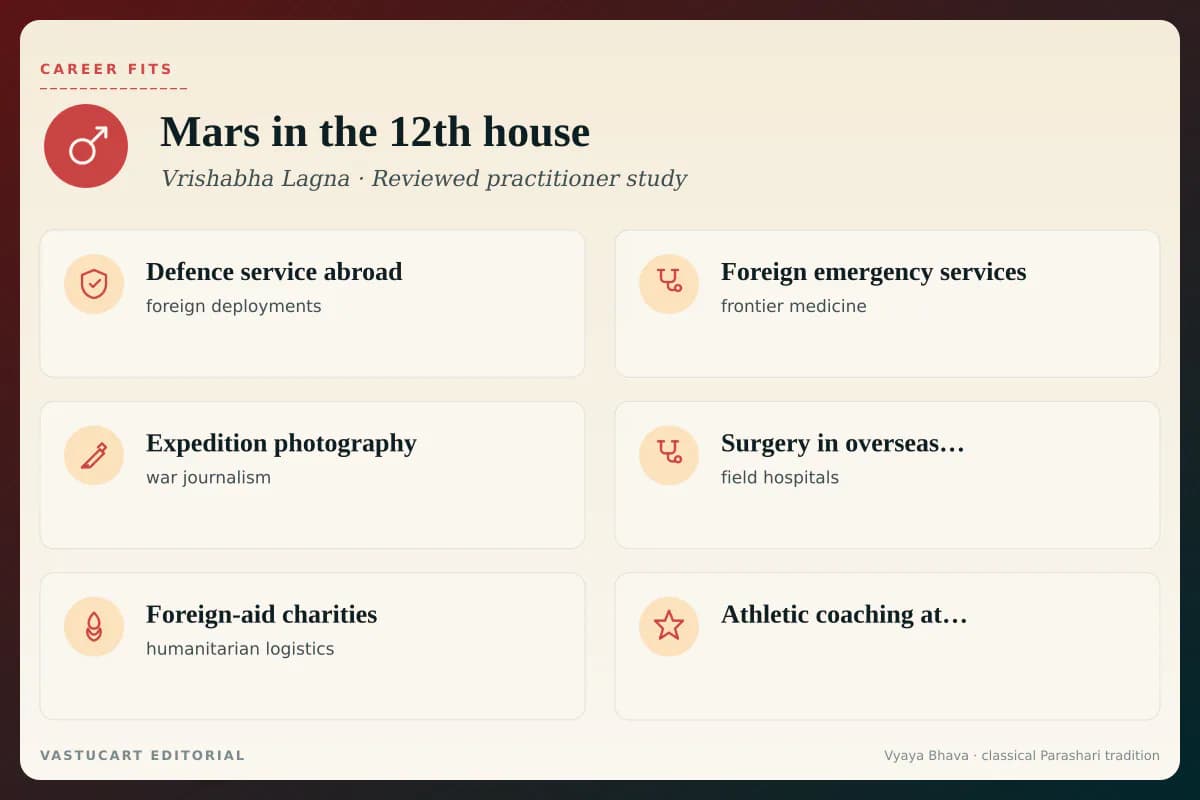
- Defence service abroad and foreign deployments
- Foreign emergency services and frontier medicine
- Expedition photography and war journalism
- Surgery in overseas placements and field hospitals
- Foreign-aid charities and humanitarian logistics
- Athletic coaching at expeditionary or training-camp level
Where the foreign-vocation Mars finds its public form
Career paths cluster around fields that draw on Mars's natural rulership of action, courage, and surgical precision but route those qualities through the twelfth house's foreign-and-unseen significations. Defence service abroad is the cleanest single fit: the seventh-aspect Mars on the lagna gives the body the warrior frame, while the twelfth-house seat sends the work overseas. Many natives find their first vocational foothold in armed forces, intelligence corps, or international peacekeeping postings before age thirty-five.
Foreign emergency services and frontier medicine form the second cluster because Mars in 12 in his own sign carries surgical precision into the bandhana sthana settings that hospitals and field clinics structurally are. Surgery in overseas placements is a recurring clinical observation, especially when supporting Sun or Jupiter strengthens the credentialing chain.
Expedition photography, war journalism, and field-reporting work suit natives whose 7L-and-12L composite turns the partnership channel itself into a foreign-territory engine. Foreign-aid charities, humanitarian logistics, and ashram-led contemplative service are recurring vocational templates because the twelfth's moksha and charity significations meet the swakshetra Mars's drive without distortion. Career typically peaks during Mangal mahadasha or its bhuktis when those windows fall in the productive years, and the income engine usually compounds through cross-border channels by the second mahadasha. Work environments that drain the native are noisy office cultures, conflict-saturated sales floors, and any role where the body cannot move and the manas cannot retreat into solitude on a regular schedule.
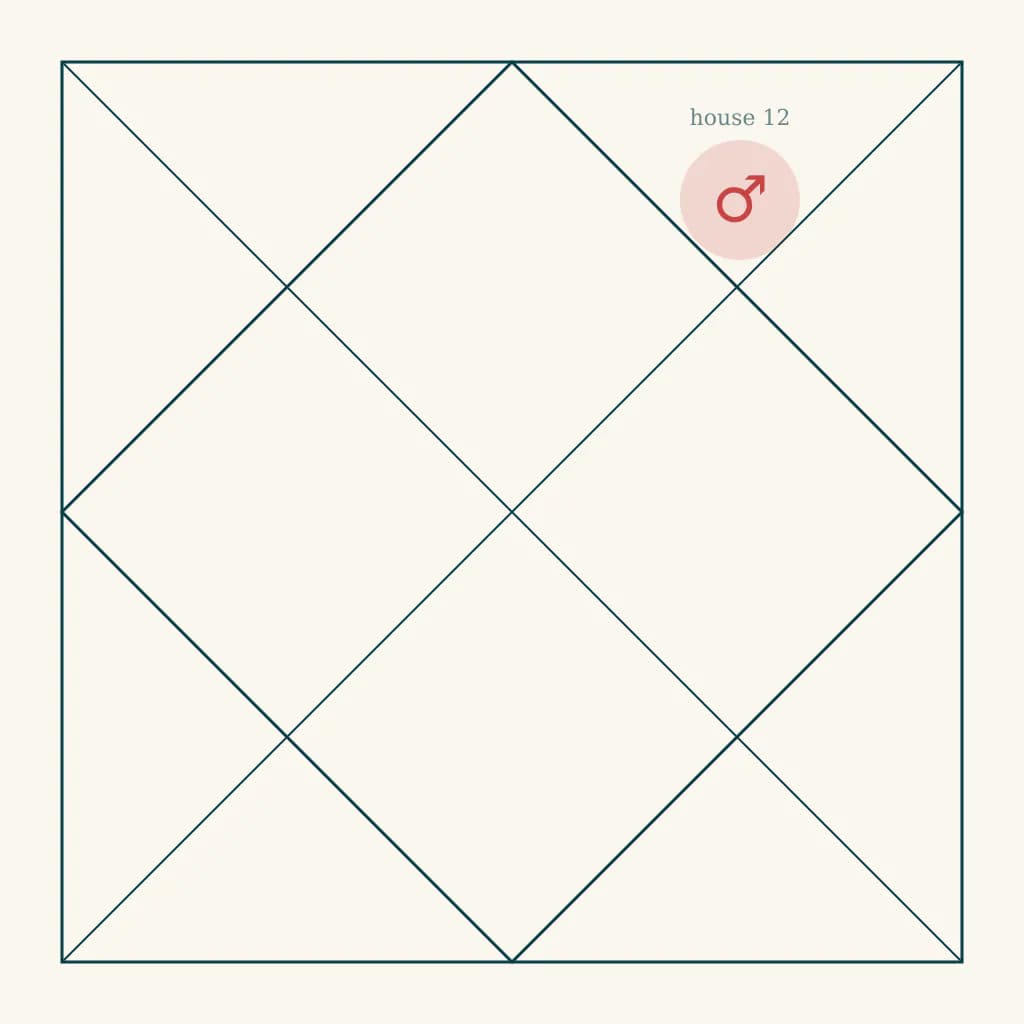
Why the swakshetra in Vyaya reads as channelled intensity rather than rupture
The cleanest way to interpret Mangal in 12th of Vrishabha is to read three structural facts as a single composite. The first is the Manglik flag itself. Mars in 1, 4, 7, 8, or 12 from the lagna marks the chart with the classical kuja dosha signature, and the twelfth-house position is one of the canonical five. The dosha is not a curse; it is a karmic notice that the partnership angle carries unusual heat and asks the matching protocol to find a partner whose own chart can hold the temperature. Several classical schools recognise own-sign cancellation, where Mars in Mesha or Vrishchika reduces the dosha to a partial flag because an unafflicted Mars carries focused force rather than chaotic friction.
The second compositional feature is the eighth aspect from the twelfth. Mars throws his special drishti from the twelfth onto the seventh house (full eighth aspect). For Vrishabha lagna the seventh is Vrishchika, the marriage seat, also ruled by Mangal. The result is that the twelfth-house Mars projects his force directly back onto the partnership angle that he also rules, creating a self-reinforcing loop the spouse-and-public field absorbs as commitment fuel rather than as rupture risk.
The third compositional feature is the lord-in-own-dushthana logic. Classical Parashari texts recognise a vipareet rajayoga seed when the lord of a dushthana (6, 8, 12) sits in another dushthana, and the lord-in-own-dushthana variant is one of the cleanest forms because the lord controls his own loss. Mangal sitting in the 12th in own sign produces an enriched vipareet pattern: foreign expenditure converts to foreign income, sleep losses convert to spiritual gains, isolation converts to professional moksha service. The rajayoga seed activates fully only when chart-confirmed remedies are sustained across a Mangal mahadasha, but the structural promise is in the placement from birth.
When Mangal in 12th delivers its Vyaya Bhava chapter
Mangal mahadasha is the defining window for this placement and arrives with the foreign relocation, the expedition vocation, or the surgical-charity transition that crystallises the twelfth-house Mars vocation.
Feet, blood, and the Vyaya health link
Health follows the Mars-in-Mesha-in-12th pattern with specific Vyaya body-part vulnerabilities. Constitution is pitta-kapha because Vrishabha carries earth-cool kapha and Mars adds fire-pitta to the channel; the digestion is generally strong but reactive to travel stress, schedule disruption, and the chronic time-zone load that foreign-vocation work brings. The twelfth-house body-part rulership covers the feet, the left side of the head, the eyes (especially the left eye), and the venous-return system, and the placement raises specific risk for foot injury, lower-leg circulation issues, eye strain during long screen or surveillance work, and the occasional severe headache during high-stress windows.
The blood-and-injury signature is the second body layer to read carefully. Mangal rules blood circulation, the muscular system, and the bone marrow, and his presence in the twelfth from the lagna casts the eighth aspect on the seventh house and a tenth aspect on the ninth. Cuts requiring stitches, road traffic incidents on foreign roads, and the occasional surgical procedure recur in clinical histories more than the lagna alone would predict. Active driving caution during foreign-country travel, protective gear during expedition work, and full-panel blood screening from the late twenties are non-negotiable lifestyle rules.
The sleep signature is the third clinically distinctive feature. The twelfth house rules the bed itself, and a Mars sitting in the bed of the chart registers life-stress as sleep disturbance before any other body system catches the signal. Most natives report that whenever a phase of insomnia or vivid disturbed dreams begins, an unexpressed expedition or relocation impulse is somewhere in the background. Daily meditation, evening pranayama, and the explicit physical-output discipline mentioned earlier resolve far more sleep complaints in this configuration than any over-the-counter intervention.
Remedies for Mangal in the Vrishabha Vyaya angle
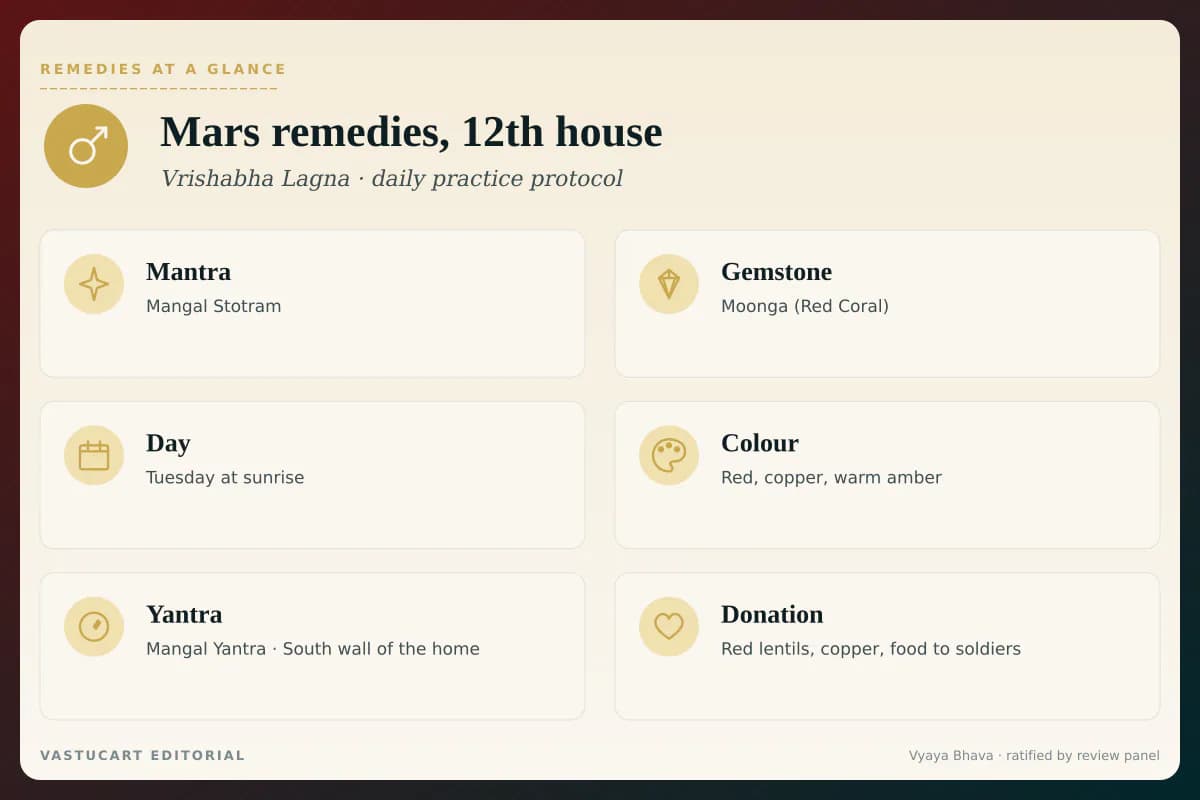
The daily Hanuman worship is the primary remedy because Hanuman is the patron deity of Mangal in the puranic tradition, and his stable courage holds the twelfth-house Mars without releasing it as foreign-territory misadventure. Rise before sunrise, bathe, wear red or saffron clothing on Tuesday, and visit a Hanuman temple if accessible. The Hanuman Chalisa is the primary recitation, the forty-verse hymn that builds a containing field for the Mars energy across decades. Reciting it daily at sunrise for forty consecutive Tuesdays at any major Vyaya transition (foreign relocation, surgery, expedition departure) is the formal protocol.
Pair the recitation with the Mangal Stotram on Tuesday morning. Offer red flowers, jaggery, urad dal, and red lentils at the home altar, and donate red items (lentils, jaggery, copper objects) to a soldier, a sportsperson, or a frontier-service worker on Tuesday at sunrise with your own hand. The 12th-house specific addition is regular charitable donation to hospital, ashram, or hospice causes, since the Vyaya Bhava itself is the chart's charity channel and the 12L ruling the twelfth wants its expense routed deliberately rather than randomly. Most clinical follow-ups confirm that natives who sustain a structured monthly charity rhythm across a year report the most stable foreign-finance flow and the cleanest expedition outcomes.
The gemstone is red coral (Moonga), the primary Mangal ratna. The configuration is generally well tolerated because Mars sits in his own sign, and the swakshetra dignity prevents the stone from over-firing the chart's pitta load. Wear a natural Mediterranean or Italian red coral of minimum five ratti, set in copper or panchaloha, on the ring finger of the right hand, on a Tuesday at sunrise after Mangal mantra recitation. Vrishabha is a friendly host for an own-sign Mars (Shukra and Mangal carry mutual respect in the Parashari friendship table), so coral over a 12L Mesha rarely overheats; the more common error is under-dosing the stone and missing the structural support. Always consult a qualified Jyotishi who has read the full kundali before permanent wearing.
Gemstones for Mangal in 12th house Vrishabha Lagna
Red coral is the primary Mangal gemstone and pairs cleanly with this 7L-and-12L swakshetra placement after a careful chart confirmation.



Disclaimer: Red coral over a Mesha swakshetra Mars is generally well tolerated for the Vrishabha lagna because Shukra and Mangal hold mutual respect in classical relationships. Even so, always confirm the full kundali with a qualified Jyotishi before permanent wearing.

Rudraksha beads for Mangal in 12th house
The Mangal-aligned rudraksha is the Teen Mukhi (Three Mukhi), the bead directly ruled by Agni and Mars.
The classical Mars rudraksha and the bead directly associated with Agni. Holds the twelfth-house Mars without inflaming it, supports the foreign-relocation and expedition vocation, and stabilises the marriage signature when worn through the Manglik partnership window.
The eleven-mukhi bead is the Hanuman bead, classically associated with the Mars deity himself. Wearing the Ekadash Mukhi alongside the Teen Mukhi compounds the placement's strength by honouring both the planet and his ruling deity, especially during foreign-vocation transitions and charity-led service phases.
Mangal Yantra for the Vyaya placement
Sacred recitations for Mangal in the Vyaya angle
kumaram shakti hastam tam mangalam pranamamy aham
Translation: I bow to Mangal, born of the womb of the earth, glowing like lightning, the youthful warrior bearing the spear in his hand. The Mangal Stotram is the canonical Navagraha verse to Mars and the most direct daily recitation for any Vrishabha native carrying Mangal in his own sign in the foreign-and-expense angle of the chart.
Read the full stotra on stotra.vastucart.in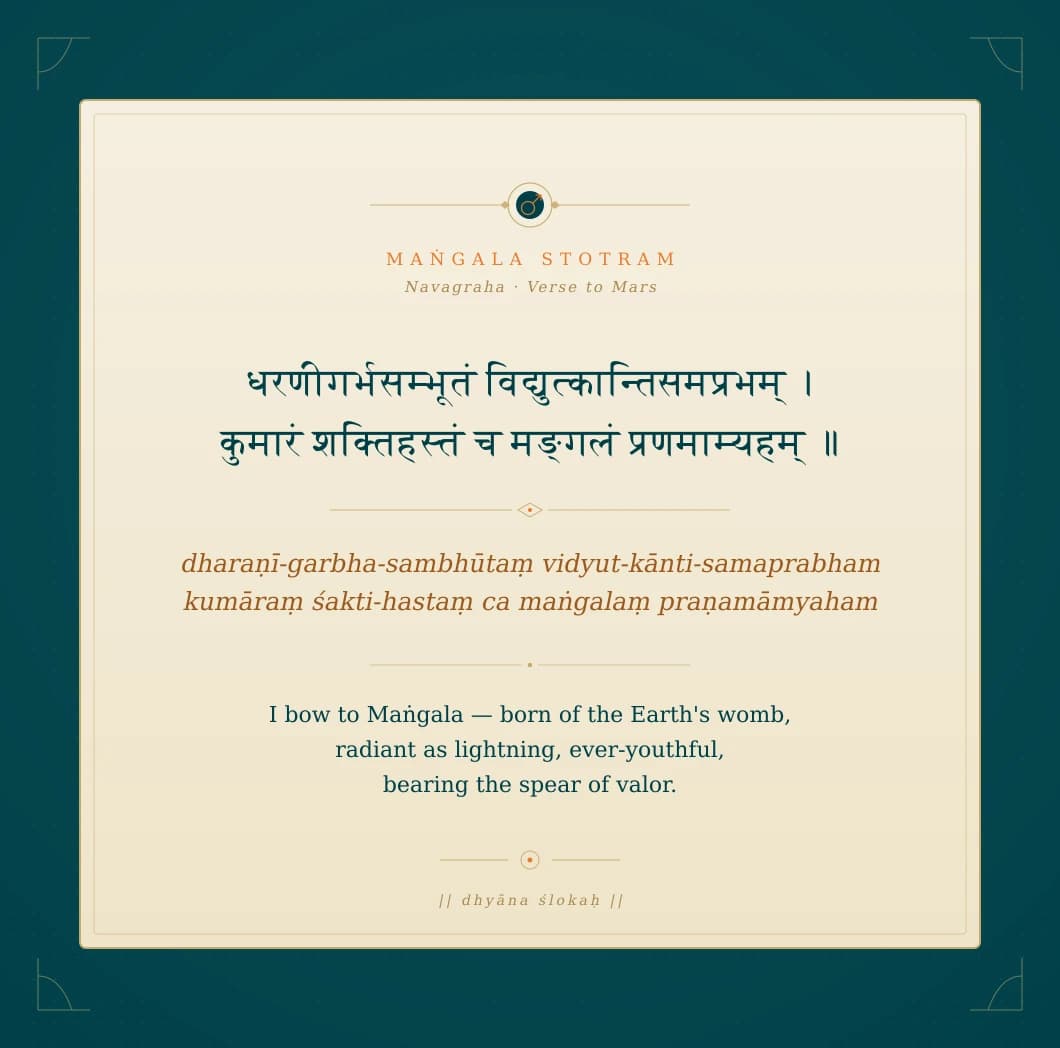
Tools for Mangal 12th house Vrishabha natives
Is your Vyaya Bhava Mars carrying the swakshetra Manglik signature?
Get a full personalised analysis of your twelfth house Mangal, the foreign-vocation arc, and the red coral protocol.