Ketu in the 6th house
Mesh Lagna (Aries Ascendant)
A practitioner study of Ketu in Ripu Bhava for Aries ascendant natives. The south node in Kanya under Mercury's dispositorship, the upachaya bhava that classical texts call Ketu's strongest placement, and the victory-over-enemies signature that distinguishes this configuration from the Rahu 6th amplification.
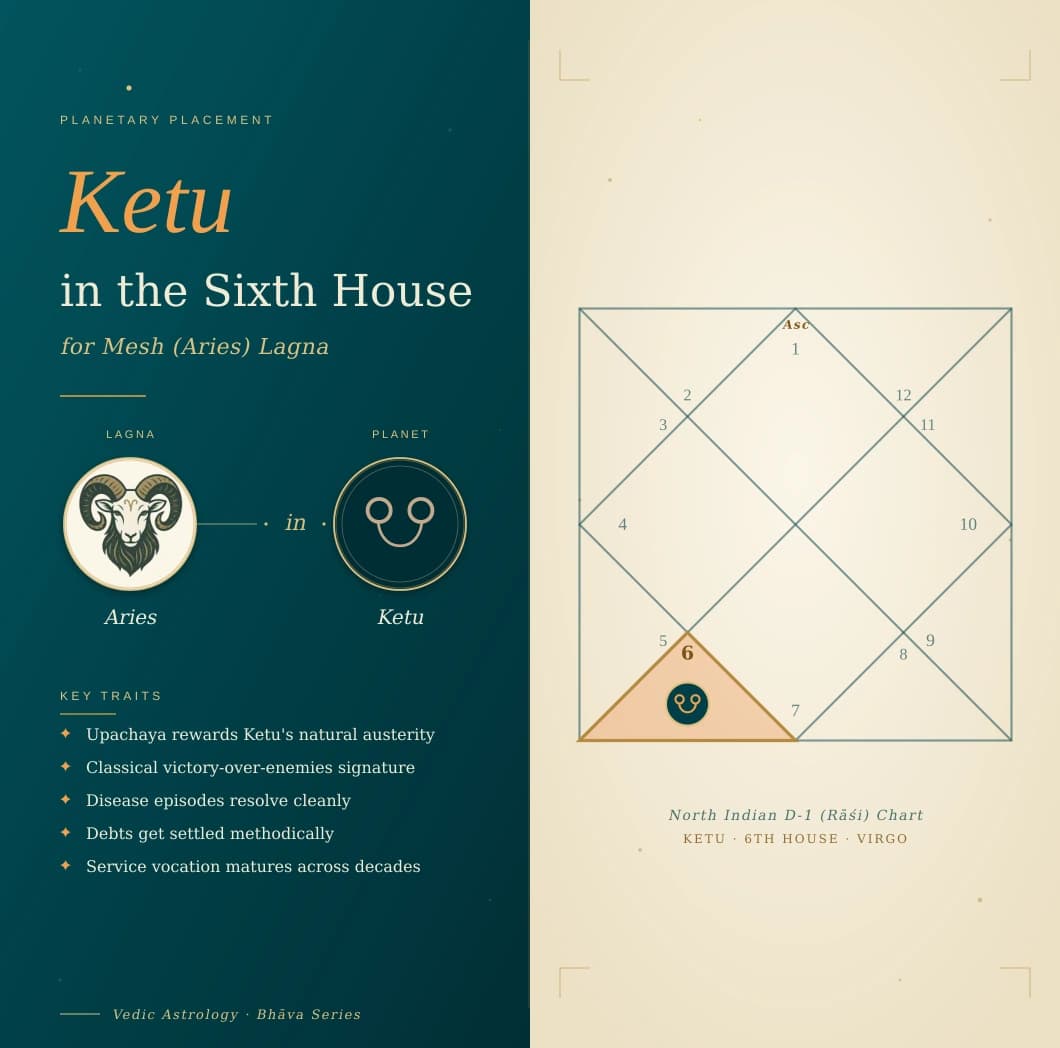
Ketu sits in Kanya in the sixth house for Aries ascendant natives, the classical victory-over-enemies and service-vocation signature.
Ketu in 6th house for Mesh Lagna, the quick reference
If you carry Ketu in the sixth house of a Mesh chart, you hold what classical Parashari recognises as Ketu's strongest possible placement, because the south node sits in Ripu Bhava (the sixth house, the bhava of enemies, debts, disease, service, and adversarial work). The 6th is one of the upachaya houses, and Parashari assigns special favour to malefics in the upachaya bhavas because the bhava grows stronger over time and rewards austere, persistent effort. Ketu's natural temperament (detachment, single-point focus, austerity) maps onto Ripu Bhava's pedagogy more cleanly than onto any other house in the chart, which is why most experienced practitioners read this placement as the single most rewarding configuration Ketu can occupy.
The sixth house from Mesh is Kanya (Virgo), ruled by Budha (Mercury). Mercury and Ketu are read as enemies in classical Parashari (Ketu disrupts Mercury's continuous analytical mind), but the upachaya context softens the friction substantially because the bhava itself rewards the disciplined-detachment that Ketu carries. The dispositor advantage means the Ketu energy is processed through the 6th lord (Mercury) before it reaches the rest of the chart, and Mercury routes the south node signature toward analytical-service territories rather than toward raw spiritual withdrawal. The third structural feature is the victory-over-enemies signature. Classical texts read Ketu in 6 as the single placement most reliably associated with the native overcoming adversaries, settling debts, and conquering chronic-illness episodes, and modern clinical reports confirm this pattern decisively. This guide reads every layer of Ketu in 6th house for Mesh Lagna natives: the Kanya sign and Mercury dispositorship, the upachaya rewards, the victory-over-enemies signature, the service vocation, and the cat's eye protocol.
Why Ketu in Ripu Bhava is the victory vehicle rather than the disease threat
Students often arrive at this placement carrying anxiety from popular astrology readings that label the 6th house as the bhava of disease and Ketu in it as the marker of chronic illness. The honest practitioner answer is that this reading is structurally inverted. Ketu in 6 is not the disease placement. It is the disease-conquering placement. The 6th house rules disease as one of its multiple significations, but it also rules the resolution of disease, debts, and adversaries, and Ketu's presence here favours the resolution side of the bhava rather than the affliction side. Most natives with this placement do encounter health challenges across life, and they consistently overcome them more cleanly than peers, often discovering exact diagnostic and treatment paths that elude others.
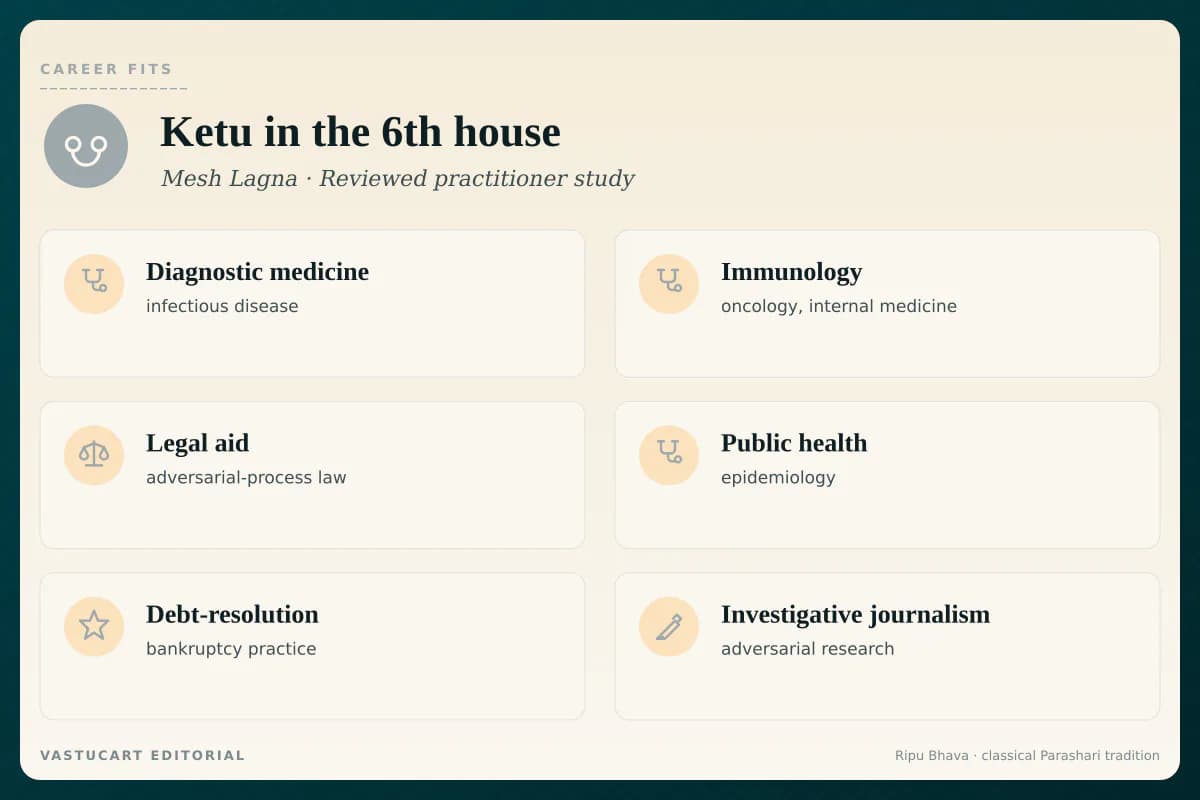
The upachaya redemption is the second specific feature that practitioners need to handle correctly. Classical Parashari assigns special favour to malefics in upachaya houses (3, 6, 10, 11) because these bhavas reward austere, persistent, self-driven effort. Ketu's natural temperament matches the upachaya pedagogy almost exactly, and Ripu Bhava in particular is the upachaya that Ketu was structurally designed to inhabit. The third interpretive layer is the service-vocation reading. The 6th house rules service work, and Ketu in this bhava produces natives whose career is structurally oriented toward serving the underserved (the sick, the indebted, the falsely accused, the marginalised). Many natives become physicians (especially in diagnostic, infectious-disease, and immunology specialties), legal aid lawyers, debt-resolution specialists, public-health workers, and adversarial-process professionals. The service is not performative charity but career-grade competence, and the chart specifically supports the durable build-out of the vocation across decades.
Ketu in Ripu Bhava is not the disease placement. It is the disease-conquering placement, the debt-resolution placement, the adversary-defeating placement that classical texts call Ketu's strongest configuration.
Terms used in this article
A short glossary of the Sanskrit and Jyotish terms that recur in this study. First-occurrence expansion is also retained inline.
- Ripu Bhava
- The 6th house, the bhava of enemies, debts, disease, service work, and adversarial process.
- Upachaya
- Growing house. The 3rd, 6th, 10th, 11th — they reward placements that mature over time.
- Dushthana
- Difficulty house, the 6th, 8th, and 12th, where ordinary growth is harder.
- Rina
- Debts, financial and karmic, ruled by the 6th house.
- Roga
- Disease and chronic illness, also ruled by the 6th house.
- 6L
- Sixth-house lord, the planet ruling the sign on the 6th house cusp.
- Dispositor
- The lord of the sign in which another planet sits.
How Ketu in Ripu Bhava shapes the Aries native
Physically the native carries the Mesh Lagna frame with a noticeable lean strength that strangers register as athletic without being showy. The body is often unusually resilient: many natives recover from injuries, infections, and surgical interventions faster than peers, and the immune system tends to handle exposure to unusual environments (foreign travel, hospital settings, conflict zones) with surprising resilience. The face often combines the Mesh sharpness with a watchful interior quality, and many natives have a mark or scar on the lower abdomen, side, or hip, classical 6th house Ketu signatures.
Temperament is the layer where the placement most distinguishes the native from popular Aries stereotypes. These natives carry the Mesh courage and the willingness to act, but they also carry an instinctive orientation toward the underdog and the adversarial process. They are drawn to disputes that need fair adjudication, illnesses that need careful diagnosis, debts that need patient resolution, and people who need defending against unjust treatment. They consistently report a clinical detachment under pressure that surprises peers expecting an Aries hot-headed reaction; the chart specifically rewards the calm, methodical approach to conflict that produces clean victories over decades. The shadow side is the same intensity: natives who do not channel the conflict-orientation consciously can experience repeated cycles of voluntarily entering disputes that drain them, and the cycles compound across the years into reputational fatigue. Natives who pair the conflict-aptitude with explicit selectivity (taking only the cases, patients, or causes that deserve their depth) develop the rare integration of warrior detachment with sustainable practice that the placement is genuinely capable of supporting.
Strengths, shadows and career fits
- Upachaya rewards Ketu's natural austerity
- Classical victory-over-enemies signature
- Disease episodes resolve cleanly
- Debts get settled methodically
- Service vocation matures across decades
- Mercury dispositor sharpens the diagnostic mind
- Drawn into too many disputes if undirected
- Lower abdomen and immune-system sensitivity
- Family reads the conflict-orientation as combative
- Periods of overwork in service settings
- Romantic life can feel transactional in cycles
- Inheritance debts may surface unexpectedly
- Diagnostic medicine and infectious disease
- Immunology, oncology, internal medicine
- Legal aid and adversarial-process law
- Public health and epidemiology
- Debt-resolution and bankruptcy practice
- Investigative journalism and adversarial research
Where the service-vocation plays out
Career paths cluster around fields that combine adversarial process, service to the underserved, and methodical resolution of difficulty. Diagnostic medicine and infectious disease are the strongest single fit because the 6th house rules disease and the Mercury dispositor sharpens the analytical mind that complex diagnostics demand. Many natives become specialists in internal medicine, infectious disease, immunology, or oncology, and the careers tend to deepen rather than burn out because the chart specifically supports the long-arc engagement these fields require.
Legal aid and adversarial-process law work because the 6th rules disputes and Ketu's calm-under-pressure produces practitioners who handle high-stakes adversarial work without losing composure. Public health and epidemiology suit natives whose vocational mode is population-level rather than clinical, and many natives in their forties move from individual practice into systems-level service. Debt-resolution and bankruptcy practice fit the chart because the 6th rules debts and Ketu's detachment produces specialists who handle the emotional weight of debt without absorbing it. Investigative journalism and adversarial research suit natives whose service orientation expresses through the published exposure of injustice rather than through direct clinical or legal practice. Ketu mahadasha is the defining career window and arrives with the specialty accreditation, the major case win, the public-health appointment, or the published investigation that crystallises the service vocation for the rest of the working life.
Why a shadow planet in Ripu Bhava reads stronger than its dushthana label suggests
The clearest way to understand Ketu in 6th of Mesh is to read the upachaya context together with the Mercury dispositorship. The 6th house is classified as both an upachaya (a growing house that rewards malefics) and a dushthana (a difficulty house). The dual classification matters because most experienced practitioners read the upachaya signal as dominant for malefics and the dushthana signal as dominant for benefics. Ketu, despite his shadow nature, behaves like a malefic in this calculation, which means the 6th-house upachaya elevation governs the placement reading and the dushthana label is structurally minor for this specific configuration.
The Mercury-Ketu enmity is the second specific feature the textbook accounts often skim. Classical Parashari lists Mercury and Ketu as enemies because Ketu disrupts Mercury's continuous analytical mind. Clinical reports show, however, that Ketu in Mercury's signs in the upachaya houses produces a specific synthesis: the analytical mind learns to operate from inner stillness rather than restless chatter, and the detached-Mercury combination is exactly what diagnostic medicine, adversarial law, and investigative work demand. The dispositor advantage means the Ketu energy is processed through the 6th lord (Mercury) before it reaches the rest of the chart, and Mercury routes the south node signature toward analytical-service territories. The third interpretive layer is the comparison with Rahu in 6 (the other nodal upachaya placement). Rahu in 6 amplifies the conflict and gain themes with foreign and unconventional flavour. Ketu in 6 refines the same themes through detached methodical mastery. Both placements work the upachaya, but they express it through opposite doorways.
When Ketu in 6th delivers its Ripu Bhava chapter
Ketu mahadasha is the defining window for this placement and arrives with the specialty accreditation, the major case win, the public-health appointment, or the published investigation that crystallises the service vocation.
Lower abdomen, immunity, and the Ripu health link
Health follows the Ketu-in-6th pattern with specific Ripu body-part vulnerabilities. Constitution is generally lean and resilient, with vata most prominent because Ketu carries the air-shadow temperament and Kanya is itself a Mercury earth-sign, producing a temperament that benefits from steady warming routines and a regular pranayama practice. The 6th house body-part rulership covers the lower abdomen, intestines, immune system, and the broad bandwidth of digestive and immunological function, and the placement raises specific risk for irritable-bowel patterns, food-sensitivity emergence, and immune-system irregularity during extended-stress periods.
The disease-conquering signature is the second specific layer. Despite the 6th house ruling disease as one of its significations, Ketu's presence here favours the resolution side of the bhava more strongly than the affliction side. Most natives encounter health challenges across life and consistently overcome them more cleanly than peers, often discovering exact diagnostic and treatment paths that elude others. Annual full-panel screening from the late twenties is recommended and especially important for digestive and immunological markers. Daily yoga (specifically twists and digestive-fire practices), moderate intake of warming spices (ginger, hingu, cumin), and avoidance of cold-drink habits are the lifestyle stabilisers because the chart's natural pull toward methodical work needs ordinary body discipline as a counterweight.
Remedies for Ketu in the Mesh ripu angle
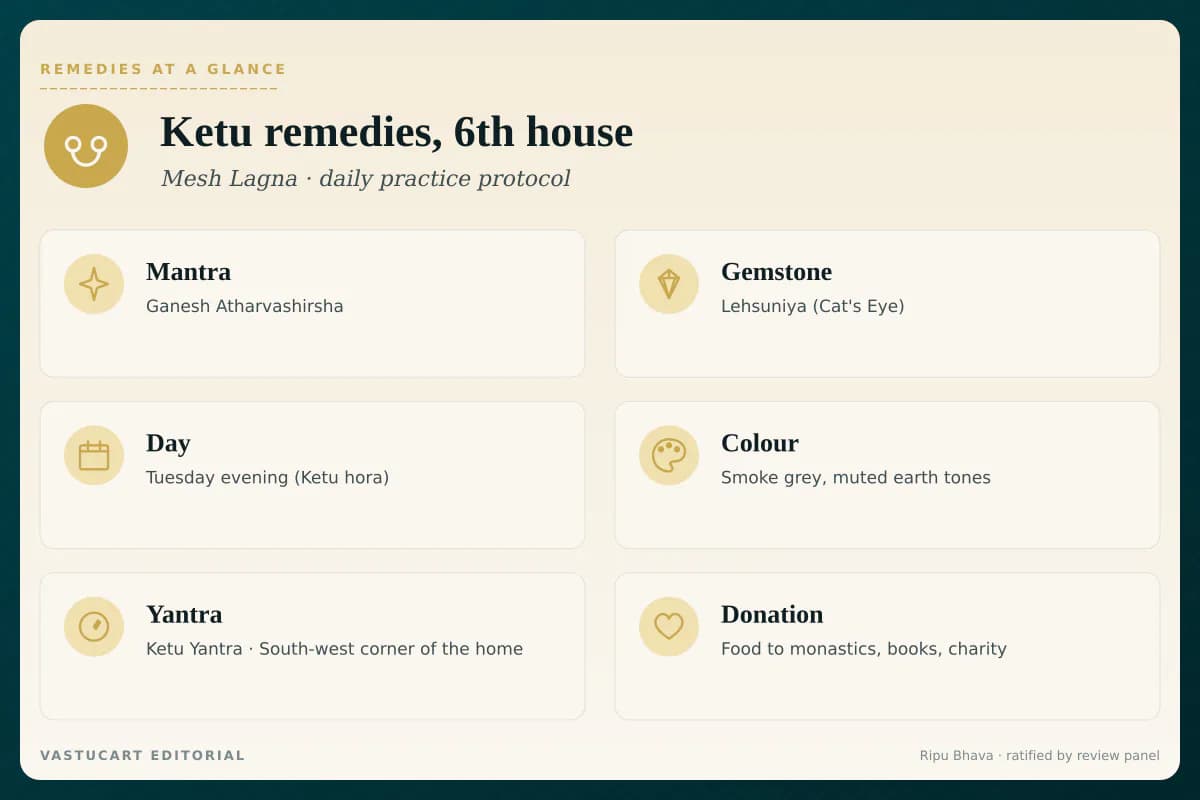
The daily Ganesha worship is the primary remedy for this placement because Ganesha is the classical patron deity of Ketu, and the obstacle-removing form is the deity who clears the path through adversarial processes that Ripu Bhava brings. Rise before sunrise, bathe, wear white or pale yellow clothing on Wednesdays, and visit a Ganesha temple if accessible. The Ganesh Atharvashirsha is the primary recitation, the Upanishadic hymn to Ganapati that creates a containing field for the Ketu signature in its upachaya expression. Reciting it at sunrise daily for forty days at any major Ripu transition (a court date, a diagnostic procedure, a debt-negotiation milestone) is the formal protocol.
Offer red flowers, modak, dhruva grass, and durva at the altar, and donate to causes that serve the underserved (free-clinic medicine, legal aid for the indigent, debt-counselling services for low-income households). The conscious-selectivity practice is the lifestyle remedy that compounds across decades into the difference between Ketu-6-mastery and Ketu-6-burnout: a daily commitment to take only the cases or patients or causes whose depth matches the native's bandwidth prevents the placement's natural tendency to over-extend in the service vocation. The gemstone is cat's eye (Lehsuniya, chrysoberyl), and unlike most Ketu placements, this configuration responds particularly well to wearing the gemstone because the upachaya bhava channels the amplification into the strongest dimension of the placement. Wear a natural cat's eye of minimum five ratti set in silver on the small finger of the right hand on a Wednesday at sunrise after Ketu mantra recitation, after a confirmed reading.
Gemstones for Ketu in 6th house Mesh Lagna
Cat's Eye is the primary Ketu gemstone and works particularly well here because the 6th house upachaya channels the amplification into the strongest dimension of the placement.


Disclaimer: Cat's eye in the upachaya of victory channels the placement's strongest signal cleanly. Always consult a qualified Jyotishi before permanent wearing.
Rudraksha beads for Ketu in 6th house
The Ketu-aligned rudraksha is the Aath Mukhi (Eight Mukhi) Ganesha bead, with the Tin Mukhi as a paired secondary for adversarial-process protection.
The eight-mukhi bead is the Ganesha bead and the standard daily-practice bead for Ketu-6 natives. Supports the victory-over-enemies signature, channels the service orientation toward sustainable territory, and stabilises the inner intensity when the adversarial-process signature is active.
The three-mukhi bead is associated with Agni (fire) and traditionally supports natives in adversarial professions. Wearing the Tin Mukhi alongside the Aath Mukhi compounds the placement's natural strength in dispute-resolution and disease-resolution work.
Ketu Yantra for the ripu placement
Sacred recitations for Ketu in the ripu angle
Tvameva pratyaksham tattvam asi
Tvameva kevalam karta'si
Tvameva kevalam dharta'si
Tvameva kevalam harta'si
Tvameva sarvam khalvidam brahma'si
Translation: Om, salutations to Ganapati. You alone are the manifest reality. You alone are the sole creator. You alone are the sole sustainer. You alone are the sole destroyer. You alone are everything, indeed Brahman itself. The Ganesh Atharvashirsha is the Upanishadic hymn to Ganapati and is the perfect daily recitation for a chart where Ketu sits in the ripu upachaya and the victory-over-enemies signature needs a containing devotional field.
Read the full stotra on stotra.vastucart.in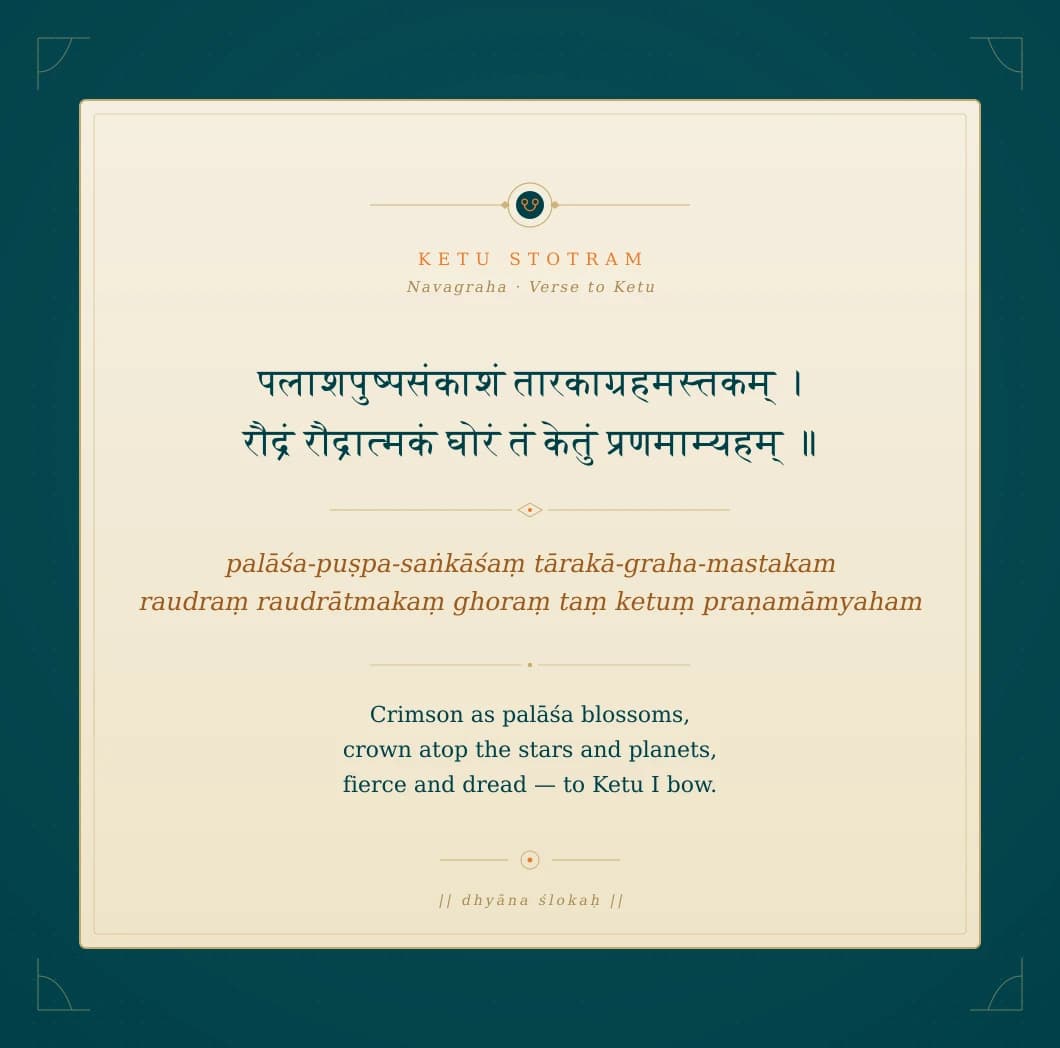
Tools for Ketu 6th house Mesh natives
Is your Ripu Bhava Ketu carrying the victory-over-enemies signature?
Get a full personalised analysis of your sixth house Ketu, the Mercury dispositor link, and the service-vocation timing.