Ketu in the 11th house
Mesh Lagna (Aries Ascendant)
A practitioner study of Ketu in Labha Bhava for Aries ascendant natives. The south node in friendly Kumbha under Saturn's dispositorship, the upachaya bhava that supports Ketu's austere channel, and the gains-through-detachment signature that distinguishes this configuration from the Rahu 11th amplification.
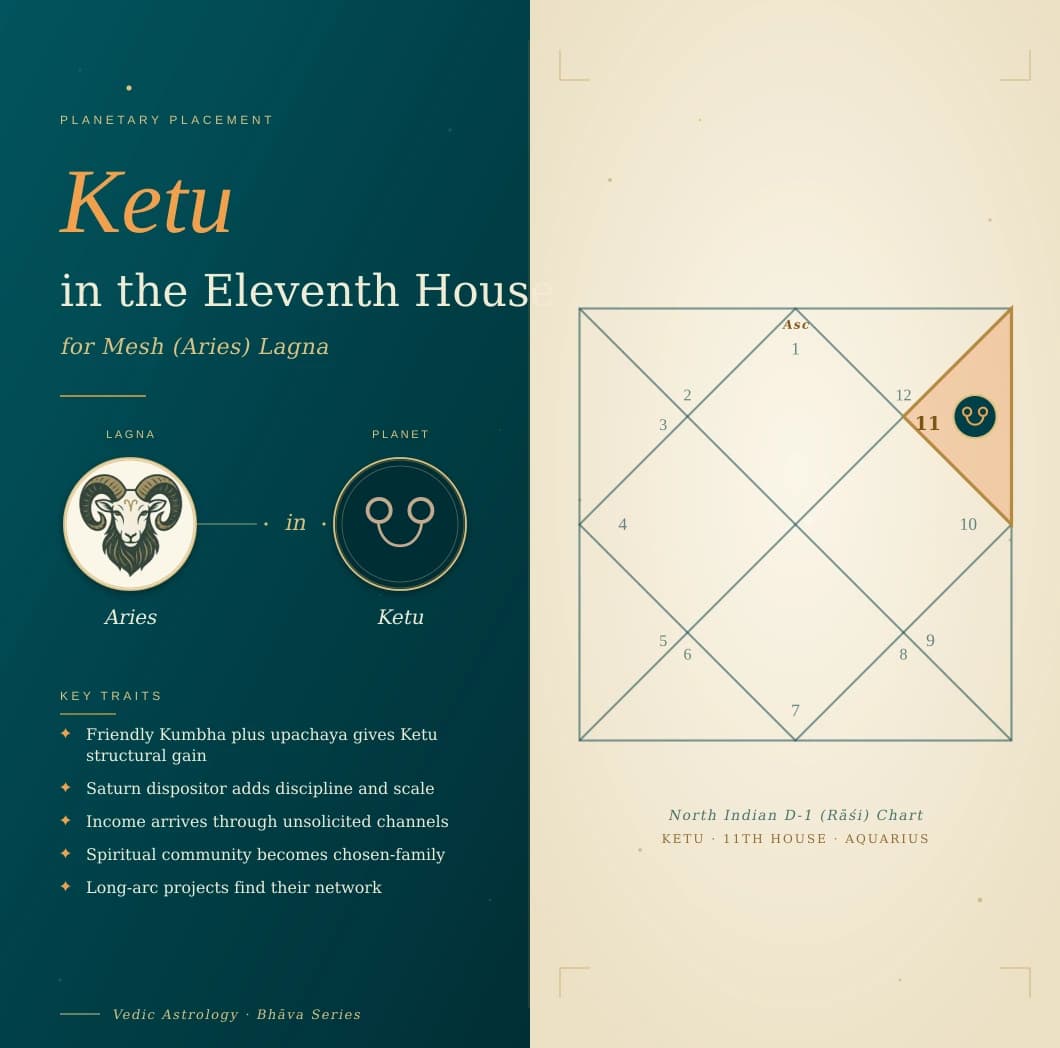
Ketu sits in friendly Kumbha in the eleventh house for Aries ascendant natives, the gains-through-detachment and spiritual-community signature.
Ketu in 11th house for Mesh Lagna, the quick reference
If you carry Ketu in the eleventh house of a Mesh chart, you hold one of the strongest Ketu placements in the entire Aries ascendant catalogue, because the south node sits in friendly Kumbha (Aquarius) ruled by Shani (Saturn) in Labha Bhava (the eleventh house, the bhava of gains, network, elder siblings, and aspirations). The 11th is one of the upachaya houses, and Parashari assigns special favour to malefics in the upachaya bhavas because they grow stronger over time and reward austere, persistent effort. Ketu's natural temperament (detachment, austerity, single-point focus) maps onto the upachaya pedagogy cleanly, and Saturn's friendly dispositorship adds structural support that most Ketu placements do not enjoy.
The Saturn-Ketu friendship is the second specific structural feature. Saturn and Ketu are read as friends in classical Parashari because both planets share an austere temperament, and Saturn appreciates the disciplined-detachment that Ketu carries. The dispositor advantage means the Ketu energy is processed through Saturn (the 10th and 11th lord for Mesh) before it reaches the rest of the chart, and Saturn routes the south node signature toward structured, scalable, often technology-mediated or community-mediated channels. The third feature is the gains-through-detachment signature. Most natives with this placement build income through channels they did not actively chase: gains arrive via spiritual community, philanthropy, scientific or technical work without strong commercial intent, or large-group memberships where the native serves rather than profits from. The income is real and durable, but it arrives through a doorway that seems indifferent to it, which is the Ketu signature in the gains bhava expressed cleanly. This guide reads every layer of Ketu in 11th house for Mesh Lagna natives: the Kumbha sign and Saturn dispositorship, the upachaya rewards, the gains-through-detachment signature, the elder sibling and network reading, and the cat's eye protocol.
Why Ketu in Labha Bhava is the detached-gains vehicle rather than the gains-deficit signature
Students often arrive at this placement carrying anxiety from popular astrology readings that label Ketu in the 11th as the marker of gains-deficit or absent friend-network. The honest practitioner answer is that this reading is structurally inverted. Ketu in 11 is not the gains-deficit placement. It is the detached-gains placement that produces a specific signature: income arrives through channels the native is not chasing, and the absence of grasping appears to be precisely what releases the income channel. Most natives with this placement build durable wealth across decades, but the wealth arrives sideways from causes the native serves, communities the native joins for non-monetary reasons, or scientific and technical work that has no immediate commercial application.
The upachaya redemption is the second specific feature that practitioners need to handle correctly. Classical Parashari assigns special favour to malefics in upachaya houses (3, 6, 10, 11) because these bhavas reward austere, persistent, self-driven effort. Ketu's natural temperament matches the upachaya pedagogy almost exactly, and the 11th in particular adds the network and aspiration dimension that compounds across decades. The third interpretive layer is the elder-sibling reading. The 11th house rules elder siblings and Ketu's presence often produces patterns where the native's elder sibling is structurally separated (geographic distance, monastic path, only-child situation, or eldest-cousin filling the role) and the native fills the elder-sibling role through chosen kinship in spiritual community or non-blood network. The gains-through-detachment signature works because the chart specifically supports building work and community without aggressive social positioning, and many natives in this configuration become quiet anchors of their professional or spiritual networks.
Ketu in Labha Bhava is not a gains-deficit signature. It is the detached-gains placement where income arrives through doorways the native is not chasing and the absence of grasping is precisely what releases the channel.
Terms used in this article
A short glossary of the Sanskrit and Jyotish terms that recur in this study. First-occurrence expansion is also retained inline.
- Labha Bhava
- The 11th house, the bhava of gains, network, elder siblings, and aspirations.
- Upachaya
- Growing house. The 3rd, 6th, 10th, 11th — they reward placements that mature over time.
- Aaya
- Income, the steady gain channel ruled by the 11th house.
- Dispositor
- The lord of the sign in which another planet sits.
- 11L
- Eleventh-house lord, the planet ruling the sign on the 11th house cusp.
- Karakatva
- The natural significations a planet rules independent of any chart.
- Moksha
- Liberation, the final purushartha, the karmic release Ketu signifies.
How Ketu in Labha Bhava shapes the Aries native
Physically the native carries the Mesh Lagna frame with a noticeable composure that strangers register as quiet authority. The body is generally lean and resilient, with the Saturn-Ketu austerity producing a temperament that handles ordinary life with surprising economy: the native sleeps less than peers, eats less than peers, and finds steady energy in routines that others find ascetic. Many natives have a mark or feature on the calf or ankle, classical 11th house signatures, and the build tends toward wiry strength rather than bulk.
Temperament is the layer where the placement most distinguishes the native from popular Aries stereotypes. These natives carry the Mesh courage but route it through community service rather than personal display. They are drawn to spiritual communities, scientific networks, technical guilds, and philanthropic associations from early adulthood, and they consistently report that their best friendships emerged from contexts where no one was trying to network. The Aries directness combines with the Ketu detachment to produce natives who are unusually generous with time and resources but unusually private about personal matters; the chart specifically supports the long-term anchor role in chosen-family communities. The shadow side is the same orientation: natives who do not channel the community-anchor role consciously can experience repeated cycles of giving past their bandwidth and ending in withdrawal. Natives who pair the community generosity with explicit boundaries about responsibility scope develop the rare integration of detached anchor with sustainable practice that the placement is genuinely capable of supporting.
Strengths, shadows and career fits
- Friendly Kumbha plus upachaya gives Ketu structural gain
- Saturn dispositor adds discipline and scale
- Income arrives through unsolicited channels
- Spiritual community becomes chosen-family
- Long-arc projects find their network
- Aspirations clarify around service themes
- Elder sibling distance or estrangement
- Family reads detachment as gains-deficit
- Calf and ankle sensitivity in Ketu dasha
- Periods of community-giving past bandwidth
- Hopes-and-wishes can detach from practical timing
- Romantic life can feel community-mediated
- Spiritual-community building and ashram work
- Scientific research and technical guilds
- Philanthropy and grant-making
- Open-source software and shared infrastructure
- Cooperative and member-network business
- Teaching and mentorship at scale
Where the detached-community vocation plays out
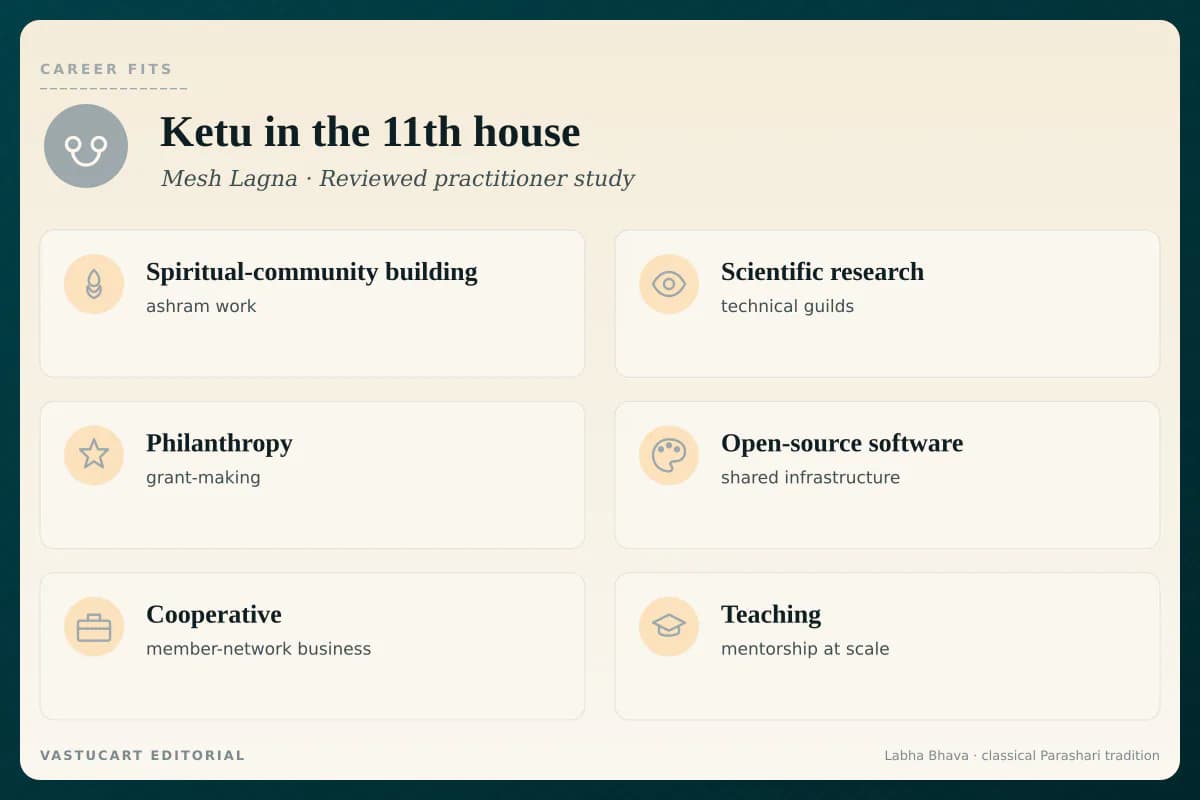
Career paths cluster around fields that braid community service with structured scale. Spiritual-community building and ashram work are a strong fit because the chart specifically supports anchoring chosen-family networks, and many natives in this configuration become long-term members or trustees of practice communities, classical-arts guilds, or contemplative-tradition institutions. Scientific research and technical guilds suit natives whose vocational mode is collaborative and disciplined: open-source software contribution, academic-research collaboration, scientific-society leadership, and similar non-commercial collective work.
Philanthropy and grant-making fit the chart because the 11th rules income flowing to large groups and Ketu's detachment produces practitioners who allocate resources without becoming attached to outcomes. Open-source software and shared-infrastructure work suit natives whose Saturn-dispositor influence channels the Ketu output through structured technology that scales. Cooperative and member-network business fits when the chart specifically supports ownership models that distribute rather than concentrate, and many natives in their thirties build cooperative-structure businesses that grow steadily without venture-capital scaling. Teaching and mentorship at scale work because the chart specifically supports passing knowledge through community channels rather than through hierarchical institutions. Ketu mahadasha is the defining career window and arrives with the public emergence of long-cultivated community work, the publication of a major collaborative project, or the formal trustee or anchor role that crystallises the detached-gains vocation.
Why a shadow planet in the gains upachaya reads stronger than the popular reading suggests
The clearest way to understand Ketu in 11th of Mesh is to read the friend-sign together with the upachaya context. Classical Parashari recognises the upachaya houses as the growth-favouring quadrant, and a malefic placed in any upachaya gains over time rather than expressing his nature at full intensity from the start. The 11th in particular adds the network and aspiration dimension that compounds across decades for natives whose temperament aligns with disciplined effort.
The Saturn-Ketu friendship is the second specific feature that the textbook accounts often skim. Saturn and Ketu share an austere temperament: both planets reward discipline, persistence, and detached effort, and both are sensitive to the shadow dimension of life that ordinary planets handle less skilfully. Most experienced practitioners read Saturn-Ketu in friend signs as functionally cooperative, and the dispositor advantage means the Ketu energy is processed through the 10th and 11th lord (Saturn) before it reaches the rest of the chart, which routes the south node signature toward structured, scalable, community-mediated channels. The third interpretive layer is the comparison with Rahu in 11. Rahu in 11 amplifies the gains and network themes with foreign and unconventional flavour, often producing intense networks and amplified income channels. Ketu in 11 refines the same themes through detached community service, producing slower but durable gains and chosen-family networks rather than wide professional ones. Both placements work the upachaya, simply through opposite means.
When Ketu in 11th delivers its Labha Bhava chapter
Ketu mahadasha is the defining window for this placement and arrives with the public emergence of long-cultivated community work, the publication of a major collaborative project, or the formal trustee or anchor role that crystallises the detached-gains vocation.
Calves, ankles, and the Labha health link
Health follows the Ketu-in-11th pattern with specific Labha body-part vulnerabilities. Constitution is generally lean and resilient, with vata most prominent because Ketu carries the air-shadow temperament and Kumbha is itself an air sign, producing a temperament that benefits from steady warming routines and weight-bearing exercise. The 11th house body-part rulership covers the calves, ankles, left ear, and the broader circulation of the lower body, and the placement raises specific risk for calf cramps, ankle sprains, varicose veins, and circulatory issues during prolonged-standing or seated periods.
The community-overgiving signature is the second specific layer. Ketu in 11 produces natives whose generosity can outrun their bandwidth, and the body absorbs the excess as fatigue, sleep disturbance, and lower-leg stress. Annual full-panel screening from the late twenties is recommended and especially important for circulatory and metabolic markers. The intoxicant risk is lower than for other Ketu placements because the Saturn-dispositor influence supports discipline, but watch for over-reliance on stimulants during community-work peaks. Daily yoga (specifically standing-pose work and pranayama practices), moderate intake of warming spices, and avoidance of late-night community calls are the lifestyle stabilisers because the chart's natural pull toward community service needs ordinary body discipline as a counterweight.
Remedies for Ketu in the Mesh labha angle
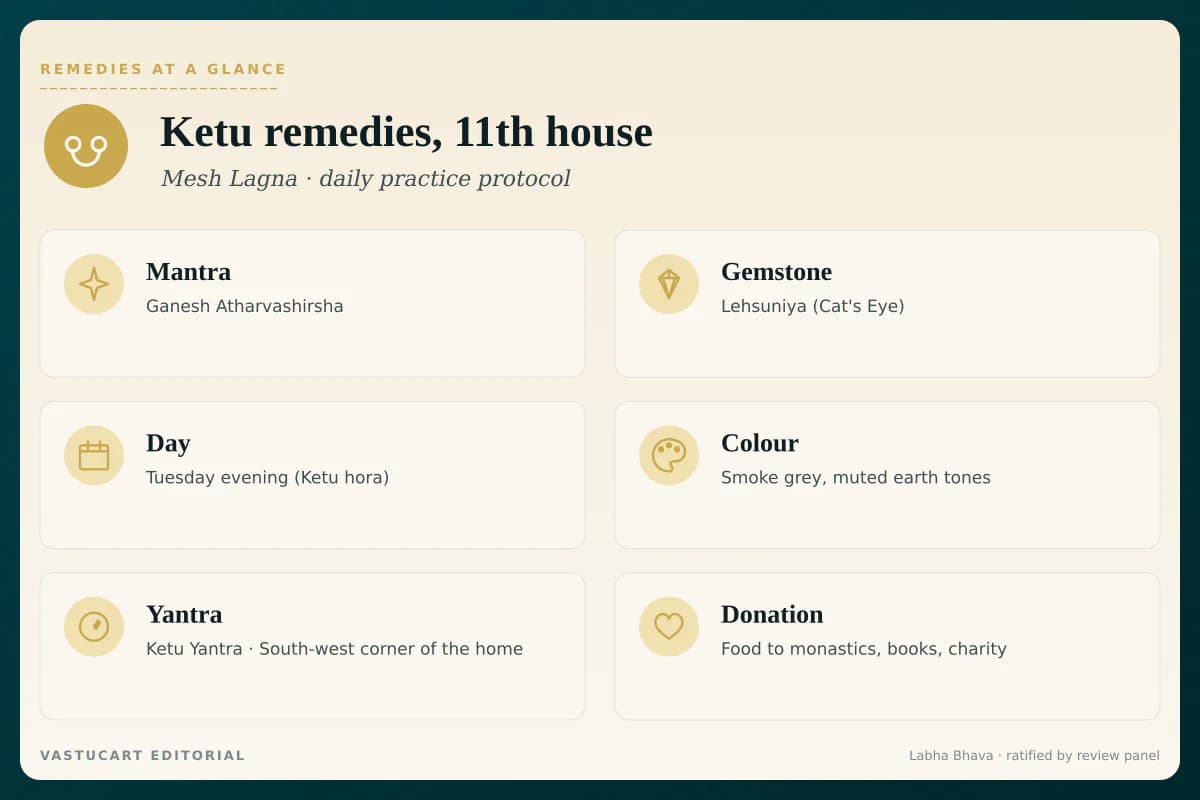
The daily Ganesha worship is the primary remedy for this placement because Ganesha is the classical patron deity of Ketu, and the obstacle-removing form is the deity who guides the south node's detachment toward genuine community territory. Rise before sunrise, bathe, wear white or pale yellow clothing on Wednesdays, and visit a Ganesha temple if accessible. The Ganesh Atharvashirsha is the primary recitation, the Upanishadic hymn to Ganapati that creates a containing field for the Ketu signature in its upachaya expression. Reciting it at sunrise daily for forty days at any major Labha transition (a community trustee role, a major grant, a network anchor commitment) is the formal protocol.
Offer red flowers, modak, dhruva grass, and durva at the altar, and donate to causes that serve the structural community-service domain (free spiritual community access, open-source software grants, cooperative-business apprenticeships). The conscious-bandwidth practice is the lifestyle remedy that compounds across decades into the difference between Ketu-11-anchor and Ketu-11-burnout: a daily reflection on which community commitments are nourishing and which are draining keeps the placement directed. The gemstone is cat's eye (Lehsuniya, chrysoberyl), and this placement responds well to the gemstone because the upachaya plus friend-sign combination channels the amplification cleanly. Wear a natural cat's eye of minimum five ratti set in silver on the small finger of the right hand on a Wednesday at sunrise after Ketu mantra recitation, after a confirmed reading.
Gemstones for Ketu in 11th house Mesh Lagna
Cat's Eye is the primary Ketu gemstone and works well here because the friend-sign upachaya supports clean channelling of the amplification.



Disclaimer: Cat's eye in the friend-sign upachaya channels Ketu cleanly but blue sapphire is recommended only after rigorous chart-confirmation. Always consult a qualified Jyotishi before permanent wearing.
Rudraksha beads for Ketu in 11th house
The Ketu-aligned rudraksha is the Aath Mukhi (Eight Mukhi) Ganesha bead, with the Saat Mukhi as a paired secondary for Saturn-dispositor support.
The eight-mukhi bead is the Ganesha bead and the standard daily-practice bead for Ketu-11 natives. Supports the gains-through-detachment signature, channels the community-anchor instinct toward sustainable territory, and stabilises the inner intensity when the network-overgiving pattern is active.
The seven-mukhi bead is the Saturn bead and serves as primary secondary support for this placement because Saturn is the dispositor of Ketu in Kumbha. Wearing the Saat Mukhi alongside the Aath Mukhi compounds the placement's natural strength by honouring both the planet and his sign-lord.
Ketu Yantra for the labha placement
Sacred recitations for Ketu in the labha angle
Tvameva pratyaksham tattvam asi
Tvameva kevalam karta'si
Tvameva kevalam dharta'si
Tvameva kevalam harta'si
Tvameva sarvam khalvidam brahma'si
Translation: Om, salutations to Ganapati. You alone are the manifest reality. You alone are the sole creator. You alone are the sole sustainer. You alone are the sole destroyer. You alone are everything, indeed Brahman itself. The Ganesh Atharvashirsha is the Upanishadic hymn to Ganapati and is the perfect daily recitation for a chart where Ketu sits in the labha upachaya and the gains-through-detachment signature needs a containing devotional field.
Read the full stotra on stotra.vastucart.in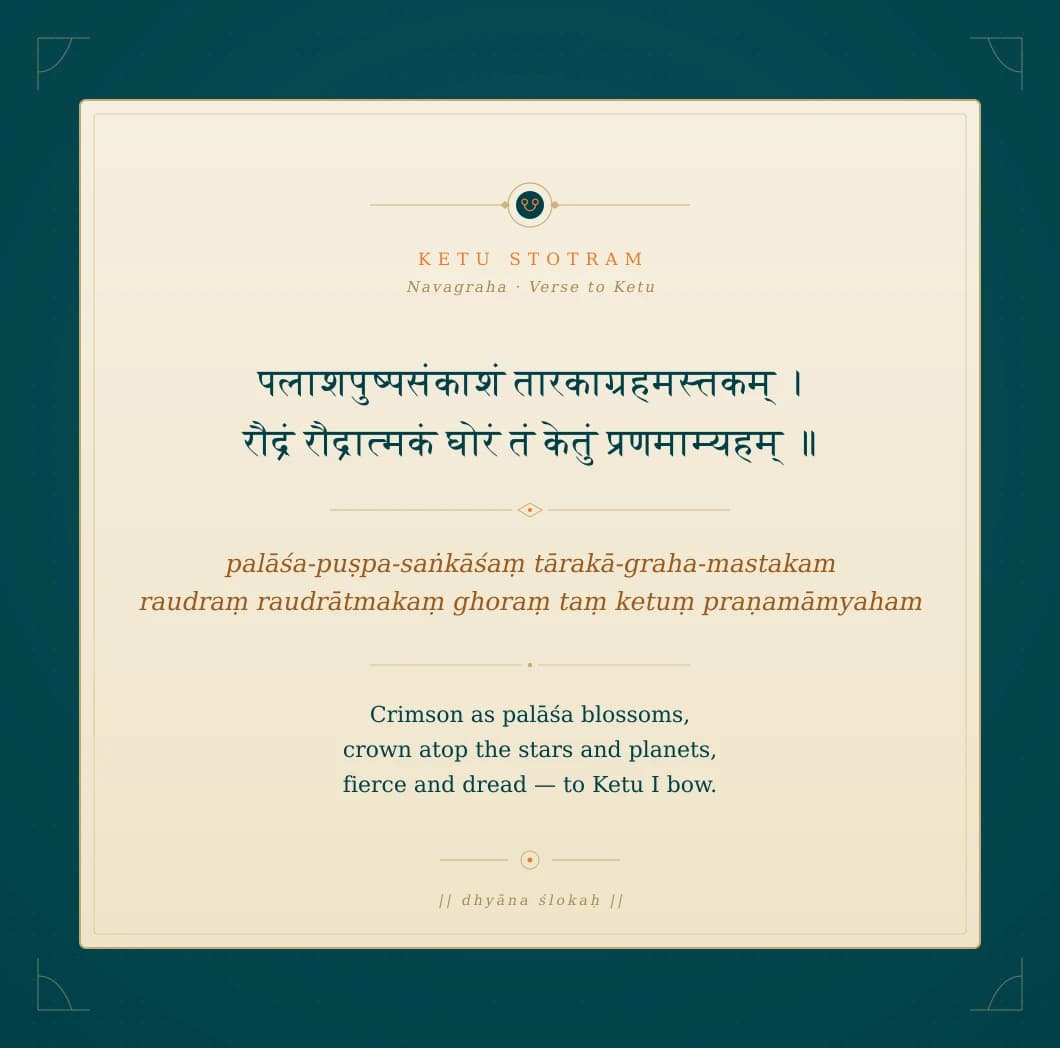
Tools for Ketu 11th house Mesh natives
Is your Labha Bhava Ketu carrying the detached-gains signature?
Get a full personalised analysis of your eleventh house Ketu, the Saturn dispositor link, and the community-anchor timing.