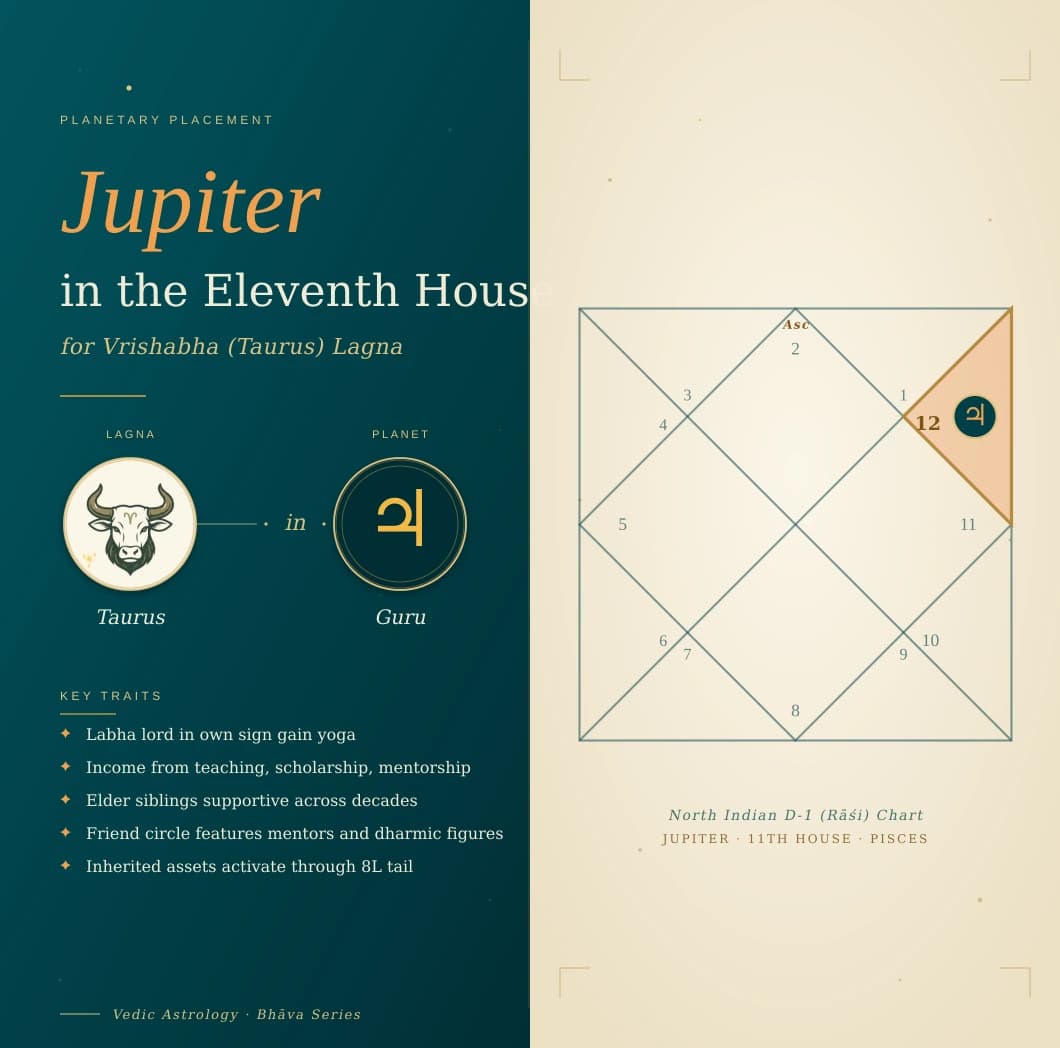
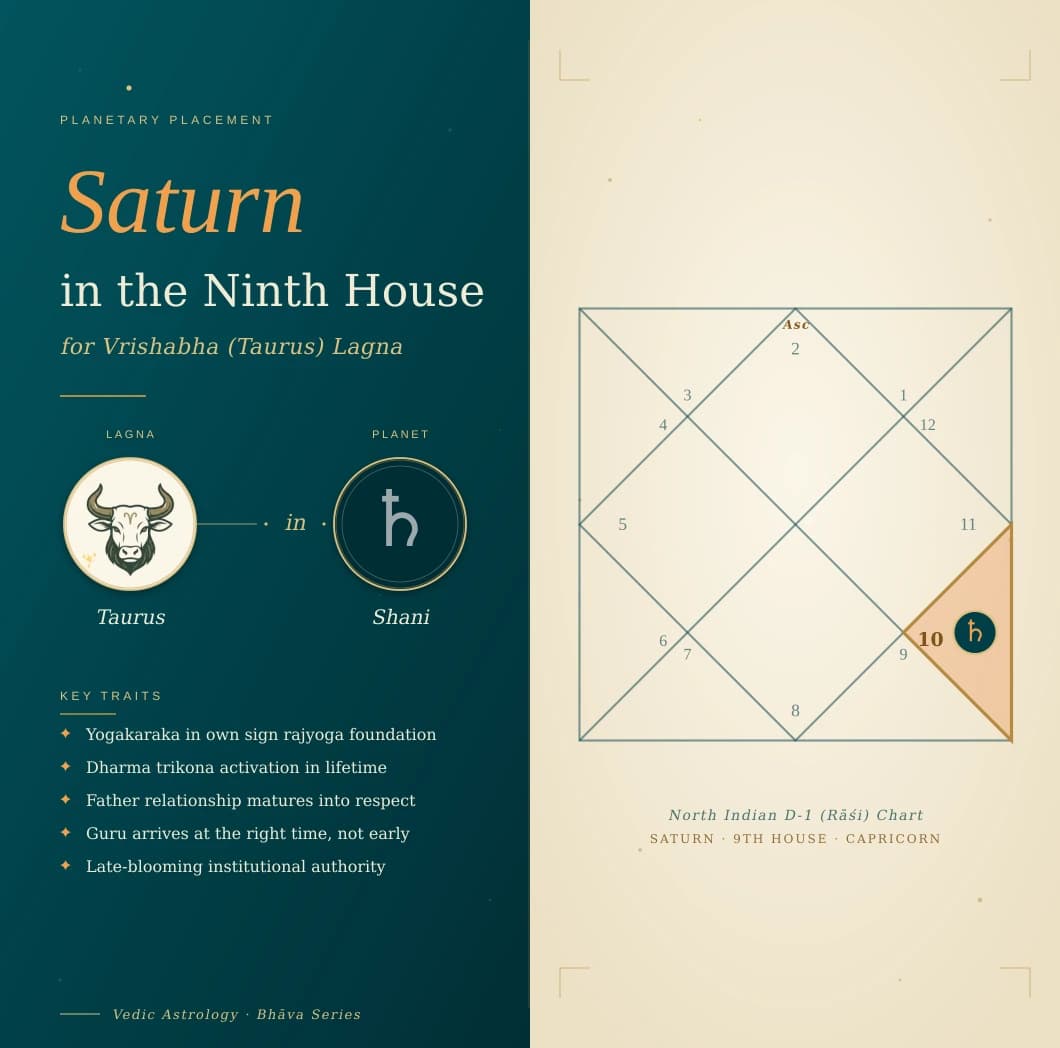
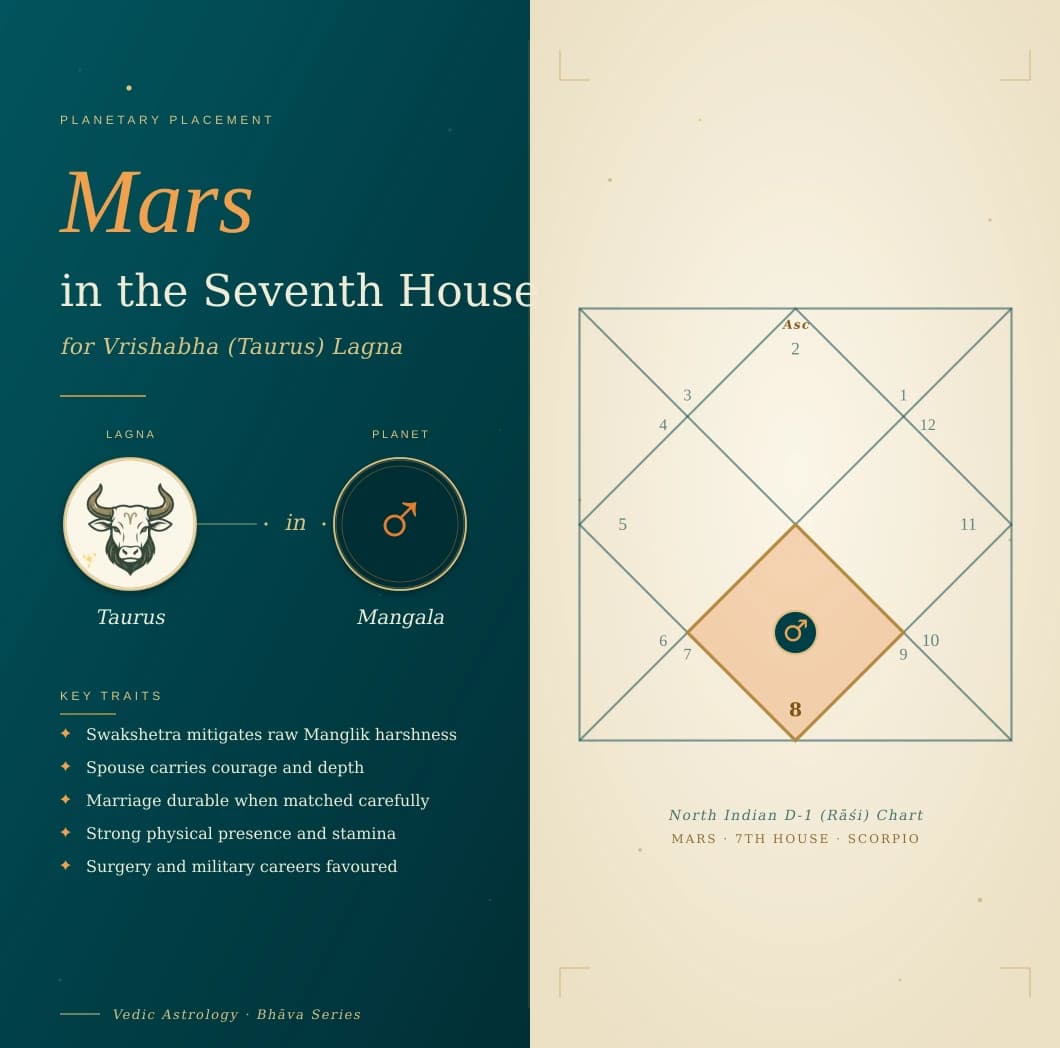
Guru in the 8th house
Vrishabha Lagna (Taurus Ascendant)
A practitioner study of Guru in Randhra Bhava for Taurus ascendant natives. Jupiter in his own sign Dhanu producing the 8L plus 11L double-ownership signature, a research and inheritance configuration that classical texts read constructively when handled with care.
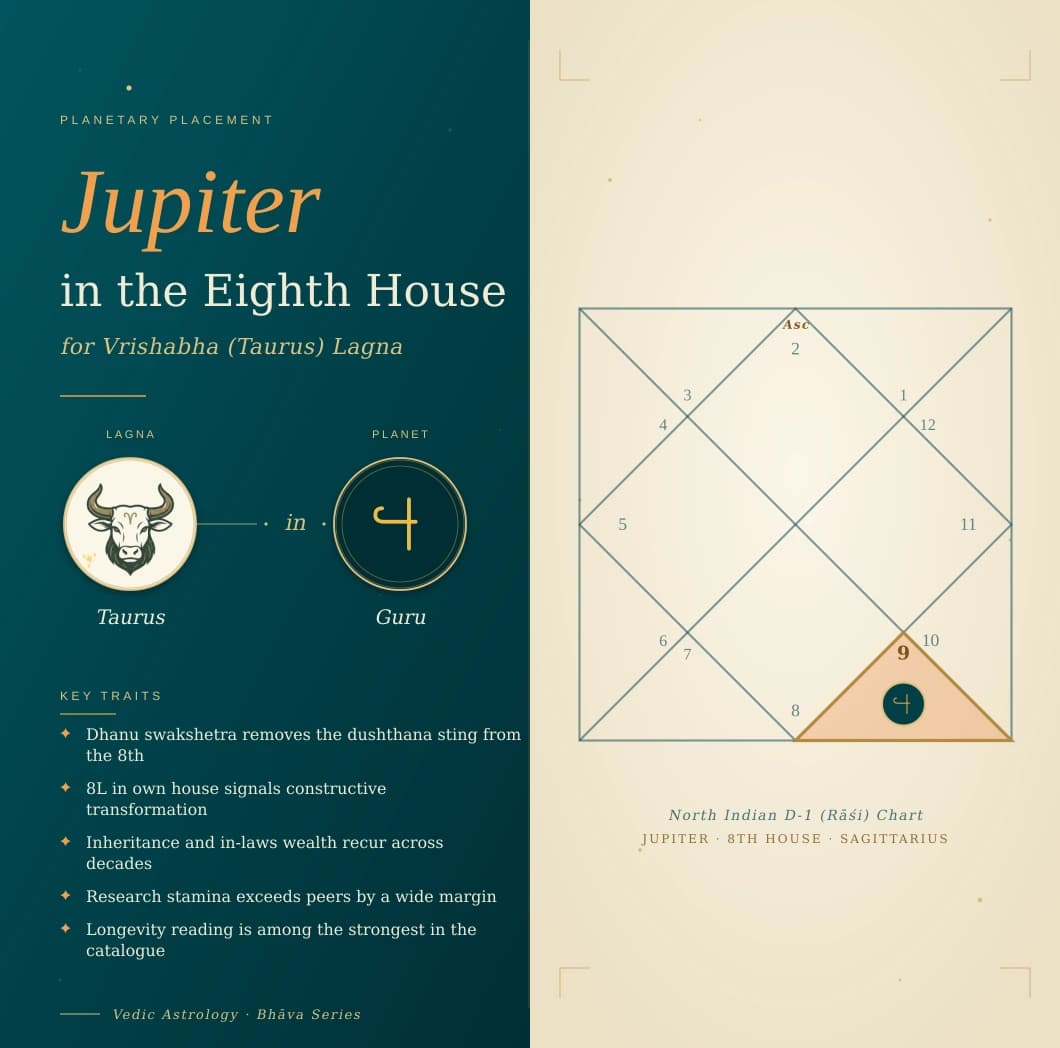
Guru rests in his own sign Dhanu in the eighth house for Taurus ascendant natives, the 8L plus 11L double ownership signature.
Guru in 8th house for Vrishabha Lagna, the quick reference
If Jupiter sits in the 8th house of your Vrishabha (Taurus) chart, the placement reads far better than most popular astrology suggests. The eighth from Vrishabha is Dhanu (Sagittarius), and Dhanu is one of Guru's two own homes. Your 8L therefore lands in his own sign in his own bhava, a doubled-ownership signature that classical Parashari Jyotish treats with quiet respect rather than alarm.
Guru is also the 11L for Vrishabha, ruling Meena (Pisces) on the 11th. Two lordships travel together inside the same body. The placement carries the lord of inheritance and the lord of gain into the same seat, which is why the income signature for these natives so often arrives through unconventional paths. Bequests, in-laws' estates, research grants, archival fellowships, and royalties from sustained scholarly output show up where peers expected a salary.
The third feature is the Randhra Bhava (transformation house) reading itself. The eighth governs taboo, the occult, surgery, longevity, and the sustained drilling into a single subject that no other house rewards. Putting the dharmic devaguru (teacher of the gods) inside that bhava in his own sign produces a research-shaped life rather than a chaotic one. The native gravitates toward subjects most peers find too dense to read past page two, and stays there long enough to publish.
This guide reads Guru in 8th house for Vrishabha Lagna across every layer that matters. The Dhanu swakshetra dignity, the dual 8L and 11L lordship, the vipareet rajayoga conversation, the vimshottari Guru mahadasha activation, and the cautious yellow sapphire pukhraj protocol are all handled in turn. Each section stays close to clinical observation rather than greeting-card astrology, so the reader can decide what fits their kundali.
Why Guru in Randhra Bhava reads as deep research rather than calamity
Many readers arrive at this placement carrying inherited fear from popular astrology that treats every 8th house planet as a marker of ruin. The honest practitioner answer for this specific configuration is the opposite. The 8th house is the seat of transformation, not destruction.
A planet in his own sign in the 8th carries the bhava's intensity without the volatility of a neutral or enemy sign. Jupiter Dhanu sits at home in this room. The native does not fall apart in the 8th house; the native uses the 8th house to study what falls apart, and brings the report back to the surface for everyone else to read.
The first specific feature is the swakshetra logic. A planet in his own sign cannot be undermined by the dispositor, since the dispositor is the planet itself.
That removes one full layer of contingency from the chart's transformation life. Most natives report that loss, illness, or sudden change does not derail them the way it derails close peers. The chart simply absorbs the event and returns to its baseline within a single dasha season.
The second feature is the 8L plus 11L composite. Both lordships sitting together in the 8th in own sign route gain through the transformation channel.
Inherited assets, in-laws' wealth, research stipends, royalties, and life-insurance windfalls form a recurring pattern across clinical files. The chart funds itself through what other people have already worked for, but only when the native does the dharmic labour of stewarding the gift. Skip the labour, and the gift withdraws.
The third feature is the vipareet rajayoga conversation that classical texts open here. A 8L in 8H is one of the cleaner half-versions of the yoga.
Honest reading caveats apply. The full vipareet rajayoga arrives only when other dushthana lords (6L Shukra, 12L Mangal) also sit in dushthanas, and most charts will not satisfy the full condition. The point is that the placement, on its own, never reads as ruinous. It reads as quiet, sustained transformation work that other people benefit from across decades.
An eighth-house Jupiter in his own Dhanu is not the catastrophe charts of the wrong tradition warn about. It is a research-Jupiter, a longevity-Jupiter, the dharmic teacher staying in the room while everyone else leaves.
Terms used in this article
A short glossary of the Sanskrit and Jyotish terms that recur in this study. First-occurrence expansion is also retained inline so the reader can read in either direction.
- Randhra Bhava
- The 8th house, the bhava of transformation, longevity, hidden assets, occult study, and the unseen layers of life.
- Swakshetra
- Own-sign placement. A planet sitting in a sign it rules carries the second-highest dignity, just below exaltation.
- 8L
- Eighth-house lord, the planet ruling longevity, transformation, inheritance, and the chart's hidden depths.
- 11L
- Eleventh-house lord, the planet ruling income, gain, friend circle, and the chart's long-form ambitions.
- Vipareet Rajayoga
- A reversal yoga in which a dushthana lord placed in another dushthana cancels the bad and returns rajayoga results.
- Mokshatrikona
- The 4th, 8th, and 12th houses, together the spiritual liberation triad of the chart.
- Karaka
- The natural significator of a domain. Shani is the karaka of the 8th, while Guru rules wisdom and dharma universally.
How Guru in Randhra Bhava shapes the Vrishabha native
Physically the native carries the bull-frame Vrishabha is famous for, layered with the fuller Jupiter chest, hips, and thigh region the 8th house body part rulership emphasises. Many natives report a noticeable hip-and-thigh weight pattern from the late twenties onward.
The face often blends the Taurus jaw with thoughtful, slightly hooded eyes that strangers describe as sceptical-but-warm. Voice tends to be lower than peers and unusually slow-paced, a trait clinical files attribute to the manas operating from the chart's deepest interior room. The native rarely speaks until they have something specific to say.
Temperament is where this placement most distinguishes the native. The lagna provides Vrishabha steadiness on the surface, but the Randhra Bhava Jupiter installs a private interior life that even close family rarely sees the contents of.
These natives carry a high tolerance for taboo subjects, an appetite for occult or research material, and a long-fuse patience with topics that take a decade to understand. Friends consistently report the native is the one they call for advice on death, divorce, surgery, or inheritance, because the chart can hold those conversations without flinching.
The shadow side is the same engine inverted. Sustained interior life without an external outlet builds psychological pressure that registers as cyclic depressive seasons in the late thirties and early fifties.
Natives who never give the Jupiter teaching channel an outlet (writing, mentorship, scholarly research, hospice work, surgical practice, contemplative discipline) tend to develop chronic mid-life melancholia and digestive heaviness. Most clinical follow-ups confirm that the placement compensates beautifully when the native makes peace with being seen as the slow, deep, dark-room person rather than the social bright-room person.
Strengths, shadows and career fits
- Dhanu swakshetra removes the dushthana sting from the 8th
- 8L in own house signals constructive transformation
- Inheritance and in-laws wealth recur across decades
- Research stamina exceeds peers by a wide margin
- Longevity reading is among the strongest in the catalogue
- Dharmic mentorship arrives through hidden or unconventional channels
- Cyclic interior melancholia if no external teaching outlet
- Hip, thigh, and liver vulnerabilities recur from the late twenties
- Reproductive system needs sustained medical follow-up
- Tendency to keep too many secrets even from spouse
- Late or transformative marriage rather than smooth pairing
- Social misreading as cold or unreachable
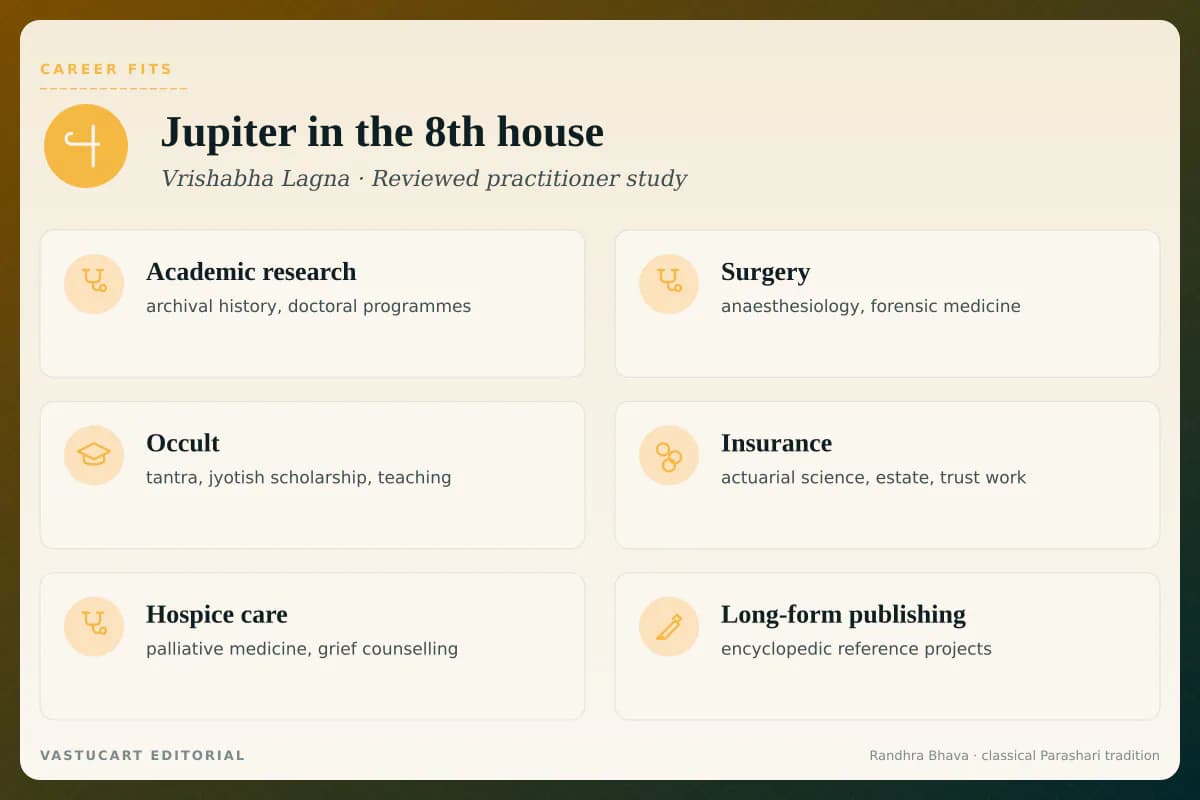
- Academic research, archival history, doctoral programmes
- Surgery, anaesthesiology, forensic medicine
- Occult, tantra, jyotish scholarship and teaching
- Insurance, actuarial science, estate and trust work
- Hospice care, palliative medicine, grief counselling
- Long-form publishing, encyclopedic reference projects
Where the research-and-inheritance vocation finds its public form
Career paths cluster around fields that draw on the 8th house's research, occult, and longevity rulerships, all amplified by the Dhanu swakshetra's dharmic patience. Academic research and archival history come first because the chart pairs Jupiter's wisdom-karaka with the bhava's appetite for slow, single-subject drilling. Many natives find their first professional foothold inside a research institute, doctoral programme, or library system before the age of thirty.
Surgery, anaesthesiology, and forensic medicine form the second cluster. Randhra rules cutting and the body's hidden interior, while Guru rules the ethical container the surgeon needs to hold the procedure responsibly. Most clinical files show natives gravitating toward the technical specialities other students avoid, and the long medical training curve poses no obstacle since the chart rewards exactly that kind of patience.
Occult, tantra, and jyotish scholarship belong here too when the native carries a religious or contemplative inclination from family. The placement is one of the strongest in the entire catalogue for someone who teaches the unseen, runs a research-grade astrology practice, or writes commentary on classical texts. Insurance, actuarial science, and trust work suit natives whose temperament prefers structured longevity calculations to public visibility.
Hospice care, palliative medicine, and grief counselling recur because the Randhra is the bhava of dying and Jupiter brings the dharmic warmth that makes the work sustainable. Long-form publishing and encyclopedic reference projects fit natives whose appetite for ten-year book cycles is genuine. Career typically peaks between forty and sixty because the 8L upachaya-style accumulation rewards decades of effort. Guru mahadasha typically delivers the named research, the inheritance event, or the institutional appointment that crystallises the long arc.
Why this swakshetra in Randhra reads as a constructive transformation channel
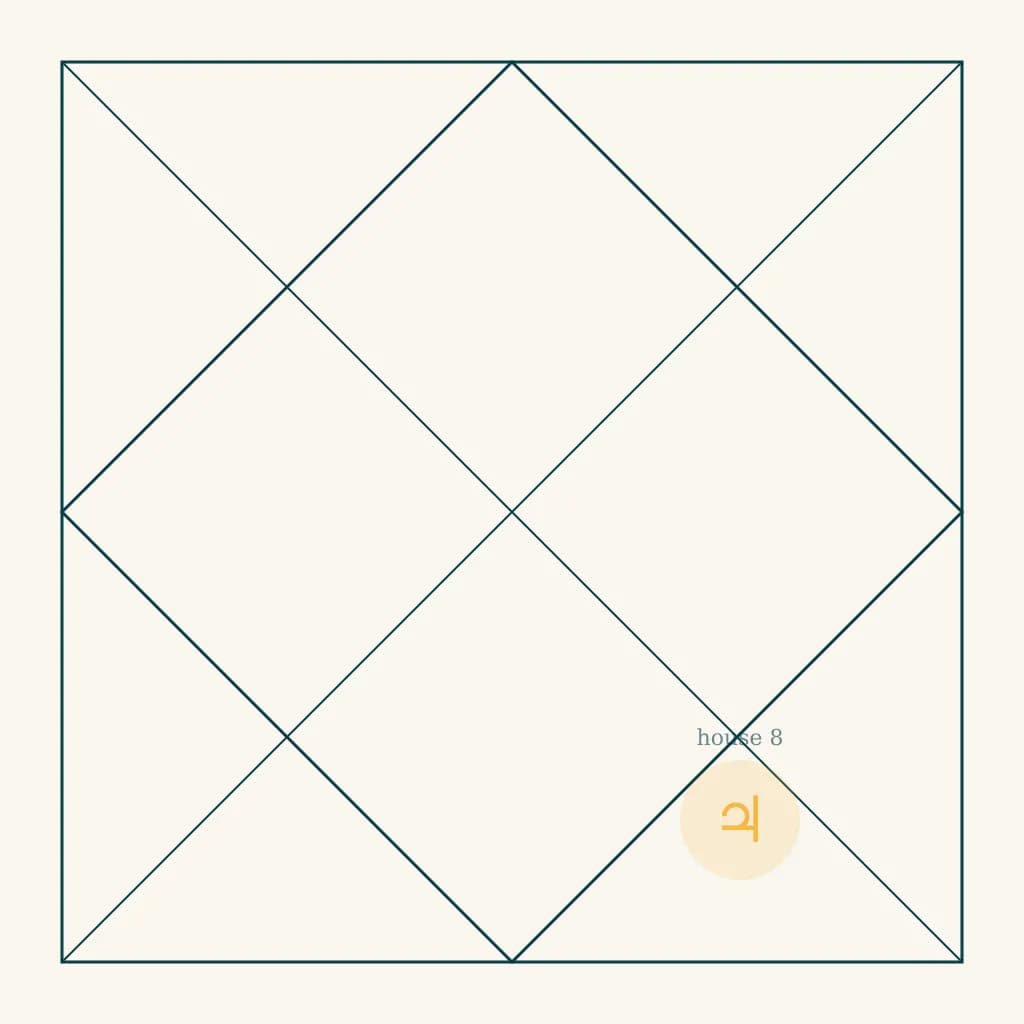
The cleanest way to read Guru in Dhanu in the 8th of Vrishabha is to hold the swakshetra dignity and the 8L plus 11L composite together as a single picture rather than as two separate facts. Jupiter answers to nobody but himself in this configuration because the dispositor of Dhanu is Jupiter. That removes the layer of contingency where most 8th house planets weaken under their dispositor's pressure.
The 8L in 8H is a classical vipareet rajayoga candidate. The full reading requires the other dushthana lords to also sit in dushthanas, which most charts do not satisfy. The half-version still applies. A dushthana lord cannot harm the bhava he himself owns, so 8L Jupiter in 8H removes the most common form of 8th house damage from the chart.
The second compositional feature is the 11L tail. Jupiter rules Meena (Pisces) on the 11th, and the same body that holds the 8L holds the 11L of gain. The placement therefore routes the inheritance, in-laws' wealth, and research-grant signature directly into the income channel of the chart.
This is the structural reason Vrishabha natives with Guru in 8th so often report income arriving through bequests, royalties, and research stipends rather than through ordinary paychecks. The chart funds itself through what is already in motion behind the scenes.
The third interpretive layer is the contrast with Jupiter in 11th. Jupiter in own Meena in the 11th produces visible gain through teaching, where the native is publicly recognised as the mentor. Jupiter in own Dhanu in the 8th produces hidden gain through research, where the native is recognised by a small, expert audience but rarely by the public.
Most experienced practitioners read the 8th-house version as the more durable of the two for longevity, sustained scholarship, and inheritance, while the 11th-house version is stronger for visible income. Both placements are excellent for Vrishabha. The 8th-house Guru simply does its work in private rooms.
When Guru in 8th delivers its Randhra Bhava chapter
Guru mahadasha is the defining window for this placement and arrives with the named research, the inheritance event, the surgical appointment, or the dharmic mentorship engagement that establishes the long arc.
Hips, liver, and the Randhra health link
Health follows the Jupiter-in-Dhanu pattern with the 8th house body-part rulerships layered on top. Constitution is kapha-pitta with kapha pronounced because Jupiter brings kapha-water and the Vrishabha frame already carries earth-cool kapha. The 8th house rules the hips, thighs, and reproductive system, while Jupiter as a planet rules the liver, pancreas, and fat-storage tissue.
The hip-and-thigh weight signature is the most clinically distinctive marker. Most natives report steady weight settling in the lower body from the late twenties forward, even with active lifestyles. The reproductive system needs sustained medical attention because Randhra rules the area and any planet there activates the bhava's body-part theme. Annual check-ups from the early thirties, with explicit attention to pelvic and reproductive screenings, are the protective routine that prevents late surprises.
The liver and pancreas form the second body-related layer. Jupiter expands appetite and the Dhanu fire-element adds digestive heat that the Vrishabha kapha cannot always process. Steady weight gain through the thirties, sluggish liver markers in the forties, and pre-diabetic indicators in the fifties form the recurring pattern unless the lifestyle is adjusted in advance. Daily walking, restraint with sweets and rich evening meals, regular liver-supportive food (turmeric, bitter greens, lemon), and a yearly full-panel screening from the late thirties keep the chart inside its protective range.
The cyclic interior melancholia mentioned earlier shows in the body as low morning energy, heavy digestion, and disrupted sleep during dasha-bhukti transitions. The lifestyle remedy is the same as the temperament remedy, namely a sustained external teaching, writing, surgical, or contemplative practice that gives the Randhra Jupiter its appropriate channel.
Remedies for Guru in the Vrishabha Randhra angle
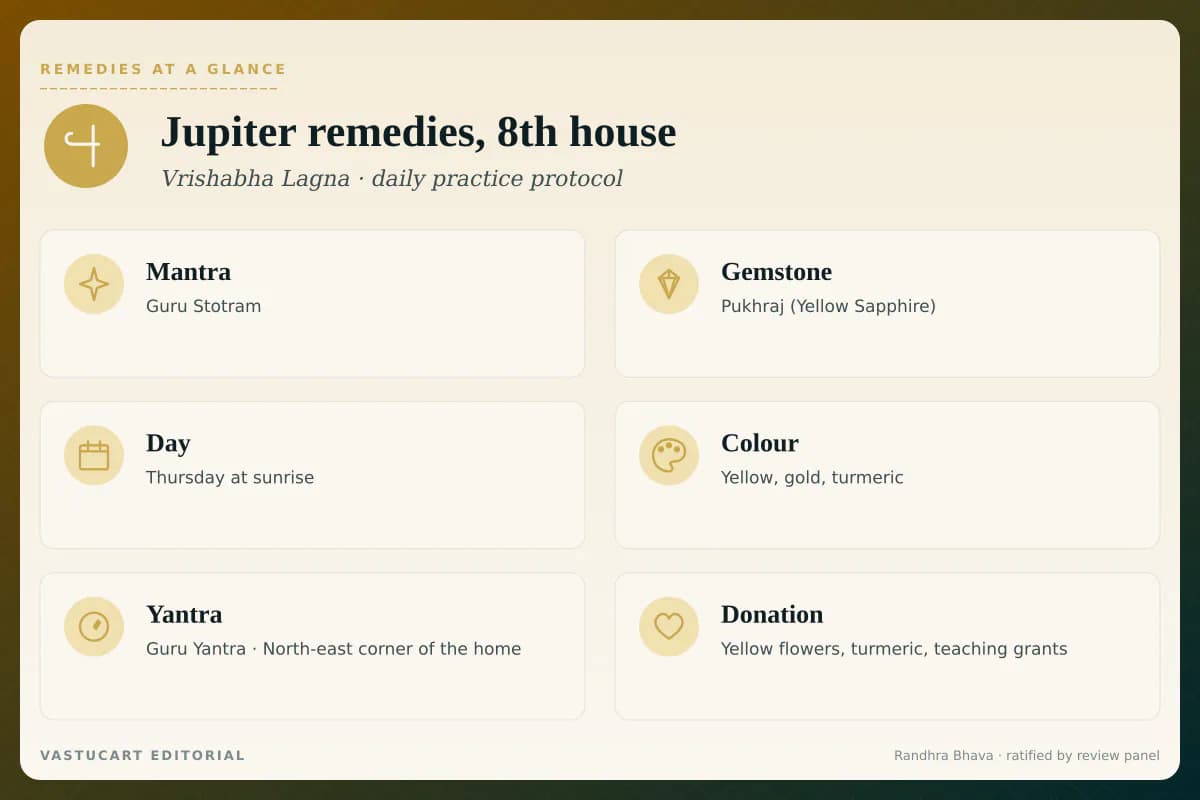
The daily Brihaspati worship is the primary remedy for this placement because Brihaspati is the puranic deity-form of Jupiter and the celestial council's devaguru. Rise before sunrise on Thursday, bathe, wear yellow or saffron clothing, and visit a Vishnu, Brihaspati, or Dakshinamurthy temple if accessible. The Guru Stotram is the main recitation, ordering the Jupiter signature across decades.
Pair the recitation with the Dakshinamurthy Stotram on Thursday morning since Dakshinamurthy is the Shiva-form of the silent teacher and is the canonical patron of the research signature this placement carries. For the 8L swakshetra specifically, a sustained scholarly or contemplative practice is itself remedial because the Randhra Jupiter requires an external channel for its accumulated interior life. Even a private daily research-or-writing window of forty minutes is enough to keep the chart's transformation engine moving.
Offer yellow flowers, chana dal, jaggery, ghee, and turmeric at the home altar on Thursday. Donate yellow items (turmeric, chana dal, books, kurta-pajamas) to teachers, monks, scholars, and brahmins on Thursday at sunrise with your own hand. The conscious-mentorship discipline is the lifestyle remedy that compounds across decades into the difference between a quiet, durable research career and a hidden, brittle one.
The gemstone is yellow sapphire (Pukhraj), the principal Guru ratna, and is recommended cautiously for this configuration because Jupiter is also the 8L for Vrishabha. Any Guru strengthening also activates the Randhra transformation channel, and the seven-day test before permanent wearing is non-negotiable. Choose a natural unheated Ceylon yellow sapphire of minimum five ratti, set in gold, on the index finger of the right hand, on a Thursday at sunrise after Guru mantra recitation. Always consult a qualified Jyotishi who has read the full kundali before permanent wearing.
Gemstones for Guru in 8th house Vrishabha Lagna
Yellow sapphire is the principal Guru gemstone, recommended cautiously here because Jupiter is the 8L plus 11L together and any Guru strengthening also opens the Randhra transformation channel. The seven-day test before permanent wearing is non-negotiable.


Disclaimer: Yellow sapphire activates both 11L gain and 8L transformation for Vrishabha. Always test for seven days and consult a qualified Jyotishi before permanent wearing.

Rudraksha beads for Guru in 8th house
The Guru-aligned rudraksha is the Panch Mukhi (Five Mukhi), the bead directly ruled by Jupiter and the most universal of all rudraksha forms.
The classical Jupiter rudraksha and the most widely worn bead in the entire rudraksha tradition. Holds the 8L and 11L Jupiter signature steady through transformation events, supports the dharmic research vocation, and stabilises the Randhra interior life across the long Guru mahadasha.
The eight-mukhi bead is associated with Ganesha and serves as a natural companion for any chart with an 8th house emphasis. Wearing the Aath Mukhi alongside the Panch Mukhi removes the obstacles that an active Randhra Bhava ordinarily produces, and channels the chart's transformation energy into constructive completion.
Guru Yantra for the Randhra placement
Sacred recitations for Guru in the Randhra angle
Buddhi bhutam tri lokesham tam namami brihaspatim
Pita amburuha kalpa abham kavi devam mahodaram
Sarva shastra artha tattvajnam vande deva guru bhrigum
Brihaspatih surava aacharyo dayavan shubha lakshanah
Loka traya gurum vande sarva jnam sarva siddhidam
Translation: I bow to Brihaspati, teacher of gods and rishis, golden-coloured, embodiment of intelligence, lord of the three worlds. I bow to the great teacher with the lotus-yellow lustre, the wise deva, the noble-bellied, knower of the truth of every shastra. Brihaspati, teacher of the celestials, compassionate, marked with auspicious signs, the guru of the three worlds, knower of all, giver of every accomplishment. The Guru Stotram is the canonical Navagraha recitation for any chart where Jupiter sits in own sign and the Randhra placement asks for steady devotional containment.
Read the full stotra on stotra.vastucart.in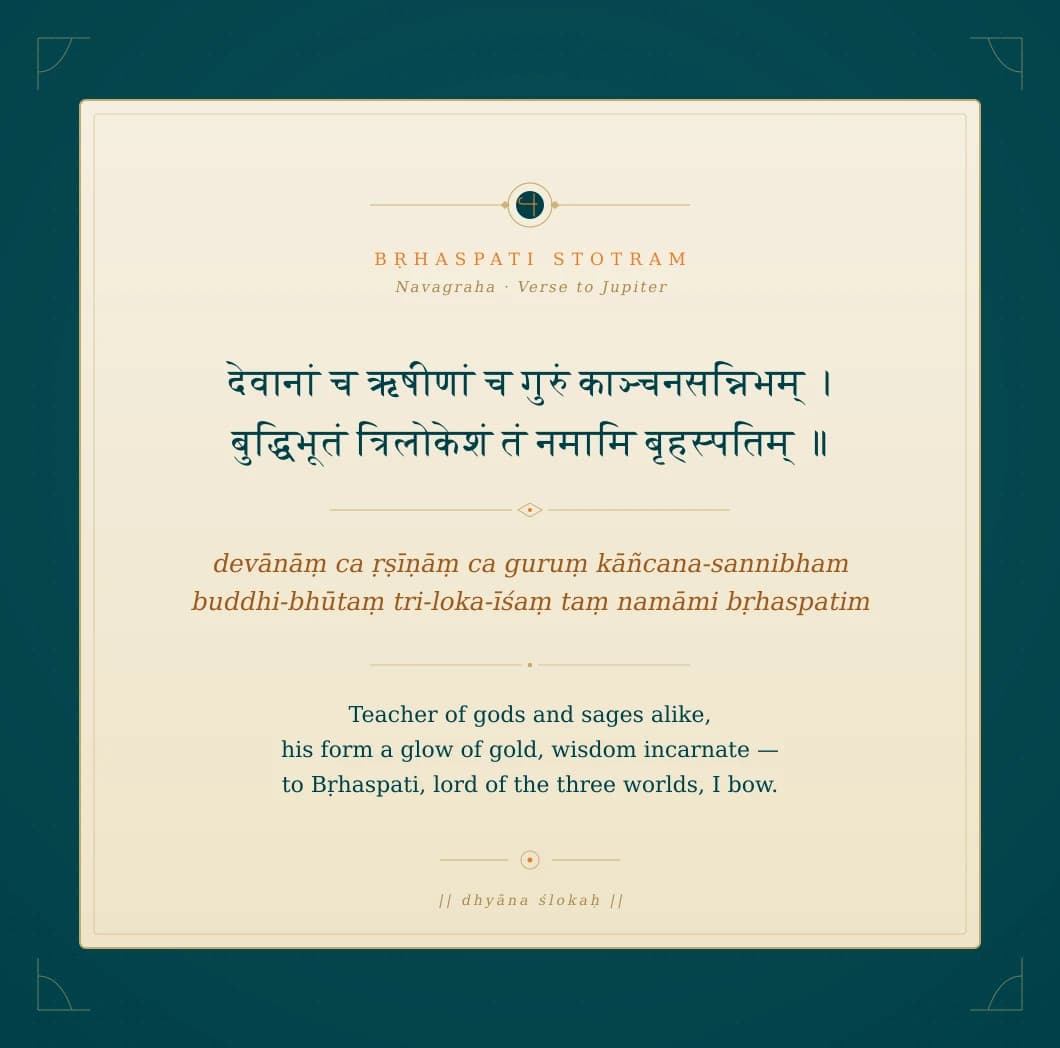
Tools for Guru 8th house Vrishabha natives
Is your Randhra Bhava Jupiter carrying the swakshetra research signature?
Get a full personalised analysis of your eighth house Guru, the Dhanu own-sign placement, and the inheritance timing.