Moon in the 5th house
Meena Lagna (Pisces Ascendant)
A practitioner study of Chandra in Putra Bhava for Pisces ascendant natives. Moon swakshetra in his own nurturing Karka, the sole 5L lordship sitting in the dharmic-trikona seat, the past-merit Lakshmi yoga that defines the most luminous mind-and-creativity Moon signature available to this lagna.
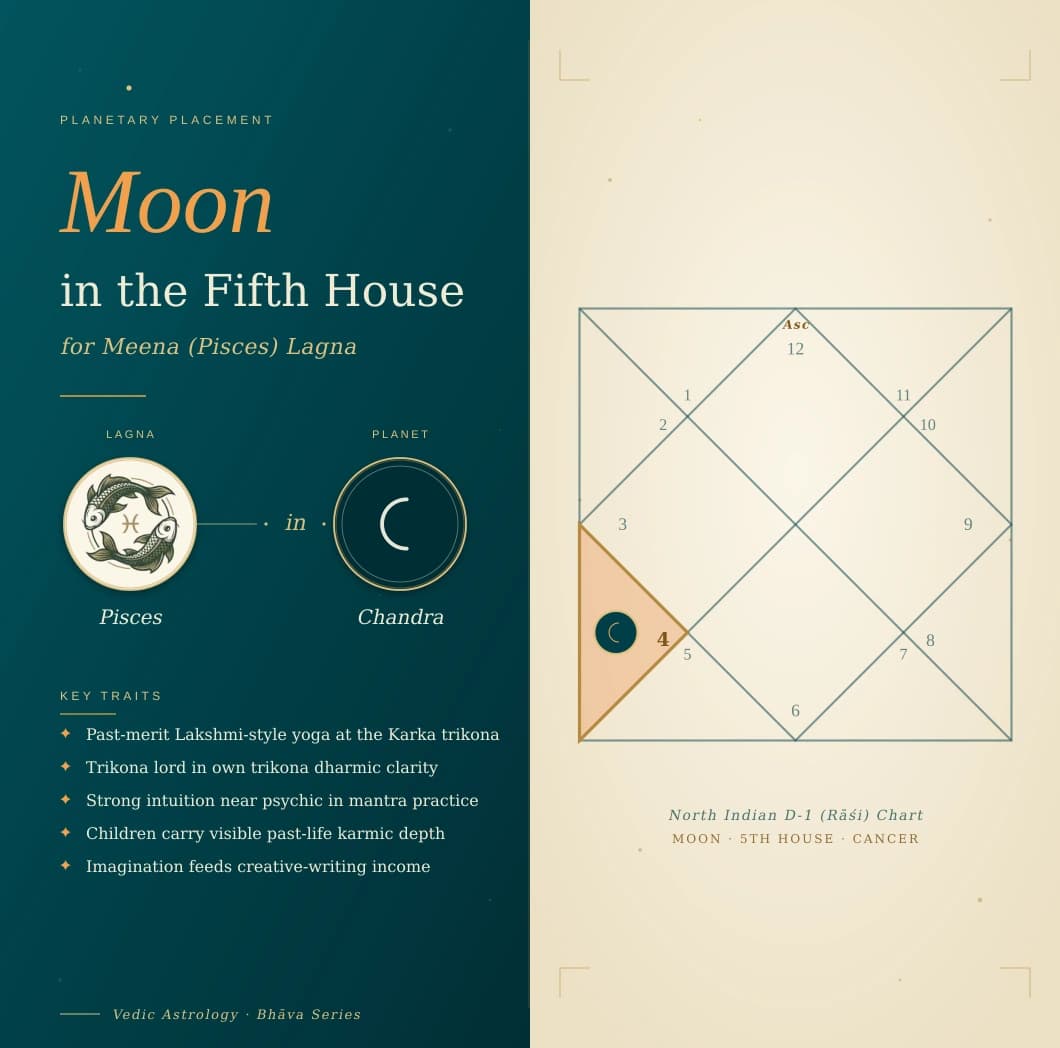
Moon sits swakshetra in his own Karka in the fifth house for Pisces ascendant natives, the past-merit Lakshmi-style trikona signature.
Moon in 5th house for Meena Lagna, the quick reference
If you carry the Moon in the fifth house of a Meena (Pisces) chart, you hold one of the most luminous Moon placements available to any lagna in the entire Vedic catalogue. Chandra (the Moon) rules only the fifth here, because Karka (Cancer) is the natural sign on the fifth cusp of every Meena ascendant. The dignity is therefore swakshetra (own-sign) Moon, and the placement seats the Putra Bhava (fifth house, the trikona of intelligence, mantras, children, and past-life merit) lord at home in his own dharmic angle.
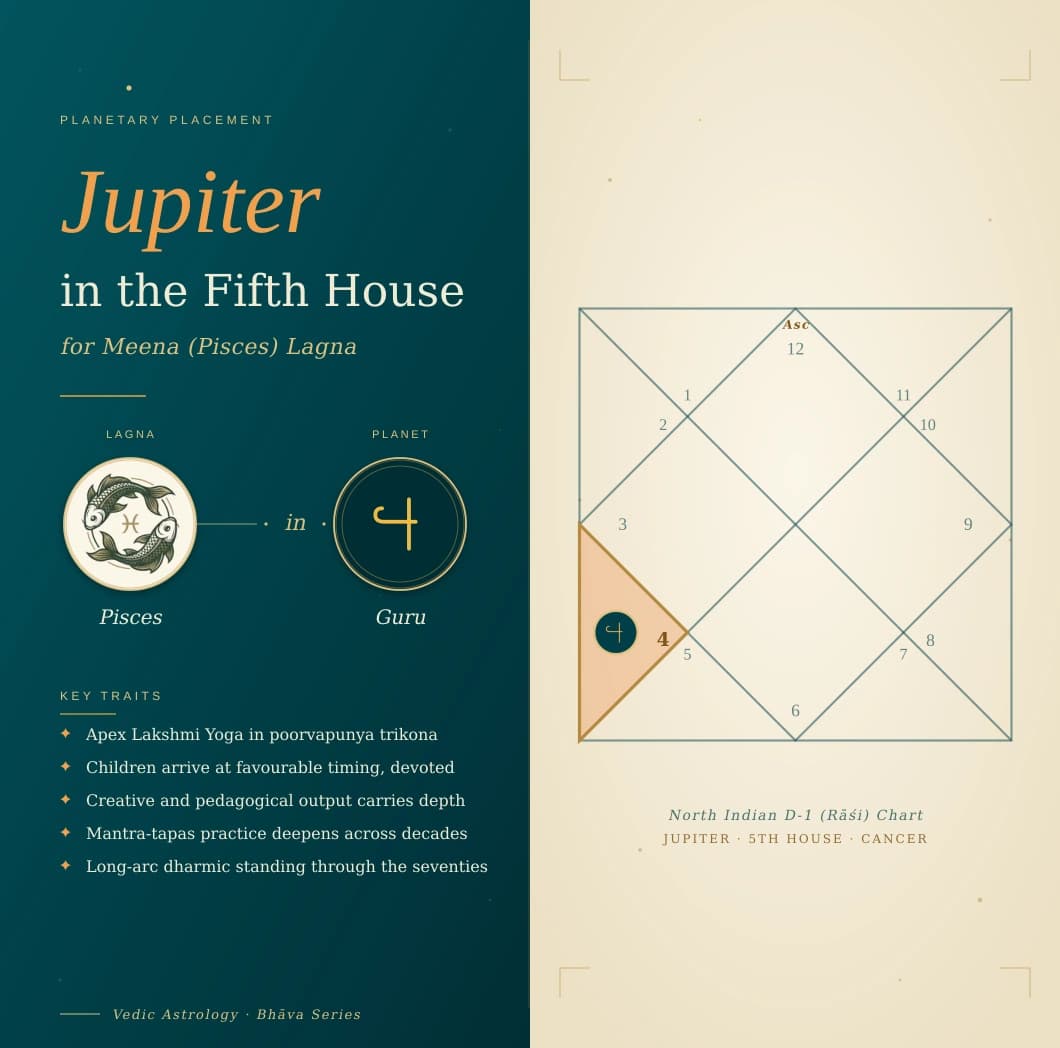
The first feature is the trikona-lord-in-trikona alignment. Trikona houses (1, 5, 9) carry the dharmic backbone of the chart, and a trikona lord sitting in his own trikona compounds the bhava strength with own-sign dignity. The second feature is the poorva-punya (past-life merit) reading. The fifth house is the karmic credit account the soul brings into this lifetime, and a swakshetra Moon banking that account in own Karka means the native draws on a deep reservoir of past-life devotion, mantra practice, and creative output. The third feature is the Gajakesari overlap. When Jupiter conjoins or aspects this Moon (a common Meena-chart configuration because Jupiter is the lagna lord), the chart forms Gajakesari Yoga (the elephant-and-lion mutual-kendra yoga of Jupiter and Moon) and the placement leaps from luminous to apex. This guide reads every layer of the Moon in 5th house for Meena Lagna natives: the Karka swakshetra, the 5L trikona seat, the past-merit Lakshmi formation, the mantra-siddhi signature, and the pearl protocol.
Why swakshetra Moon in Putra Bhava forms the past-merit Lakshmi reading
Students often arrive at this placement aware that the Moon is strong in his own sign but uncertain why classical commentators rank Moon-in-5th-of-Meena alongside the apex Jupiter and Venus placements available to the same lagna. The answer is structural. Phaladeepika calls a fifth-house Moon in own Karka buddhi-pradayini (wisdom-conferring) and pairs the verse with a separate clause on chitta-saukhya (mind-comfort) because the placement settles the most volatile planet of the chart in the most karmically nourishing house. Karka is the Moon's nurturing watery own sign, and the 5th is the trikona that holds the soul's accumulated devotional credit.
The single-lordship reading is the second specific feature that practitioners need to handle correctly. The Moon owns only Karka, so for Meena natives the Moon is a pure 5L (lord of the fifth, called the Putra-pati). When this single trikona lord sits in his own trikona, classical sources describe the configuration as a Lakshmi-style yoga formation because trikona-trikona placement of an own-sign benefic compounds the bhava's natural prosperity reading. Many natives in this configuration become recognised by their thirties for creative output that visibly carries past-life depth: poets and lyricists whose verses move audiences to tears, devotional musicians whose kirtans hold rooms in stillness, mantra-tradition stewards whose teaching transmits an inherited current, classical-arts performers whose training carries lineage weight, and educators whose students remember them across decades. The third interpretive layer is the comparison with Jupiter exalted in the same fifth (already published as guru-5 Meena). Exalted Jupiter in 5H Karka is dharmic-wisdom apex through the lagna-lord route. Swakshetra Moon in 5H Karka is past-merit apex through the mind-and-mantra route. Both placements live in Karka. When they conjoin in a single chart, the conjunction creates Gajakesari at the trikona itself, the rare configuration where two apex luminous yogas occupy the same bhava.
The Moon in his own Karka at the Meena Putra trikona is not a generic strong placement. It is the single configuration where the mind-karaka, the past-merit fifth, and the swakshetra-own-sign signal all align in one position, and the native's intelligence and creativity become the visible surface of inherited devotional credit.
Terms used in this article
A short glossary of the Sanskrit and Jyotish terms that recur in this study. First-occurrence expansion is also retained inline.
- Putra Bhava
- The 5th house, the trikona of intelligence, mantras, children, creativity, and past-life merit. Dharmic backbone bhava.
- Swakshetra
- Own-sign placement. A planet sitting in a sign it rules carries the second-highest dignity, just below exaltation.
- Trikona
- Dharmic angles 1, 5, 9. The three houses that hold the chart's accumulated grace and karmic credit.
- 5L
- Fifth-house lord, the planet ruling the sign on the 5th cusp. Carries intelligence, mantra capacity, children, and past-life merit.
- Poorva-punya
- Past-life merit. The karmic credit the soul brings into the present birth, read primarily from the 5th house.
- Gajakesari Yoga
- The elephant-and-lion mutual-kendra yoga formed when Jupiter sits in a kendra from the Moon. Confers fame and durable wisdom.
- Karakatva
- The natural significations a planet rules independent of any chart.
How swakshetra Moon at the Karka trikona shapes the Meena native
Physically the native carries the Meena soft-water frame softened further by the Moon's pearl-light register, often producing a body that strangers describe as gentle and visibly receptive. The face tends round and luminous with a noticeable inner-glow quality, the eyes are large and liquid, and the smile carries a quiet sweetness that puts other people instantly at ease. Skin tends fair and slightly translucent in the early decades, the bearing carries a soft fluidity rather than angularity, and many natives notice an unusual capacity for the body to mirror emotional weather: tension carries quickly to the stomach, joy lifts the chest visibly, and grief settles into the lower face within hours. The voice is soft and melodic, often pitched higher than the body suggests, and translates well to singing, recitation, mantra-chanting, devotional broadcasting, and any platform where vocal intimacy matters more than vocal force.
Temperament is where the placement most distinguishes the native. These natives carry the standard Meena receptivity but route it through the Karka mother-channel rather than the lagna-empathic one. They are drawn from young to creative-output roles, mentoring positions, and lineage-stewardship work: writing poetry from primary school onward, taking on storyteller roles for younger cousins, mentoring devotional-music students through teenage years, and seeking out mantra teachers who model long-form sadhana practice. The Karka nurture combines with the past-merit credit to produce natives whose creative output carries inherited weight, the rare combination that translates into published verse, recorded devotional music, mantra-tradition teaching, classical-arts performance, and senior education roles over the working decades. The shadow side is the same emotional dimension. Natives who do not channel the Karka tide consciously can experience cycles of mood-volatility (especially through waning-Moon weeks), comfort-eating patterns when emotions overspill, addictive temperament toward sweet and dairy-rich food, and a tendency to absorb the emotional weather of every room they enter. Pairing the past-merit abundance with explicit emotional hygiene and a regular tithi-aware practice produces the rare integration of luminous warmth and durable presence the placement is structurally capable of supporting.
Strengths, shadows and career fits
- Past-merit Lakshmi-style yoga at the Karka trikona
- Trikona lord in own trikona dharmic clarity
- Strong intuition near psychic in mantra practice
- Children carry visible past-life karmic depth
- Imagination feeds creative-writing income
- Mother is a powerful spiritual influence
- Mood volatility through waning-Moon weeks
- Comfort-eating patterns with sweet and dairy
- Absorbs emotional weather of every room
- Addictive temperament toward emotional sedation
- Romantic life can carry mother-child undertones
- Stomach and digestion sensitive to emotional load
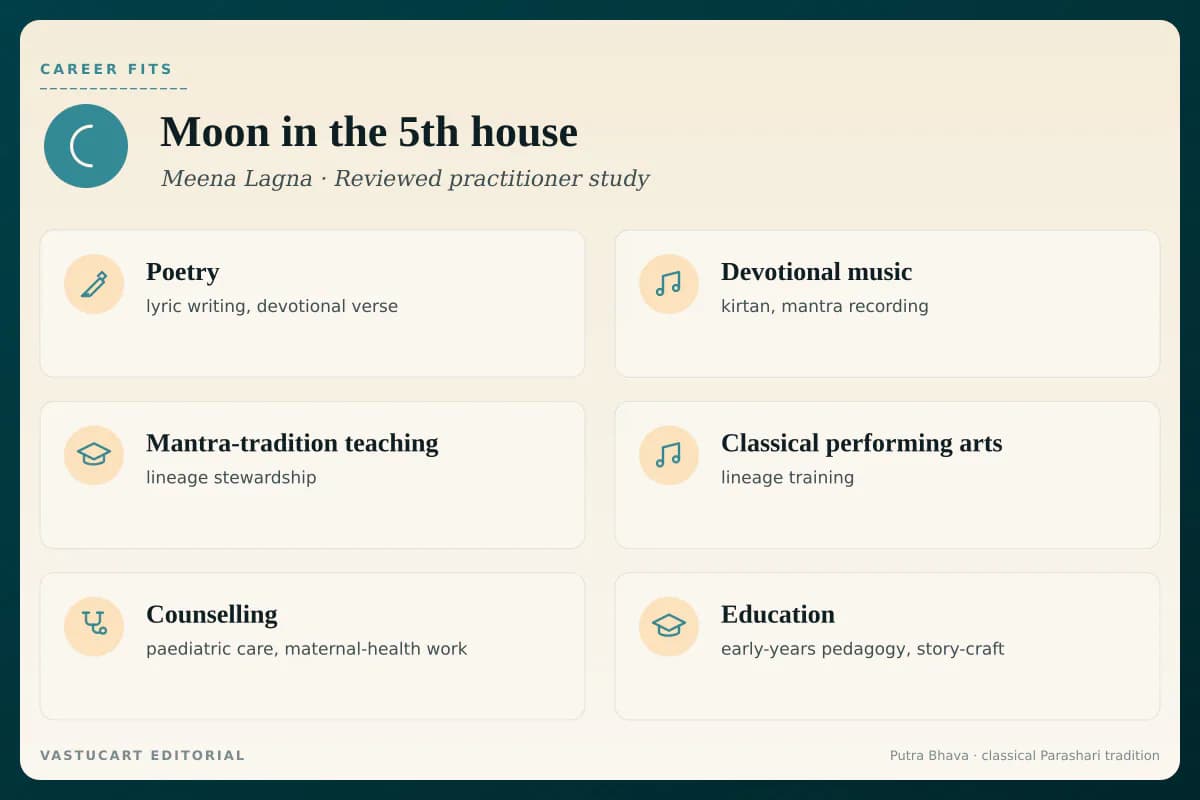
- Poetry, lyric writing, devotional verse
- Devotional music, kirtan, mantra recording
- Mantra-tradition teaching and lineage stewardship
- Classical performing arts with lineage training
- Counselling, paediatric care, maternal-health work
- Education, early-years pedagogy, story-craft
Where the creative and mantra vocation plays out
Career paths cluster around fields that braid creative output with devotional and intuitive depth. Poetry, lyric writing, and devotional verse come first because the swakshetra Moon at the Putra trikona gives the native a verbal sensitivity other lagnas spend decades cultivating, and the Meena imaginative reach makes the verse cross temperaments rather than addressing only the literary. Devotional music, kirtan-singing, and mantra-recording suit natives whose vocational mode is sound-based devotion: many become published recording artists, kirtan-circle leaders, or temple-music directors whose careers compound across decades into substantial spiritual-arts standing.
Mantra-tradition teaching and lineage-stewardship work fit naturally because the Moon as 5L in own Karka is the chart's clearest mantra-siddhi signature, the placement classical sources cite for natives who can teach a mantra and have students experience its inner movement within weeks. Many such natives take initiation roles by their forties and rise to lineage-stewardship positions through their fifties and sixties. Classical performing arts (Bharatanatyam, Odissi, Carnatic vocal, Hindustani vocal) work because the Karka Moon carries the inner-rasa channel these forms transmit, and the Putra trikona seat gives the performer the past-merit reservoir audiences register without naming. Counselling, paediatric care, and maternal-health work suit natives whose vocational mode is the long nurturing arc: the Karka tenderness combines with the Putra-children significator to produce clinicians whose work with mothers, infants, and adolescents is held by both ethical structure and emotional attunement. Education, early-years pedagogy, and story-craft fit because the 5L Moon is the karaka of teaching at the foundation level and the trikona placement produces natives whose presence carries the warmth early-years work requires. The Moon mahadasha is the defining creative window for this placement and arrives with the first published verse collection, the studio-album release, the mantra-initiation appointment, the dance-debut platform, the senior teacher recognition, or the maternal-clinic founding that crystallises the past-merit vocation.
Why this is the most luminous Moon placement available to Meena Lagna
The clearest way to read the Moon in 5th of Meena is to hold the swakshetra dignity, the trikona seat, and the past-merit reading together rather than treating any of them in isolation. Classical Parashari recognises that own-sign placement gives a planet his full natural strength and lord-in-his-own-house pattern gives the bhava his full natural strength because the lord and the house align without mediation. When the lord is also a trikona lord and the house is also a trikona, the alignment compounds again: the planet's own-sign strength, the bhava's lord-in-house strength, and the trikona's dharmic-credit strength all point at the same single position.
The single-lordship simplicity is the second specific feature that practitioners need to handle correctly. The Moon rules only Karka, so the placement carries no awkward dual-lordship mixing the way some other planets do. For Meena the Moon is a pure benefic 5L, and the placement therefore reads cleanly: the entire Putra-Bhava significator load sits at home in own sign with no compromised lordship to weigh against the dharmic seat. Many natives report that the creative output they were known for at thirty looked like an honest expression of who they already were at twenty, and the work at fifty looked like a deeper devotional version of the work at thirty, with the surface variety hiding a single inner thread. The third interpretive layer is the Gajakesari overlap. Jupiter at the lagna or in the kendras (1, 4, 7, 10) for the same chart forms a kendra-to-Moon configuration, and that pattern creates Gajakesari directly. When Jupiter exalted in 5H Karka conjoins this Moon (a documented Meena configuration), the chart hosts Hamsa, Lakshmi-style trikona, and Gajakesari in one bhava. No other lagna hosts this triple-alignment in the same trikona house.
When the swakshetra Moon at Karka delivers its past-merit chapter
The Moon mahadasha is the defining window for this placement and arrives with the first published verse collection, the studio-album release, the mantra-initiation appointment, the dance-debut platform, or the maternal-clinic founding that crystallises the past-merit creative vocation.
Stomach, hydration, and the Karka Moon vitality signature
Health follows the Meena-with-Moon-in-5th pattern with a kapha-pitta constitution that leans kapha-dominant because the Moon carries water-element rasa and Karka is itself a water-kapha sign. Body-part rulership for the 5th house emphasises the upper abdomen, stomach, and the heart region, while the Karka sign emphasises the chest, breast tissue, and the body's overall fluid-handling capacity. The Moon rules the lymphatic system, fluid balance, breast tissue, sleep architecture, and the broader emotional-endocrine axis. The placement therefore raises specific lifelong vulnerabilities to digestive sensitivity when emotional load runs high, fluid-retention patterns through humid weather and waning-Moon weeks, lactation challenges for natives who become mothers, and sleep-disturbance signatures the moment the daily tithi-rhythm slips.
The emotional-eating risk is the second body-related layer to read carefully. The Karka Moon at the trikona gives the body a strong attachment to comfort food, especially sweets, dairy preparations, and warm liquids, and the Meena digestion handles this only up to a point. The pattern that recurs across clinical practice is steady weight gain through the thirties when emotional challenges go unprocessed, plateauing if a tithi-aware fast on full and new moon evenings is held, and chronic kapha-related markers (lymphatic sluggishness, breast-tissue density variation, blood-sugar variability) emerging in the forties when emotional-hygiene practice is absent. Daily walking near water before sunrise, restraint with milk-sweets after sunset, the classical Monday fast on Chandra-vrata day, and quarterly lymphatic check-ups from the early thirties are the protective routines. Hydration also deserves specific attention because the Karka Moon rules fluid balance directly: warm water through the morning, coconut water in heat months, and care during long emotional-labour days protect the body across decades.
Remedies for the Moon in the Karka Putra trikona
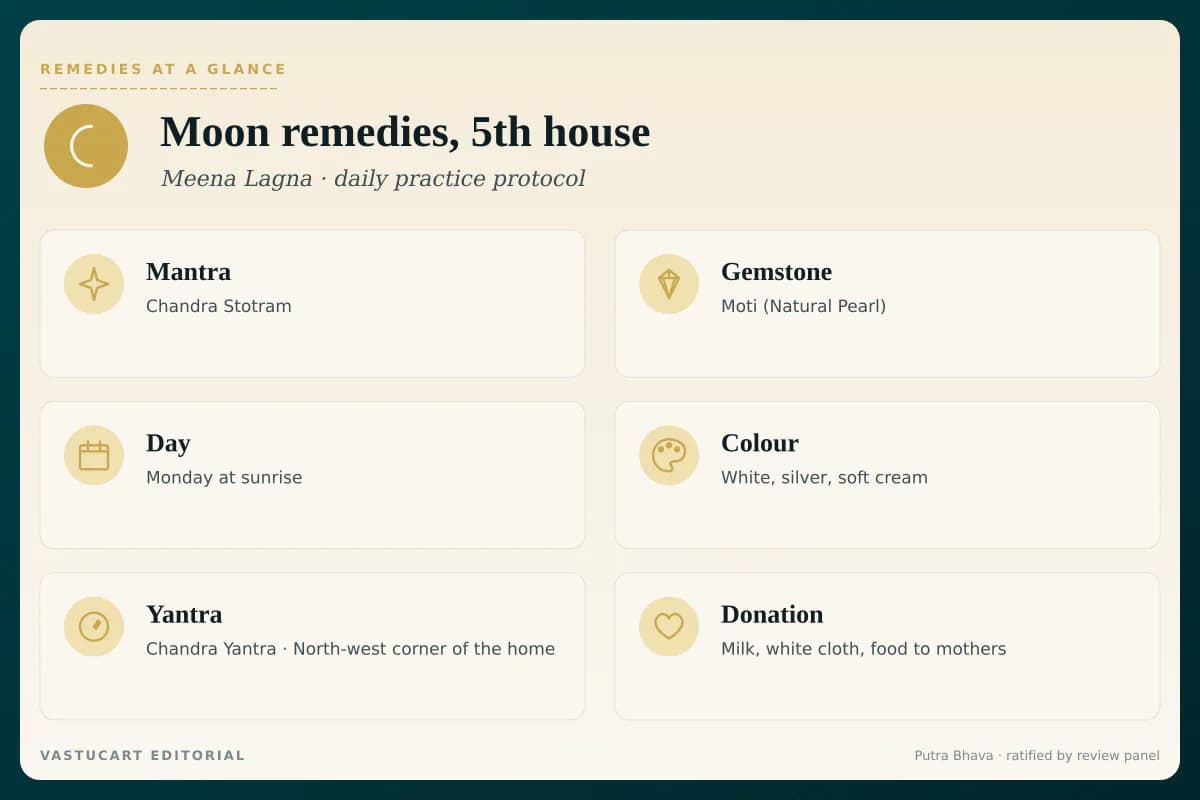
Daily Devi worship is the primary remedy for this placement because the Devi (the divine mother in her many forms, especially Parvati and Lakshmi) is the classical patron of the Moon in the Vedic tradition, and the Moon's mother-significator function holds the Karka signature in its most refined expression. Rise before sunrise, bathe, wear white or pale silver clothing on Mondays, and visit a Devi temple if accessible. The Chandra Stotram is the primary recitation, the Navagraha verse to the Moon that creates a containing devotional field for the past-merit signature in its swakshetra-trikona expression. Reciting it at sunrise daily for forty days at any major Moon transition (a creative project launch, a mantra-initiation appointment, a recording-studio commitment, a maternal-clinic founding, or a child's birth) is the formal protocol classical sources prescribe.
Offer white flowers (especially jasmine and lotus), milk-rice (kheer), white sweets, and white camphor at the altar. Donate to causes that support women, children, and the lineage-arts: maternal-health funding for under-resourced mothers, scholarship support for classical-arts students, mantra-tradition publishing, and devotional-music recording archives are the structural gift channels for this placement. The tithi-aware lifestyle practice is the lifestyle remedy that compounds across decades into the difference between Karka-luminosity and Karka-volatility: a daily check on the moon-phase and a weekly Monday fast keep the placement directed and the mood weather steady. The gemstone is pearl (Moti), the primary Moon ratna, and is worn confidently here because the swakshetra Karka Moon responds to amplification cleanly without volatility risk. Wear a natural Basra or South-Sea pearl of minimum five carats set in silver on the small finger of the right hand on a Monday at sunrise after Chandra mantra recitation, and only after a confirmed reading by a qualified Jyotishi.
Gemstones for Moon in 5th house Meena Lagna
Pearl is the primary Moon gemstone and is worn confidently for this placement because the trikona-lord-in-trikona Karka configuration is foundationally clean and benevolent.
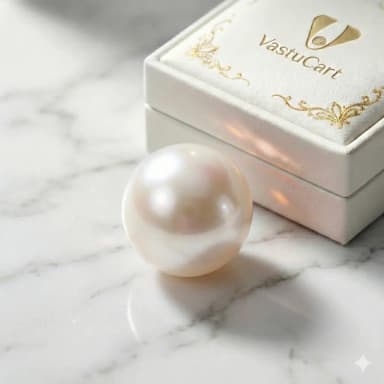

Disclaimer: Pearl over a swakshetra Karka Moon at the Putra trikona amplifies the past-merit creative channel cleanly. Always consult a qualified Jyotishi before permanent wearing because the Moon is the most emotionally-sensitive of the seven amplifiable planets.
Rudraksha beads for Moon in 5th house
The Moon-aligned rudraksha is the Do Mukhi (Two Mukhi), the bead directly ruled by Ardhanarishvara and the Moon.
The classical Moon rudraksha and the bead specifically associated with mind-stability and emotional harmony. Supports the past-merit Karka signature, channels the Moon's tide-bearing instinct toward steady creative output, and stabilises the mood-bandwidth when the poetry, music, mantra-teaching, paediatric, or maternal-clinic vocation is in active phase.
The five-mukhi bead supports mantra-siddhi and the dharmic dimension of practice. Wearing the Panch Mukhi alongside the Do Mukhi compounds the placement's natural strength in mantra-tradition stewardship, lineage-arts performance, and the institutional dimension of the Putra-Bhava creative vocation.
Chandra Yantra for the swakshetra-trikona placement
Sacred recitations for the Moon at the Karka trikona
Namami shashinam somam shambhor mukuta-bhushanam
Translation: I bow to the Moon, lustrous as curd and conch and frost, born from the ocean of milk, the cool-rayed Soma who adorns the crown of Shambhu. The Chandra Stotram is the canonical Navagraha verse to the Moon and is the primary daily recitation for a chart where the Moon sits swakshetra at the Putra trikona and the past-merit Lakshmi signature needs a containing devotional field. Many natives advanced in practice add the Devi Kavacham recitation as a secondary layer because the 5th-house Moon benefits specifically from the mother-deity invocation that the kavacha carries.
Read the full stotra on stotra.vastucart.in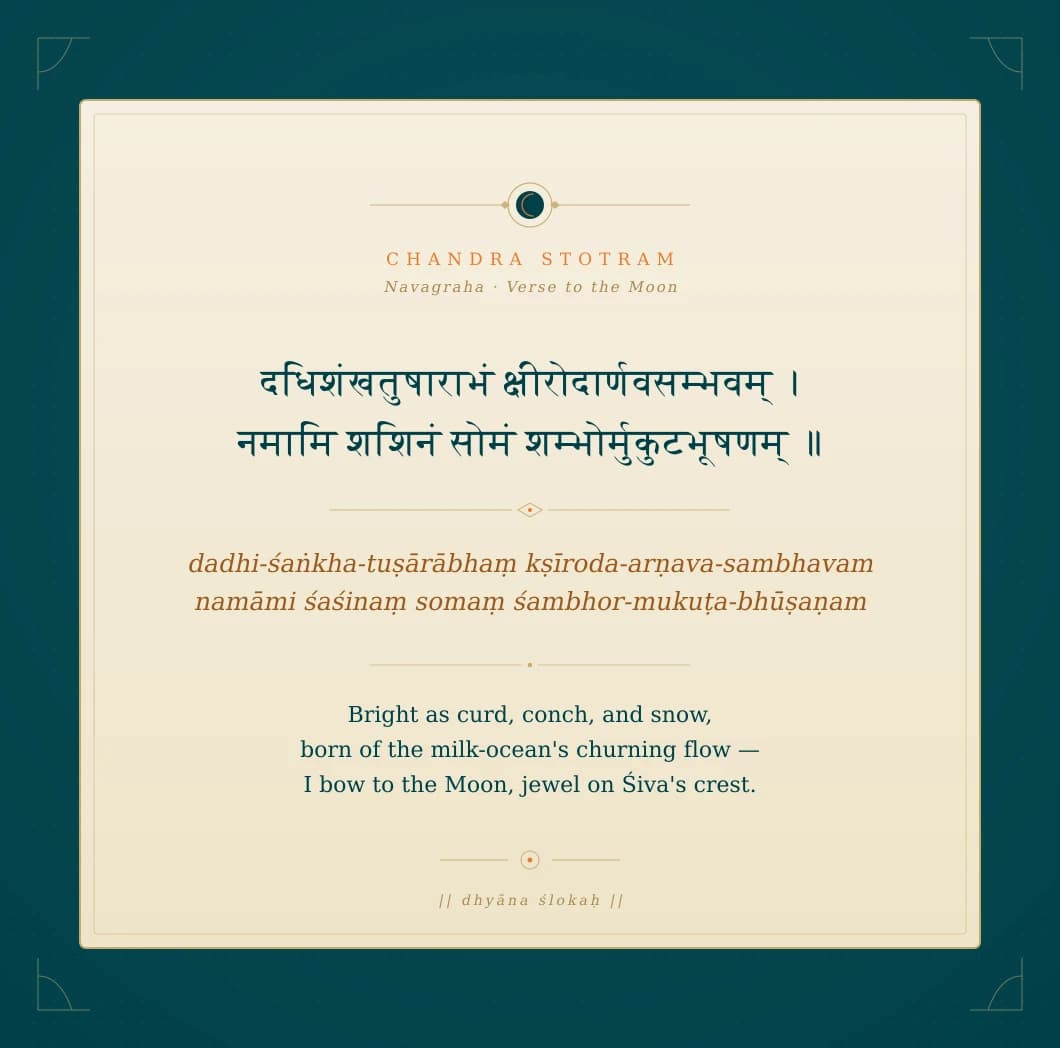
Tools for Moon 5th house Meena natives
Is your Putra Bhava Moon carrying the past-merit Karka signature?
Get a full personalised analysis of your fifth house Moon, the swakshetra Karka seat, and the creative-and-mantra timing.