Moon in the 12th house
Mithuna Lagna (Gemini Ascendant)
A practitioner study of Chandra exalted in Vyaya Bhava for Gemini ascendant natives. The Moon uchha in Vrishabha in the moksha angle, the 2L lordship reaching its full sign-strength inside the foreign-and-contemplation bhava, and the foreign-residence and contemplative-wealth signature that defines the most paradoxical Mithuna placement Moon can occupy.
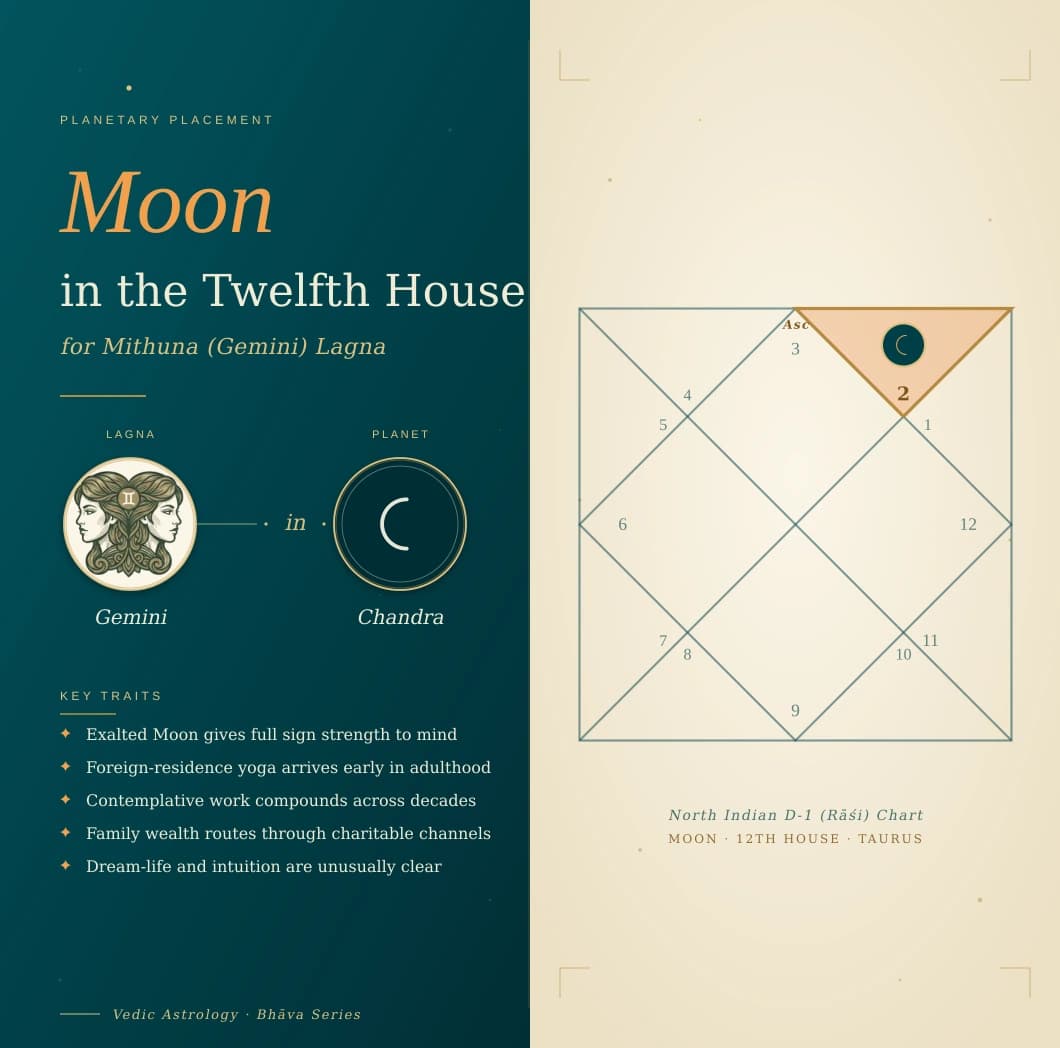
Moon sits exalted in Vrishabha in the twelfth house for Gemini ascendant natives, the foreign-residence and contemplative-wealth signature.
Moon in 12th house for Mithuna Lagna, the quick reference
If you carry the Moon in the twelfth house of a Mithuna chart, you hold one of the most paradoxical and quietly rewarding placements in the entire Vedic catalogue, because Chandra (Moon) reaches his full sign strength in Vrishabha (Taurus, his exaltation sign), yet that strength is routed into Vyaya Bhava (the twelfth house, the bhava of expenditure, foreign residence, retreat, dreams, and moksha). The first practitioner reading is that the Moon in 12 of Mithuna is uchha-in-dushthana, a configuration where the planet keeps full structural dignity but the bhava redirects the dignity inward and outward toward the foreign-and-contemplative dimension of life rather than toward the worldly accumulation reading.
The second structural feature is the 2L-in-12H pattern. The Moon is the 2L for Mithuna, ruling family wealth, speech, lineage, and accumulated resources, and his arrival in the twelfth house places the dhana significations directly inside the expenditure-and-foreign bhava. Classical Parashari recognises 2L-in-12H as a wealth-flow-toward-foreign-and-charitable-channels signature, and when the 2L is exalted in the 12H the configuration consistently produces natives who build family resources through foreign-resident work, charitable institutions, ashrams and retreat centres, hospitality abroad, contemplative-cuisine ventures, or cross-border family-business stewardship. The third feature is the contemplative-wealth signature. The 12th house rules retreat, meditation, dream-life, and inner research, and the exalted Moon here often produces natives whose adult identity centres on the integration of inner and outer prosperity. This guide reads every layer of Moon in 12th house for Mithuna Lagna natives: the Vrishabha exaltation, the 2L lordship in 12H, the foreign-and-moksha yoga, the contemplative-wealth signature, and the pearl protocol.
Why an exalted Moon in the moksha angle creates a foreign-residence yoga
Students often arrive at this placement worried that an exaltation in the twelfth house must be wasted, and the honest practitioner answer is that exaltation is never wasted but it is always relocated. The Vrishabha exaltation gives the Moon his full sign-strength, which means the lunar significations (mind, mother, family wealth, public connection, emotional resilience) operate at their peak natural intensity. The twelfth-house placement does not weaken these significations, it relocates them away from the visible-worldly axis (career-marriage-wealth-display) and toward the invisible-inner axis (foreign-residence-retreat-charity-meditation). Many natives in this configuration build genuine wealth and emotional standing, but the wealth often expresses through assets held abroad, the family is often physically distant, and the public connection often forms around contemplative or institutional work rather than mainstream visibility.
The 2L-in-12H reading is the second specific feature that practitioners need to handle correctly. Classical Parashari treats the 2L in 12H carefully because it indicates wealth that flows out as readily as it flows in. When the 2L is exalted in 12H, the flow becomes consciously directed rather than leak-shaped, which is the difference between charitable-institution wealth and dissipating-resource wealth. Many natives in this configuration become foundation directors, ashram administrators, foreign-aid programme leaders, hospice founders, or family-trust stewards whose family resources route through institutional vehicles for cultural and humanitarian impact. The third interpretive layer is the contrast with Moon in 2 (the swakshetra dhana Moon for Mithuna) and Moon in 4 (the kendra Moon). Moon in 2 of Mithuna places Moon in his own Karka in the wealth angle, the foundational dhana yoga. Moon in 12 places Moon exalted in Vrishabha in the foreign-and-moksha angle, the foundational moksha-and-foreign yoga. Both are strong but the vocational expression differs sharply.
Moon exalted in the twelfth is not a wasted exaltation. It is the specific configuration where the lunar wealth, the family resonance, and the public connection all relocate toward foreign and contemplative channels, and learn to compound there with full sign strength.
Terms used in this article
A short glossary of the Sanskrit and Jyotish terms that recur in this study. First-occurrence expansion is also retained inline.
- Vyaya Bhava
- The 12th house, the bhava of expenditure, foreign residence, retreat, dreams, and moksha.
- Uchha
- Exaltation. A planet placed in his exaltation sign gains his full natural sign-strength.
- Dushthana
- Difficult bhava (6, 8, 12). When occupied by an exalted graha, the difficulty becomes a directed channel.
- Moksha
- Spiritual release, the liberation aim that the 12th house holds in the four-fold purushartha.
- 2L in 12H
- Wealth lord in the expenditure house. Read as outward-flowing wealth, refined when the lord is exalted.
- Karakatva
- The natural significations a planet rules independent of any chart.
- Foreign-residence yoga
- Classical pattern where 12H placements indicate residence away from the birth land.
How the Moon exalted in the moksha angle shapes the Mithuna native
Physically the native carries the Mithuna versatility softened by the Moon's lunar refinement, often producing a face that strangers describe as inwardly composed yet quick to engage. The eyes carry an unusual depth and a slight watery quality, and many natives have notably long eyelashes or expressive lower-lid contours that classical texts attribute to a strong twelfth-house Moon. The build keeps the standard Mithuna lean frame but adds a settled stillness around the lower body and feet (classical Vyaya body-part signatures), and most natives have unusually quiet sleep, vivid dream-life from childhood, and a natural pull toward water-edge environments.
Temperament is where the placement most distinguishes the native. These natives carry the Mithuna versatility (curiosity across domains, comfort with multiple frames) but route it through inward-attuned channels rather than purely socially-attuned ones. They are drawn to retreat, contemplation, and foreign cultural environments from young: international study, residence abroad, ashram visits, or extended creative-research travel often arrive in the early twenties and shape the rest of the life. The Mithuna directness combines with the Vrishabha steadiness of the exalted Moon to produce natives who can hold long contemplative work without flinching, the rare combination that translates well into research, foundation administration, hospice direction, and the kind of cultural-trust stewardship that requires both intellectual range and emotional patience. The shadow side is the same inwardness: natives who do not consciously translate the contemplation into structured public practice can experience repeated cycles of withdrawal that drain professional bandwidth, and the cycles can compound across years into reputational invisibility. Natives who pair the inwardness with explicit public-output discipline (a book a decade, an institution founded, a programme led) develop the rare integration of contemplative authority and durable practice the placement is genuinely capable of supporting.
Strengths, shadows and career fits
- Exalted Moon gives full sign strength to mind
- Foreign-residence yoga arrives early in adulthood
- Contemplative work compounds across decades
- Family wealth routes through charitable channels
- Dream-life and intuition are unusually clear
- Hospitality and retreat ventures abroad open
- Wealth flows out as readily as it flows in
- Mother may live geographically distant
- Sleep and lymphatic cycles need discipline
- Public visibility comes late if at all
- Family closeness can feel diluted by distance
- Withdrawal cycles can drain professional bandwidth
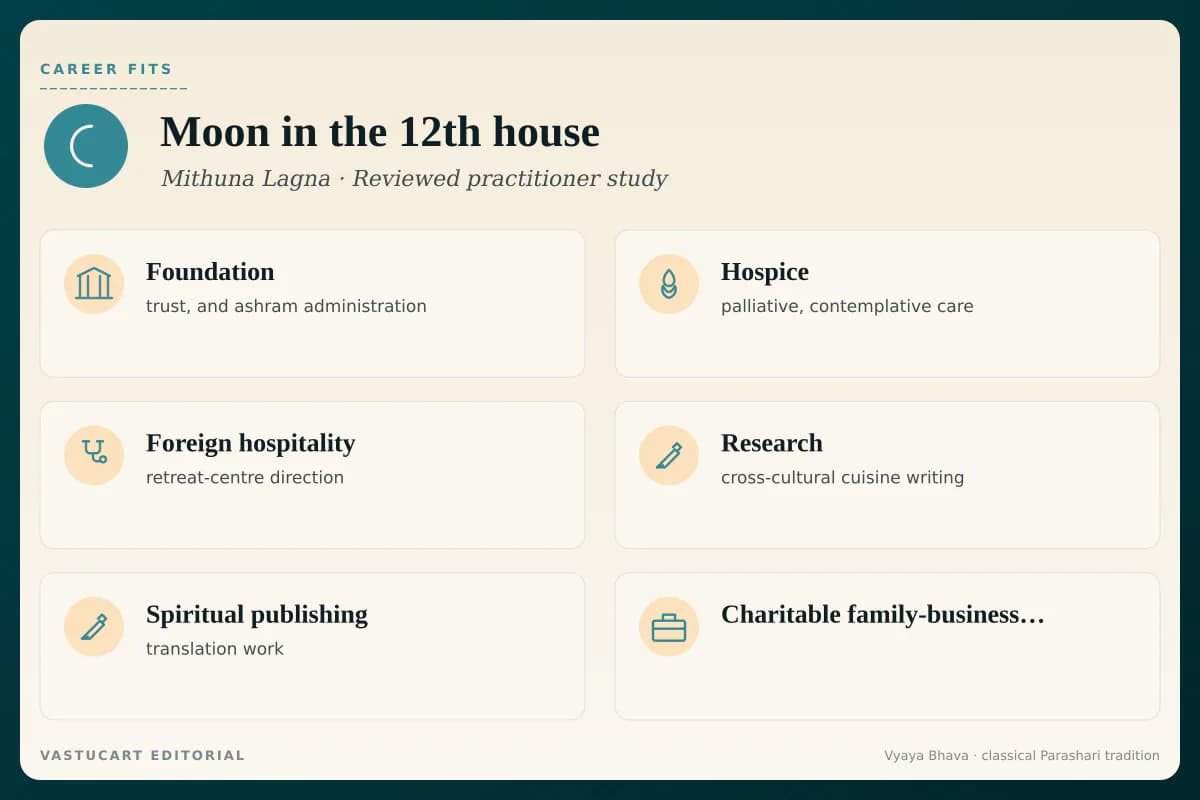
- Foundation, trust, and ashram administration
- Hospice, palliative and contemplative care
- Foreign hospitality, retreat-centre direction
- Research and cross-cultural cuisine writing
- Spiritual publishing and translation work
- Charitable family-business stewardship abroad
Where the contemplative-wealth vocation plays out
Career paths cluster around fields that braid contemplative discipline with structured commerce held at one or two removes from mainstream visibility. Foundation, trust, and ashram administration are the strongest single fit because the 12th house rules charitable-institutional vehicles, the exalted Moon rules emotional-cultural stewardship, and the Mithuna versatility extends institutional administration into writing, fundraising, and cross-cultural translation. Many natives in this configuration become foundation directors, family-trust stewards, ashram administrators, or programme leaders for foreign-aid institutions whose careers compound across decades into substantial cultural reach without requiring conventional spotlight.
Hospice, palliative and contemplative care fit natives whose vocational mode is more service-oriented: the Vyaya Bhava rules end-of-life care, the Moon rules emotional resonance and nourishment, and the combination produces natives who can hold the most difficult emotional material with steady kindness. Foreign hospitality, retreat-centre direction, and contemplative cuisine ventures suit natives drawn to the food-and-shelter dimension of service: many natives in midlife open boutique retreat properties abroad, lead silent-retreat programmes, or run contemplative-cuisine ventures combining cultural-heritage cooking with meditative hospitality. Research and cross-cultural cuisine writing fit Mithuna's communication versatility blended with the 12th-house pull toward foreign cultural material, producing food anthropologists, cookbook authors writing from foreign residence, or travel-cuisine documentary makers whose work depends on prolonged foreign immersion. Spiritual publishing and translation work suit natives whose vocational mode is textual: the exalted Moon supports clear interpretive prose and the 12th house supports the long quiet hours required for serious translation. Charitable family-business stewardship abroad is the hidden career path many natives find in their forties, inheriting family enterprises and converting them into philanthropic vehicles operating from foreign bases. Moon mahadasha is the defining career window and arrives with the foreign-residence shift, the foundation appointment, the retreat-centre opening, or the major translation project that crystallises the contemplative-wealth vocation.
Why this is among the most misread Moon placements for Mithuna
The clearest way to understand the Moon in 12th of Mithuna is to read the Vrishabha exaltation, the 2L-in-12H pattern, and the moksha-bhava translation together. Classical Parashari recognises that exaltation gives a planet his full natural strength regardless of bhava, but the bhava determines where that strength expresses. When the dhana lord (2L) sits exalted in the moksha bhava, the wealth-producing dimension of the chart receives full sign strength routed into outward-flowing channels, and the result is a chart that builds genuine wealth but holds it loosely, often through institutional or charitable vehicles rather than personal accumulation.
The dushthana redemption is the second specific feature that practitioners need to handle correctly. Classical texts read the 12th house as one of the three dushthana stations because of its expenditure-and-loss orientation, but the dushthana classification softens significantly when the resident planet is exalted. Many natives in this configuration enjoy unusually durable family-trust structures, a steady accumulation of foreign-held assets, and the kind of charitable-institution leadership that compounds across decades into substantial cultural standing without conventional career visibility. The third interpretive layer is the comparison with Moon-in-12 placements other lagnas offer. The exalted-Moon-12 of Mithuna is the cleanest possible foreign-residence-with-wealth combination because no other lagna places Moon's exaltation sign at the 12H cusp simultaneously with making Moon the 2L of the chart. Most other lagnas with Moon in 12 either lose the exaltation strength or hold the 2L role under a different planet, neither of which produces the same family-wealth-into-charitable-channel signature this Mithuna configuration carries.
When the Moon in 12th delivers its foreign-residence chapter
Moon mahadasha is the defining window for this placement and arrives with the foreign-residence shift, foundation or trust appointment, retreat-centre opening, or major translation project that crystallises the contemplative-wealth vocation.
Feet, sleep, and the Vyaya health link
Health follows the Moon-in-12th pattern with specific Vyaya body-part vulnerabilities. Constitution is generally balanced toward kapha-vata because the Moon carries water-kapha and Vrishabha is itself an earth-kapha sign, but the 12th-house location adds a vata layer through the sleep-and-foreign-travel orientation. The 12th house body-part rulership covers the feet, left eye, lymphatic system, and sleep cycles, and the placement raises specific risk for foot-and-ankle issues from extensive travel, lymphatic sluggishness, sleep-cycle disruption, and left-eye sensitivity. Many natives report that sleep quality fluctuates with travel and emotional load, which is the Moon-in-12H signature expressing through the sleep apparatus directly.
The Moon-water-Vrishabha constitution is the second specific layer. Classical reports consistently associate exalted Moon in 12H with strong base emotional resilience but slow lymphatic clearance, mild kapha excess in humid environments, and a tendency toward night-eating cycles during heavy creative or contemplative phases. Most natives benefit from disciplined daily walking (especially morning beach or garden walks), moderate fasting practice, and mindful attention to sleep hygiene (consistent bedtime, screen restriction, alcohol moderation). Annual full-panel screening from the late twenties is recommended with specific attention to thyroid, lymphatic, and ophthalmic markers. Daily yoga (specifically restorative postures and pranayama practices that support lymphatic flow), moderate intake of warm fluids, and avoidance of late-night screen indulgences are the lifestyle stabilisers because the chart's natural pull toward inward retreat needs ordinary body discipline as a counterweight.
Remedies for the Moon in the Mithuna vyaya angle
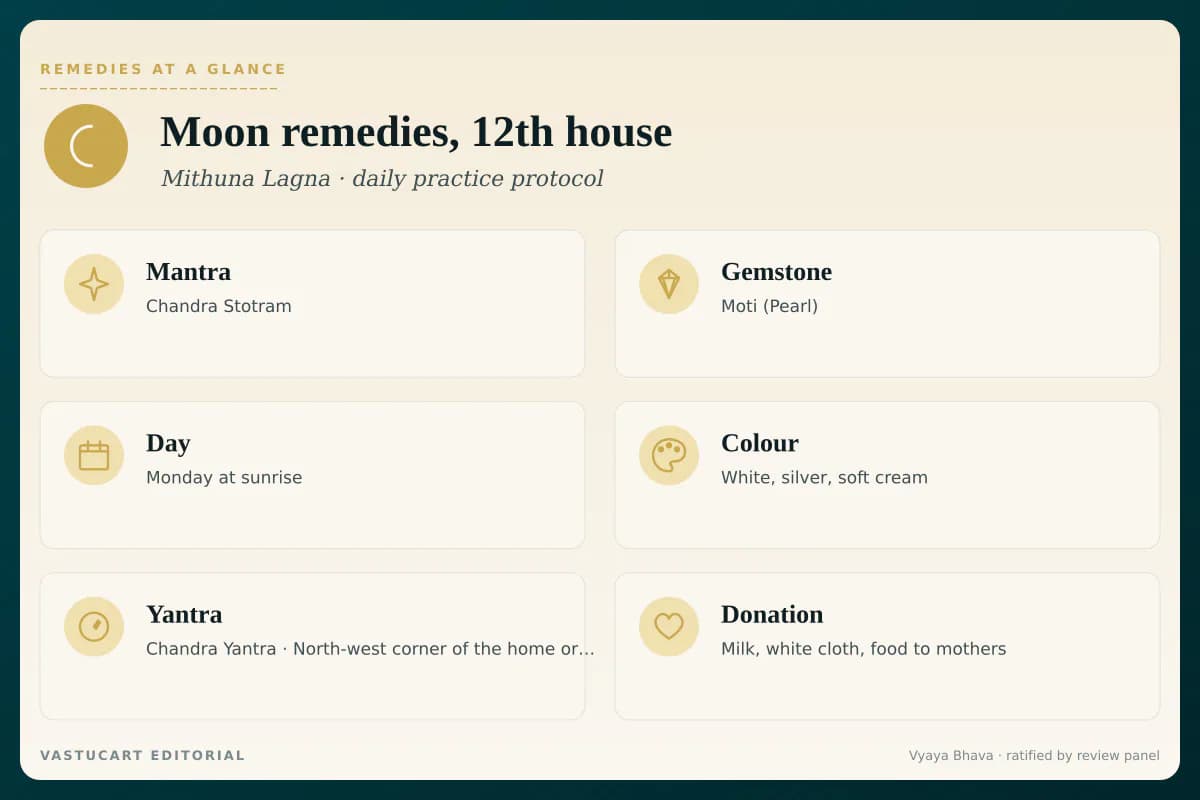
The daily Krishna or Devi worship is the primary remedy for this placement because Krishna is the classical patron deity of the Moon (and the Devi is the alternative for natives drawn to the maternal form), and either form holds the exalted-Moon signature in its most refined moksha-channel expression. Rise before sunrise, bathe, wear white or pale silver clothing on Mondays, and visit a Krishna or Devi temple if accessible (or maintain a personal altar when foreign residence makes temple access difficult). The Chandra Stotram is the primary recitation, the Navagraha verse to Chandra that creates a containing field for the Moon signature in its exalted vyaya expression. Reciting it at sunrise daily for forty days at any major Moon transition (a foreign-residence shift, a foundation appointment, a retreat-centre opening) is the formal protocol.
Offer white flowers (especially lotus and jasmine), milk-rice, kheer, and white sweets at the altar, and donate to causes that support contemplative-cultural welfare and foreign-aid institutions (orphan-care abroad, ashram-development funds, hospice institutions, retreat-centre scholarships). The conscious-output discipline is the lifestyle remedy that compounds across decades into the difference between Moon-12-mastery and Moon-12-withdrawal: a weekly practice of producing one piece of public output (article, programme, fundraising letter, translation page) keeps the contemplative work directed outward. The gemstone is pearl (Moti), and this is one of the gemstone-careful placements because the exalted vyaya Moon amplifies the moksha channel powerfully, which suits natives whose vocational direction is genuinely contemplative but can intensify withdrawal cycles for natives still building the public-output discipline. Wear a natural sea pearl of minimum five carats set in silver on the small finger of the right hand on a Monday at sunrise after Chandra mantra recitation, and only after a confirmed reading.
Gemstones for Moon in 12th house Mithuna Lagna
Pearl is the primary Moon gemstone and works carefully here because the exalted vyaya Moon amplifies the moksha channel powerfully.


Disclaimer: Pearl over an exalted vyaya Moon channels the moksha amplification powerfully. Always consult a qualified Jyotishi before permanent wearing because withdrawal cycles can intensify if the public-output discipline is not yet steady.
Rudraksha beads for Moon in 12th house
The Moon-aligned rudraksha is the Do Mukhi (Two Mukhi), the bead directly ruled by Shiva-Parvati and the Moon.
The classical Moon rudraksha and the bead specifically associated with relational and emotional harmony. Supports the contemplative-wealth signature, channels the inward instinct toward sustainable institutional output, and stabilises emotional bandwidth when the foreign-residence chapter is in active phase.
The twelve-mukhi bead supports steady directional clarity, particularly valuable for an exalted vyaya Moon native because it counterbalances inward retreat with steady outward radiance. Wearing the Barah Mukhi alongside the Do Mukhi compounds the placement's natural strength in foundation leadership and contemplative-public work.
Chandra Yantra for the vyaya placement
Sacred recitations for the Moon in the vyaya angle
Namami shashinam somam shambhor-mukuta-bhushanam
Translation: I bow to the Moon, bright as curd, conch, and snow, born from the cosmic ocean's nectar-filled flow, adorning Lord Shiva's crest with radiant glow. The Chandra Stotram is the canonical Navagraha verse to the Moon and is the perfect daily recitation for a chart where the Moon sits exalted in the vyaya angle and the contemplative-wealth signature needs a containing devotional field. Many natives advanced in practice add the Devi Suktam recitation as a secondary layer once the daily Chandra discipline is steady.
Read the full stotra on stotra.vastucart.in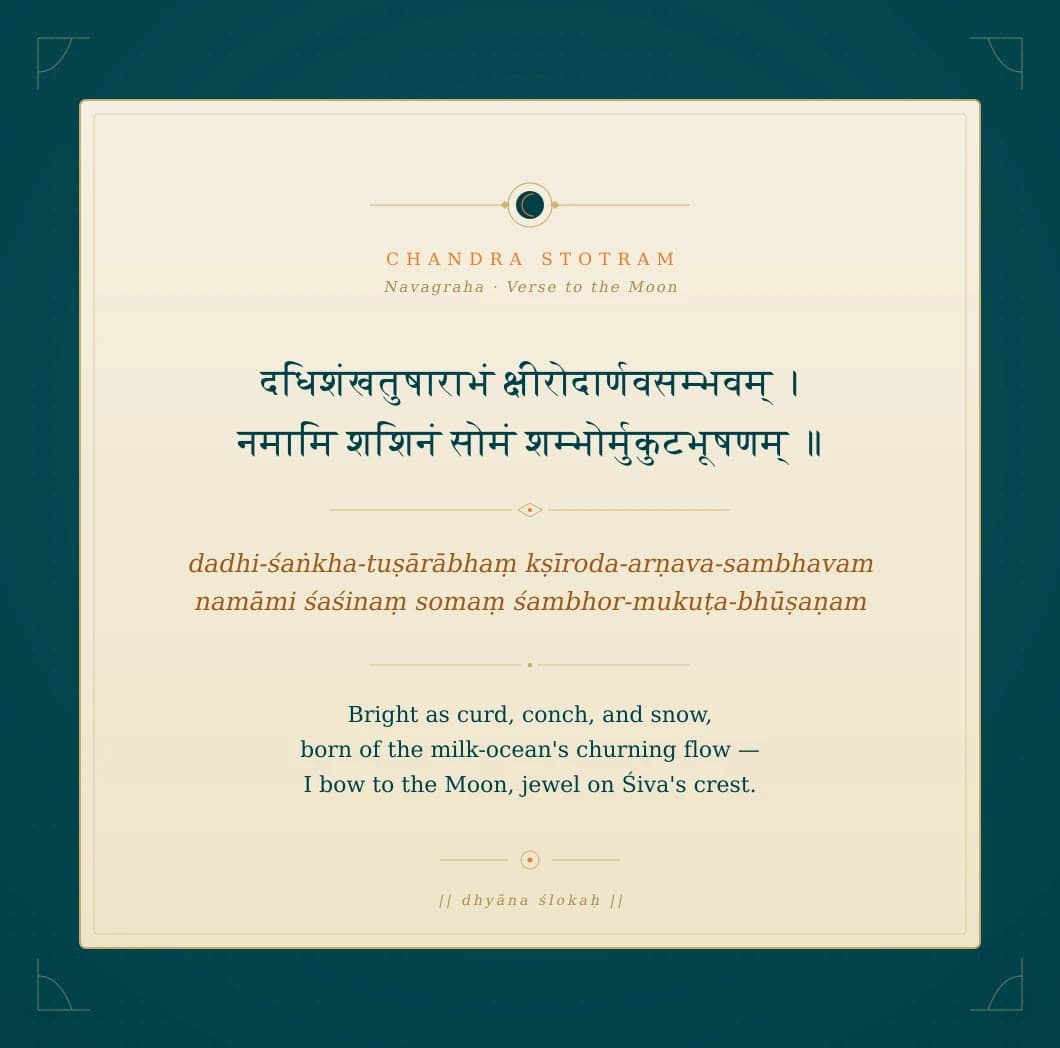
Tools for Moon 12th house Mithuna natives
Is your Vyaya Bhava Moon carrying the foreign-residence signature?
Get a full personalised analysis of your twelfth house Moon, the exaltation strength, and the foreign-residence timing.