Mercury in the 7th house
Mithuna Lagna (Gemini Ascendant)
A practitioner study of Budha in Kalatra Bhava for Gemini ascendant natives. Mercury in Dhanu opposite his own lagna, the 1L lagna lord facing the chart from the partnership angle, and the spouse-as-teacher and partnership-articulation signature that defines the most relationally-tuned Mithuna Mercury placement.
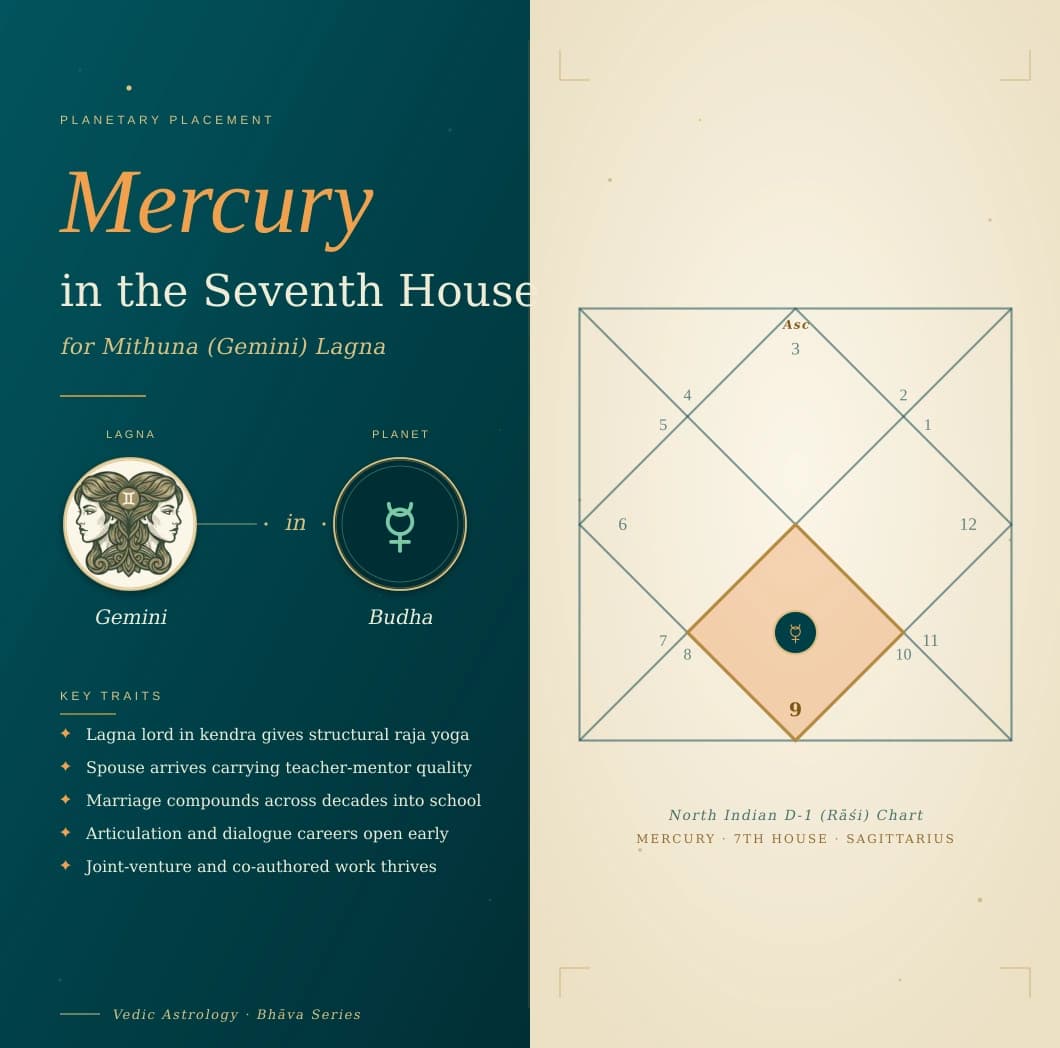
Mercury sits in Dhanu in the seventh house for Gemini ascendant natives, the spouse-as-teacher and partnership-articulation signature.
Mercury in 7th house for Mithuna Lagna, the quick reference
If you carry Mercury in the seventh house of a Mithuna chart, you hold one of the most relationally-tuned placements in the entire Vedic catalogue, because Budha (Mercury) is the natural lord of articulation, intelligence, and exchange, and his arrival in Kalatra Bhava (the seventh house, the bhava of marriage, partnership, business contracts, and public-facing relationships) places these significations into the territory where Mercury's gift for clean exchange becomes the central feature of the native's adult life. The seventh house from Mithuna is Dhanu (Sagittarius), Jupiter's own sign, which means Mercury sits in the sign of his classical adversary. Classical Parashari treats Mercury in Jupiter's sign as a moderate-dignity placement because the planets are technically enemies, yet the kendra location and the lagna-lord-faces-the-7th pattern produce a structurally consequential reading.
The second structural feature is the 1L-and-4L lordship. Mercury rules both Mithuna (1H, lagna) and Kanya (4H, sukha bhava) for this chart, which means his arrival in 7H places the body lord and the home lord directly in the partnership angle. Classical reports describe natives in this configuration whose adult identity, sense of home, and public expression all organise around the central marriage or business partnership. The third feature is the Jupiter-house spouse signature. Because the 7H falls in Dhanu (a Jupiter sign), the partner consistently arrives carrying a teacher-mentor quality that Mercury learns from across decades. Many natives marry someone older or more philosophically experienced, and the marriage itself becomes the structural school of the chart. This guide reads every layer of Mercury in 7th house for Mithuna Lagna natives: the Dhanu placement, the 1L+4L lordship, the lagna-lord-in-kalatra pattern, the spouse-as-teacher signature, and the emerald protocol.
Why lagna-lord Mercury in Dhanu kalatra is structurally consequential
Students often arrive at this placement uncertain whether to read Mercury in his enemy's sign as weak. The honest practitioner answer is that Mercury in Dhanu reads as moderate dignity in isolation but consequential in context, because the 7H is a kendra and Mercury is the lagna lord. Classical Parashari recognises that lagna-lord-in-kendra patterns are structurally constructive regardless of sign dignity, because the body and the kendra angle align without mediation. The enemy-sign nuance softens here further because Jupiter is a benefic and the philosophical-teacher tone of Dhanu enriches Mercury's communication rather than crushing it.
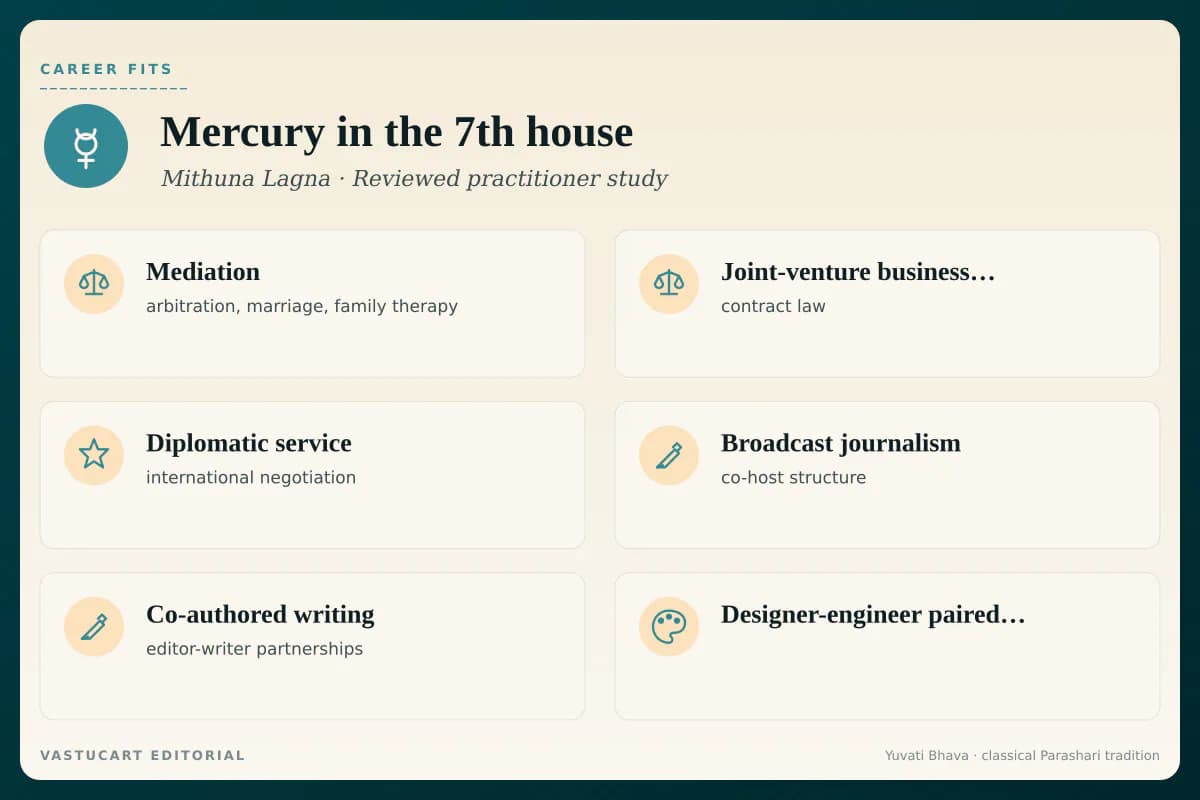
The lagna-lord-in-kalatra reading is the second specific feature that practitioners need to handle correctly. When the 1L sits in 7H, the chart's body-and-self organises around the marriage or primary partnership. This is structurally distinctive: the native's sense of who they are forms most clearly through the partnership rather than through solo achievement. Many natives in this configuration build adult careers in fields where the partnership IS the work: marriage and family therapy, mediation and arbitration, joint-venture business leadership, contract negotiation, diplomatic service, broadcast journalism with a co-host structure, and the kind of writer-editor or designer-engineer pairings that thrive on co-authored output. The third interpretive layer is the contrast with Mercury in 4 (the apex Bhadra Mercury for Mithuna). Mercury in 4 of Mithuna places Mercury exalted in Kanya in his own kendra, the foundational double-dignity Bhadra. Mercury in 7 places the lagna lord in enemy-sign kendra, the spouse-as-teacher pattern. Both are kendra-strong but the vocational tone differs sharply.
Mercury at the seventh of his own lagna is not the strongest by sign but the most relational by structure. The chart organises itself around the partnership, and the partnership becomes the lifelong school the native chose before they could remember choosing.
Terms used in this article
A short glossary of the Sanskrit and Jyotish terms that recur in this study. First-occurrence expansion is also retained inline.
- Kalatra Bhava
- The 7th house, the bhava of marriage, partnership, business contracts, and public-facing relationships.
- Lagna lord
- The planet ruling the ascendant sign, signifying the body and the central self.
- Kendra
- Angular bhava (1, 4, 7, 10). Structurally constructive locations for any planet.
- Yuvati Bhava
- Alternate Sanskrit name for the 7th house, emphasising the partner-as-companion aspect.
- 1L in 7H
- Lagna lord in the seventh, classical pattern where the body and self organise around the partnership.
- Karakatva
- The natural significations a planet rules independent of any chart.
- Maraka
- Death-like or life-event triggering classification for the 2nd and 7th houses; softens when occupied by the lagna lord.
How Mercury in the kalatra angle shapes the Mithuna native
Physically the native carries the Mithuna versatility tempered by the Dhanu Mercury's philosophical orientation, often producing a face that strangers describe as friendly and serious by turns. The eyes carry an unusual focus when listening to a partner or interlocutor, and the speaking voice tends to be measured rather than rapid. The build keeps the standard Mithuna lean frame but adds a noticeable lower-abdomen sensitivity that classical texts attribute to seventh-house planets, and many natives report a tendency to gesture broadly when explaining ideas in conversation.
Temperament is where the placement most distinguishes the native. These natives carry the Mithuna versatility (curiosity across domains, comfort with multiple frames) but route it through partnership-attuned channels rather than solo-attuned ones. They are drawn to the dialogue-and-exchange dimension of life from young: long conversations, debate and discussion practice, written correspondence, and the kind of co-authorship that compounds across years into substantial joint output. The Mithuna directness combines with the Dhanu Jupiter-influence to produce natives who can hold a difficult conversation with both clarity and patience, the rare combination that translates well into mediation, family-business arbitration, contract law, joint-venture leadership, and the broadcast formats that depend on co-host chemistry. The shadow side is the same partnership orientation: natives who do not consciously claim solo work alongside the partnership can find their identity collapsing into the relationship, and the cycle can compound across years into reputational invisibility outside the partnership context. Natives who pair the partnership orientation with explicit solo-output discipline (a personal book, a solo programme, an independent platform) develop the rare integration of relational depth and individual authority the placement is genuinely capable of supporting.
Strengths, shadows and career fits
- Lagna lord in kendra gives structural raja yoga
- Spouse arrives carrying teacher-mentor quality
- Marriage compounds across decades into school
- Articulation and dialogue careers open early
- Joint-venture and co-authored work thrives
- Public-facing partnership reputation builds steadily
- Identity can collapse into the partnership
- Marriage timing may delay until late twenties
- Lower-abdomen and kidney health needs attention
- Solo work can feel less authentic than joint work
- Disagreement with spouse drains creative bandwidth
- Public visibility tied to partnership status shifts
- Mediation, arbitration, marriage and family therapy
- Joint-venture business leadership, contract law
- Diplomatic service, international negotiation
- Broadcast journalism with co-host structure
- Co-authored writing, editor-writer partnerships
- Designer-engineer paired creative practice
Where the partnership-articulation vocation plays out
Career paths cluster around fields that braid relational discipline with structured commerce held in a partnership frame. Mediation, arbitration, and marriage and family therapy are the strongest single fit because the seventh house rules partnership and Mercury rules the articulation discipline these fields require. Many natives in this configuration build careers as marriage-and-family therapists, mediators, family-business arbitrators, or pre-marital counsellors whose work compounds across decades into substantial cultural reach.
Joint-venture business leadership and contract law fit natives whose vocational mode is more commercial: the seventh house rules contracts and Mercury rules the language-and-clause discipline these fields demand. Many natives become joint-venture CEOs, partnership-firm partners, contract-law specialists, or international-trade negotiators whose careers depend on the partnership-handling instinct the chart supplies. Diplomatic service and international negotiation suit natives drawn to the cross-cultural-partnership dimension of life: the Dhanu Jupiter influence on the 7H opens long-arc diplomatic careers in foreign-service, multilateral-institution work, or non-profit international leadership. Broadcast journalism with a co-host structure fits because Mithuna Mercury thrives in the spoken format and the 7H placement produces natives whose voice is at its best in dialogue rather than monologue. Co-authored writing and editor-writer partnerships work because the chart specifically rewards joint-output structures: many natives find their best creative work emerging through long-arc collaborations rather than solo authorship. Designer-engineer paired creative practice is the hidden career path for natives whose Mithuna-and-Dhanu blend tilts toward technical work: many natives find their flagship contributions emerging from a sustained designer-engineer or strategist-implementer pairing. Mercury mahadasha is the defining career window and arrives with the marriage event, the joint-venture launch, the long-arc partnership consolidation, or the diplomatic-mission appointment that crystallises the partnership-articulation vocation.
Why this is among the most consequential Mercury placements for Mithuna
The clearest way to understand Mercury in 7th of Mithuna is to read the Dhanu placement, the 1L+4L lordship, and the lagna-lord-in-kalatra pattern as a single integrated configuration. Classical Parashari recognises that lagna-lord-in-kendra is structurally constructive regardless of sign dignity, because the body and the angular bhava align without mediation. The enemy-sign nuance of Mercury in Dhanu softens significantly because Jupiter is a benefic and Dhanu's philosophical-teacher tone enriches Mercury's communication rather than crushing it.
The dharma-mediated kalatra is the second specific feature that practitioners need to handle correctly. The 7H in Dhanu means the partner arrives carrying a Jupiter signature: typically older or more philosophically experienced, often a teacher or mentor figure in their field, frequently from a different cultural or religious background that introduces the native to a wider frame. The marriage itself becomes the structural school of the chart, and many natives report that they could not have grown into who they became without the specific partner the chart drew. The third interpretive layer is the comparison with Mercury-in-7H placements other lagnas offer. The Mercury-in-7H-Dhanu of Mithuna is the cleanest possible lagna-lord-in-kalatra Jupiter-house combination because no other lagna places Mercury simultaneously as 1L+4L with the 7H falling in a Jupiter sign. Most other lagnas with Mercury in 7H either lose the lagna-lord status or hold a different relationship between the 7L and Mercury, and the spouse-as-teacher signature this Mithuna configuration carries is structurally distinctive.
When Mercury in 7th delivers its kalatra chapter
Mercury mahadasha is the defining window for this placement and arrives with the marriage event, joint-venture launch, long-arc partnership consolidation, or diplomatic-mission appointment that crystallises the partnership-articulation vocation.
Lower abdomen, kidneys, and the Kalatra health link
Health follows the Mercury-in-7th pattern with specific Kalatra body-part vulnerabilities. Constitution is generally vata-pitta because Mercury carries vata signature and Dhanu is itself a fire-pitta sign, but the seventh-house location adds a urinary-and-reproductive layer through the kalatra-organ rulership. The 7th house body-part rulership covers the lower abdomen, kidneys, and reproductive system, and the placement raises specific risk for kidney-related issues, urinary tract sensitivity, lower-back strain from kidney congestion, and reproductive system imbalances during high-stress periods. Many natives report that lower-abdomen sensations track with relationship-stress cycles, which is the Mercury-in-kalatra signature expressing through the kidney axis directly.
The Mercury-vata-Dhanu constitution is the second specific layer. Classical reports consistently associate Mercury in Dhanu with strong base nervous system health but vata excess in cold-dry environments, mild kidney-and-urinary sensitivity during dehydration phases, and a tendency toward lower-back strain during overwork. Most natives benefit from disciplined daily hydration (especially morning warm water with lemon), moderate salt intake calibrated to climate, and mindful attention to lower-back conditioning practice. Annual full-panel screening from the late twenties is recommended with specific attention to kidney function, urinary, and reproductive health markers. Daily yoga (specifically lower-back and pelvic-floor practices), warm sesame-oil massage in winter months, and avoidance of cold-raw foods during high-vata seasons are the lifestyle stabilisers because the chart's natural pull toward partnership-stress absorption needs ordinary body discipline as a counterweight.
Remedies for Mercury in the Mithuna kalatra angle
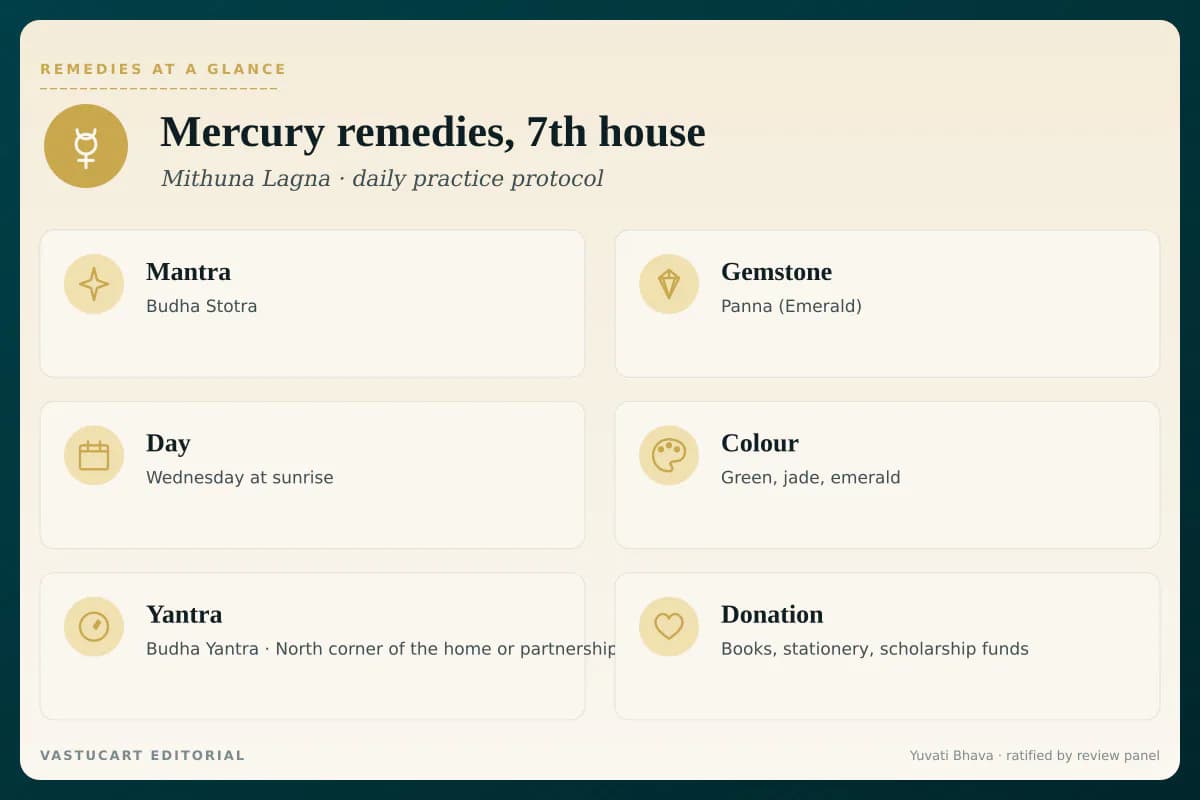
The daily Vishnu or Saraswati worship is the primary remedy for this placement because Vishnu is the classical patron deity of Mercury (and Saraswati is the alternative for natives drawn to the wisdom-articulation form), and either form holds the kalatra Mercury signature in its most refined partnership-articulation expression. Rise before sunrise, bathe, wear green or pale yellow clothing on Wednesdays, and visit a Vishnu or Saraswati temple if accessible. The Budha Stotram is the primary recitation, the Navagraha verse to Mercury that creates a containing field for the placement in its kalatra expression. Reciting it at sunrise daily for forty days at any major Mercury transition (a marriage event, a joint-venture launch, a mediation practice opening) is the formal protocol.
Offer green grams (mung beans), tulsi leaves, white-flower offerings, and donate to causes that support marriage-and-family welfare and partnership-mediation institutions (marriage-counselling scholarships, family-arbitration legal aid, pre-marital education programmes). The conscious-solo-output discipline is the lifestyle remedy that compounds across decades into the difference between Mercury-7-mastery and Mercury-7-collapsed-identity: a quarterly practice of producing one piece of solo public output (article, lecture, programme, independent platform) keeps the partnership-anchored work balanced against individual authority. The gemstone is Panna (emerald), and this is one of the gemstone-helpful placements for natives whose partnership work needs steadier articulation. Wear a natural emerald of minimum five carats set in gold on the small finger of the right hand on a Wednesday at sunrise after Budha mantra recitation, and only after a confirmed reading.
Gemstones for Mercury in 7th house Mithuna Lagna
Emerald is the primary Mercury gemstone and supports the kalatra Mercury when partnerships need clearer articulation.


Disclaimer: Emerald over a kalatra Mercury supports cleaner partnership articulation. Always consult a qualified Jyotishi before permanent wearing because the gemstone activates the relationship channel quickly.
Rudraksha beads for Mercury in 7th house
The Mercury-aligned rudraksha is the Char Mukhi (Four Mukhi), the bead directly ruled by Brahma and the intelligence channel.
The classical Mercury rudraksha and the bead specifically associated with articulation and intelligence. Supports the partnership-articulation signature, channels the dialogue-instinct toward sustainable joint-output, and stabilises communication bandwidth when the kalatra Mercury is in active phase.
The nine-mukhi bead supports relationship strength and partnership endurance directly. Wearing the Nau Mukhi alongside the Char Mukhi compounds the placement's natural strength in mediation, marriage and family therapy, and joint-venture leadership.
Budha Yantra for the kalatra placement
Sacred recitations for Mercury in the kalatra angle
Soumyam soumya-gunopetam tam budham pranamamy aham
Translation: I bow to Mercury, dark like the priyangu blossom, beautiful in form, gentle in nature, possessing every gentle quality. The Budha Stotra is the canonical Navagraha verse to Mercury and is the perfect daily recitation for a chart where Mercury sits in the kalatra angle and the partnership-articulation signature needs a containing devotional field. Many natives advanced in practice add the Vishnu Sahasranama recitation as a secondary layer once the daily Budha discipline is steady.
Read the full stotra on stotra.vastucart.in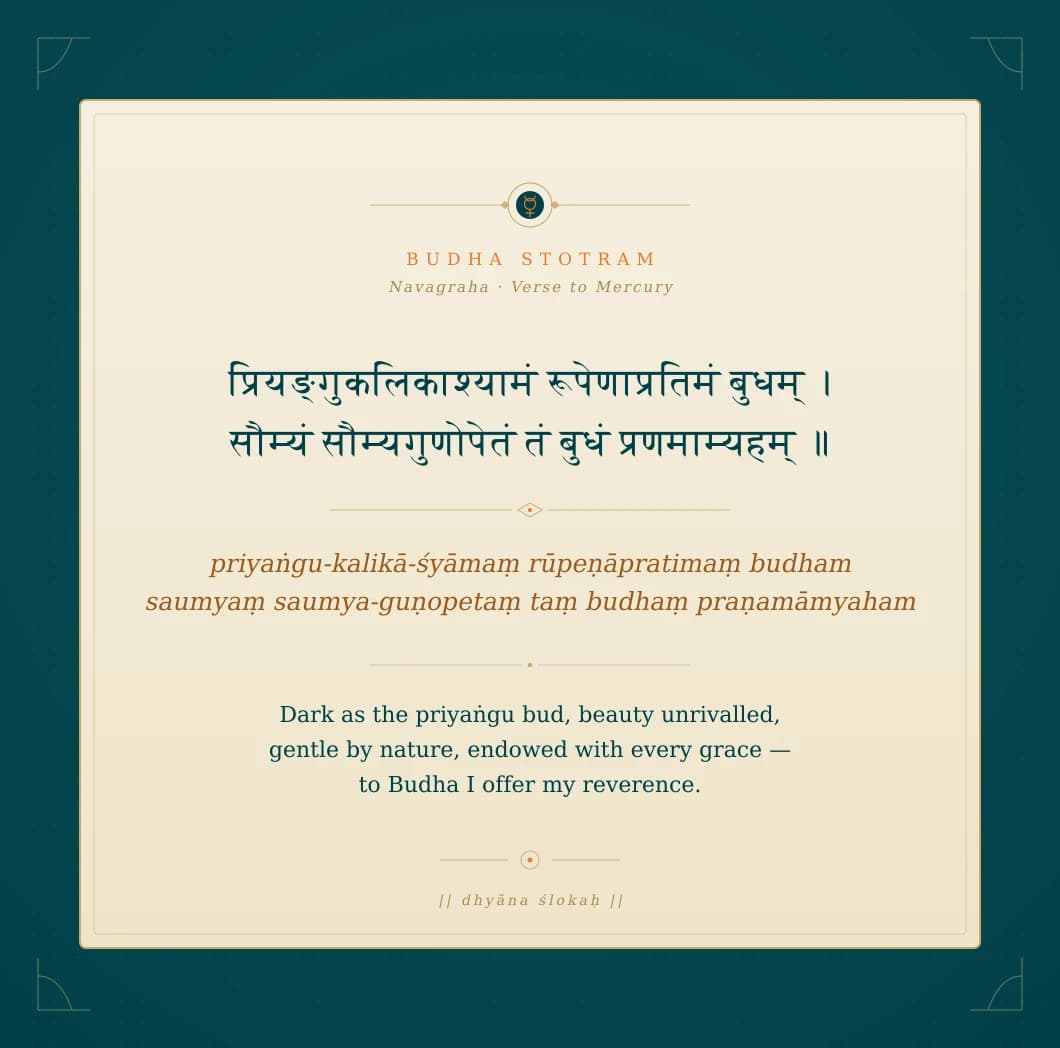
Tools for Mercury 7th house Mithuna natives
Is your Kalatra Bhava Mercury carrying the spouse-as-teacher signature?
Get a full personalised analysis of your seventh house Mercury, the lagna-lord-in-kendra strength, and the marriage timing.