Mercury in the 4th house
Meena Lagna (Pisces Ascendant)
A practitioner study of Budha in Sukha Bhava for Pisces ascendant natives. Mercury holds his swakshetra in Mithuna inside the fourth-house kendra he himself rules, and the dual 4L+7L lordship turns the family residence into the partnership hub of the chart.
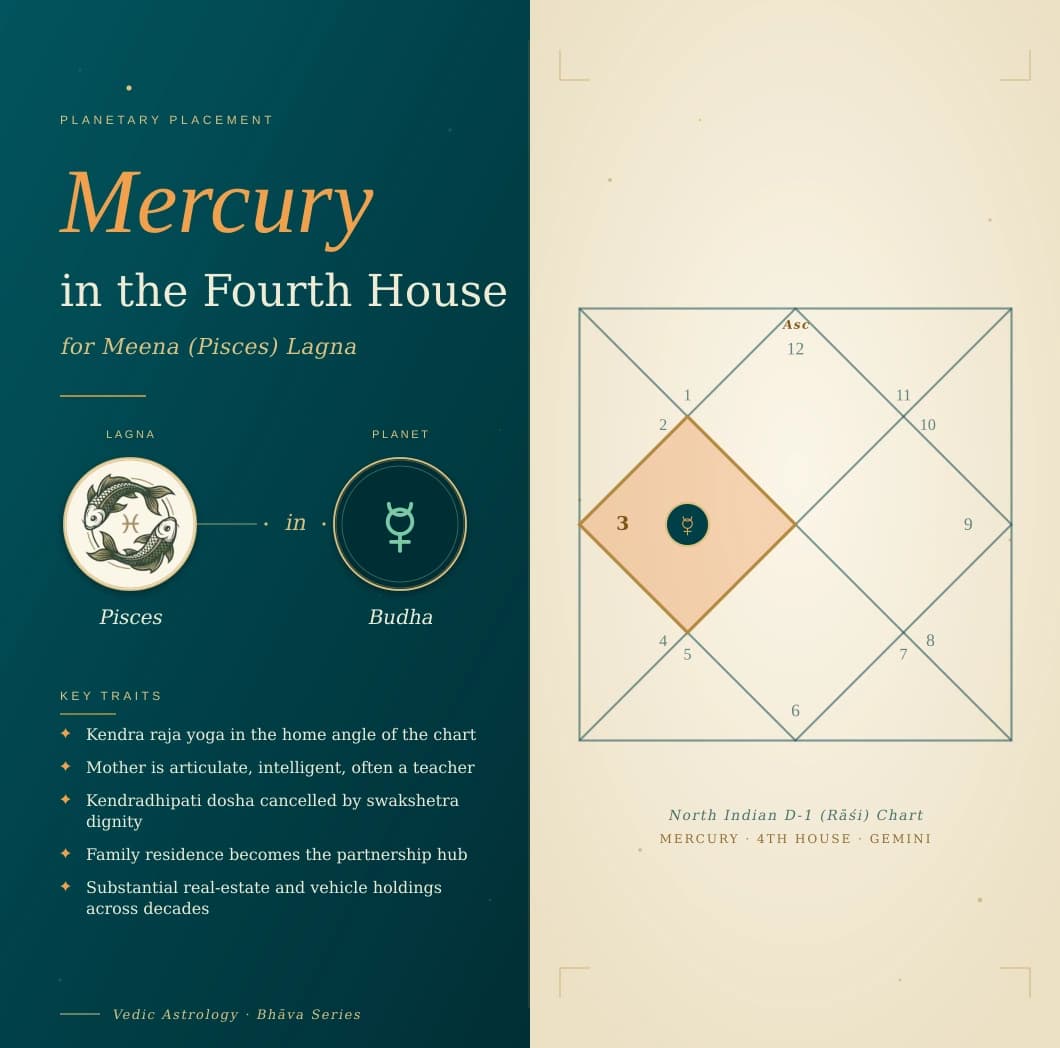
Mercury sits swakshetra in his own Mithuna in the fourth house for Pisces ascendant natives, the home-kendra raja yoga signature.
Mercury in 4th house for Meena Lagna, the quick reference
If you carry Mercury in the fourth house of a Meena chart, the family residence does double duty. It is also the office, the studio, the classroom, and the negotiating table where every important partnership is sealed.
Budha (Mercury) lands in Sukha Bhava (the fourth house, the bhava of mother, home, vehicles, real estate, schooling, and inner contentment) in his own air sign Mithuna (Gemini). Own-sign placement is called swakshetra.
Because the fourth house is also a kendra (an angular pillar of the chart), Mercury sits in his own sign in his own kendra. Two layers of structural strength stack in a single position.
The second feature is the dual lordship. Mercury rules Mithuna (the 4th, sukha) and simultaneously rules Kanya (the 7th, kalatra). For Meena Lagna he is therefore the 4L (sukha lord, ruling home and education) and the 7L (kalatra lord, ruling marriage and partnership).
When this 4L+7L Mercury sits in his own 4th in own-sign dignity, the home and partnership channels merge inside the residence. The spouse moves into the family home, the business partner shares the dining table, the children are tutored at the kitchen counter, and the household becomes the consolidated hub of the chart.
The third feature is the kendradhipati doctrine and its specific exception here. Classical Parashari notes that a benefic ruling two kendras (Mithuna 4H and Kanya 7H) carries the kendradhipati dosha which would ordinarily mute the planet.
The exception, recognised by Sanjay Rath and B.V. Raman in the modern Parashari schools, is that when the kendradhipati benefic sits in his own or exalted sign in a kendra he himself rules, the dosha is overridden and the planet becomes a powerful raja yoga producer. Mercury swakshetra in his own 4H is the cleanest example.
This guide reads every layer: the Mithuna swakshetra, the 4L+7L dual lordship, the kendra raja yoga, the cosmopolitan-residence signature, and the emerald protocol.
Why swakshetra Mercury in the 4th kendra forms a kendra raja yoga at home
Students often arrive at this placement aware that Mercury in his own sign is strong, yet uncertain why classical commentators treat Budha-in-4H-of-Meena differently from a generic swakshetra Mercury elsewhere. The answer hinges on three stacked rules.
Rule one. Own-sign placement gives the planet his full structural strength. Mercury in Mithuna anywhere in the chart already carries the swakshetra dignity.
Rule two. Lord-in-his-own-house pattern gives the bhava his full natural strength because the planet ruling the bhava sits inside it without needing aspect or transfer. The fourth house ruled by Mercury in Meena charts therefore becomes textually pristine when Mercury occupies it.
Rule three. The fourth is a kendra (angular bhava), and a planet in a kendra he himself rules carries kendra dignity that classical sources treat as a raja yoga producer.
Stacking these three: the swakshetra dignity, the lord-in-house alignment, and the kendra placement all compound on the same position. The placement reads as foundationally strong rather than as merely lucky, and it produces the kind of long-arc material consolidation that does not depend on transit luck.
The kendradhipati cancellation is the second specific feature practitioners need to handle correctly. Mercury rules Mithuna (the 4th house, called Sukha Bhava) and Kanya (the 7th house, called Kalatra Bhava) for Meena Lagna, two adjacent kendras.
The classical kendradhipati doctrine would ordinarily mute his benefic capacity. The exception, recognised by Parashara himself, is that when a kendradhipati benefic sits in his own or exalted sign in a kendra he rules, the dosha is overridden and the placement reads as pure raja yoga.
Mercury swakshetra in Mithuna in 4H is the cleanest 4L example available across the twelve lagnas, and Mercury exalted-and-swakshetra in Kanya in 7H is the cleanest 7L counterpart in the same chart.
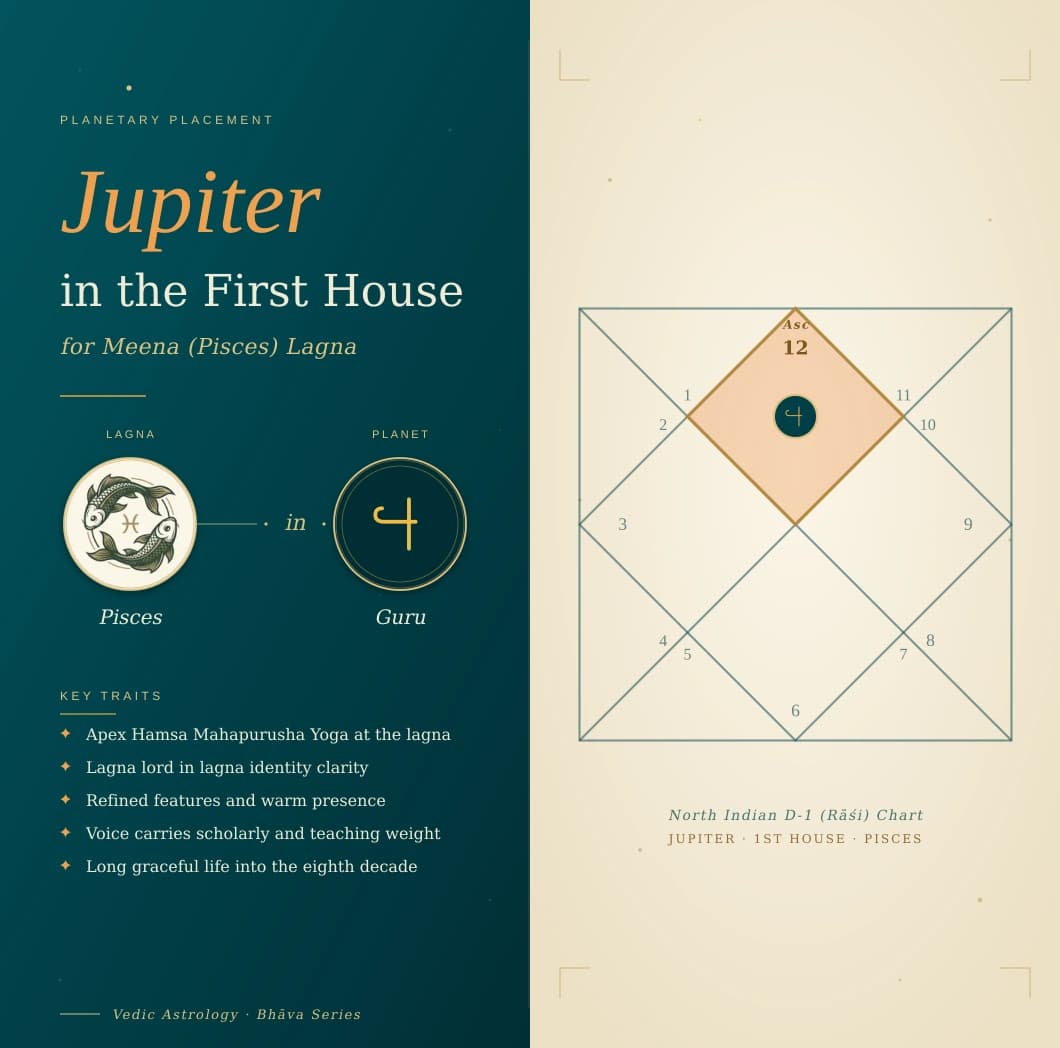
The third interpretive layer is the lagna-quincunx reading. The fourth house always sits four signs from the first, in the second-half of the trine to the lagna. For Meena Lagna the lagna lord is Jupiter (dharmic, expansive, intuitive).
The fourth-house Mercury reads as the analytical processor through which the Jupiter-Meena native organises home, schooling, and family enterprise. Mother teaches, the household runs on books and conversation, and the residence becomes the place where intellect is socialised across generations.
Mercury in his own Mithuna in the fourth kendra of Meena is not a generic strong placement. It is the single position where the lord of the home angle sits inside his own home angle, the partnership channel folds into the residence, and the family address itself becomes the long-arc raja yoga of the chart.
Terms used in this article
A short glossary of the Sanskrit and Jyotish terms that recur in this study. First-occurrence expansion is also retained inline.
- Sukha Bhava
- The 4th house, the bhava of mother, home, vehicles, real estate, primary schooling, and the felt sense of inner contentment.
- Swakshetra
- Own sign. A planet placed in his own sign gains structural strength, just below exaltation in dignity.
- Kendra
- Angular houses 1, 4, 7, 10. Bhavas of structural strength where planets express through public life and visible outcomes.
- Kendra Raja Yoga
- A planet in his own or exalted sign sitting in a kendra he himself rules. Treated by Parashara as a raja yoga producer.
- Kendradhipati Dosha
- Classical doctrine where a benefic ruling two kendras loses some auspiciousness. Cancelled when the planet holds own-sign or exalted dignity in his own kendra.
- Karakatva
- The natural significations a planet rules independent of any chart. Mercury rules speech, calculation, books, and trade.
- Mithuna
- Gemini, the air sign ruled by Mercury. Carries the dual-natured intellectual register of conversation, neighbourhood, and short-distance commerce.
How swakshetra Mercury at the home angle shapes the Meena native
Physically the native carries the soft Meena frame with an extra brightness around the upper body that the fourth-house Mercury contributes through chest and lung capacity. The face tends round and gentle with the typical Meena warmth.
The eyes carry an alert receptivity. The smile arrives quickly and the voice tends bright in the mid-range, well suited to teaching, presenting, and broadcast work.
Hands and forearms are unusually expressive. Many natives gesture while talking and report that their best ideas arrive while pacing the home corridor or sitting at the kitchen table with a notebook.
The 4H rulership of the chest cavity means breath capacity is generally good and singing voice often surprises people in casual settings. Posture tends slightly forward as if always leaning into a conversation.
Temperament is where the placement most distinguishes the native. These natives carry the Meena receptivity (intuitive sensing, emotional generosity) but route it through the home and through the ongoing daily conversation rather than through solitary contemplation.
They are drawn from young to multi-generational settings. They love hosting friends in the family home, organising book clubs around the dining table, mentoring younger cousins through evening homework, and treating the residence as the natural centre of social and intellectual life.
The Meena emotional warmth combines with the fourth-house Mercury intellectual current to produce a kind of household scholarship that runs across decades. The shadow side is the same domestic concentration.
Natives who do not channel the home-as-hub pattern consciously can struggle to leave the residence for opportunities elsewhere, can over-invest in family enterprise to the exclusion of independent ventures, and can experience anxiety when forced to relocate. Pairing the home anchor with explicit periodic travel and one annual project located outside the residence preserves the strength without the rigidity.
Strengths, shadows and career fits
- Kendra raja yoga in the home angle of the chart
- Mother is articulate, intelligent, often a teacher
- Kendradhipati dosha cancelled by swakshetra dignity
- Family residence becomes the partnership hub
- Substantial real-estate and vehicle holdings across decades
- Cosmopolitan dwelling with books, music, conversation
- Reluctance to leave the family home for outside opportunity
- Over-investment in family enterprise versus solo ventures
- Chest, lung, and respiratory sensitivity in monsoon
- Anxiety patterns when relocation is forced
- Information overload at home creating thinking-fatigue
- Mother dependency that lingers into the working decades
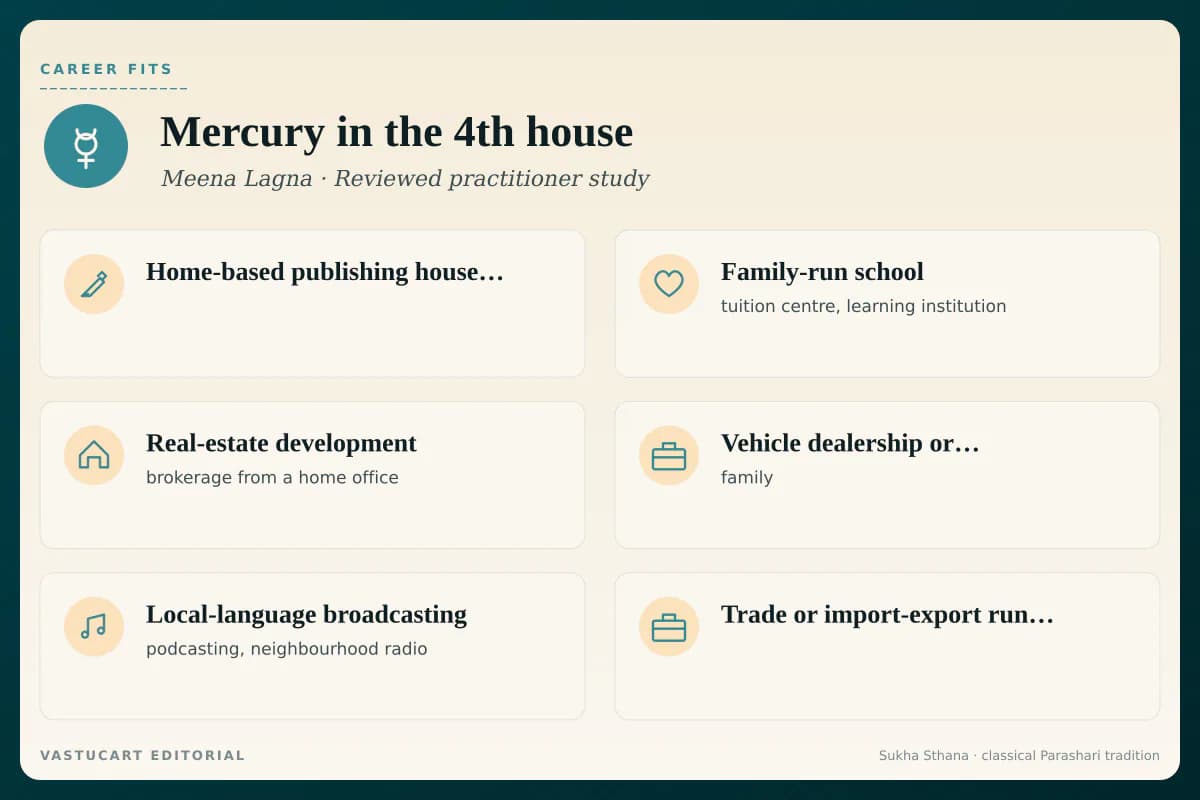
- Home-based publishing house or content studio
- Family-run school, tuition centre, learning institution
- Real-estate development and brokerage from a home office
- Vehicle dealership or transport business with family
- Local-language broadcasting, podcasting, neighbourhood radio
- Trade or import-export run from the family residence
Where the home-as-vocation pattern plays out
Career paths cluster around fields where the residence itself becomes the working asset rather than a parallel concern. A home-based publishing house or content studio is the strongest single fit because the fourth-house swakshetra Mercury folds editorial precision into the family address. Many natives spend decades running magazines, podcasts, newsletters, and small-press imprints out of a study room that gradually expands into a converted ground floor with shelves, a recording booth, and a meeting table for visiting authors.
A family-run school, tuition centre, or learning institution works for the same reason. Mercury is the karaka of teaching and the fourth house is the karaka of primary education. When the lord of one sits in the bhava of the other, the household naturally generates the small classrooms, the after-school tuition groups, the music coaching for the neighbourhood, and over time the formal institution that grows from those informal beginnings.
Real-estate development and brokerage from a home office fits naturally because the fourth house rules property and Mercury supplies the negotiation, listing, and contract-writing capacity the work demands. Many natives build substantial property portfolios across decades through family-trust ventures, ancestral-land partnerships, and the patient compounding of rental yield run from the residence ledger.
Vehicle dealership and transport business with family suits the placement because Mercury and the fourth house both rule conveyances. Local-language broadcasting, podcasting, and neighbourhood radio fit because Mercury is the speech karaka and the fourth house is the karaka of mother tongue and immediate community. Trade and import-export run from the family residence consolidates well because the fourth-house Mercury merges stock-keeping precision with the living-room hub.
Mercury mahadasha is the defining career window for natives with this placement. The seventeen-year period typically arrives with the property purchase that becomes the studio, the publishing imprint that consolidates the editorial career, the ancestral-land subdivision that crystallises the family wealth, the vehicle-fleet expansion that anchors the transport business, or the school registration that formalises the learning centre.
Why this is the cleanest 4L kendra raja yoga in the wheel
The clearest way to read Mercury in 4th of Meena is to hold the swakshetra dignity, the lord-in-house alignment, and the kendra raja yoga together rather than in isolation. Three independently strong rules collapse onto one position.
Mercury in his own Mithuna gets the full natural strength of own-sign placement. The lord of the fourth house sitting inside the fourth house gives the bhava its own lord without aspect dilution or sign exchange.
The fourth house being a kendra means the planet expresses through visible, structural outcomes rather than through hidden inner dynamics. All three rules favour the same single placement.
The dual lordship reading is the second specific feature. Mercury rules Mithuna (the 4th, sukha) and Kanya (the 7th, kalatra) for Meena Lagna. When the 4L+7L sits in his own 4H, the home and partnership channels fuse inside the family residence.
The spouse moves into the family home rather than the native moving away. The business partner often shares the household. Family enterprise and personal enterprise blur into a single ledger.
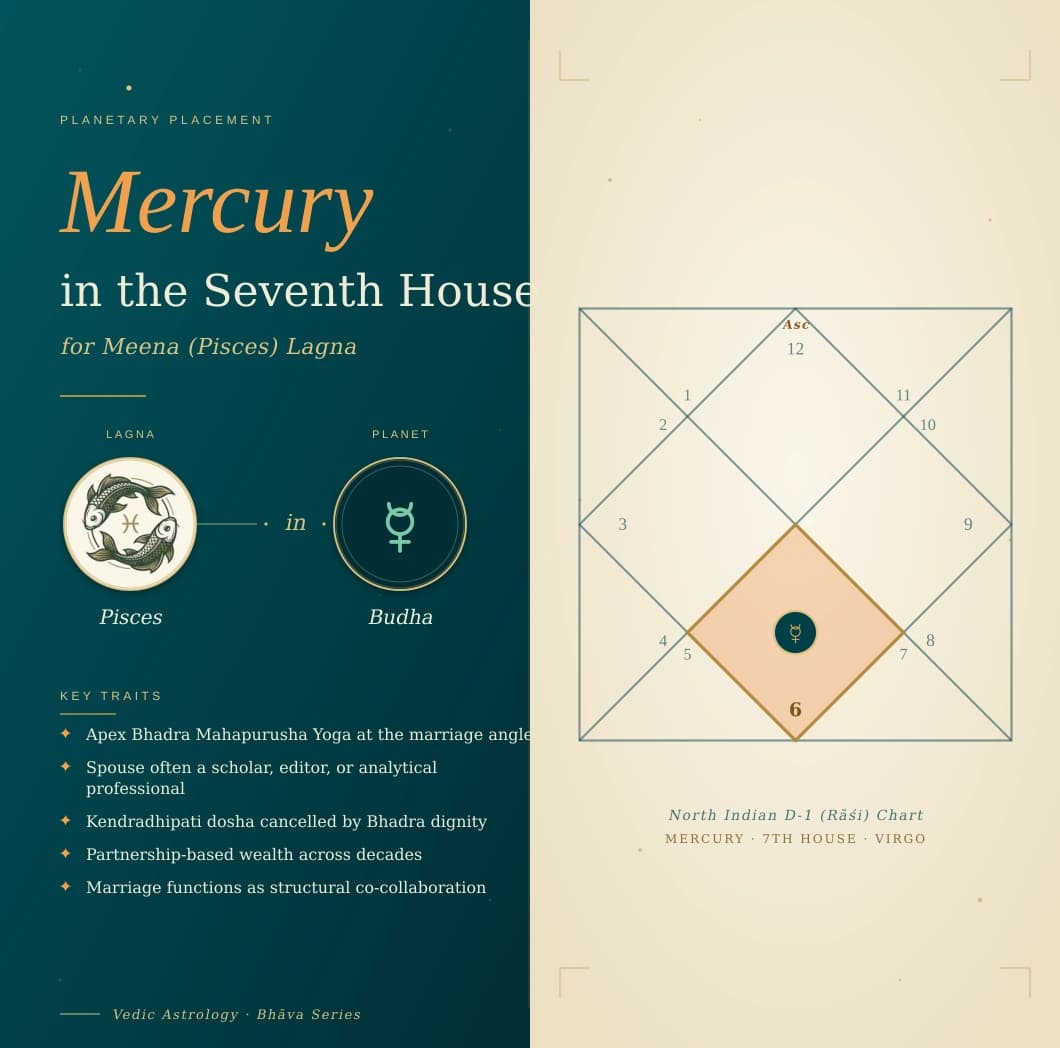
The third interpretive layer is the comparison with the same planet in 7H of the same chart. Mercury in 7H of Meena is exalted-and-swakshetra in Kanya, the apex Bhadra Mahapurusha at the marriage angle, the chart's strongest kalatra signature.
Mercury in 4H of Meena is the same dual lord but expressed through the home angle rather than the marriage angle. The 7H reading is marriage-defining. The 4H reading is residence-defining.
Many Meena natives carry both placements in extended-family charts, and the contrast shows clearly: the 7H Mercury makes the spouse the analytical complement, while the 4H Mercury makes the residence the analytical hub.
When the swakshetra Mercury in 4th delivers its kendra raja chapter
Mercury mahadasha is the defining window for this placement. It commonly arrives with the property purchase that becomes the studio, the publishing imprint that consolidates the editorial career, the ancestral-land subdivision that crystallises the family wealth, the vehicle-fleet expansion that anchors the transport business, or the school registration that formalises the learning centre.
Chest, lungs, and the fourth-house respiratory link
Health follows the Mercury-in-4th pattern with specific chest and respiratory body-part vulnerabilities. Constitution is generally vata-kapha because Mercury carries air-vata and Meena itself carries water-kapha, with hidden pitta from Mercury's intellectual activity.
The 4H rulership covers the chest cavity, lungs, heart-region, and stomach lining, while the Meena lagna emphasises the feet and the lymphatic system, and Mercury rules the nervous system broadly.
The placement raises lifelong vulnerability to bronchial sensitivity in monsoon and winter, mild asthma patterns under stress, indigestion when the household is in argument, and nervous-system fatigue during peak career-and-family load.
Classical reports associate Mercury swakshetra with strong intellectual capacity and good general health. The kendradhipati doctrine even when cancelled by own-sign dignity leaves a subtle excess-vata signature.
The pattern shows up as sleep disturbances, dry skin, and occasional dizziness during heavy reading or screen-work cycles.
Most natives benefit from disciplined daily breathing practice (pranayama that regulates the lungs and clears bronchial tissue), moderate fasting on Wednesdays (the Mercury day), and mindful attention to dietary vata (warming foods with healthy oils, avoidance of cold drinks).
Annual full-panel screening from the late twenties is recommended with attention to lung function, cardiac markers, and digestive health. Daily walking before sunrise, a small home plant garden for indoor air quality, and avoidance of late-night intellectual stimulation are the lifestyle stabilisers.
Foot care also deserves attention because Meena rules the feet directly: well-fitted shoes and regular foot massage with warming oil protect the lower body.
Remedies for Mercury in the Meena home angle
The daily Vishnu worship is the primary remedy for this placement because Vishnu is the classical patron deity of Mercury, and the iṣṭa-devatā connection runs strong for Meena natives whose lagna lord Jupiter shares the same Vaishnava lineage. Rise before sunrise, bathe, wear emerald-green or pale yellow clothing on Wednesdays, and visit a Vishnu temple if accessible.
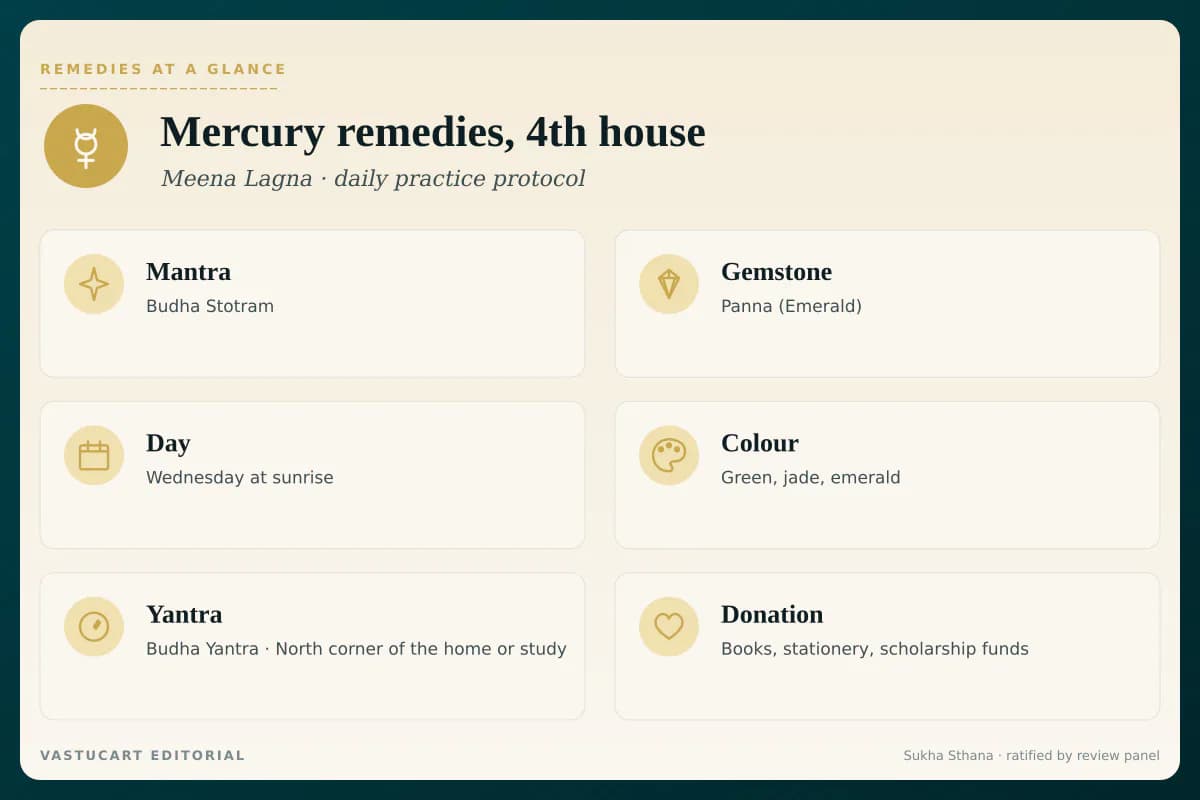
The Budha Stotram is the primary recitation, the Navagraha verse to Mercury that creates a containing field for the swakshetra-kendra-raja-yoga expression at the home angle.
Reciting it at sunrise daily for forty days at any major Mercury transition (a property purchase, a publishing-imprint launch, a school registration, a vehicle-fleet expansion) is the formal protocol. Saraswati Stotram is a secondary recitation many Meena practitioners adopt because Saraswati is the patron of learning, books, and speech, all karakas the fourth-house Mercury activates.
Offer green leaves (especially fresh tulsi and durva grass), green-and-white sweets, and white sandal paste at the altar.
Donate to causes that support neighbourhood education and home-based learning: tuition scholarships for under-resourced students, lending-library funding, mother-tongue publishing support, and small-school endowments.
The conscious-mobility practice is the lifestyle remedy that compounds across decades. A short annual project located outside the residence, a quarterly travel commitment, and a willingness to delegate the home-hub during seasonal absences all preserve the placement's strength without the rigidity.
The gemstone is emerald (Panna), worn confidently here because the swakshetra Mercury in own kendra responds to amplification cleanly.
Wear a natural Colombian emerald of minimum five carats set in gold on the small finger of the right hand on a Wednesday at sunrise, and only after a confirmed reading by a qualified Jyotishi. Many practitioners pair the emerald with a small Char Mukhi rudraksha worn on a green thread for the daily round.
Gemstones for Mercury in 4th house Meena Lagna
Emerald is the primary Mercury gemstone and works exceptionally well here because the swakshetra Mercury in own kendra responds to amplification cleanly.


Disclaimer: Emerald over a swakshetra kendra-raja Mercury in the home angle amplifies the residence channel cleanly. Always consult a qualified Jyotishi before permanent wearing.
Rudraksha beads for Mercury in 4th house
The Mercury-aligned rudraksha is the Char Mukhi (Four Mukhi), the bead directly ruled by Brahma and Mercury.
The classical Mercury rudraksha and the bead specifically associated with scholarship, articulate intelligence, and learning. Supports the swakshetra-kendra-raja signature, channels the analytical instinct toward sustainable territory, and stabilises mental bandwidth when the publishing, school, real-estate, or transport vocation is in active phase. Worn close to the chest, it also calms the bronchial sensitivity the fourth-house Mercury can carry.
The six-mukhi bead supports family stability, marital harmony, and the household-as-hub pattern this placement organises around. Wearing the Chhah Mukhi alongside the Char Mukhi compounds the placement's natural strength in family-business stewardship while reducing the home-anxiety tendency that the kendradhipati Mercury can otherwise produce.
Budha Yantra for the home-kendra placement
Sacred recitations for Mercury at the home angle
Saumyam saumya-gunopetam tam budham pranamamy aham
Translation: I bow to Budha, dark as a bud of Priyangu, peerless in form, gentle in nature and adorned with peaceful qualities. The Budha Stotram is the canonical Navagraha verse to Mercury and is the perfect daily recitation for a chart where Mercury sits swakshetra in his own kendra at the home angle and the residence-as-hub signature needs a containing devotional field. Many Meena natives add the Saraswati Stotram as a secondary layer because Saraswati is the patron of books, learning, and speech that the fourth-house Mercury activates.
Read the full stotra on stotra.vastucart.in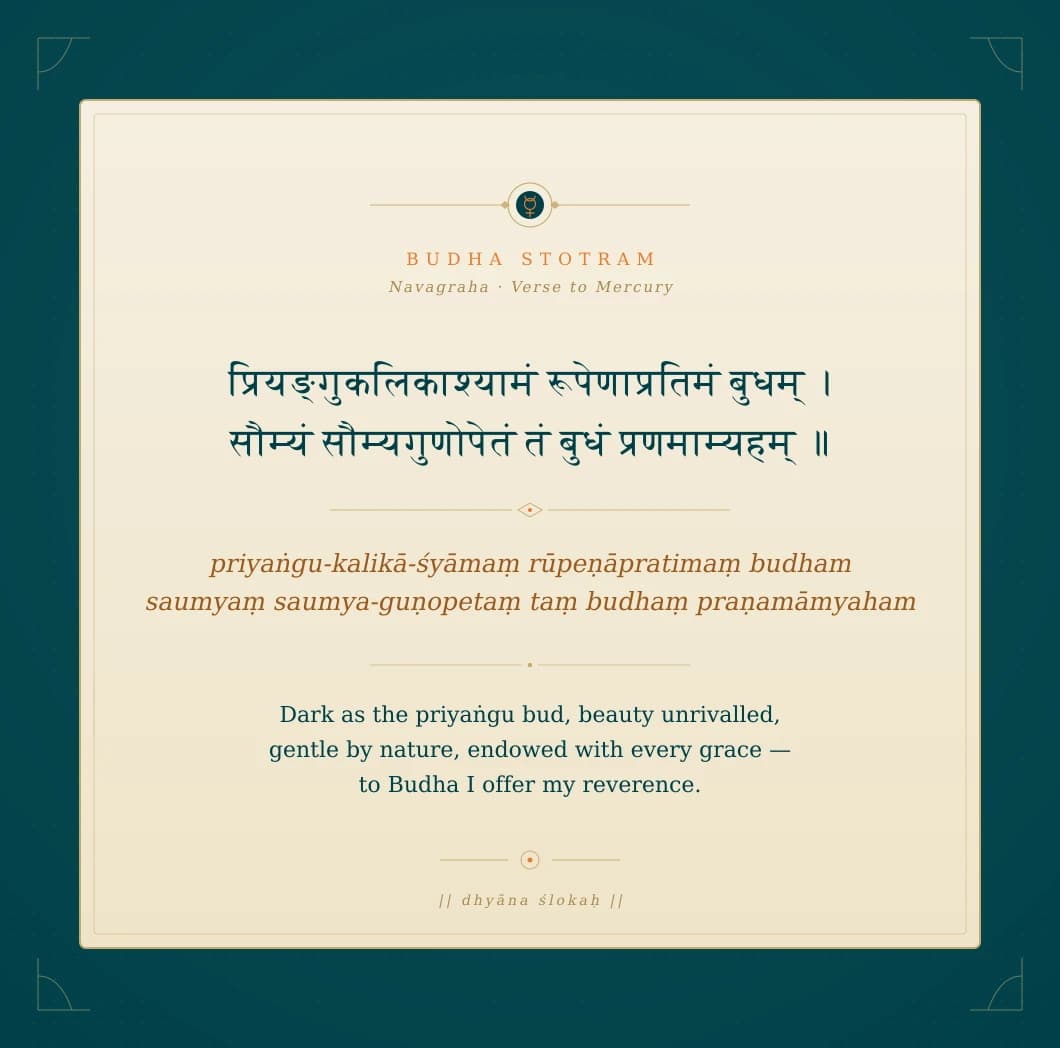
Tools for Mercury 4th house Meena natives
Is your Sukha Bhava Mercury organising the residence as hub?
Get a full personalised analysis of your fourth house Mercury, the swakshetra dignity, and the home-vocation timing.