Venus in the 9th house
Mesh Lagna (Aries Ascendant)
A practitioner study of Shukra in Dharma Bhava for Aries ascendant natives. Venus in Jupiter's Dhanu under Guru's dispositorship, the 2L and 7L elevated to the trikona, the dharmic-aesthete and pilgrimage-companion signature, and the maraka-to-trikona reading that distinguishes this placement from a kendra Venus.
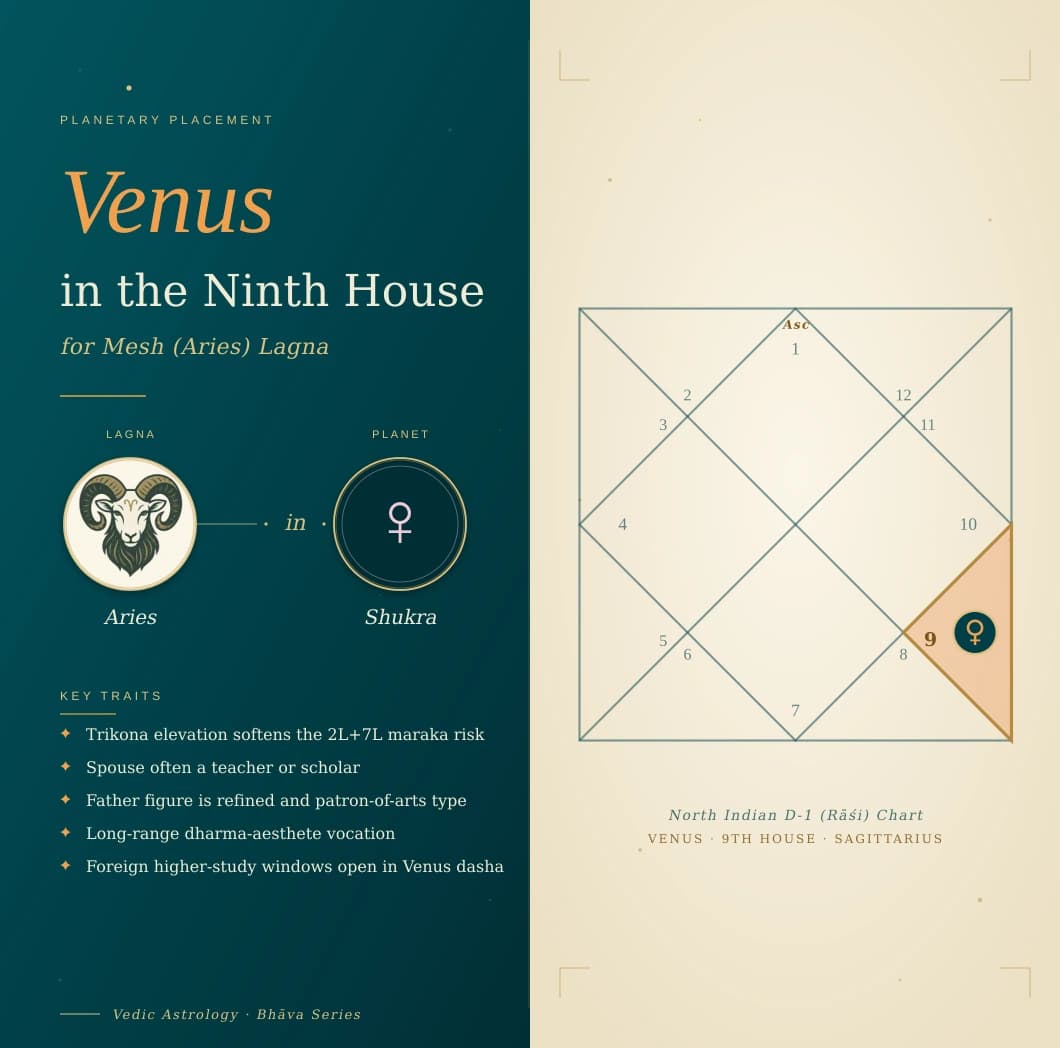
Venus sits in Jupiter's Dhanu in the ninth house for Aries ascendant natives, the dharmic-aesthete and pilgrimage-companion signature.
Venus in 9th house for Mesh Lagna, the quick reference
If you carry Venus in the ninth house of a Mesh chart, you hold one of the most refined Venus placements in the entire Aries ascendant catalogue, because Shukra (Venus) is the natural lord of love, beauty, refinement, and partnership, and his arrival in Dharma Bhava (the ninth house) lifts these significations into the territory of philosophy, higher learning, fortune, and the long-range life direction. The ninth house from Mesh is Dhanu (Sagittarius), ruled by Guru (Jupiter), and the Venus-Jupiter relationship is read as neutral or mildly enemy in classical schools (Mantreshwara lists them as enemies, modern Parashari often softens to neutral). Despite the planetary-friendship friction, Venus performs measurably well in Jupiter's signs because Jupiter's wisdom-territory contains the refinement Venus naturally seeks, and Dhanu in particular gives Venus a dharmic and contemplative outlet that the busier Mars or Sun signs do not provide.
The second structural feature is that Venus is the lord of two houses for Mesh: the 2nd (Vrishabha, his own sign) and the 7th (Tula, also his own sign). Both lordships are classical maraka stations because the 2nd and 7th houses are the death-inflicting houses in Parashari tradition. When Venus rises into a trikona (1, 5, 9 are the trikonas of dharma), the maraka classification is partially neutralised by the trikona elevation, and the Venus signification (relationships, wealth, refinement, beauty) gains a dharmic orientation that protects the placement from the negative side of his maraka role. The third feature is the Jupiter dispositorship. Guru is the 9th and 12th lord for Mesh and his ownership of Dhanu means he routes the Venus energy through the dharma and moksha houses of the chart. The result is a native whose Venus signature does not express as ordinary romantic indulgence but as a refined, philosophical, often pilgrimage-flavoured aesthetic. This guide reads every layer of Venus in 9th house for Mesh Lagna natives: the Dhanu dignity question, the 2L and 7L lordship, the trikona elevation, the dharmic-aesthete signature, and the diamond protocol.
Why Venus in Dharma Bhava lifts the maraka lordships into a refined trikona signature
Students often arrive at this placement uncertain whether the Venus 9th is a benefic placement (because trikona) or a problematic one (because Venus is a maraka lord). The honest practitioner answer is that the trikona elevation is the dominant signal, and the maraka lordships are partially neutralised by the dharmic placement. Venus in the 9th of Mesh produces natives whose love, refinement, and partnership instincts are oriented around philosophy, higher learning, foreign culture, and long-range dharmic projects rather than around immediate sensual gratification. The 9th house is the bhava of the father, the teacher, the long pilgrimage, and the inherited wisdom-stream, and Venus here means the native's romantic life, aesthetic life, and wealth life are all braided into the dharma stream rather than running parallel to it.
The 2L and 7L reading is the second specific feature that practitioners need to handle carefully. The 2nd house rules family wealth, lineage, and speech, and the 7th house rules marriage and partnership. With Venus elevated to the trikona, the 2L and 7L significations gain a dharmic refinement: family wealth often arrives through patron-of-the-arts patterns, partnership tends to involve a spouse who is a teacher, scholar, or fellow seeker, and speech carries an unusual diplomatic and persuasive quality. The placement is one of the classical signatures for marriage to a teacher, professor, or someone whose work is in higher education or a religious tradition. The third interpretive layer is the contrast with Jupiter in 9. Jupiter in 9 is exalted-strength dharma, the swakshetra Hamsa pattern that classical texts celebrate. Venus in 9 is refined dharma, the aesthete-pilgrim pattern that produces the same trikona benefit through a different signature. Both are excellent placements; they simply express dharma through different doorways.
Venus in the dharma angle is not ordinary romantic indulgence. It is the refinement-of-the-soul placement that braids beauty into wisdom and partnership into pilgrimage.
Terms used in this article
A short glossary of the Sanskrit and Jyotish terms that recur in this study. First-occurrence expansion is also retained inline.
- Dharma Bhava
- The 9th house, the bhava of dharma, fortune, father, teacher, and pilgrimage.
- Trikona
- The trine houses (1, 5, 9), the most auspicious houses in Parashari tradition.
- Maraka
- Death-inflicting station, classically the 2nd and 7th houses.
- 2L
- Second-house lord, the planet ruling the sign on the 2nd house cusp.
- 7L
- Seventh-house lord, the planet ruling the sign on the 7th house cusp.
- Dispositor
- The lord of the sign in which another planet sits.
- Bhagya
- Fortune, the dharma stream that supports the native through life.
How Venus in Dharma Bhava shapes the Aries native
Physically the native carries the Mesh Lagna frame softened by the Venus refinement. The face is often unusually attractive without being conventionally pretty, and strangers consistently report a gravitational quality in the gaze that is hard to place. The build keeps the standard Mesh leanness but adds a Venusian grace to the bearing, and many natives have an instinctive elegance in movement that they did not consciously cultivate. The hair is often abundant and well-formed, the complexion clear, and the eyes carry a depth that tilts more toward kindness than toward sharp watchfulness. Many natives have a beauty mark on the face or neck, classical Venus 9 signatures.
Temperament is the layer where the placement most distinguishes the native from popular Aries stereotypes. These natives carry the Mesh courage and the willingness to act, but they also carry an instinctive philosophical turn that surprises peers expecting an Aries action-orientation. They are drawn to art forms with a contemplative dimension (sacred music, classical dance, devotional poetry, scholarly aesthetics), they enjoy long conversations about meaning, and they consistently report partners who themselves are teachers, scholars, or people on a serious dharmic path. The Aries directness combines with the Venus refinement to produce natives who can speak truthfully about beauty in a register peers find unusual. The shadow side is the maraka lordship: Venus rules the 2nd and 7th and his elevation in 9 partially neutralises but does not eliminate the maraka classification, so the placement still asks for vigilance about speech (2nd house) and partnership (7th house) in major Venus periods.
Strengths, shadows and career fits
- Trikona elevation softens the 2L+7L maraka risk
- Spouse often a teacher or scholar
- Father figure is refined and patron-of-arts type
- Long-range dharma-aesthete vocation
- Foreign higher-study windows open in Venus dasha
- Wealth arrives through patron and luxury channels
- Maraka lordship still asks for speech vigilance
- Romantic life can feel philosophically demanding
- Refined tastes may strain ordinary budgets
- Pilgrimage longing can compete with home life
- Father figure absent during early childhood
- Hip and pelvis sensitivity in Venus dasha
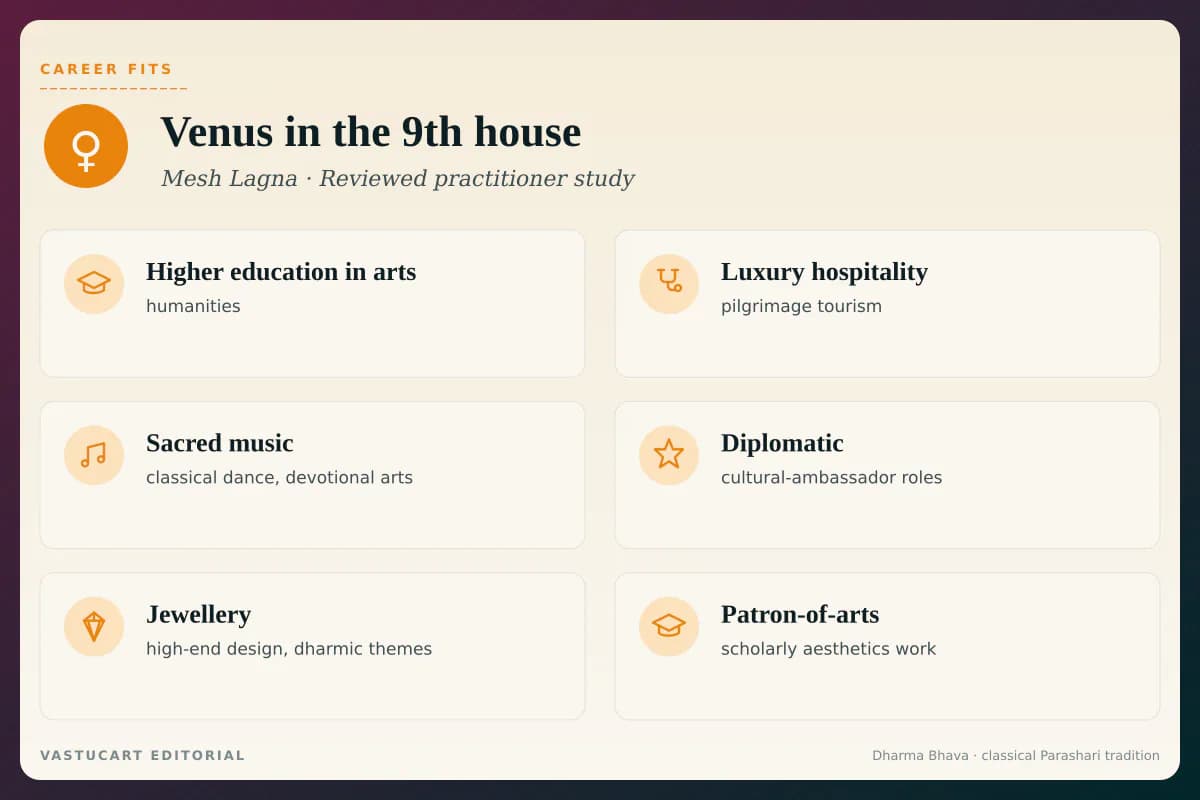
- Higher education in arts and humanities
- Luxury hospitality and pilgrimage tourism
- Sacred music, classical dance, devotional arts
- Diplomatic and cultural-ambassador roles
- Jewellery and high-end design with dharmic themes
- Patron-of-arts and scholarly aesthetics work
Where the dharmic-aesthete vocation plays out
Career paths cluster around fields that braid beauty with wisdom. Higher education in the arts and humanities is the strongest single fit because the 9th house rules higher learning and Venus rules the aesthetic mind. Many natives become professors of art history, comparative literature, classical music, religious aesthetics, or cultural studies, and the academic life often combines with regular travel for research, conferences, and pilgrimage. Luxury hospitality and pilgrimage tourism suit natives whose vocational mode is more direct contact with travellers seeking refined and dharmically meaningful experiences.
Sacred music, classical dance, and devotional arts work because the chart specifically rewards the meeting point of refinement and devotion. Many natives in this configuration have lifelong practices in Carnatic vocal, Hindustani classical, Bharatanatyam, or kirtan-based work, and the practice becomes both vocation and remedy. Diplomatic and cultural-ambassador roles fit the chart because the 9th house rules foreign relations through dharma, and Venus's diplomatic refinement turns the foreign posting into a genuine cultural exchange rather than transactional negotiation. Jewellery and high-end design with dharmic themes (temple jewellery, ritual textiles, sacred-art objects) work because Venus rules ornament and the 9th elevates the work into the meaningful tier of the market. Patron-of-arts and scholarly-aesthetics roles fit natives whose career arc includes an explicit philanthropic dimension. Venus mahadasha is the defining career window and arrives with the international academic posting, the major patron commission, or the marriage that launches the public phase of the dharmic-aesthete life.
Why a maraka-lord Venus in the dharma trikona is more strength than threat
The clearest way to understand Venus in 9th of Mesh is to read the trikona elevation alongside the 2L and 7L maraka classification rather than reading either in isolation. Classical Parashari assigns the 2nd and 7th houses as marakasthana (death-inflicting) houses because they relate to the end of the body's tenure in this birth (2H is the kutumba-staying-power and 7H is the marriage-and-mortality bridge). When the lord of these houses is also a natural benefic (Venus, Jupiter, Mercury) and is placed in a trikona (1, 5, 9), the trikona elevation partially neutralises the maraka classification because the trikona is dharmic-supporting and the dharmic placement contains the 2L and 7L damage potential.
The Jupiter-dispositor relationship is the second specific feature that the textbook accounts often skim. Some classical schools list Jupiter and Venus as enemies because Jupiter rules the priestly path and Venus rules the asuric (refined-but-worldly) path. Modern Parashari softens the relationship to neutral, and clinical reports consistently show Venus performing well in Jupiter signs because Jupiter's wisdom-territory contains the refinement Venus seeks. The dispositor advantage means the Venus energy is processed through the 9th lord (Jupiter) before it reaches the rest of the chart, and Jupiter routes the Venus signature toward dharmic territories. The third interpretive layer is the comparison with Venus in 5 (the other Mesh trikona Venus). Venus in 5 is romantic-creative trikona, the lover-poet pattern. Venus in 9 is dharmic-aesthete trikona, the pilgrim-aesthete pattern. Both are excellent for the lagna and both partially neutralise the maraka lordship, but they express the trikona benefit through different doorways.
When Venus in 9th delivers its Dharma Bhava chapter
Venus mahadasha is the defining window for this placement and arrives with the international academic posting, the major patron commission, or the marriage to a teacher that launches the public phase of the dharmic-aesthete life.
Hips, kidneys, and the Dharma health link
Health follows the Venus-in-9th pattern with specific Dharma body-part vulnerabilities. Constitution is generally balanced, with kapha and pitta both elevated because Venus carries water-kapha and the dharmic placement adds Jupiter's expansive kapha. The 9th house body-part rulership covers the hips and thighs, and Venus rules the kidneys, urinary system, and reproductive organs, so the placement combines pelvic and renal vulnerabilities into a single zone. Many natives report sciatica, hip-joint sensitivity, or kidney conditions during Venus mahadasha, and the conditions usually respond well to disciplined yoga and hydration.
The luxury-temptation signature is the second specific layer. Venus in 9 produces refined tastes, and the chart's elevated dharmic dimension can mask a slow drift into ornamental indulgence (rich food, wine, late-night cultural events) that compromises pelvic and metabolic health over decades. Annual full-panel screening from the late twenties is recommended and especially important for the renal and reproductive markers. Disciplined daily yoga (specifically hip-opening practices), moderate intake of dairy and ghee, and avoidance of late-night refined-food indulgences are the lifestyle stabilisers because the chart's natural pull toward refined enjoyment needs ordinary discipline as a counterweight.
Remedies for Venus in the Mesh dharma angle
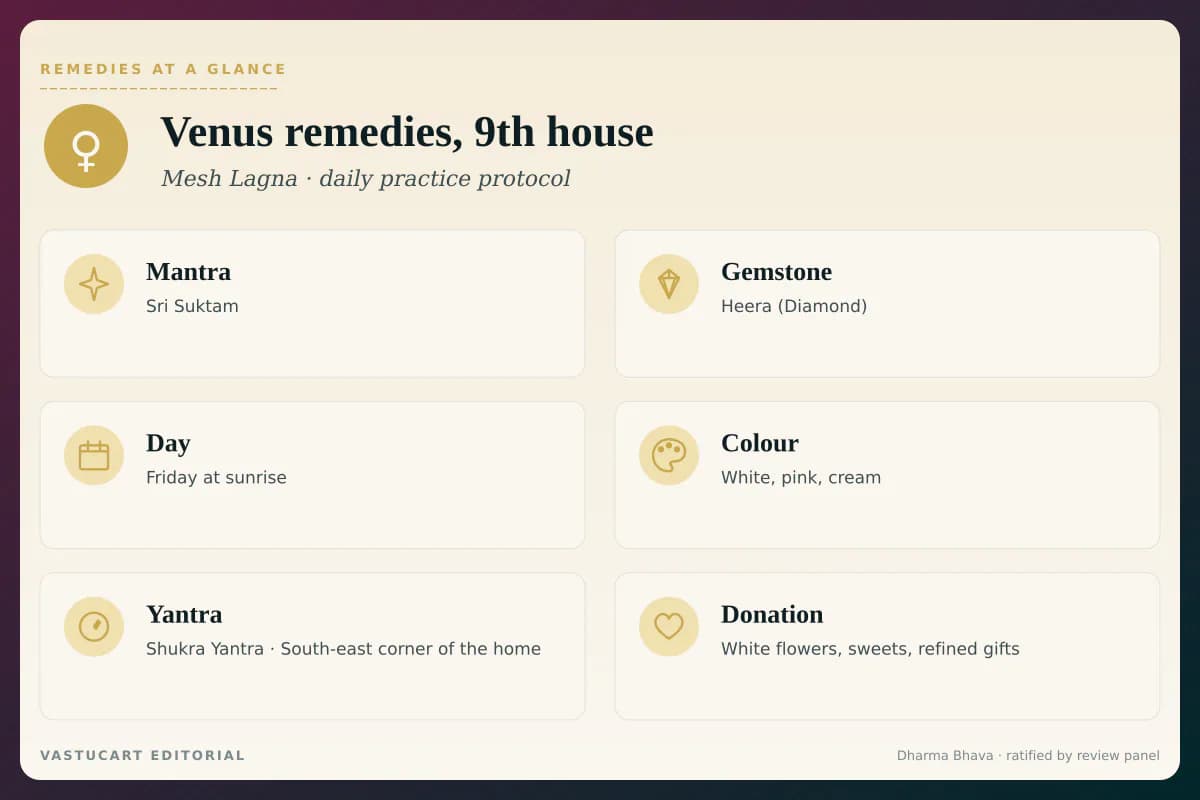
The daily Lakshmi worship is the primary remedy for this placement because Lakshmi is the classical patron deity of Venus, and her form holds the wealth, refinement, and dharmic-aesthete energies the placement amplifies. Rise before sunrise, bathe, wear white or pale rose clothing on Fridays, and visit a Lakshmi or Venkateshwara temple if accessible. The Sri Suktam is the primary recitation for this placement, the Vedic hymn to Lakshmi that creates a containing field for the Venus signature in its dharmic-trikona expression. Reciting the Sri Suktam at sunrise daily for forty days at any major Venus transition is the formal protocol.
Offer white flowers (especially lotus and jasmine), fresh fruit, sweet rice, and curd at the altar, and donate to causes that support the dharmic-aesthete tradition (classical-music schools, Sanskrit colleges, traditional-arts patronage), all of which channel the Venus and Dharma karakatvas constructively. The conscious-aesthete practice is the lifestyle remedy that compounds across decades into the difference between Venus-9-success and Venus-9-indulgence: a daily practice in a refined art (music, calligraphy, painting, devotional reading) keeps the placement directed. The gemstone is diamond (Heera), recommended after careful chart confirmation because Venus is the 2L and 7L for Mesh and his elevation amplifies both the dharmic gain and the maraka lordship simultaneously. Wear a natural certified diamond of minimum quarter-carat to half-carat set in white gold or platinum on the small finger of the right hand on a Friday at sunrise after Shukra mantra recitation. White sapphire is the classical alternative when diamond is not feasible.
Gemstones for Venus in 9th house Mesh Lagna
Diamond is the primary Venus gemstone but is recommended after careful chart confirmation because Venus is the 2L and 7L maraka for Mesh and the dharma elevation amplifies both gain and lordship.
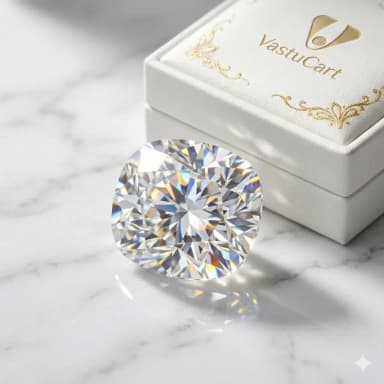

Disclaimer: Diamond over a 2L-7L Venus elevated to the trikona amplifies both the dharma gain and the maraka lordship. Always consult a qualified Jyotishi before permanent wearing.
Rudraksha beads for Venus in 9th house
The Venus-aligned rudraksha is the Chha Mukhi (Six Mukhi), the bead directly ruled by Kartikeya and Venus.
The classical Venus rudraksha and the bead specifically associated with Kartikeya as the warrior of refinement. Supports the Venus signification in its dharmic-trikona expression, channels the aesthete instinct toward classical territory, and stabilises the inner refinement when the maraka lordship is active in dasha.
The five-mukhi bead is the Jupiter bead and serves as primary secondary support for this placement because Jupiter is the dispositor of Venus in Dhanu. Wearing the Panch Mukhi alongside the Chha Mukhi compounds the placement's natural strength.
Shukra Yantra for the dharma placement
Sacred recitations for Venus in the dharma angle
Chandram hiranmayim Lakshmim jatavedo ma avaha
Tam ma avaha jatavedo Lakshmim anapagaminim
Yasyam hiranyam vindeyam gam ashvam purusham aham
Translation: Invoke for me, O Jatavedas (the all-knowing fire), the goddess Lakshmi who is golden-hued, deer-like, garlanded with gold and silver, moon-like, and made of gold. Invoke that Lakshmi for me who never departs, by whose grace I shall obtain gold, cattle, horses, and human company. The Sri Suktam is the primary Vedic hymn to Lakshmi and is the perfect daily recitation for a chart where Venus sits in the dharma trikona and the refinement-of-soul placement needs a containing devotional field.
Read the full stotra on stotra.vastucart.in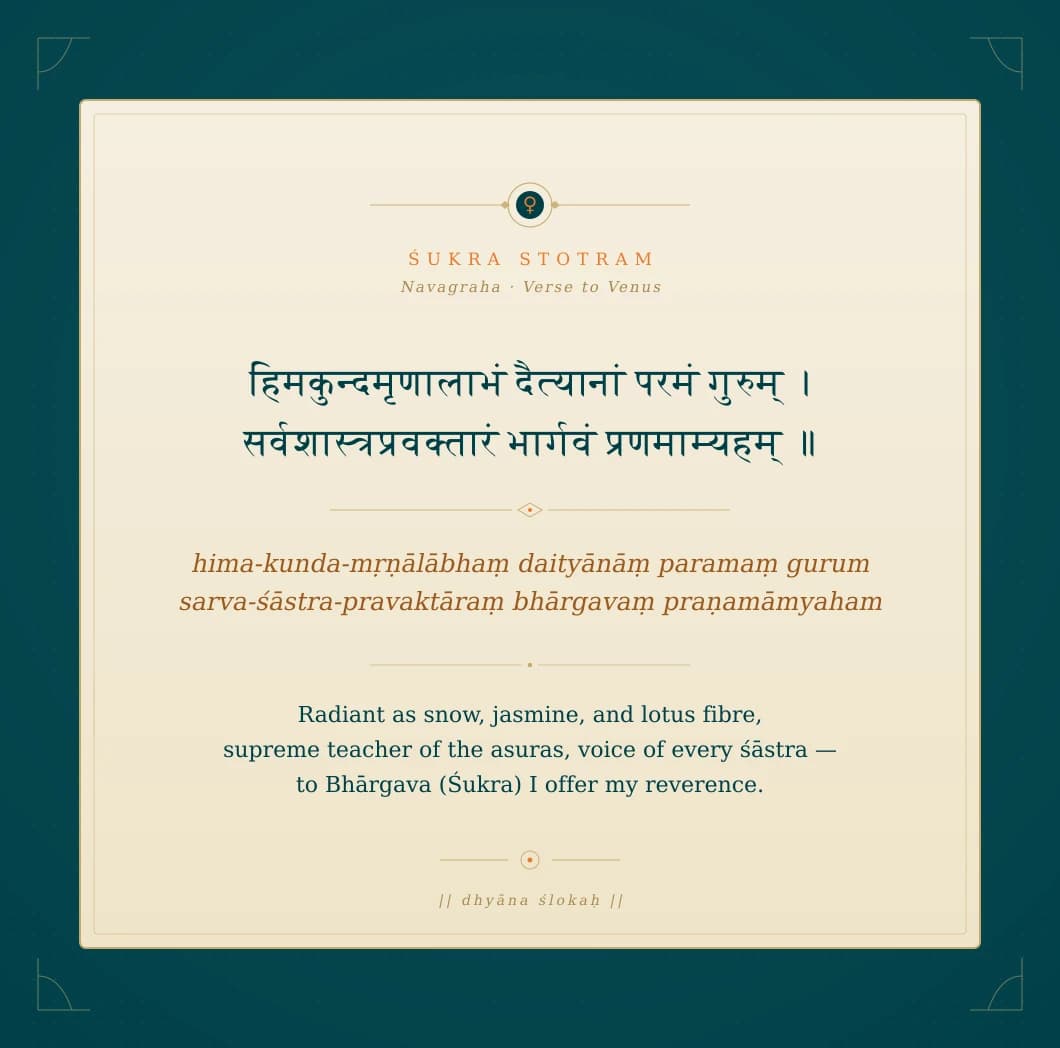
Tools for Venus 9th house Mesh natives
Is your Dharma Bhava Venus carrying the dharmic-aesthete signature?
Get a full personalised analysis of your ninth house Venus, the maraka-trikona reading, and the marriage timing.