
Venus in the 1st house
Mesh Lagna (Aries Ascendant)
A practitioner study of Shukra at the ascendant of Mesh Lagna. Venus in martial Mesha at the body angle, the 2L plus 7L dual lordship, the body-as-vessel-for-refinement signature, and the magnetic personal presence the placement specifically produces in the Aries native.
Venus in 1st house for Mesh Lagna, the quick reference
If you carry Shukra at the lagna of a Mesh chart, you hold one of the most personally significant Venus placements in the entire Aries ascendant catalogue, because Venus at the first house literally becomes the body it occupies. The first house from Mesh is Mesha, ruled by Mangal, and the Mars-Venus relationship is classical neutrality (neither friend nor enemy), which means the placement neither benefits from nor suffers under the sign's lordship in the way that friend or enemy sign placements would. Venus in martial Mesha expresses the refined planet through the warrior sign, producing a native who carries Aries directness combined with Venusian beauty in a way that distinguishes them from every other Mesh placement. The functional output is mid-strength rather than peak, but the personal nature of the lagna position amplifies the placement's emotional and physical impact regardless of the quantitative strength reading.
The second structural feature is the dual lordship Venus carries for Mesh Lagna. Shukra rules both Vrishabha (2nd house) and Tula (7th house), so any Venus placement for Mesh natives carries a 2L plus 7L double role. Placing this dual-role planet at the lagna means the body itself becomes the carrier of both the wealth-and-family signature of the second house and the marriage-and-partnership signature of the seventh, and the native's identity is built around the simultaneous expression of both. The body becomes the vehicle for accumulated resources, family inheritance, refined speech (in the 2L family-tradition sense), and the marriage drive that the chart specifically wires into the personality from birth. Note that this is NOT Pancha Mahapurusha Malavya Yoga, which requires Venus exalted or in own sign in a kendra. Mesha is neither, so even though the placement sits in the strongest kendra, the named yoga does not form. This guide reads every layer of Venus in 1st house for Mesh Lagna natives: the martial Mesha sign, the 2L plus 7L dual lordship, the body-as-refinement-vessel signature, and the diamond protocol that applies here with confidence despite the neutral sign relationship.
Why Venus at the body of an Aries native produces magnetic refinement
Students often ask whether Venus in martial Mesha is comfortable for the planet, and the honest practitioner answer is that the placement is structurally interesting precisely because the sign and the planet operate in different registers. Mesha is the warrior's sign, fast, fiery, and direct. Venus is the planet of refinement, beauty, sensuality, and the slower aesthetic register that takes time to mature. Placing Venus in Mesha at the lagna does not blunt the refinement, it expresses the refinement through the fiery body. The result is a native whose beauty is intense rather than soft, whose magnetism is felt as direct presence rather than as gentle attraction, and whose Venusian gifts arrive in the warrior package the lagna provides. Many natives with this placement are described by acquaintances as striking before they are described as beautiful, and the distinction matters because it tells the reader exactly how the chart is delivering the Venus karakatvas.
The 2L plus 7L dual lordship at the lagna is the second specific feature that practitioners need to read carefully. The second lord brings wealth, family, accumulated resources, food, speech (in the inherited family-tradition sense), and the inner sense of material security. The seventh lord brings marriage, partnership, business collaboration, the public-facing relational life, and the karaka of agreements. Placing both lords at the lagna wires both domains directly into the personality from birth, which means the native's identity is structurally inseparable from their relationship to wealth and from their relationship to marriage. They will not be able to feel like themselves until they are settled in both, and the chart specifically pulls them toward marriage early because the 7L at the body angle wants the partnership to become part of the identity rather than something added later. The third interpretive layer is aspect. From the first, Shukra aspects the seventh house with his full opposition aspect, doubling the marriage signature and producing natives whose partnership life is the central feature of their adult years regardless of how the rest of the chart is configured.
When Venus sits at the body of a warrior native, the beauty arrives wearing armour. The native does not need to soften the Aries fire to be refined. They need to let the refinement burn through the fire instead.
How Shukra in martial Mesha shapes the Aries native
Physically the native carries the Mesh Lagna frame with the Venusian refinement that distinguishes them from every other Aries ascendant in the room. The face combines the Aries angularity with the Venus beauty markers in a way that strangers find arresting: full lips, well-formed cheekbones, clear eyes, and a complexion that runs notably fairer than typical Mesh natives because Venus rules complexion at the surface level. The Aries fire adds a brightness to the eyes and a steadiness to the gaze that other Venus placements do not produce. Hair is typically thick, healthy, and well-kept, often with a natural lustre that family members notice from infancy. The body is naturally well-proportioned and tends toward the athletic-elegant rather than the soft-curved register that more watery Venus signs produce. The 1st house body-part rulership covers the head and face, and the Venus refinement gives the native one of the most photogenic Mesh frames in the catalogue.
Temperament is the layer where the placement most clearly diverges from the popular Aries portrait. These natives carry Mesh courage but the courage is filtered through an unusual aesthetic awareness that other Aries placements do not have. They notice beauty everywhere, often without conscious decision, and they make most life choices partly on aesthetic grounds even when the ostensible criterion is practical. They love quickly, intensely, and visibly, and they are not embarrassed by the visible affection because Venus at the body makes love expression part of the native's self-presentation rather than a private matter to be managed. They are unusually attuned to the partner's mood and presentation, often noticing changes in tone or appearance the partner did not consciously make, and the attunement produces the magnetic intimacy that this placement is famous for. The shadow side is the same magnetism, because natives who do not develop discernment can experience repeated cycles of intense attraction followed by disappointment when the aesthetic resonance turns out not to match deeper compatibility. Natives who pair the Venus magnetism with explicit relational discernment develop the rare combination of beauty and depth that this placement is genuinely capable of supporting.
Strengths, shadows and career fits
- Body becomes vessel for Venus refinement
- 2L plus 7L dual lordship at the lagna
- Magnetic personal presence from childhood
- Beauty arrives in the warrior package
- Aspects 7H, doubles the marriage signature
- Wealth and partnership wired into identity
- Not technically Malavya Yoga
- Aesthetic responsiveness without discernment
- Marriage urgency can produce early haste
- Self-image tied to appearance can fragility
- Family wealth pressure shapes identity
- Comfort can dampen Mars action drive
- Modeling, fashion, beauty industry leadership
- Hospitality and refined service work
- Performing arts (actor, dancer, musician)
- Sales and brand-led commerce
- Wedding and event industries
- Family business and inherited enterprises
Where the body-as-asset vocation plays out
Career paths cluster around fields where personal magnetism and aesthetic awareness are vocational assets, and the strongest single fit is modelling, fashion, and beauty industry leadership. The chart literally produces natives whose face is the work. Many spend years modelling, acting, or working in fashion where the body is the primary instrument and the Venus refinement combined with Aries fire produces a presence other charts cannot replicate. Hospitality and refined service work fit because the warmth translates directly into making other people feel at ease.
Performing arts (acting, dance, music) work because the placement supports forms where the body and presence are inseparable from the craft. Many natives find their footing in their twenties through a single high-visibility performance moment that establishes the rest of their career. Sales and brand-led commerce suit the chart because the same magnetism that draws romantic partners also draws customers. Wedding and event industries channel the 7L marriage signature productively. Family business and inherited enterprises round out the list because the 2L wealth signature wires the native into family money channels, and many step into family business roles in their thirties even when they had originally pursued a different career. Shukra mahadasha is when the vocation crystallises, often through a marriage or a public-visibility moment that opens the next phase of the working life.
Venus marked at the first house of Mesh
- Shukra at the lagna in Mesha, marked in pearl rose
- 12 houses in North Indian format
- Central diamond is the 1st house of Tanu Bhava
Why this placement makes wealth and marriage inseparable from the personality
The body-as-asset reading is the most useful frame for Venus in 1st of Mesh because the native cannot cleanly separate who they are from how they look, who they marry, and how family wealth relates to identity. Venus at the body of any chart produces this entanglement, but the dual 2L plus 7L lordship intensifies it. The 2L brings family wealth into the body, so the native's sense of self is structurally tied to their material situation in ways others can ignore but Mesh Venus 1st natives cannot. The 7L brings marriage into the same body angle, so identity feels incomplete until partnership is established, and the chart pulls the native toward marriage with a force other placements do not match. Many natives marry earlier than peers because the structural pull is difficult to resist.
The aesthetic-discernment training is the second specific feature practitioners need to read. Venus at the body amplifies response to beauty in others, felt as immediate recognition rather than gradual development. The training the chart asks for is the deliberate distinction between aesthetic resonance (which is real and valid as a signal) and deep compatibility (which requires more than resonance to verify). Natives who do not learn this distinction experience repeated cycles of intense attachment followed by disappointment. Those who learn it develop a calibrated aesthetic sense that becomes one of the most reliable instruments of adult life. The third pattern is the family wealth dynamic. Because the 2L is at the body, money runs through the family channel rather than independent earning, and many natives experience a complicated relationship with family money: dependence in their twenties, friction in their thirties, integration only in their forties when the inheritance becomes part of their own working capital.
When Venus in 1st delivers its Tanu Bhava chapter
Shukra mahadasha is the defining window for this placement and arrives with the marriage, refinement, and personal magnetism crystallising in measurable form.
Head, complexion and the magnetic vitality profile
Health follows the Venus-at-the-body pattern with specific considerations from the martial sign. Constitution is generally strong because Venus at the lagna supports tissue quality and surface presentation, with kapha most prominent and pitta secondary because Mesha adds fire to the otherwise watery Venus base. The 1st house body-part rulership covers the head, complexion, and face. Natives often have unusually strong skin and hair throughout adulthood. The shadow side is cosmetic vulnerability when stress disrupts the chart's natural flow: hair fall and skin changes appear earlier than for others when sleep or emotional balance lapse.
The reproductive system is the second specific layer because Venus karakatva covers reproductive fluids and the body-angle placement gives generally good fertility. Natives benefit from sustained hydration because watery Venus on a fiery body needs water input to balance the natural heat. The metabolic risk from comfort-loving lifestyle appears in the forties for natives who do not maintain active living. Friday is the ritual day. Annual general screening from the late twenties is recommended because the dual 2L plus 7L lordship makes baseline data more valuable than reactive testing.
Remedies for Shukra at the Mesh lagna
The Friday discipline is foundational and delivers genuine benefit for this placement because the chart is structurally aligned with the refined-pleasure current that Shukra rules and the day carries. Rise before sunrise, bathe with cool water and a light scent, wear white, soft pink, or pale ivory clothing, and offer white flowers, sweets, perfume, or rice at a Lakshmi or Devi shrine. The Lakshmi Hridayam is the primary recitation for this placement because it is the heart of Lakshmi the goddess of refined abundance and personal beauty, and the placement specifically asks for her blessing on the body that is the chart's central asset. Reciting the Lakshmi Hridayam daily for forty days at any major life decision (marriage, public visibility moment, career transition involving appearance) is the formal protocol, and natives often report a noticeable shift in inner stability and outer radiance by the third week.
Offer white flowers, sweets, and refined food at the altar, and donate to causes that protect refined craft (artisan support, traditional craft preservation, women's vocational training), all of which channel the Venus karakatvas constructively. The body-care practice is the single most important lifestyle remedy for this placement because the chart literally asks the native to honour the body as a sacred instrument. A daily body-care routine (skincare, hydration, exercise, refined dressing) compounds across decades into the difference between the placement's full expression and the version that fades into self-neglect. The gemstone is diamond (Heera) and is recommended with confidence here because the body-angle placement gives Venus its most personal expression and the gemstone supports the personal channel directly. Wear a natural colourless diamond of minimum half a ratti or a quarter-carat stone set in platinum or white gold on the small finger of the right hand on a Friday at sunrise after Shukra mantra recitation. White sapphire (Safed Pukhraj) is the accessible substitute. The lifestyle adjustment that compounds most is treating discernment as the partner of magnetism. Because the chart amplifies aesthetic response, natives who develop the explicit practice of distinguishing aesthetic resonance from deeper compatibility experience the placement as a reliable instrument rather than as a source of relational confusion.
Gemstones for Venus in 1st house Mesh Lagna
Diamond is the primary recommendation here because the body-angle placement gives Venus its most personal expression.
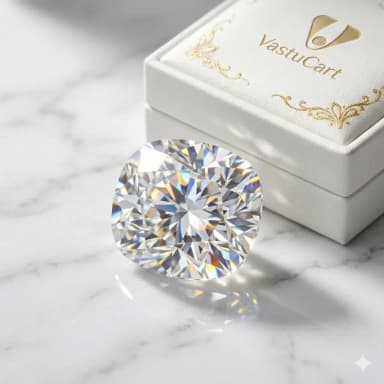

Disclaimer: Diamond at the body angle is one of the strongest possible Venus placements for gemstone work, but always consult a qualified Jyotishi before permanent wearing.
Rudraksha beads for Venus in 1st house
The Shukra-aligned rudraksha is the Chha Mukhi (Six Mukhi), the bead directly ruled by Venus and Kartikeya.
The classical Venus rudraksha and the safest daily-wear bead for any Shukra strengthening protocol. Supports the body-angle Venus, amplifies the magnetic presence, and is specifically recommended for natives in performing arts, fashion, hospitality, or any vocation where personal presence is the primary instrument.
The Mars bead serves as secondary support for this placement because the dispositor of Venus here is Mangal (Mars rules Mesha). Wearing the Teen Mukhi alongside the Chha Mukhi compounds the placement's strength by honouring both planet and sign-lord, and it specifically integrates the warrior-refinement combination the chart produces.
Shukra Yantra for the lagna Venus
Sacred recitations for Shukra at the Mesh lagna
Soubhagyada padma vadane mahalakshmi devi pranamamyaham
Padma asane padma kara padma patra ayata akshi
Padma anane mahalakshmi devi pranamamyaham
Hari hridayam patni rakshe mam sarva mangala
Sarva mangala mangalye shive sarva artha sadhike
Translation: Daughter of the ocean, with lotus-bowed hands, hailed by Katyayana. Bestower of fortune, lotus-faced Mahalakshmi, I salute you. Seated on the lotus, hands holding the lotus, eyes wide as lotus petals, lotus-faced Mahalakshmi, I salute you. Wife of Hari, residing in his heart, protect me, all-auspicious one. Auspicious of all the auspicious, Shiva, accomplisher of all aims. The Lakshmi Hridayam is the heart of Lakshmi the goddess of refined abundance and is the perfect daily recitation for a chart where Venus sits at the body angle and the body itself is the chart's central asset.
Read the full stotra on stotra.vastucart.inTools for Venus 1st house Mesh natives
Is your Tanu Bhava Venus carrying the dual lordship signature?
Get a full personalised analysis of your first house Shukra, the marriage timing, and the body-as-asset pattern.
Questions about Venus in 1st house, Mesh Lagna
Pt. Raghav Sharma has practiced Parashari Jyotish for over twenty two years from Varanasi. A student of the Varanasi Jyotish tradition, he specialises in Graha-in-Bhava analysis, Vimshottari Dasha predictions, and Muhurta. He has authored over four hundred in-depth articles on Jyotish principles across the VastuCart knowledge network.