
Sun in the 7th house
Mesh Lagna (Aries Ascendant)
A practitioner study of Surya debilitated in Kalatra Bhava for Aries ascendant natives. Sun in neecha Tula, the fifth lord in the seventh, marriage, partnership, debilitation cancellation and the remedies that actually work.
Sun in 7th house for Mesh Lagna, the quick reference
Few placements demand as much interpretive care as Sun in 7th house for Mesh Lagna. The seventh house from Mesh is Tula (Libra), which is the exact sign of Surya's debilitation (neecha rashi), with the deepest point of weakness at 10 degrees Tula. On top of that, classical Parashara texts name the seventh house as Surya's marana karaka sthana, the positional state where the Sun suffers the most symbolic death of authority. And yet, this Sun in 7th house is also the fifth lord (Surya is lord of Simha which falls on the fifth for Mesh) sitting in the seventh, which is a trine lord in a kendra, one of the foundational signatures of a raja yoga in making. This guide reads every layer of Sun in 7th house for Mesh Lagna natives: the debilitation picture, the marana karaka nuance, neecha bhanga conditions that cancel the weakness, the spouse profile, partnership business fit, surya mahadasha delivery, and the specific gemstone caution practitioners like me apply when Surya is weak.
When the Sun sets on the seventh horizon
The seventh house is Kalatra Bhava, the house of marriage, spouse, open enemies, public dealings, trade, and the individual the native stands across from in any transaction. For Mesh Lagna, this house carries Tula rashi, ruled by Shukra (Venus), and everything Tula represents, balance, aesthetics, diplomacy, mutual consent, is the exact opposite of the fire and assertion Mesh Lagna runs on through its Mars ascendant. When Surya enters this Tula seventh, he steps into a sign that does not suit him on every axis. The Sun is pure individual identity, Tula is social negotiation. The Sun asserts, Tula mediates. The classical debilitation of Surya in Tula is not arbitrary symbolism, it is the most literal description of an identity that cannot accept compromise arriving in a house where compromise is the whole currency.
Add the marana karaka sthana overlay and the picture sharpens. Parashara lists the seventh as the position where Surya experiences a symbolic death, because the Sun as the king cannot function fully when placed opposite the lagna and forced to face the public horizon rather than rise from it. This is not a placement that destroys the native, far from it, but it does impose specific marriage and partnership lessons that the native will spend the first three decades of life learning the hard way. The saving grace, and it is a real one, is that Surya is also the fifth lord for Mesh, and a trikona lord in a kendra carries raja yoga potential even when weakened by sign.
A debilitated Sun in Kalatra Bhava does not break the chart, it forces the native to build identity through partnership rather than assert it above partnership.
How a debilitated Surya shapes the Aries native
Physically the native holds the Mesh Lagna baseline of upright posture and athletic build, but the usual Mars-driven assertion is noticeably softened. The face carries a gentler jaw line, the eyes hold more warmth than command, and the voice, though clear, lacks the metallic edge that Sun in own sign or Sun in lagna delivers to other Aries ascendant natives. Complexion is often fair with a slight rose undertone because Shukra colours the physical expression through the seventh house Tula rising. The hair tends to be softer and less coarse than the typical Mars-ruled Aries native. Walking is easy rather than striding, and the overall impression strangers form is of a diplomat first and a warrior second, which the chart itself confirms.
Temperament is the interesting layer. These natives carry the Mars courage of the lagna but process it through a need for validation that most Aries ascendants simply do not have. They want to win the argument, but they also want the loser to agree that they won fairly. They are ambitious, but they cannot stand the taste of victory without acknowledgement. Left unchecked, this becomes dependency on others' approval, and the classical marana karaka sthana description of Sun in 7th manifests as the native losing authority precisely because they keep asking for permission to exercise it. The good side is that these natives are rarely tyrannical, rarely cruel, and almost always build their authority through actual competence and fair dealing rather than inherited privilege or brute force.
Strengths, shadows and career fits
- Raja yoga potential through 5L in 7H
- Partnership-based career success
- Diplomatic skill and fair dealing
- Love marriage more common
- Strong navamsa often rescues the Sun
- Competence earned the hard way
- Debilitated Sun ego friction
- Marriage stress in the twenties
- Over-dependence on spouse approval
- Father relationship is distant
- Partnership business disputes
- Marana karaka fatigue in Surya dasha
- Law and advocacy
- Diplomacy and foreign service
- Partnership consulting
- Arbitration and mediation
- Trade, import and export
- Public relations and brand voice
Why partnership careers succeed where solo ventures stall
The career signature reads very differently from what the surface of a debilitated Sun suggests. Because Surya is still the fifth lord and is in a kendra, the raja yoga seed is there, it just has to germinate through partnership rather than through solo authority. Law is the single strongest fit because law is a profession in which you formally represent someone else's interests, you negotiate across a table, and the seventh house literally governs open courts and legal disputes. Advocacy, litigation, and especially family law and matrimonial practice suit these natives because their own life experience teaches them the terrain. Diplomacy and foreign service are the second cluster, international postings, trade negotiation, consular work, and anything that requires the native to represent one party before another.
Partnership consulting, business advisory work where the native advises a founder or a board but is not the founder themselves, is a third natural fit and often the most lucrative. Arbitration, mediation, and conflict resolution roles work because the debilitated Sun in Tula has been forced to develop the balance gene, and natives in their forties often become sought-after neutral third parties in commercial disputes. Trade, import and export, partnership businesses where the native runs the external-facing side while a partner runs operations, also fit. Public relations and brand voice work suit the softer Sun that this placement produces. The key rule: never go solo. Every career framework that requires the native to be the sole authority figure will amplify the marana karaka exhaustion, while every framework that is built on formal partnership will harness the 5L in 7H raja yoga and deliver.
Sun marked in the seventh house of Mesh
- Surya in Kalatra Bhava, marked in dusk rose
- 12 houses in North Indian format
- Right-hand diamond is the 7th house, opposite the lagna
When the debilitation is cancelled and becomes a strength
The single most important question in any chart with Sun in 7th for Mesh is whether neecha bhanga, debilitation cancellation, applies. Parashara lists several classical conditions and at least one of them must hold for the debilitation to lift. First, the lord of the debilitation sign (Shukra, since Tula is ruled by Venus) must be in a kendra from the lagna or from the Moon. Second, the planet whose exaltation sign is Tula (which is Shani, since Saturn is exalted in Libra) must be in a kendra from the lagna or the Moon, or must aspect the debilitated Sun itself. Third, the debilitated planet must be aspected by a benefic, especially Guru (Jupiter). Fourth, the debilitated planet must be in a kendra from the Moon rather than the lagna.
In practice, the second condition is the most commonly fulfilled one for Mesh Lagna charts because Shani exalted in the seventh with the Sun (same sign, Tula) instantly creates a powerful neecha bhanga raja yoga and also forms a Shani-Surya sign conjunction that classical texts treat as ego-cauterising but ultimately character-building. When the neecha bhanga applies, the native's thirties and forties deliver dramatic professional and personal rewards that look nothing like the struggles of the twenties. When it does not apply, the native has to rely on remedial practice, navamsa strength, and deliberate lifestyle choices to manage the debilitation. The Navamsa chart is the single most important diagnostic, if the Sun is well-placed in navamsa (say, in Simha, Mesh, or even Dhanu navamsa), the rashi debilitation loses most of its bite.
When Sun in 7th fires and when it strains
Surya mahadasha is the central interpretive window for this placement. Six years, intense, and direction depends entirely on whether neecha bhanga applies. Guru, Shukra and Shani periods also colour the seventh house story.
Lower abdomen, vitality and the debilitated solar fire
Health runs on an unusual pattern for this placement. The pitta fire the Sun normally contributes is dampened by the Tula debilitation, so the body actually runs cooler than the typical Mesh Lagna profile. Digestion is moderate rather than strong, the native feels cold more easily than peers, and morning energy is slower to build. The seventh house governs the lower abdomen, the urinary tract, and the reproductive organs, so these are the vulnerable zones. Common issues include low-grade reproductive weakness, kidney function below optimal, and lower back fatigue that amplifies in Shani transits over the seventh. Women with this placement sometimes face irregular menstrual cycles until the late twenties, men face lower testosterone patterns unless corrected.
The corrective routine is classical and specific. Surya Namaskar (the twelve-pose solar salutation) is non-negotiable, done every morning facing east at sunrise. It is the single most powerful lifestyle remedy for a debilitated Sun because it physically moves the body through twelve postures named after the twelve solar adityas and activates the vitality channel the placement has weakened. Twelve rounds minimum, twenty-four if the native is disciplined. Warm cooked foods, adequate protein, ginger and black pepper in daily cooking, and early bedtime. Avoid cold salads at dinner, avoid late-night work past ten in the evening, and avoid prolonged isolation because social contact actually feeds the seventh house vitality for these natives. The placement responds remarkably well to discipline, natives who commit to the Surya Namaskar routine and Aditya Hridayam recitation often report their Surya mahadasha delivering completely different outcomes from what their twenties seemed to predict.
The spouse, the timing, and the lessons the chart delivers
This is the central interpretive theme for Sun in 7th, Mesh Lagna, because the seventh house is marriage and Surya debilitated inside it paints a very specific spouse picture. The partner is almost always older than the native, frequently by three to seven years, and carries a commanding or authority-associated background, government service, senior corporate, academic position, family business leadership, or established professional practice. The spouse tends to come from a family more socially established than the native's own, and classical texts specifically note that the native often marries upward into a family with greater public standing. Love marriage is more common than arranged marriage in this combination because the native is naturally drawn to a partner who already has authority rather than building it together.
Timing is the other question natives always ask. Marriage rarely happens before the mid-twenties in this combination, the debilitation and marana karaka overlay tend to push the marriage window to the Guru or Shukra mahadasha years, and the most common timing window is during the Surya antardasha of Guru mahadasha or the Guru antardasha of Shukra mahadasha. First marriages formed in the early twenties without chart verification often struggle, and I have seen enough of this pattern in practice that I now specifically advise natives with this placement to delay the decision to at least twenty-six and to insist on Navamsa matching. Practical pairing: prefer Tula, Dhanu, Kumbha, or Mithuna lagnas for the partner. Always run a full Manglik audit, always verify the Navamsa lord of the seventh, and never proceed on a first marriage proposal without the exact Navamsa check a practicing Jyotishi can provide.
Remedies for debilitated Surya in the seventh
The Sunday discipline is foundational here and has to be done more rigorously than for natives with a strong Sun. Rise before sunrise, offer water to Surya facing east through a copper vessel while standing still in direct morning light, and recite the Aditya Hridayam in full. This is the one stotra Sage Agastya gave Rama before the final battle with Ravana, and classical tradition treats it as the primary debility cure for any weak Sun placement. Twelve rounds of Surya Namaskar follow immediately after the recitation. On Sundays eat one simple meal at midday, avoid salt, and wear copper-toned or deep red clothing. Donate red wheat, raw sugar, jaggery, or a book on dharma to a senior teacher or to a fatherless child on Sunday mornings.
The Hanuman Chalisa recited daily at dusk is the secondary remedy and the one I emphasise most strongly. Hanuman is the son of Vayu but in classical lore is associated with Surya as his first teacher, and Hanuman remedies are traditionally prescribed when both Surya and Mangal need strengthening. Mesh Lagna gets the double benefit because Hanuman supports the lagna lord Mars at the same time. The gemstone question is where I slow down. Ruby (Manik) is the classical Surya stone, but a debilitated Sun in marana karaka sthana is exactly the condition where wearing ruby can backfire, amplifying ego friction rather than strengthening authority. I recommend red garnet as the milder substitute for daily wear, save ruby only for cases where a practising Jyotishi has confirmed neecha bhanga applies strongly, and never wear ruby during the Shani antardasha windows without a direct consultation. The lifestyle adjustment that compounds most is accepting that authority will come through partnership rather than through solo command, natives who internalise this in their thirties see the raja yoga deliver fully, natives who resist it keep hitting the same wall.
Gemstones for Sun in 7th house Mesh Lagna
For a debilitated Surya in marana karaka sthana, the gemstone rule is unusual, red garnet is safer than ruby for daily wear and ruby is reserved for confirmed neecha bhanga cases.

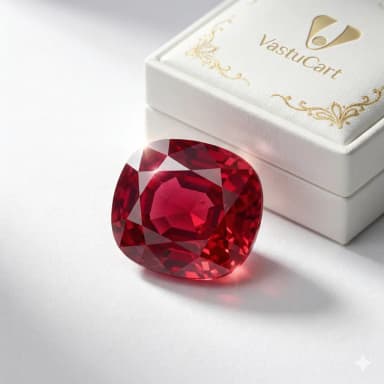

Disclaimer: A debilitated Sun should never be given ruby without a full chart review. Always consult a qualified Jyotishi.
Rudraksha beads for Sun in 7th house
The classical Surya rudraksha is the Ek Mukhi, and for debilitated Sun cases the Hanuman-associated Gyarah Mukhi is the supporting bead that strengthens the solar channel indirectly through Mars and Vayu.
Strengthens the soul clarity signal that the debilitation weakens, removes distortion in the self-authority channel, and is the single best rudraksha for any weakened Surya placement. Worn after Shiva abhishek on Sunday.
The Hanuman bead that strengthens courage, removes fear in public dealings, and indirectly supports debilitated Surya through the Mars-Vayu channel that Hanuman represents. Classical secondary remedy for Sun in marana karaka sthana.
Surya Yantra for a debilitated Sun
Sacred recitations for a debilitated Surya
Ravanam chagrato drshtva yuddhaya samupasthitam
Daivataishcha samagamya drashtumabhyagato ranam
Upagamyabravid Ramam Agastyo bhagavanrishih
Translation: When Rama stood exhausted in battle, the sage Agastya approached and said, recite Aditya Hridayam and you shall conquer all enemies, attain all knowledge, and never face defeat. For a debilitated Sun in the seventh, this hymn is the foundational daily practice.
Read the full stotra on stotra.vastucart.inTools for Sun 7th house Mesh natives
Does neecha bhanga apply in your chart?
Get a full personalised analysis of your debilitated Surya, Navamsa strength, and marriage timing windows.
Questions about Sun in 7th house, Mesh Lagna
Pt. Raghav Sharma has practiced Parashari Jyotish for over twenty two years from Varanasi. A student of the Varanasi Jyotish tradition, he specialises in Graha-in-Bhava analysis, Vimshottari Dasha predictions, and Muhurta. He has authored over four hundred in-depth articles on Jyotish principles across the VastuCart knowledge network.