
Rahu in the 10th house
Mesh Lagna (Aries Ascendant)
A practitioner study of Rahu at the career zenith of an Aries ascendant chart. The north node in Shani's sign Makara, classical BPHS favourable placement, sudden rise and foreign career signatures, and the eighteen-year mahadasha that delivers them.
Rahu in 10th house for Mesh Lagna, the quick reference
Rahu in 10th house for Mesh Lagna is one of the placements Brihat Parashara Hora Shastra names explicitly for sudden worldly rise, government favour, and public recognition. The tenth house for Mesh is Makara (Capricorn) ruled by Shani, and Rahu in Makara enjoys a cooperative sign relationship because Shani and Rahu are classically described as compatible outsider energies, both slow-building, both working through unconventional channels, and both indifferent to the warmth the solar establishment runs on. Place the north node in this Shani-ruled tenth and the result is a native whose career arc does not follow the conventional ladder, who rises through foreign markets, technology, media, politics, or any frontier the mainstream has not yet labelled, and whose Rahu mahadasha (eighteen years) becomes the single defining career chapter of the life. This guide reads every layer of Rahu in 10th house for Mesh Lagna natives: the BPHS favourable verdict, the Shani-Rahu sign synergy, foreign career signatures, the classical rise-and-fall risk, mahadasha delivery, the hessonite protocol, and the Durga worship that anchors the placement through decades.
When the north node climbs to the zenith of the chart
The tenth house is Karma Bhava, the zenith of the kundali, and classical texts treat any planet here as a significator of career and public reputation. Rahu in particular receives favourable commentary in BPHS because the north node at the top of the chart amplifies whatever the native is known for, multiplies the scale at which they operate, and opens doors to institutions, territories, and audiences that other placements cannot reach. The shadow planet's hunger for expansion finds its most productive channel in the karma house because career is the one domain where human ambition genuinely rewards the boundary-breaking intensity that Rahu represents.
Makara rashi adds a second layer. Shani rules Makara, and Shani governs discipline, institutional structure, and the long horizon of patient effort. Rahu in Shani's sign is not in enemy territory, it is in an ally's territory. Both planets work through endurance rather than flash, both succeed in domains the conventional establishment avoids, and both reward natives who build slowly through the twenties and then accelerate dramatically in their mid-thirties. For Mesh Lagna this placement produces a career arc that looks unremarkable for the first decade out of school, then begins compounding in unexpected directions, and by the mid to late thirties often places the native in positions of institutional visibility that their early career simply could not have predicted. Foreign connections, technology adoption, and unconventional industry choices show up frequently, because Rahu's natural signature is the territory no one else has colonised yet.
Rahu at the zenith does not hand the native a polished career path. It hands them a ladder nobody else has noticed, and rewards the ones brave enough to climb it without a map.
How a zenith Rahu shapes the Aries native
Physically the native carries a slightly taller-than-average Mesh Lagna frame with a lean, wiry build that compounds endurance over raw strength. The face tends to be longer, with pronounced cheekbones, watchful eyes that carry an unusual depth of focus, and a subtle asymmetry that many people find compelling without being able to articulate why. The complexion often runs darker than the family average and the hair tends to be thicker and slightly wavy. Walking has a faintly restless quality, as if the native is always scanning the edges of the room for something others have not noticed yet, which is exactly the behavioural signature the north node at the zenith produces.
Temperament is the layer that explains the career trajectory. These natives carry Mars ambition from the lagna but process it through a Rahu hunger for the unconventional, which means they are rarely satisfied with the roles their peers settle into. They leave stable jobs to join startups, they relocate internationally when their friends are buying houses, they adopt new technologies before the herd, and they are willing to spend years in obscurity if the obscurity contains an opportunity others cannot see. The shadow side is restlessness that never resolves, a tendency to chase the next thing before the current thing has matured, and an ego that can inflate rapidly during the Rahu mahadasha when recognition arrives. The discipline the placement demands is twofold, learn to finish what you started, and learn to manage visibility without letting it become the point of the work.
Strengths, shadows and career fits
- Sudden career elevation in mid-thirties
- Foreign market access and success
- Mass audience and public visibility
- Government or institutional recognition
- Wealth through unconventional channels
- Technology and frontier adoption advantage
- Rise-and-fall risk in Rahu mahadasha
- Ego inflation after first big success
- Legal or compliance exposure if unchecked
- Restlessness that skips commitment
- Distance from family of origin
- Mental fatigue from constant reinvention
- Technology and software leadership
- Foreign trade and international consulting
- Media, film and digital platforms
- Politics and public affairs
- Cryptocurrency and alternative finance
- Unorthodox research and innovation roles
Why unorthodox paths deliver more than conventional ones
Career paths cluster around frontier territories where the conventional establishment has not yet written the rules. Technology leadership is the single strongest modern fit because Rahu rules the domain of whatever is new, and technology careers reward the boundary-breaking curiosity that the north node represents. Software engineering leadership, product roles in emerging categories, technical co-founder positions, and senior engineering management at companies operating in new markets all suit these natives. Foreign trade and international consulting form the second cluster because Rahu is classically associated with foreign lands, cross-cultural work, and any career that involves moving between jurisdictions or dealing with markets the native did not grow up in.
Media, film, and digital platform careers work because the tenth house public visibility channel pairs with the Rahu capacity for mass appeal to produce natives who can build audiences where other people cannot. Politics and public affairs are a classical Rahu-in-tenth fit because BPHS explicitly mentions government favour and political elevation as effects of this placement. Cryptocurrency, alternative finance, venture capital, and any frontier area of financial markets suit these natives because the Makara Shani colouring adds institutional credibility to the Rahu hunger for the new. Unorthodox research, innovation roles inside otherwise conventional organisations, and any position that requires the native to be the internal advocate for a direction the rest of the team does not yet understand, also works. The wealth picture is volatile in the first half of the Rahu mahadasha and consolidates significantly in the second half. The single most important career rule is to finish things. Rahu natives who build a completed track record before chasing the next opportunity compound reputation enormously, while those who leave projects half-done before harvesting the reputation benefit end up recycling through the same lessons each decade.
Rahu marked at the zenith of Mesh
- Rahu in Karma Bhava, marked in smoky indigo
- 12 houses in North Indian format
- Top-central diamond is the 10th house
Why Rahu gives in order to test and tests in order to mature
No reading of Rahu in 10th can skip the classical rise-and-fall warning that practitioners have observed across centuries. The north node gives rapid career elevation to natives who otherwise might have waited decades for the same recognition, and this early gift is genuinely real. The risk is that the gift is not properly consolidated. Rahu natives who receive sudden visibility in their late twenties or early thirties sometimes mistake the visibility itself for the achievement, expand their commitments faster than their foundation can support, and crash during the antardashas of hostile planets later in the Rahu mahadasha. I have seen this pattern dozens of times in practice, and it almost always correlates with the native skipping the consolidation phase classical texts specifically prescribe.
The consolidation phase has three components. First, finish the project that brought the elevation before taking on the next one. Second, document the work in a way that makes it independently verifiable, because Rahu's shadow tendency is to leave ambiguous trails that can be disputed later. Third, build a small number of deep relationships with people who knew you before the rise, because these are the relationships that will catch the native if any fall happens. Natives who follow these three rules see the eighteen-year Rahu mahadasha deliver progressive elevation without crash phases, and by the end of the mahadasha they stand in institutional positions their early twenties could not have imagined. Natives who skip the consolidation see the mahadasha deliver a sharp rise followed by a sharp correction, and spend the Guru mahadasha that follows rebuilding what they should have built carefully the first time.
When Rahu in 10th fires most powerfully
Rahu mahadasha is the defining eighteen-year career window for this placement. Shani, Guru and Budha periods also shape the trajectory significantly.
Nervous system, joints and the shadow-planet vitality profile
Health follows an unusual pattern because Rahu is a shadow planet that does not own physical territory the way the seven classical planets do, so its influence shows up as a nervous system signature rather than an organ-specific one. Constitution is vata-dominant, the body runs with irregular sleep and hunger rhythms unless deliberately regulated, and stress expresses through the nervous system before it expresses through obvious physical symptoms. The specific vulnerabilities are anxiety that peaks during transit activation of the tenth house, insomnia during high-ambition work phases, and digestive irregularity when meals are skipped or shifted. The Makara sign rules the knees and bone structure, so natives should track joint health from the late thirties and schedule preventive imaging if knee discomfort becomes persistent.
The corrective routine is grounding-focused because a shadow planet at the zenith creates an ungrounded quality that needs active counterbalance. Walking outdoors for thirty minutes every day is the single most effective practice because it connects the body to the earth element that Makara naturally represents. Warm cooked meals at consistent times anchor the vata constitution, while regular sleep hygiene prevents the Rahu-typical late-night overstimulation that damages the nervous system across years. The most important practice for this placement is silence, because Rahu natives are continuously exposed to information and noise, and a daily period of silence, whether through meditation, journaling, or simply a walk without headphones, resets the nervous system in a way nothing else does. Ayurveda prescribes grounding oils like sesame, warm food temperatures, and daily routine for vata imbalance, and all three apply directly here.
Why the chart keeps pointing the native overseas
Rahu is classically the planet of foreign lands, foreign people, and careers that involve crossing jurisdictional boundaries, and placing Rahu in the tenth house of career makes the foreign signature an explicit feature rather than an occasional episode. Natives with this placement typically experience at least one significant period of living or working abroad, and the relocation usually correlates with a major career inflection rather than a personal choice. International postings, overseas education followed by work, business partnerships with foreign companies, and roles that involve frequent international travel are all typical expressions. The country the native is drawn to often has a Shani-Rahu signature culturally, meaning it rewards discipline, institutional structure, and unconventional work in equal measure.
The second expression is foreign partnerships even when the native stays in their home country. Clients, investors, business partners, or mentors from abroad frequently become pivotal to the career, and the native's reputation often reaches an international audience before it reaches their domestic peers. The third expression is technology or knowledge products that are consumed across borders regardless of where the native is physically located, which is the modern form of the foreign signature. Whatever the specific expression, the chart is pointing at a career that cannot be contained within a single regional market, and natives who consciously lean into the international dimension of their work tend to see the Rahu mahadasha deliver far more than those who resist the signal and try to build a purely local career.
Remedies for Rahu at the career zenith
The Saturday observance is the most closely associated ritual day for Rahu because Shani is the friend of Rahu and the two share Saturday as a ritual anchor. Rise before sunrise, recite the Rahu Kavacham or Rahu Stotram, and make a small offering of black sesame seeds or black cloth on Saturday morning. Donate food to the poor, especially to people who are displaced or without family support, because Rahu's karmic signature responds strongly to acts that reduce the isolation of others. On Saturdays avoid major decisions during Rahu kaal, and avoid beginning any new foreign-facing commitment without a muhurta check.
The primary deity worship for Rahu is Durga, the adhidevata of Rahu in classical tradition. Reciting the Durga Kavach or the Durga Chalisa regularly, visiting a Devi temple on Navratri, and observing the nine-night Navratri fast are all classical remedies for any strong Rahu placement. Ganesha worship is the secondary deity remedy because Ganesha is the remover of obstacles and Rahu's shadow tendency is exactly to create hidden obstacles that the native cannot see coming. Recite the Ganesh Chalisa or the Sankat Nashan Ganesh Stotra before any major business meeting or career decision during the Rahu mahadasha. The gemstone is hessonite (Gomed). Wear a natural Ceylon hessonite of minimum six ratti set in silver or panchdhatu on the middle finger of the right hand on a Saturday at sunrise after Rahu mantra recitation. Hessonite is effective for this placement because it strengthens the ambition channel while the Durga worship prevents the shadow from turning into crash risk. The lifestyle adjustment that compounds most is commitment to finishing things, which the entire remedial framework is effectively supporting.
Gemstones for Rahu in 10th house Mesh Lagna
The primary stone for Rahu is hessonite (Gomed). It is one of the most commonly mismatched stones and should never be worn without a full chart review.
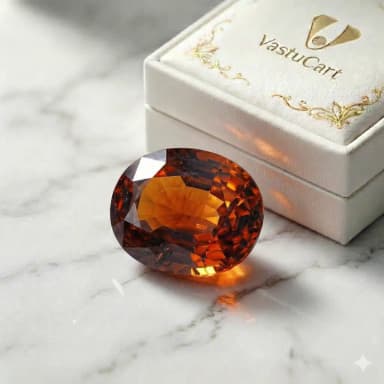

Disclaimer: Hessonite is one of the most sensitive gemstones in the Vedic system. Never wear it without a full chart review by a qualified Jyotishi.
Rudraksha beads for Rahu in 10th house
The Rahu-aligned rudraksha is the Ath Mukhi (eight-faced), directly associated with Ganesha. The Nau Mukhi adds Durga's protective armour.
The direct rudraksha for Rahu. Removes hidden obstacles the shadow planet creates, stabilises ambition, and is the primary bead for any career-positioned Rahu. Worn after Ganesha puja on Saturday or Chaturthi.
The Durga bead. Strengthens the protective Devi channel that Rahu responds to, reduces rise-and-fall volatility, and anchors the native through institutional transitions during the Rahu mahadasha.
Rahu Yantra for the zenith north node
Sacred recitations for Rahu
Sainhikeyam karaalaasyam lokaanaam abhayapradam
Neelaambaro neelavapuh kireeti khadgee gadee
Charma dhaaro raahuh krodhamaana charuh
Translation: I bow before Rahu, the winnower-shaped, crowned one, son of Simhika, of terrible visage, the giver of fearlessness to the worlds. Dark-clothed, dark-bodied, crowned, sword-wielder, mace-bearer, shield-holder, Rahu of measured wrath. The Rahu Kavacham is the primary protective recitation for any strong Rahu placement, and Durga Kavach is the secondary deity-level remedy.
Read the full stotra on stotra.vastucart.inTools for Rahu 10th house Mesh natives
Is your Rahu mahadasha active or approaching?
Get a full personalised analysis of your Rahu placement, mahadasha timing windows, and career trajectory.
Questions about Rahu in 10th house, Mesh Lagna
Pt. Raghav Sharma has practiced Parashari Jyotish for over twenty two years from Varanasi. A student of the Varanasi Jyotish tradition, he specialises in Graha-in-Bhava analysis, Vimshottari Dasha predictions, and Muhurta. He has authored over four hundred in-depth articles on Jyotish principles across the VastuCart knowledge network.