
Mercury in the 7th house
Mesh Lagna (Aries Ascendant)
A practitioner study of Budha in Kalatra Bhava for Aries ascendant natives. Mercury in friendly Tula, the 3L plus 6L dual lordship in the marriage angle, and the spouse-as-intellectual-partner signature that defines the partnership and often the business life simultaneously.
Mercury in 7th house for Mesh Lagna, the quick reference
If you carry Budha in the seventh house of a Mesh chart, you hold one of the most interpretively clean partnership Mercury placements in the entire Aries ascendant catalogue, because the placement combines three structural features that all work in the same direction. The seventh house from Mesh is Tula (Libra), ruled by Shukra, and the Mercury-Venus relationship is classical friendship. Both planets share a temperamental affinity for beauty, proportion, refinement, and the intellectual apparatus that aesthetic discrimination requires, and a Mercury in Venus's sign expresses through a medium that welcomes its full karakatva range without friction. The friendly Tula sign therefore gives the placement comfortable functional output at the kalatra angle. The seventh house is also the kendra of marriage, partnership, business collaboration, agreements, and the public-facing relational life that defines how the native shows up in one-on-one situations throughout adult life.
The second structural feature is the dual lordship Mercury carries for Mesh Lagna. Budha rules both Mithuna (3rd house) and Kanya (6th house), so any Mercury placement for Mesh natives carries a 3L plus 6L double role. Placing this dual-role planet in the 7H wires both the parakrama (self-effort, communication) signature of the third house and the service-and-discipline signature of the sixth into the marriage angle, and the practical effect is that the native's partnership life is built around verbal compatibility and shared work from the start. This is NOT Pancha Mahapurusha Bhadra Yoga because Tula is neither Mercury's own sign nor exaltation, but the structural strength of friendly sign plus dual lordship in the kendra produces one of the cleanest partnership Mercury configurations possible. This guide reads every layer of Mercury in 7th house for Mesh Lagna natives: the Mercury-Venus friendship, the 3L plus 6L dual lordship in the marriage angle, the spouse-as-intellectual-partner signature, and the emerald protocol that applies here with confidence.
Why Mercury and Venus produce one of the cleanest classical friendships
The Mercury-Venus friendship is one of the most structurally stable planetary relationships in classical Jyotish because the two planets share a fundamental commitment to the refined perception that both aesthetic and analytical work require. Venus is the planet of beauty, balance, and the pleasurable dimension of experience. Mercury is the planet of perception, discrimination, and the cognitive apparatus that notices the subtle differences Venus responds to. Neither planet can do its work without the other at a certain level, and classical texts recognise this by treating their relationship as friendly in both directions. When Mercury sits in Venus's own sign Tula, the friendship expresses at its cleanest: the cognitive apparatus has aesthetic material to work on, and the aesthetic material is processed with the precision that gives Venus his full reach. The result is a native whose intellect is naturally beautiful in its expression and whose aesthetic sense carries an unusual intellectual depth that pure Venus placements do not produce.
The 3L plus 6L dual lordship in the 7H is the second specific feature that needs careful reading because it shapes the partnership life with unusual specificity. The third lord brings parakrama, communication, and self-effort into the marriage angle. The sixth lord brings service, routine, daily discipline, and the willingness to engage with difficulty into the same marriage angle. The two lordships compound, and the practical effect is that the native's partnership is structurally built around two specific dimensions: verbal connection (3L) and shared work or service (6L). Natives with this placement consistently choose partners who are intellectual peers first and romantic partners second, and the partnerships that last are the ones where the two people can genuinely think together across domains and where daily collaboration is itself the texture of the relationship. The third interpretive layer is aspect. From the 7th, Budha aspects the 1st house (the lagna) with his full opposition aspect, bringing analytical intelligence into the body and identity. Natives often develop their sense of self through conversation with the spouse rather than through solitary introspection, and the partnership becomes the mirror in which the native sees themselves most clearly.
When Mercury sits in the marriage angle of a friendly sign, the partnership becomes the chart's central workshop. The native does not find themselves in solitude. They find themselves in the conversation with the one partner who can keep up with them.
How Budha in friendly Tula shapes the Aries native
Physically the native carries the Mesh Lagna frame with the unmistakable Budha refinement that classical texts catalogue, modified by the Venusian sign in specific ways. The face is intelligent and balanced rather than angular, the eyes are quick and observant but softer than the typical Mesh gaze, and the overall expression carries the youthful kumara quality that strong Mercury produces. Complexion runs notably fairer because Mercury rules complexion at the surface level and Venus adds the Tula softness to the base. Hair is typically thick, well-kept, and often slightly wavy, and the body has an athletic-elegant build that combines the Aries frame with the Venusian proportion the sign supplies. The 7th house body-part rulership covers the lower abdomen, kidneys, and pelvis, and natives should pay sustained attention to all three throughout life because the combination of Mercury sensitivity and 7th house rulership produces specific vulnerabilities around digestive health, kidney function, and reproductive health.
Temperament is the layer where the placement most distinguishes the native from popular Aries stereotypes, and the distinction comes through the partnership dimension specifically. These natives carry Mesh courage and willingness to act, but they almost always think best in dialogue rather than in solitude, and the preference is structural rather than learned. Children with this placement often talk through their homework with a parent rather than working through it alone, and the pattern continues into adult life where they do their best creative, analytical, and decision-making work in conversation with a trusted interlocutor. They choose spouses for verbal compatibility before any other quality, often described as marrying their best conversationalist, and the partnerships that last are the ones where the two people can keep up with each other intellectually across decades. They are charming in professional settings because they treat even brief interactions as small conversations rather than transactional exchanges. The shadow side is the dependency on dialogue that the placement can produce. Natives who do not develop their solitary reflection capacity alongside their conversational mode can feel lost when the partner is unavailable or when work requires extended solo concentration. Natives who develop both modes produce the rare combination of intellectual partnership and independent thought that this placement is capable of supporting.
Strengths, shadows and career fits
- Friendly Venusian sign welcomes Mercury
- 3L plus 6L dual lordship in the marriage angle
- Spouse becomes intellectual partner
- Business and marriage often overlap
- Aspects 1H, partnership mirrors identity
- Verbal compatibility guides spouse choice
- Not technically Bhadra Yoga
- Dependency on dialogue for self-reflection
- Lower abdomen and kidney attention required
- Work and marriage can blur boundaries
- 6L role brings periodic partnership friction
- Solitary reflection needs deliberate building
- Consulting and advisory work with a partner
- Law, legal research and mediation practice
- Journalism, broadcasting in a duo format
- Teaching and training partnerships
- Sales and business development
- Editorial work and collaborative writing
Where the spouse-as-partner vocation plays out
Career paths cluster around fields that reward collaborative intelligence and the specific capacity to think in partnership rather than in isolation. The strongest single fit is consulting and advisory work with a partner, frequently the spouse. Many natives build their professional identity around a joint enterprise where husband and wife are the two founders. The chart supports this pattern because the 3L plus 6L dual lordship wires communication and service directly into the partnership angle.
Law, especially legal research and mediation practice, fits the chart because the analytical discipline combined with verbal fluency produces a temperament well-suited to collaborative legal work. Journalism and broadcasting in a duo format fit natives who want to work in front of audiences, and many build podcast or co-authored publishing careers where the conversation with the co-host is itself the product. Teaching and training partnerships work because the chart rewards collaborative pedagogy. Sales and business development suit natives who close deals through relationship. Editorial work and collaborative writing round out the list. Budha mahadasha is when the vocational identity crystallises, often through a specific partnership that opens the next phase of working life.
Mercury marked in the seventh house of Mesh
- Budha in Kalatra Bhava in friendly Tula, marked in emerald
- 12 houses in North Indian format
- Lower-right diamond is the 7th house of marriage
Why the chart makes thinking-together the core of the marriage
The intellectual-spouse reading is the most useful frame for Mercury in 7th of Mesh because it captures both the structural prediction and the lived experience. The placement wires verbal connection directly into the marriage angle. The native's partnership is built around dialogue as the primary substance rather than around shared beauty, family, or ambition alone. Other placements produce partnerships that work on other axes, but this placement specifically asks for a spouse who can keep up intellectually, and partnerships that lack this dimension consistently fade. Practitioners should describe this explicitly because natives often need permission to make verbal compatibility the deciding factor in partner choice.
The business-and-marriage overlap is the second specific feature clinical reports consistently show. Because Mercury is 3L plus 6L combined in the 7H, the partnership angle carries both communication and service signatures. Many natives build businesses with their spouses or find that their spouse becomes their primary professional collaborator even when the formal career is separate. The overlap is structural rather than incidental, and natives who deliberately build joint enterprises experience the placement as the source of unusually sustainable partnerships where love and work reinforce each other. The third pattern is the identity-through-dialogue signature from the 1H aspect. Because Budha aspects the lagna from the 7th, the native's sense of self is built largely through conversation with the partner. The pattern is a gift and a vulnerability: the native has unusually articulated self-understanding when the partnership is working, and can feel structurally lost when it is not.
When Mercury in 7th delivers its Kalatra Bhava chapter
Budha mahadasha is the defining window for this placement and arrives with marriage, business partnership, or the intellectual collaboration that crystallises the rest of the life.
Lower abdomen, kidneys and the verbal-instrument profile
Health follows the friendly-sign Mercury in the 7th pattern with specific body-part considerations. Constitution is generally lean and balanced, with vata most prominent because Mercury carries vata qualities and the air sign Tula reinforces them. The 7th house body-part rulership covers the lower abdomen, kidneys, urinary tract, and pelvis, and natives should pay sustained attention to all of these regions throughout life. Hydration is non-negotiable because the kidney signature combined with the nervous-system sensitivity that Mercury placements produce makes dehydration a specific risk. Regular urinary screening, pelvic-area awareness, and attention to digestive patterns are preventive practices the chart specifically requests.
The verbal instrument is the second specific layer because the placement makes throat, vocal cords, and verbal stamina into specific care areas, especially for natives whose profession involves speaking. Daily hydration, vocal warm-ups for natives in speaking professions, and periodic vocal rest are the maintenance the body structurally requests. The nervous system is the third layer because Mercury rules the nervous system itself and the placement at the partnership angle means the native's mental state is unusually responsive to the state of the relationship: when the partnership is stable the nervous system runs smoothly, and when the partnership is in turmoil the nervous system shows the stress before the native consciously registers it. Wednesday is the ritual day, and Friday adds a secondary observance because the dispositor of Mercury here is Shukra. Annual general screening from the late twenties is recommended because the dual 3L plus 6L lordship makes baseline data more valuable than reactive testing.
Remedies for Budha in the Mesh marriage angle
The Wednesday discipline is foundational and delivers benefit for this placement because the chart is structurally aligned with the Mercury current, and Friday adds a secondary observance because Venus is the dispositor of Mercury here and the two planets reinforce each other. Rise before sunrise, bathe, wear green or pale aqua clothing on Wednesdays and white or pale pink on Fridays, and visit a Vishnu, Saraswati, or Lakshmi temple as accessible. The Saraswati Kavacham is the primary recitation for this placement because it is the protective armour stotra for the learning deity, and it specifically protects the verbal and intellectual channel that the placement makes central to the marriage life. Reciting the Saraswati Kavacham daily for forty days at any major partnership transition (engagement, marriage, joint venture launch) is the formal protocol.
Offer green dub grass, mung beans, fresh fruit, and white flowers at the altar, and donate books, school supplies, or scholarships, all of which channel the Mercury karakatvas constructively. The daily couple-journaling or shared-reading practice is the single most important lifestyle remedy because the chart specifically rewards the intellectual dimension of partnership. Couples who establish a shared reading practice or a daily conversation ritual (even fifteen minutes of deliberate dialogue about something beyond logistics) experience the placement deliver its fullest expression across decades. The gemstone is emerald (Panna) and is recommended with confidence here because the friendly Venusian sign and the kendra placement together support the gemstone protocol cleanly. Wear a natural Colombian or Zambian emerald of minimum five ratti set in gold or silver on the small finger of the right hand on a Wednesday at sunrise after Budha mantra recitation. Green tourmaline is the accessible substitute. The lifestyle adjustment that compounds most is treating verbal compatibility as the primary spouse criterion during the years of partner search. Because the chart asks for the intellectual partner as the structural requirement, natives who refuse to compromise on this dimension even under family pressure experience the placement as the source of the deepest partnership of their adult life.
Gemstones for Mercury in 7th house Mesh Lagna
Emerald is the primary recommendation here because the friendly Venusian sign and the kendra placement together support the gemstone protocol with confidence.
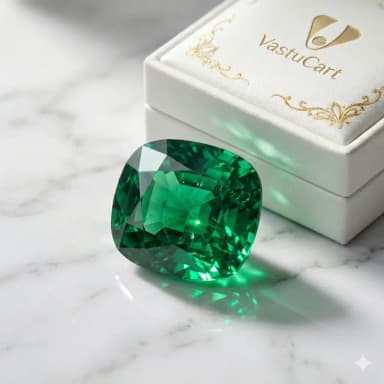

Disclaimer: Emerald at the kalatra angle amplifies partnership themes. Always consult a qualified Jyotishi before permanent wearing.
Rudraksha beads for Mercury in 7th house
The Budha-aligned rudraksha is the Char Mukhi (Four Mukhi), the bead directly ruled by Mercury and Brahma.
The classical Mercury rudraksha and the safest daily-wear bead for any Budha strengthening protocol. Supports the verbal-intellectual marriage signature, amplifies the partnership communication channel, and is specifically recommended for natives who build their career alongside their spouse or close partner.
The Venus bead serves as secondary support for this placement because the dispositor of Mercury here is Shukra (Venus rules Tula). Wearing the Chha Mukhi alongside the Char Mukhi compounds the placement's strength by honouring both planet and sign-lord, and specifically supports the refined aesthetic dimension of the partnership.
Budha Yantra for the Kalatra Mercury
Sacred recitations for Budha in the marriage angle
Padmanabhasya patni ya vishnu maya prakirtita
Prathamam shrada rupena dvitiyam kaanta rupini
Tritiya vag rupena chaturthi saraswati smrita
Panchamam kamala rupena shashti vidya ukta
Saraswati kavacham pathya sarvam artham labhet sada
Translation: Listen, O best of sages, to this armour hymn that grants honour. She who is called the wife of Vishnu, Vishnu-Maya, is first in the form of Shraddha (faith), second as the beloved consort, third as the form of speech, fourth remembered as Saraswati, fifth as the lotus goddess, sixth as the goddess of learning. Those who recite the Saraswati Kavacham always attain all desired objects. The Saraswati Kavacham is the protective armour stotra for the learning goddess and is the perfect daily recitation for a chart where Mercury sits in the marriage angle and the verbal-intellectual dimension needs protection and strengthening.
Read the full stotra on stotra.vastucart.inTools for Mercury 7th house Mesh natives
Is your Kalatra Bhava Mercury carrying the intellectual-spouse signature?
Get a full personalised analysis of your seventh house Budha, the marriage timing, and the joint-enterprise pattern the chart is preparing.
Questions about Mercury in 7th house, Mesh Lagna

Pt. Raghav Sharma has practiced Parashari Jyotish for over twenty two years from Varanasi. A student of the Varanasi Jyotish tradition, he specialises in Graha-in-Bhava analysis, Vimshottari Dasha predictions, and Muhurta. He has authored over four hundred in-depth articles on Jyotish principles across the VastuCart knowledge network.