Mars in the 11th house
Mithuna Lagna (Gemini Ascendant)
A practitioner study of Mangal in Labha Bhava for Gemini ascendant natives. Mars swakshetra in his own Mesha in the upachaya gains angle, the dual 6L and 11L lordship in own labha producing the foundational warrior-income yoga, and the athletic-and-competitive signature that defines one of the most lucrative Mithuna Mars placements.
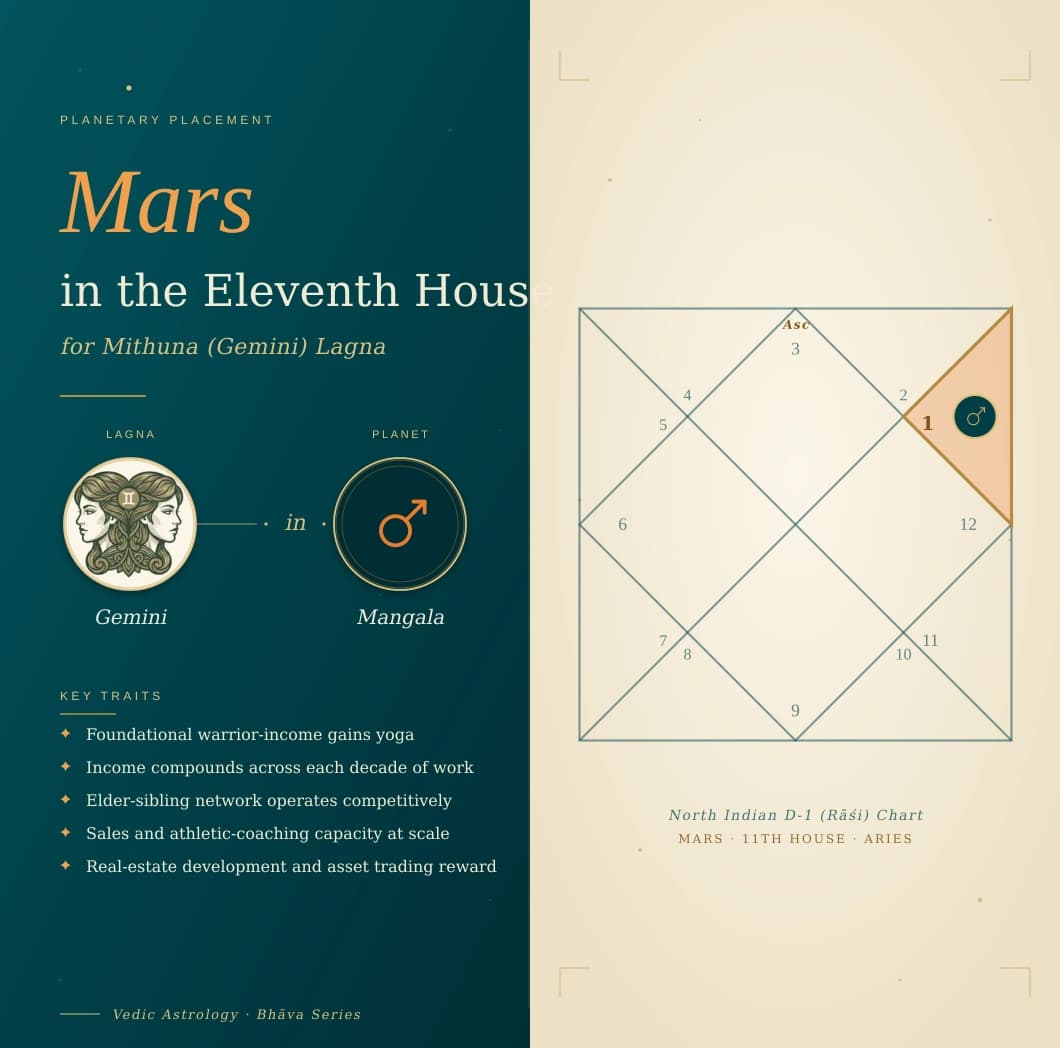
Mars sits swakshetra in his own Mesha in the eleventh house for Gemini ascendant natives, the warrior-income gains signature.
Mars in 11th house for Mithuna Lagna, the quick reference
If you carry Mars in the eleventh house of a Mithuna chart, you hold one of the most lucrative warrior placements in the entire Vedic catalogue, because Mangal (Mars) is the natural lord of courage, technique, and disciplined action, and his arrival in Labha Bhava (the eleventh house, the bhava of gains, fulfilment of desires, elder siblings, large networks, and public recognition) lifts these significations into territory where Mars's competitive nature becomes the structural engine of the native's income generation. The eleventh house from Mithuna is Mesha (Aries), Mars's own sign, which means Mars sits swakshetra in the labha angle. Classical Parashari recognises swakshetra placement of the labha lord (11L) in the labha house (11H) as one of the foundational gains-yoga formations, the lord-in-his-own-house pattern where the income channel receives structural reinforcement.
The second structural feature is the dual lordship. Mars is the 6L (Vrishchika, the bhava of enemies, debts, disease, service) AND the 11L (Mesha, the bhava of gains and fulfilment) for Mithuna, which means the same swakshetra planet that handles enemy-and-debt-resolution simultaneously handles gains-and-network-fulfilment. When this dual lord sits in his own 11H, the chart fuses the conflict-resolution capacity directly to the income channel: every successful adversarial engagement (sales pitch closed, athletic competition won, real-estate deal negotiated, debt recovered, litigation settled) converts into measurable income at scale. The third feature is the upachaya placement. The 11th house is one of the four upachaya bhavas (3, 6, 10, 11), the houses where a planet gains strength gradually across decades rather than expressing fully at first contact. Mars in upachaya compounds across each decade, producing natives whose income peaks, network reach, and competitive standing all expand decisively from the late twenties through the sixties. This guide reads every layer of Mars in 11th house for Mithuna Lagna natives: the Mesha swakshetra, the 6L+11L lordship, the warrior-income yoga, the upachaya growth principle, and the red coral protocol.
Why swakshetra Mars in own labha produces the warrior-income yoga
Students often arrive at this placement aware that Mars in 11H is generally favourable but uncertain why Mars swakshetra specifically in 11th of Mithuna is treated by classical commentators as among the most rewarding Mars placements available to the lagna. The honest practitioner answer requires reading the swakshetra status, the lord-in-own-house principle, and the upachaya growth pattern together. Classical Parashari recognises that own-sign placement gives a planet his full natural strength, and lord-in-own-house pattern gives the bhava his full natural strength because the lord and the house align without mediation. When Mars as 11L sits in his own Mesha which is the 11H, the planet, the lord, and the bhava all integrate into a single channel where the gains-of-effort dimension expresses without friction.
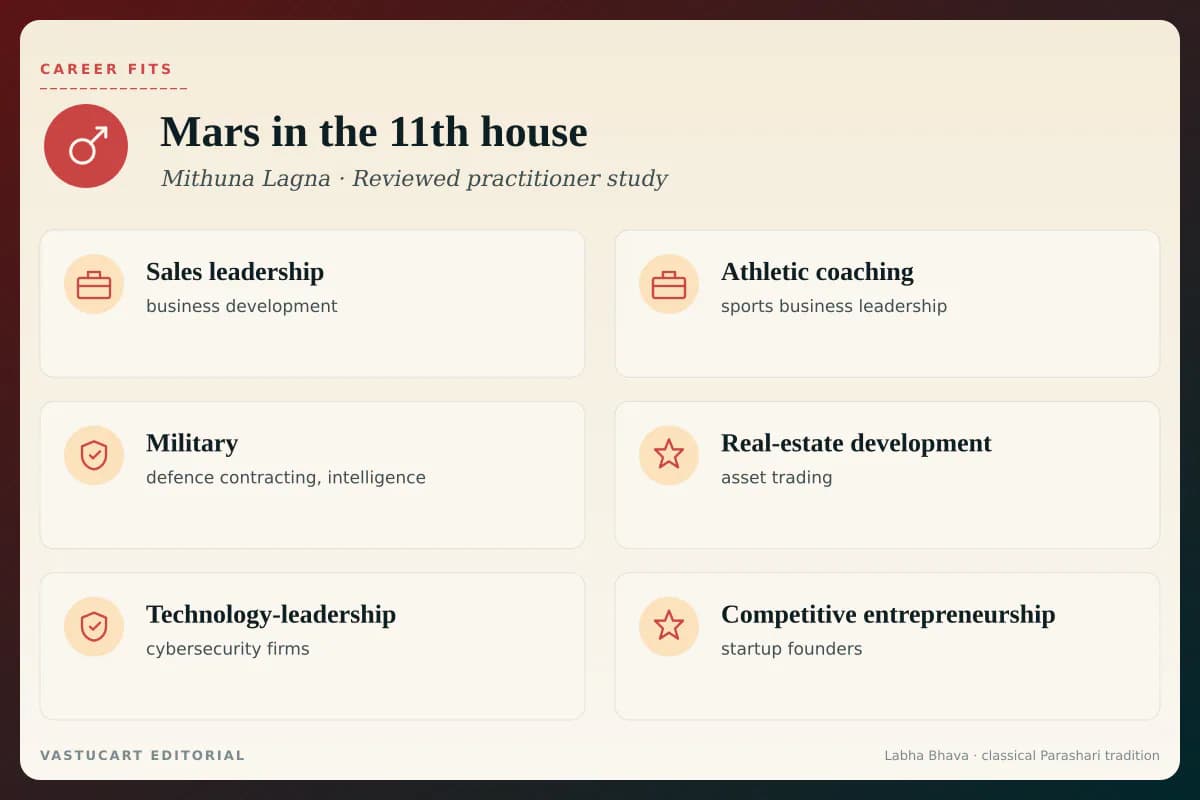
The dual 6L+11L combined reading is the second specific feature that practitioners need to handle correctly. The 6L rules adversarial work, debt-resolution, daily-service, and disease-management, while the 11L rules income, network reach, elder-sibling alliances, and desire-fulfilment. When this dual lord sits in his own 11H, the adversarial-work capacity directly fuels the income-and-network channel: the chart's natural mode is to convert difficulty into measurable return. Many natives in this configuration develop adult careers in sales-leadership, athletic-coaching, military-and-defence contracting, real-estate development, technology-leadership, and competitive entrepreneurship where the dual-lord swakshetra produces both the conflict-management capacity and the gains-from-conflict structural reward. The third interpretive layer is the contrast with Mars in 6 (the swakshetra Vrishchika placement for Mithuna, the Harsha Yoga). Mars in 6 is swakshetra Harsha in dushthana producing the Viparita-Raja-Yoga warrior signature. Mars in 11 is swakshetra in own labha producing the gains-yoga warrior-income signature. Both are top-tier Mars placements but they route Mars's strength through structurally distinct life-domains.
Swakshetra Mars in own labha bhava is not a generic strong placement. It is the specific configuration where adversarial competence, network leadership, and income generation all become carriers of one continuous warrior-with-discipline signature.
Terms used in this article
A short glossary of the Sanskrit and Jyotish terms that recur in this study. First-occurrence expansion is also retained inline.
- Labha Bhava
- The 11th house, the bhava of gains, income, elder siblings, networks, and fulfilment of desires.
- Swakshetra
- Own sign. A planet placed in his own sign gains structural strength.
- 11L
- Eleventh-house lord, the planet ruling gains, income, and networks.
- Upachaya
- Houses 3, 6, 10, 11. Bhavas where planets gain strength gradually across decades.
- 6L
- Sixth-house lord, the planet ruling enemies, debts, and disease.
- Aaya
- Income, monthly earnings, ruled by the 11th house.
- Karakatva
- The natural significations a planet rules independent of any chart.
How swakshetra Mars in own labha shapes the Mithuna native
Physically the native carries the Mithuna lean frame strengthened by the Mars-Mesha competitive signature, often producing a body that strangers describe as wiry and athletically built. The eyes carry an unusual alertness combined with the quick-decision quality the Mithuna lagna supplies, and the gaze tends to be direct and combat-ready, the rare combination that translates well to sales pitches, athletic competitions, real-estate negotiations, military command, and any setting where physical readiness combines with rapid information processing. The build keeps the Mithuna agility but adds a fibrous athletic strength through the shoulders, arms, and calves (classical Mars-11H signatures), and many natives carry small scars from athletic training and competitive sports in their formative years. Hair tends to be coarse and abundant, the complexion runs warm-tan, and the voice carries a clipped authoritative quality that registers as command rather than aggression.
Temperament is where the placement most distinguishes the native. These natives carry the Mithuna versatility (curiosity across domains, comfort with multiple frames) but route it through competitive-action and network-leadership channels rather than purely communicative ones. They are drawn to athletic, sales-leadership, and entrepreneurial training from young: leading sports teams in school, organising peer competitions, taking on sales roles in college (clubs, fundraising, summer jobs), and building friend-networks based on shared competitive activities. The Mithuna communicative versatility combines with Mars's tactical drive to produce natives who can lead a sales team without losing the room, the rare combination that translates well into sales-leadership, athletic-coaching, military-and-defence contracting, real-estate development, technology-leadership, and competitive entrepreneurship. The shadow side is the same competitive dimension: natives who do not channel the Mars-labha role consciously can experience cycles of network conflict (over-aggressive networking that alienates allies, sales-quota burnout, athletic-injury patterns from over-training, sibling-rivalry that compounds across decades) that drain personal bandwidth. Natives who pair the competitive drive with explicit network-stewardship discipline develop the rare integration of warrior-income mastery and durable practice the placement is genuinely capable of supporting.
Strengths, shadows and career fits
- Foundational warrior-income gains yoga
- Income compounds across each decade of work
- Elder-sibling network operates competitively
- Sales and athletic-coaching capacity at scale
- Real-estate development and asset trading reward
- Technology and defence-contracting leadership
- Over-aggressive networking can alienate allies
- Sales-quota burnout from sustained pressure
- Athletic-injury patterns from over-training
- Sibling rivalry can compound across decades
- Calf and ankle sensitivity in stress periods
- Romantic life can carry competitive friction
- Sales leadership, business development
- Athletic coaching, sports business leadership
- Military, defence contracting, intelligence
- Real-estate development, asset trading
- Technology-leadership, cybersecurity firms
- Competitive entrepreneurship, startup founders
Where the warrior-income vocation plays out
Career paths cluster around fields that braid competitive drive with network-and-income leadership. Sales leadership and business development are the strongest single fit because the 11L-in-own-11H combination produces natives whose income directly tracks competitive sales performance, swakshetra Mars rules sustained competitive pressure, and the Mithuna communication versatility extends sales work into multi-channel and multi-product territory. Many natives become senior sales directors, vice-presidents of business development, sales-team founders, or revenue-leadership executives whose careers compound across decades into substantial network-based income. Athletic coaching and sports business leadership work because the Mars-Mesha combination produces athletic capacity that grows decisively across each decade, and many natives in their thirties and forties build coaching practices, sports-business ventures, or athletic-academy leadership roles.
Military, defence contracting, and intelligence roles fit naturally because Mars rules the warrior dimension and the 11H placement produces natives whose military or defence work operates at network-supplier scale (procurement, contracting, supply-chain) rather than purely combat-front scale. Real-estate development and asset trading work because the placement specifically rewards the conversion of competitive deal-making into measurable income, and many natives build property portfolios, development firms, or asset-trading practices. Technology-leadership and cybersecurity firm founding fit because Mars-Mesha rules technical-and-tactical mastery and the 11H placement produces technology entrepreneurs whose ventures scale across networks and platforms. Competitive entrepreneurship and startup founding suit natives whose vocational mode is fundamentally about taking calculated competitive risk: many natives build multiple ventures across the working decades, each compounding the network reach and income capacity of the previous. Mars mahadasha is the defining career window and arrives with the sales-leadership promotion, the coaching-practice founding, the real-estate development project, the technology firm launch, the defence-contracting partnership, or the entrepreneurial venture that crystallises the warrior-income yoga.
Why this is among the most lucrative Mars placements for Mithuna
The clearest way to understand Mars in 11th of Mithuna is to read the swakshetra status, the upachaya placement, and the dual lordship together. The own-sign foundation gives Mars his full innate strength while the lord-in-own-house alignment activates the labha bhava without intermediary. With Mars as 11L sitting in his own Mesha at the 11H cusp, the planet, the lord, and the bhava integrate into a single direct channel where the gains-of-effort dimension expresses with structural completeness, producing the foundational gains-yoga the chart can carry.
The upachaya growth principle is the second specific feature that practitioners need to handle correctly. The 11th house belongs to the upachaya group of bhavas where planets are designed to grow stronger across the working years rather than express fully at birth. When Mars (a fast-acting planet whose mahadasha is seven years) sits in his own upachaya, the growth principle and the swakshetra strength compound rather than conflict: the early decades produce solid competitive standing, the mid-thirties bring decisive income breakthroughs, and the forties through sixties produce the platform-level network reach the warrior-income yoga is structurally capable of supporting. Many natives in this configuration become senior figures in their chosen field by the late forties and continue building income-generating networks through the sixties. The third interpretive layer is the comparison with Mars in 6 of Mithuna (Harsha Yoga) and Mars in 8 of Mithuna (exalted Makara). Mars in 6 is the swakshetra-Harsha dushthana warrior, Mars in 8 is the exalted-randhra researcher, and Mars in 11 is the swakshetra-labha income generator. All three are top-tier Mars placements but they route the Mars strength through structurally distinct life-domains.
When swakshetra Mars in 11th delivers its warrior-income chapter
Mars mahadasha is the defining window for this placement and arrives with the sales-leadership promotion, coaching-practice founding, real-estate development, technology firm launch, defence-contracting partnership, or entrepreneurial venture that crystallises the warrior-income yoga.
Calves, kidneys, and the Labha health link
Health follows the Mars-in-11th pattern with specific Labha body-part vulnerabilities. Constitution is generally robust, with pitta most prominent because Mars carries fire-pitta and Mesha is itself a fire-pitta sign. The 11th house body-part rulership covers the calves, ankles, and lower legs, and Mars rules cuts, surgical wounds, accidents, and inflammatory conditions broadly. The placement raises specific risk for calf-and-ankle injuries during athletic-training periods, repetitive-strain on the lower legs from sales-and-business travel intensity, accident-related injuries during Mars dashas, and the inflammatory cardiovascular markers that competitive-pressure work can compound. Many natives report that injury recovery is unusually fast (a Mars-Mesha signature), but the same competitive instinct attracts injuries in the first place.
The Mars-fire-Mesha swakshetra constitution is the second specific layer. Classical reports consistently associate Mars swakshetra with strong physical resilience and rapid recovery, but excess pitta can produce hyper-acidity, digestive inflammation, and elevated blood pressure during competitive periods. Most natives benefit from disciplined daily training (specifically incorporating calf-stabilising and ankle-mobility work), moderate fasting practice, and mindful attention to dietary pitta (reducing chilli, spirits, and fried foods during summer months). Annual full-panel screening from the late twenties is recommended with specific attention to cardiovascular markers, kidney function, and lower-leg circulation review. Daily yoga (specifically calf-strengthening and breath-cooling pranayama practices that support cardiovascular regulation), moderate intake of warming foods in winter, and avoidance of late-night confrontational activity are the lifestyle stabilisers because the chart's natural pull toward competitive engagement needs ordinary body discipline as a counterweight.
Remedies for swakshetra Mars in the Mithuna gains angle
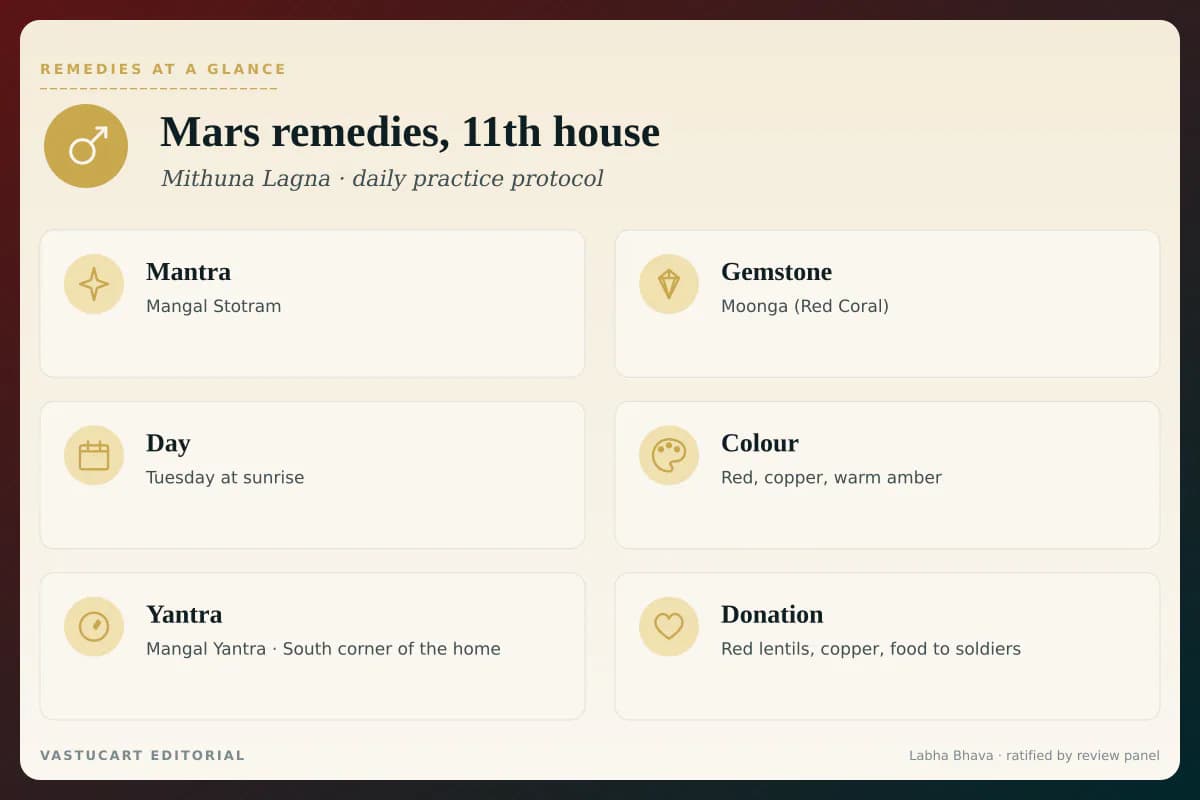
The daily Hanuman or Kartikeya worship is the primary remedy for this placement because Hanuman is the classical patron deity of Mars (and Kartikeya is the warrior-commander form), and either form holds the swakshetra warrior-income signature in its most refined expression. Rise before sunrise, bathe, wear red or deep saffron clothing on Tuesdays, and visit a Hanuman or Kartikeya temple if accessible. The Mangal Stotram is the primary recitation, the Navagraha verse to Mars that creates a containing field for the Mars signature in its swakshetra-labha expression. Reciting it at sunrise daily for forty days at any major Mars transition (a sales-leadership promotion, a coaching-practice founding, a real-estate development launch, a technology firm founding, a defence-contracting partnership) is the formal protocol.
Offer red flowers (especially hibiscus and red lotus), jaggery sweets, and red sandal paste at the altar, and donate to causes that support warrior-service and athletic discipline (military veteran welfare, athletic-coaching scholarships, defence-personnel support, sports-development for under-resourced youth). The conscious-network-stewardship practice is the lifestyle remedy that compounds across decades into the difference between Mars-11-mastery and Mars-11-overreach: a daily reflection on which network engagements are productive and which are merely competitive keeps the placement directed. The gemstone is red coral (Moonga), and this is one of the most gemstone-rewarding placements because the swakshetra labha Mars responds to amplification cleanly. Wear a natural red coral of minimum five carats set in copper on the ring finger of the right hand on a Tuesday at sunrise after Mangal mantra recitation, and only after a confirmed reading.
Gemstones for Mars in 11th house Mithuna Lagna
Red coral is the primary Mars gemstone and works powerfully here because the swakshetra labha Mars responds to amplification cleanly.


Disclaimer: Red coral over a swakshetra labha Mars amplifies the warrior-income channel cleanly. Always consult a qualified Jyotishi before permanent wearing.
Rudraksha beads for Mars in 11th house
The Mars-aligned rudraksha is the Teen Mukhi (Three Mukhi), the bead directly ruled by Agni and Mars.
The classical Mars rudraksha and the bead specifically associated with disciplined competitive drive. Supports the warrior-income signature, channels the network-leadership instinct toward sustainable territory, and stabilises competitive bandwidth when the sales-leadership, coaching, real-estate, or technology-firm vocation is in active phase.
The eleven-mukhi bead supports tactical command and network-leadership presence. Wearing the Gyarah Mukhi alongside the Teen Mukhi compounds the placement's natural strength in sales leadership, athletic coaching, and competitive-entrepreneurship practice.
Mangal Yantra for the swakshetra-labha placement
Sacred recitations for swakshetra Mars in the gains angle
Kumaram shakti-hastam cha mangalam pranamamy aham
Translation: I bow to Mangala, son of the Earth, radiant as a flash of lightning, the warrior youth holding the spear of victory. The Mangal Stotram is the canonical Navagraha verse to Mars and is the perfect daily recitation for a chart where Mars sits swakshetra in the labha angle and the warrior-income signature needs a containing devotional field. Many natives advanced in practice add the Hanuman Chalisa recitation as a secondary layer once the daily Mangal discipline is steady.
Read the full stotra on stotra.vastucart.in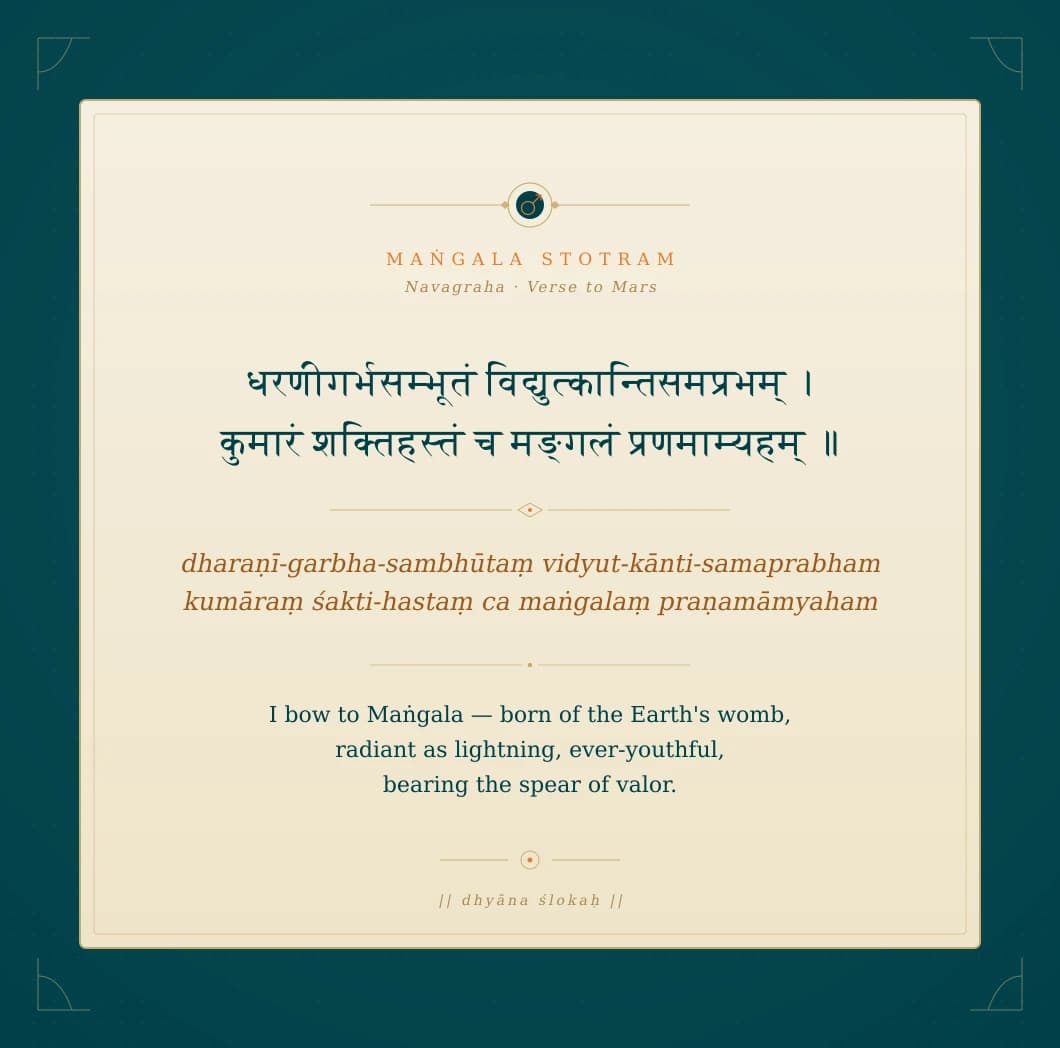
Tools for Mars 11th house Mithuna natives
Is your Labha Bhava Mars carrying the warrior-income signature?
Get a full personalised analysis of your eleventh house Mars, the swakshetra strength, and the warrior-vocation timing.