Ketu in the 5th house
Mesh Lagna (Aries Ascendant)
A practitioner study of Ketu in Putra Bhava for Aries ascendant natives. The south node in Simha under the Sun's dispositorship, the trikona of past-life merit, and the spiritual-intelligence signature that distinguishes this configuration from the Rahu 5th amplification.
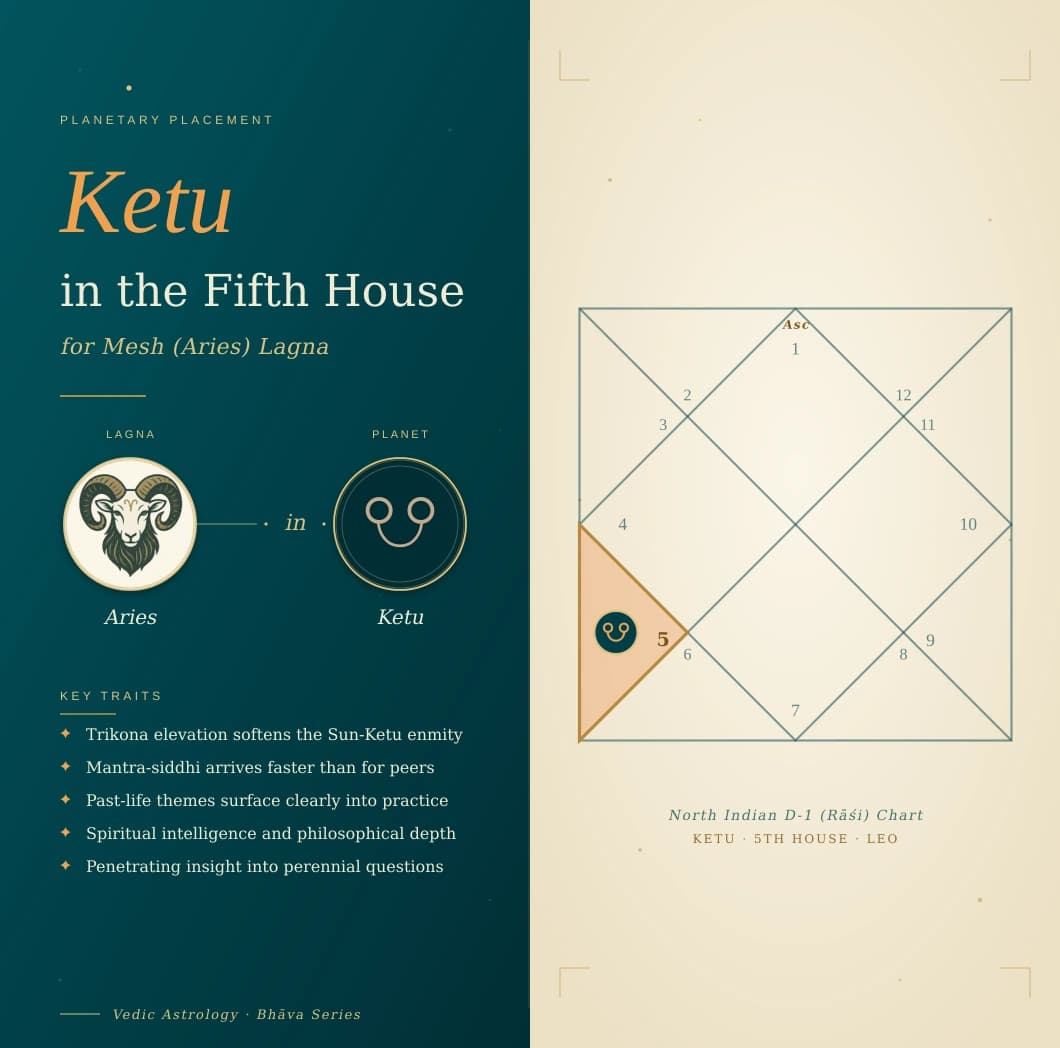
Ketu sits in Simha in the fifth house for Aries ascendant natives, the past-life-merit and spiritual-intelligence signature.
Ketu in 5th house for Mesh Lagna, the quick reference
If you carry Ketu in the fifth house of a Mesh chart, you hold one of the most spiritually loaded Ketu placements in the entire Aries ascendant catalogue, because the south node sits in Putra Bhava (the fifth house, the bhava of children, intelligence, past-life merit, creative expression, and devotional practice). The 5th house is a trikona (one of the three dharma trines) and classical Parashari assigns the 5th specifically to poorvapunya, the karmic merit carried forward from previous incarnations. Ketu's natural temperament (detachment, single-point focus, karmic-axis pedagogy) maps unusually well onto a bhava whose theme is the merit and pattern carried from past lives.
The fifth house from Mesh is Simha (Leo), ruled by Surya (the Sun). Sun and Ketu are read as enemies in classical Parashari (Ketu eclipses the Sun in nodal events), so the sign-level relationship is not friendly. The dispositor friction matters because it shapes how the Ketu signature expresses: the inner authority that Sun rules has to make peace with the inner detachment that Ketu rules, and the resolution typically arrives through spiritual intelligence rather than through ordinary leadership ambition. The trikona placement softens the dispositor friction because dharma trines reward dharmic placements regardless of sign-level dignity, and Ketu's karmic-axis nature is fundamentally dharmic. The third structural feature is the children reading. Ketu in 5 is one of the classical signatures the texts read for delayed, unconventional, or single-child progeny patterns, and the practitioner reading is more nuanced than the popular fertility-fear framing. This guide reads every layer of Ketu in 5th house for Mesh Lagna natives: the Simha sign and Sun dispositorship, the trikona of past-life merit, the spiritual-intelligence signature, the children pattern, and the cat's eye protocol.
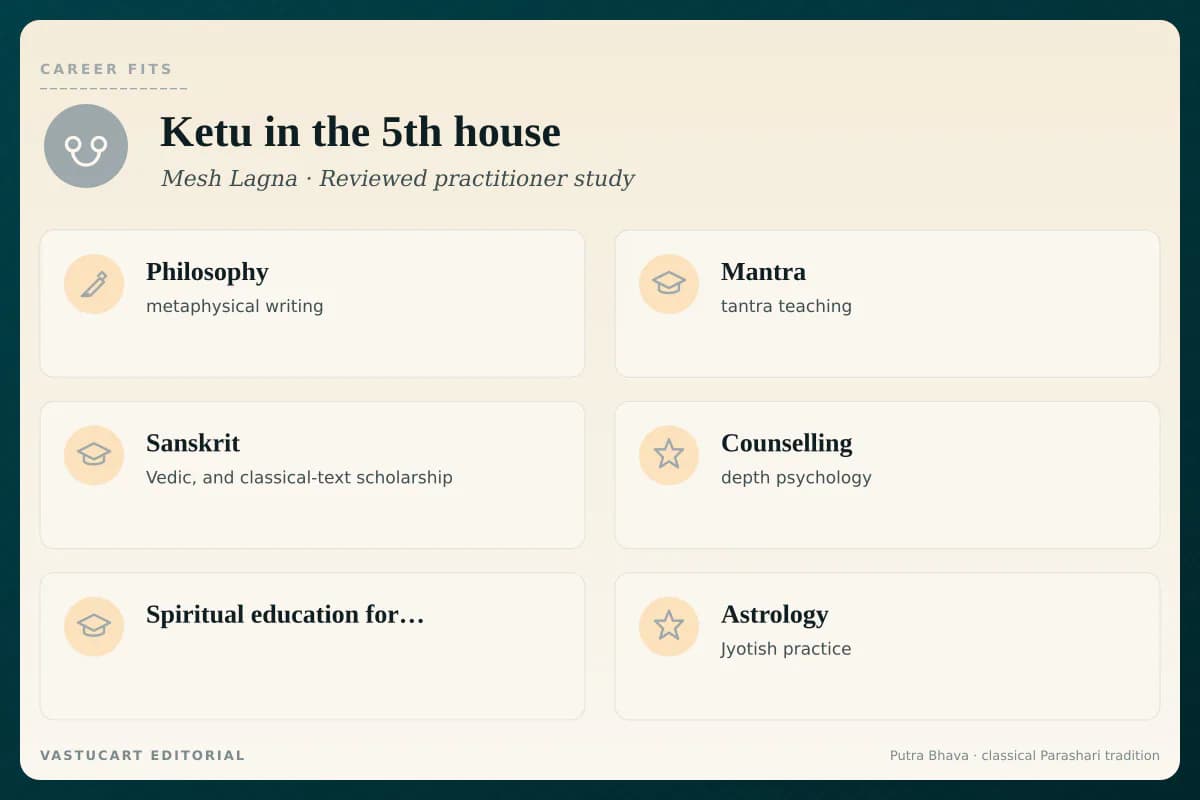
Why Ketu in Putra Bhava is the past-life-merit vehicle rather than the children-deficit signature
Students often arrive at this placement carrying anxiety from popular astrology readings that label Ketu in the 5th as the marker of fertility problems or absent children. The honest practitioner answer is more layered. Ketu in the 5th does affect the children theme, but the modal pattern is delayed-onset or unconventional progeny rather than absence. Many natives have children later than peers, often after a deliberate delay for spiritual practice, study, or travel. Some natives raise children through adoption or through partnership with someone who already has children. A smaller number live a child-free life as a conscious choice that aligns with the Ketu-axis pedagogy. In all three patterns the children theme is reorganised rather than eliminated.
The past-life-merit reading is the second specific feature that practitioners need to handle carefully. Classical Parashari assigns the 5th house specifically to poorvapunya, the karmic merit carried forward from previous incarnations, and Ketu in this bhava is read as the placement where past-life patterns surface most directly into present-life experience. Many natives report childhood interest in religious or philosophical themes that the family did not introduce, fluency in spiritual concepts they had not formally studied, and a feeling that they are remembering rather than learning when they encounter classical material. Mantra-siddhi (the rapid maturation of mantra practice into direct realisation) is a specific clinical signature reported repeatedly for this placement. The third interpretive layer is the contrast with Rahu in 5. Rahu in 5 amplifies the creative and progeny themes with foreign and unconventional flavour. Ketu in 5 refines the same themes through detachment and spiritual depth. Both work the trikona, but Rahu adds heat and Ketu adds stillness.
Ketu in Putra Bhava is not a fertility sentence. It is the past-life-merit placement that asks the native to honour the pattern they arrived with rather than to invent a new one.
Terms used in this article
A short glossary of the Sanskrit and Jyotish terms that recur in this study. First-occurrence expansion is also retained inline.
- Putra Bhava
- The 5th house, the bhava of children, intelligence, past-life merit, and devotional practice.
- Trikona
- Trine houses (1, 5, 9), the dharma trines and most auspicious houses in Parashari tradition.
- Poorvapunya
- The karmic merit carried forward from previous incarnations, ruled by the 5th house.
- Dispositor
- The lord of the sign in which another planet sits.
- 5L
- Fifth-house lord, the planet ruling the sign on the 5th house cusp.
- Mantra-siddhi
- The rapid maturation of mantra practice into direct realisation.
- Karakatva
- The natural significations a planet rules independent of any chart.
How Ketu in Putra Bhava shapes the Aries native
Physically the native carries the Mesh Lagna frame with a noticeable economy and a watchful interior quality strangers register as composed. The face often combines the Mesh sharpness with an inwardly luminous quality that comes from regular contemplative life, and many natives have a mark or feature on the upper abdomen, stomach, or near the heart, classical 5th house signatures. The eyes carry an unusual stillness even in conversation, and the bearing is that of someone who has done long inner work even when young.
Temperament is the layer where the placement most distinguishes the native from popular Aries stereotypes. These natives carry the Mesh courage but route it through inner understanding rather than outward performance. They are drawn to philosophy, religious study, mantra practice, and contemplative arts from childhood, and they consistently report family bewilderment at the early seriousness about these themes. The fifth house signification of intelligence combines with Ketu's depth to produce a specific mind: it is not encyclopaedic in the Mercury sense but is unusually penetrating in the perennial-questions sense. Many natives become philosophers, mantra teachers, or scholars whose work emerges from sustained inner practice rather than from academic formalism. The shadow side is the same depth: natives who do not channel the spiritual orientation consciously can experience repeated cycles of withdrawal that their family reads as detachment from family responsibility, and the cycles compound across decades into significant relational distance. Natives who pair the inner depth with explicit family commitment (active grandparenting if children come late, formal mentorship of younger relatives, sustained engagement with the family's dharmic responsibilities) develop the rare integration of spiritual depth with family continuity that the placement is genuinely capable of supporting.
Strengths, shadows and career fits
- Trikona elevation softens the Sun-Ketu enmity
- Mantra-siddhi arrives faster than for peers
- Past-life themes surface clearly into practice
- Spiritual intelligence and philosophical depth
- Penetrating insight into perennial questions
- Devotional practice deepens early in life
- Children often delayed or unconventional
- Sun-Ketu enmity can sharpen ego conflicts
- Romantic life can feel philosophically demanding
- Family reads detachment as distance
- Speculation and gambling losses likely
- Heart and upper abdomen sensitivity
- Philosophy and metaphysical writing
- Mantra and tantra teaching
- Sanskrit, Vedic, and classical-text scholarship
- Counselling and depth psychology
- Spiritual education for children
- Astrology and Jyotish practice
Where the spiritual-intelligence vocation plays out
Career paths cluster around fields that braid intelligence with depth. Philosophy and metaphysical writing are the strongest single fit because the 5th house rules intelligence and Ketu's depth produces natives whose inquiry penetrates beyond surface scholarship. Many natives become long-form essayists, comparative-philosophy scholars, or perennial-tradition translators whose work is recognised slowly but durably. Mantra and tantra teaching work because the chart specifically supports the rapid maturation of devotional practice, and many natives in this configuration become initiates and teachers in classical lineages.
Sanskrit, Vedic, and classical-text scholarship suit natives whose vocational mode is academic but whose interest is dharmic rather than purely critical. Counselling and depth psychology fit the chart because the inner stillness that Ketu cultivates produces practitioners capable of holding the heaviest material clients bring. Spiritual education for children works because the chart specifically supports passing dharmic understanding to younger generations, and many natives find their own children-theme honoured through the children of others. Astrology and Jyotish practice are particularly well-suited because the 5th house rules mantra and the karmic-axis Ketu produces specifically clear chart-reading capacity. Ketu mahadasha is the defining career window and arrives with the public emergence of long-cultivated practice, the publication of a major translation or scholarly work, or the formal teaching role that crystallises the spiritual-intelligence vocation.
Why a Sun-enemy Ketu in the dharma trikona reads stronger than the sign-friction suggests
The clearest way to understand Ketu in 5th of Mesh is to read the trikona elevation alongside the Sun-Ketu enmity rather than reading either in isolation. Classical Parashari assigns the 5th to the dharma trines, and trikona placements gain a structural strength that partially neutralises sign-level friction because the bhava itself is dharmic and dharma trines reward dharmic placements. Ketu's karmic-axis nature is fundamentally dharmic (the south node represents the dharma the native has already mastered in past lives), which means the trikona elevation specifically supports Ketu's inherent temperament.
The Sun-Ketu enmity is the second specific feature that the textbook accounts often skim. Classical Parashari lists Sun and Ketu as enemies because Ketu eclipses the Sun in nodal events, and the relationship is read as adversarial in sign-friendship calculations. Clinical reports show, however, that the enmity in the dharma trikona usually expresses as inner tension between authority and detachment rather than as outright damage to the bhava. Many natives report a lifelong negotiation between the urge to lead (Sun in fire sign) and the urge to step away (Ketu's detachment), and the resolution typically arrives through spiritual leadership where authority is rooted in inner stillness rather than in personal will. The third interpretive layer is the comparison with Ketu in 9 (the other dharma trikona Ketu). Ketu in 9 is dharma-trikona surrender, the renunciate-by-temperament pattern. Ketu in 5 is dharma-trikona inheritance, the past-life-merit pattern. Both reward the trikona but they express the dharma signal through different doorways.
When Ketu in 5th delivers its Putra Bhava chapter
Ketu mahadasha is the defining window for this placement and arrives with the public emergence of long-cultivated mantra practice, the publication of a major scholarly work, or the formal teaching role that crystallises the spiritual-intelligence vocation.
Stomach, heart, and the Putra health link
Health follows the Ketu-in-5th pattern with specific Putra body-part vulnerabilities. Constitution is generally lean and intense, with vata most prominent because Ketu carries the air-shadow temperament and Simha is itself a fire sign, producing a temperament that benefits from steady warming routines and adequate ghee in the diet. The 5th house body-part rulership covers the stomach, upper abdomen, heart, and the digestive fire (jathara-agni), and the placement raises specific risk for digestive sensitivity, peptic conditions, and irregular jathara-agni patterns during stress periods.
The heart-and-mantra link is the second specific layer. The 5th house rules the heart and mantra practice (which classical texts associate with the heart-centre prana). Ketu's presence specifically supports cardiac stability through devotional practice, and natives who maintain a daily mantra discipline report fewer cardiac and digestive issues than peers. The intoxicant risk is real because the placement amplifies whatever the native uses to soothe spiritual longing during dry-practice periods. Annual full-panel screening from the late twenties is recommended and especially important for digestive and cardiac markers. Daily yoga (specifically heart-opening and digestive-fire practices), moderate intake of warm cooked food, and avoidance of speculation that destabilises the household are the lifestyle stabilisers because the chart's natural pull toward inner depth needs ordinary body discipline as a counterweight.
Remedies for Ketu in the Mesh putra angle
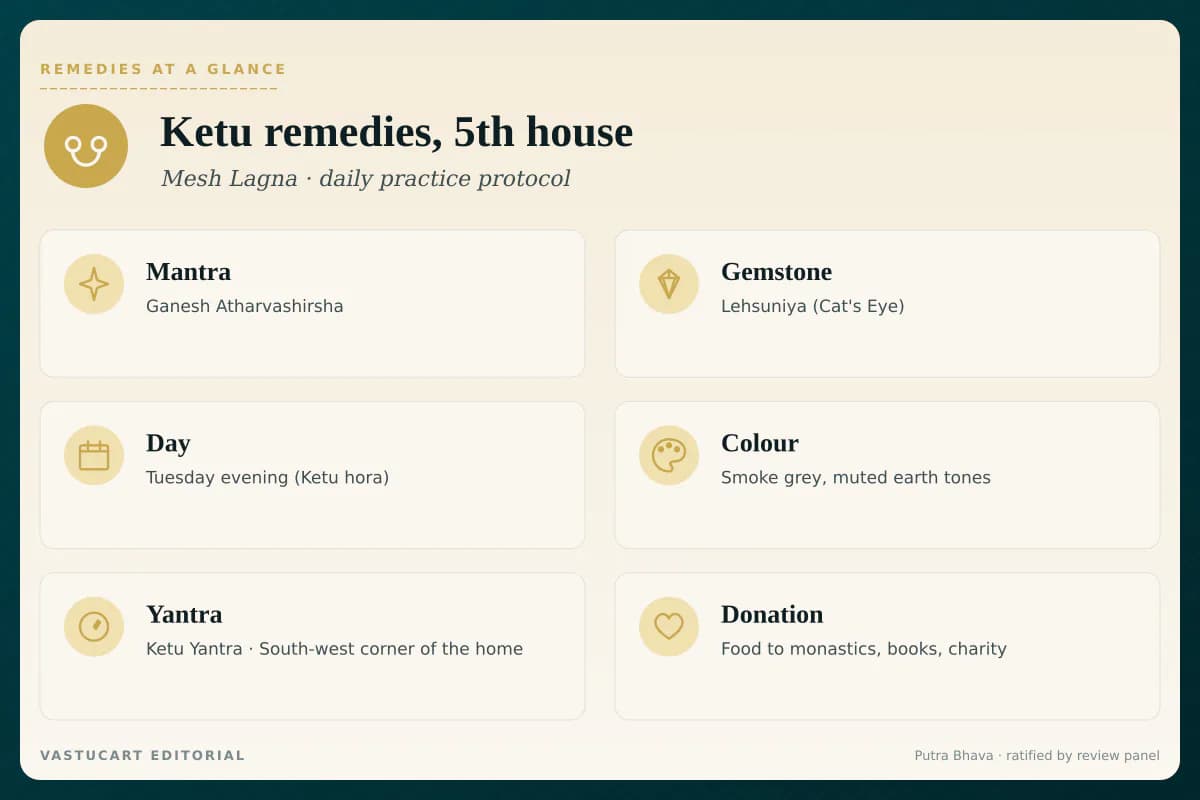
The daily Ganesha worship is the primary remedy for this placement because Ganesha is the classical patron deity of Ketu, and the obstacle-removing form is the deity who guides the south node's spiritual signal toward genuine territory. Rise before sunrise, bathe, wear white or pale yellow clothing on Wednesdays, and visit a Ganesha temple if accessible. The Ganesh Atharvashirsha is the primary recitation, the Upanishadic hymn to Ganapati that creates a containing field for the Ketu signature in its trikona expression. Reciting it at sunrise daily for forty days at any major Putra transition (the conception decision, a major spiritual initiation, an important publication) is the formal protocol.
For the Putra placement specifically, a sustained mantra discipline (often the Mahamrityunjaya, the Gayatri, or a deity-specific bija from a qualified teacher) compounds the placement's natural strength. Offer red flowers, modak, dhruva grass, and durva at the altar, and donate to causes that support spiritual education for children (gurukula scholarships, classical-music apprenticeships for young students, Sanskrit study grants). The conscious-engagement practice is the lifestyle remedy that compounds across decades into the difference between Ketu-5-mastery and Ketu-5-withdrawal: a daily commitment to participate in the family's ordinary rituals (mealtimes, festivals, child-rearing) prevents the placement's natural tendency to drift into solo practice. The gemstone is cat's eye (Lehsuniya), recommended only after careful chart confirmation because Ketu in the trikona specifically affects past-life-merit themes and the gemstone amplifies whatever the placement is currently producing. Wear a natural cat's eye of minimum five ratti set in silver on the small finger of the right hand on a Wednesday at sunrise after Ketu mantra recitation.
Gemstones for Ketu in 5th house Mesh Lagna
Cat's Eye is the primary Ketu gemstone but is recommended carefully because the trikona placement amplifies past-life themes sharply.

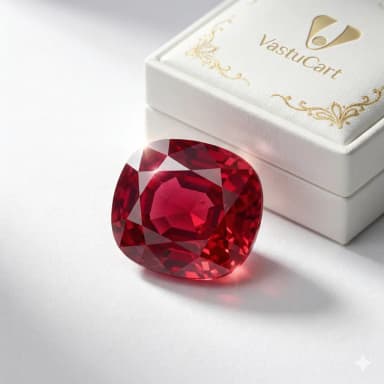

Disclaimer: Cat's eye in the trikona of past-life merit amplifies the karmic-axis signature sharply. Always consult a qualified Jyotishi before permanent wearing.
Rudraksha beads for Ketu in 5th house
The Ketu-aligned rudraksha is the Aath Mukhi (Eight Mukhi) Ganesha bead, with the Nau Mukhi as a paired secondary.
The eight-mukhi bead is the Ganesha bead and the standard daily-practice bead for Ketu-5 natives. Supports the past-life-merit signature, channels the spiritual intelligence toward classical territory, and stabilises the inner depth when the silent practice signature is active.
The one-mukhi bead is the Sun bead and serves as primary secondary support for this placement because the Sun is the dispositor of Ketu in Simha. Wearing the Ek Mukhi alongside the Aath Mukhi compounds the placement's natural strength by honouring both the planet and its sign-lord.
Ketu Yantra for the putra placement
Sacred recitations for Ketu in the putra angle
Tvameva pratyaksham tattvam asi
Tvameva kevalam karta'si
Tvameva kevalam dharta'si
Tvameva kevalam harta'si
Tvameva sarvam khalvidam brahma'si
Translation: Om, salutations to Ganapati. You alone are the manifest reality. You alone are the sole creator. You alone are the sole sustainer. You alone are the sole destroyer. You alone are everything, indeed Brahman itself. The Ganesh Atharvashirsha is the Upanishadic hymn to Ganapati and is the perfect daily recitation for a chart where Ketu sits in the putra trikona and the past-life-merit signature needs a containing devotional field. Many natives advanced in practice add a deity-specific bija mantra (Mahamrityunjaya, Gayatri, or an istha-devata bija) once the daily Ganesha discipline is steady.
Read the full stotra on stotra.vastucart.in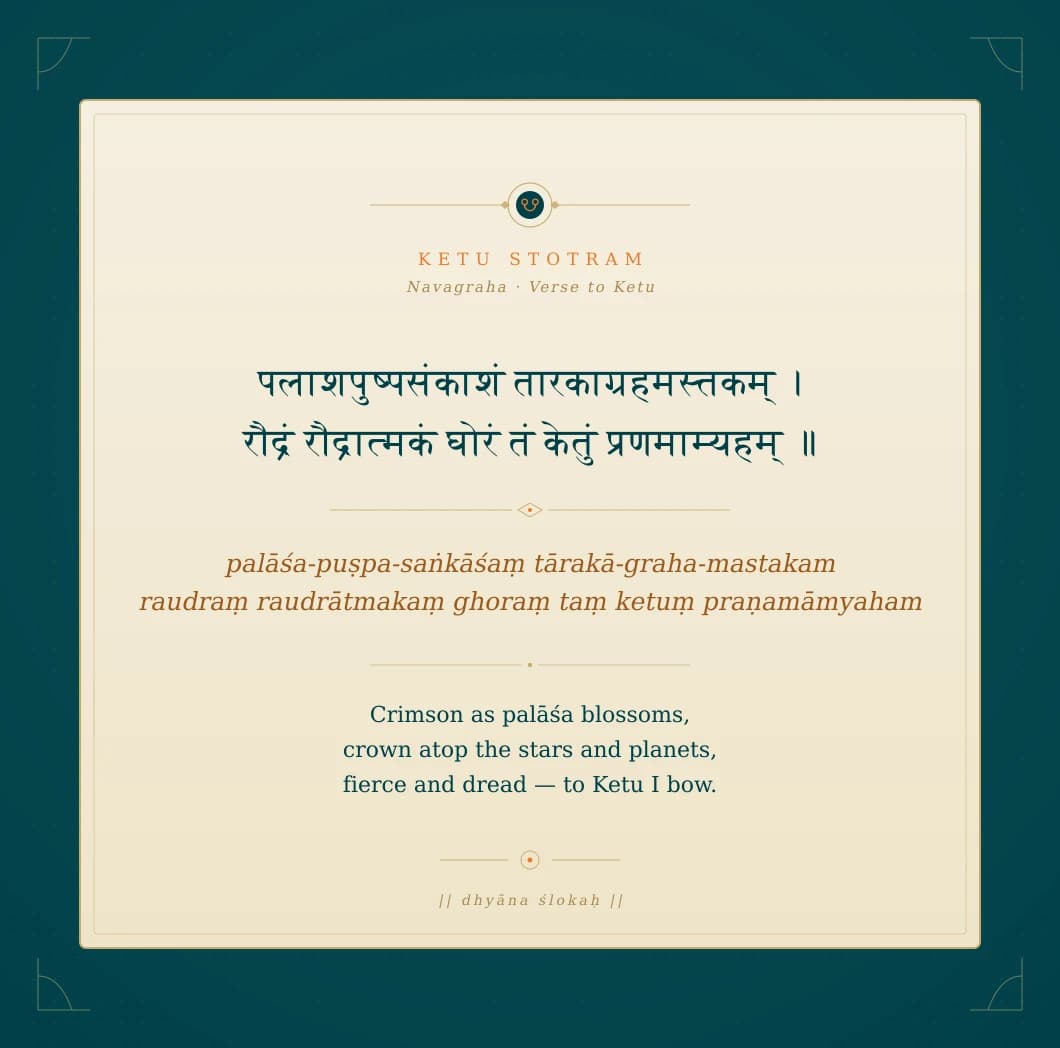
Tools for Ketu 5th house Mesh natives
Is your Putra Bhava Ketu carrying the past-life-merit signature?
Get a full personalised analysis of your fifth house Ketu, the Sun dispositor link, and the children timing.